
Life, 1910-02-03 · page 15 of 44
Life — February 3, 1910 — page 15: what you’re looking at
What you’re looking at
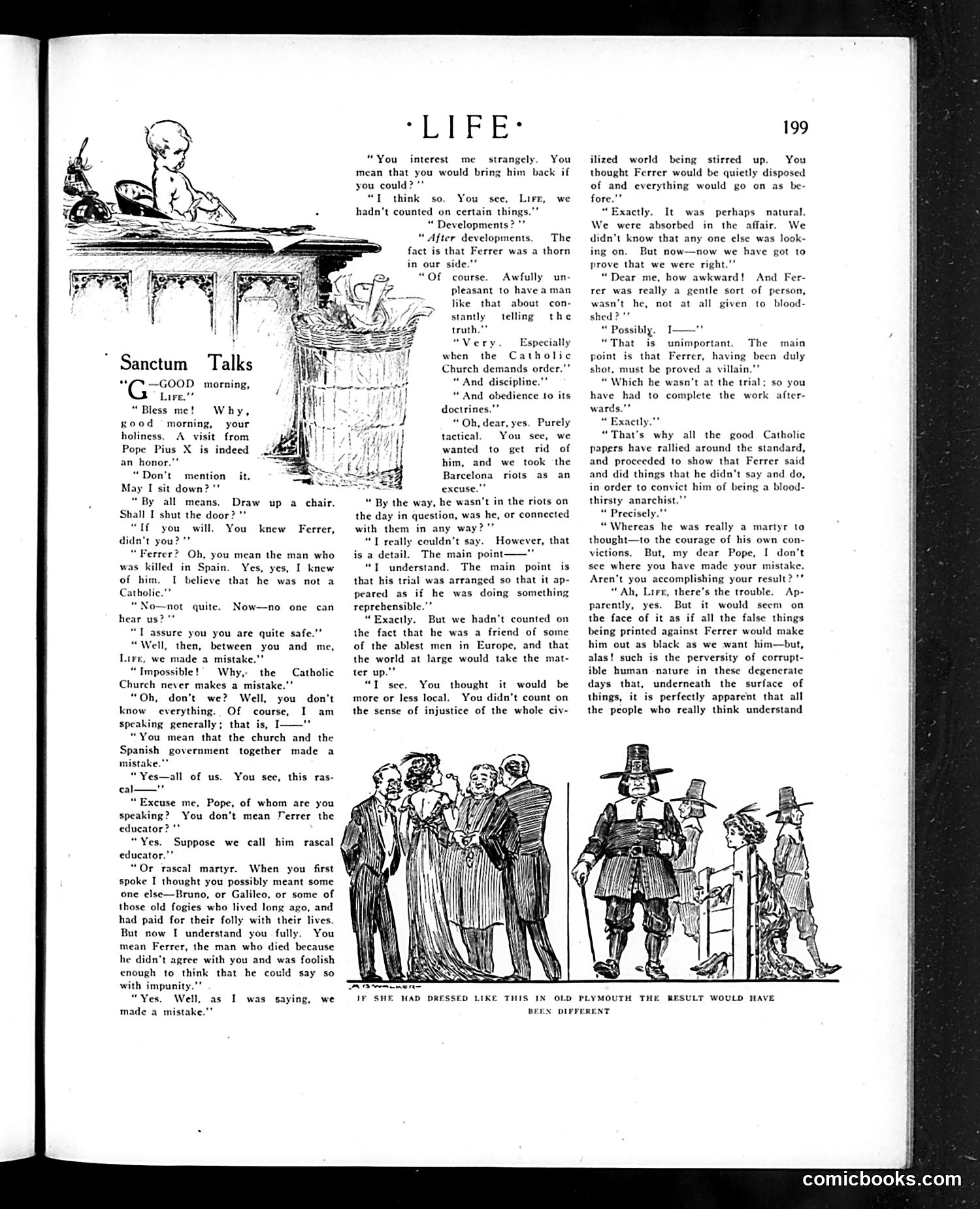
This satirical dialogue concerns **Francisco Ferrer**, a Spanish educator executed in 1909. The cartoon depicts Pope Pius X admitting to "Life" (the magazine's personified editor) that the Church and Spanish government made a mistake executing Ferrer. **The satire's point:** The Pope confesses they used the Barcelona riots as a pretext to eliminate Ferrer, a vocal critic of Church authority. They expected his death to pass quietly but underestimated international outrage from "the ablest men in Europe." Now trapped, they've enlisted Catholic newspapers to retroactively blacken Ferrer's reputation—painting him a "bloodthirsty anarchist" when he was actually "a martyr to thought." **The joke:** The Pope candidly admits to orchestrated injustice, character assassination, and propaganda—treating it as a tactical miscalculation rather than moral wrong. The cartoon mocks institutional hypocrisy: the Church preaches truth while systematically manufacturing lies to cover its crime.
📄 Transcribed text from this page (OCR, searchable)
Machine-transcribed from the original scan — historical spelling and the odd misread are preserved.
* Sanctum Talks “ GOOD Lire.” “Bless me! good morning, your holiness. A visit from Pope Pius X is indeed an hono “Don’t mention it. May I sit down?” “By all means. Draw up a chair. Shall I shut the door?” “If you will. You didn't you?” ‘errer? Oh, you mean the man who was killed in Spain. Yes, yes, I knew of him. I believe that he was not a Catholic."" No—not hear us?” “I assure you you are quite safe.” “Well, then, between you and me, Lire, we made a mistake.” “Impossible!” Why, the Catholic Church never makes a mistake.” “Oh, don't we? Well, you don’t know everything. Of course, I am speaking generally; that is, I—" “You mean that the church and the Spanish government together made a mistake.” “Yes—all of us. cal—" “Excuse me, Pope, of whom are you speaking? You don’t mean Terrer the educator?" “Yes. Suppose we call educator. “Or rascal martyr. When you first spoke I thought you possibly meant some one else—Bruno, or Galileo, or some of those old fogies who lived long ago, had paid for their folly with their I But now I understand you fully. mean Ferrer, the man who died because he didn’t agree with you and was foolish enough to think that he could say so with impunity.”” “Yes. Well, as made a mistake.” morning, Why, knew Ferrer, quite. Now—no one can You see, this ras- him rascal I was saying, we "LIP E* “You interest. me strangely. You mean that you would bring him back if you could?" “I think so. You see, Lirr, we hadn't counted on certain thing “ Developments? "” After developments. The fact is that Ferrer was a thorn in our side.’ “Of course. Awfully un- pleasant to have aman like that about con- stantly telling the truth.”* “Very. Especially when the Catholic Church demands order."" “And discipline.”” “And obedience to its doctrines.”” “Oh, dear, yes. Purely tactical. You see, we wanted to get rid of him, and we took the Barcelona riots as an excuse.” “ By the way, he wasn’t in the riots on the day in question, was he, or connected with them in any way ly couldn't say. However, that The main point—" “T understand. The main point is that his trial was arranged so that it ap- peared as if he was doing something reprehensible."” “Exactly. But we hadn't counted on the fact that he was a friend of some of the ablest men in Europe, and that the world at large would take the mat- ter up.”” “T sce. You thought it would be more or less local. You didn’t count on the sense of injustice of the whole civ- IP SHE MAD DRESSED LIKE THIS IN OLD PLYMOUTH THE 199 ilized world being stirred up. You thought Ferrer would be quietly disposed of and everything would go on as be- fore.”” “Exactly. It was perhaps natural. We were absorbed in the affair. We didn’t know that any one else was look- ing on. But now—now we have got to prove that we were right.” “Dear me, how awkward! And F rer was really a gentle sort of person, wasn’t he, not at all given to blood- shed? "” “ Possibly. I— “That is unimportant. The point is that Ferrer, having been duly shot, must be proved a villain.”’ “Which he wasn’t at the trial: so you have had to complete the work after- wards.” “ Exactly.” “That's why all the good Catholic papers have rallied around the standard, and proceeded to show that Ferrer said and did things that he didn’t say and do, in order to convict him of being a blood- thirsty anarchist.’” “ Precisely.”” “Whereas he was really a martyr to thought—to the courage of his own con- victions. But, my dear Pope, I don’t sce where you have made your mistake. Aren’t you accomplishing your result? ’* “Ah, Lire, there's the trouble. Ap- parently, yes. But it would seem on the face of it as if all the false things being printed against Ferrer would make him out as black as we want him—but, alas! such is the perversity of corrupt- ible human nature in these degenerate days that, underneath the surface of things, it is perfectly apparent that all the people who really think understand main RESULT WOULD HAVE BEEN DIFFERENT comicbooks.com