
Life, 1910-02-03 · page 10 of 44
Life — February 3, 1910 — page 10: what you’re looking at
What you’re looking at
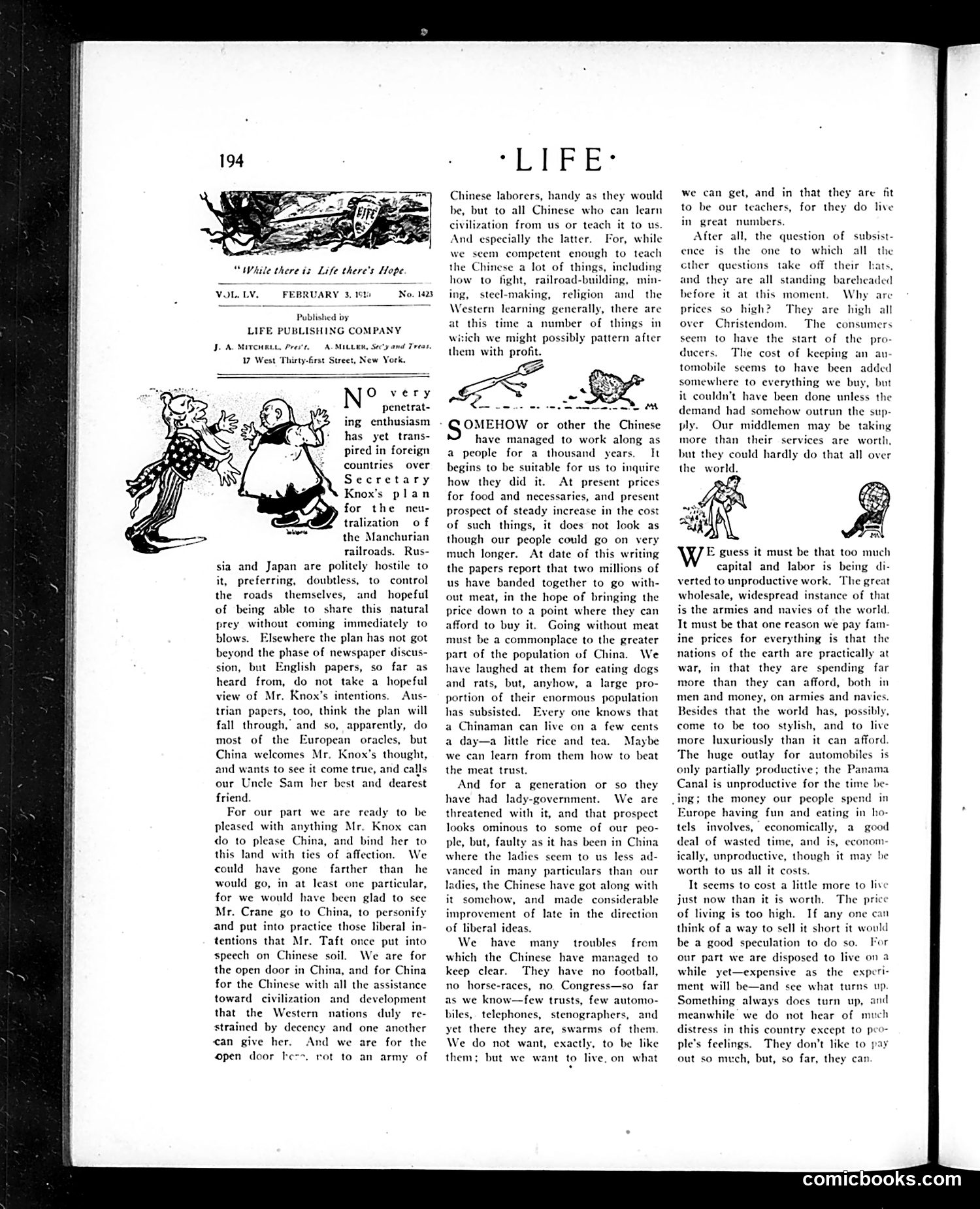
This February 3, 1912 *Life* magazine page satirizes American attitudes toward China. The main illustration shows a figure labeled "Secretary Knox's plan for the neutralization of the Manchurian railroads"—likely referencing Secretary of State Philander Knox's actual diplomatic efforts in Manchuria. The cartoon depicts a portly Western figure attempting to control or manipulate Chinese affairs, personified as a small Chinese character. The satire mocks American presumption that Western powers could easily reshape Asian geopolitics through financial schemes. The accompanying text expresses skeptical, paternalistic views typical of the era: praising Chinese laborers while doubting Chinese capability for self-governance, and questioning whether American commercial interests should dominate Chinese development. The overall message critiques both American foreign interventionism and Western assumptions of cultural superiority.
📄 Transcribed text from this page (OCR, searchable)
Machine-transcribed from the original scan — historical spelling and the odd misread are preserved.
Published by LIFE PUBLISHING COMPANY J. AC MITOHRLE, Presi, AMILLEM, Sey and Treas, 17 West Thirty-first Street, New York. N O very penetrat- ing enthusiasm has yet trans- pired in foreign countries over Secretary Knox's plan for the neu- tralization o f the Manchurian railroads. Rus- sia and Japan are politely hostile to it, preferring, doubtless, to control the roads themselves, and hopeful of being able to share this natural prey without coming immediately to blows. Elsewhere the plan has not got beyond the phase of newspaper discus- sion, but English papers, so far as heard from, do not take a hopeful view of Mr. Knox’s intentions. Aus- trian papers, too, think the plan will fall through,’ and so, apparently, do most of the European oracles, but China welcomes Mr. Knox's thought, and wants to see it come true, and calls our Uncle Sam her best and dearest friend. For our part we are ready to be pleased with anything Mr. Knox can do to please China, and bind her to this land with ties of affection. We could have gone farther than he would go, in at least one particular, for we would have been glad to see Mr. Crane go to China, to personify and put into practice those liberal in- tentions that Mr. Taft once put into speech on Chinese soil. We are for the open door in China, and for China for the Chinese with all the assistance toward civilization and development that the Western nations duly re- strained by decency and one another ‘can give her. And we are for the open door ber>, rot to an army of "LIP ES Chinese laborers, handy as they would he, but to all Chinese who can learn civilization from us or teach it to us. And especially the latter. For, while We seem competent enough to teach the Chinese a lot of things, includin; how to fight, railroad-building, min- ing, stecl-making, religion and the Western learning generally, there are this time a number of things in ich we might possibly pattern after them with profit. OMEHOW or other the Chinese have managed to work along as a people for a thousand years, It begins to be suitable for us to inquire how they did it. At present prices for food and necessaries, and present prospect of steady increase in the cost of such things, it does not look as though our people could go on very much longer. At date of this writing the papers report that two millions of us have banded together to go with- out meat, in the hope of bringing the price down to a point where they can afford to buy it. Going without meat must be a commonplace to the greater part of the population of China. We have laughed at them for eating dogs and rats, but, anyhow, a large pro- portion of their enormous population has subsisted. Every one knows that a Chinaman can live on a few cents a day—a little rice and tea. Maybe we can learn from them how to beat the meat trust. And for a generation or so they have had lady-government. We are threatened with it, and that prospect looks ominous to some of our pco- ple, but, faulty as it has been in China where the ladies seem to us less ad- vanced in many particulars than our ladies, the Chinese have got along with it somehow, and made considerable improvement of late in the direction of liberal ideas. We have many troubles from which the Chinese have managed to keep clear. They have no football, no horse-races, no. Congress—so far as we know—few trusts, few automo- biles, telephones, stenographers, and yet there they are, swarms of them We do not want, exactly, to be like them; but we want to live. on what we can get, and in that they are fit to be our teachers, for they do live in great numbers. After all, the question of subsist- one to which all the questions take off their hats, and they are all standing bareheaded before it at this moment. Why are prices so high? They are high all over Christendom. The consumers seem to have the start of the pro- ducers. The cost of keeping an au tomobile seems to have been added somewhere to everything we buy, but it couldn't have been done unless the demand had somehow outrun the sup- ply. Our middlemen may be taking more than their services are worth, but they could hardly do that all over the world. ence is the cther = guess it must be that too much capital and labor is being di- verted to unproductive work. The great wholesale, widespread instance of that is the armies and navies of the world. It must be that one reason we pay fam- ine prices for everything is that the nations of the earth are practically at war, in that they are spending far more than they can afford, both in men and money, on armies and navies. Besides that the world has, possibly, come to be too stylish, and to live more luxuriously than it can afford. The huge outlay for automobiles is only partially productive; the Panama Canal is unproductive for the time be- .ing; the money our people spend in Europe having fun and eating in ho- tels involves, economically, a good deal of wasted time, and is, e ically, unproductive, though it may be worth to us all it costs. It seems to cost a little more to live just now than it is worth. The price of living is too high. If any one can think of a way to sell it short it would be a good speculation to do so. For our part we are disposed to live on a while yet—expensive as the experi- ment will be—and sce what turns up. Something always does turn up, and meanwhile we do not hear of much distress in this country except to pco- ple’s feelings. They don’t like to pay out so much, but, so far, they can. ynom- comicbooks.com