
Life, 1910-02-03 · page 18 of 44
Life — February 3, 1910 — page 18: what you’re looking at
What you’re looking at
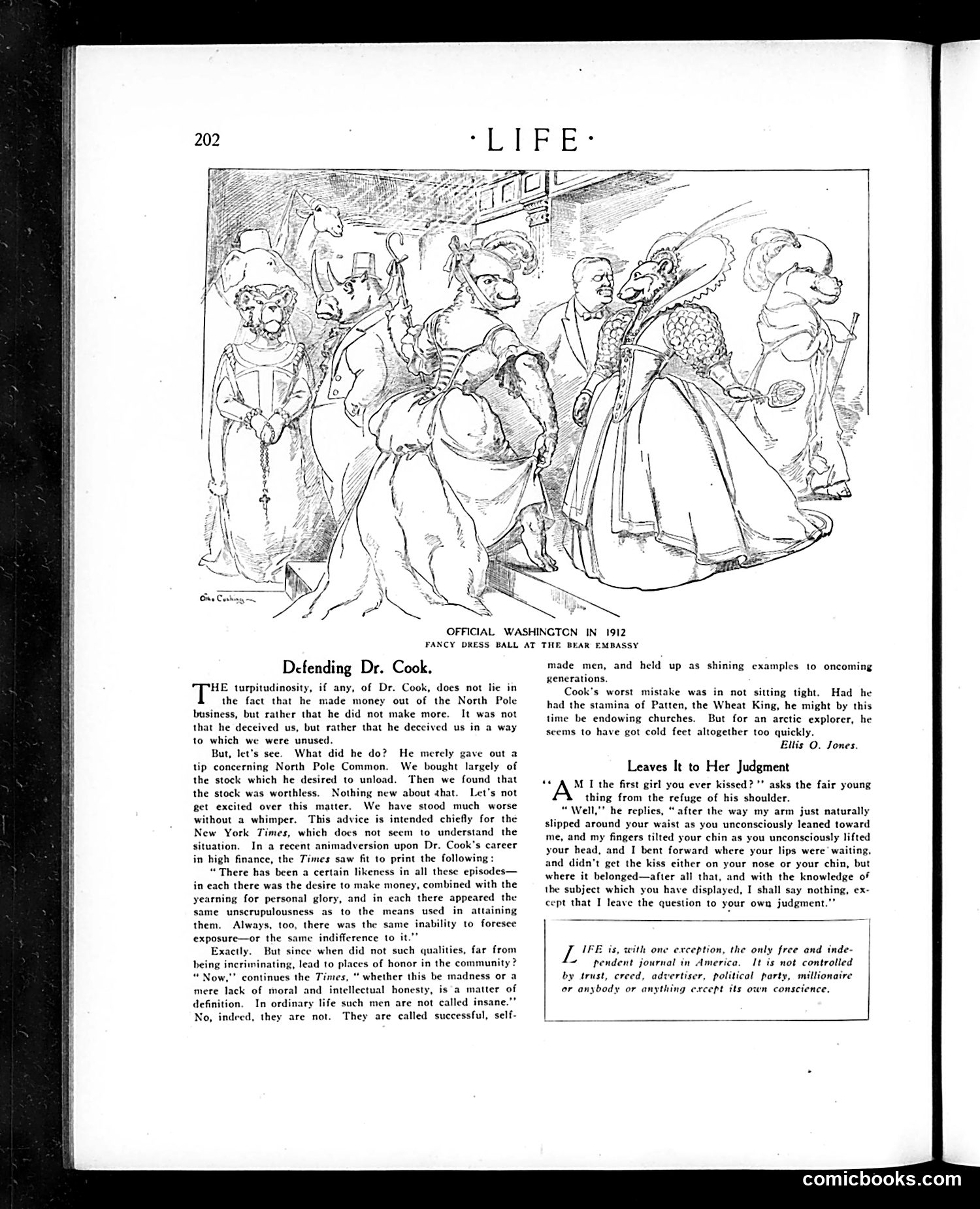
**The Cartoon:** The illustration depicts a fancy dress ball at the "Bear Embassy" in official Washington, 1912. The figures wear animal heads—likely representing political figures as bears and other creatures—satirizing Washington society and power players. **"Defending Dr. Cook":** This article defends Arctic explorer Frederick Cook, who had made money promoting worthless stock based on North Pole claims. Life's satirical point: Cook's real crime wasn't deception itself, but being *bad at it*. The magazine cynically argues that financial manipulation, greed, and dishonesty are actually rewarded in American society—successful businessmen do exactly what Cook did and receive honor. Cook's mistake was getting caught. The article contrasts him with Patten ("the Wheat King"), a wealthy commodities speculator who "might by this time be endowing churches." **"Leaves It to Her Judgment":** A brief romantic comedy about a young couple kissing, where the man deflects answering whether she's his first kiss by turning the question back to her. **Overall Context:** This page illustrates Life's role as a satirical social critic, exposing hypocrisy in American business and politics.
📄 Transcribed text from this page (OCR, searchable)
Machine-transcribed from the original scan — historical spelling and the odd misread are preserved.
OFFICIAL WASHINGTCN IN 1912 FANCY DRESS BALL AT THE BEAR EMBASSY Defending Dr. Cook. HE turpitudinosity, if any, of Dr. Cook, does not lie in the fact that he made money out of the North Pole business, but rather that he did not make more. It was not that he deceived us, but rather that he deceived us in a way to which we were unused. But, let’s see. What did he do? He merely gave out a tip concerning North Pole Common. We bought largely of the stock which he desired to unload. Then we found that the stock was worthless. Nothing new about that. Let's not get excited over this matter. We have stood much worse without a whimper. This advice is intended chiefly for thé New York Times, which docs not sccm to understand the situation. In a recent animadversion upon Dr. Cook's career in high finance, the Times saw fit to print the following : “There has been a certain likeness in all these episodes— in each there was the desire to make money, combined with the yearning for personal glory, and in each there appeared the same unscrupulousness as to the means used in attaining them. Always, too, there was the same inability to foresee exposure—or the same indifference to it Exactly. But since when did not such qualities, far from being incriminating, lead to places of honor in the community? “Now,” continues the Times, “ whether this be madness or a mere lack of moral and intellectual honesty, isa matter of definition. In ordinary life such men are not called insane.”” No, indeed, they are not. They are called successful, self- made men, and held up as shining examples to oncoming xenerations. Cook's worst mistake was in not sitting tight. Had he had the stamina of Patten, the Wheat King, he might by this time be endowing churches. But for an arctic explorer, he scems to have got cold feet altogether too quickly. Ellis O. Jones. Leaves It to Her Judgment “+ A ML the first girl you ever kissed?" asks the fair young thing from the refuge of his shoulder. Well,” he replies, “after the way my arm just naturally slipped around your waist as you unconsciously leaned toward me, and my fingers tilted your chin as you unconsciously lifted your head, and I bent forward where your lips were’ waiting, and didn't get the kiss either on your nose or your chin, but where it belonged—after all that, and with the knowledge of the subject which you have displayed, I shall say nothing, ex- cept that I leave the question to your own judgment.” IFE is, with one exception, the only free and inde- ~ pendent journal in America, It is not controlled by trust, creed, advertiser, political party, millionaire or anybody or anything except its own conscience. comicbooks.com