
A complete issue · 44 pages · 1908
Life — June 4, 1908
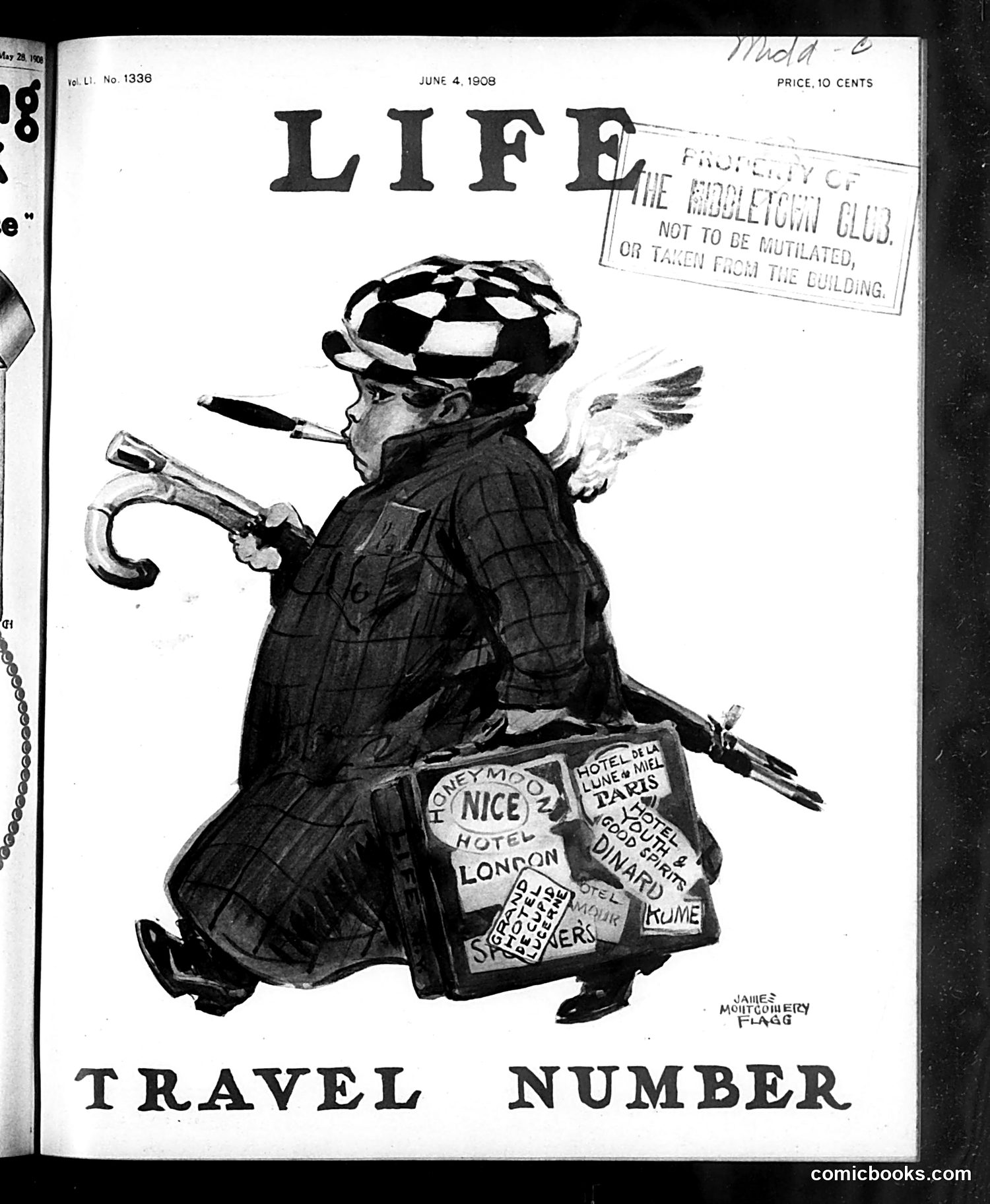
This is a satirical cover illustration by James Montgomery Flagg depicting a wealthy traveler—identifiable by the checkered cap, monocle, and fashionable coat—laden with luggage covered in hotel labels from major European destinations (Nice, London, Paris, Rome, and others). The figure is portrayed as a portly, somewhat pompous tourist weighted down by travel stickers and carrying a cane and umbrella, with small wings awkwardly attached to the back. The satire mocks wealthy Americans' obsession with continental European travel during the Gilded Age—suggesting they accumulate destinations as status symbols while remaining essentially ridiculous figures. The cover announced Life's "Travel Number" issue, likely featuring articles and commentary on leisure tourism among the affluent.
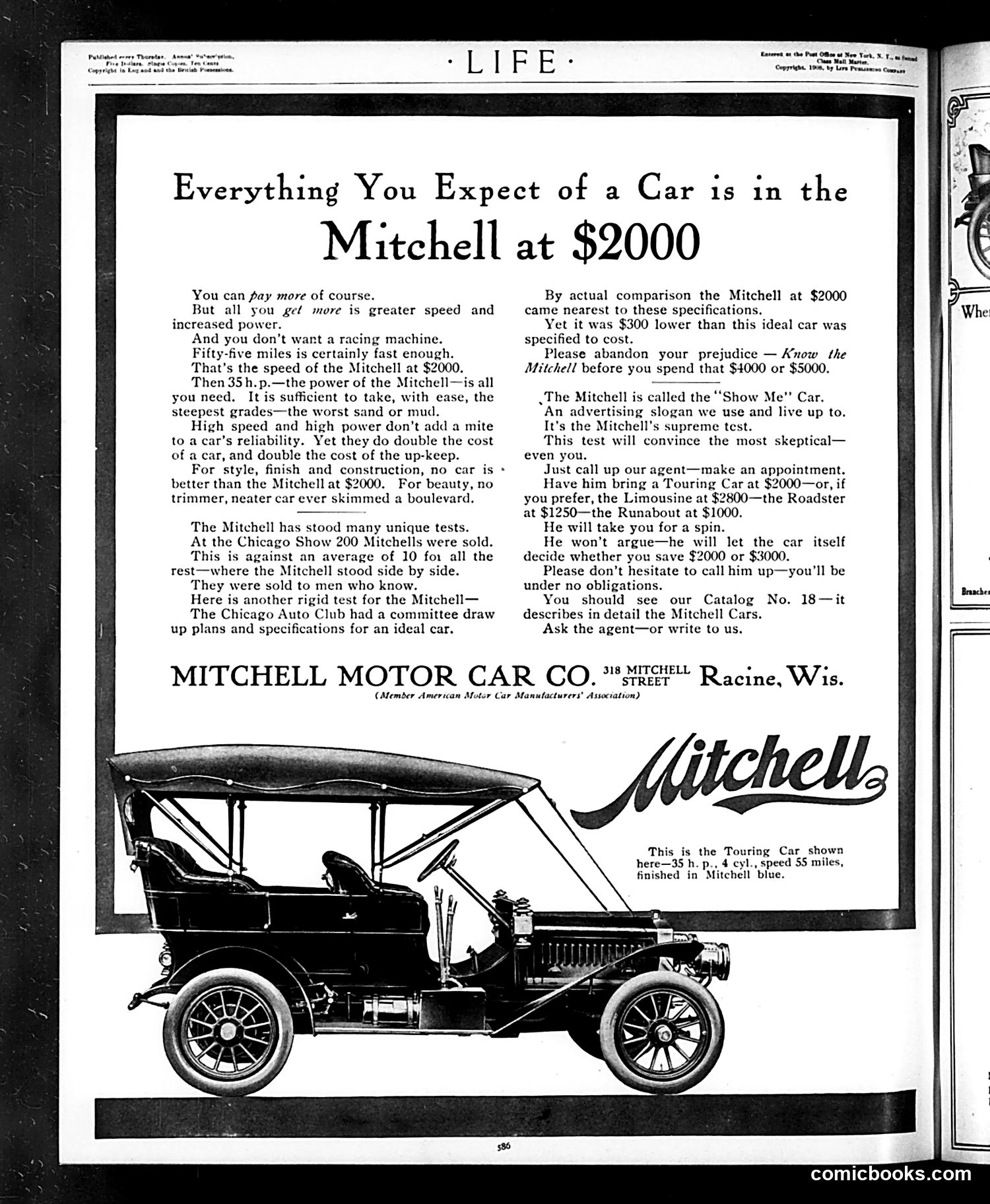
This is **not a cartoon or satire page**, but rather a **straightforward advertisement** for the Mitchell Motor Car Company of Racine, Wisconsin. The ad promotes the Mitchell automobile at $2,000, positioning it as offering excellent value—claiming it provides everything one expects from a car at that price point. The text argues that while faster, more powerful cars exist, they're unnecessary for practical driving and cost significantly more to maintain. The ad references the Mitchell's success at the Chicago Auto Show, where 200 units sold, and invites potential customers to test-drive the vehicle (a "Touring Car" model shown) against competitors. This represents typical early automotive advertising from the pre-1920s era, when car manufacturers competed heavily on value and practical features rather than luxury or speed.
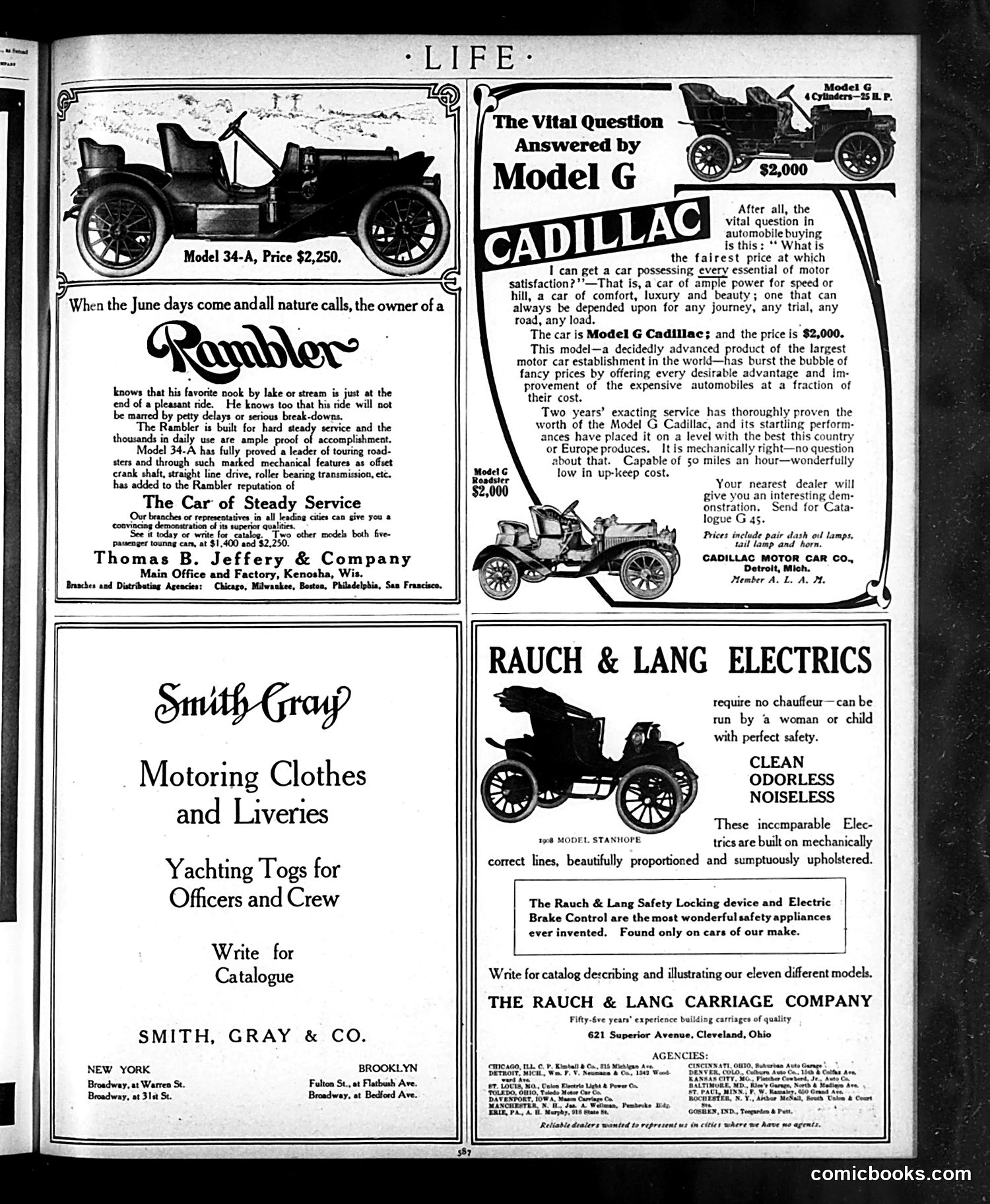
This page is primarily **advertising**, not satire or political cartooning. It contains four automobile and related-goods advertisements from the early 1900s: 1. **Rambler** (top left): Positions the car as ideal for leisure drives and outdoor recreation, emphasizing reliable "steady service." 2. **Cadillac Model G** (top right): Addresses "the vital question" of affordable luxury automobiles, claiming superior quality at $2,000—positioning itself competitively against other manufacturers. 3. **Smith, Gray & Co.** (bottom left): Advertises motoring clothes and yachting attire for affluent buyers. 4. **Rauch & Lang Electrics** (bottom right): Markets electric automobiles as clean, quiet, and safe—particularly appealing to women drivers, requiring "no chauffeur." The ads collectively reflect early automotive culture: luxury positioning, emerging female consumers, and competition among manufacturers.
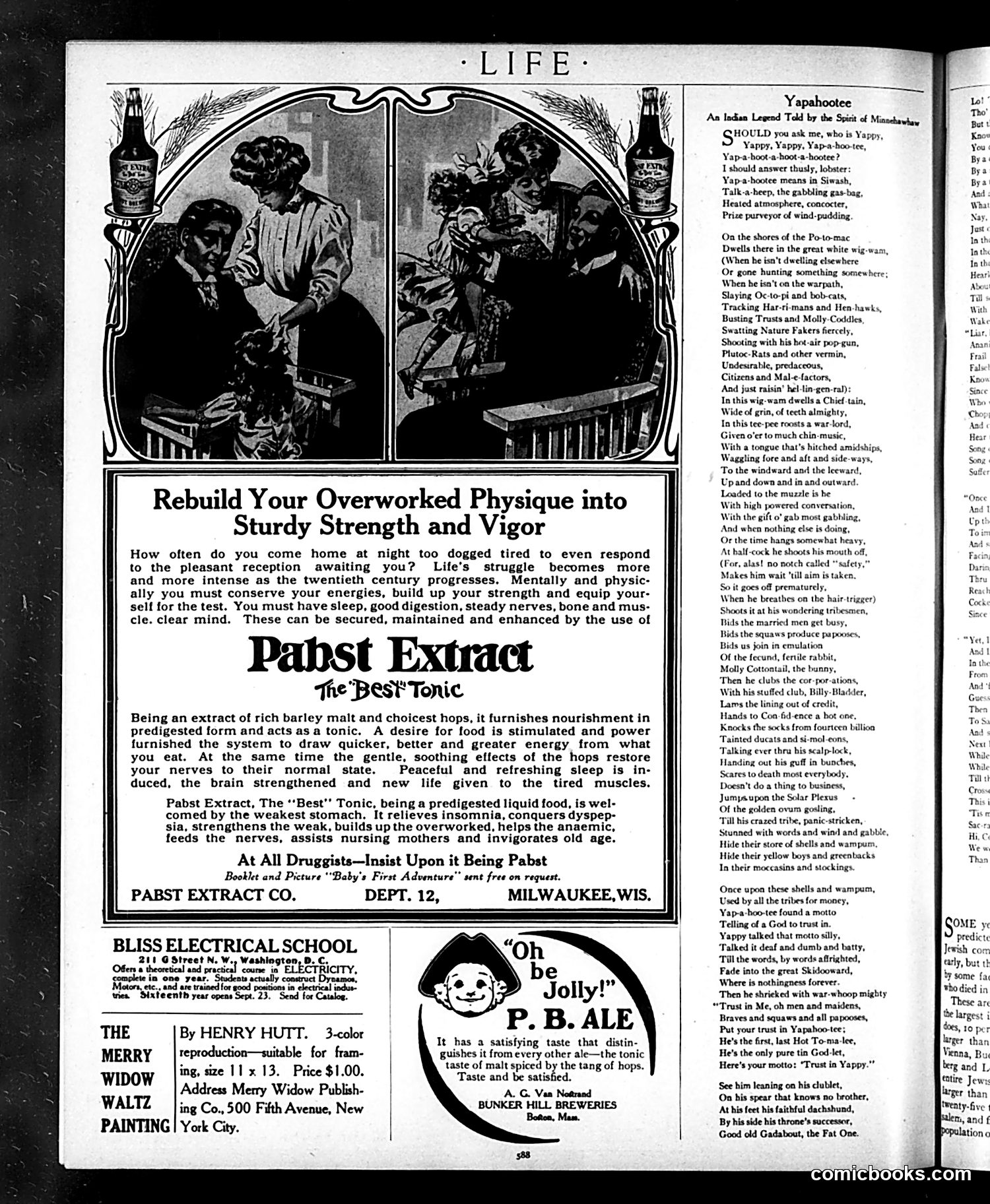
This page is **primarily advertising** rather than political satire. The dominant content is a Pabst Extract tonic advertisement featuring illustrated scenes of men in what appears to be a tavern or social setting, with decorative beer bottles flanking the image. The ad's headline promises to "Rebuild Your Overworked Physique into Sturdy Strength and Vigor"—reflecting early-20th-century marketing claims that malt extract tonics provided health benefits. The copy emphasizes nutrition, energy, and nerve restoration. The right side includes "Yapahootee," a humorous poem in mock-Native American dialect style, typical of period entertainment content. Below are smaller ads for electrical school training, a painting, and P.B. Ale beer. The page reflects historical advertising standards before modern consumer protection regulations.
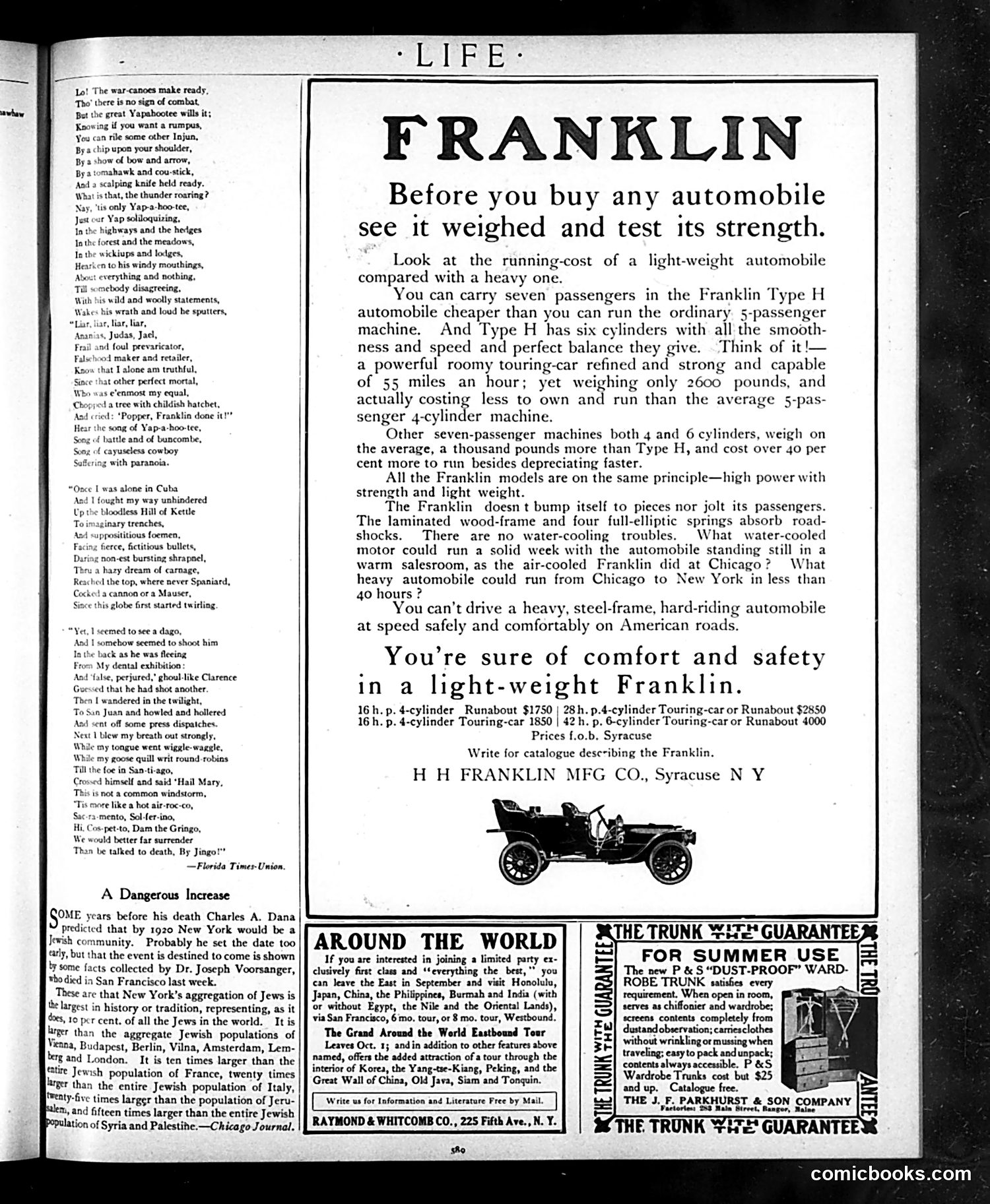
This page is primarily **advertising**, not political satire. The dominant content is a Franklin automobile advertisement emphasizing the vehicle's light weight, fuel efficiency, and comfort compared to heavier competitors. The ad targets affluent readers with specific model prices ($1,750-$4,000) and lists performance claims like carrying seven passengers while costing less to operate than standard five-passenger cars. The left column contains poetry or literary content unrelated to the ads. A small section titled "A Dangerous Increase" discusses pre-1920 predictions about New York's demographic changes, but lacks sufficient detail to determine its satirical intent. The remaining space features travel advertisements and trunk guarantees—typical commercial content for this era's Life magazine.
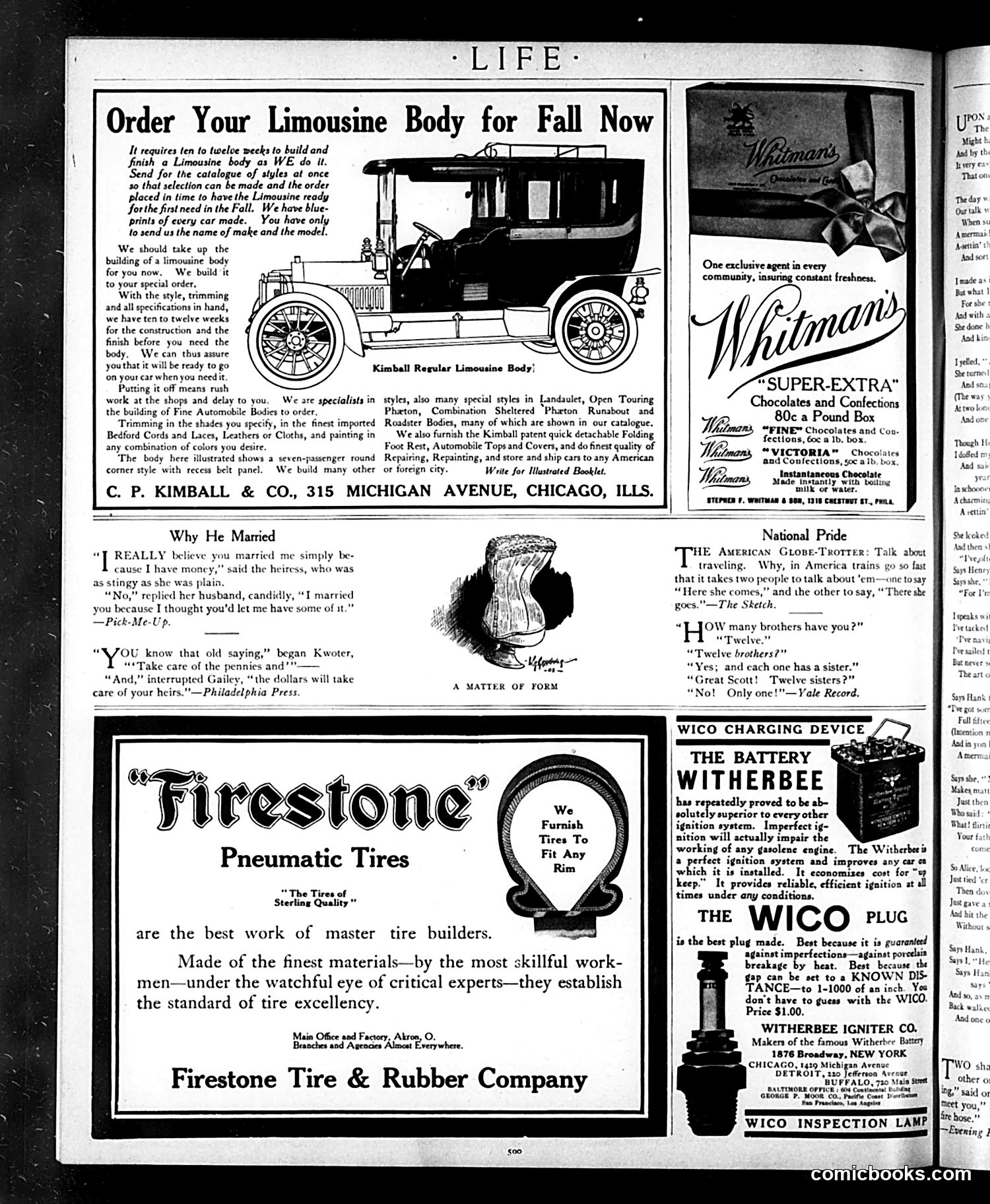
This page is primarily **advertising**, not political satire. The main content includes: 1. **C.P. Kimball & Co. advertisement** (top): Promotes custom limousine bodies for automobiles, emphasizing the ten-to-twelve-week build time needed for fall delivery. 2. **Two brief humorous anecdotes** (middle): "Why He Married" presents quips about marriage motivations, while "National Pride" jokes about sibling counts—light domestic humor rather than political commentary. 3. **Product advertisements** (bottom half): Firestone Pneumatic Tires, Whitman's Chocolates, and Witherbee Battery/ignition systems. The page reflects early 20th-century consumer culture, showcasing luxury automobiles and branded products. The cartoons are incidental filler—gentle domestic jokes typical of Life magazine's satirical approach, not commentary on significant political or social events.
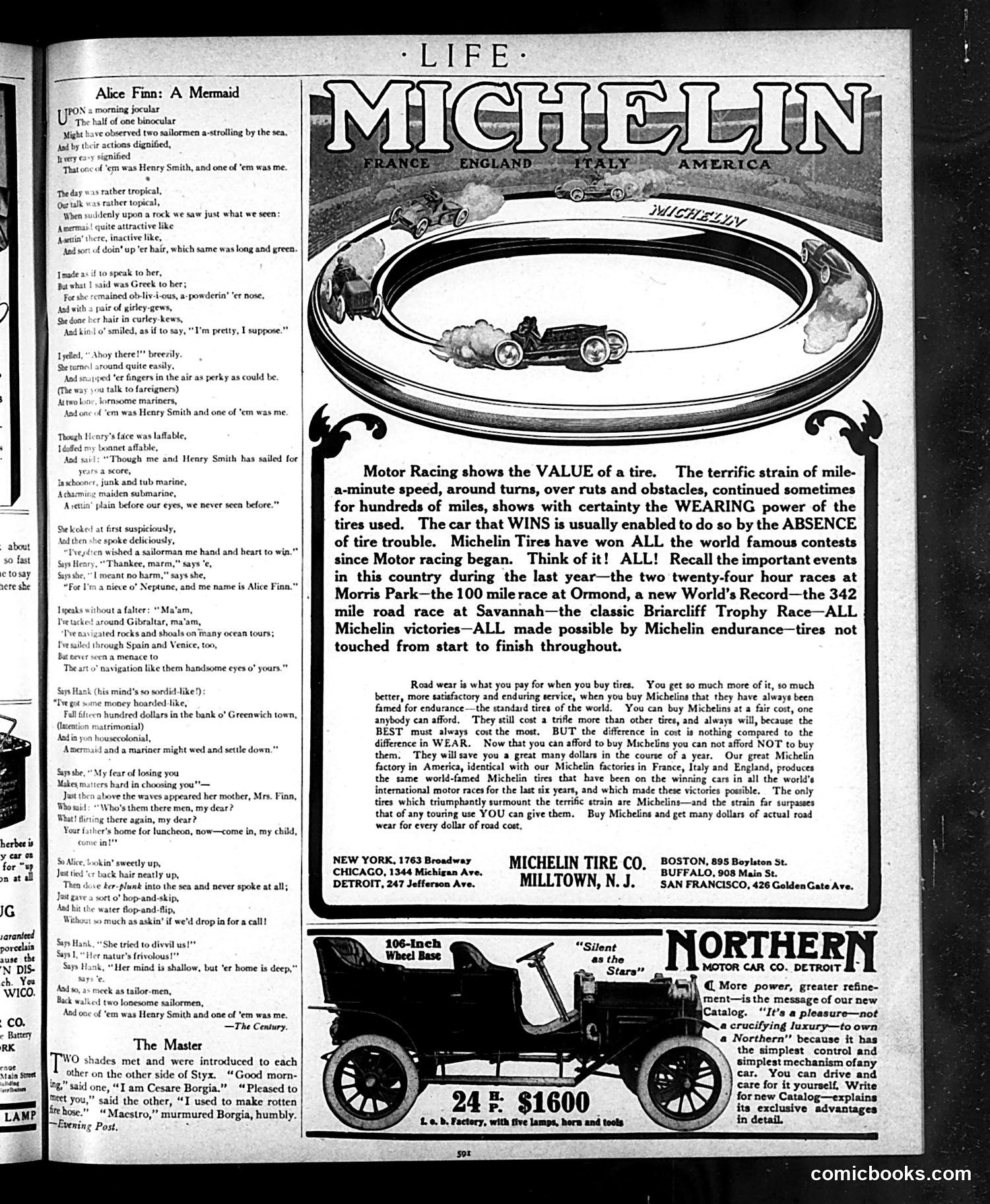
This page is primarily **advertising**, not satire or political content. The left column contains poetry titled "Alice Finn: A Mermaid" and "The Master"—literary content unrelated to cartooning. The dominant right side features two **automobile advertisements**: 1. **Michelin Tires**: A large ad emphasizing tire durability through motor racing victories, particularly referencing the Morris Park 100-mile race and Savannah races. The visual shows a racing car on a tire track. The pitch argues that Michelin's racing success proves their tires' superior "wearing power" for consumers. 2. **Northern Motor Car Co.**: Advertises a 24 h.p. automobile priced at $1600, emphasizing "power" and "refinement." This reflects early 1900s automotive industry marketing, where racing performance was used to validate consumer tire and vehicle quality. No political satire is present.
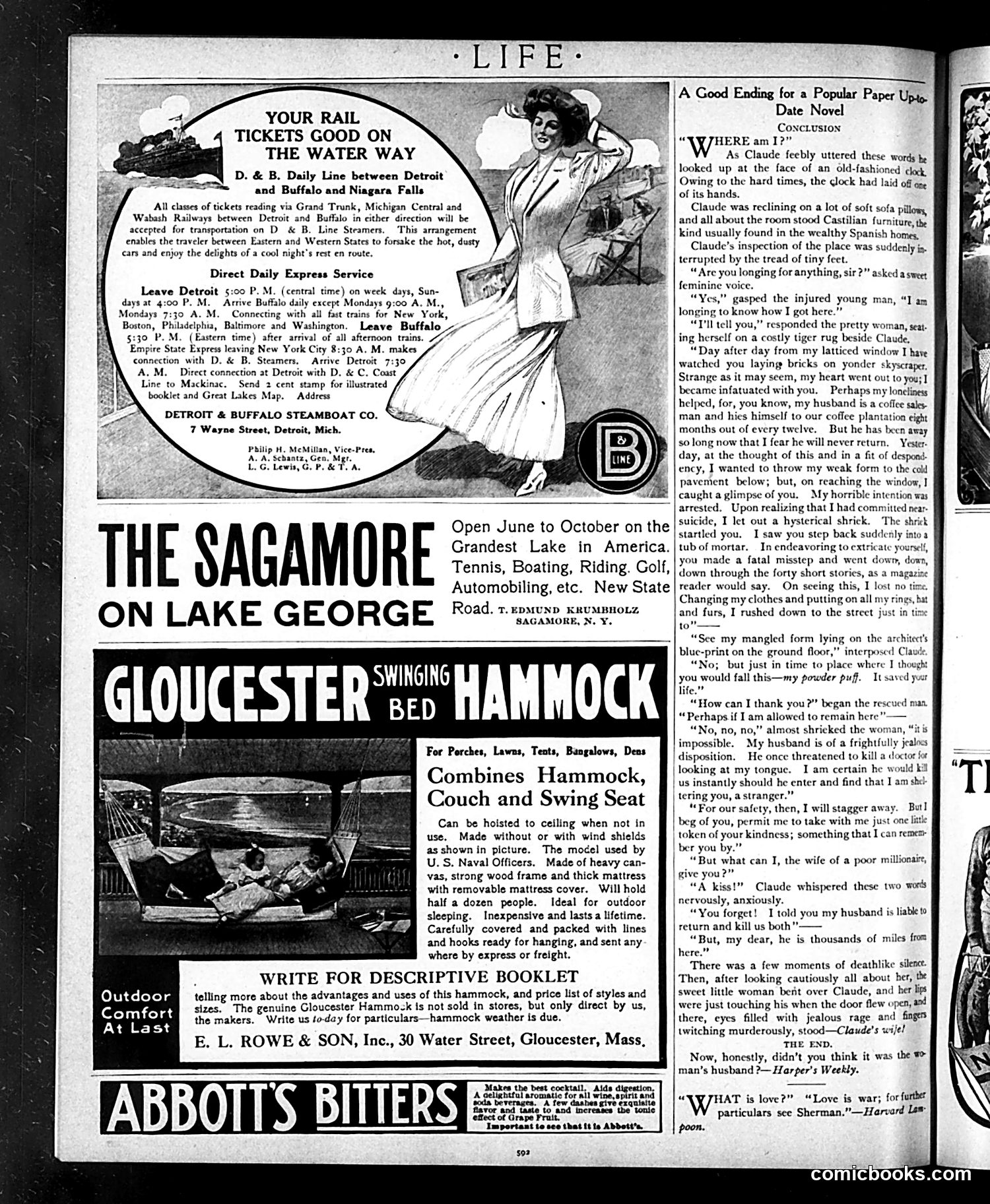
This page is **primarily advertising** with a serialized fiction conclusion. The advertisements include: - **Rail travel** between Detroit and Buffalo via D&B Daily Line - **The Sagamore resort** on Lake George, New York - **Gloucester Swinging Bed Hammock** (a multipurpose outdoor furniture piece) - **Abbott's Bitters** (a patent medicine/digestive aid) The right column contains the **conclusion of a serialized romantic story** from Harper's Weekly, featuring characters Claude and a rescued injured man, resolving their romantic complications. No political satire or caricature appears on this page. The content reflects early 20th-century consumer culture, leisure activities, and popular serialized fiction typical of Life magazine's format during this era.
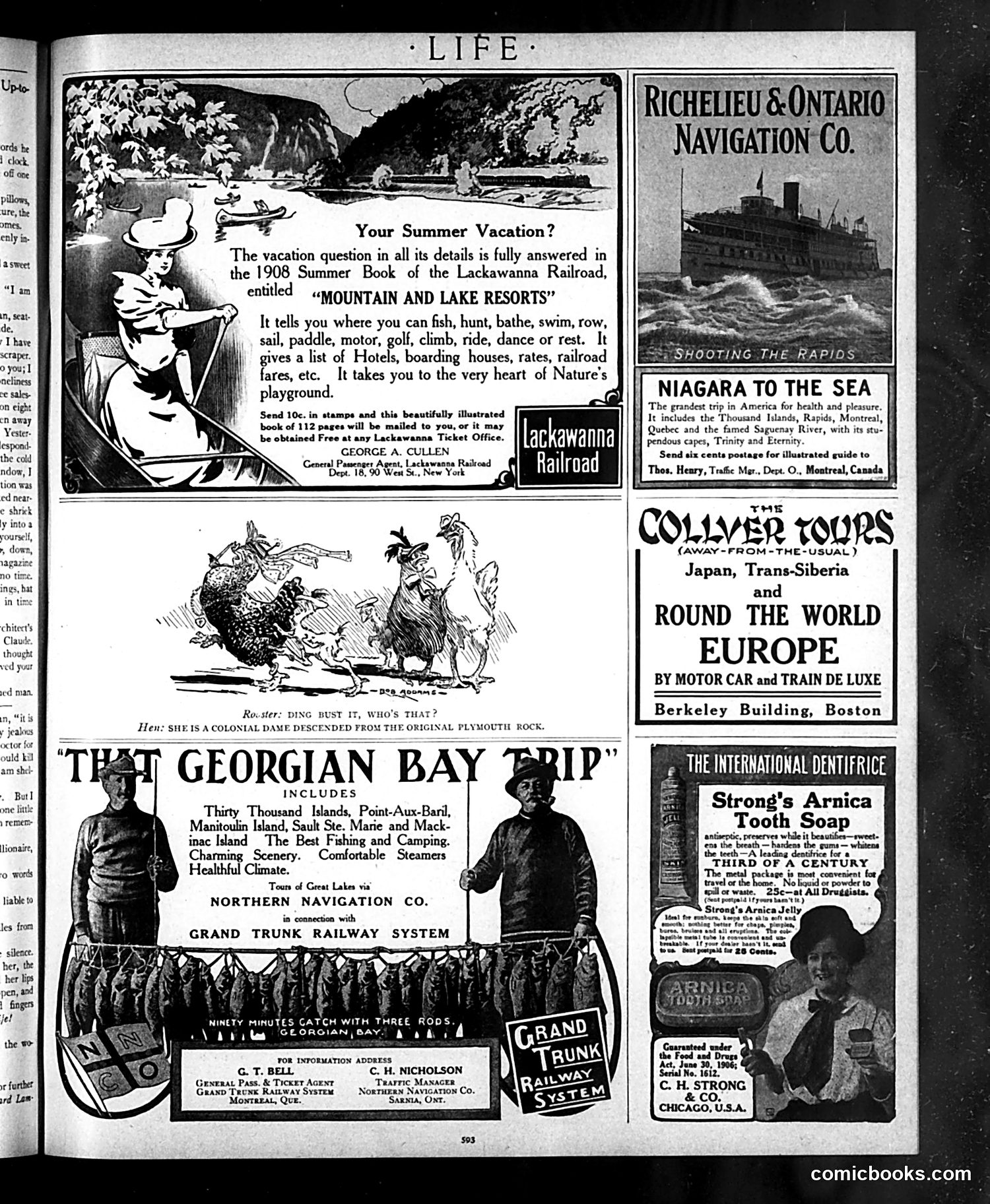
This page is primarily **advertisements** for travel and consumer products, with one small cartoon labeled "That Georgian Bay Trip." The cartoon depicts a rooster attacking a hen, captioned: "Rooster: DING BUST IT, WHO'S THAT? / Hen: SHE IS A COLONIAL DAME DESCENDED FROM THE ORIGINAL PLYMOUTH ROCK." The joke plays on American colonial pride and ancestry. A hen claims prestigious heritage from the original "Plymouth Rock" settlers, but the rooster—unconcerned with her pedigree—attacks her anyway. The satire mocks the pretension of boasting about colonial ancestry, suggesting such genealogical status is meaningless in practical situations. It's a lighthearted jab at Americans' reverence for early settler heritage. The page also advertises railroad travel (Lackawanna Railroad, Grand Trunk Railway System) and tours (Collier Tours), reflecting early-20th-century leisure culture.
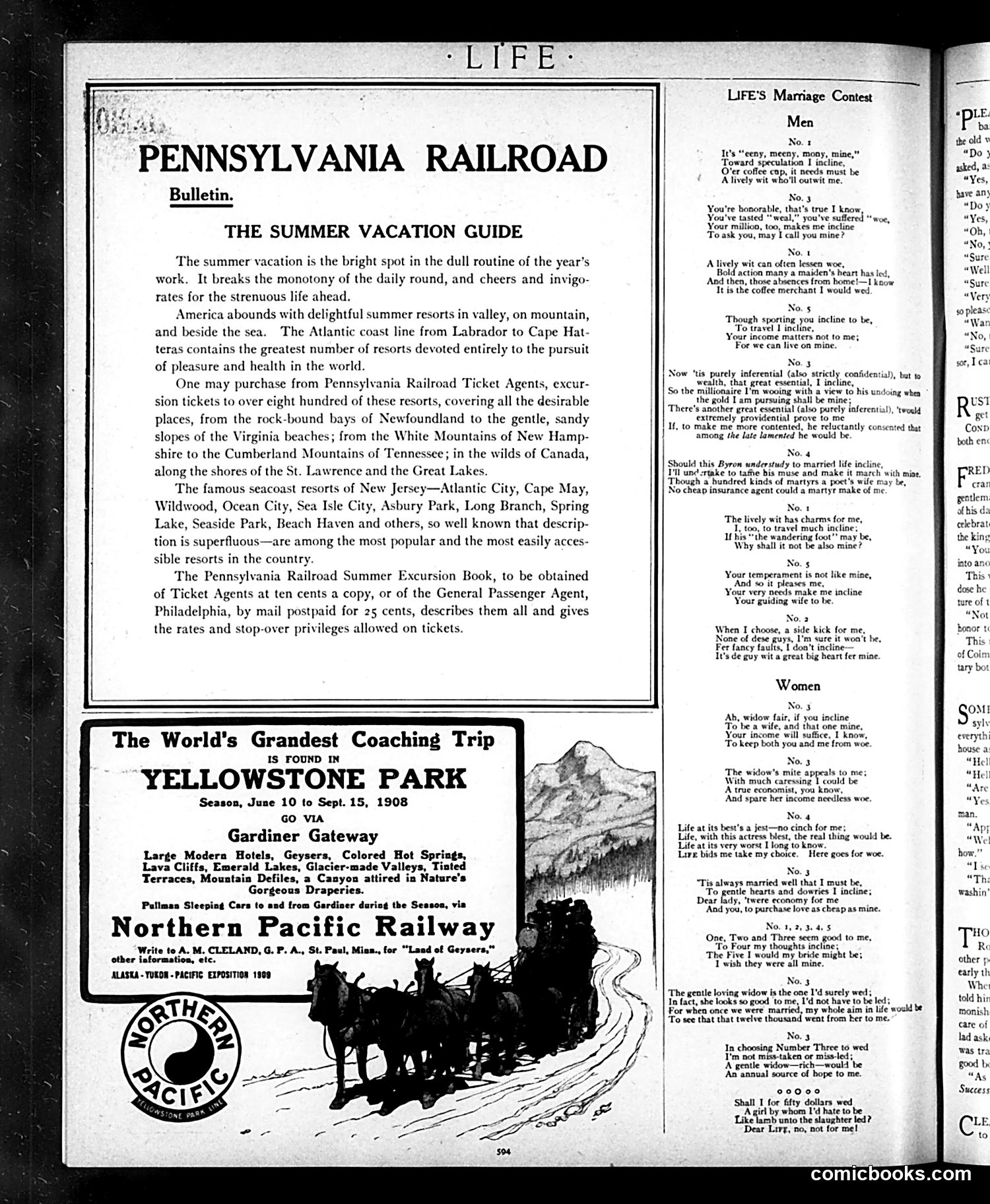
This page consists primarily of **period advertising** rather than satirical content. The main elements are: 1. **Pennsylvania Railroad bulletin** promoting summer vacation packages to resorts across America—from Newfoundland to the Virginia beaches to Canadian wilderness. This reflects early 1900s leisure travel marketed to the affluent. 2. **Yellowstone Park coaching trip advertisement** via the Northern Pacific Railway, promoting a "grandest coaching trip" with luxury accommodations. 3. **"Life's Marriage Contest"** on the right: humorous poems from both men and women debating marriage compatibility and financial concerns—typical satirical content for Life magazine, poking fun at romantic expectations versus practical realities of married life. The page represents Life's mixed model: serious travel advertising alongside social satire about courtship and marriage.
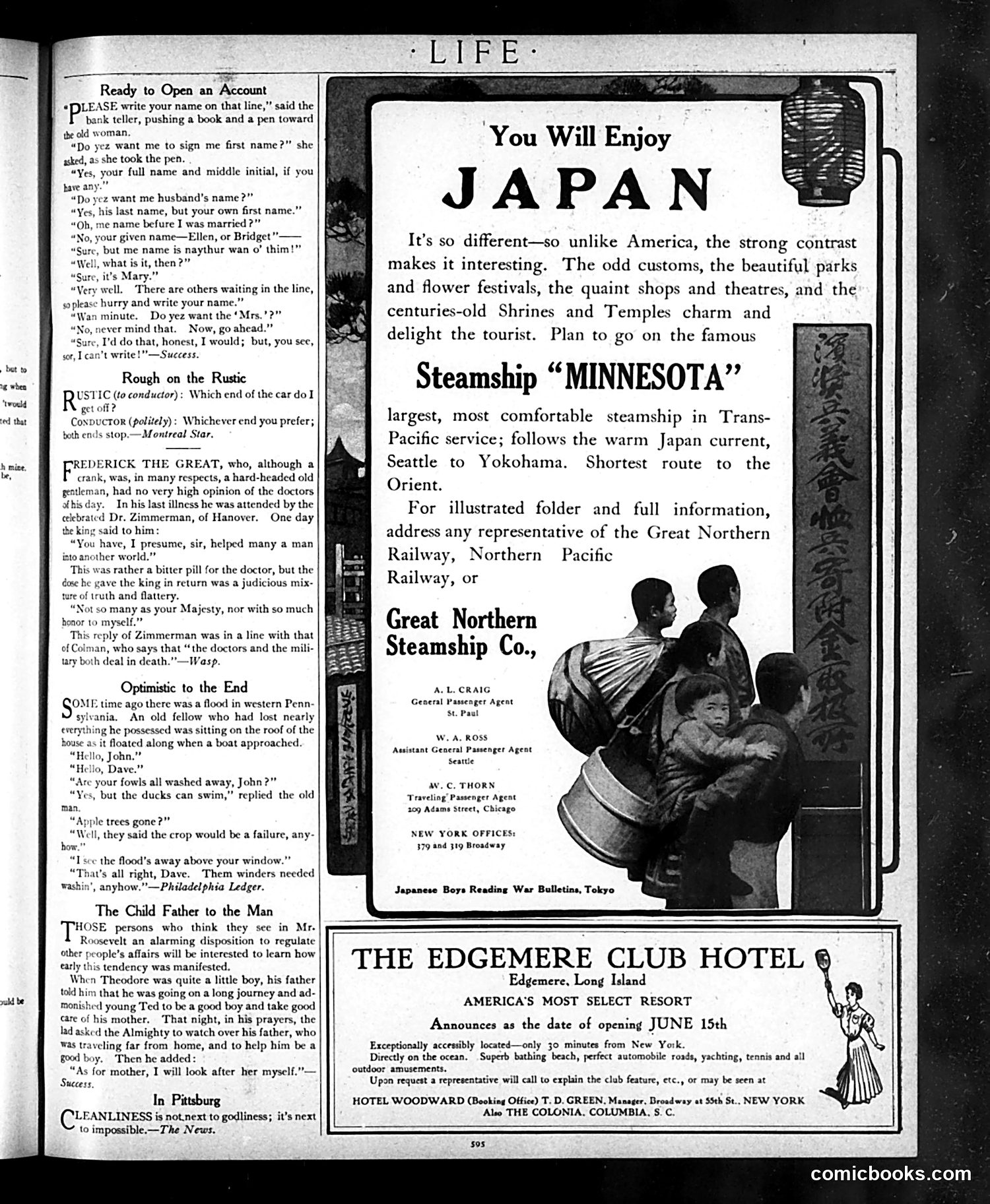
This page is primarily **advertising content** rather than satirical cartoons. The main advertisement promotes travel to Japan via the Steamship "Minnesota" operated by Great Northern Steamship Co., emphasizing Japan's contrast with America—its "odd customs," temples, shrines, and parks. The ad targets wealthy tourists seeking exotic experiences. Below that, **The Edgemere Club Hotel** on Long Island advertises as "America's Most Select Resort," opening June 15th, positioned as an exclusive retreat near New York. The left column contains brief humorous **anecdotes** (jokes) about everyday situations—opening a bank account, a conductor's rudeness, a doctor's bedside manner—typical of *Life*'s satirical humor about American social interactions and class dynamics. These are observational rather than political satire.
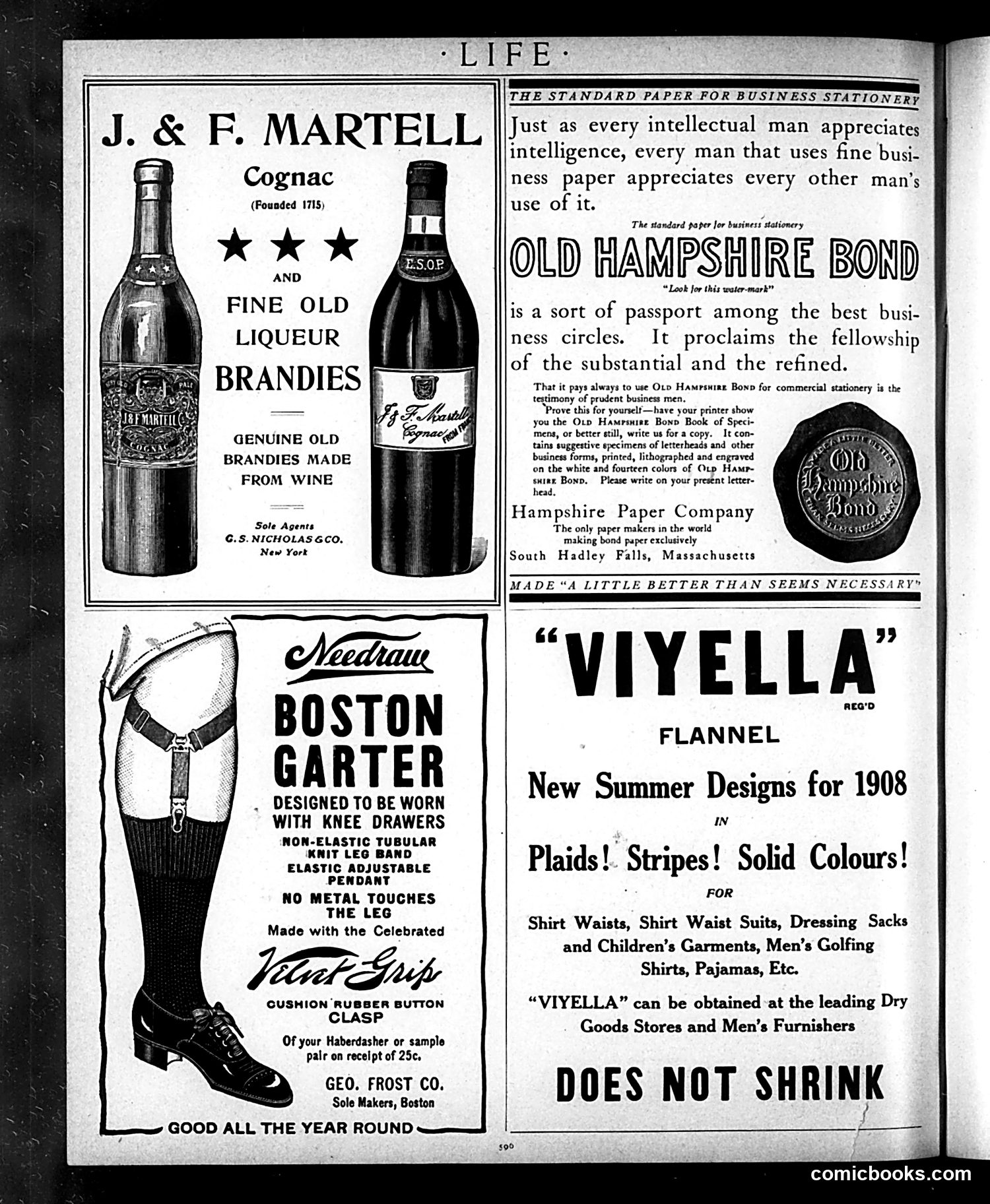
This page is **primarily advertising**, not satire or political commentary. It contains four advertisements from approximately 1908: 1. **J. & F. Martell Cognac** — promotes French brandy, founded 1715 2. **Old Hampshire Bond** — business stationery paper with a water-mark, marketed as a status symbol among professionals 3. **Needham Boston Garter** — men's garters designed to wear with knee drawers, emphasizing comfort features 4. **Viyella Flannel** — fabric for summer 1908 clothing in various patterns, advertised as non-shrinking There are no political cartoons, caricatures, or satirical commentary visible. The page reflects early 1900s consumer goods and social conventions (e.g., men wearing garters and knee-length drawers as standard dress).
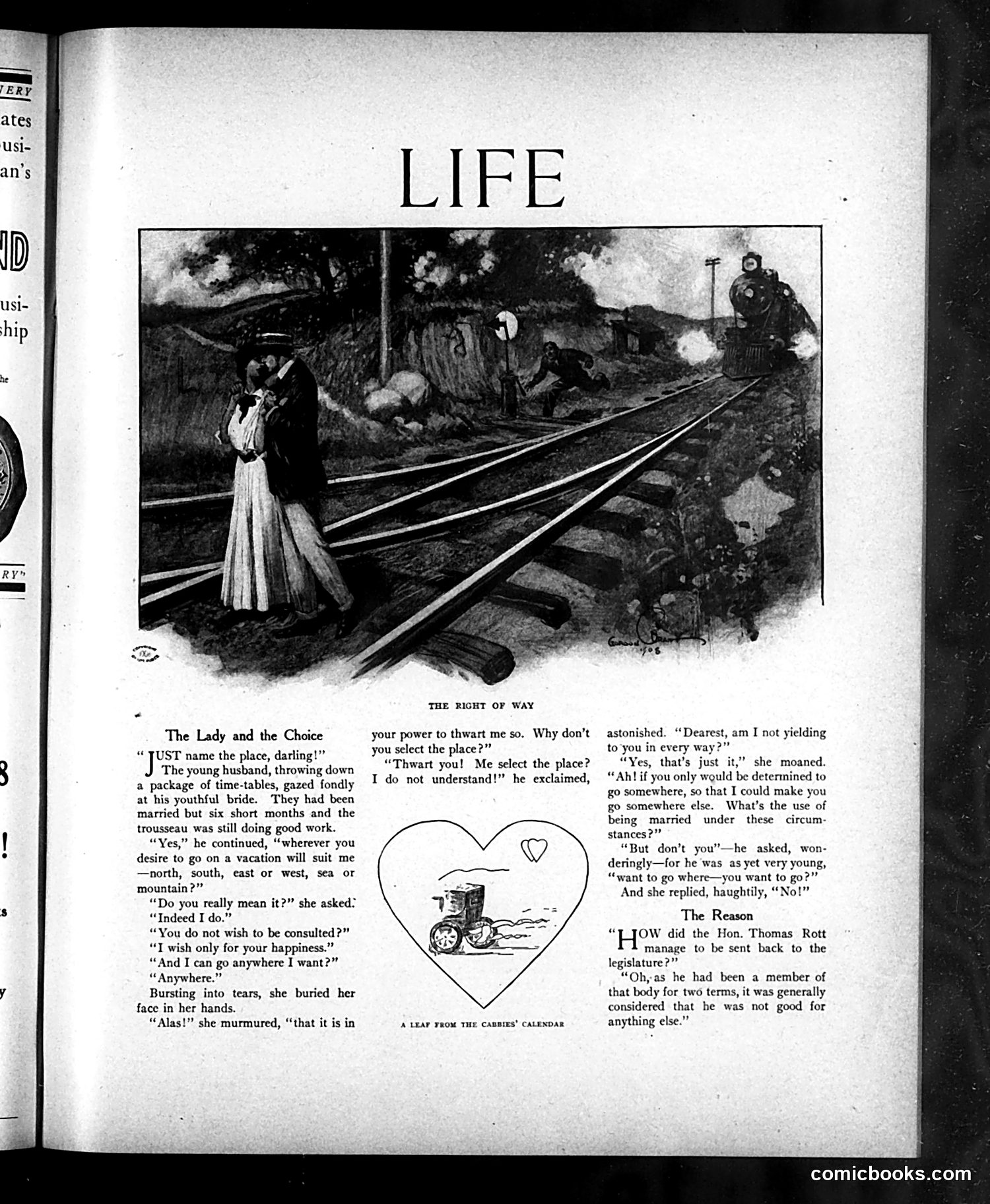
This page contains two distinct pieces: an illustration and accompanying fiction. **The illustration** ("The Right of Way") depicts a woman in a long dress standing on railroad tracks facing an oncoming locomotive. It satirizes a woman's powerlessness in marriage through the metaphor of inevitable collision—she cannot choose her direction or escape her fate, much like her lack of agency in selecting where to live after marriage. **The fiction pieces** below expand this theme. "The Lady and the Choice" shows a newlywed couple debating where to settle; the husband dismisses her preferences entirely, asserting complete control. "The Reason" comments on male politicians' unsuitability for office, suggesting incompetence based on gender parallels the marital power imbalance. Together, these pieces critique early-20th-century women's legal and social subordination in marriage and public life.
This editorial page discusses Theodore Roosevelt's impending departure from the presidency and William Howard Taft's expected succession. The piece explains why business confidence is rising despite Roosevelt's unpopularity among the wealthy. **Key political figures:** - **Roosevelt**: characterized as a "pall of death" over business (quoting a critical newspaper); credited with steering the country through dangerous economic waters - **Taft**: presented as "safe and sane"—a moderate alternative to Roosevelt who can continue reforms without radicalism - **Bryan**: referenced as a potential Democratic nominee whose election would cause less damage than feared **The satire's point:** Life defends Roosevelt's legacy while explaining why even Republicans feel relief at his departure. The magazine argues that public confidence is returning not because Taft represents change, but because citizens are satisfied with achieved reforms and want stability—to "take their profits" and "make a living again." The small cartoon illustrations (children, animals) appear decorative rather than satirical.
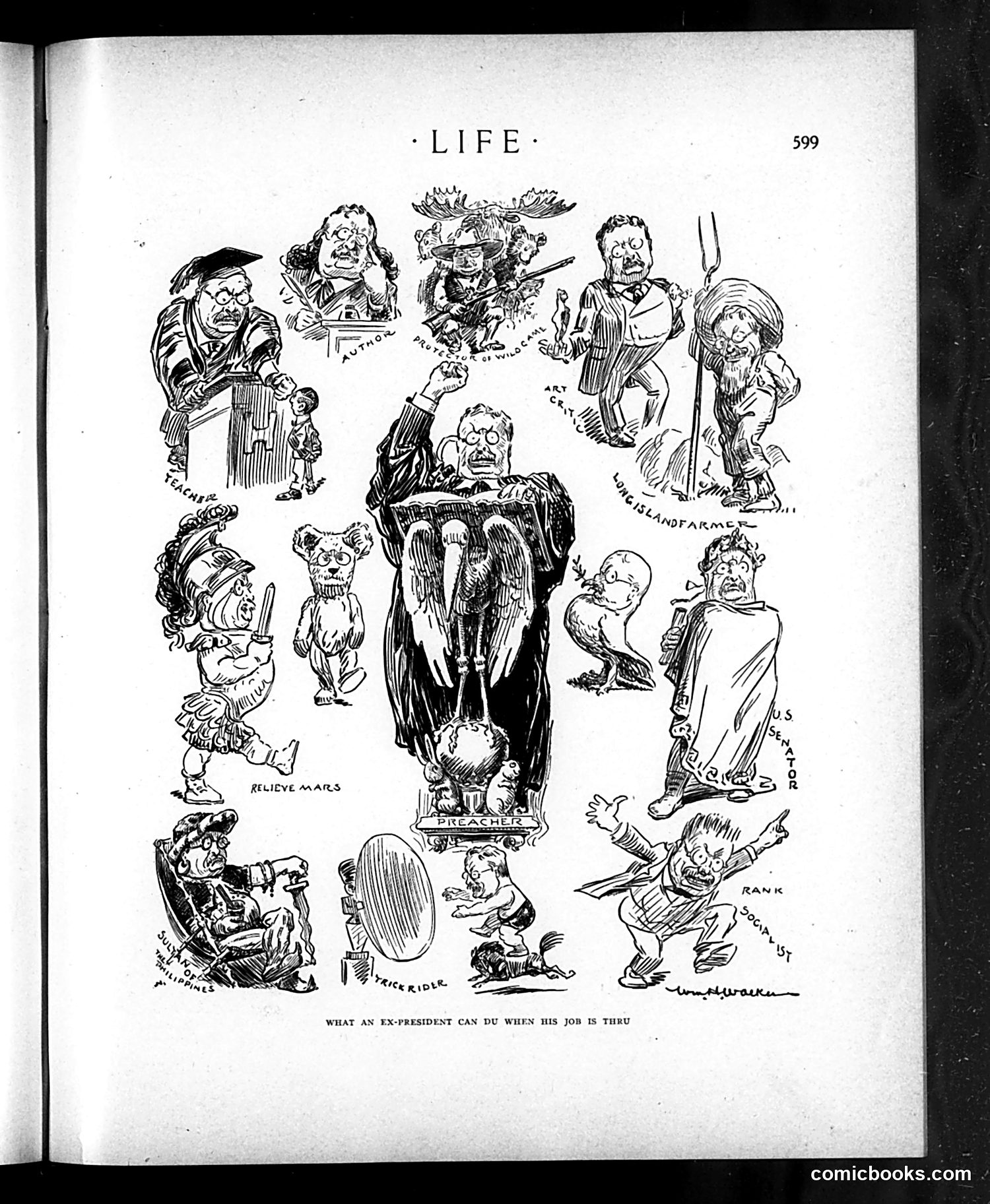
This is a satirical illustration titled "WHAT AN EX-PRESIDENT CAN DO WHEN HIS JOB IS THRU" showing various caricatured figures engaged in different activities and professions after leaving the presidency. The cartoon depicts former presidents pursuing alternative careers and roles—labeled figures appear to include positions like "Preacher," "U.S. Senator," "Rank Socialist," and others. Each caricature shows an ex-president in a different occupation or social role, satirizing the various paths available to former chief executives. The satire mocks what becomes of presidents after their term ends, suggesting they pursue diverse—sometimes questionable or diminished—endeavors. Without clearer date context, the specific presidents referenced remain unclear, but the cartoon's premise criticizes the post-presidential trajectories available to former leaders, implying some pursue less dignified or relevant pursuits than their former office.
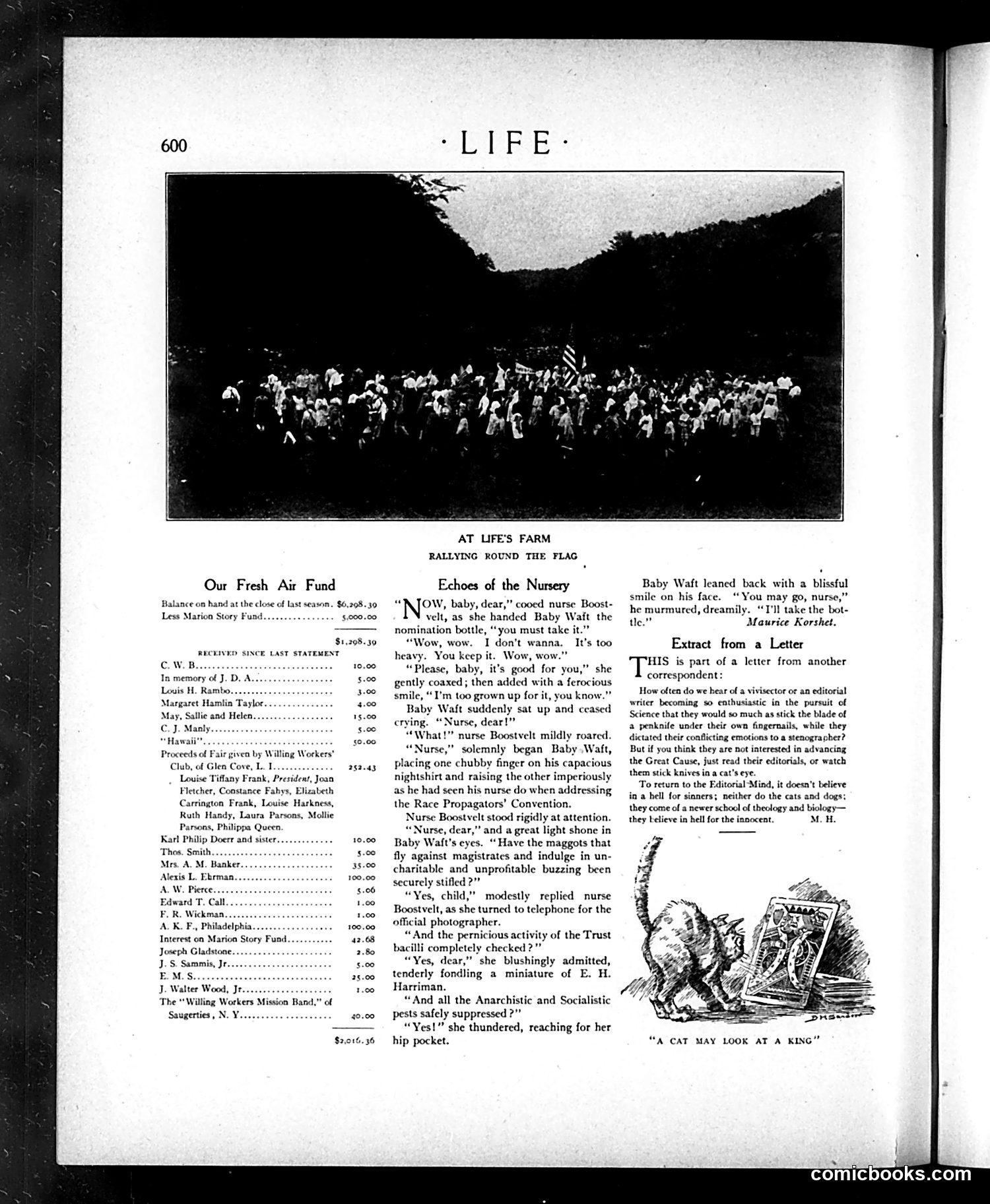
This page combines fundraising notices with political satire disguised as nursery rhymes. The main cartoon, "Echoes of the Nursery," presents a dialogue between "nurse Boostvelt" (Theodore Roosevelt) and "Baby Waft" (William Howard Taft, his chosen successor). The satire mocks Roosevelt's aggressive progressive agenda by depicting him as a domineering nurse force-feeding reluctant "Baby Waft" the "nomination bottle"—suggesting Taft's unwilling acceptance of Roosevelt's political legacy. Baby Waft's subsequent questions parody Roosevelt's trust-busting, anarchist-suppressing, and socialist-combating crusades, treating serious reform efforts as absurd nursery concerns. The piece ridicules both figures: Roosevelt's overbearing reformism and Taft's passivity. The illustration "A Cat May Look at a King" complements this by suggesting animals observe human folly without judgment. The page also includes an "Extract from a Letter" criticizing editorial writers who advocate vivisection while avoiding personal discomfort—satirizing hypocritical reformers.
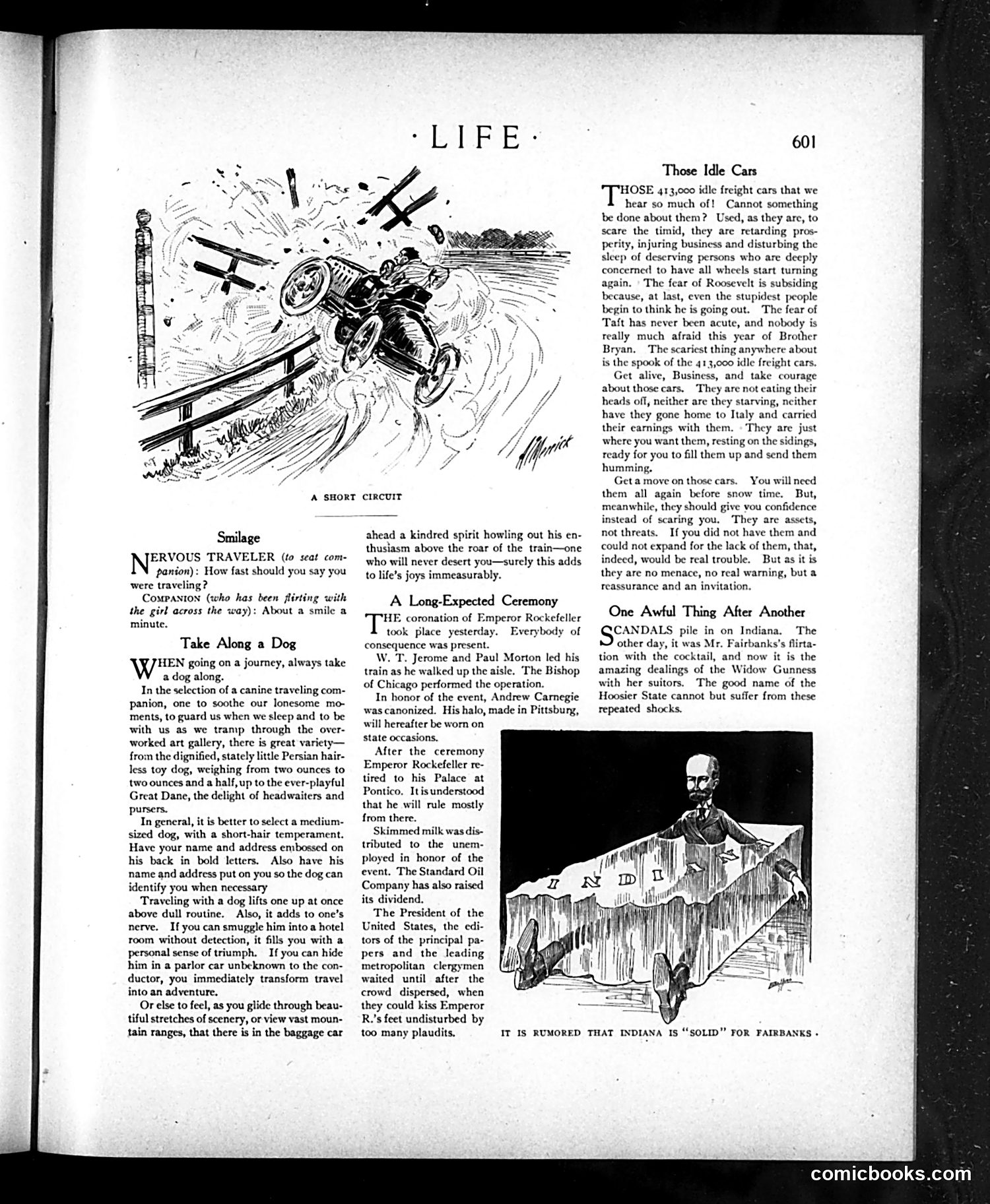
**"A Short Circuit"** (top left cartoon): Depicts a train derailment with violent collision. The accompanying text jokes about a nervous traveler asking a companion how fast to claim they were going—the companion flippantly suggests "a smile a minute," satirizing casual dishonesty about accidents, likely insurance fraud. **"A Long-Expected Ceremony"**: Sharp satire on wealthy industrialist **John D. Rockefeller** as "Emperor Rockefeller," mocking America's gilded-age plutocracy. References **Andrew Carnegie's** "canonization" and mentions **W.T. Jerome** and **Paul Morton** (prominent figures of the era). The joke: while the president, newspaper editors, and clergy wait obsequiously to kiss the tycoon's feet, only skimmed milk reaches the unemployed—depicting extreme wealth inequality and the subservience of institutions to industrial titans. **"Those Idle Cars"**: Commentary on 413,000 idle freight cars and economic anxiety. Dismisses public fear of economic stagnation under President **Roosevelt** and **Taft**, suggesting business should trust these idle assets will be needed soon—likely reflecting Progressive-era tensions over railroad monopolies and economic uncertainty.
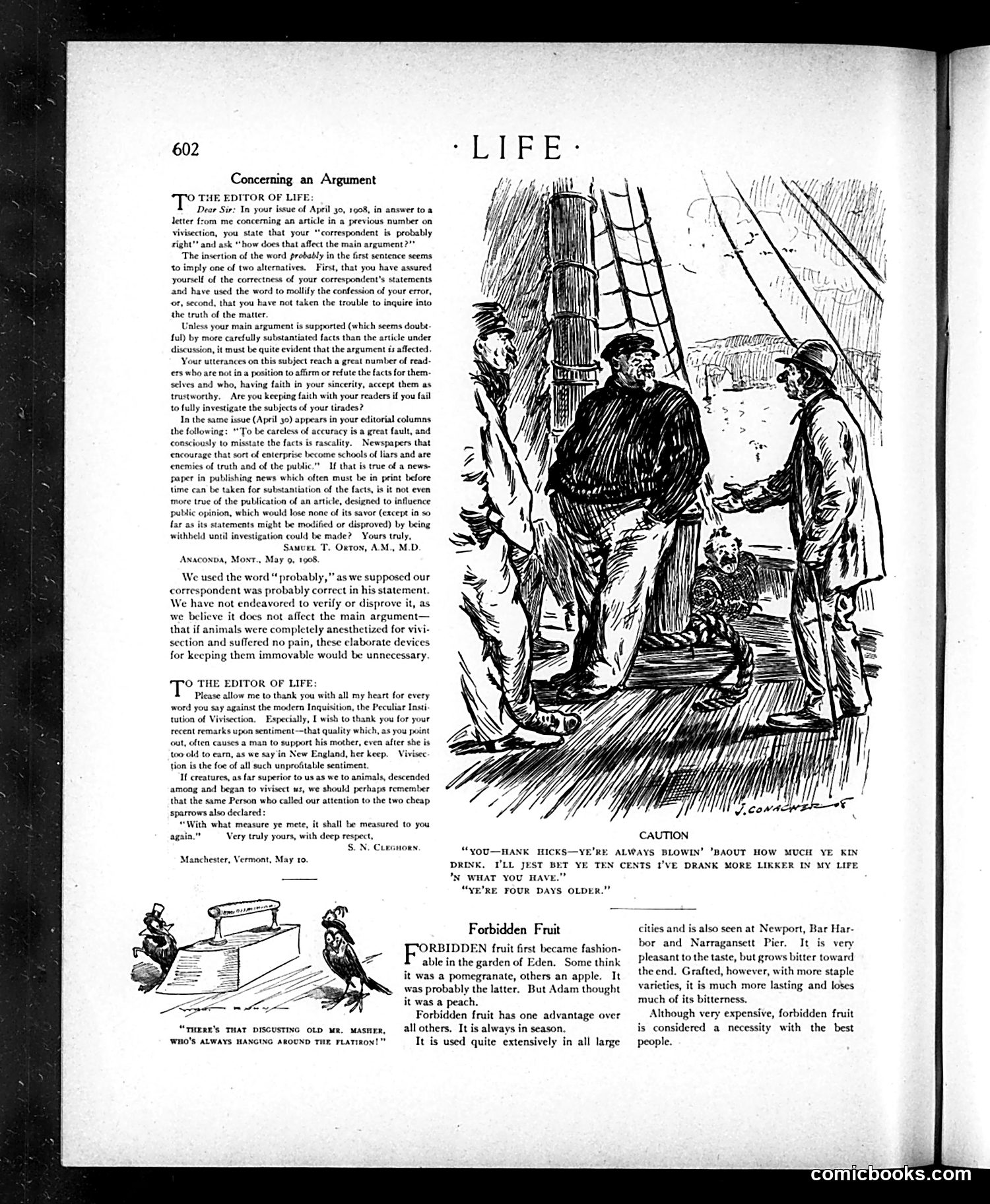
This page contains reader letters debating journalistic accuracy in *Life* magazine's coverage of vivisection (animal testing), plus two unrelated cartoons and a brief article. **The Letters:** Readers criticize *Life*'s editorial standards, arguing that using the word "probably" in defending a previous article about vivisection is evasive. They demand rigorous fact-checking, especially for opinion pieces meant to influence public opinion. The editor responds defensively, claiming the word choice doesn't affect their main argument. **Top Cartoon:** Two men aboard a ship; one brags about drinking capacity. The caption deflates his boast: he's simply "four days older." **Bottom Cartoon:** Shows an older man ("Mr. Masher") frequenting the Flatiron building (a NYC landmark), with women gossiping about his persistent presence there—a comment on unwanted male attention in public spaces. **"Forbidden Fruit" Article:** A brief, humorous piece suggesting the forbidden fruit was likely a peach (Adam's mistaken belief), noting forbidden fruit's perpetual "availability."
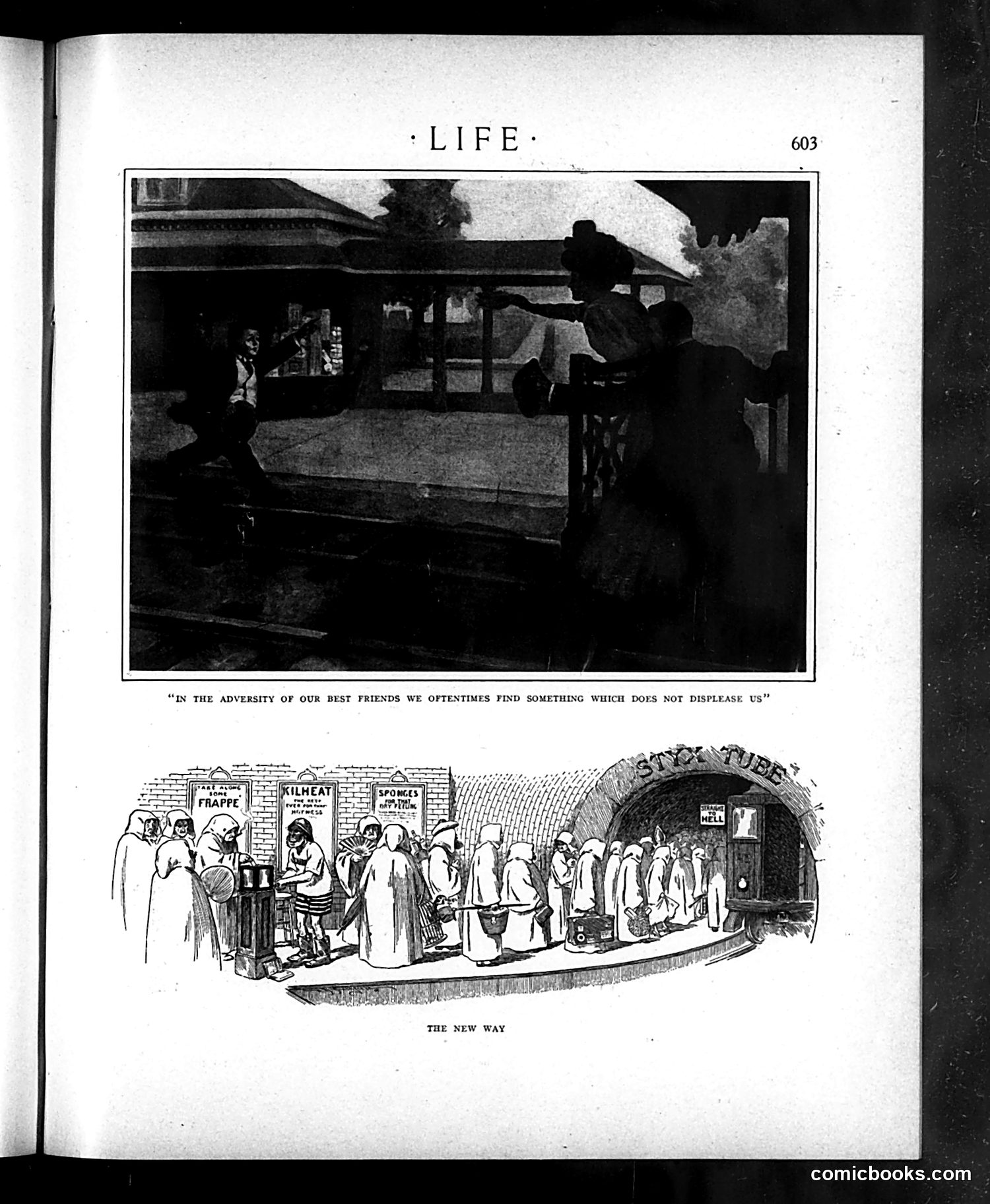
This page contains two images satirizing social behavior and economic systems. The **top photograph** appears to depict a dramatic scene with silhouetted figures, though its exact meaning is unclear without more context. The **bottom cartoon** titled "THE NEW WAY" shows a crowded underground passage or tunnel (marked "STOCK TUBES") with many people queuing at various vendor stalls selling items like "FRAPPE," "SPONGES," and other goods. This appears to satirize **modern consumer capitalism and mass consumption**—people cramped together in an underground network, mechanically purchasing standardized goods. The epigraph about finding pleasure in friends' misfortune suggests **schadenfreude**, implying the cartoon critiques how people derive satisfaction from economic systems that may disadvantage others, or how commercial society creates underground, dehumanizing conditions for the masses.
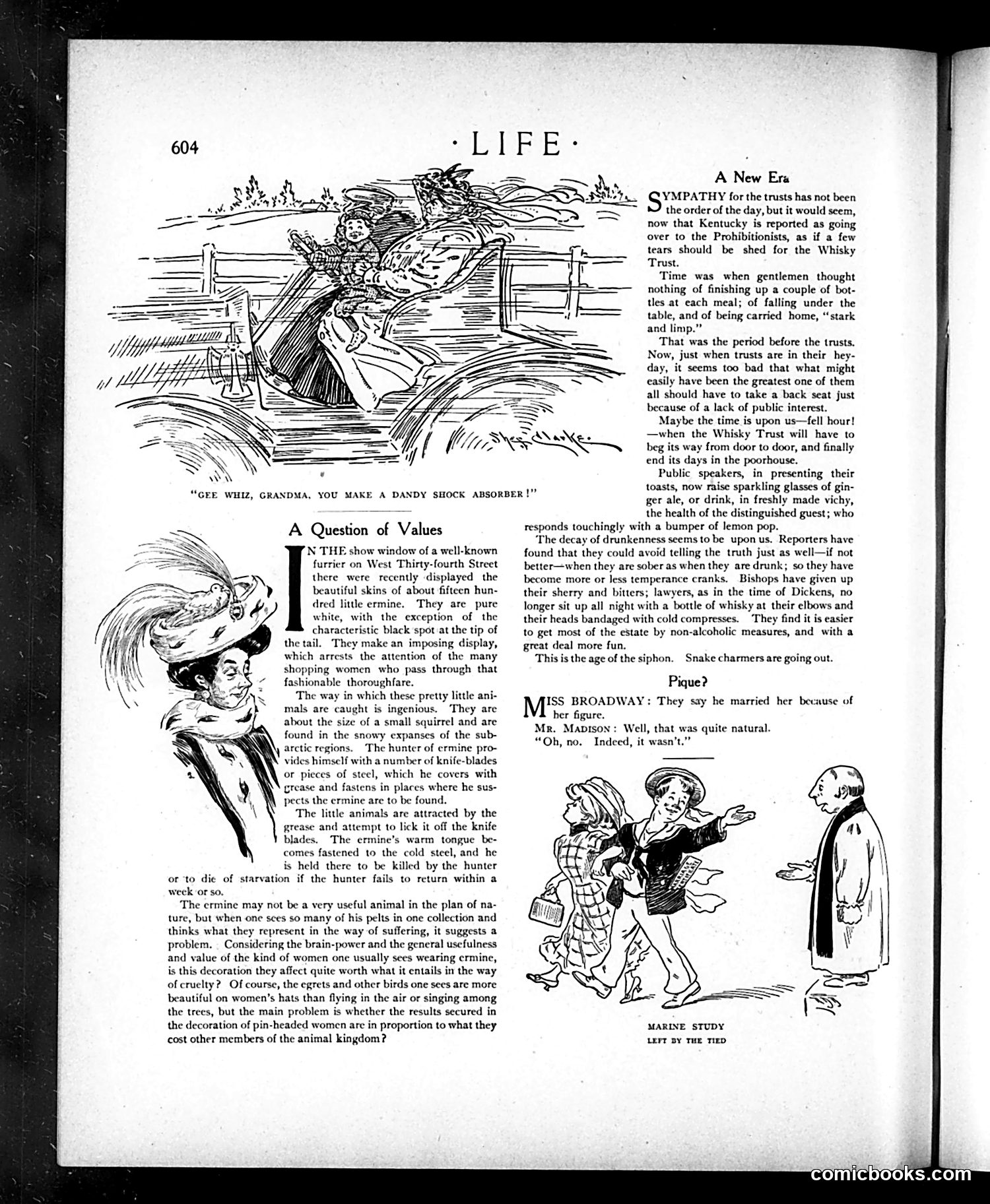
This *Life* magazine page contains satirical commentary on Prohibition and social change in America. **"A New Era"** mocks the decline of the Whisky Trust due to Prohibition sentiment (Kentucky reportedly "going over to the Prohibitionists"). The satire is ironic: Life pretends to sympathize with the whisky industry's misfortune, having previously been a symbol of gentlemanly excess. The joke contrasts the old days of acceptable drunkenness with the new temperance movement. **"A Question of Values"** critiques wealthy women's fashion choices. It describes ermine pelts displayed in a furrier's window, detailing how ermines are caught and killed—their warm tongues freezing to steel blades. The satire's harsh punch: these animals suffer and die so that vapid, "pin-headed women" can wear fashionable furs. Life questions whether the aesthetic benefit to shallow women justifies the animal cruelty involved. Both pieces use biting sarcasm to expose hypocrisy and misplaced priorities in American society.
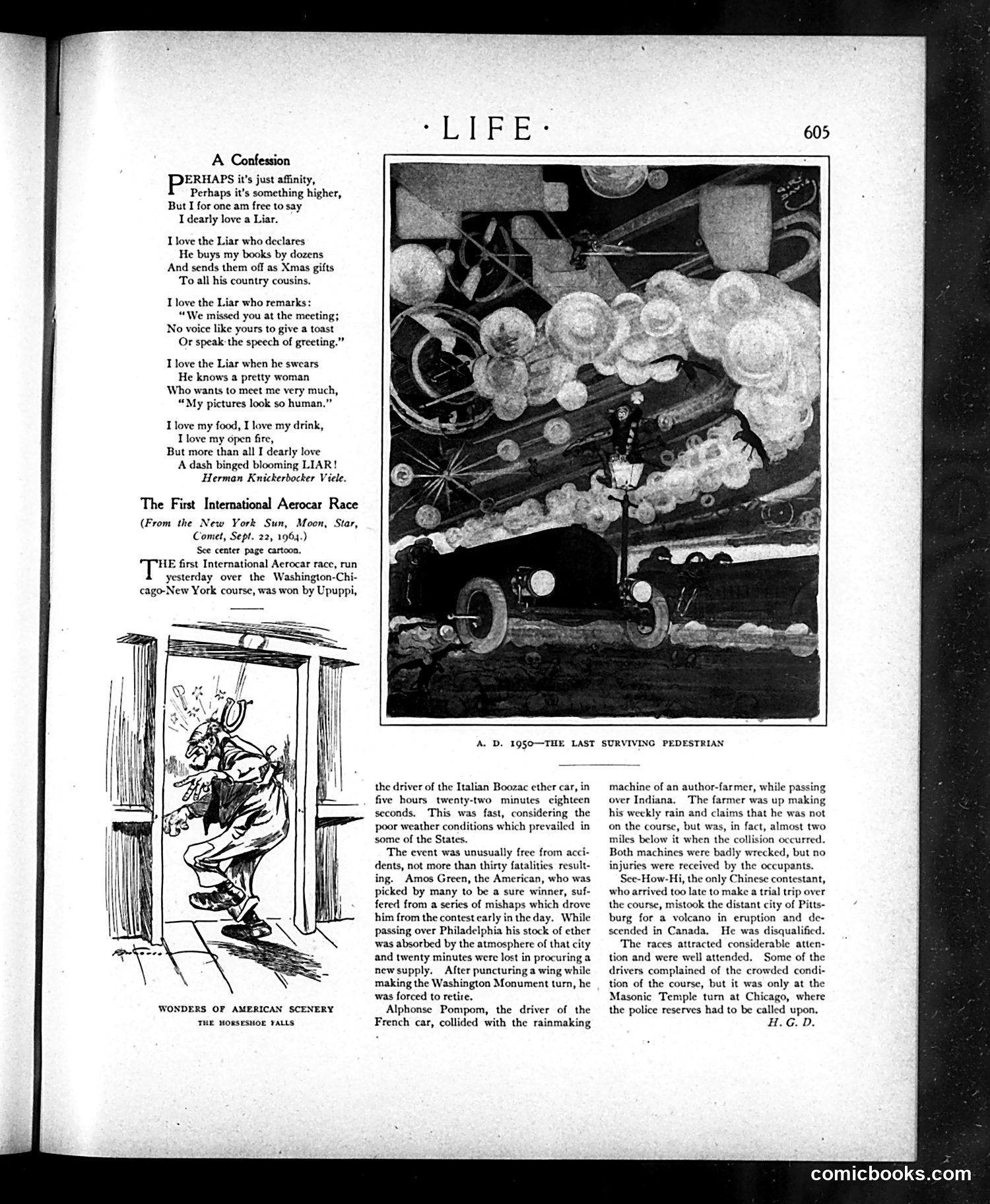
This satirical piece imagines a future (1950) where automobiles have become so dominant and dangerous that pedestrians are extinct. The cartoon depicts an early aerocar race with absurdly high casualty counts treated casually ("not more than thirty fatalities"). The joke reflects early-20th-century anxiety about the automobile's rapid proliferation and deadly consequences. By 1904, cars were still novel but already notorious for accidents. The satire presents a dystopian extrapolation: if this trend continues unchecked, walking will become impossible. The accompanying poem "A Confession" about loving liars appears unrelated to the cartoon. The "Wonders of American Scenery" illustration likely satirizes industrial/technological "progress" destroying natural landscapes—a common theme in Life magazine's social commentary. This reflects Progressive Era concerns about unregulated technological change and urban safety.
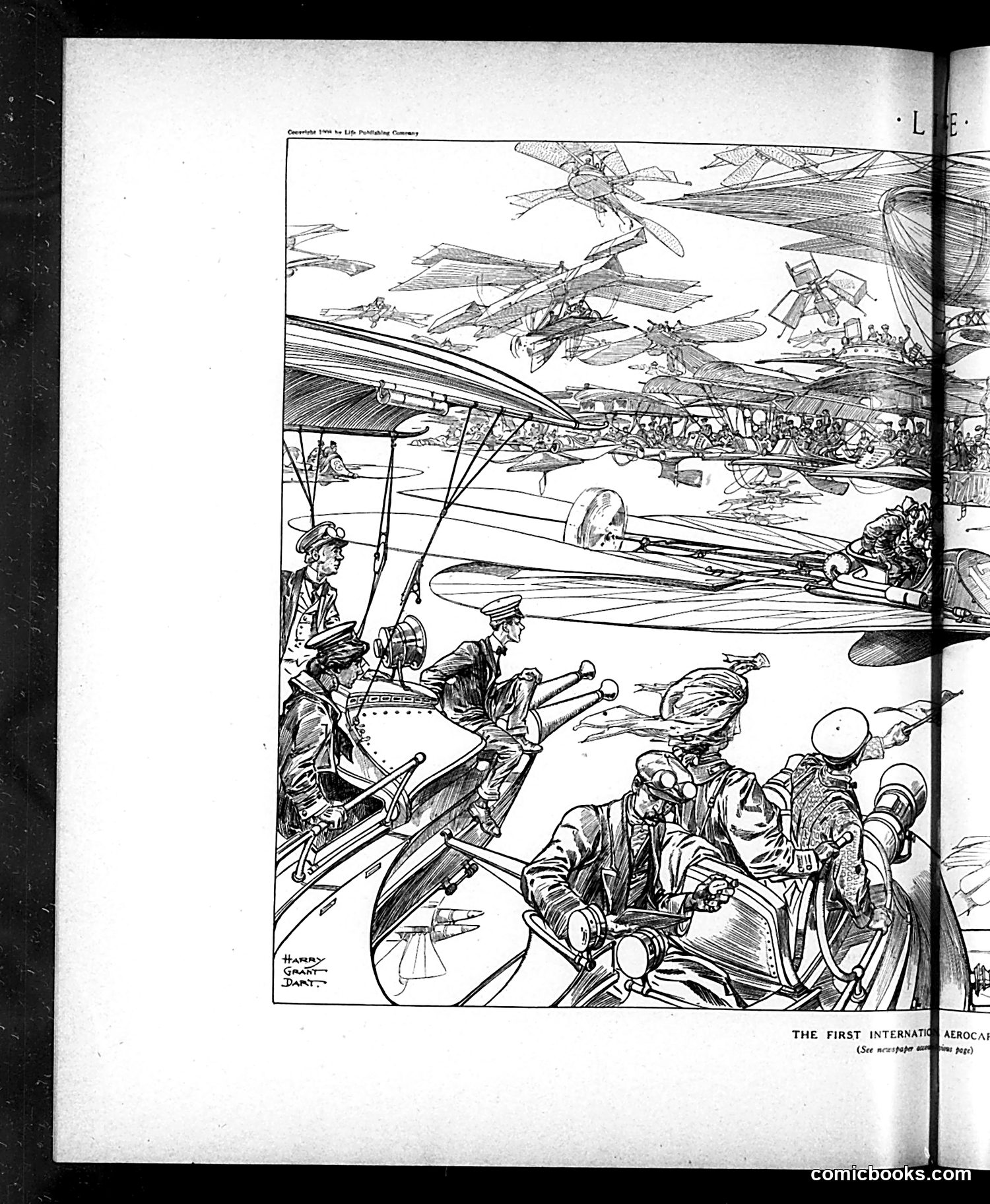
This illustration depicts "The First International Aerocar" — an early aviation fantasy scene. The detailed pen drawing (signed by Hardy Grant Dart) shows a futuristic airship or flying vessel crowded with passengers and crew members operating various mechanical controls and equipment. The satire likely mocks the era's wild speculation about aviation's future and the absurdly optimistic visions of what air travel might become. The chaotic arrangement of figures, pulleys, mechanical devices, and the densely-packed scene suggest humor about overcrowding and the impracticality of such designs. This reflects turn-of-the-century *Life* magazine's characteristic irreverent commentary on technological progress and human folly, poking fun at grandiose predictions about transportation innovation.
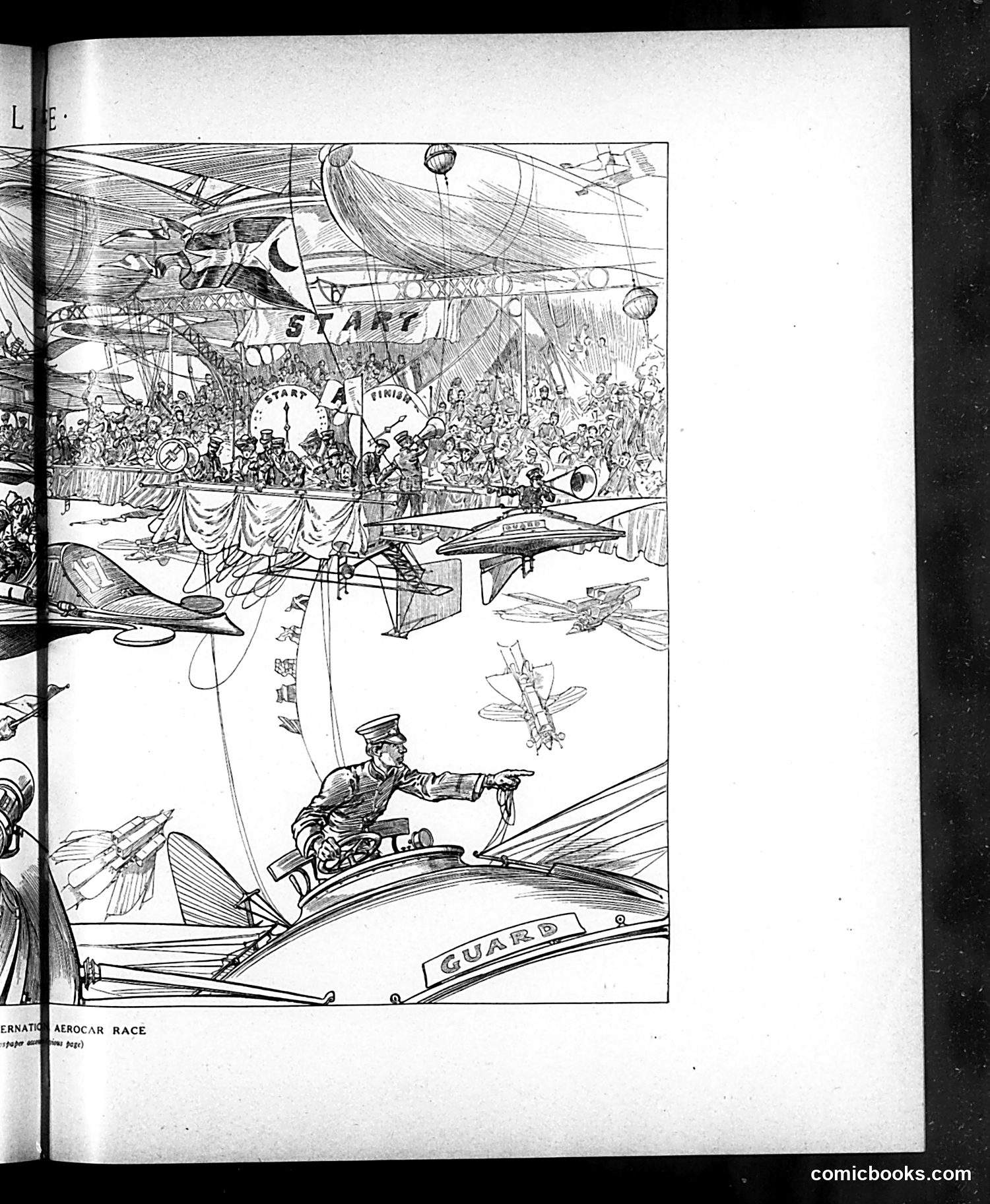
This appears to be an illustration from Life magazine depicting an "International Aerocar Race." The drawing shows a futuristic aerial event with crowds watching from bleachers marked "START," various flying vehicles in the air, and a uniformed guard or official in the foreground pointing and directing traffic below. The satire likely targets early 20th-century enthusiasm for aviation technology and racing spectacles. The elaborate scene—with massive crowds, elaborate staging, multiple aircraft types, and ceremonial pageantry—exaggerates how society was embracing these new flying machines as entertainment, reflecting contemporary excitement about aviation's potential while perhaps gently mocking the grandiosity of such public spectacles. The exact date and specific race referenced remain unclear from visible text.
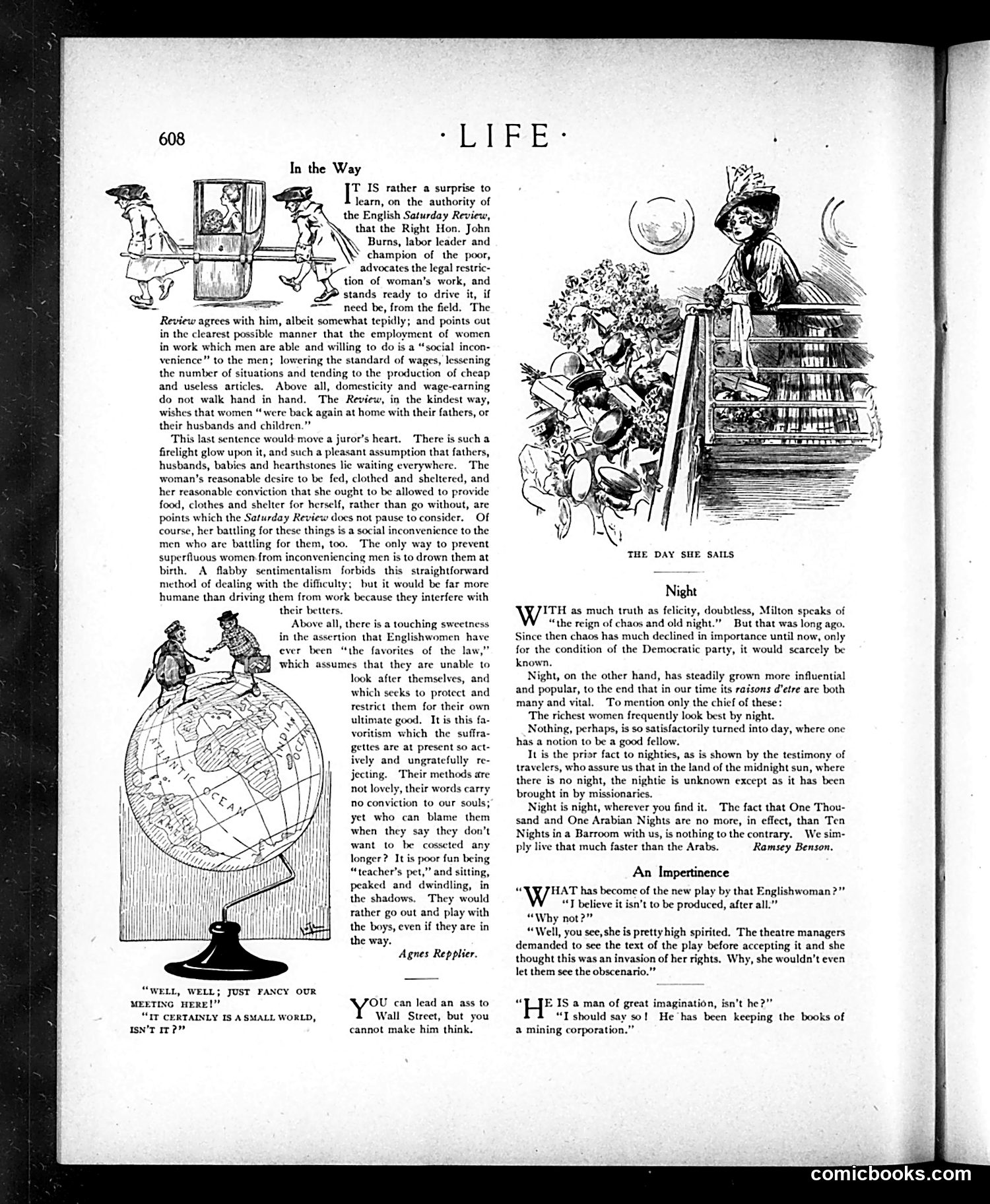
This page satirizes John Burns, a British Labour leader and champion of the poor, for advocating legal restriction of women's work. The Saturday Review supports him, arguing women workers create "social inconvenience" by lowering wages and distracting from domesticity. The article's author (Agnes Repplier) attacks this logic mercilessly. She notes the hypocrisy: women need to eat and shelter themselves, yet are told they're "favorites of the law" needing protection. She connects this to the suffragettes' justified anger at being treated as perpetual children—"teacher's pet" sitting "peaked and dwindling, in the shadows" while denied adult agency. The cartoons illustrate women's actual work and independence, contrasting the article's sentimental vision of domesticity with reality. The satire exposes how male workers and paternalistic institutions collaborated to exclude women from economic participation, disguising self-interest as chivalry.
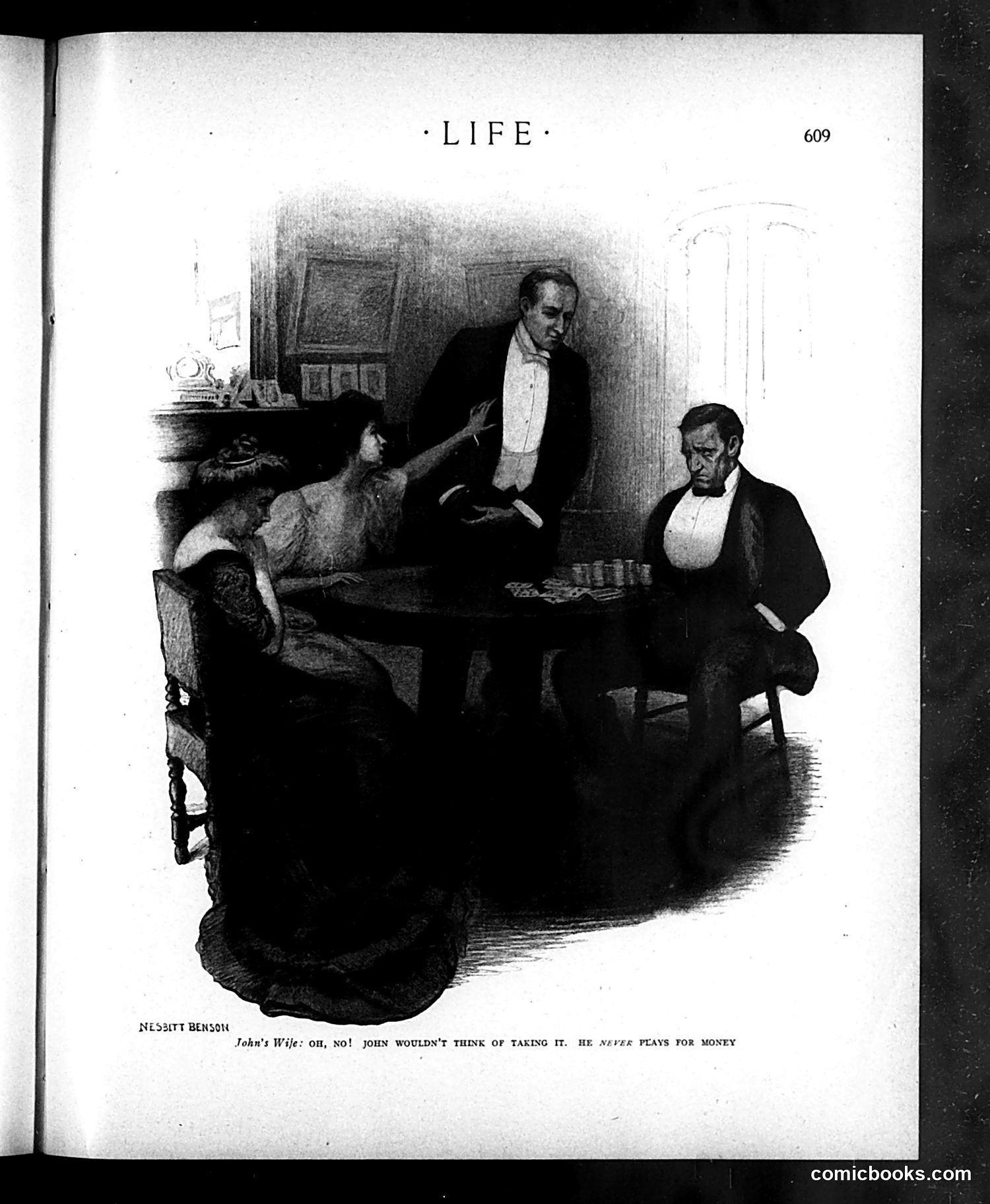
This is a satirical cartoon by Nesbitt Benson depicting a domestic scene where a woman (John's wife) protests that her husband "never plays for money." The cartoon shows three men in formal dress around a table—apparently engaged in card-playing or gambling. The wife's defensive statement appears ironic, given the scene's clear suggestion of gambling activity. The satire targets hypocrisy: the wife's claim that John doesn't gamble for money contradicts the visual evidence of the men at the gaming table. The joke likely mocks the gap between what spouses claim about their husbands' habits and reality—a common domestic tension point in early 20th-century satire. The cartoon reflects period anxieties about male gambling and the financial consequences for families.
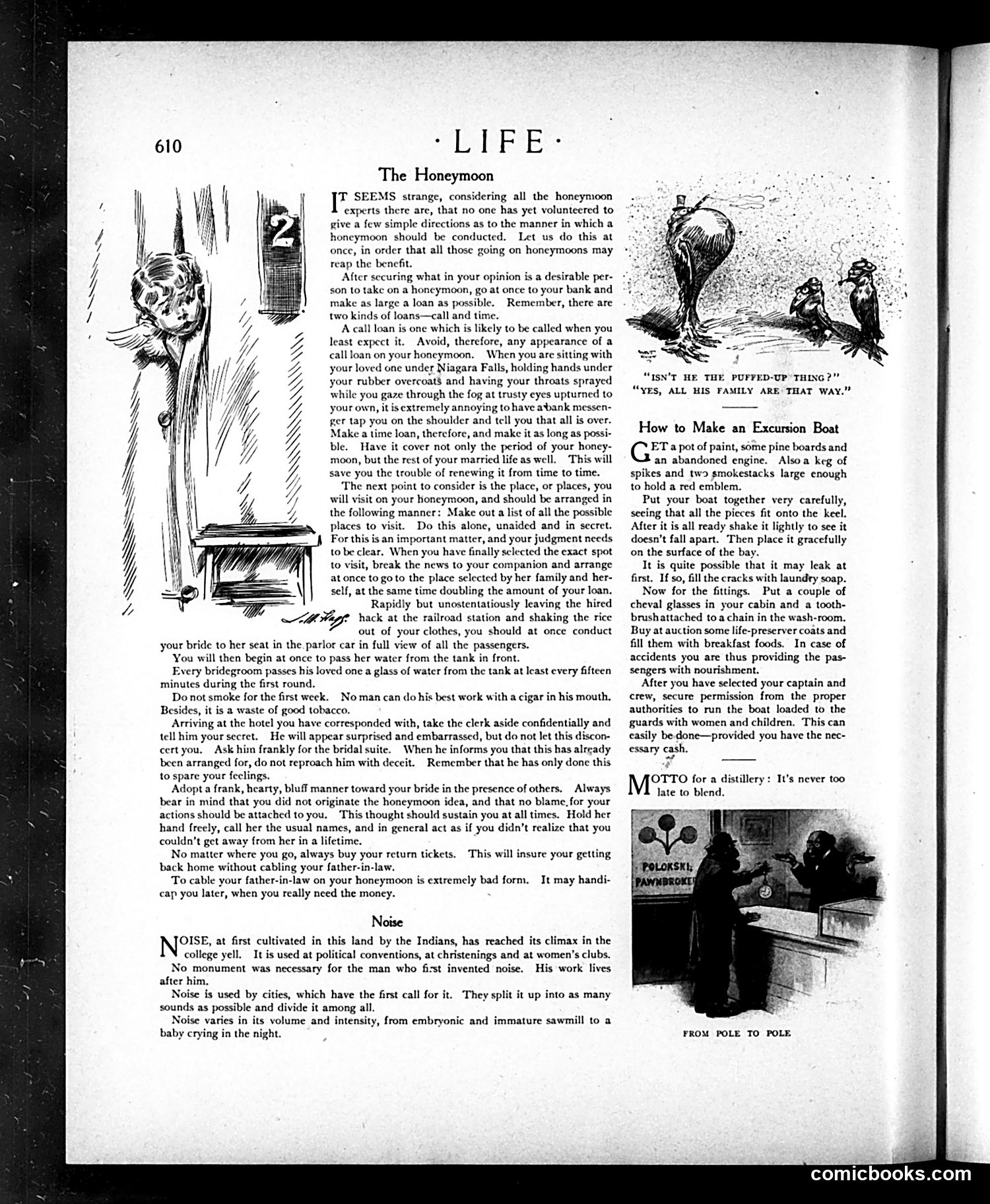
This is humorous advice satirizing honeymoon conventions of the era. The piece mocks newlyweds' expectations through mock-serious guidance: **The Satire:** - Newlyweds should take out maximum loans (not just for the honeymoon, but "the rest of your married life") - The groom should secretly plan destinations, then immediately abandon his choices for what the bride's family wants—while *doubling* the loan - At Niagara Falls, couples sit under rubber overcoats in fog, constantly passing water to each other - Grooms must pretend ignorance of honeymoon conventions to avoid blame for romantic expectations - Arriving at hotels, clerks have already arranged bridal suites without being asked, implying this is standard deception **The Point:** This satirizes the commercialization, financial burden, and performative nature of honeymoons—particularly how grooms lose all agency while pretending enthusiasm, and how the entire institution is designed to extract money from newlyweds while meeting others' expectations rather than the couple's desires.
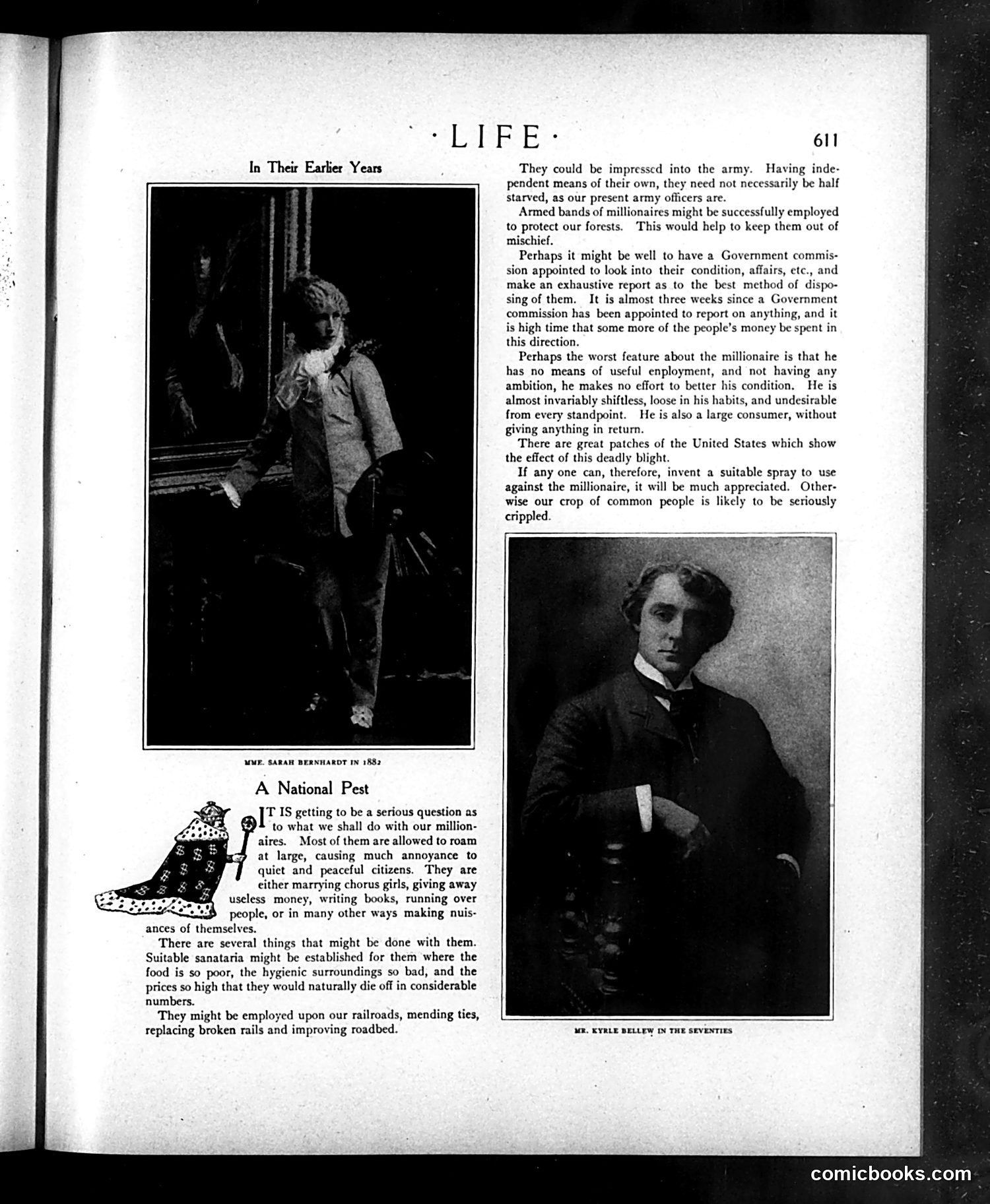
This is Gilded Age satire mocking wealthy industrialists. The article sarcastically proposes absurd "solutions" to the "millionaire problem": impressing them into military service, employing them as forest rangers, or establishing sanatoriums where poor conditions would naturally kill them off. The satire inverts typical 19th-century attitudes toward the poor. Rather than viewing poverty as a natural condition requiring intervention, it treats extreme wealth as a social disease. The author ridicules millionaires as idle, shiftless parasites who consume without producing—contrasting sharply with the hardworking "common people" supposedly being economically crushed by their existence. The piece references contemporary wealthy behavior: marrying showgirls, wasteful philanthropy, and reckless conduct ("running over people"—likely referring to carriage accidents). This reflects genuine Progressive Era criticism of unregulated capitalism and the visible excess of the robber baron class during the 1880s-90s.
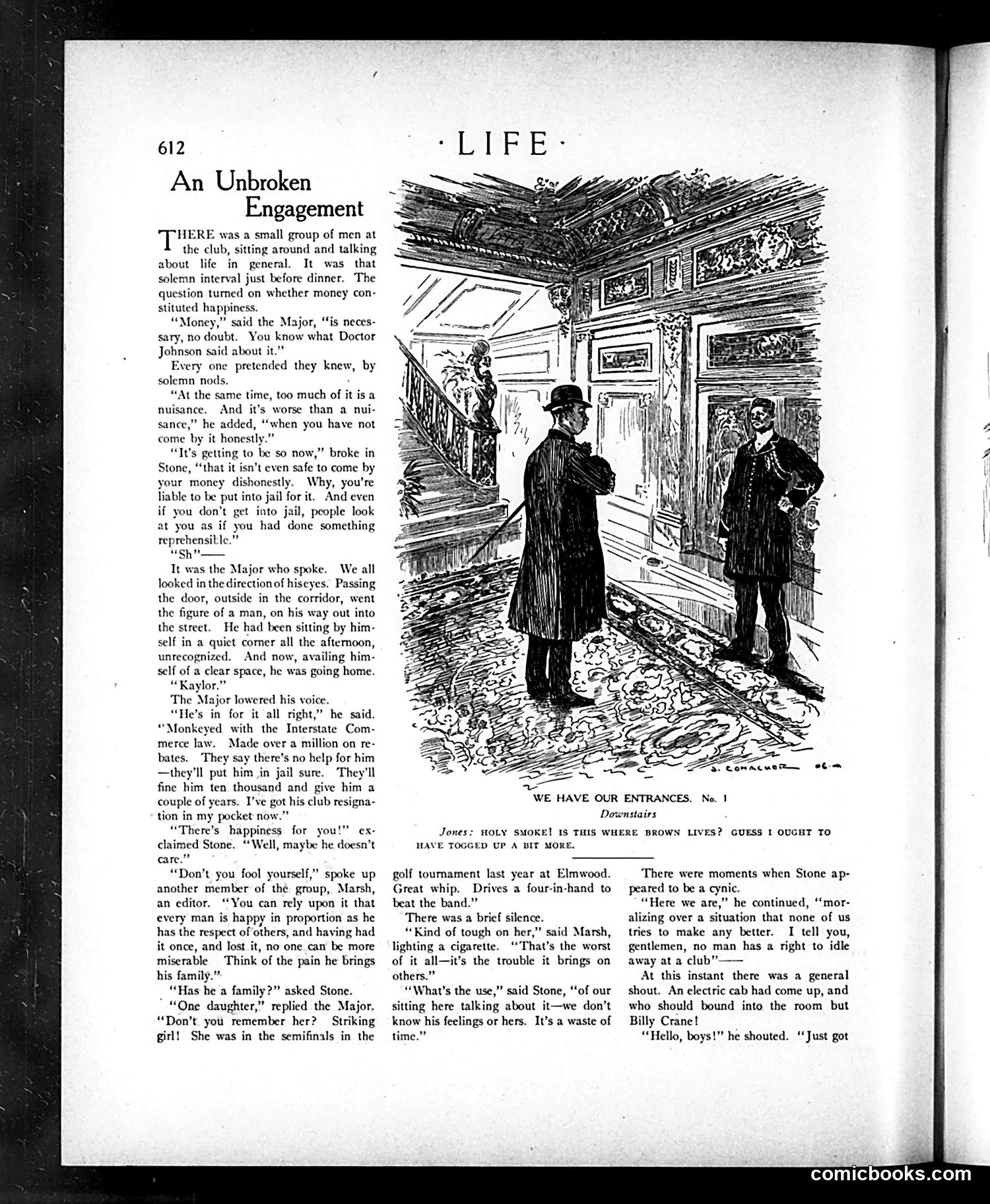
This is a satirical short story about hypocrisy among gentlemen at an exclusive club. The narrative establishes irony through contrasting attitudes: the men discuss whether wealth brings happiness and moralize about a disgraced member named Kaylor, who faces jail for violating the Interstate Commerce law through rebate fraud—a real scandal concern of the era. The satire peaks when Stone cynically observes that none of them actually *do* anything to help, only talk. The accompanying illustration shows men in an elegant hallway, underscoring their privileged detachment. The final interruption by Billy Crane's arrival suggests the story's title "An Unbroken Engagement"—likely implying that despite Kaylor's ruin and the men's moralizing, their social routines and club life continue uninterrupted, indifferent to consequences.
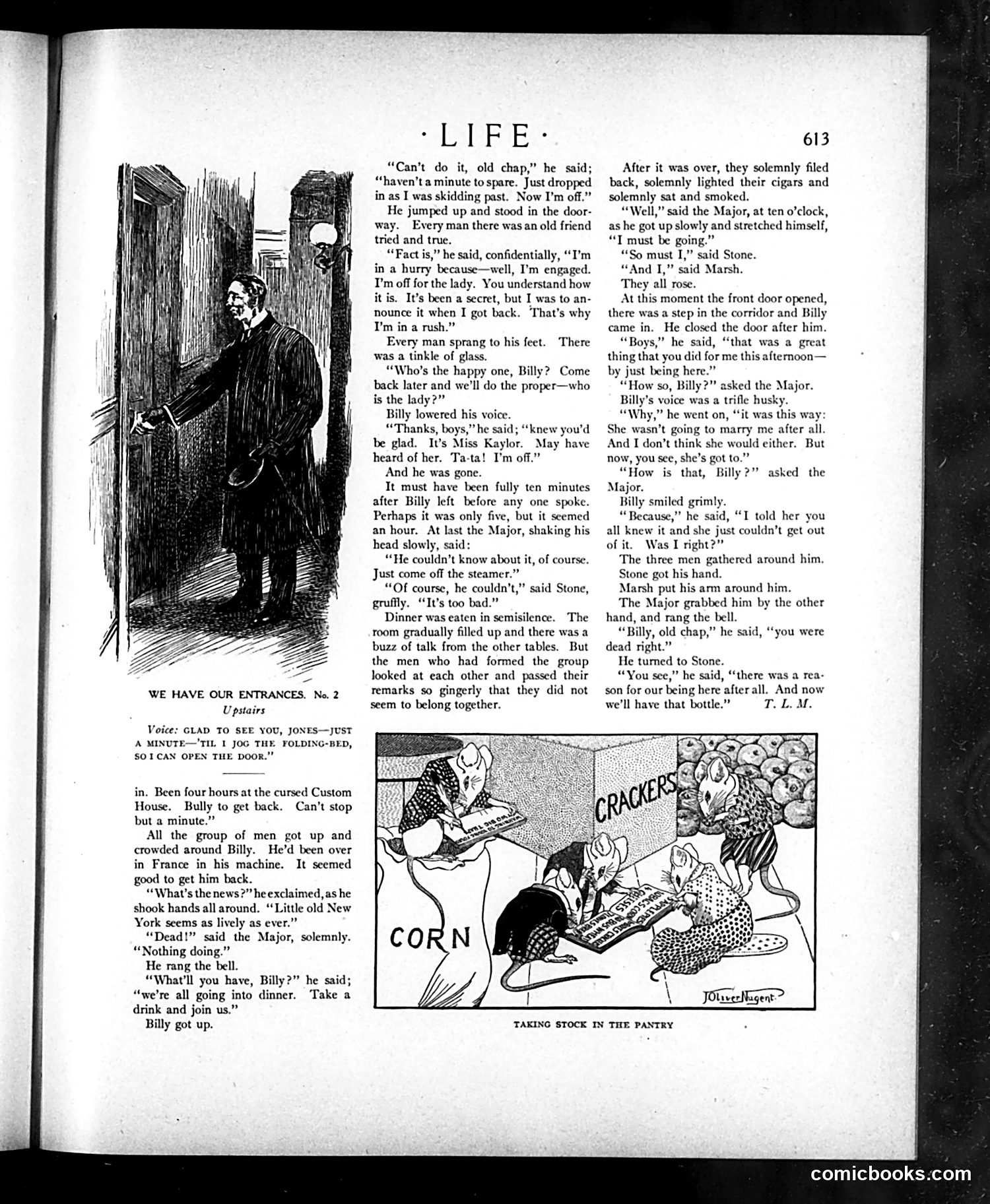
This page contains a WWI-era story about Billy, a soldier recently returned from France ("been over in France in his machine"). Billy briefly visits old friends at what appears to be a gentlemen's club, announcing he's engaged to Miss Kaylor but rushing off to see her. The twist reveals Billy's social strategy: he told his fiancée that his friends already knew about the engagement, making it impossible for her to refuse him. His friends—the Major, Stone, and Marsh—realize they've inadvertently helped him by simply being present and welcoming him home. Their solidarity as "tried and true" friends provided the social credibility Billy needed. The bottom cartoon, "Taking Stock in the Pantry," appears to be unrelated domestic humor about household inventory or kitchen management, featuring a rat or mouse among groceries. The story's satire targets masculine social maneuvering and the power of peer approval in courtship during this period—using his friends' acceptance as leverage for romantic persuasion.
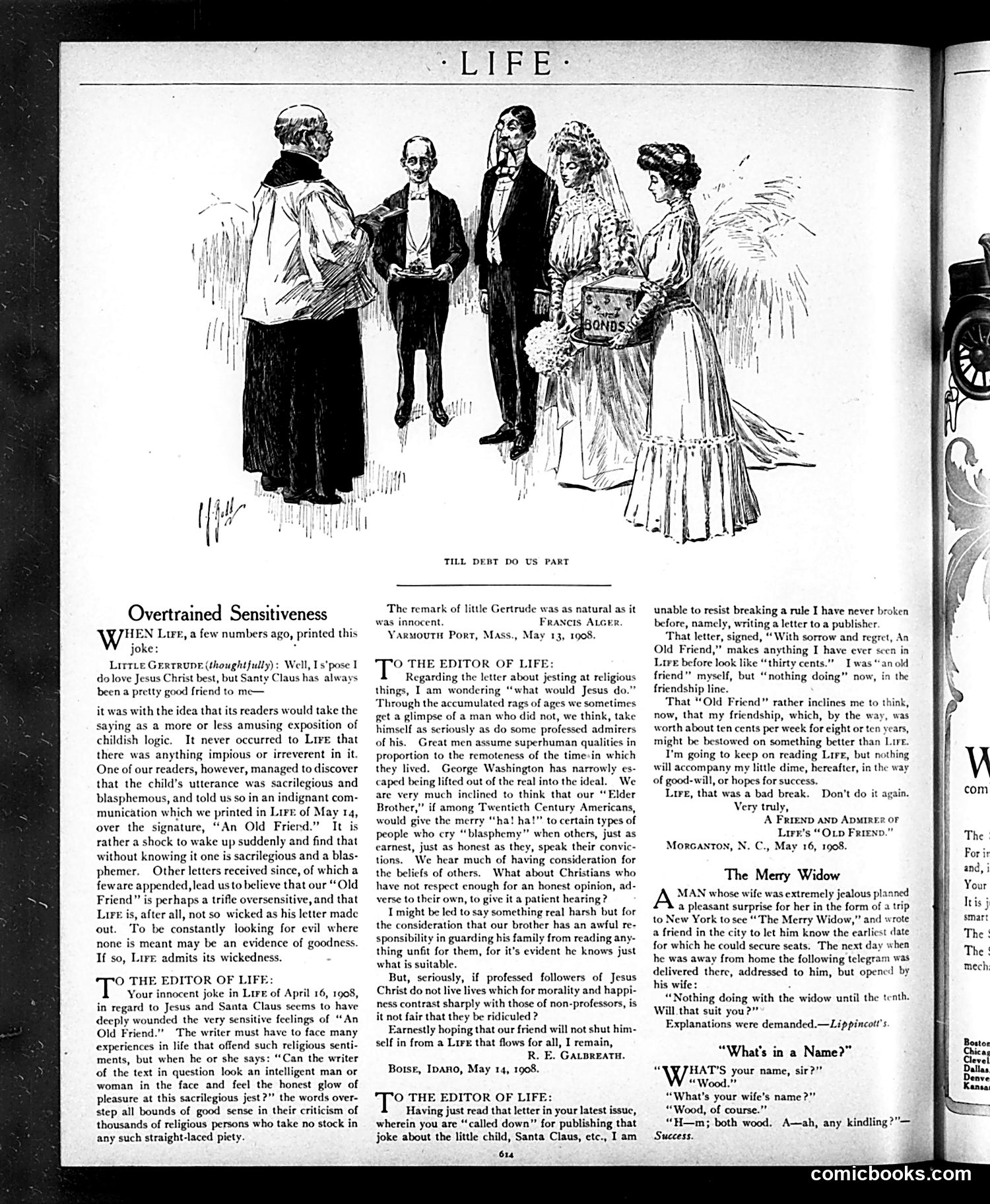
The cartoon depicts a wedding ceremony with six figures: a clergy member, groom, bride (in veil holding flowers), and two female attendants. A money box labeled "BONDS" is prominently displayed. **The Satire:** This is social commentary on marriages motivated by financial interest rather than love. The title "Till Debt Do Us Part" plays on traditional wedding vows, suggesting the union is a transaction—specifically involving financial "bonds." The conspicuous placement of the bonds box indicates the bride (or her family) brings wealth as her primary asset to the marriage. **Context:** This reflects early 20th-century concerns about wealthy heiresses being married off for money and status. The satire targets both the mercenary nature of such unions and, implicitly, the superficiality of high society where financial considerations overshadow genuine emotional connection. The accompanying letters debate whether Life magazine's humor about religion is offensive—unrelated to this cartoon's satirical critique of wealth-based matrimony.
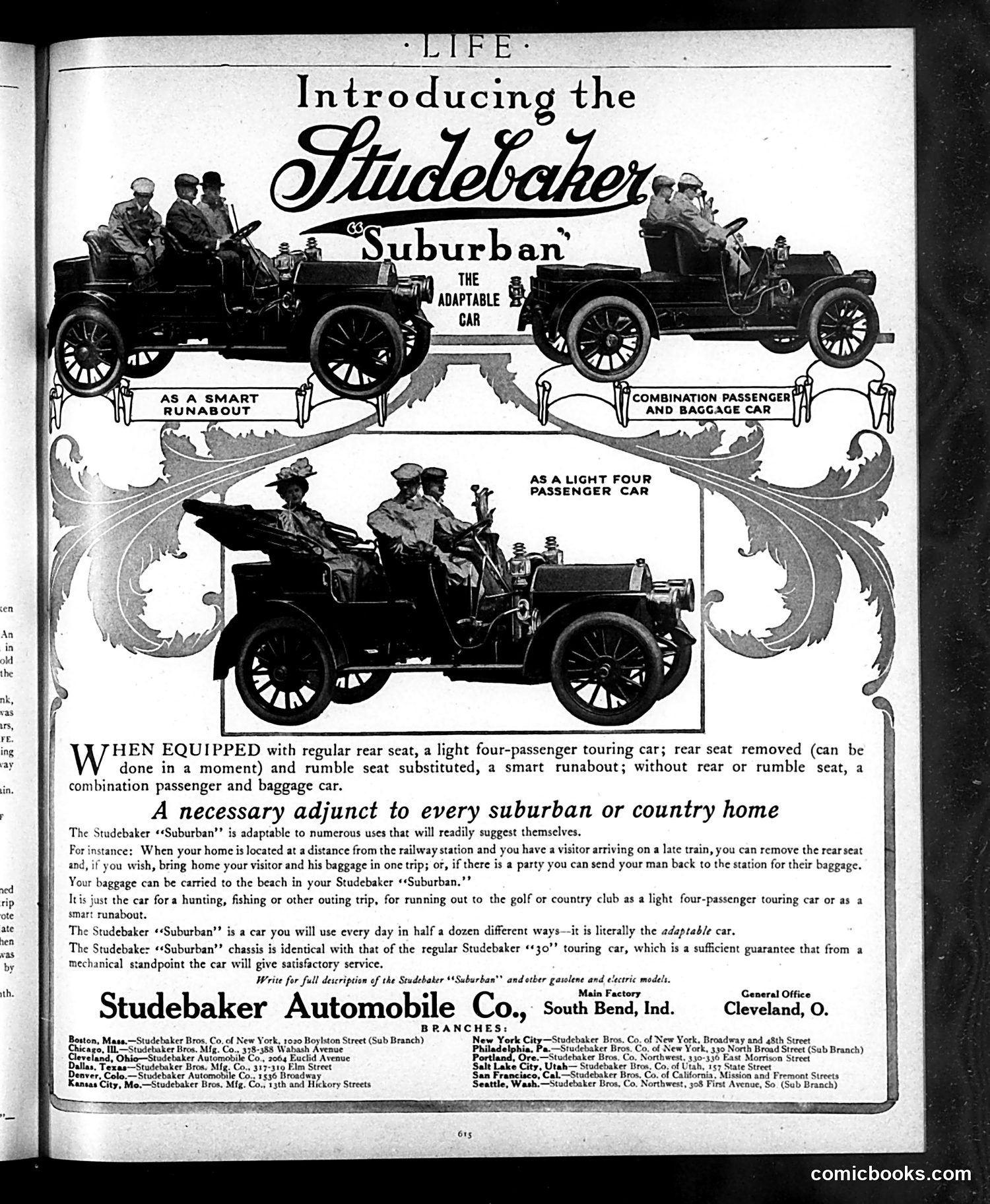
This is a **product advertisement**, not satire or political commentary. It promotes the Studebaker "Suburban" automobile by emphasizing its versatility—marketed as "the adaptable car." The ad showcases the vehicle's convertibility: with a regular rear seat it's a four-passenger touring car; remove the seat and add a rumble seat for a "smart runabout"; remove both for a cargo vehicle. The pitch targets affluent suburban and country-home owners, emphasizing practical uses: fetching train-arriving guests and their baggage, transporting party attendees, hauling beach gear, and serving as a golf-club or hunting-trip vehicle. The visual demonstrates these three configurations with illustrations of well-dressed passengers in different scenarios. This reflects early-20th-century automotive marketing, where automobiles were still luxury items promoted to the wealthy as essential for suburban living. The "adaptable" concept was genuinely novel—cars that could transform for different purposes.
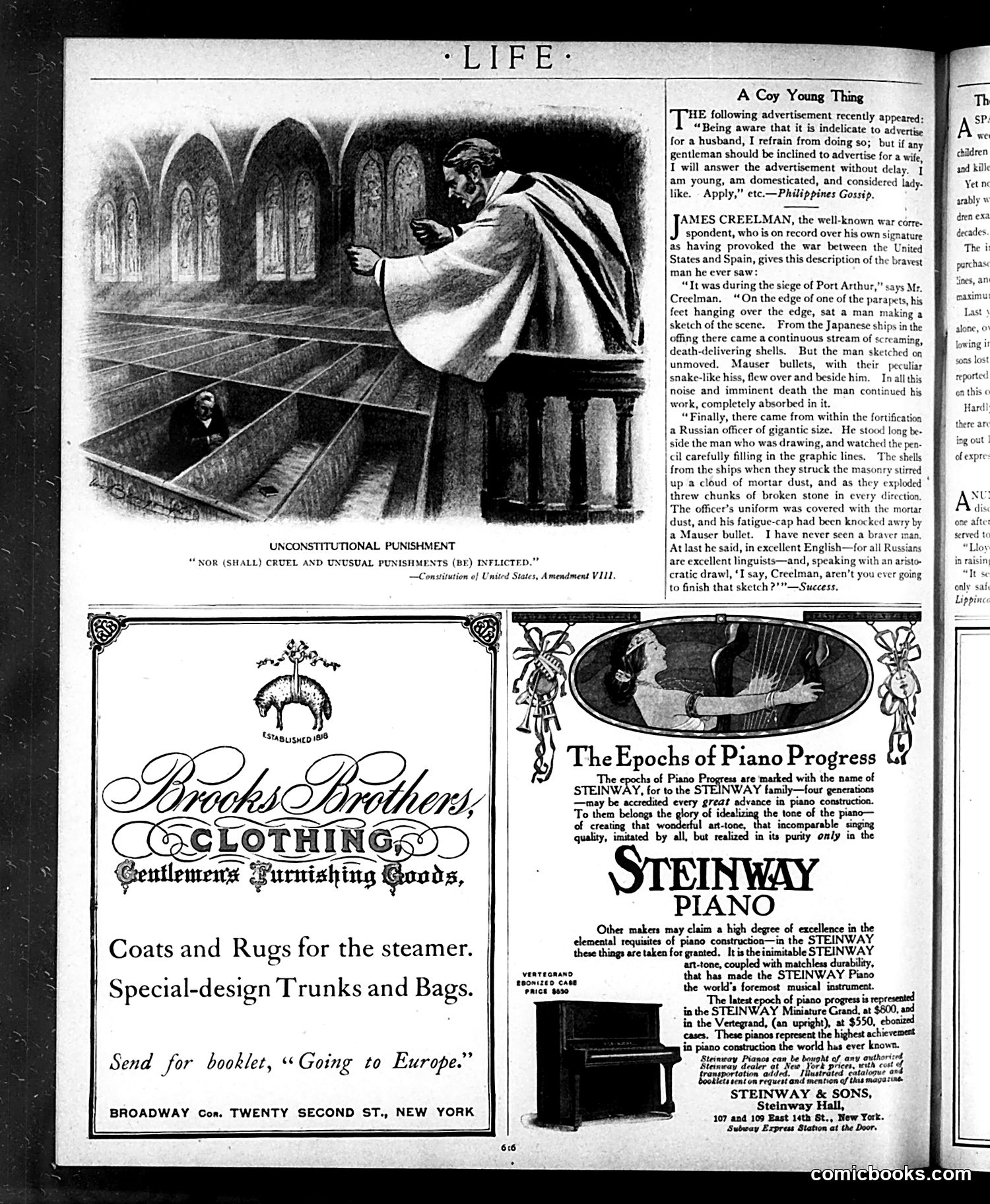
The main cartoon satirizes the U.S. Constitution's Eighth Amendment protection against "cruel and unusual punishments." It depicts a man leaning from a high window, reading what appears to be a letter or document—likely a marriage proposal response (referenced in "A Coy Young Thing" article beside it). The joke: receiving an enthusiastic response to a marriage advertisement is presented as cruel and unusual punishment, humorously suggesting that marriage itself constitutes unconstitutional torture. The accompanying text about war correspondent James Creelman recounts an anecdote from the Russo-Japanese War's siege of Port Arthur, praising an artist who sketched enemy positions under heavy fire. A Russian officer finally interrupts him sarcastically, asking when he'll finish—the "brave man" being the one calmly drawing amid artillery shells. The page is primarily advertisements (Brooks Brothers, Steinway Piano) with satirical editorial content typical of *Life* magazine's humor.
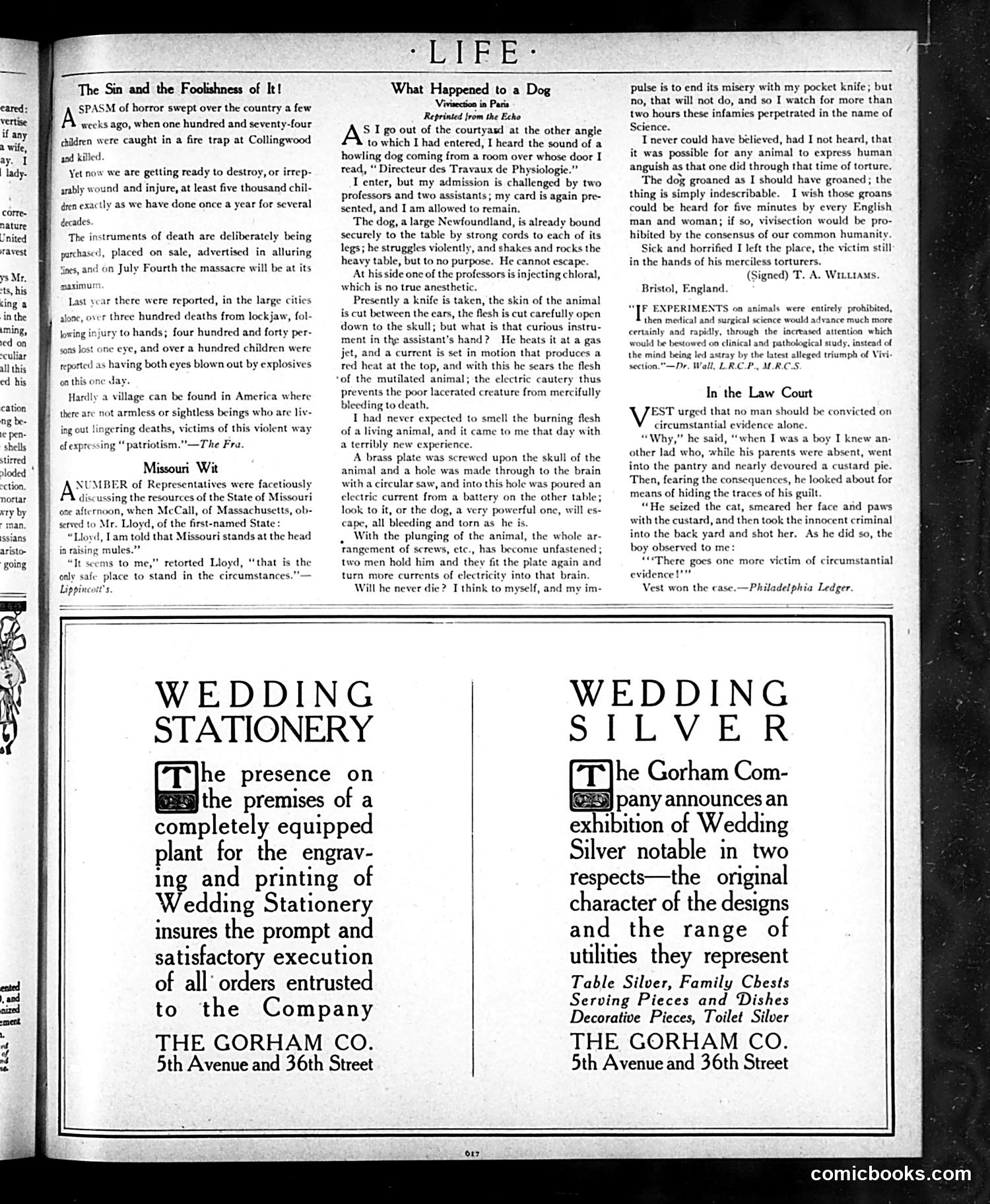
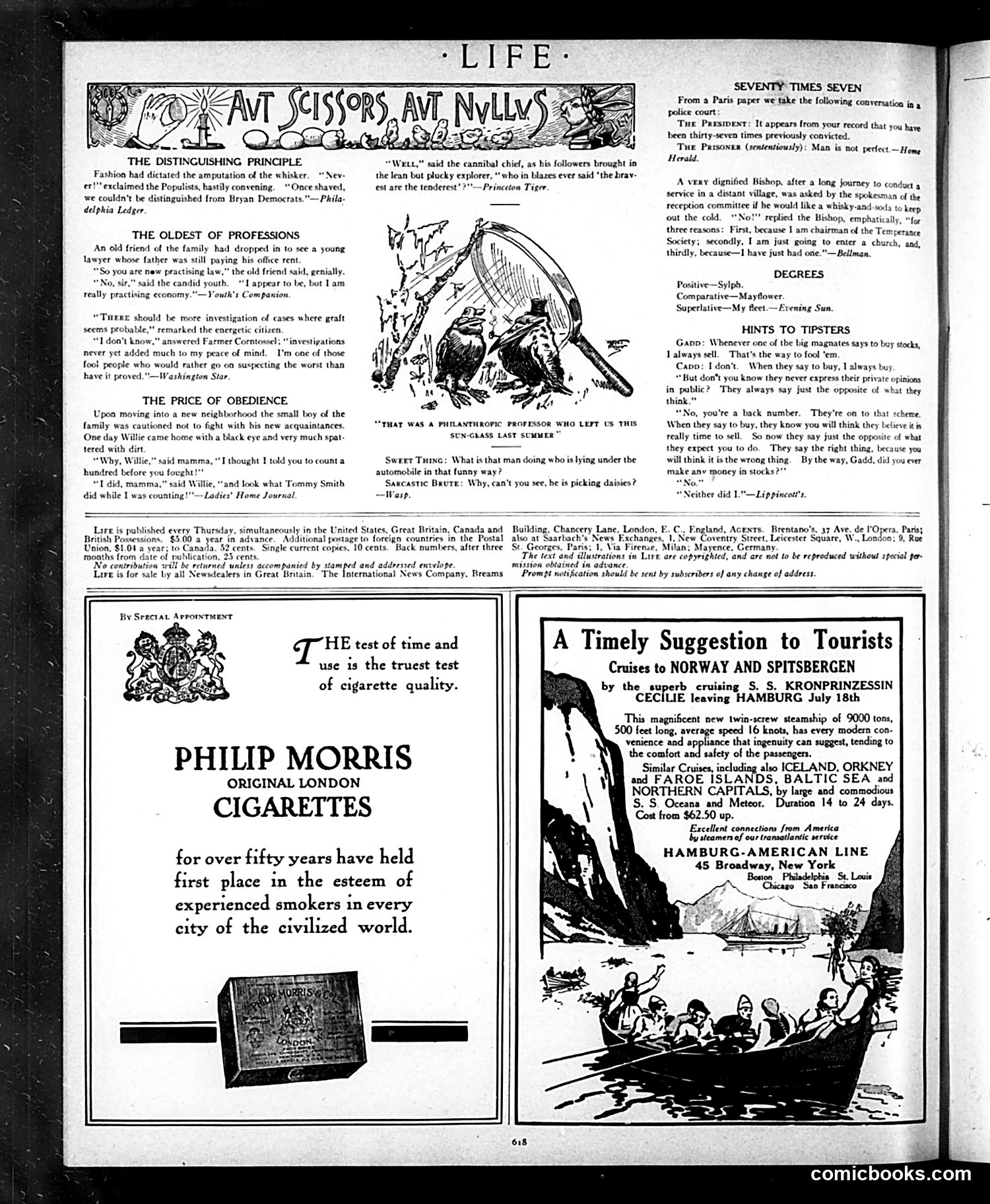
This is a humor page from *Life* magazine featuring several short satirical pieces and jokes typical of early 20th-century American wit. **Key content:** - **"The Distinguishing Principle"**: Mocks Populists (William Jennings Bryan supporters) for their distinctive whiskers as a political identifier—they feared shaving would make them indistinguishable from Democrats. - **"The Oldest of Professions"**: A young lawyer admits he's "practicing economy" rather than law—satirizing struggling young professionals. - **"Seventy Times Seven"**: A prisoner with 37 prior convictions philosophically notes "Man is not perfect," mocking judicial leniency or repeat offenders. - **"Hints to Tipsters"**: Financial satire about stock-market advice—depicting the absurd logic of second-guessing wealthy investors' recommendations. The page also includes period advertisements for Philip Morris cigarettes and Hamburg-American cruise lines. The humor reflects concerns about political identity, professional struggle, crime, and financial manipulation—themes resonating across decades.
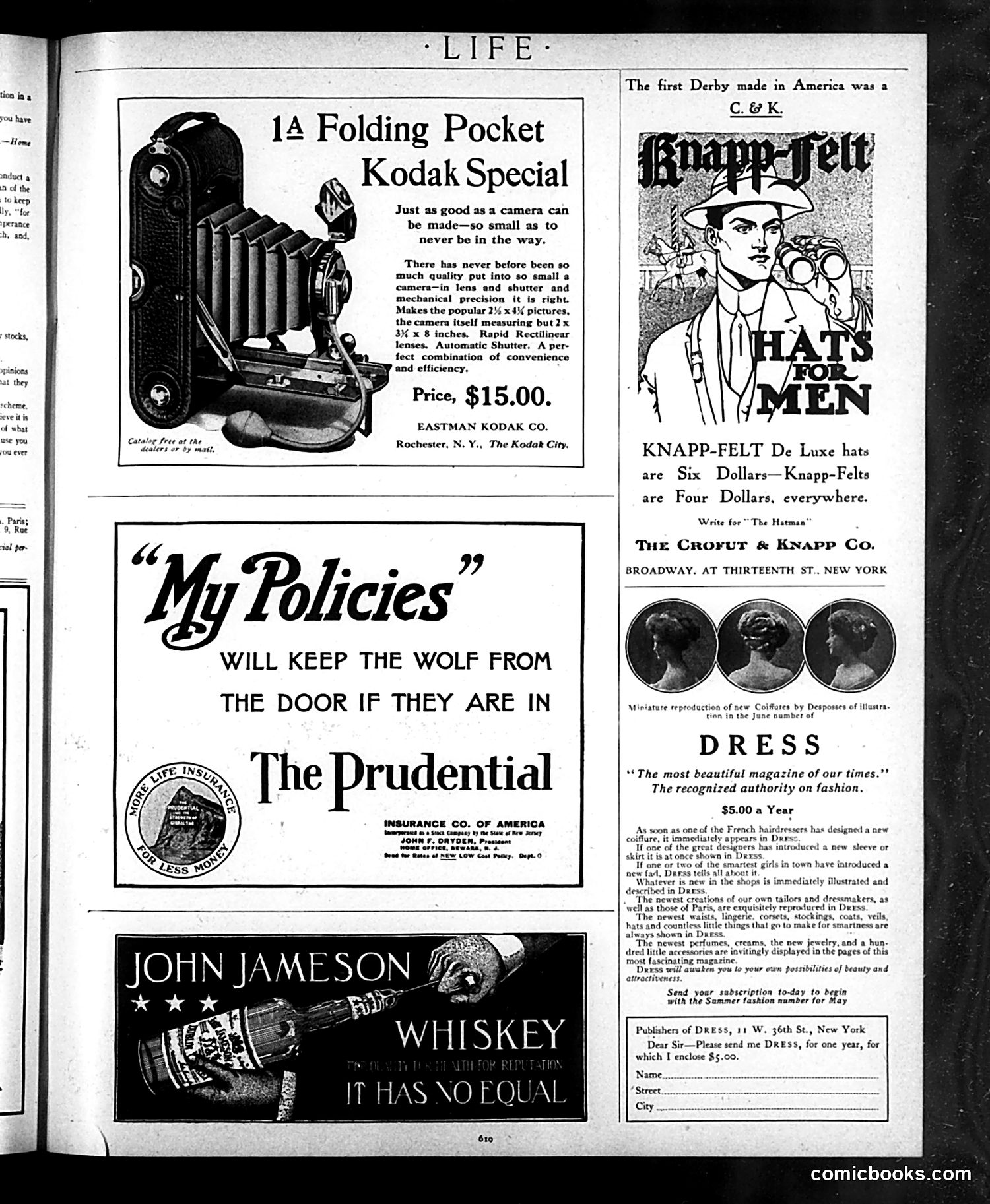
This page consists primarily of **advertisements**, not editorial cartoons or satire. The ads showcase early 20th-century consumer products: 1. **Kodak Special Camera** ($15) — promotes a compact folding pocket camera, emphasizing portability and quality. 2. **Knapp-Felt Hats** — advertises men's hats at various price points, featuring the "Hatman" branding. 3. **The Prudential Insurance** — uses the slogan "My Policies will keep the wolf from the door," a common metaphor for financial security against hardship. 4. **John Jameson Whiskey** — promotes Irish whiskey with the claim "It has no equal." 5. **Dress Magazine** — subscription ad for a fashion publication, emphasizing it covers the latest designs from Paris and American designers. The page reflects **consumer culture and lifestyle advertising** of the era, targeting middle and upper-class readers. The Prudential ad is the closest to containing messaging (financial security), but this remains advertisement rather than satire or political commentary.
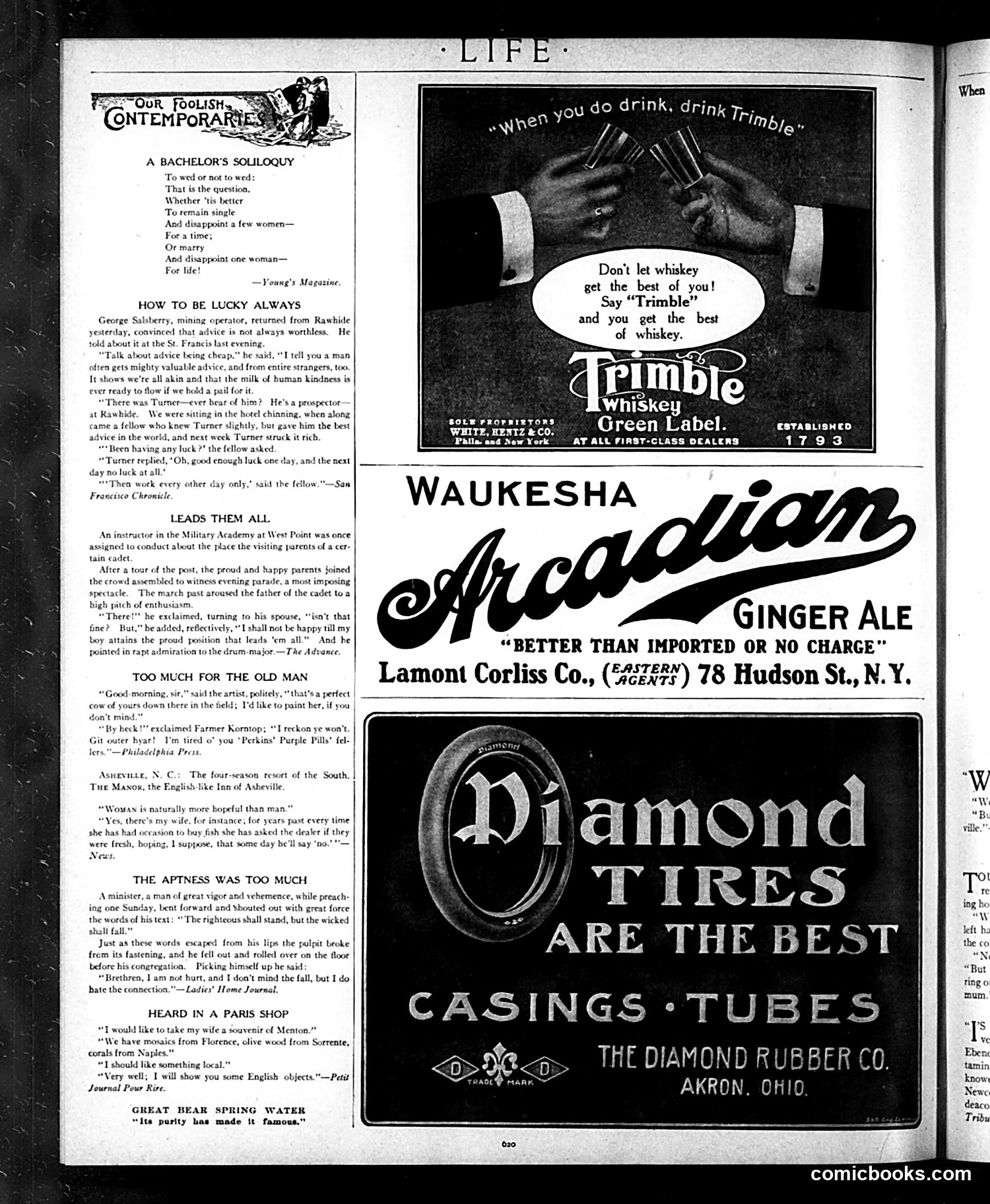
This page from *Life* magazine contains several short humorous anecdotes under "Our Foolish Contemporaries," a regular satirical feature mocking human folly. The jokes target predictable social behaviors: **"A Bachelor's Soliloquy"** plays on Shakespeare, presenting marriage as disappointing either way—a bachelor disappoints multiple women temporarily, a husband disappoints one woman permanently. **"How to Be Lucky Always"** and **"Leads Them All"** mock people who offer unsolicited advice or make foolish assumptions about success and status. **"The Aptness Was Too Much"** uses ironic physical comedy: a preacher shouting "the wicked shall fall" literally falls through the pulpit. **"Heard in a Paris Shop"** satirizes English tourists abroad, suggesting English goods are the only "local" souvenirs worth buying in continental Europe. The surrounding advertisements (Trimble Whiskey, Waukesha Ginger Ale, Diamond Tires) are period products. The page represents turn-of-the-century American satire targeting genteel society's pretensions and human nature's predictable flaws.
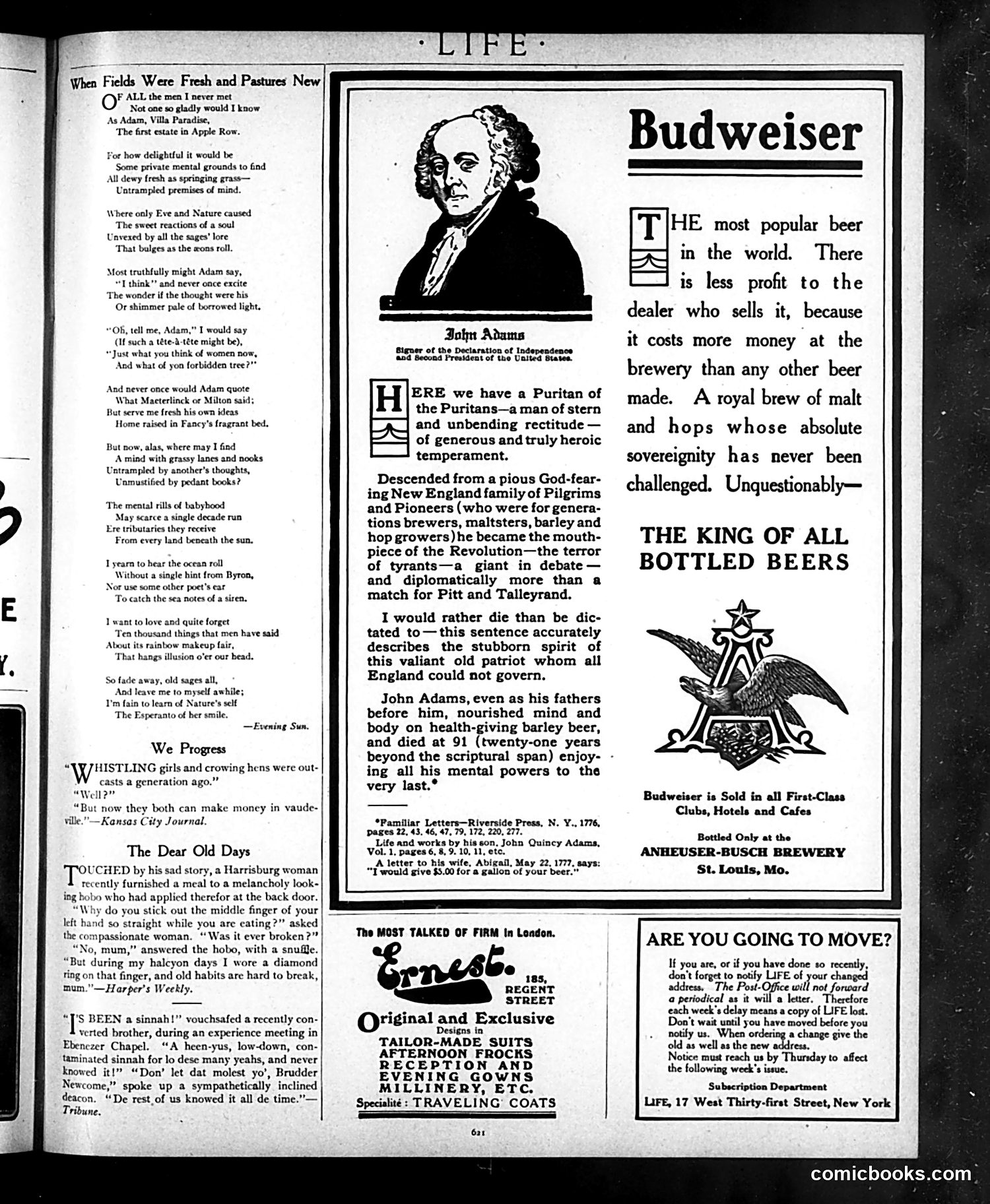
This page contains satirical poetry and biographical content rather than political cartoons. The main feature is a biographical portrait of **John Adams**, the second U.S. President and Founding Father. The accompanying text celebrates Adams as a "Puritan of the Puritans"—emphasizing his stern rectitude and revolutionary spirit against tyranny. Notably, the biography stresses that Adams came from a **brewing family** (brewers, maltsters, barley and hop growers) and credits "health-giving barley beer" with sustaining his mind and body into his 91st year. This detail appears designed to endorse beer consumption as beneficial to health and longevity. The page also includes lighter satirical items: a poem lamenting modern minds "untrampled by pedant books," a brief joke about women entering vaudeville, and an anecdote about a nostalgic hobo. These are typical of Life's humorous filler content. The **Budweiser advertisement** dominates the right column, strategically positioned alongside Adams content to associate the product with American patriotic heritage and respectability.
This page is primarily **advertising and light humor**, not political satire. The main content includes: **Advertisements:** - Coupon Bond paper (emphasizing quality business stationery) - Underberg Bitters (a digestive liqueur) - Corliss-Coon Collars (men's neckwear) - Great Western Champagne (claiming a Paris gold medal) - Rad-Bridge cigars **Humor sections:** - A joke about Senator Sorghum showing reluctance when called to public service—satirizing political hypocrisy about duty - A classroom grammar joke playing on "court" as a verb - An Irish-American "socialism" joke where Pat describes redistributing wealth but refuses to share his pigs—mocking socialist rhetoric as hypocritical - Simple definition jokes about "rule of three" and proper behavior The page reflects early 20th-century American commercial culture and gentle social humor rather than sharp political critique. The socialism joke likely reflects period anxiety about radical ideologies, though it's presented as simple ethnic humor.
This page from *Life* magazine is primarily **advertising and humorous anecdotes** rather than political satire. The content includes several short comic stories mocking social pretension and miscommunication: Lady Duff-Gordon describes appearing ignorant in Chinatown; a Yorkshireman misunderstands a British Museum closure, mistakenly thinking a mummy "died"; a scout cryptically attributes Indian unrest to "the Indians." Other brief jokes target pomposity—a superintendent's long speech is cut short by a child's lisped "Thay amen and thit down"—and editorial incompetence. The page is dominated by **period advertisements**: wine (A. De Luze & Fils clarets), the Autopiano (a player piano marketed as accessible to all), and Winchester rifles/ammunition. These ads reflect early 20th-century consumer goods and leisure interests. The satire is mild, genteel humor typical of *Life*'s gentlemen's magazine tone, not sharp political commentary.
This page is primarily **advertisements** interspersed with short satirical pieces typical of Life magazine's format. **Main Advertisements:** - **Hunter Baltimore Rye** whiskey promotes itself as a "stimulant" for those needing "cheer, comfort or strength"—reflecting pre-Prohibition era marketing - **Iver Johnson Safety Revolver** emphasizes its firing mechanism safety feature - **Mobiloil** and **Haskell-Whiz golf ball** ads **Satirical Content:** The brief story "Always Good" presents a Fool and Sage debating whether a beautiful woman is inherently "wicked." The Sage's paradoxical answer suggests outer beauty doesn't determine moral character—a gentle philosophical joke. "Harben's Run from His Life" satirizes the chain-reaction of busy people declining requests: a lady asks author Harben for his life story; he redirects her to a governor; the governor to a mayor; the mayor to a friend—mocking how important people dodge obligations through circular referrals. **Historical Note:** The whiskey ad is notable as this predates Prohibition (1920-1933), when alcohol advertising was still standard in mainstream publications.
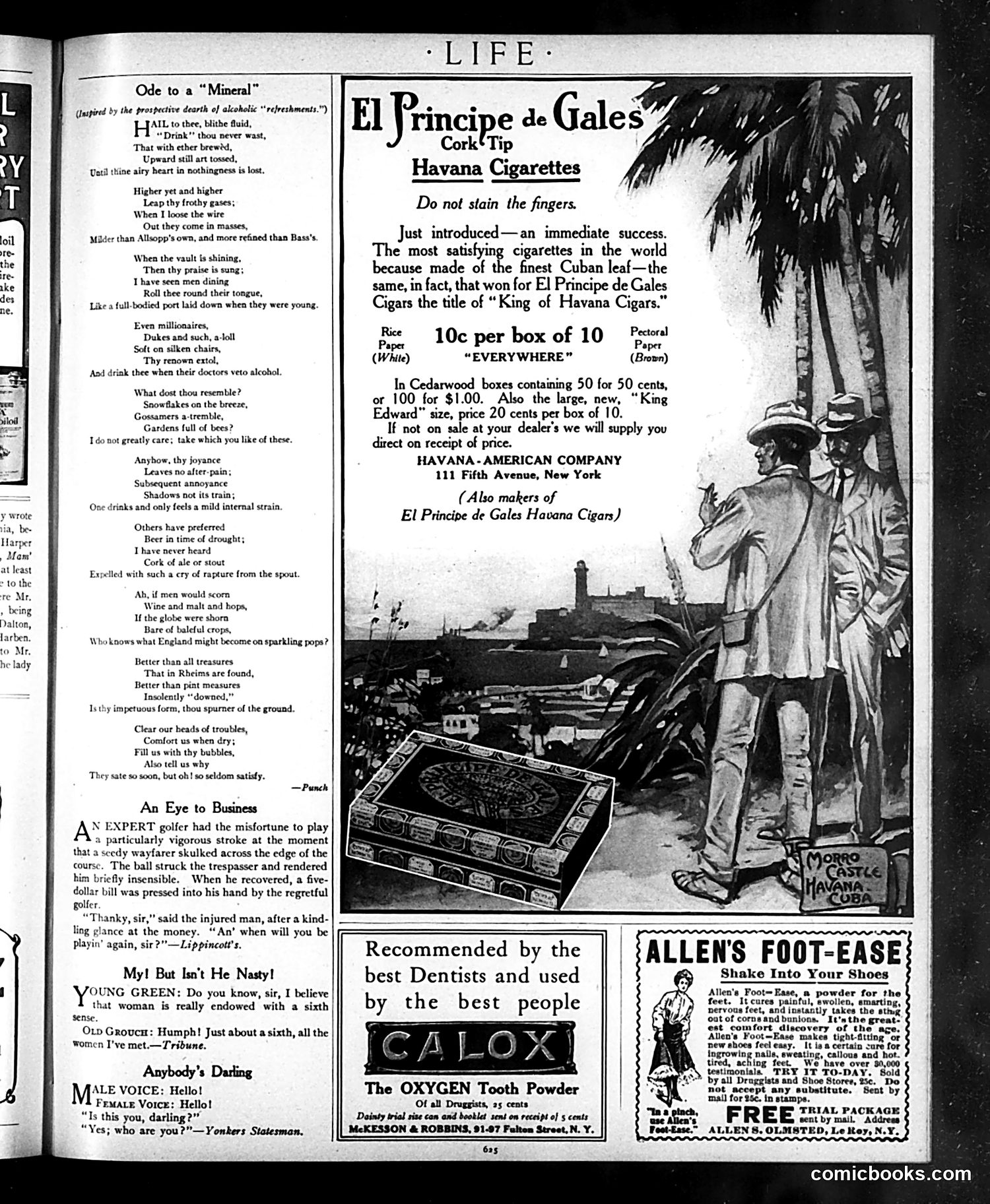
This Life magazine page combines satirical poetry and humor pieces with period advertisements. **"Ode to a 'Mineral'"** is a mock-heroic poem celebrating carbonated beverages—likely soda water or seltzer—as alcohol substitutes. The title's quotation marks suggest irony about calling fizzy drinks "mineral water." The poem laments potential alcohol prohibition (referenced as "prospective dearth of alcoholic refreshments"), praising carbonated drinks as compensation. It's political satire about impending Prohibition, mocking the notion that sparkling beverages could replace alcoholic ones. **"An Eye to Business"** is a brief humorous anecdote about a golfer who hits a vagrant with a golf ball, compensates him with $5, and the man's immediate response is asking when the golfer will play again—implying he hopes for another profitable "accident." The remaining pieces are light comedy sketches about social miscommunication. The advertisements (cigarettes, tooth powder, foot powder) are period-appropriate products typical of early 20th-century Life magazine.
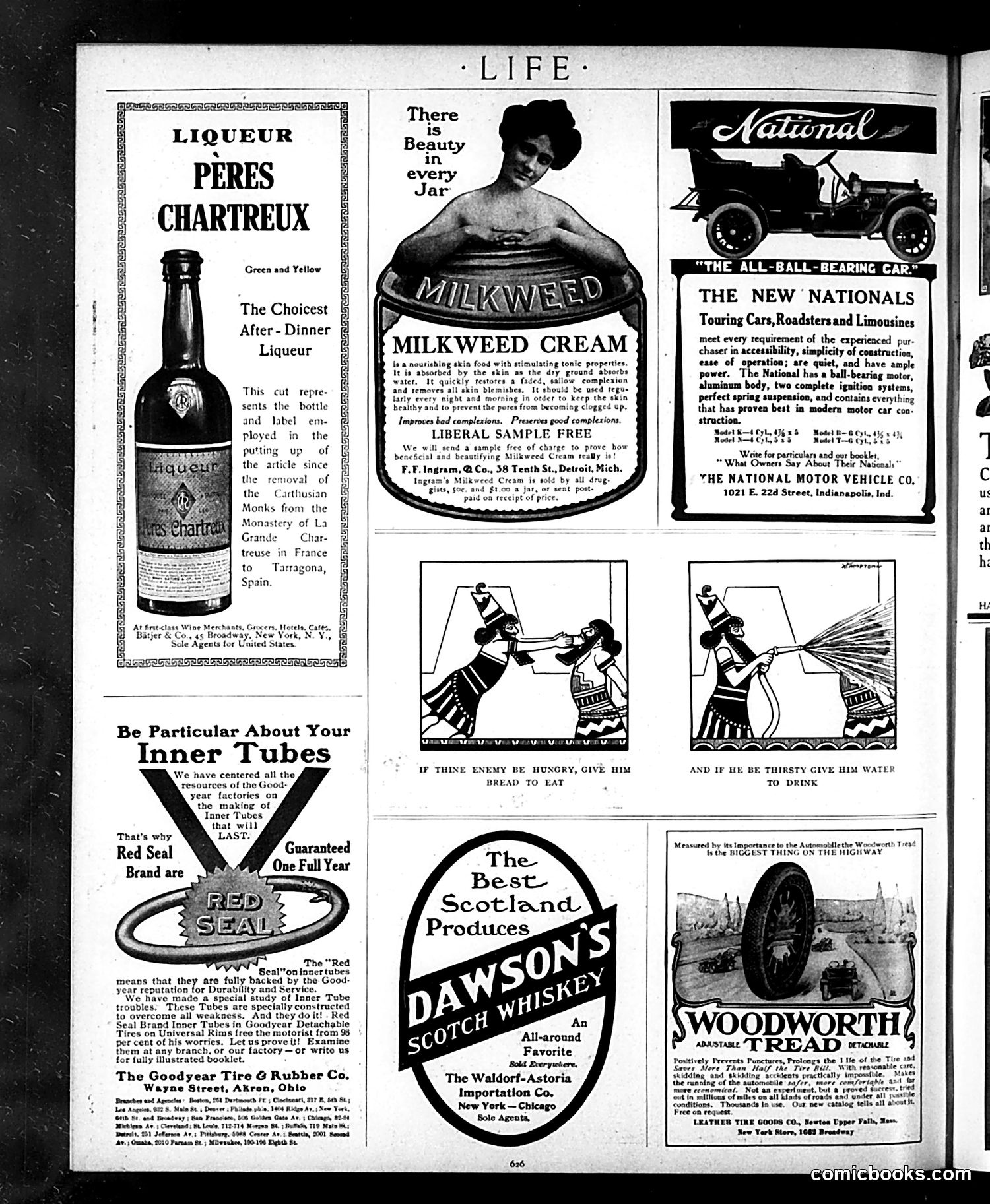
This page is primarily **advertisements**, not political satire. It showcases early 20th-century consumer products typical of *Life* magazine's commercial content. The two cartoon panels (center) depict biblical allegory: "If thine enemy be hungry, give him bread to eat / And if he be thirsty give him water to drink." These appear to be generic moral illustrations rather than specific political commentary—likely promoting virtue or peacetime values, though the exact context is unclear without surrounding editorial material. The advertisements reflect period concerns: **Milkweed Cream** promises to cure "sallow complexion" and skin blemishes (reflecting era's beauty anxieties); **automobile ads** (National, Woodworth tread) emphasize durability and reliability; **Goodyear inner tubes** address common motorist frustrations; **liqueur and whiskey ads** are prominent (pre-Prohibition era). The page reveals early 1900s consumer culture priorities: automobiles, cosmetics, alcohol, and rubber goods—with little apparent political messaging.
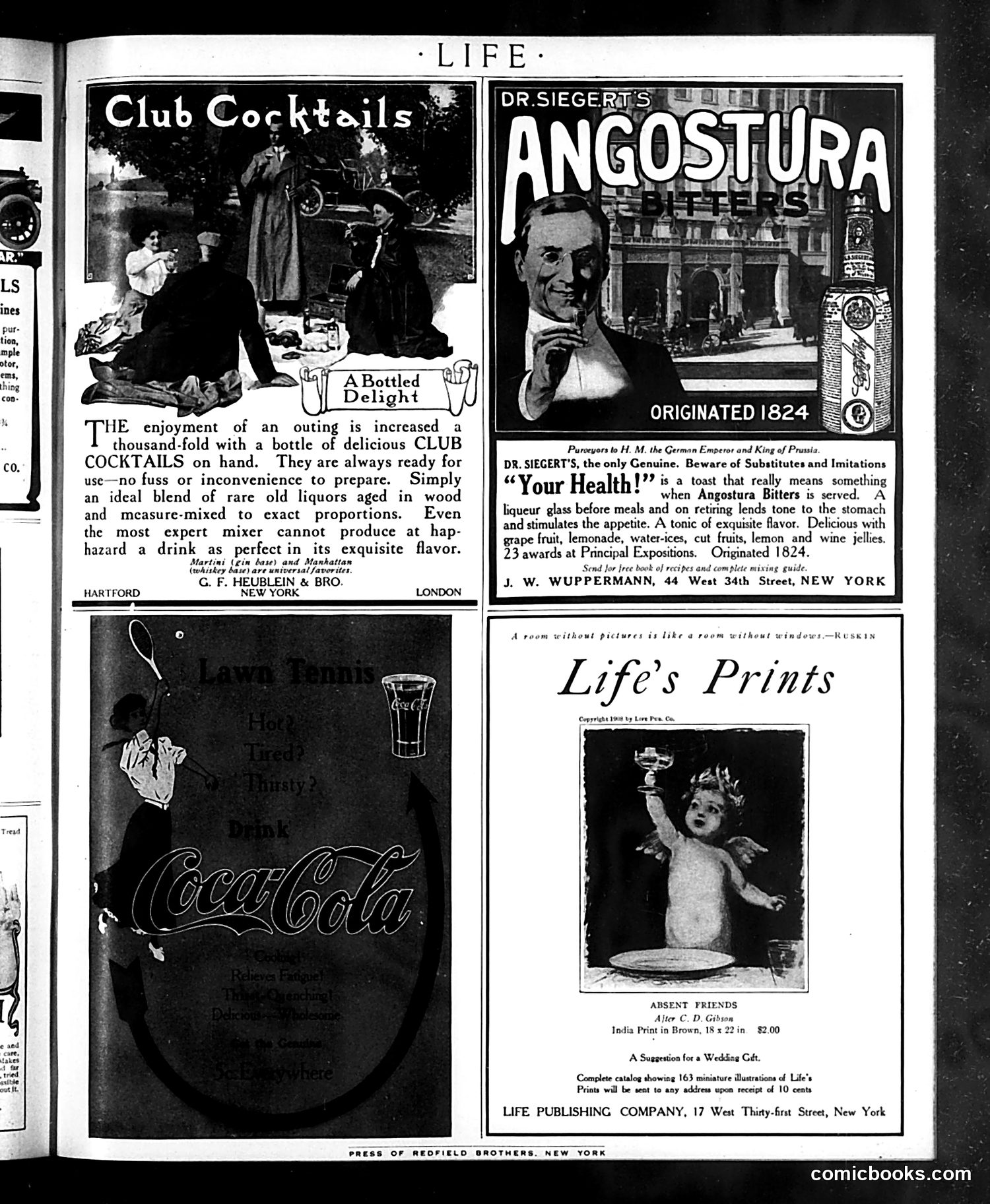
This page is primarily **advertising**, not satirical content. It contains four commercial advertisements from the early 20th century: 1. **Club Cocktails** (top left): Promotes pre-mixed bottled cocktails as convenient for outings, marketed by Heublein & Bro. 2. **Angostura Bitters** (top right): Advertises a digestive tonic/"health" product with aristocratic credentials (noting patronage by German Emperor), positioned as a medicinal bitters for stomach health and appetite stimulation. 3. **Coca-Cola** (bottom left): A thirst-quenching beverage ad using period imagery. 4. **Life's Prints** (bottom right): An art print service offering reproduction illustrations, including the featured "Absent Friends" print by Alice C.D. Gibson. The page reflects early-1900s marketing strategies emphasizing convenience, health benefits, and cultural sophistication. The Angostura and Club Cocktails ads appear particularly relevant to the **Prohibition era's approach**, where medicinal/tonic positioning helped market alcohol-containing products.
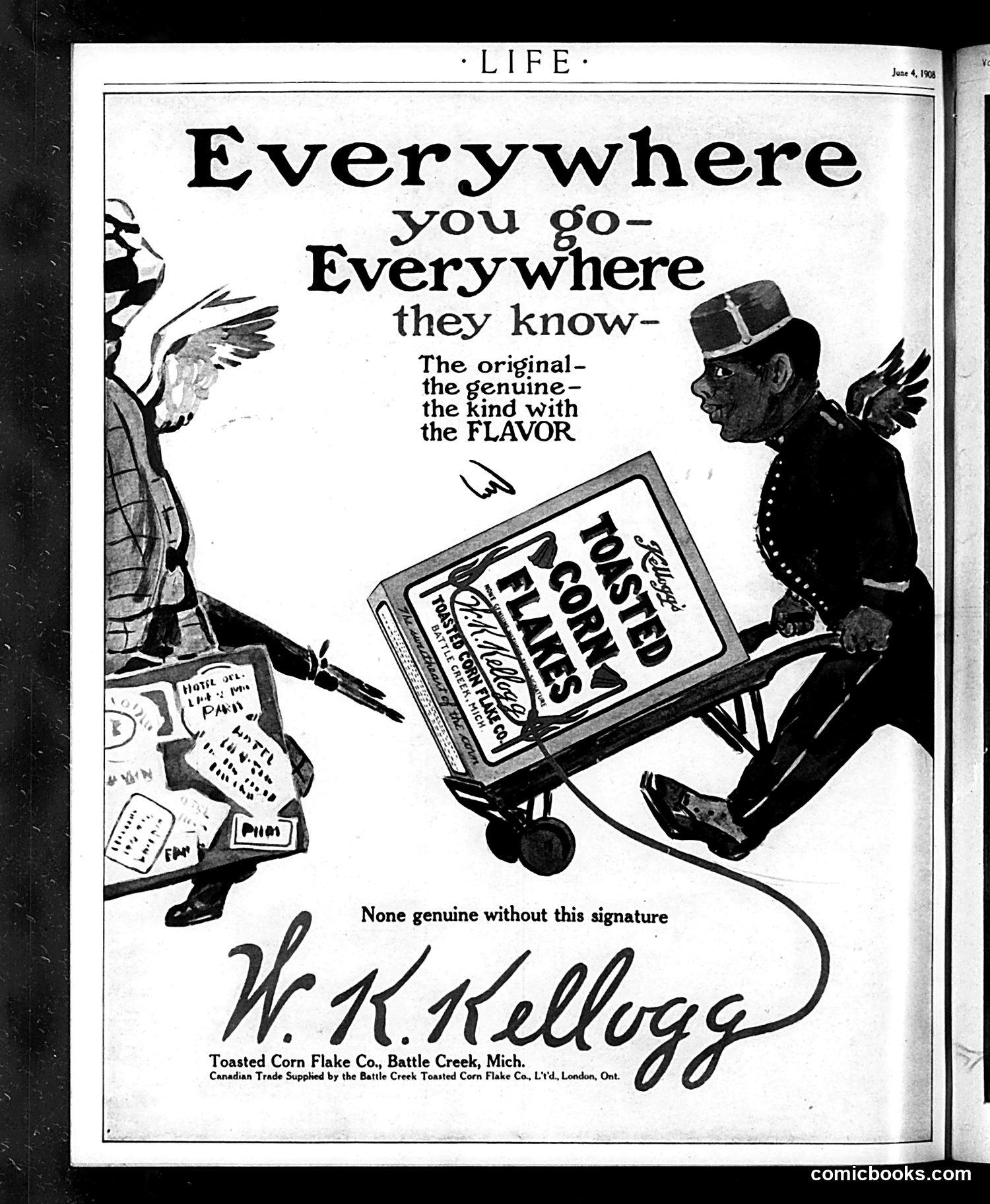
This is a **product advertisement**, not political satire. It promotes Kellogg's Toasted Corn Flakes as a globally recognized brand. The imagery depicts two figures (appearing to represent people from different cultures or regions, rendered in a style typical of early-20th-century advertising) encountering the product. The message emphasizes that Kellogg's Corn Flakes are so widely known and distributed worldwide that they're recognized "everywhere you go." The signature of W.K. Kellogg (founder of the Toasted Corn Flake Co.) authenticates the product. This reflects the era's marketing of American mass-produced goods as internationally successful consumer products.