
Life, 1908-06-04 · page 24 of 44
Life — June 4, 1908 — page 24: what you’re looking at
What you’re looking at
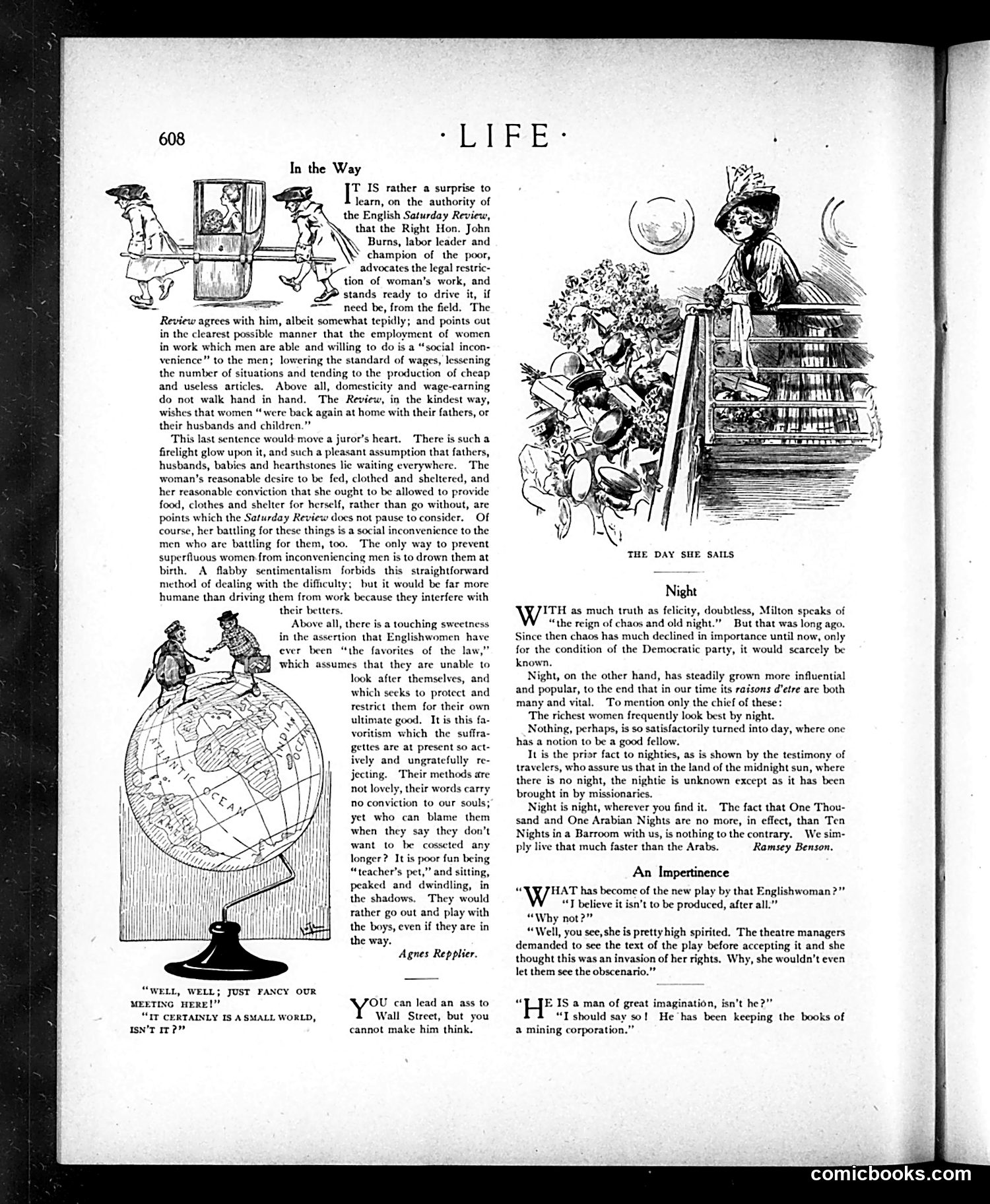
This page satirizes John Burns, a British Labour leader and champion of the poor, for advocating legal restriction of women's work. The Saturday Review supports him, arguing women workers create "social inconvenience" by lowering wages and distracting from domesticity. The article's author (Agnes Repplier) attacks this logic mercilessly. She notes the hypocrisy: women need to eat and shelter themselves, yet are told they're "favorites of the law" needing protection. She connects this to the suffragettes' justified anger at being treated as perpetual children—"teacher's pet" sitting "peaked and dwindling, in the shadows" while denied adult agency. The cartoons illustrate women's actual work and independence, contrasting the article's sentimental vision of domesticity with reality. The satire exposes how male workers and paternalistic institutions collaborated to exclude women from economic participation, disguising self-interest as chivalry.
📄 Transcribed text from this page (OCR, searchable)
Machine-transcribed from the original scan — historical spelling and the odd misread are preserved.
al lREsEs: In the Way T IS rather a surprise to of the English Saturday Review, that the Right Hon. John Burns, labor leader and S champion of the poor, advocates the legal restric- tion of woman's work, and AP stands ready to drive it, if “== need be, from the field, The Review agrees with him, albeit somewhat tepidly; and points out in the clearest possible manner that the employment of women in work which men are able and willing to do is a “social incon- venience” to the men; lowering the standard of wages, lessening the number of situations and tending to the production of cheap and useless articles. Above all, domesticity and wage-carning do not walk hand in hand. The Review, in the kindest way, wishes that women “were back again at home with their fathers, or their husbands and children.” ‘This last sentence would move a juror’s heart. ‘There is such a firelight glow upon it, and such a pleasant assumption that fathers, husbands, babies and hearthstones lie waiting everywhere. ‘The woman’s reasonable desire to be fed, clothed and sheltered, and her reasonable conviction that she ought to be allowed to provide food, clothes and shelter for herself, rather than go without, are points which the Saturday Review docs not pause to consider. Of course, her battling for these things is a social inconvenience to the men who are battling for them, too, The only way to prevent superfluous women-from inconveniencing men is to drown them at birth. A flabby sentimentalism forbids this straightforward method of dealing with the difficulty; but it would be far more humane than driving them from work because they interfere with their betters. Above all, there is a touching sweetness in the assertion that Englishwomen have been “the favorites of the law,” which assumes that they are unable to look after themselves, and which seeks to protect and restrict them for their own ¢ good, It is this fa- ism which the suffra- gettes are at present so act- ively and ungratefully re- jecting. ‘Their methods are not lovely, their words carry no conviction to our souls; yet who can blame them when they say they don’t ed any longer? It is poor fun being “teacher's pet,” and sitting, peaked and dwindling, in the shadows. They would rather go out and play with the boys, even if they are in the way. Agnes Rep plier. want to be cos: “WELL, WELL; JUST FANCY OUR MEETING HERE!” “IT CERTAINLY IS A SMALL WORLD, Isn’r mr?” OU can lead an ass to Wall Street, but you cannot make him think. THE DAY SHE SAILS Night ITH as much truth as felicity, doubtless, Milton speaks of “the reign of chaos and old night.” But that was long ago. Since then chaos has much declined in importance until now, only for the condition of the Democratic party, it would scarcely be known. Night, on the other hand, has steadily grown more influential and popular, to the end that in our time its raisons d'etre are both many and vital. To mention only the chief of these: The richest women frequently look best by night. Nothing, perhaps, is so satisfactorily turned into day, where one has a notion to be a good fellow. It is the prior fact to nighties, as is shown by the testimony of travelers, who assure us that in the land of the midnight sun, where there is no night, the nightie is unknown except as it has been brought in by missionaries. Night is night, wherever you find it. The fact that One Thou- sand and One Arabian Nights are no more, in effect, than Ten Nights ina Barroom with us, is nothing to the contrary. We sim- ply live that much faster than the Arabs. Ramsey Benson. An Impertinence “\Y/HAT has become of the new play by that Englishwoman?” “T believe it isn’t to be produced, after all.” “Why not?” “Well, you see, she is pretty high spirited. The theatre managers demanded to sce the text of the play before accepting it and she thought this was an invasion of her rights, Why, she wouldn't even let them see the obscenario.”” “HE IS a man of great imagination, isn't he? “I should say so! He has been keeping the books of a mining corporation.” comicbooks.com