
Life, 1908-06-04 · page 30 of 44
Life — June 4, 1908 — page 30: what you’re looking at
What you’re looking at
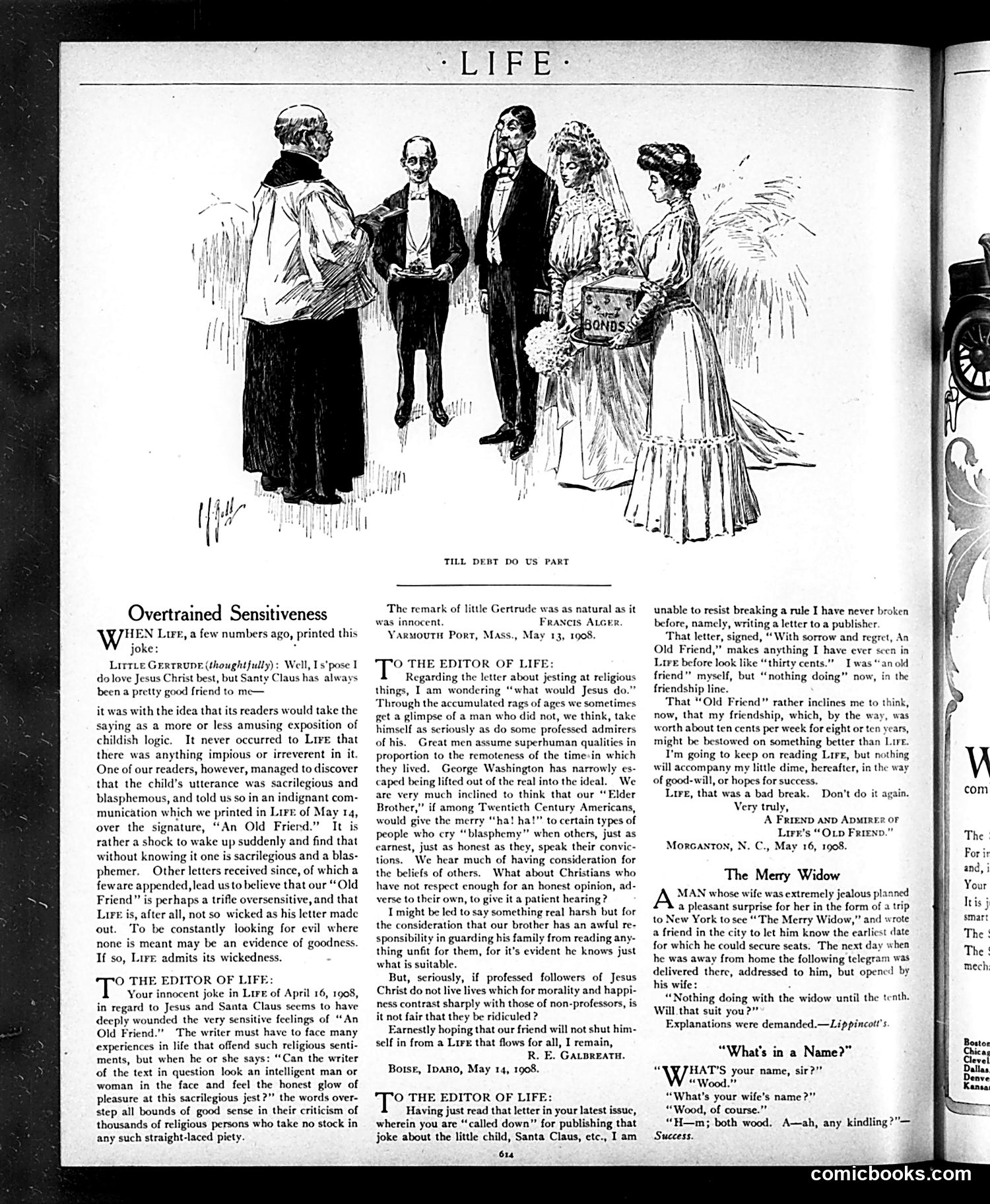
The cartoon depicts a wedding ceremony with six figures: a clergy member, groom, bride (in veil holding flowers), and two female attendants. A money box labeled "BONDS" is prominently displayed. **The Satire:** This is social commentary on marriages motivated by financial interest rather than love. The title "Till Debt Do Us Part" plays on traditional wedding vows, suggesting the union is a transaction—specifically involving financial "bonds." The conspicuous placement of the bonds box indicates the bride (or her family) brings wealth as her primary asset to the marriage. **Context:** This reflects early 20th-century concerns about wealthy heiresses being married off for money and status. The satire targets both the mercenary nature of such unions and, implicitly, the superficiality of high society where financial considerations overshadow genuine emotional connection. The accompanying letters debate whether Life magazine's humor about religion is offensive—unrelated to this cartoon's satirical critique of wealth-based matrimony.
📄 Transcribed text from this page (OCR, searchable)
Machine-transcribed from the original scan — historical spelling and the odd misread are preserved.
Overtrained Sensitiveness HEN Lure, a few numbers ago, printed this joke: : Litre Gertrunr (thoughtfully): Well, Is'pose 1 do love Jesus Christ best, but Santy Claus has always been a pretty good friend to me— it was with the idea that its readers would take the saying as a more or less amusing exposition of childish logic. It never occurred to Lire that there was anything impious or irreverent in it. One of our readers, however, managed to discover that the child’s utterance was sacrilegious and blasphemous, and told us so in an indignant com- munication which we printed in Lire of May 14, over the signature, “An Old Friend.” It is rather a shock to wake up suddenly and find that without knowing it one is sacrilegious and a blas- phemer. Other letters received since, of which a feware appended, lead us to be! that our “Old ” is perhaps a trifle oversensitive, and that after all, not so wicked as his letter made To be constantly looking for evil where none is meant may be an evidence of goodness. If so, Lire admits its wickedness. ‘0 THE EDITOR OF LIF Your innocent joke in Lire of April 16, 1908, in regard to Jesus and Santa Claus seems to have deeply wounded the very sensitive feelings of “An Old Friend.” The writer must have to face many experiences in life that offend such religious senti- ments, but when he or she says: “Can the writer of the text in question look an intelligent man or woman in the face and feel the honest glow of pleasure at this sacrilegious jest?” the words over- step all bounds of good sense in their criticism of thousands of religious persons who take no stock in any such straight-laced piety. TILL DEBT DO US PART The remark of little Gertrude was as natural as it was innocent FRANCIS ALGER YarmoutH Port, Mass., May 13, 1908. 'O THE EDITOR OF LIFE Regarding the letter about jesting at religious things, Iam wondering “what would Jesus do.” hrough the accumulated rags of ages we sometimes ct a glimpse of a man who did not, we think, take If as seriously as do some professed admirers of his. Great men assume superhuman qualities in proportion to the remoteness of the timesin which they lived. George Washington has narrowly caped being lifted out of the real into the ideal. We are very much inclined to think that our “Elder Brother,” if among Twenticth Century Americans, would give the merry “ha! ha!” to certain types of people who cry “blasphemy” when others, just as earnest, just as honest as they, speak their convic- tions. We hear much of having consideration for the beliefs of others. What about Christians who have not respect enough for an honest opinion, ad- verse to their own, to give it a patient hearing? I might be led to say something real harsh but for the consideration that our brother has an awful re- sponsibility in guarding his family from reading any- thing unfit for them, for it's evident he knows just what is suitable. But, seriously, if professed followers of Jesus Christ do not live lives which for morality and happi- ness contrast sharply with those of non-professors, is it not fair that they be ridiculed ? nestly hoping that our friend will not shut him- self in from a Lire that flows for all, I remain, R. E. GALBREATH. Boise, Ipano, May 14, 1908. © THE EDITOR OF LIFE: Having just read that letter in your latest issuc, wherein you are “‘called down” for publishing that joke about the little child, Santa Claus, etc., I am 614 unable to resist breaking a rule I have never broken before, namely, writing a letter to a publisher. ‘That letter, signed, ‘‘ With sorrow and regret, An Old Friend,” makes anything I have ever seen in Lire before look like “thirty cents.” I was “an old friend” myself, but “nothing doing” now, in the friendship line. ‘That “Old Friend” rather inclines me to think, now, that my friendship, which, by the way, was worth about ten cents per week for eight or ten years, might be bestowed on something better than Lire. I'm going to keep on reading Lire, but nothing will accompany my little dime, hereafter, in the way of good-will, or hopes for success. Lire, that was a bad break. Very truly, Don't do it again. AND ADMIRER OF “Op FRienn.” C., May 16, 1908. The Merry Widow MAN whose wife was extremely jealous planned a pleasant surprise for her in the form of a trip to New York to sce “The Merry Widow,” and wrote a friend in the city to let him know the earliest late for which he could secure seats. The next day when he was away from home the following telegram was delivered there, addressed to him, but opened by his wife: ‘ “Nothing doing with the widow until the tenth. Will that suit you?” Explanations were demanded.—Lippincott’s “What's in a Name?” “\Y7HAT’S your name, sir?” * Wood.” “What's your wife's name?” “Wood, of course.” “H—m; both wood. A—ah, any kindling ?”"— Success. Morcanro: comicbooks.com