
Life, 1908-06-04 · page 14 of 44
Life — June 4, 1908 — page 14: what you’re looking at
What you’re looking at
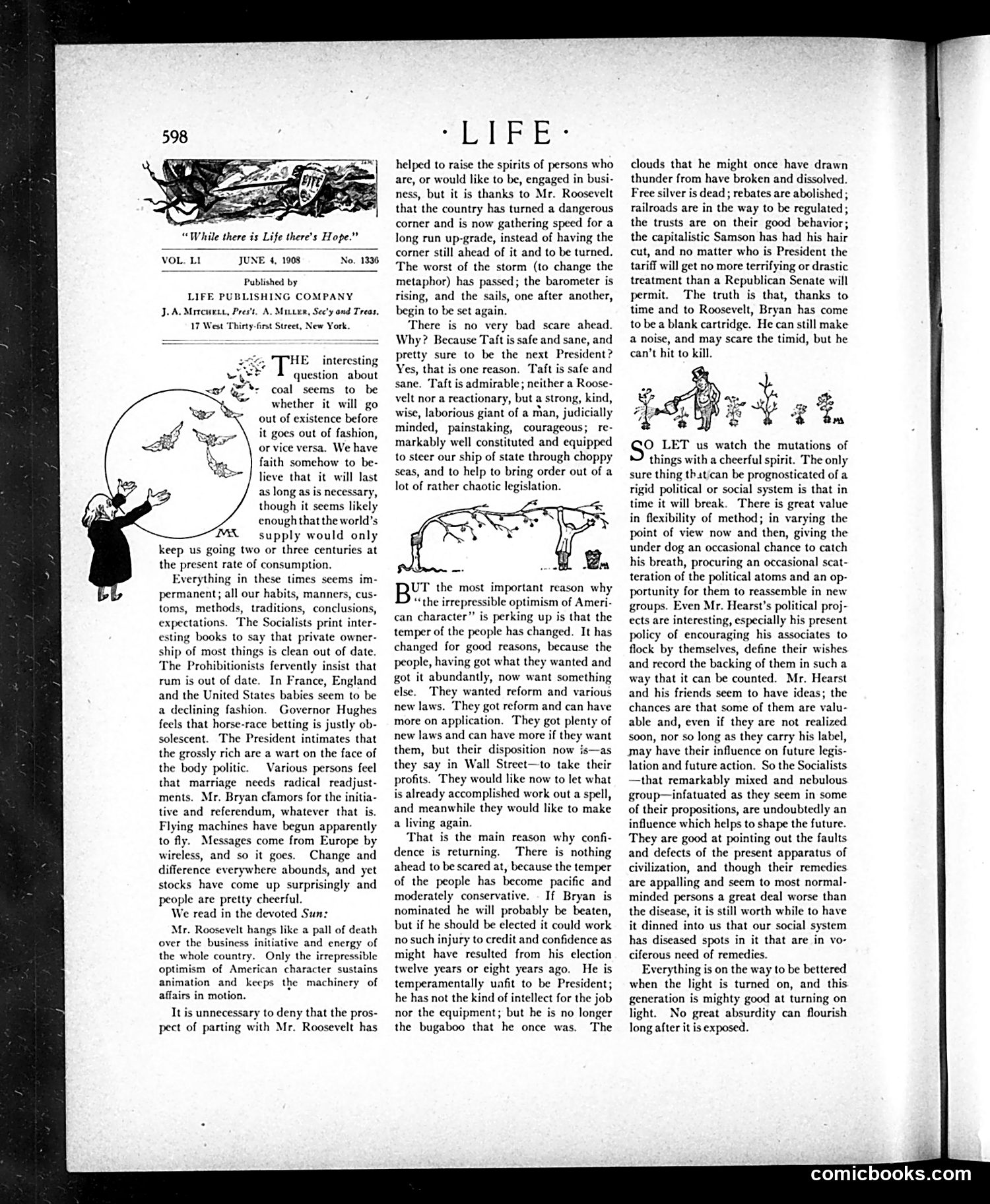
This editorial page discusses Theodore Roosevelt's impending departure from the presidency and William Howard Taft's expected succession. The piece explains why business confidence is rising despite Roosevelt's unpopularity among the wealthy. **Key political figures:** - **Roosevelt**: characterized as a "pall of death" over business (quoting a critical newspaper); credited with steering the country through dangerous economic waters - **Taft**: presented as "safe and sane"—a moderate alternative to Roosevelt who can continue reforms without radicalism - **Bryan**: referenced as a potential Democratic nominee whose election would cause less damage than feared **The satire's point:** Life defends Roosevelt's legacy while explaining why even Republicans feel relief at his departure. The magazine argues that public confidence is returning not because Taft represents change, but because citizens are satisfied with achieved reforms and want stability—to "take their profits" and "make a living again." The small cartoon illustrations (children, animals) appear decorative rather than satirical.
📄 Transcribed text from this page (OCR, searchable)
Machine-transcribed from the original scan — historical spelling and the odd misread are preserved.
VOL. LI Published by LIFE PUBLISHING COMPANY See'y and Treas, interesting tion about coal seems to be whether it will go out of existence before it goes out of fashion, or vice versa. We have faith somehow to be- lieve that it will last as long as is necessary, though it seems likely enough that the world’s supply would only keep us going two or three centuries at the present rate of consumption. Everything in these times seems im- permanent; all our habits, manners, cus- toms, methods, traditions, conclusions, expectations. The Socialists print inter- esting books to say that private owner- ship of most things is clean out of date. The Prohibitionists fervently insist that rum is out of date. In France, England and the United States babies seem to be a declining fashion. Governor Hughes feels that horse-race betting is justly ob- solescent. The President intimates that the grossly rich are a wart on the face of the body politic. Various persons feel that marriage needs radical readjus ments. Mr. Bryan clamors for the initi tive and referendum, whatever that is. Flying machines have begun apparently to fly. Messages come from Europe by wireless, and so it goes. Change and difference everywhere abounds, and yet stocks have come up surprisingly and people are pretty cheerful. We read in the devoted Sun: Mr. Roosevelt hangs like @ pall of death over the business initiative and energy of the whole country. Only the irrepressible optimism of American character sustains animation and keeps the machinery of affairs in motion. It is unnecessary to deny that the pros- pect of parting with Mr. Roosevelt has oA Pen helped to raise the spirits of persons who are, or would like to be, engaged in busi- ness, but it is thanks to Mr. Roosevelt that the country has turned a dangerous corner and is now gathering speed for a long run up-grade, instead of having the corner still ahead of it and to be turned. The worst of the storm (to change the metaphor) has passed; the barometer is rising, and the sails, one after another, begin to be set again. There is no very bad scare ahead. Why? Because Taft is safe and sane, and pretty sure to be the next President? Yes, that is one reason. Taft is safe and sane. Taft is admirable; neither a Roose- velt nor a reactionary, but a strong, kind, wise, laborious giant of a man, judicially minded, painstaking, courageous; re- markably well constituted and equipped to steer our ship of state through choppy seas, and to help to bring order out of a lot of rather chaotic legislation. Bu" the most important reason why “the irrepressible optimism of Ameri- can character” is perking up is that the temper of the people has changed. It has changed for good reasons, because the people, having got what they wanted and got it abundantly, now want something else. They wanted reform and various new laws. They got reform and can have more on application. They got plenty of new laws and can have more if the; them, but their disposition now is—as they say in Wall Street—to take their profits. They would like now to let what is already accomplished work out a spell, and meanwhile they would like to make a living again. ‘That is the main reason why confi- dence is returning. There is nothing ahead to be scared at, because the temper of the people has become pacific and moderately conservative. If Bryan is nominated he will probably be beaten, but if he should be elected it could work no such injury to credit and confidence as might have resulted from his election twelve years or eight years ago. He is temperamentally unfit to be President; he has not the kind of intellect for the job nor the equipment; but he is no longer the bugaboo that he once was. The clouds that he might once have drawn thunder from have broken and dissolved. Free silver is dead ; rebates are abolished ; railroads are in the way to be regulated ; the trusts are on their good behavior; the capitalistic Samson has had his hair cut, and no matter who is President the tariff will get no more terrifying or drastic treatment than a Republican Senate will permit. The truth is that, thanks to time and to Roosevelt, Bryan has come to bea blank cartridge. He can still make a noise, and may scare the timid, but he can’t hit to kill. 'O LET us watch the mutations of things with a cheerful spirit. The only sure thing thatcan be prognosticated of a rigid political or social system is that in time it will break. There is great value in flexibility of method; in varying the point of view now and then, giving the under dog an occasional chance to catch his breath, procuring an occasional scat- teration of the political atoms and an op- portunity for them to reassemble in new groups. Even Mr. Hearst's political proj- ects are interesting, especially his present policy of encouraging his associates to flock by themselves, define their wishes and record the backing of them in such a way that it can be counted. Mr. Hearst and his friends seem to have ideas; the chances are that some of them are valu- able and, even if they are not realized soon, nor so long as they carry his label, may have their influence on future legis- lation and future action. So the Socialists —that remarkably mixed and nebulous group—infatuated as they seem in some of their propositions, are undoubtedly an influence which helps to shape the future. They are good at pointing out the faults and defects of the present apparatus of civilization, and though their remedies are appalling and seem to most normal- minded persons a great deal worse than the disease, it is still worth while to have it dinned into us that our social system has diseased spots in it that are in vo- ciferous need of remedies. Everything is on the way to be bettered when the light is turned on, and this generation is mighty good at turning on light. No great absurdity can flourish long after it is exposed. comicbooks.com