
Life, 1908-06-04 · page 20 of 44
Life — June 4, 1908 — page 20: what you’re looking at
What you’re looking at
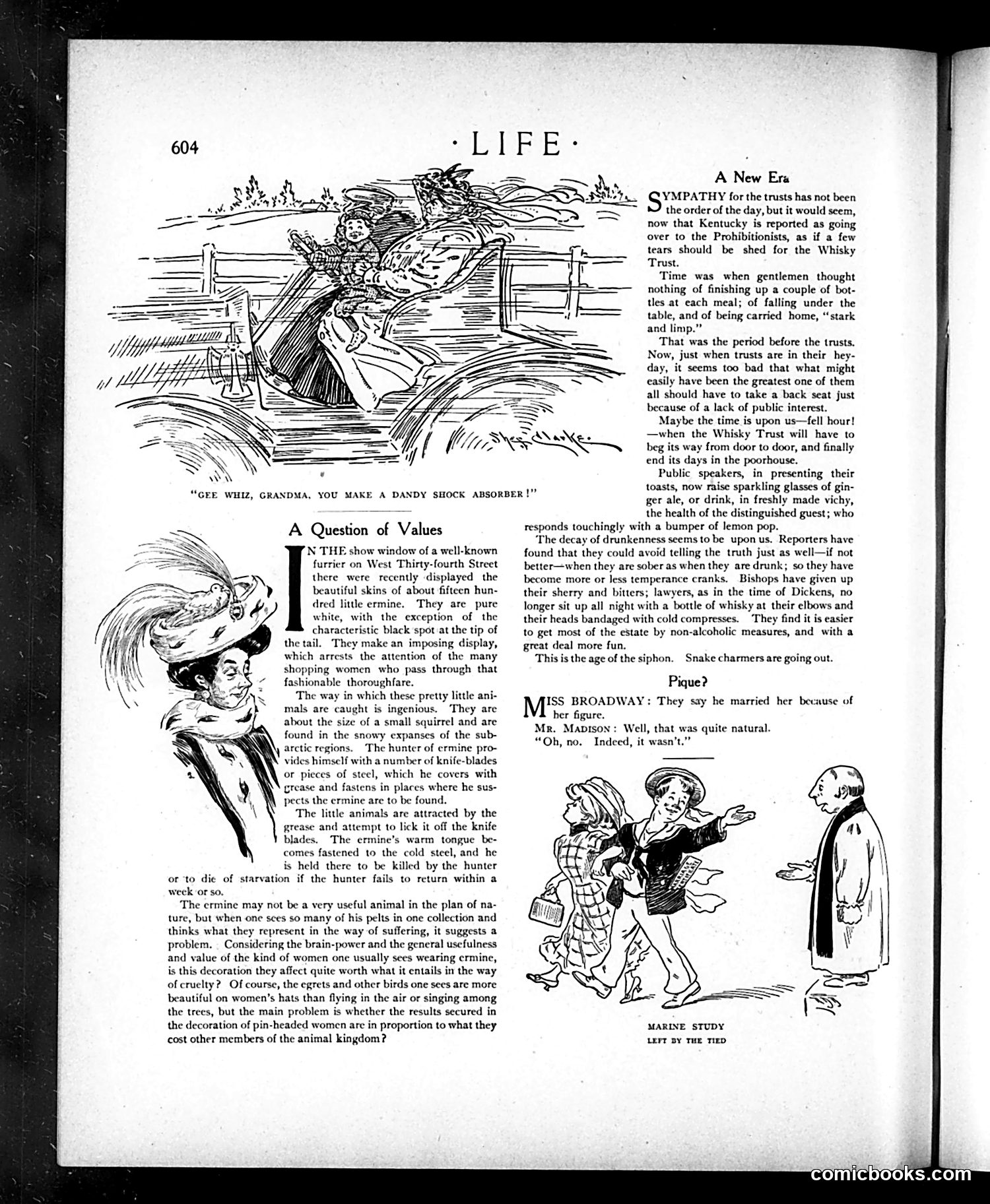
This *Life* magazine page contains satirical commentary on Prohibition and social change in America. **"A New Era"** mocks the decline of the Whisky Trust due to Prohibition sentiment (Kentucky reportedly "going over to the Prohibitionists"). The satire is ironic: Life pretends to sympathize with the whisky industry's misfortune, having previously been a symbol of gentlemanly excess. The joke contrasts the old days of acceptable drunkenness with the new temperance movement. **"A Question of Values"** critiques wealthy women's fashion choices. It describes ermine pelts displayed in a furrier's window, detailing how ermines are caught and killed—their warm tongues freezing to steel blades. The satire's harsh punch: these animals suffer and die so that vapid, "pin-headed women" can wear fashionable furs. Life questions whether the aesthetic benefit to shallow women justifies the animal cruelty involved. Both pieces use biting sarcasm to expose hypocrisy and misplaced priorities in American society.
📄 Transcribed text from this page (OCR, searchable)
Machine-transcribed from the original scan — historical spelling and the odd misread are preserved.
A New Era Satu, S84. QYMPATHY for the trusts has not been Pea N) the order of the day, but it would seem, —~ now that Kentucky is reported as going over to the Prohibitionists, as if a few tears should be shed for the Whisky Trust. ‘Time was when gentlemen thought nothing of finishing up a couple of bot- tles at each meal; of falling under the table, and of being carried home, “stark and limp." That was the period before the trusts. “GEE WHIZ, GRANDMA, YOU MAKE A DANDY SHOCK ABSORBER !”” A Question of Values N THE show window of a well-known furrier on West Thirty-fourth Street there were recently displayed the beautiful skins of about fifteen hun- dred little ermine. They are pure white, with the exception of the characteristic black spot at the tip of the tail. They make an imposing display, which arrests the attention of the many shopping women who pass through that fashionable thoroughfare. ‘The way in which these pretty little ani- mals are caught is ingenious. ‘They are about the size of a small squirrel and are found in the snowy expanses of the sub- arctic regions. The hunter of ermine pro- vides himself with a number of knife-blades or pieces of stecl, which he covers with crease and fastens in places where he sus pects the ermine are to be found. The little animals are attracted by the grease and attempt to lick it off the knife blades. The ermine’s warm tongue be- comes fastened to the cold steel, and he is held there to be killed by the hunter or to die of starvation if the hunter fails to return within a week or so. The ermine may not be a very useful animal in the plan of na- ture, but when one sces so many of his pelts in one collection and thinks what they represent in the way of suffering, it suggests a problem. Considering the brain-power and the general usefulness and value of the kind of women one usually sees wearing ermine, is this decoration they affect quite worth what it entails in the way of cruelty? Of course, the egrets and other birds one secs are more beautiful on women’s hats than flying in the air or singing among the trees, but the main problem is whether the results secured in the decoration of pin-headed women are in proportion to what they cost other members of the animal kingdom? just when trusts are in their hey- seems too bad that what might have been the greatest one of them all should have to take a back seat just because of a lack of public interest. Maybe the time is upon us—fell hour! —when the Whisky Trust will have to beg its way from door to door, and finally end its days in the poorhouse. Public speakers, in presenting their toasts, now raise sparkling glasses of gin- ger ale, or drink, in freshly made vichy, the health of the distinguished guest; who responds touchingly with a bumper of lemon pop. ‘The decay of drunkenness seems to be upon us. Reporters have found that they could avoid telling the truth just as well—if not better—when they are sober as when they are drunk; so they have become more or less temperance cranks. Bishops have given up their sherry and bitters; lawyers, as in the time of Dickens, no longer sit up all night with a bottle of whisky at their elbows and their heads bandaged with cold compresses. They find it is easier to get most of the estate by non-alcoholic measures, and with a great deal more fun. This is the age of the siphon. Snake charmers are going out. Pique? ISS BROADWAY: They say he married her because of her figure. Mr. Mapison : Well, that was quite natural. “Ob, no. Indeed, it wasn’t.” MARINE STUDY LEYT BY THE TIED