
Life, 1908-06-04 · page 28 of 44
Life — June 4, 1908 — page 28: what you’re looking at
What you’re looking at
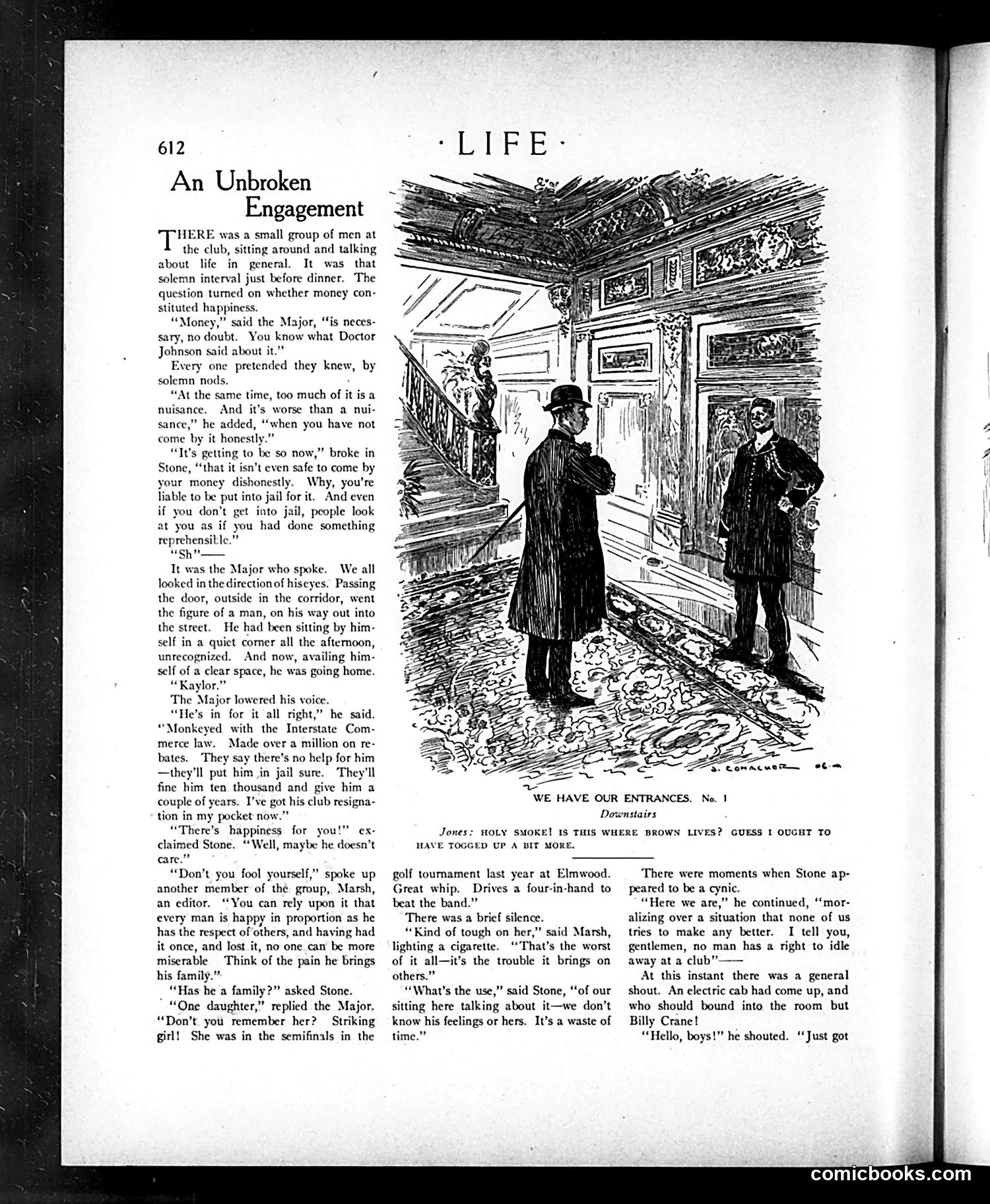
This is a satirical short story about hypocrisy among gentlemen at an exclusive club. The narrative establishes irony through contrasting attitudes: the men discuss whether wealth brings happiness and moralize about a disgraced member named Kaylor, who faces jail for violating the Interstate Commerce law through rebate fraud—a real scandal concern of the era. The satire peaks when Stone cynically observes that none of them actually *do* anything to help, only talk. The accompanying illustration shows men in an elegant hallway, underscoring their privileged detachment. The final interruption by Billy Crane's arrival suggests the story's title "An Unbroken Engagement"—likely implying that despite Kaylor's ruin and the men's moralizing, their social routines and club life continue uninterrupted, indifferent to consequences.
📄 Transcribed text from this page (OCR, searchable)
Machine-transcribed from the original scan — historical spelling and the odd misread are preserved.
612 An Unbroken Engagement HERE was a small group of men at the club, sitting around and talking about life in general. It was that solemn interval just before dinner. The question tumed on whether money con- stituted happiness. “Money,” said the Major, “‘is neces- sary, no doubt. You know what Doctor Johnson said about it.” Every one pretended they knew, by solemn nods. “At the same time, too much of it isa nuisance. And it’s worse than a nui- sance,” he added, “when you have not come by it honestl: “It’s getting to be so now,” broke in Stone, “that it isn’t even safe to come by your money dishonestly. Why, you're liable to be put into jail for it. And even if you don’t get into jail, people look at you as if you had done something reprehensitle.”” “Sh It was the Major who spoke. We all looked in the direction of hiseyes. Passing the door, outside in the corridor, went the figure of a man, on his way out into the street. He had been sitting by him- self in a quict comer all the afternoon, unrecognized. And now, availing him- self of a clear space, he was going home. “Kaylor.” The Major lowered his voice. “He’s in for it all right,” he said. “Monkeyed with the Interstate Com- merce law. Made over a million on re- bates. They say there’s no help for him —they’ll put him jin jail sure. They'll fine him ten thousand and give him a couple of years. I’ve got his club resigna- tion in my pocket now.” “There’s happiness for you!” ex- claimed Stone. “Well, maybe he doesn’t care.” “Don’t you fool yourself,” spoke up another member of the group, Marsh, an editor. ‘You can rely upon it that every man is happy in proportion as he has the respect of others, and having had it once, and lost it, no one can be more miserable Think of the pain he brings his family.” “Has he a family?” asked Stone. “One daughter,” replied the Major. “Don’t you remember her? Striking girl! She was in the semifinals in the 7 WE HAVE OUR ENTRANCES. No. 1! Downstairs Jones: HOLY SMOKE! IS THIS WHERE BROWN LIVES? GUESS I OUGHT TO HAVE TOGGED UP A BIT MORE. golf tournament last year at Elmwood. Great whip. Drives a four-in-hand to beat the band.” There was a brief silence. “Kind of tough on her,” said Marsh, lighting a cigarette. ‘‘That’s the worst of it all—it’s the trouble it brings on others.” “What’s the use,” said Stone, “‘of our sitting here talking about it—we don’t know his feelings or hers. It’s a waste of time.” ‘There were moments when Stone ap- peared to be a cynic. “Here we are,” he continued, ‘“mor- alizing over a situation that none of us tries to make any better. I tell you, gentlemen, no man has a right to idle away at a club”— At this instant there was a general shout. An electric cab had come up, and who should bound into the room but Billy Crane! “Hello, boys!” he shouted. “Just got comicbooks.com ma YY