
Life, 1908-06-04 · page 32 of 44
Life — June 4, 1908 — page 32: what you’re looking at
What you’re looking at
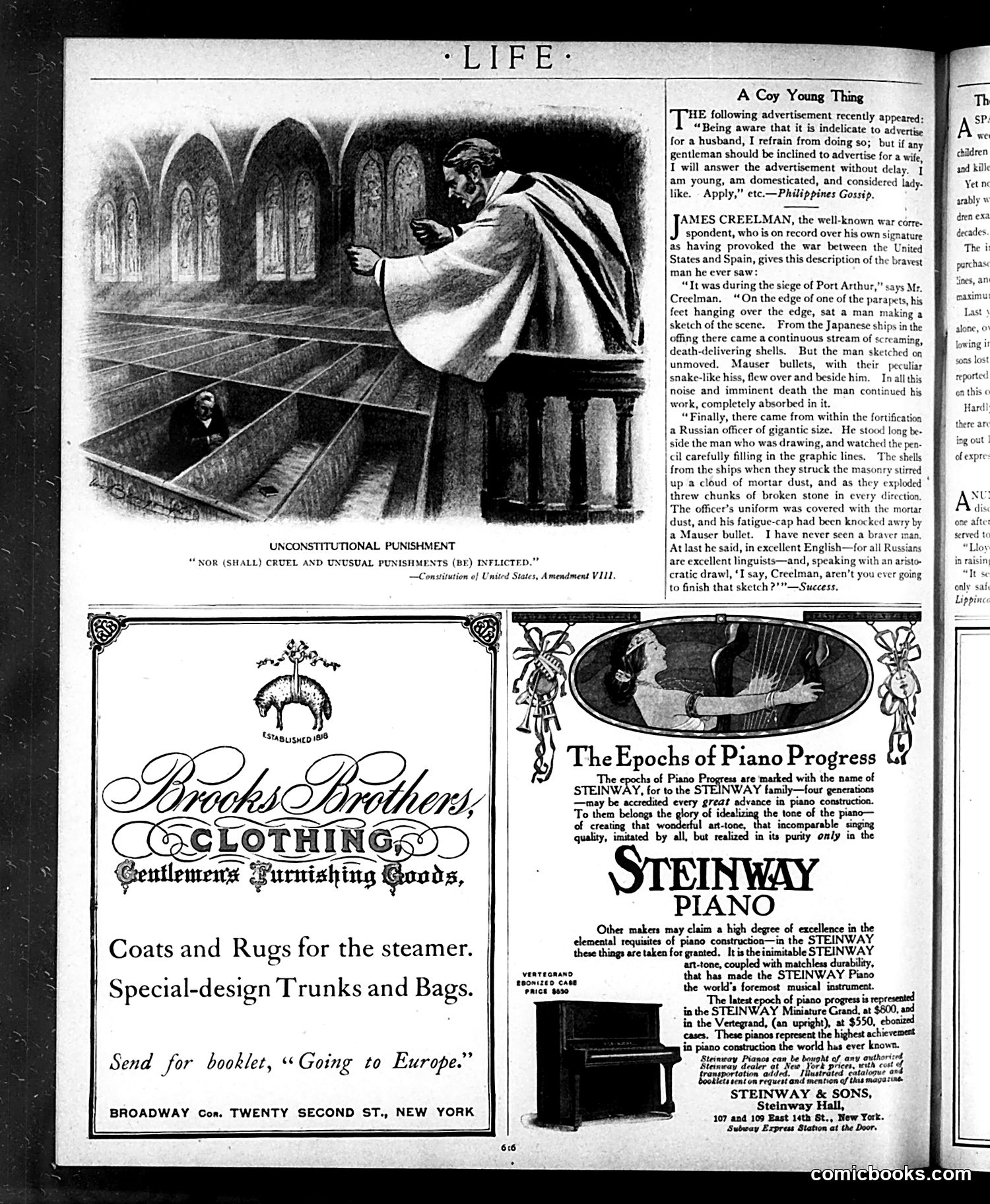
The main cartoon satirizes the U.S. Constitution's Eighth Amendment protection against "cruel and unusual punishments." It depicts a man leaning from a high window, reading what appears to be a letter or document—likely a marriage proposal response (referenced in "A Coy Young Thing" article beside it). The joke: receiving an enthusiastic response to a marriage advertisement is presented as cruel and unusual punishment, humorously suggesting that marriage itself constitutes unconstitutional torture. The accompanying text about war correspondent James Creelman recounts an anecdote from the Russo-Japanese War's siege of Port Arthur, praising an artist who sketched enemy positions under heavy fire. A Russian officer finally interrupts him sarcastically, asking when he'll finish—the "brave man" being the one calmly drawing amid artillery shells. The page is primarily advertisements (Brooks Brothers, Steinway Piano) with satirical editorial content typical of *Life* magazine's humor.
📄 Transcribed text from this page (OCR, searchable)
Machine-transcribed from the original scan — historical spelling and the odd misread are preserved.
UNCONSTITUTIONAL PUNISHMENT “NOR (SHALL) CRUEL AND UNUSUAL PUNISHMENTS (BE) INFLICTED.” A Coy Young Thing Tz following advertisement recently appeared: “Being aware that it is indelicate to advertise for a husband, I refrain from doing so; but if any gentleman should be inclined to advertise for a wife, I will answer the advertisement without delay. ] am young, domesticated, and considered lady. like. Apply,” etc.—Philippines Gossip. AMES CREELMAN, the well-known war corre- spondent, who is on record over his own signature as having provoked the war between the United States and Spain, gives this description of the bravest man he ever saw: “It was during the siege of Port Arthur,” says Mr, Creelman. “On the edge of one of the parapets, his feet hanging over the edge, sat a man making a sketch of the scene. From the Japanese ships in the offing there came a continuous stream of screaming, death-delivering shells. But the man sketched on unmoved. Mauser bullets, with their peculiar snake-like hiss, flew over and beside him. In all this noise and imminent death the man continued his work, completely absorbed in it. “Finally, there came from within the fortification a Russian officer of gigantic size. He stood long be- | side the man who was drawing, and watched the pen- | cil carefully filling in the graphic lines. The shells | from the ships when they struck the masonry stimed threw chunks of broken stone in every direction The officer's uniform was covered with the mortar dust, and his fatigue-cap had been knocked awry by a Mauser bullet. I have never seen a braver ian, At last he said, in excellent English—for all Russians are excellent linguists—and, speaking with an aristo- —Constitution of United States, Amendment VILL. cratic drawl, ‘I say, Creelman, aren’t you ever going to finish that sketch ?’"”—Success. Coats and Rugs for the steamer. Special-design Trunks and Bags. Send for booklet, «Going to Europe.” BROADWAY Corn. TWENTY SECOND ST., NEW YORK The Epochs'of Piano Progresa He ea of Piano Progress are ‘marked with the name of STEINWAY, for to the ‘STEINWAY family—four generations —may be accredited every great advance in piano construction. To them belongs the glory of idealizing the tone of the piano— of creating that wonderful ait-tone, that incomparable singing quality, imitated by all, but realized in its purity only in the STEINWAY PIANO Other makers may claim a high degree of excellence in the elemental requisites of piano constructio the STEINWAY these things are taken for granted. It is the inimitable STEINWAY ant-tone, coupled with matchless durability, that has made the STEINWAY Piano the world’s foremost musical instrument. The latest epoch of piano progress is represented ees EINAY, Nine Grn 0 in lextegr: ‘an upright), at e cases. These pianos represent the highest achievemest in piano construction the world has ever know} Hieinuey Pianos conte bone oot it of veiw ransportation added. Itustrated catalogue and eetiv tent om request and mention of tats mavaine STEINWAY & SONS, Steinway Hall, 107 and 109 East 14th St., New Yor! Subway Express Station at the Door up a cloud of mortar dust, and as they exploded ‘ Th sp. we children and kill Yet nc arably w dren exa decades The i parchasc ‘ines, an alone, 0 lowing i sos lost reported vm