
Life, 1908-06-04 · page 18 of 44
Life — June 4, 1908 — page 18: what you’re looking at
What you’re looking at
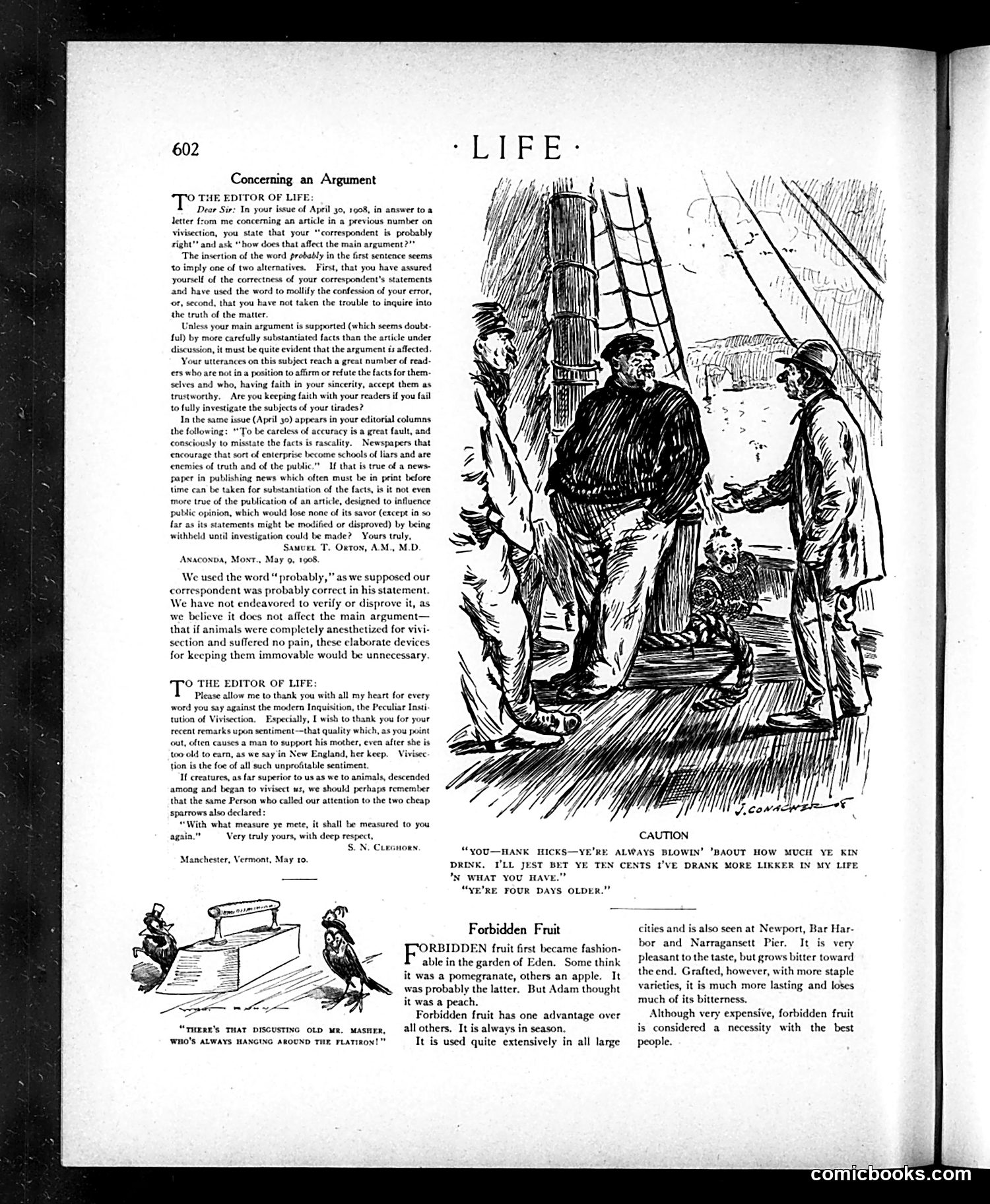
This page contains reader letters debating journalistic accuracy in *Life* magazine's coverage of vivisection (animal testing), plus two unrelated cartoons and a brief article. **The Letters:** Readers criticize *Life*'s editorial standards, arguing that using the word "probably" in defending a previous article about vivisection is evasive. They demand rigorous fact-checking, especially for opinion pieces meant to influence public opinion. The editor responds defensively, claiming the word choice doesn't affect their main argument. **Top Cartoon:** Two men aboard a ship; one brags about drinking capacity. The caption deflates his boast: he's simply "four days older." **Bottom Cartoon:** Shows an older man ("Mr. Masher") frequenting the Flatiron building (a NYC landmark), with women gossiping about his persistent presence there—a comment on unwanted male attention in public spaces. **"Forbidden Fruit" Article:** A brief, humorous piece suggesting the forbidden fruit was likely a peach (Adam's mistaken belief), noting forbidden fruit's perpetual "availability."
📄 Transcribed text from this page (OCR, searchable)
Machine-transcribed from the original scan — historical spelling and the odd misread are preserved.
602 Concerning an Argument 0 THE EDITOR OF LIFE: Dear Sir: In your issue of April 30, 1008, in answer toa letter from me concerning an article in a previous number on vivisection, you state that your “correspondent is probably right’ and ask ‘how does that affect the main argument?" The insertion of the word probably in the first sentence seems to imply one of two alternatives, First, that you have assured yourself of the correctness of your correspondent’s statements and have used the word to mollify the confession of your error, ‘of, second, that you have not taken the trouble to inquire into the truth of the matter, Unless your main argument is supported (which seems doubt ful) by more carefully substantiated facts than the article under discussion, it must be quite evident that the argument és affected. Your utterances oa this subject reach a great number of read- ers who are not in a position to affirm of refute the facts for them- selves and who, having faith in your sincerity, accept them as trustworthy. Are you keeping faith with your readers if you fail to fully investigate the subjects of your tirades? (April 30) appears in your editorial columns o be careless of accuracy is a great fault, and tate the facts is rascality, Newspapers that ‘encourage that sort of enterprise become schools of liars and are ‘enemies of truth and of the public.” If that is true of a news- paper in pablishing news which often must be in print before time can be taken for substantiation of the facts, is it not even more true of the publication of an article, designed to influence public opinion, which would lose none of its savor (except in so far as its statements might be modified or disproved) by Leing withheld until investigation could be made? Yours truly, Samvet T. Oxtos, AM., M.D. ANAcoNDA, Moxt., May 9, 1908. We used the word “ probably,” as we supposed our correspondent was probably correct in his statement. We have not endeavored to verify or disprove it, as we believe it docs not affect the main argument— that if animals were completely anesthetized for section and suffered no pain, these elaborate devices for keeping them immovable would be unnecessary. 0 THE EDITOR OF LIFE: Please allow me to thank you with all my heart for every word you say against the modern Inquisition, the Peculiar Insti tution of Vivisection Especially, I wish to thank you for your recent remarks upon sentiment—that quality which, as you point out, often causes a man to support his mother, even after she is too old to earn, as we sayin New England, her keep. Vivisec: tion is the foe of all such unprofitable sentiment. If creatures, as far superior to us as we to animals, descended among and began to vivisect us, we should perhaps remember that the same Person who called our attention to the two cheap sparrows also declared: “With what measure ye mete, it shall be measured to you again.” Very truly yours, with deep respect, S.N. Curcnory. Manchester, Vermont, May 10. “YOU—HANK HICKS—YE'RE ALWAYS BLOWIN’ ’BAOUT HOW MUCH YE KIN DRINK ’N WHAT YOU HAVE. “YE'RE FOUR DAYS OLDER.” Forbidden Fruit N fruit first became fashion- “TuERE’s THAT DISCUSTING OLD MR. MASHER, WHO'S ALWAYS HANGING AROUND THE FLATIRON!" Pomeippes able in the garden of Eden. Some think it was a pomegranate, others an apple. It was probably the latter. But Adam thought it was a peach. Forbidden fruit has one advantage over all others. It is always in season. It is used quite extensively in all large NTS I'VE DRANK MORE LIKKER IN MY LIFE cities and is also seen at Newport, Bar Har- bor and Narragansett Pier. It is very pleasant to the taste, but grows bitter toward the end. Grafted, however, with more staple varieties, it is much more lasting and loses much of its bitterness. Although very expensive, forbidden fruit is considered a necessity with the best people. comicbooks.com