
A complete issue · 44 pages · 1908
Life — January 2, 1908
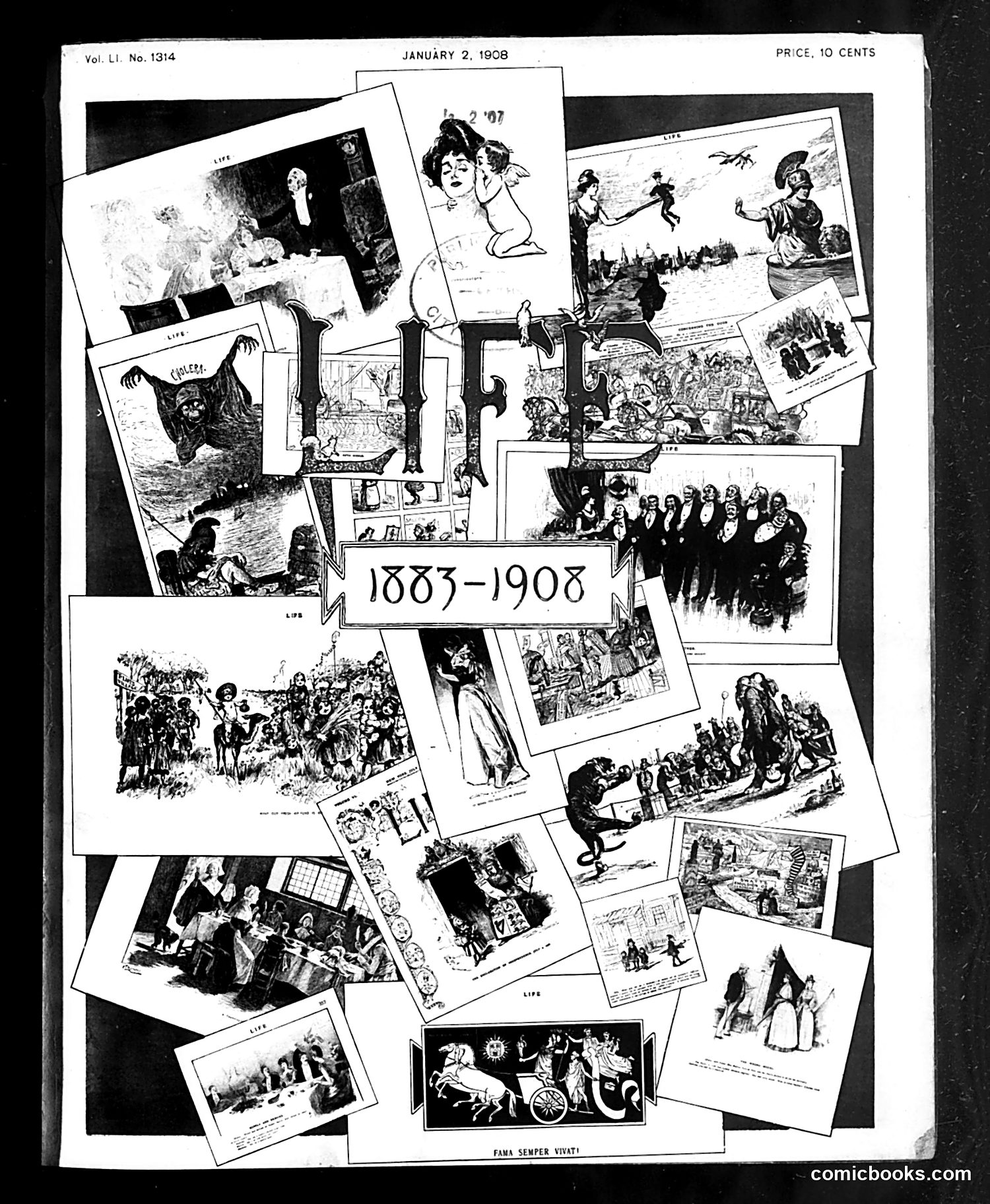
This is a commemorative collage marking the 25th anniversary of *Life* magazine (1883-1908). The central banner displays these dates prominently. The scattered illustrations around the page appear to be samples of *Life*'s satirical content from its quarter-century of publication—various cartoons, comic strips, and illustrated scenes depicting social situations, theatrical scenes, and character types typical of the era's humor. The composition itself is a visual joke: rather than a formal layout, the images are arranged haphazardly, overlapping like a pile of clippings, emphasizing the magazine's prolific output and varied content. This playful, chaotic arrangement reinforces *Life*'s identity as a humorous, irreverent publication that poked fun at American society and culture throughout its first 25 years.
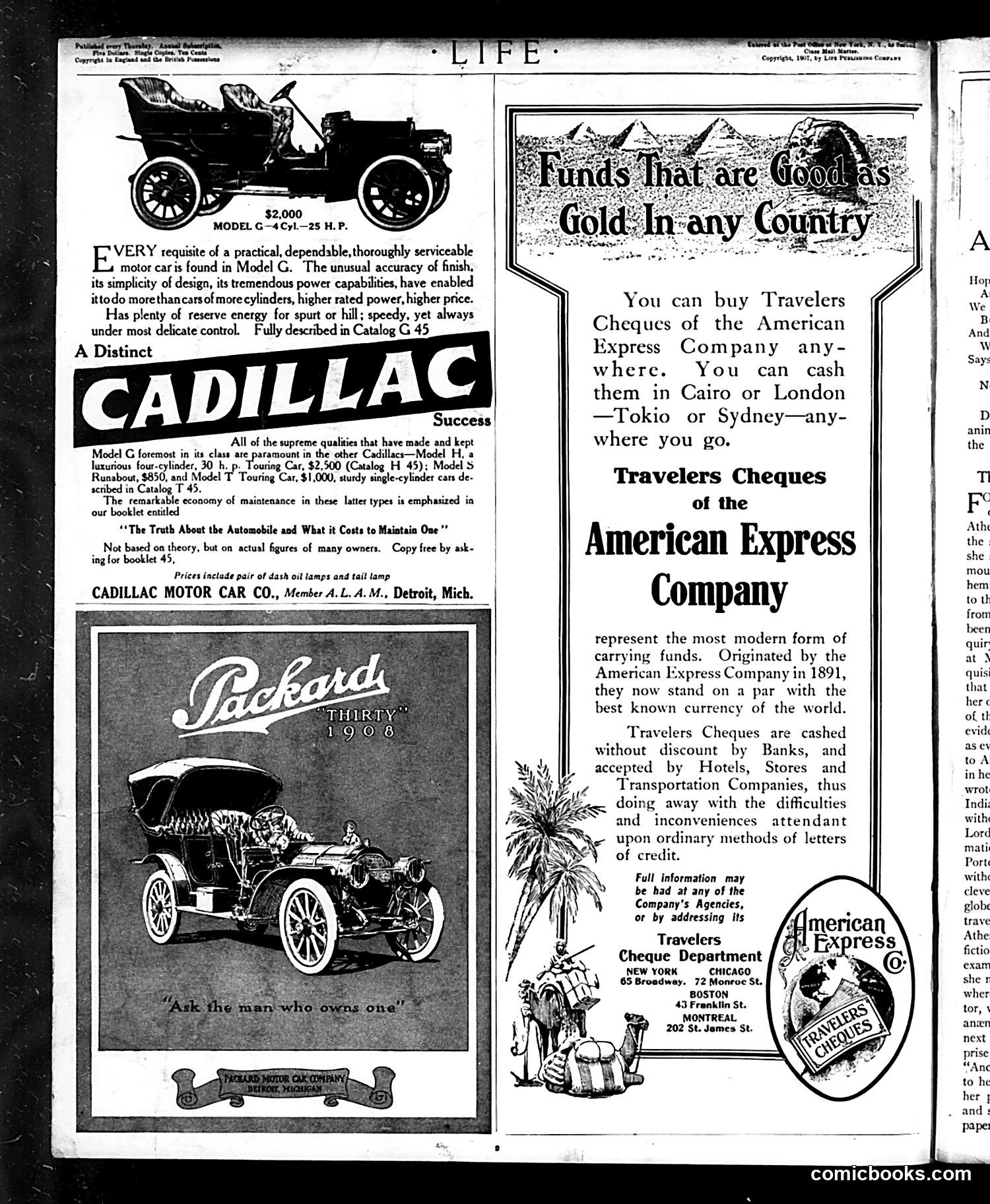
This page contains **automobile advertisements, not political cartoons or satire**. The left side advertises two early-1900s cars: a Cadillac Model C ($2,000, 4-cylinder, 25 H.P.) and a Packard "Thirty" (1906). Both ads emphasize reliability, power, and practical design—typical marketing language for competing luxury automobile manufacturers of the era. The right side advertises American Express Travelers Cheques as a safe alternative to carrying cash while traveling internationally—highlighting cities like Cairo, London, Tokyo, and Sydney. This reflects the early-20th-century expansion of international tourism among wealthy travelers. There is no political satire, caricature, or social commentary visible on this page. It's purely commercial advertising from Life magazine's revenue model.
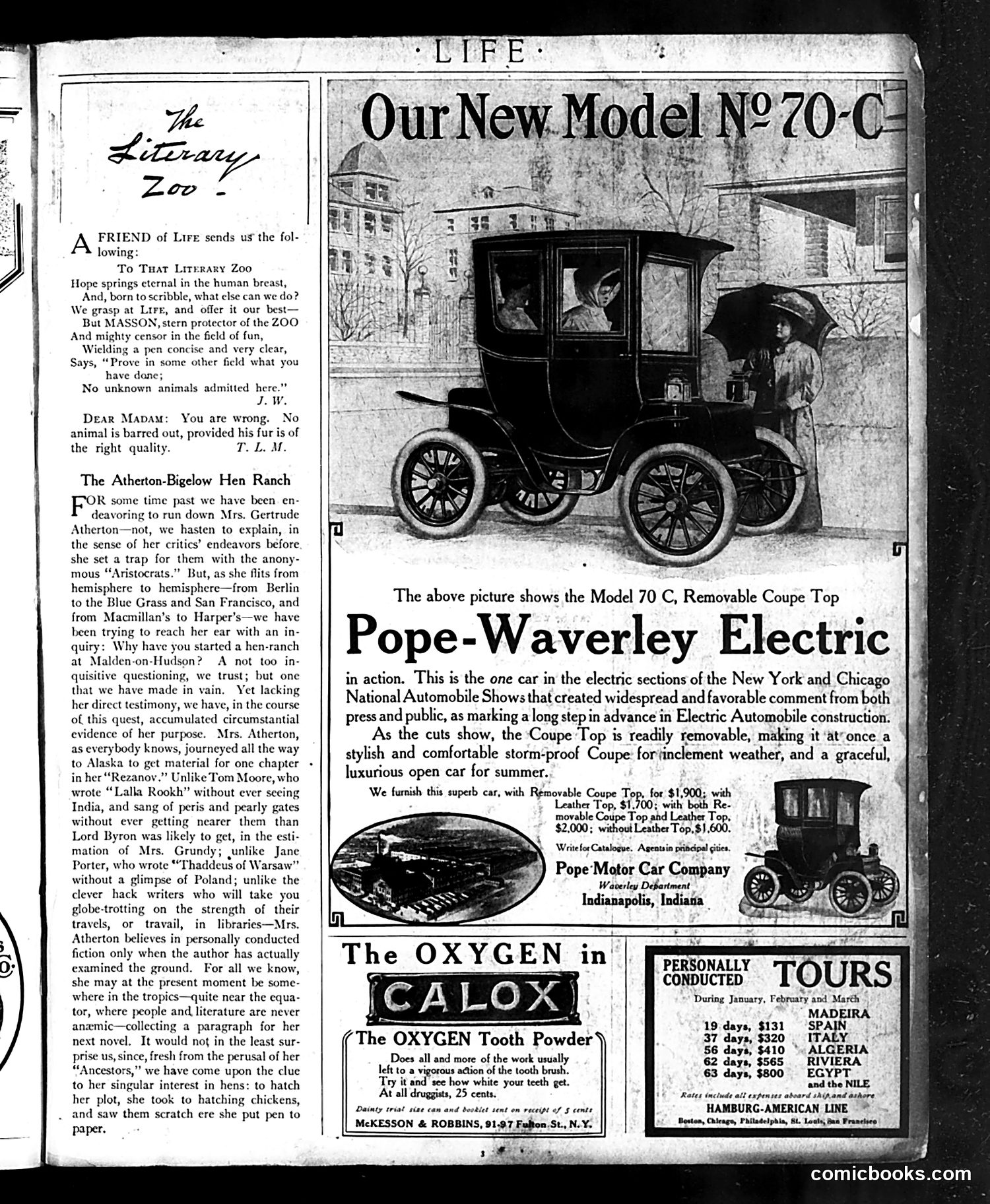
This page is primarily **advertising and general editorial content** rather than political satire. The main features are: 1. **"The Literary Zoo"** - A humorous column responding to readers' letters about literary criticism and author authenticity. It satirizes pretentious literary circles, particularly criticizing writers who claim expertise about places they haven't actually visited (referencing Jane Porter and Lord Byron as examples of authors who wrote convincingly about unfamiliar locations). 2. **Pope-Waverley Electric automobile advertisement** - Features the Model 70-C with removable coupe top, marketed as a notable entry at major auto shows. 3. **Other advertisements** - Including Calumet tooth powder and personally-conducted tour packages. The page reflects early 20th-century concerns about literary authenticity and emerging consumer culture around automobiles.
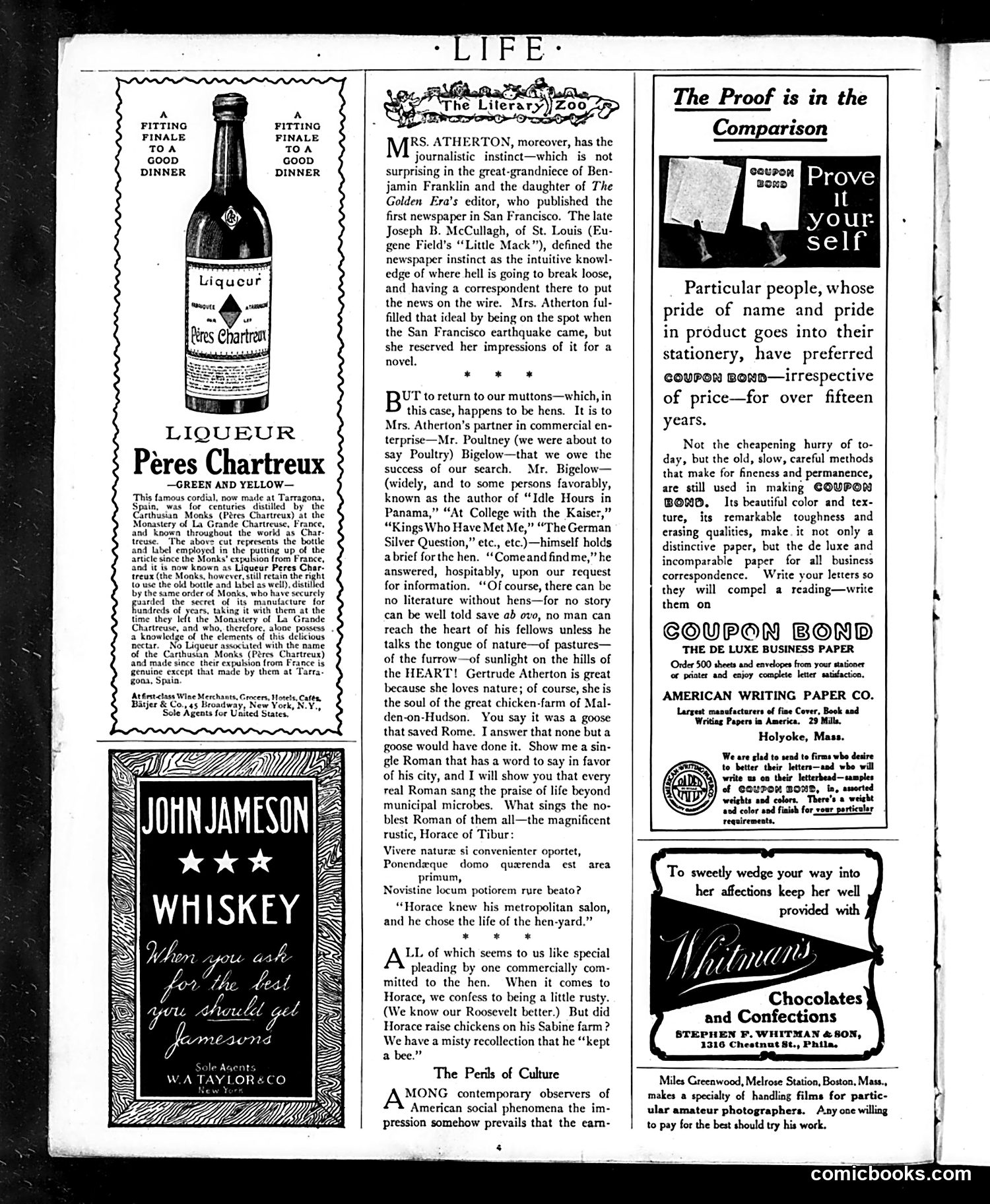
This page is primarily **advertising and editorial content** rather than political satire. The main article discusses **Mrs. Atherton**, a journalist and author, praising her "journalistic instinct" and her connection to nature—particularly her knowledge of chickens and farming life. The advertisements include liqueur, whiskey, business paper, and chocolates. The only cartoon-like element is the small "Prove it yourself" advertisement for Coupon Bond paper, which uses a visual comparison format rather than satirical commentary. **No clear political satire or social commentary is present.** This appears to be a standard Life magazine page from the early 20th century mixing celebrity profile, literary discussion, and commercial advertising—typical for the publication's format of that era.
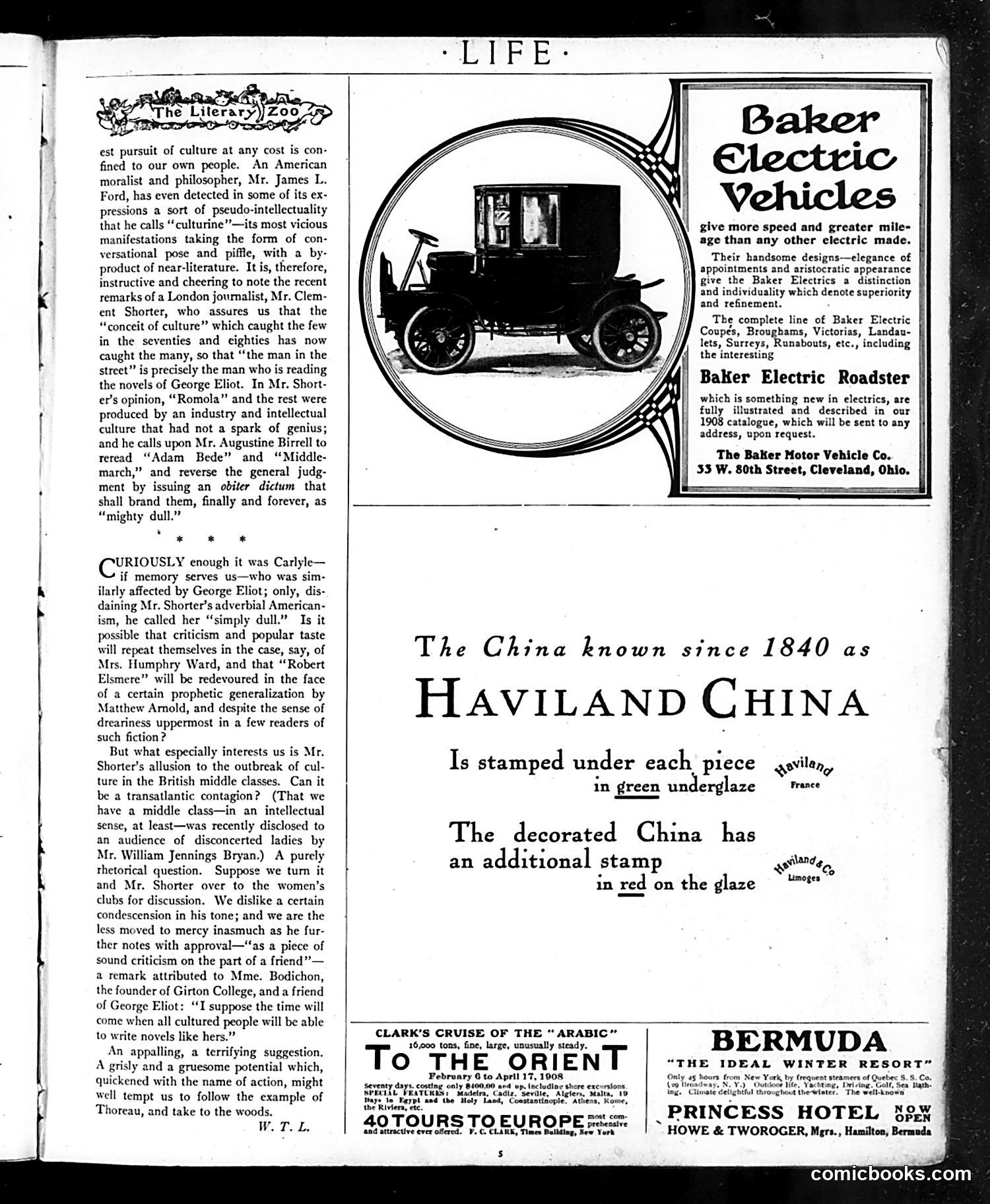
This page is primarily **advertising and literary commentary** rather than political satire. The main content—"The Literary Zoo"—is an essay critiquing American culture's relationship with intellectualism. It references journalist **Mr. James L. Ford** and London journalist **Mr. Shorter**, debating whether popular taste in literature (citing George Eliot's works) represents genuine culture or mere pretension. The piece questions whether middle-class audiences truly appreciate serious fiction or simply follow trends. The advertisements dominate: **Baker Electric Vehicles** (early automobiles), **Haviland China** (fine dishware), and travel promotions for **Europe** and **Bermuda**. The satirical thrust is mild—essentially mocking cultural pretension rather than targeting specific political figures or events.
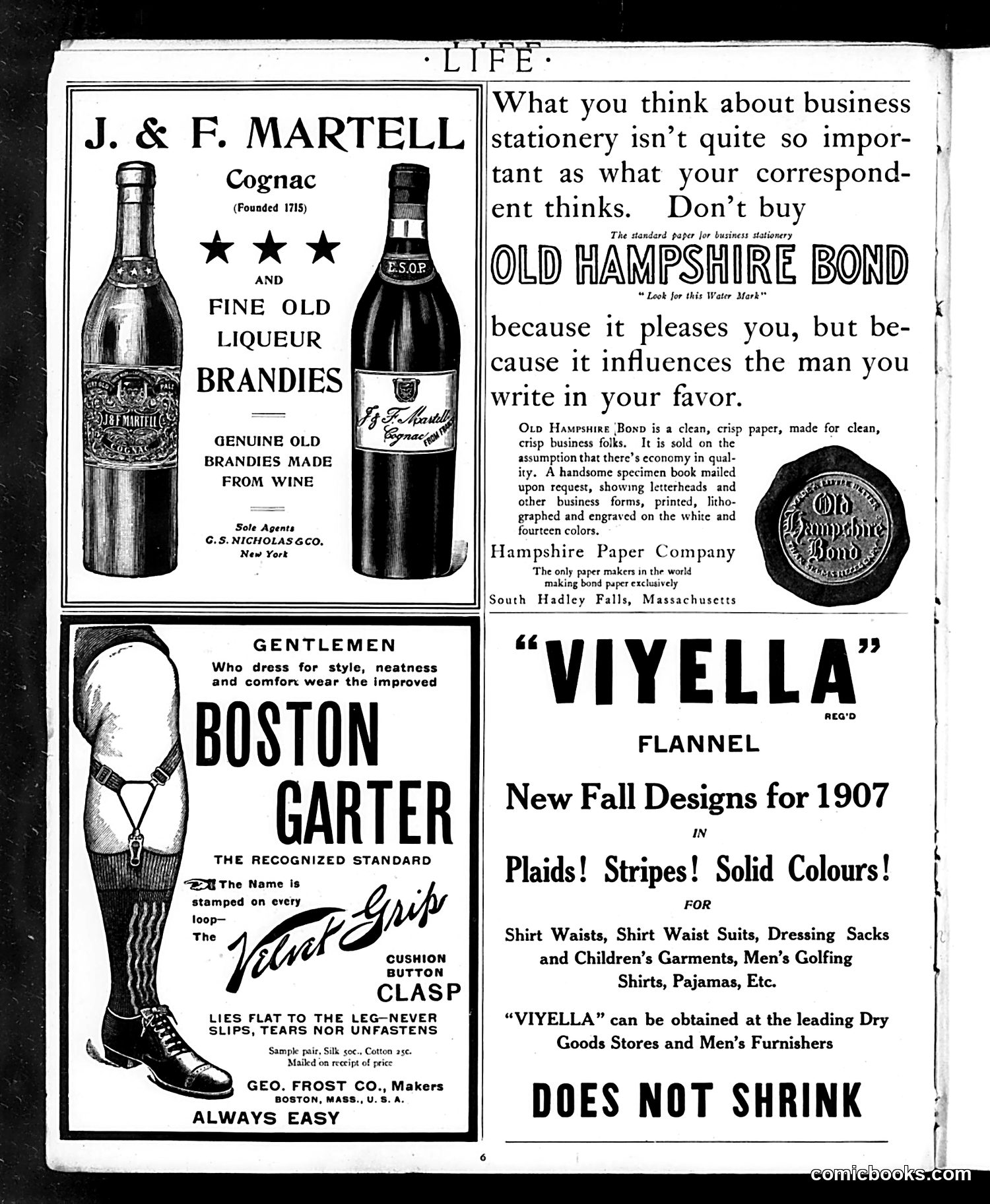
This page is **primarily advertising**, not satire or political commentary. The ads promote: 1. **J. & F. Martell Cognac** - A French brandy founded 1715, sold by C.S. Nicholas & Co. in New York 2. **Old Hampshire Bond** - Business stationery paper, with messaging that correspondents' paper choice influences how recipients perceive the writer 3. **Boston Garter** - Men's hosiery with a "Velvet Grip" cushion button clasp, emphasizing comfort and durability 4. **Viyella Flannel** - New 1907 fabric designs in plaids, stripes, and solid colors for various garments, advertised as shrink-resistant The only quasi-satirical element is the Hampshire Bond ad's suggestion that stationery choice subtly persuades business associates—a humorous commentary on professional vanity rather than political satire.
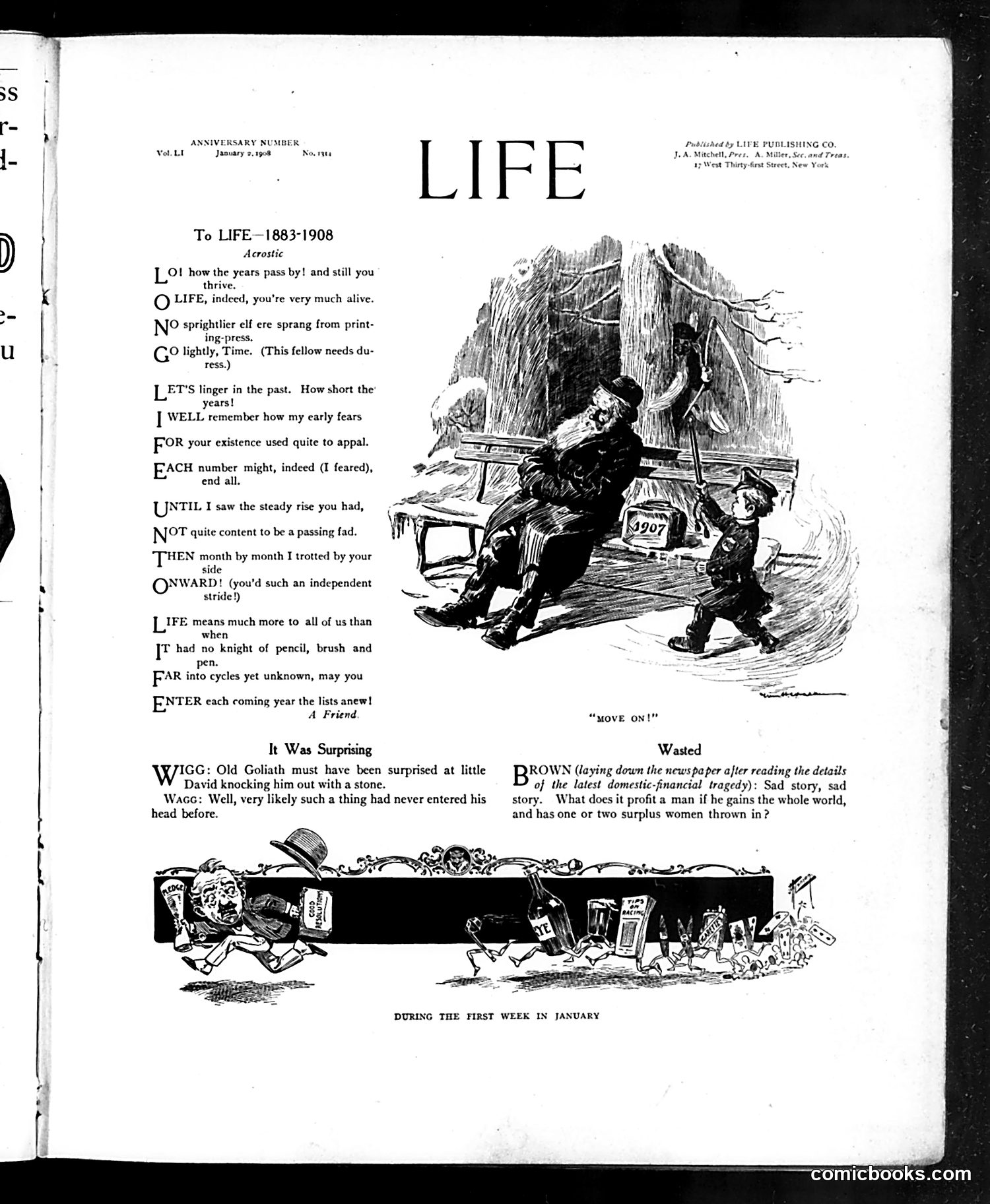
This is an **anniversary issue** celebrating Life's 25 years (1883-1908). The main content is a poetic tribute to the magazine itself, using acrostic verses where first letters spell "LIFE." The two cartoon sections below mock contemporary issues: **"It Was Surprising"** references the Biblical David and Goliath story, suggesting an underdog defeating a seemingly invincible opponent—likely commentary on a recent political or social upset, though the specific reference is unclear. **"Wasted"** depicts a man reading financial news about domestic tragedy, sardonically questioning what benefit comes from reporting on women's scandals and surplus women in society—social satire about tabloid sensationalism and gender issues of the era. The bottom illustration shows trash/debris labeled "During the First Week in January," suggesting post-holiday excess and waste.
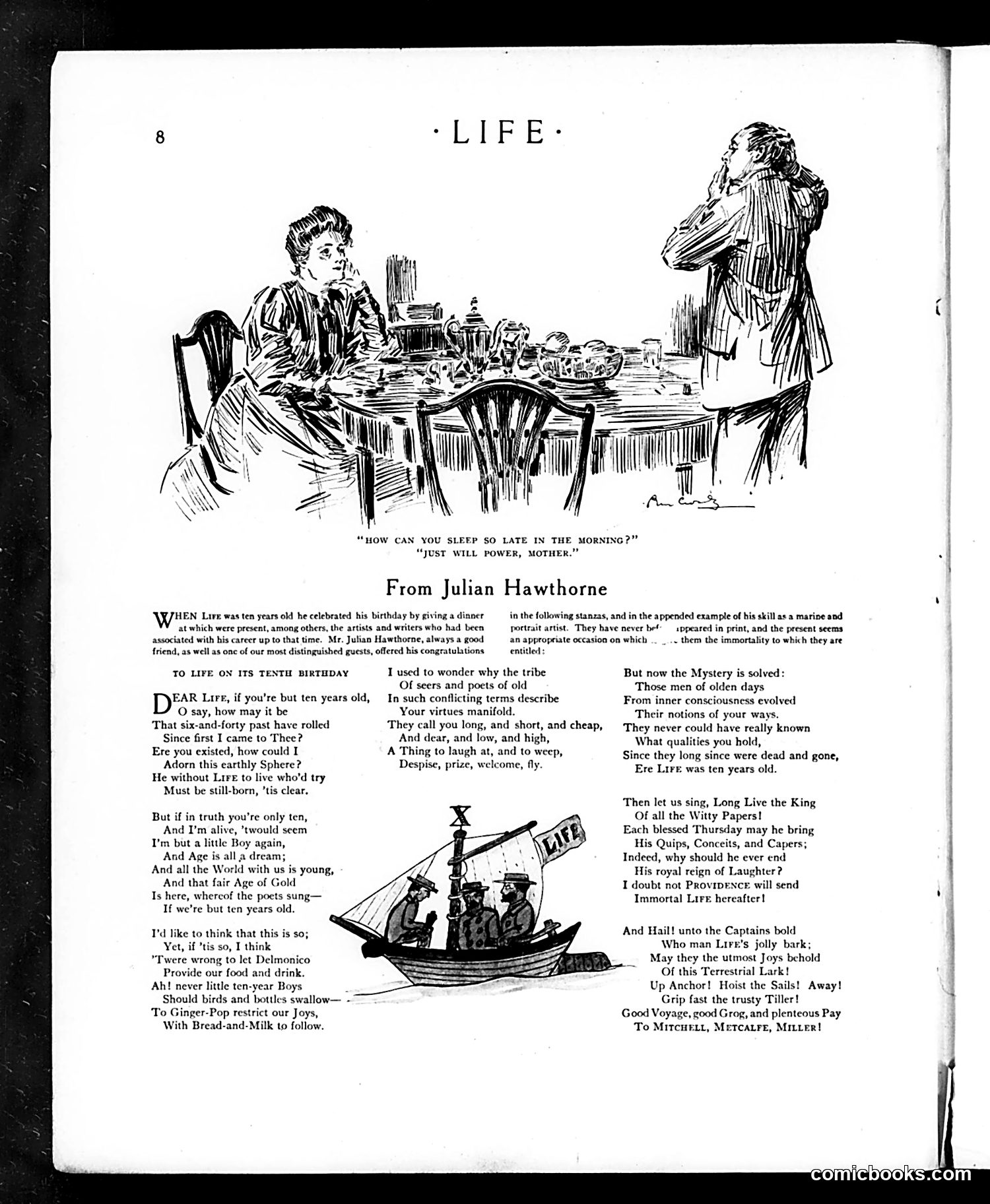
This page celebrates Life magazine's tenth birthday with a commemorative poem by Julian Hawthorne. The cartoon at top shows a domestic scene where a woman sits at breakfast while a man stands nearby, captioned "How can you sleep so late in the morning?" "Just will power, Mother."—a gentle joke about self-discipline and marital dynamics. The central illustration depicts a ship labeled "LIFE," celebrating the publication's ten-year voyage. The accompanying poem humorously reflects on Life's early years, its contributors (the "Captains"), and toasts its continued success with nautical metaphors. The overall content is self-promotional, marking the magazine's anniversary while showcasing its wit and longevity in American satirical publishing.
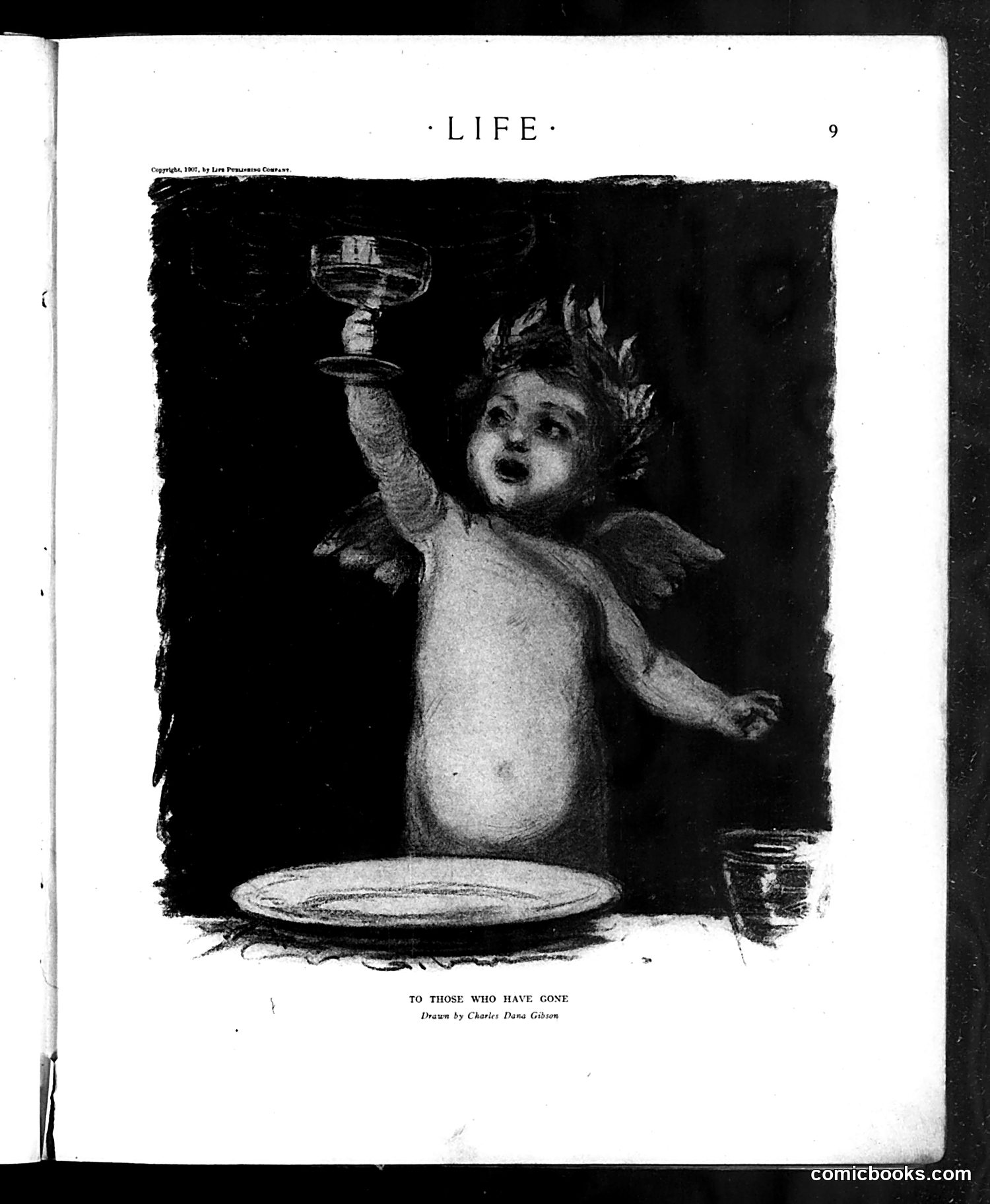
This is a memorial illustration titled "TO THOSE WHO HAVE GONE," drawn by Charles Dana Gibson. It depicts a cherubic child figure with wings and a crown, holding aloft a goblet or chalice while standing beside an empty plate. The dark, solemn background emphasizes the commemorative nature. The imagery suggests a tribute to those who have died, likely from World War I (the magazine's 1907 copyright notwithstanding, this style was common in WWI memorials). The empty plate symbolizes absence and loss, while the winged child represents departed souls or innocence lost. The raised cup appears to be a toast—a gesture honoring the dead. This is a sentimental rather than satirical piece, serving as a mourning illustration rather than political commentary.
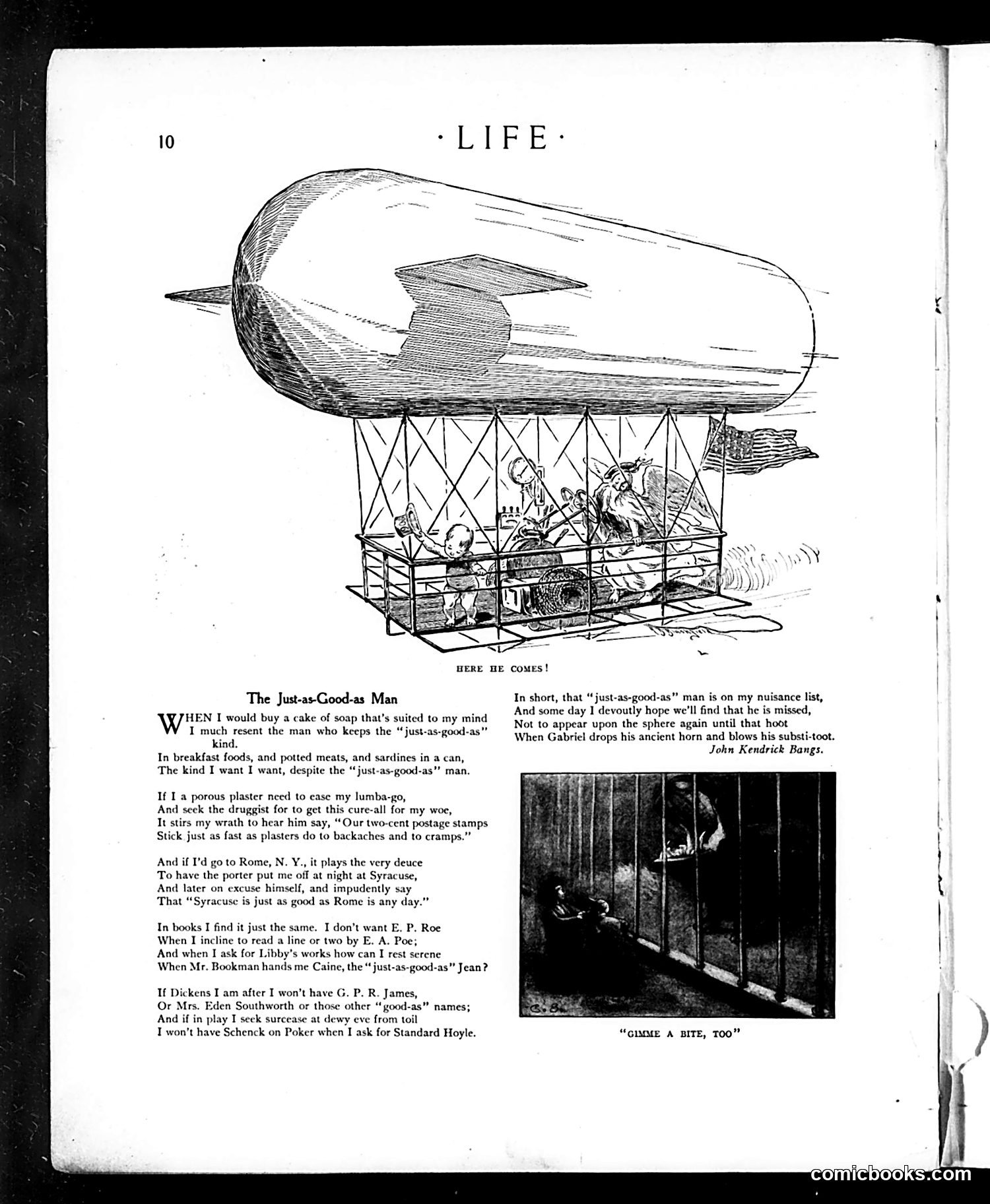
This page from *Life* magazine contains two distinct elements: **Top illustration**: A satirical drawing of an airship/dirigible with passengers in a basket below, captioned "HERE HE COMES!" The vessel appears to be arriving or descending, suggesting commentary on early aviation technology and perhaps the novelty or anxiety surrounding airships in the early 20th century. **Main article**: "The Just-as-Good-as Man" by John Kendrick Bangs is a humorous poem criticizing mediocrity and substitutes. The speaker resents people and products marketed as acceptable alternatives to quality originals—comparing cheap goods, poor service, and second-rate authors to the real thing. References to authors like E.P. Roe and Dickens suggest the poem satirizes middle-class consumers accepting inferior substitutes out of economy rather than demanding excellence. **Bottom photo**: Captioned "GIMME A BITE, TOO" shows what appears to be domestic animals eating.
This page contains no cartoon or illustration—it's entirely text. It's titled "How Life Began" and reprinted from Life's tenth anniversary issue (1893). The author describes starting a satirical magazine at Broadway and Twenty-seventh Street, initially struggling to find a business model and talented contributors. The narrative recounts early conversations with potential publishers and a business manager about what makes a successful periodical. Key themes include the difficulty of securing quality writers, finding the right editorial focus, and establishing financial viability for a new publication. This appears to be autobiographical content about Life magazine's founding, offering historical context about American publishing challenges in the 1880s-90s rather than political satire.
This page is primarily **text-based editorial content**, not a cartoon page. It discusses the early operational challenges of *Life* magazine itself—specifically the difficulty finding a suitable printer for the publication's demanding technical requirements. The narrative describes practical business struggles: printer selection, production delays, and circulation challenges. It mentions Andrew Miller joining as a business partner and references securing advertisements to sustain the fledgling publication. The page includes a brief letter from a reader ("A. Miller") complaining about delivery issues during bad weather, to which the editor responds dismissively. **No political satire or caricatures are visible on this page.** It's a behind-the-scenes account of *Life's* founding operations, offering historical insight into late-19th-century magazine publishing logistics rather than contemporary social commentary.
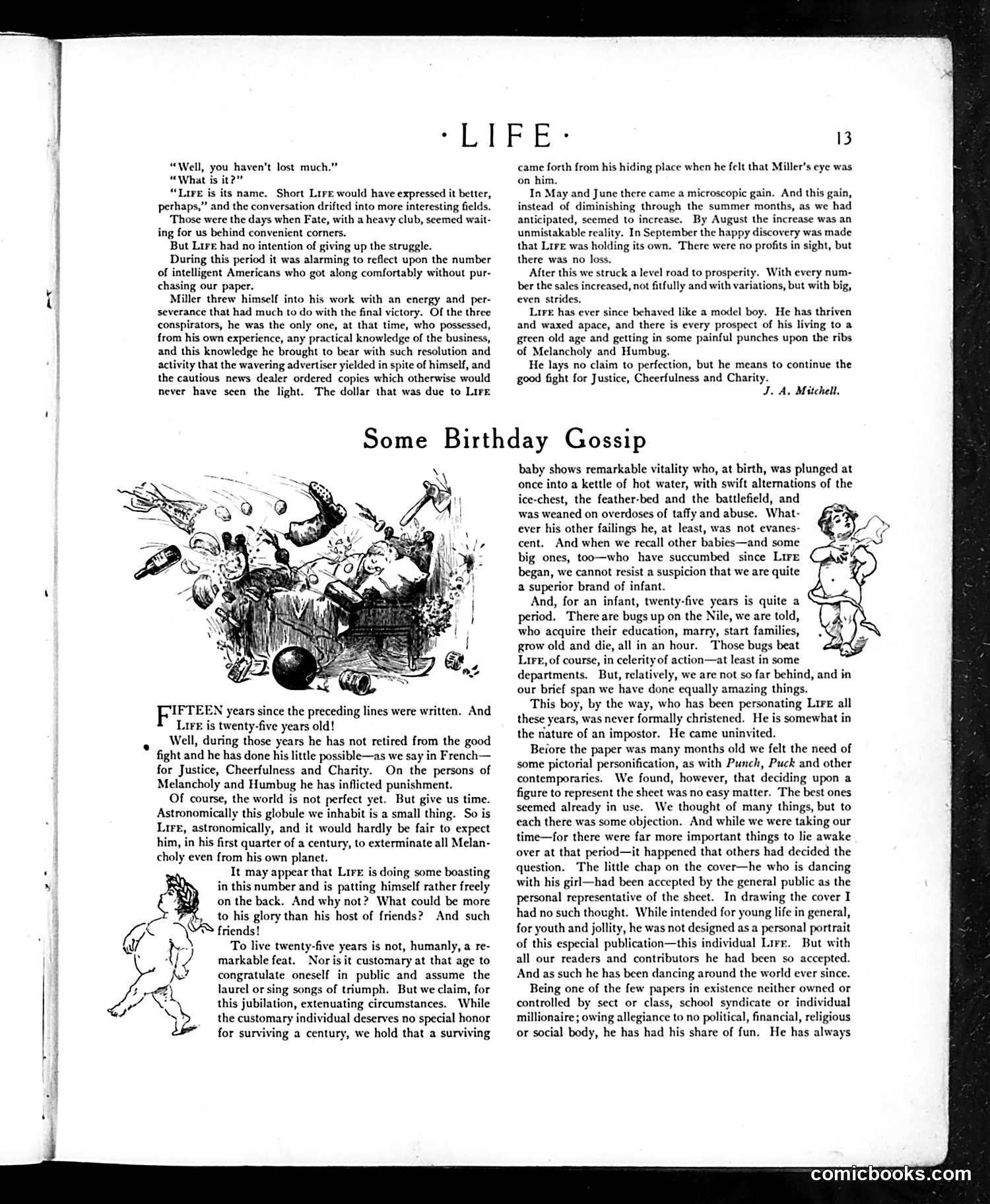
This page celebrates Life magazine's 25th anniversary. The top section concludes an article praising the publication's business success and resilience through difficult periods, attributing its survival to the magazine's integrity and practical knowledge. The main feature, "Some Birthday Gossip," includes a whimsical illustration of toys and objects, accompanied by text discussing Life's longevity. The passage humorously compares Life's survival to that of notably resilient infants, referencing other satirical publications like Punch and Puck. The text notes that Life's mascot—a dancing cherub figure on the cover—was never formally characterized as an impostor, though he required "pictorial personification" to represent the magazine's character and appeal to readers over its 25-year history.
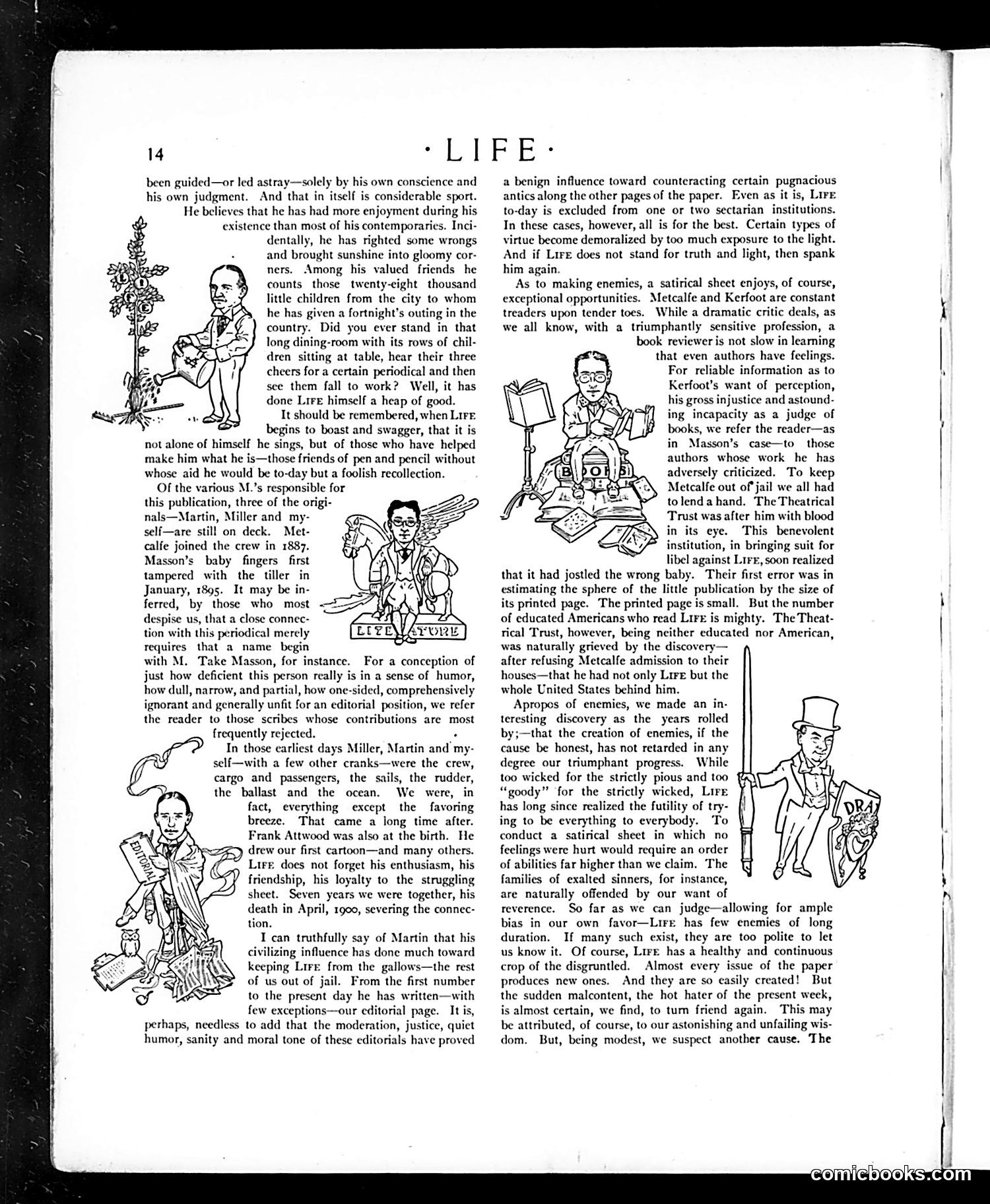
This page is a self-congratulatory editorial about *Life* magazine itself, written by one of its founders. The text celebrates the publication's satirical mission and credits its key contributors. The cartoons illustrate the magazine's staff and history. They show figures labeled as the original creators—Martin, Miller, and the author—depicted as the ship's crew that built *Life*. Additional illustrations reference Frank Attwood (an early cartoonist), and figures like Metcalfe and Kerfoot, who are credited as drama and book critics known for "treading upon tender toes" with their sharp reviews. The satire targets both the magazine's internal dynamics (mocking staff members' fitness for editorial work) and its external enemies—religious institutions that banned it, authors wounded by negative reviews, and the Theatrical Trust, which apparently opposed their drama critic. The overall tone is boastful yet self-aware, celebrating *Life*'s role as an irreverent voice that deliberately provokes powerful institutions.
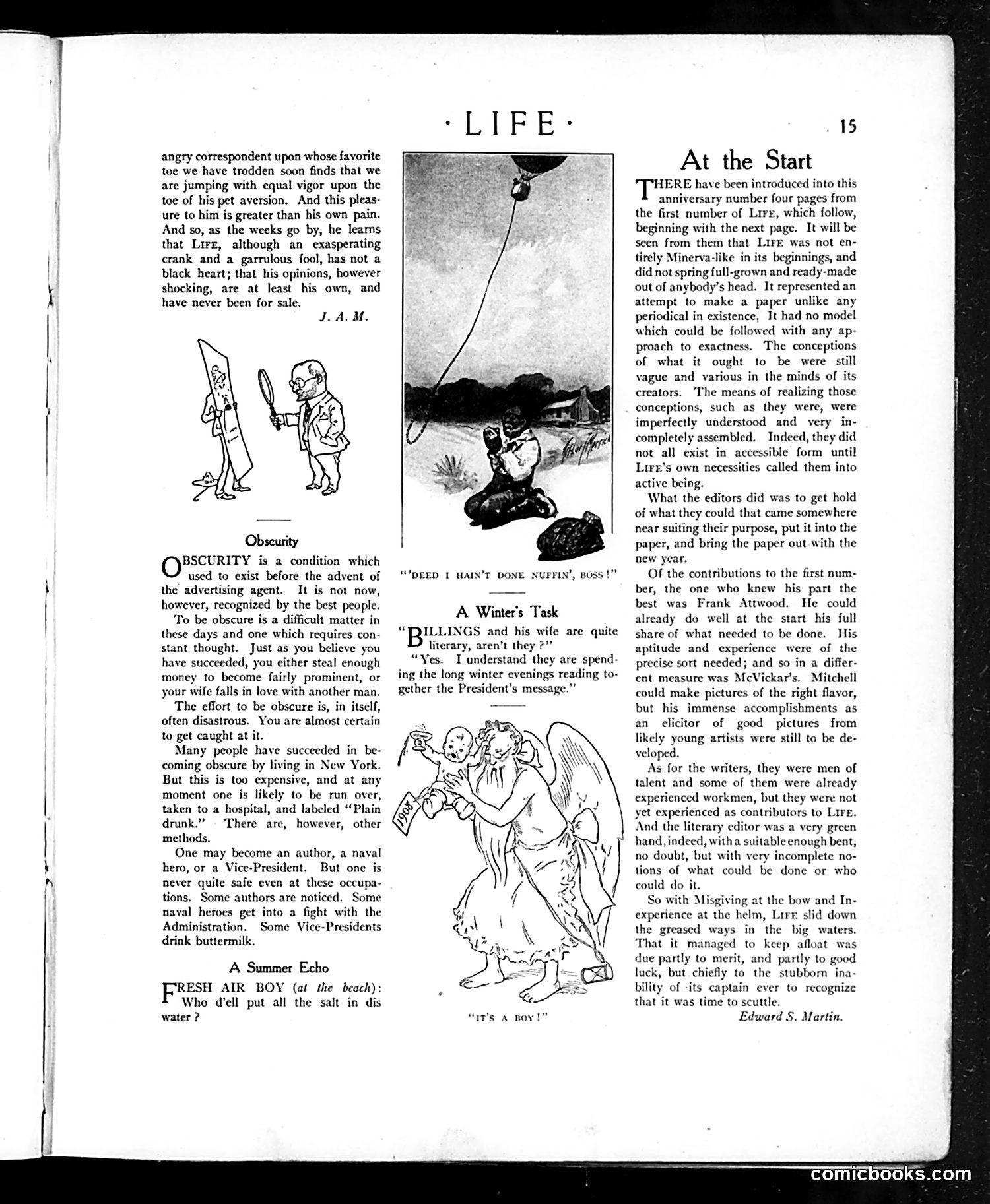
This page contains several satirical pieces typical of *Life* magazine's humor: **"Obscurity"** mocks the impossibility of remaining obscure in modern America. The essay humorously argues that attempting to hide from public notice inevitably fails—whether through scandal (stealing money, infidelity) or prominence (becoming an author, naval hero, or Vice-President). The joke satirizes American society's obsession with publicity and celebrity. **"A Summer Echo"** is a brief racial stereotype joke featuring a Black child at the beach, using dialect humor common to the era's offensive comedic conventions. **"A Winter's Task"** jokes about a couple reading President Theodore Roosevelt's message aloud during winter evenings—gently mocking both the tedium of presidential rhetoric and the pretensions of "literary" couples. The page primarily introduces *Life*'s inaugural issue, explaining the magazine's experimental, unpolished origins with various talented contributors still learning their roles. Edward S. Martin's editorial suggests *Life* began without a clear model or unified vision.
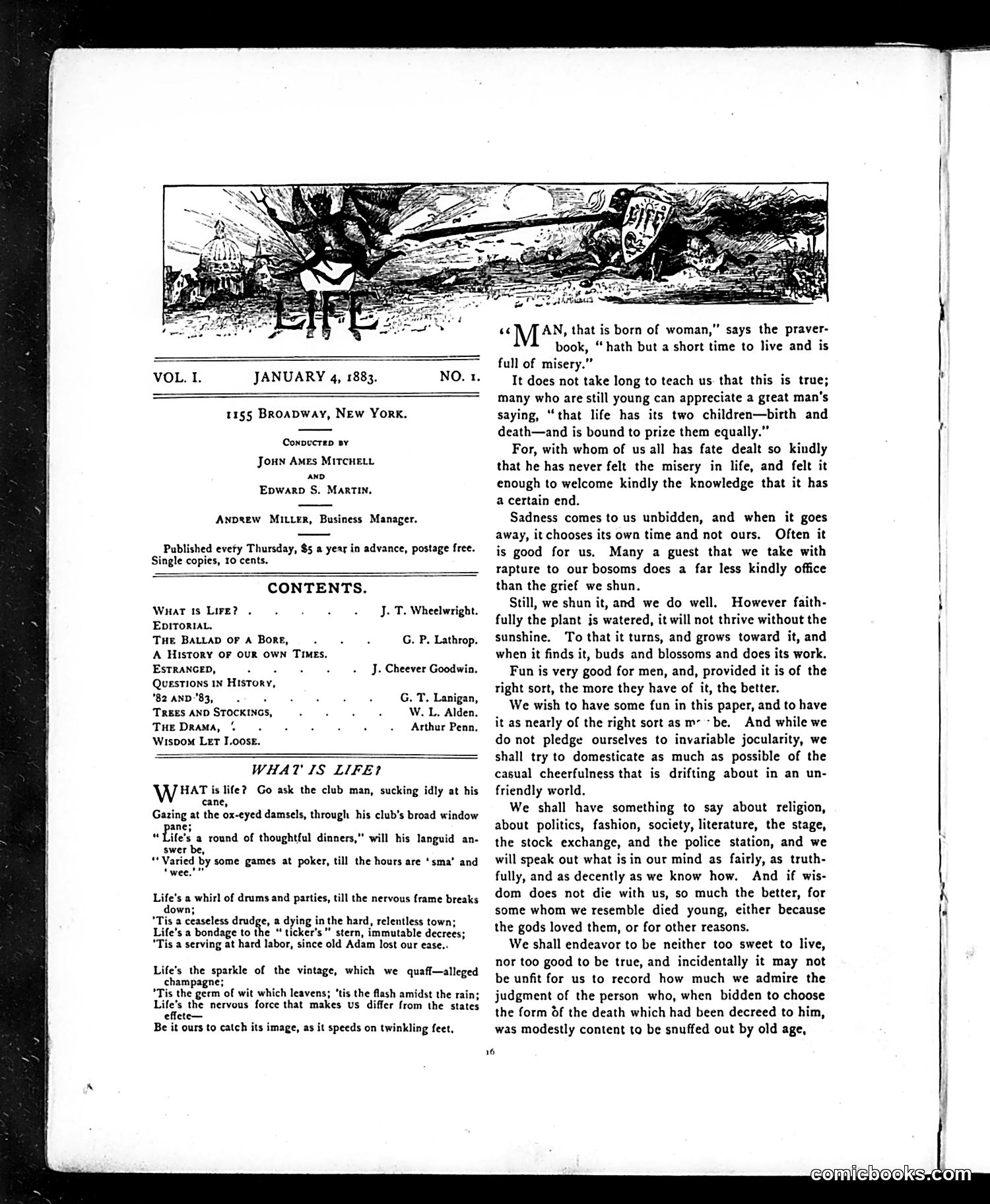
This is the **debut issue** of Life magazine, a new satirical weekly founded by John Ames Mitchell and Edward S. Martin. The page shows the table of contents and opening editorial material. The illustrated header depicts a figure under a gnarled tree—likely representing Life itself or human existence—a visual metaphor for the issue's philosophical tone. The lead poem "What is Life?" presents satirical vignettes of contemporary leisure-class life: the idle "club man" obsessed with dinners and poker, those enslaved to stock-market "tickers," those chasing champagne and wit. The editorial then pivots to serious reflection, acknowledging life's inevitable misery while advocating for "casual cheerfulness" and honest commentary on religion, politics, fashion, literature, and society. The magazine announces its ambitious scope: irreverent yet decent social criticism, steering between frivolity and solemnity. This founding statement emphasizes the new publication's intent to satirize American life while maintaining moral seriousness.
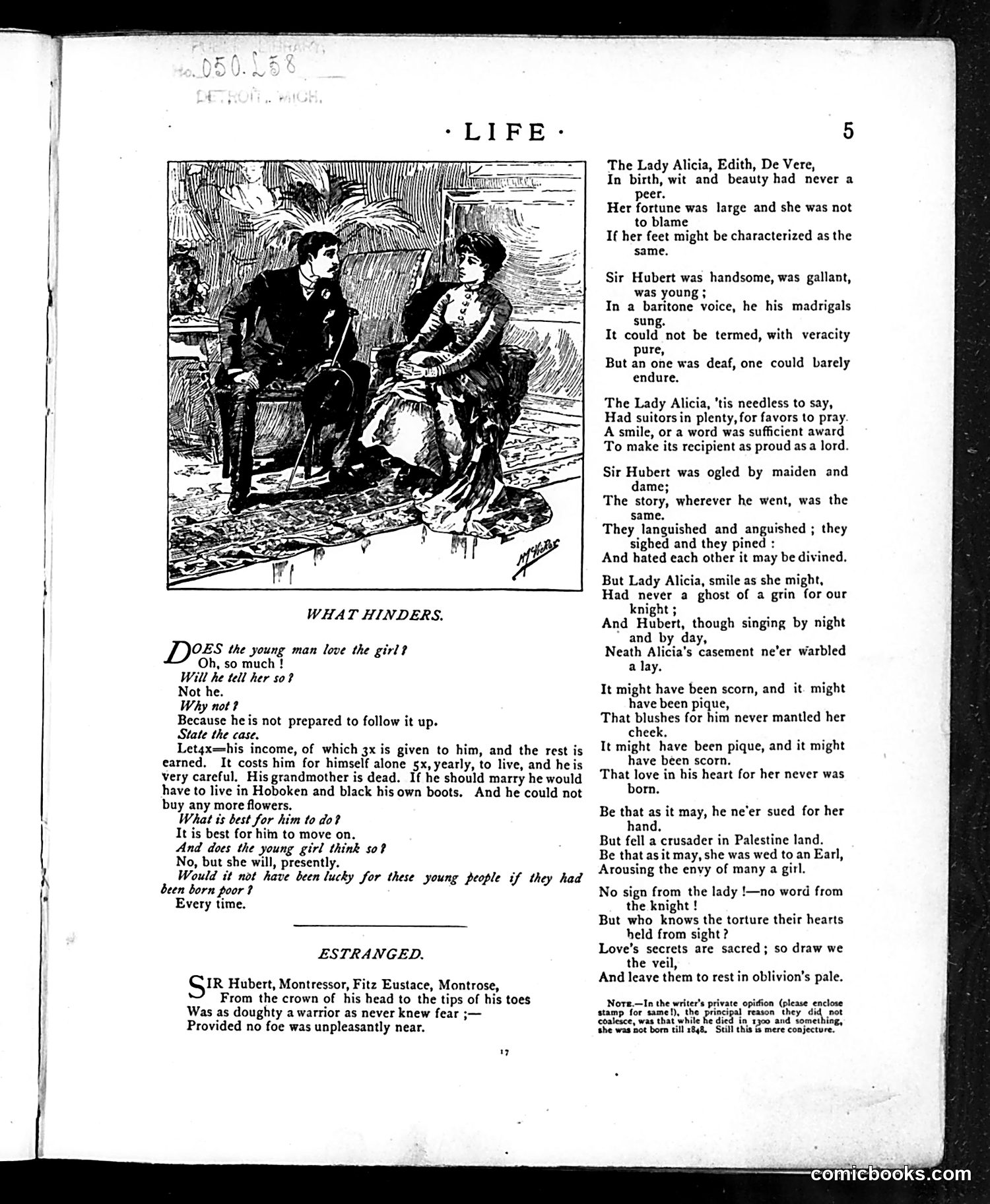
This page presents a satirical narrative poem about thwarted romance between Sir Hubert and Lady Alicia. The accompanying illustration shows the two figures in an interior setting, depicting their emotional distance. **The Satire's Point:** The dialogue section "What Hinders" uses mathematical logic to explain why Sir Hubert cannot propose marriage despite his feelings. He earns income *3x* but spends *5x* yearly on himself alone—meaning marriage would force him into poverty in Hoboken, required to black his own boots. The satire mocks Victorian economic barriers to romance: two people clearly attracted to each other remain separated purely by financial constraints. **The Irony:** The poem's conclusion reveals both characters eventually marry others, their unspoken feelings forever buried. The note at page's bottom suggests the writer blames this outcome on economic hardship rather than lack of affection. This critiques how 19th-century class anxieties and financial realities prevented genuine emotional connection from developing into marriage.
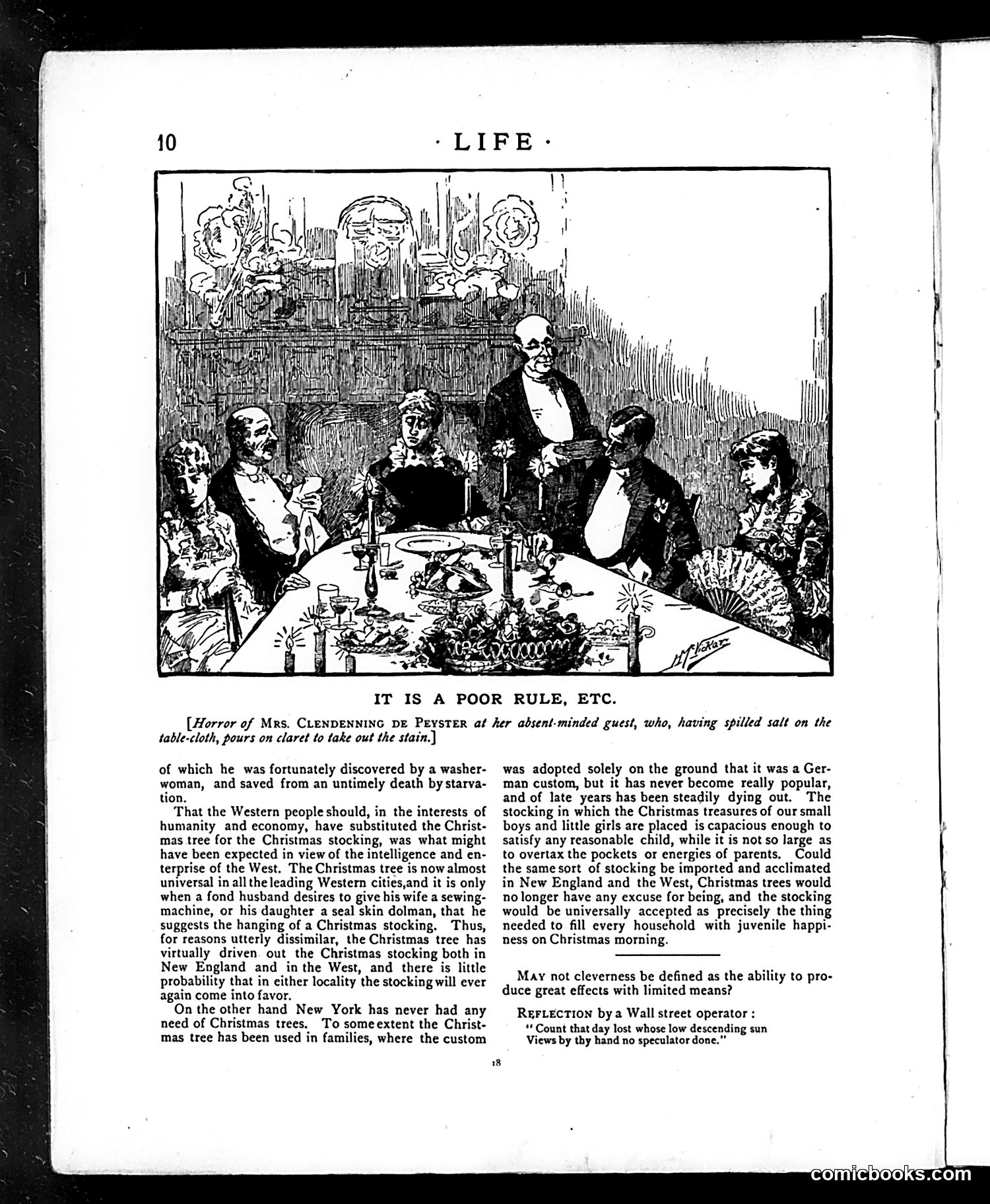
This page contains a satirical cartoon and accompanying essay about Christmas customs in 19th-century America. **The Cartoon:** Shows a formal dinner party where an absent-minded guest has spilled salt on the tablecloth. A horrified hostess (identified in the caption as Mrs. Clendenning De Peyster) watches as the guest pours claret wine on the stain to remove it—making matters worse. The joke plays on the phrase "it is a poor rule that works both ways": the guest mistakes the remedy for wine stains as applicable to salt stains. **The Essay:** Argues that Christmas trees, adopted from German tradition, have replaced Christmas stockings in Western cities due to their "intelligence and enterprise," but remain unpopular in New York, where stockings are more practical and economical. **The Point:** The satire mocks both social pretension (the fussy hostess) and the arbitrary adoption of foreign customs without questioning their utility. The closing quip about Wall Street suggests cleverness means achieving results efficiently—a dig at wasteful holiday practices.
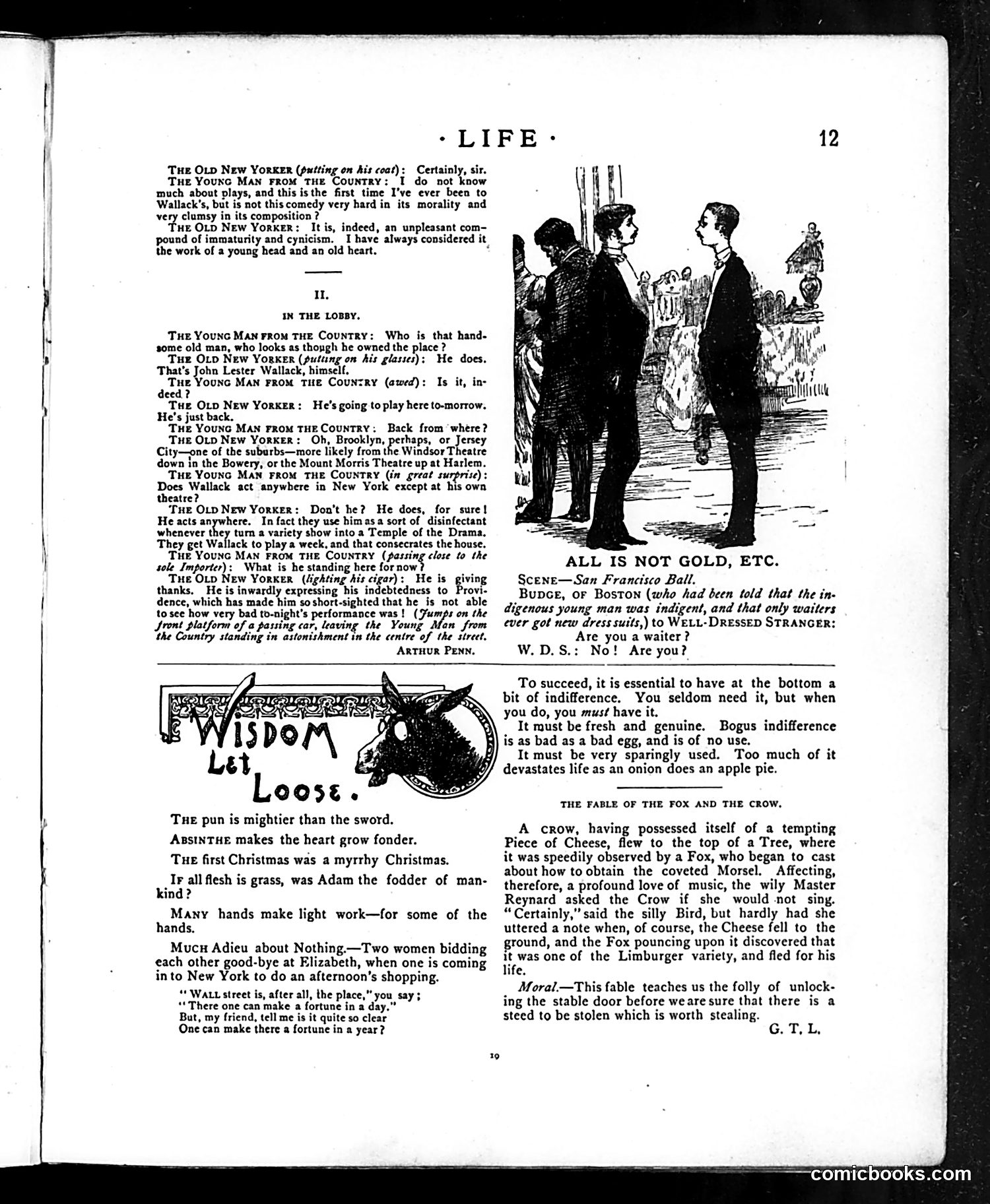
This page satirizes **John Lester Wallack**, a prominent 19th-century theater owner and actor. The main dialogue mocks his omnipresence in New York theater: though he owns Wallack's Theatre, he supposedly performs everywhere—even in disreputable variety shows and suburban theaters in Brooklyn and Jersey City—functioning as "disinfectant" to legitimize low-quality performances. The humor targets both Wallack's ego (he's so nearsighted he can't see his own bad performances) and the pretension of theater culture itself. A visiting country man expresses naive admiration, while the worldly Old New Yorker deflates it with caustic commentary. The secondary cartoon ("All Is Not Gold") jokes about class assumptions: a well-dressed stranger at a San Francisco ball is mistaken for a waiter by someone from Boston, then reverses the assumption—satirizing how appearance masks true identity or status. The page also includes aphorisms and "The Fable of the Fox and the Crow," which warns against gullibility through a corrupted classic tale.
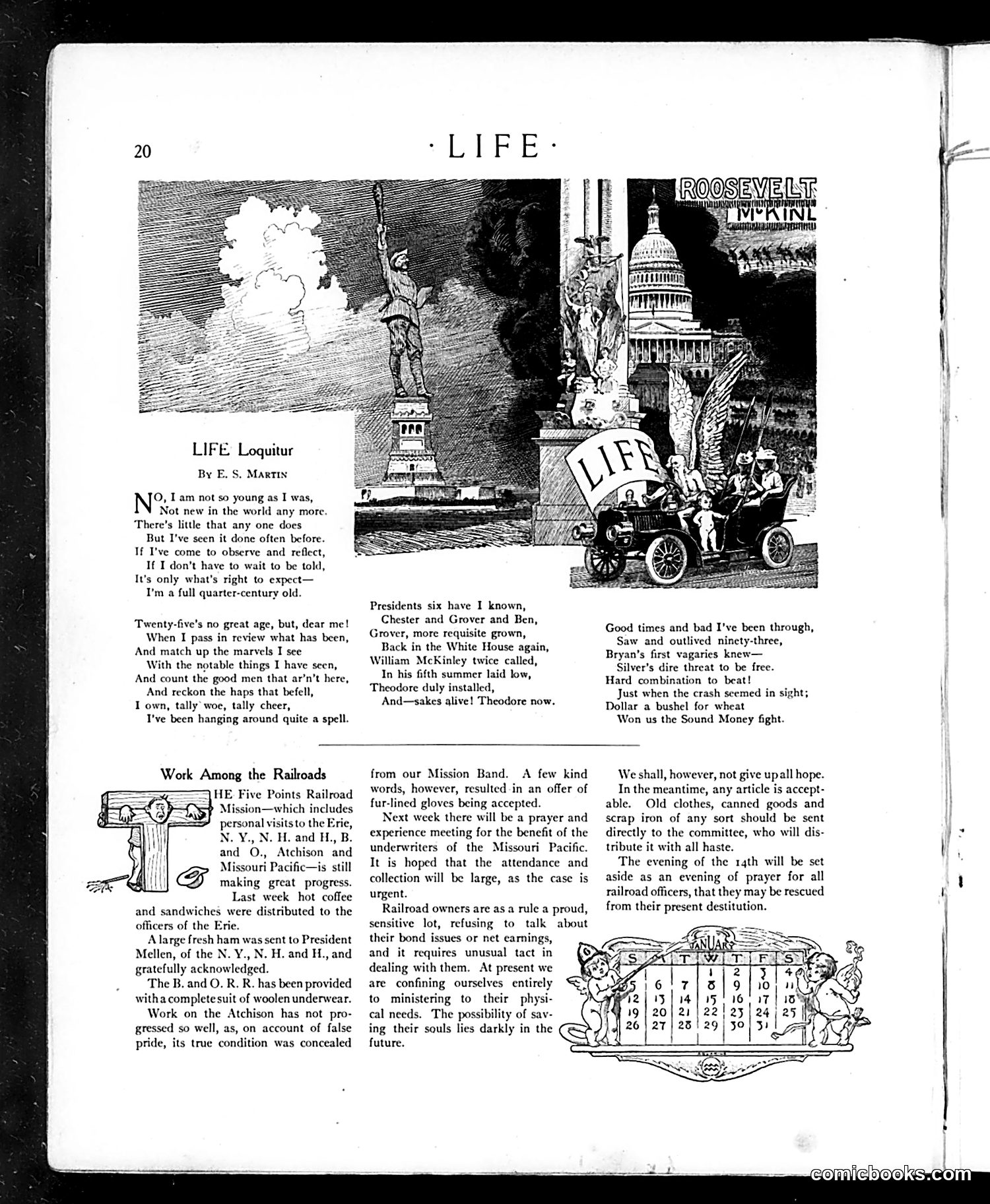
This page contains two satirical pieces mocking American institutions circa 1909. **"LIFE Loquitur"** is a poem by E.S. Martin where a "full quarter-century old" (25-year-old) narrator reflects on having witnessed six U.S. presidents: Chester Arthur, Grover Cleveland (twice), Benjamin Harrison, William McKinley (twice, with McKinley's assassination implied by "laid low"), and Theodore Roosevelt. The satire lies in the absurdity of claiming ancient wisdom at 25, while listing mundane political events (the "Sound Money fight" against William Jennings Bryan's free-silver campaign). **"Work Among the Railroads"** satirizes a charitable "Five Points Railroad Mission" that supposedly provides relief to railroad executives and owners—presenting the notion as ridiculous. The satire mocks railroad magnates as destitute figures requiring prayer meetings, hot coffee, sandwiches, and underwear donations. The phrase about "saving their souls lies darkly in the future" suggests these wealthy industrialists are morally beyond redemption, making the charitable effort absurd. Both pieces use exaggeration to criticize political complacency and corporate excess.
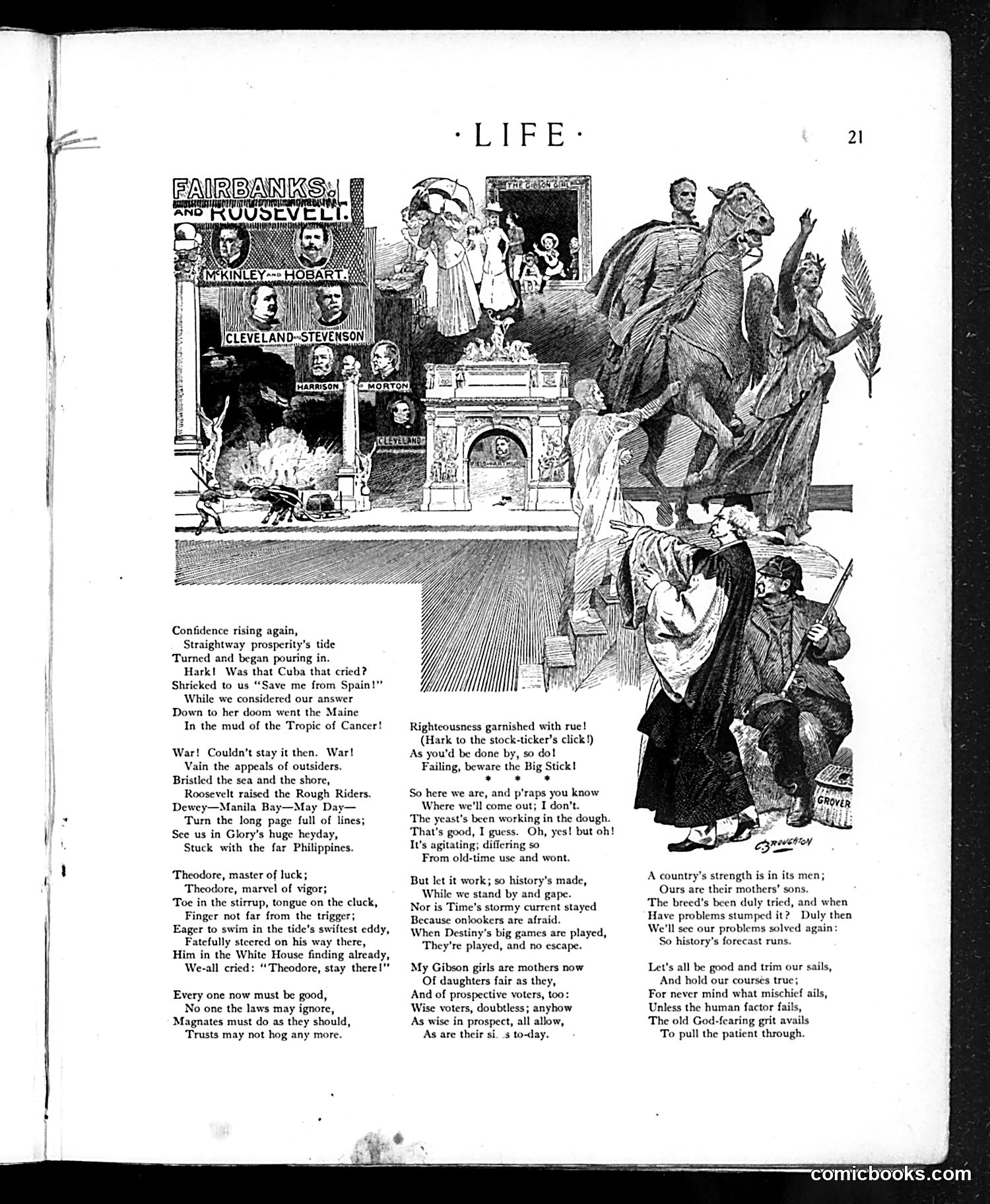
This page reflects on America's emergence as a world power following the Spanish-American War (1898). The narrative poem and accompanying illustration satirize President Theodore Roosevelt and American imperialism. **Key references:** - The USS Maine's explosion in Havana harbor (cited as the war's catalyst) - Roosevelt's "Rough Riders" cavalry unit - Commodore Dewey's victory at Manila Bay - America's controversial acquisition of the Philippines **The satire's point:** The poem traces America's confident wartime leadership under Roosevelt, then shifts to ambivalence about the consequences—particularly being "stuck with the far Philippines." The text celebrates Roosevelt's vigor ("master of luck") while expressing uncertainty about whether American expansion solved or created problems. **The political content:** References to Roosevelt wielding the "Big Stick" (his foreign policy philosophy), praise for enforcing laws against trusts, and concern about social change ("Gibson girls are mothers now") reflect contemporary Progressive Era anxieties about modernization and America's new international role. The overall message expresses faith in American character while acknowledging unease with imperial overreach.
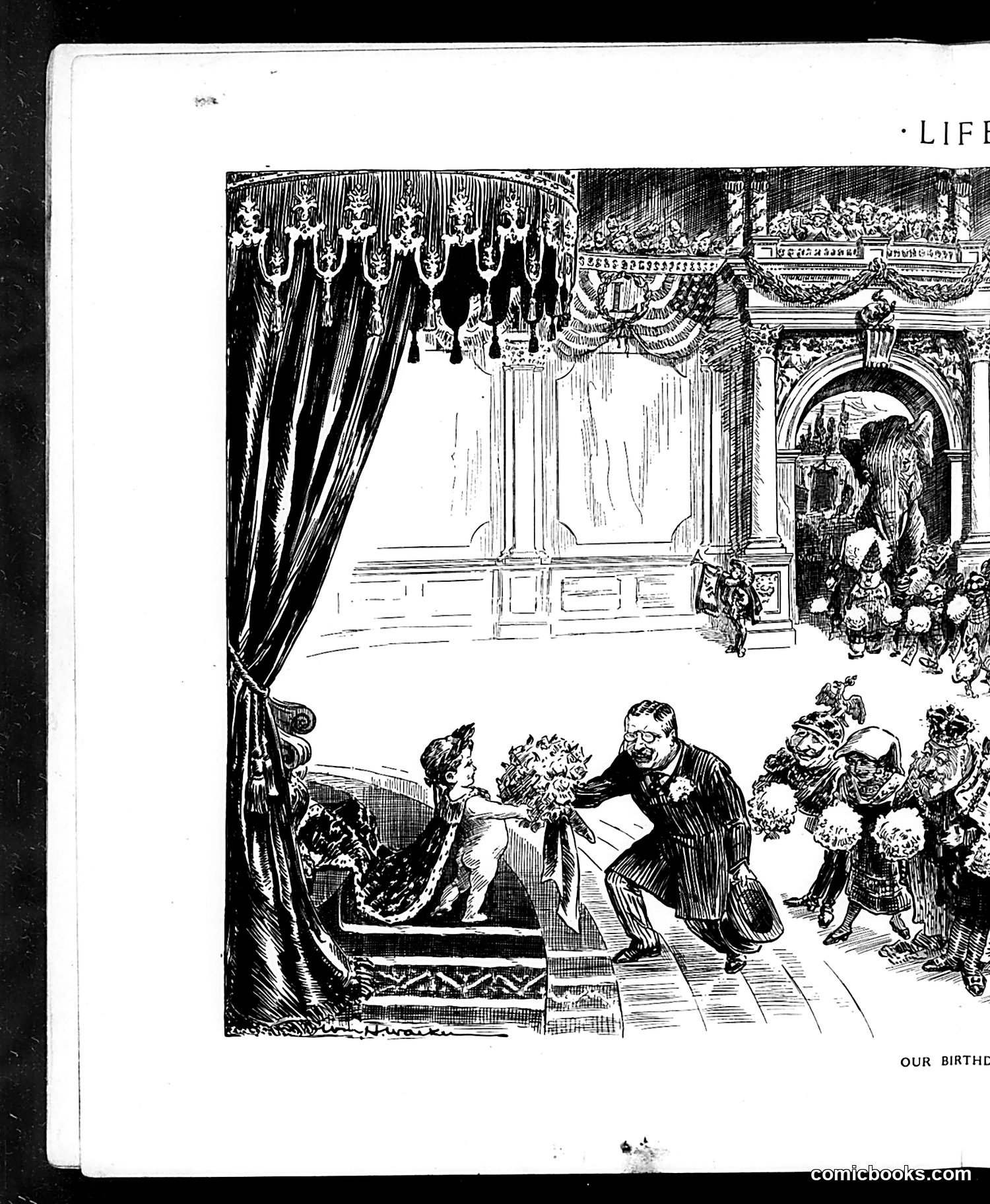
This is a satirical cartoon from *Life* magazine depicting a theatrical scene labeled "OUR BIRTH[DAY]" (text cut off). The cartoon shows a well-dressed man in the center presenting flowers to a woman seated on stage, while various grotesque caricatured figures crowd around them on the right side, appearing to celebrate or intrude upon the moment. The elaborate theatrical setting—with ornate curtains, decorated arch, and audience space—suggests this satirizes some formal public celebration or national occasion. The contrast between the dignified central figures and the crude, exaggerated crowd implies social commentary on how common people or politicians behave during official ceremonies. Without the complete caption and publication date visible, I cannot definitively identify which specific birthday or event is being mocked, though the theatrical staging suggests political or national significance.
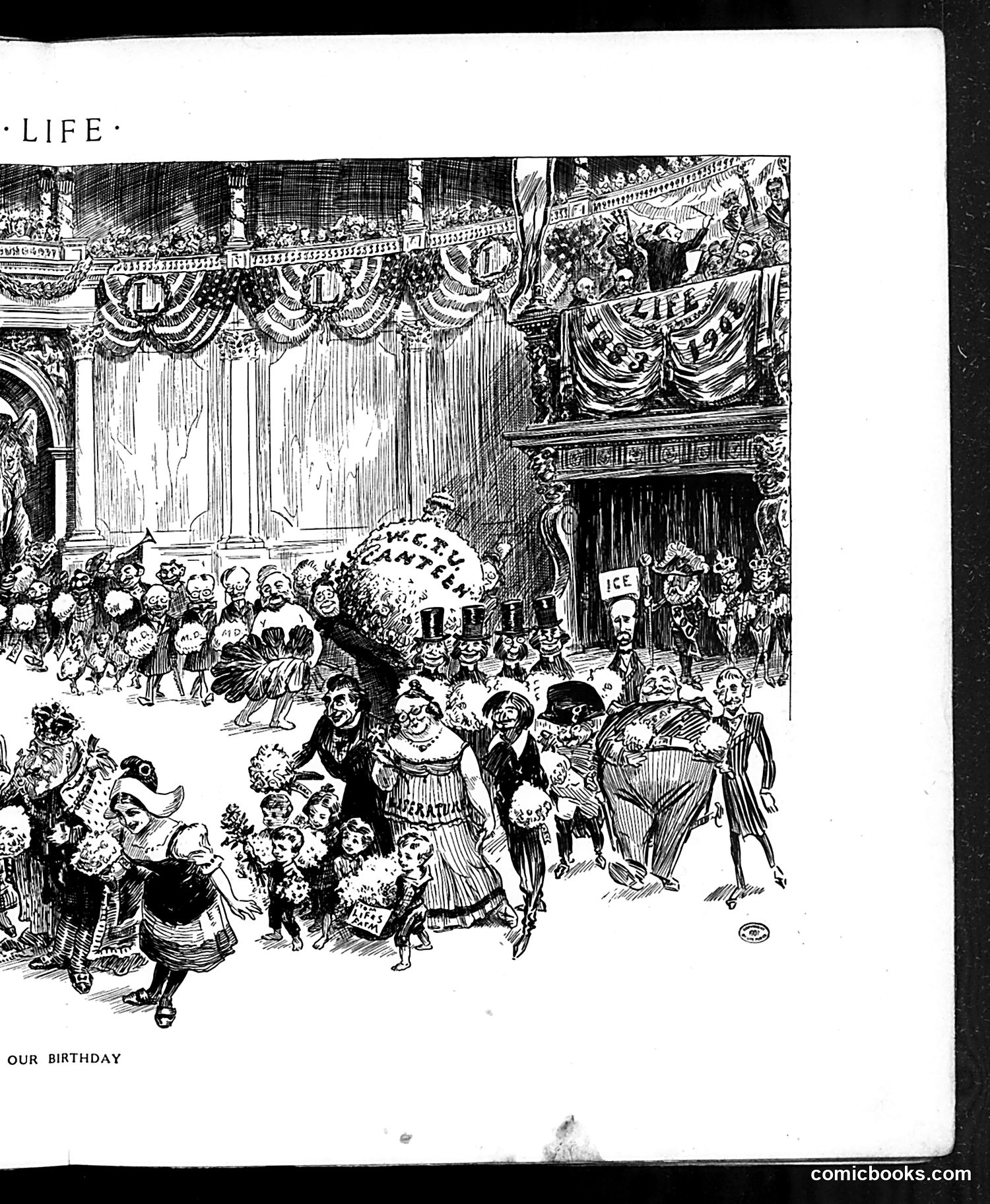
This satirical cartoon depicts a grand public celebration, likely commemorating Life magazine's anniversary ("Our Birthday"). The illustration shows an elaborate theater or civic venue decorated with patriotic bunting and shields bearing the letter "U" (possibly representing "United States" or the publication itself). The scene features well-dressed dignitaries and crowds gathered for what appears to be an official state or national celebration. A figure holding a sign marked "ICE" stands prominently, suggesting commentary on political or social circumstances of the era. The ornate architectural setting and formal pageantry indicate this celebrates something of significant national importance. Without clearer identification of specific figures or dates, the exact satirical target remains unclear, though the grandeur of the staged celebration itself may be the subject of gentle mockery.
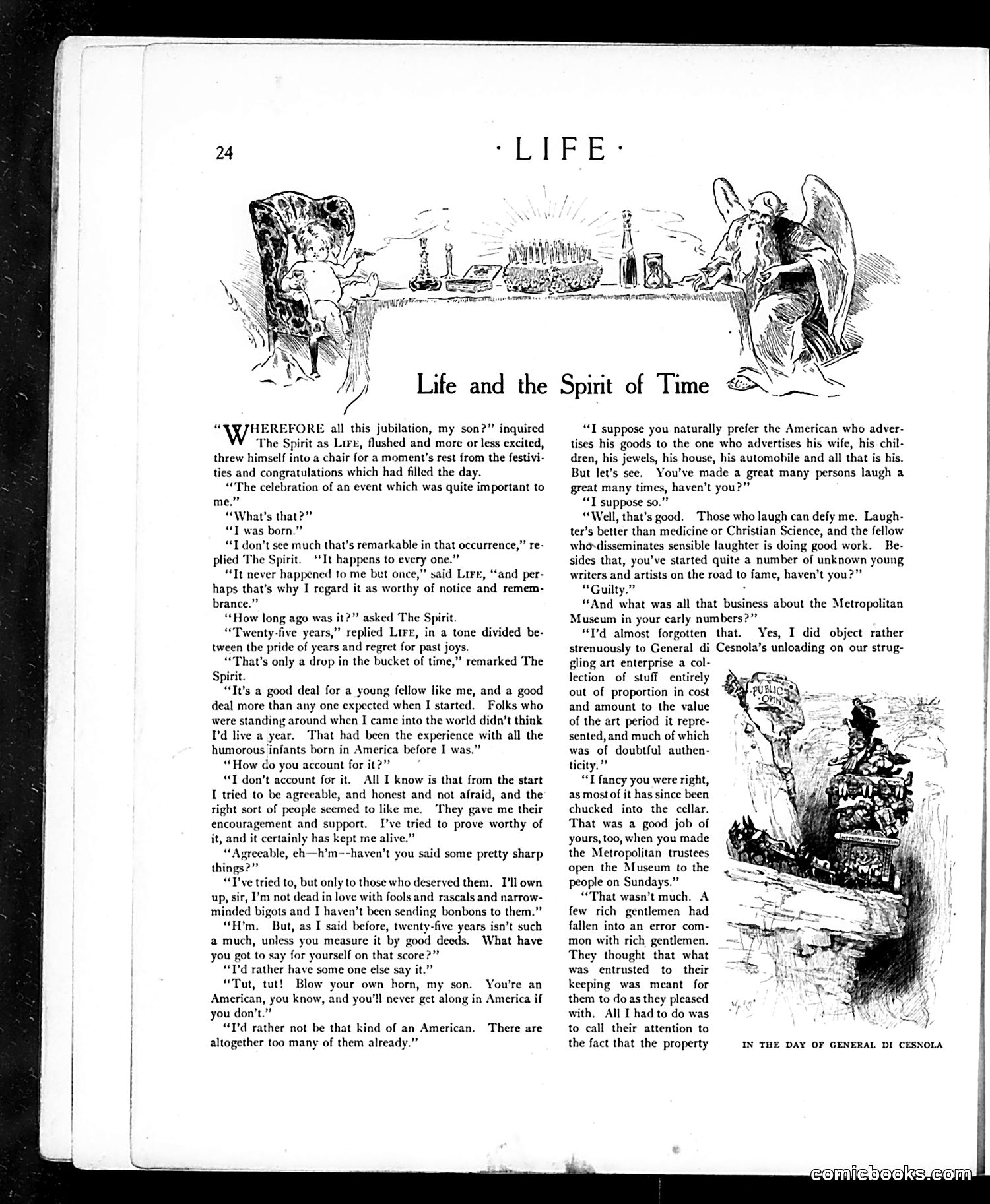
This is a dialogue between personified *Life* (the magazine) and *The Spirit of Time*, celebrating Life's 25th anniversary. The conversation defends the magazine's editorial mission and past interventions. Key references: **The Metropolitan Museum controversy**: Life objected to General Luigi Palma di Cesnola (the Met's director) acquiring a costly art collection of dubious authenticity—much later discarded. Life also advocated for opening the Museum to the public on Sundays, then restricted to wealthy patrons. **Life's self-image**: The magazine positions itself as a force for good—promoting laughter, supporting unknown writers and artists, and holding institutions accountable while avoiding self-promotion. **American values critique**: The Spirit chides Life for not "blowing its own horn" like typical Americans, but Life refuses, claiming there are already too many self-aggrandizers. The cartoon illustrates Life's perceived role: a moral watchdog for American cultural institutions and social progress, guided by humor rather than sanctimony.
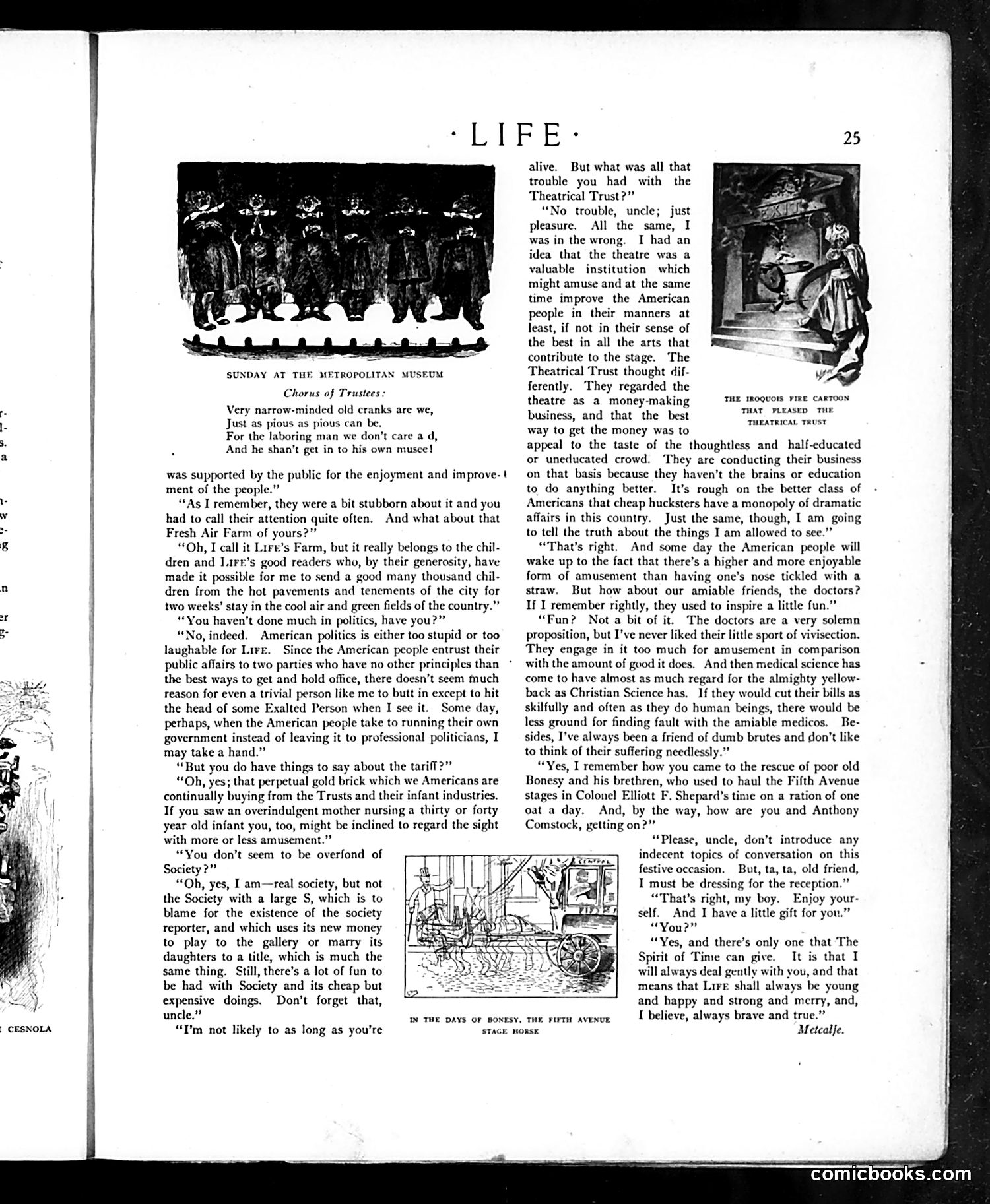
This page features a satirical interview with Life's editor, presented as a dialogue. The main cartoon ("Sunday at the Metropolitan Museum") shows museum trustees depicted as "narrow-minded old cranks" who exclude working-class visitors, satirizing wealthy institutions' gatekeeping despite public funding. The interview critiques several targets: 1. **The Theatrical Trust** — a monopoly controlling American theater, condemned for appealing to "thoughtless and half-educated" audiences with cheap entertainment rather than improving theatrical art 2. **American politics** — dismissed as too stupid to merit serious commentary, controlled by professional politicians rather than the people 3. **High society** — mocked for using new money to pursue titles and social status through convenient marriages 4. **The medical profession** — criticized for overusing vivisection (animal testing) for amusement rather than genuine scientific advancement The satirist positions himself as a gadfly targeting institutions that exploit or fail the American public, particularly working-class people and those seeking genuine culture or education.
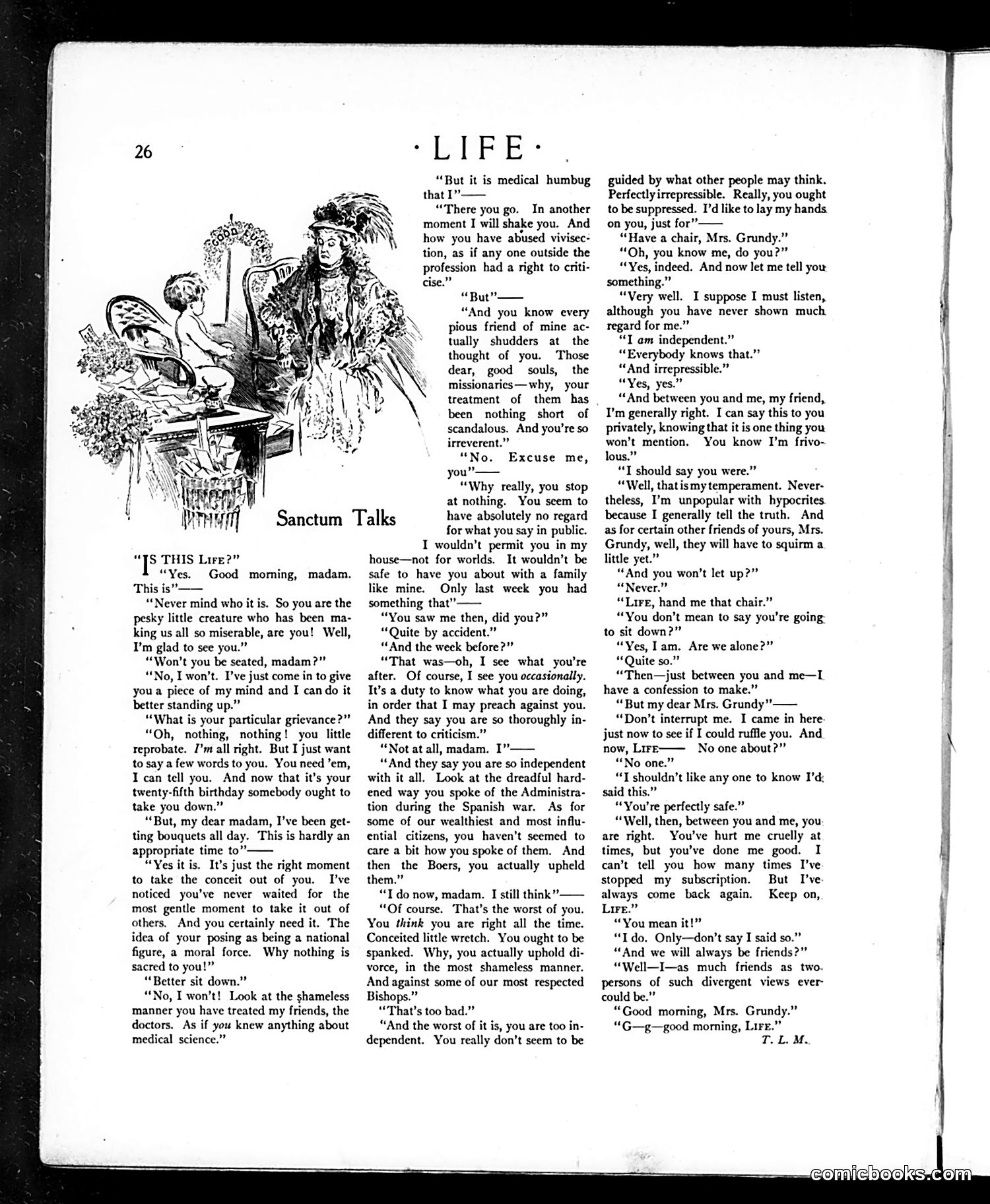
This dialogue cartoon personifies **Life magazine itself** as a young, irreverent character confronted by **"Mrs. Grundy,"** a stock figure representing rigid Victorian morality and social convention. Mrs. Grundy embodies conservative gatekeepers—religious leaders, wealthy citizens, and respectable society—who police public behavior. She scolds Life for: mocking doctors and vivisection, disrespecting missionaries, irreverence toward authority, candid speech about the Spanish-American War and the Boers, and supporting divorce against "respected Bishops." Life responds that it speaks truth independently, unconcerned with what "other people may think." The satire mocks those who demand conformity while hypocritically consuming the very irreverent content they publicly condemn (Mrs. Grundy admits she reads Life regularly "to preach against"). The cartoon celebrates Life's 25th birthday by defending satirical journalism's right to challenge establishment pieties—a core mission of the magazine.
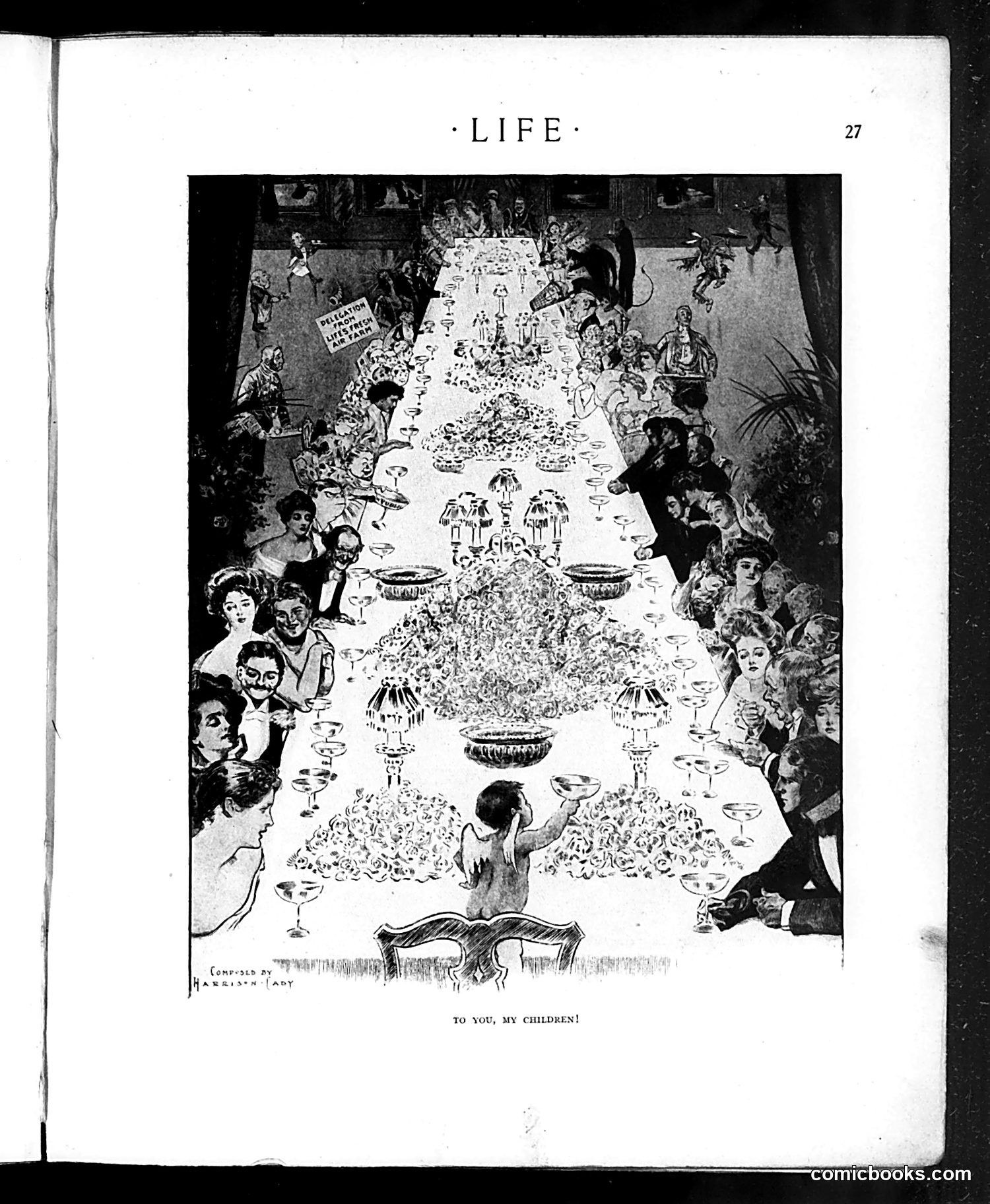
This is a satirical illustration by Harrison Cady titled "To You, My Children!" The cartoon depicts an elaborate banquet table viewed from above, with wealthy diners seated on both sides. The table itself is shaped like a large human head or face, filled with elaborate food and decorative elements. The satire appears to critique wealth inequality and excess: the affluent guests feast lavishly while appearing self-satisfied, while the composition—making the feast itself anthropomorphic—suggests they are consuming from or within a human figure, possibly implying parasitic relationships or the dehumanizing nature of unchecked wealth accumulation. The title "To You, My Children!" suggests ironic commentary on what privileged society is "feeding" or passing down to the next generation—materialism and excess rather than more meaningful values.
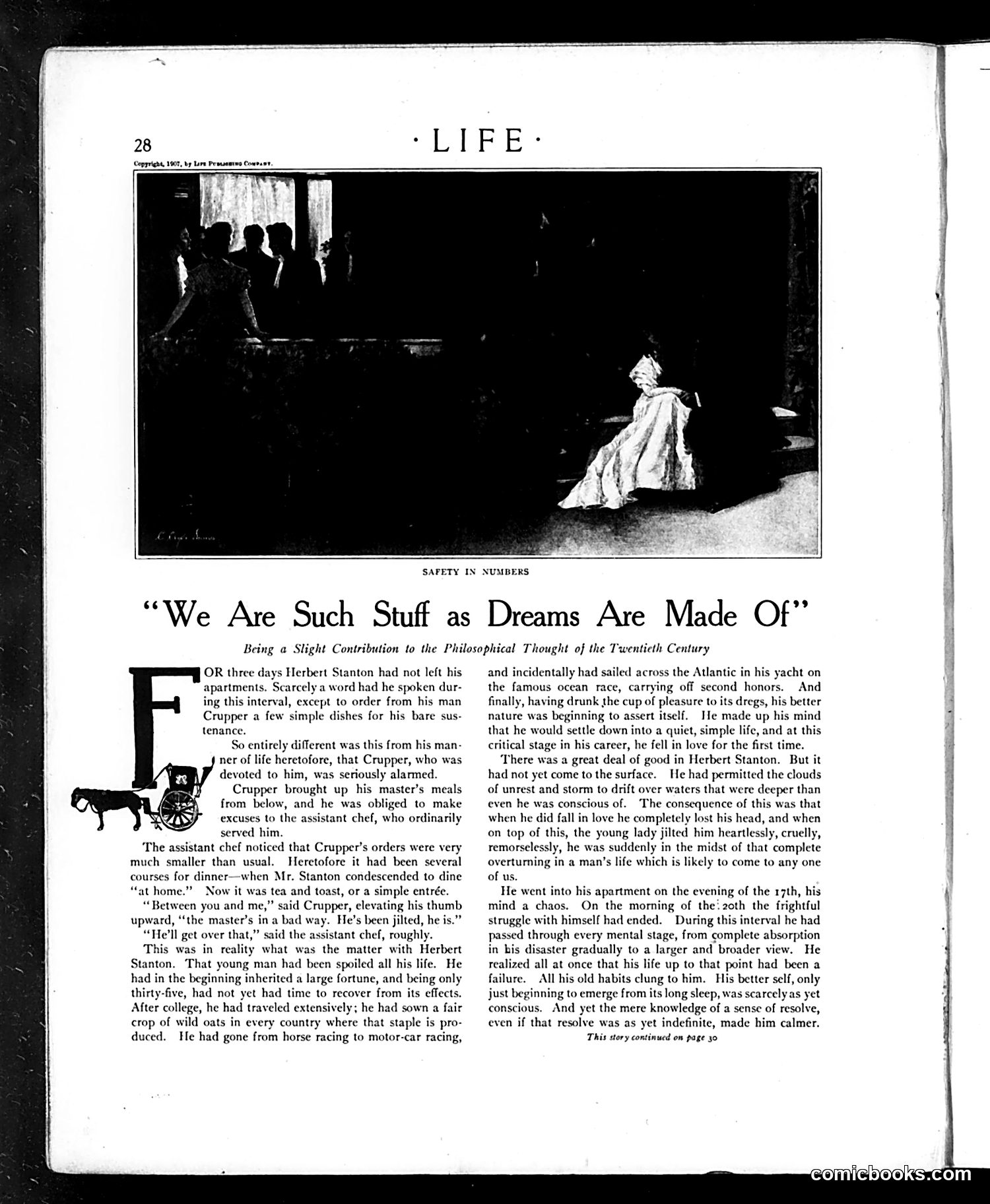
This is the opening installment of a serialized short story about Herbert Stanton, a wealthy, idle man who experiences a spiritual crisis after being jilted by a young woman. The narrative contrasts his empty, pleasure-seeking life—racing horses, motor cars, yachting—with an emerging "better nature." The illustration titled "Safety in Numbers" shows a woman in an elegant white dress isolated in the lower right, observed from a distance by silhouetted figures in shadow above—visually representing her social prominence or the attention she commands, possibly depicting the woman who rejected the protagonist. The subtitle describes this as "a slight contribution to the philosophical thought of the twentieth century," suggesting gentle satire of contemporary ideas about personal transformation and moral awakening. The story explores themes of wealth, dissolution, and redemption that appealed to Life's educated readership in 1907.
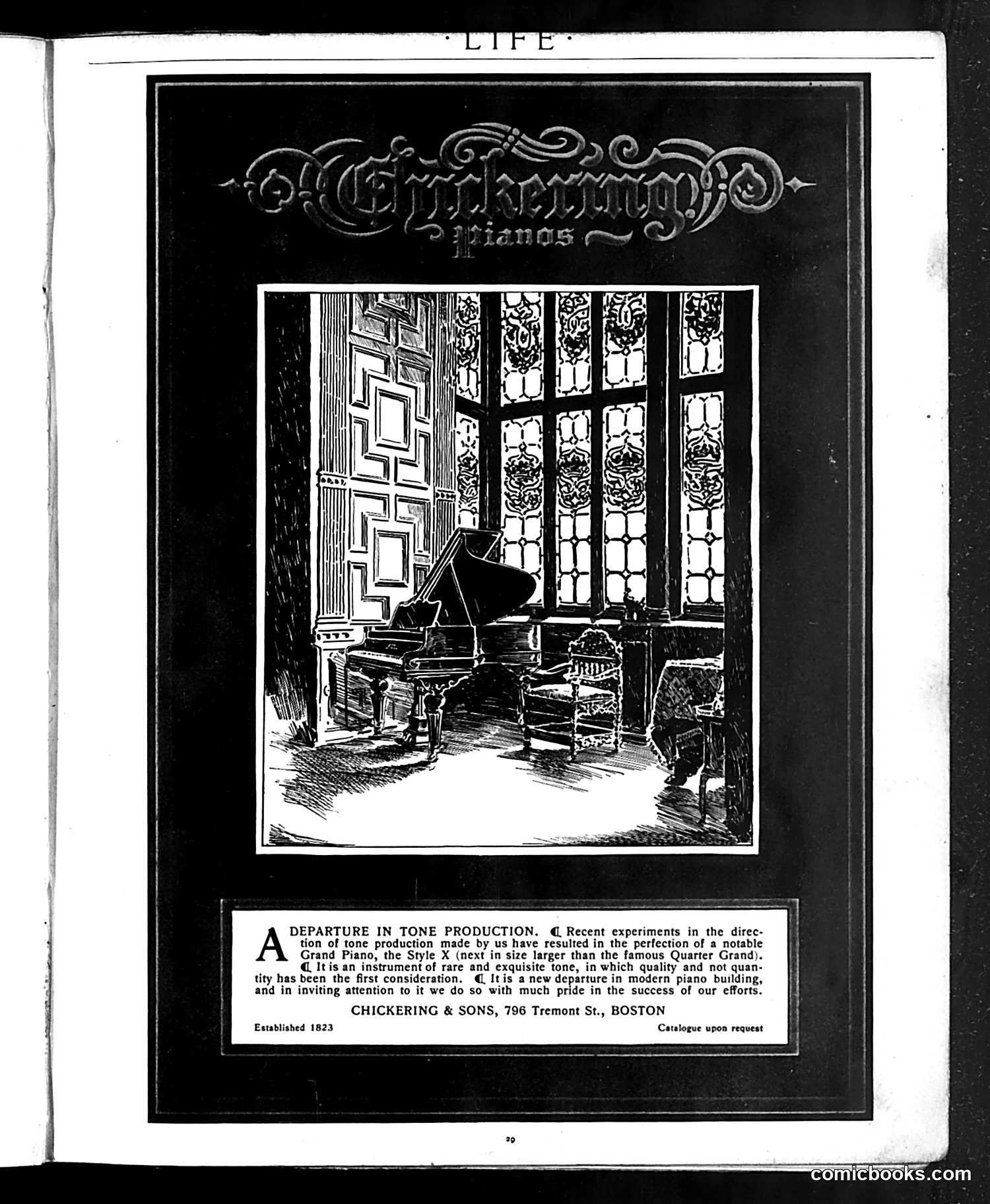
This page is primarily a **piano advertisement**, not a political cartoon. It's a Chickering & Sons advertisement for their new "Style X" Grand Piano, established in Boston in 1823. The illustration shows an elegant interior with a grand piano positioned before large decorative windows, suggesting luxury and refined taste. The ornate architectural details—geometric wall patterns and ornamental window designs—emphasize the piano's place in upscale homes. The ad's text emphasizes that the new piano prioritizes **quality of tone over quantity**, positioning it as a sophisticated instrument for discerning musicians. This was a marketing strategy appealing to wealthy consumers who valued artistic merit and craftsmanship during the early 20th century. There is **no political satire** here—it's straightforward commercial promotion typical of Life magazine's advertising content.
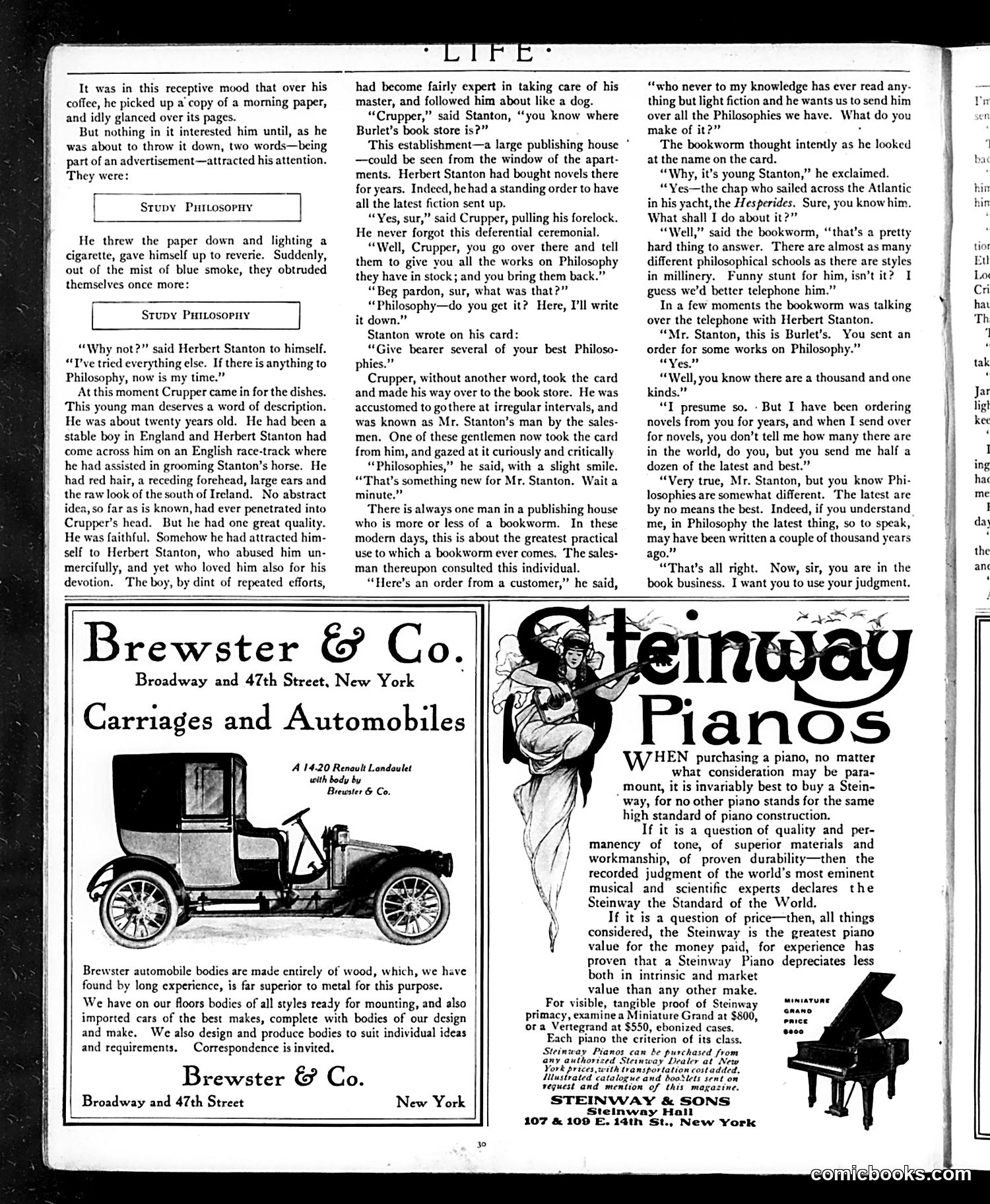
This is a humorous short story (not a political cartoon) satirizing casual intellectual pretension. The protagonist, wealthy Herbert Stanton, impulsively decides to pursue philosophy after seeing an advertisement for "Study Philosophy" in a newspaper. He orders his simple Irish servant Crupper to buy "all the works on Philosophy" from a bookstore. The satire targets two groups: the frivolous rich man who treats serious intellectual study as a passing whim (like ordering novels), and the practical bookstore clerk who recognizes the absurdity of someone with Stanton's frivolous background suddenly demanding philosophy books without guidance. The joke centers on the impossibility of the request—philosophy encompasses thousands of conflicting schools and texts—exposing Stanton's superficial approach to self-improvement. The humor derives from the clash between casual wealth and the genuine difficulty of philosophical study.
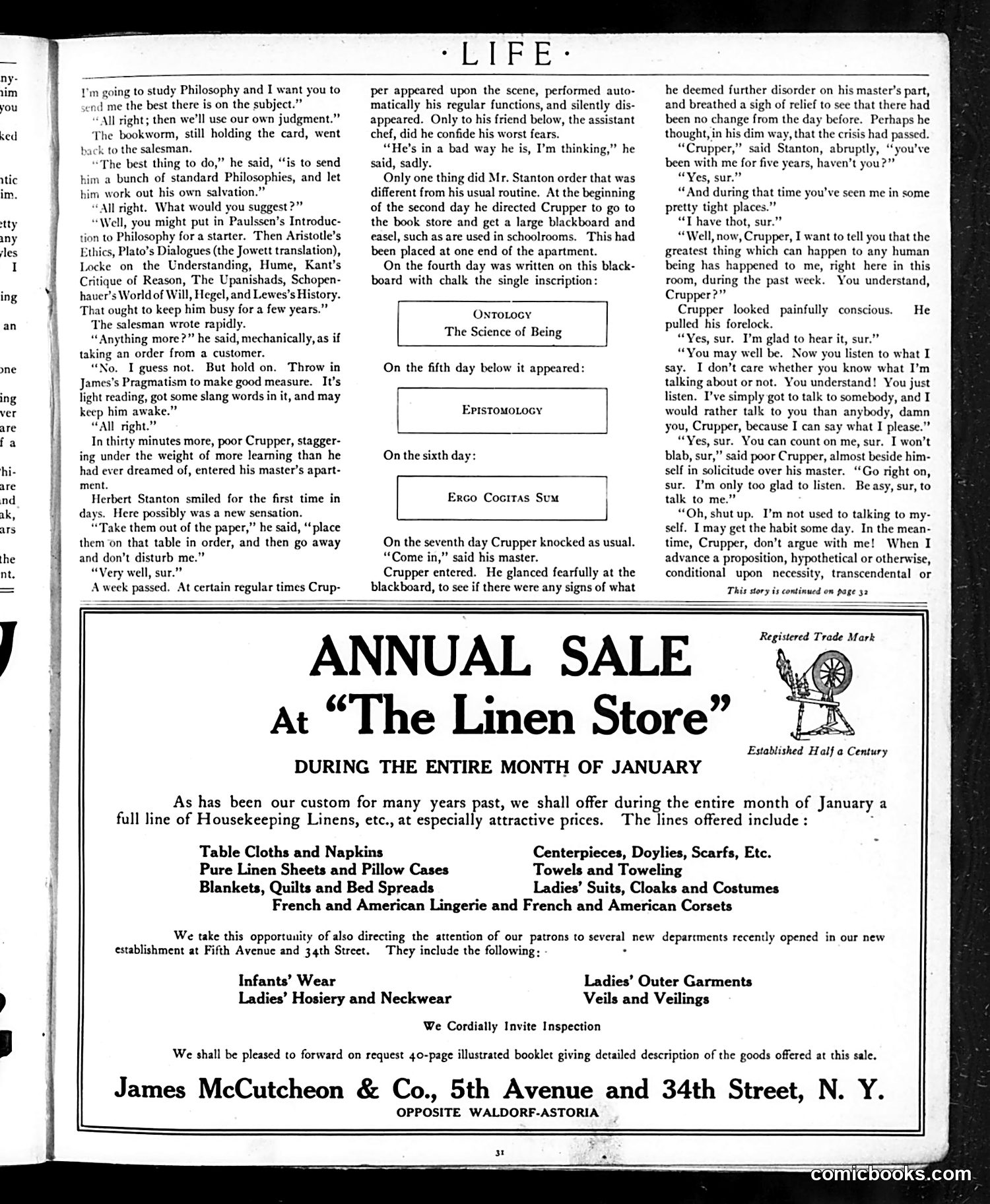
This page contains a satirical story about philosophy and intellectual pretension, not a political cartoon. **The Story's Plot:** A wealthy man (Herbert Stanton) requests philosophy books to study. His servant Crupper delivers an enormous stack of classic philosophical texts—from Aristotle to Schopenhauer—selected by a bookstore clerk. Over a week, Stanton experiences what appears to be a philosophical epiphany, writing cryptic terms on a blackboard ("Ontology," "Epistemology," "Ergo Cogitas Sum"). He then attempts to confide his "greatest" realization to his bewildered servant. **The Satire:** The joke targets intellectual affectation and the gap between philosophical ambition and actual understanding. Stanton's dramatic behavior—the blackboard inscriptions, his overwrought emotional declarations—suggests he's either genuinely confused by the dense texts or performing intellectual sophistication. His need to explain everything to an uncomprehending servant undercuts any genuine insight. The humor lies in the contrast between the weightiness of serious philosophy and the comical outcomes of amateur study. The page also includes a vintage advertisement for "The Linen Store."
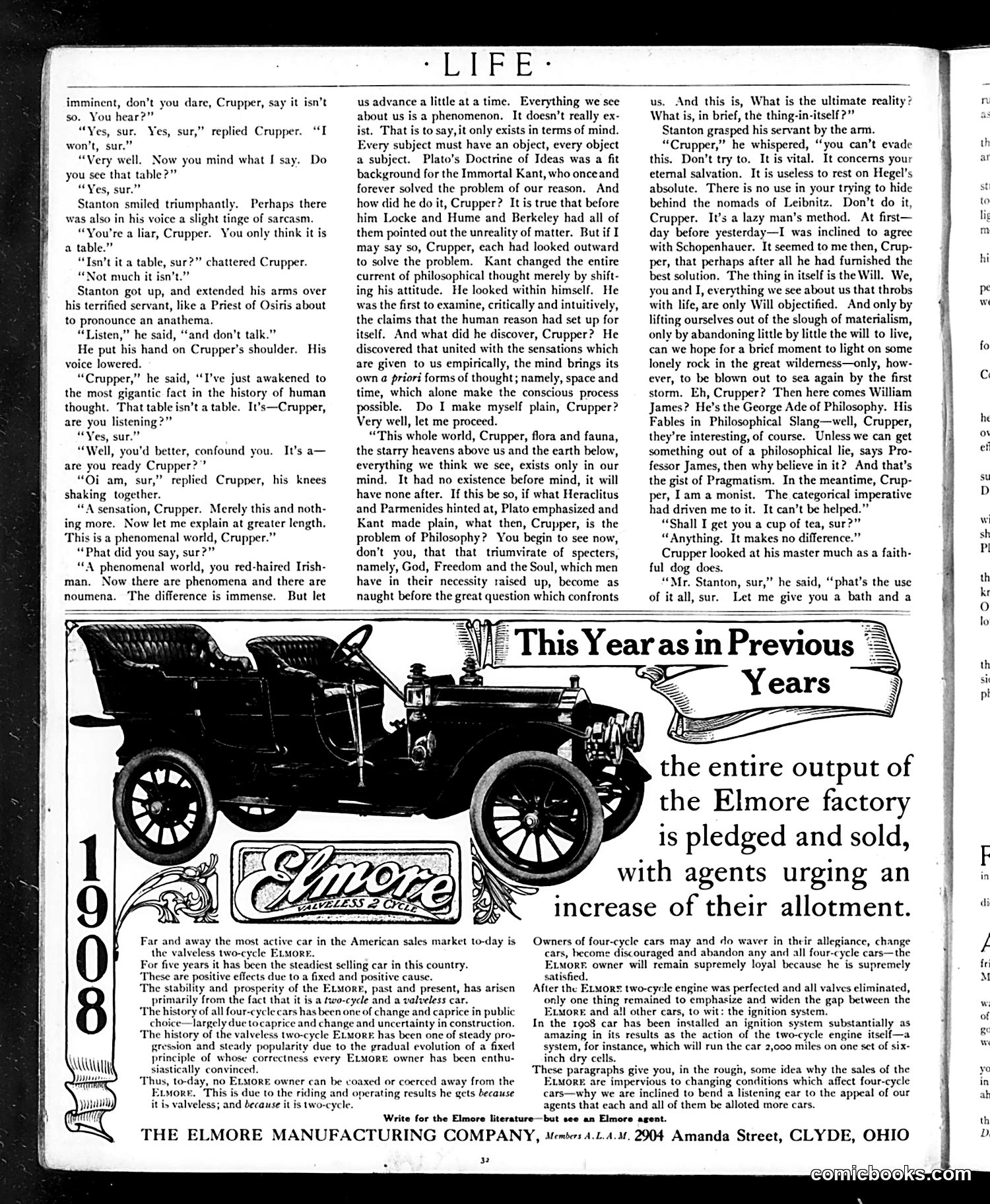
This is a satirical dialogue mocking **philosophical pedantry and pseudo-intellectualism**. A character named Stanton lectures his terrified Irish servant Crupper on German Idealist philosophy—Plato, Kant, Hegel, and Schopenhauer—using increasingly abstract jargon to prove a table "isn't really a table" but merely a "phenomenon" existing only in the mind. The satire targets: 1. **Pretentious intellectuals** who weaponize dense philosophy to confuse ordinary people 2. **The absurdity of pure idealism**—the notion that material reality doesn't exist independently of perception 3. **Class dynamics**: the servant's bewilderment and fear emphasize how such discourse serves to dominate rather than enlighten The humor lies in Stanton's escalating absurdity: he's using heavyweight philosophical concepts to deny the obvious reality of furniture, then connects this somehow to the servant's "eternal salvation." The accompanying **Elmore automobile ad** appears unrelated to the satire.
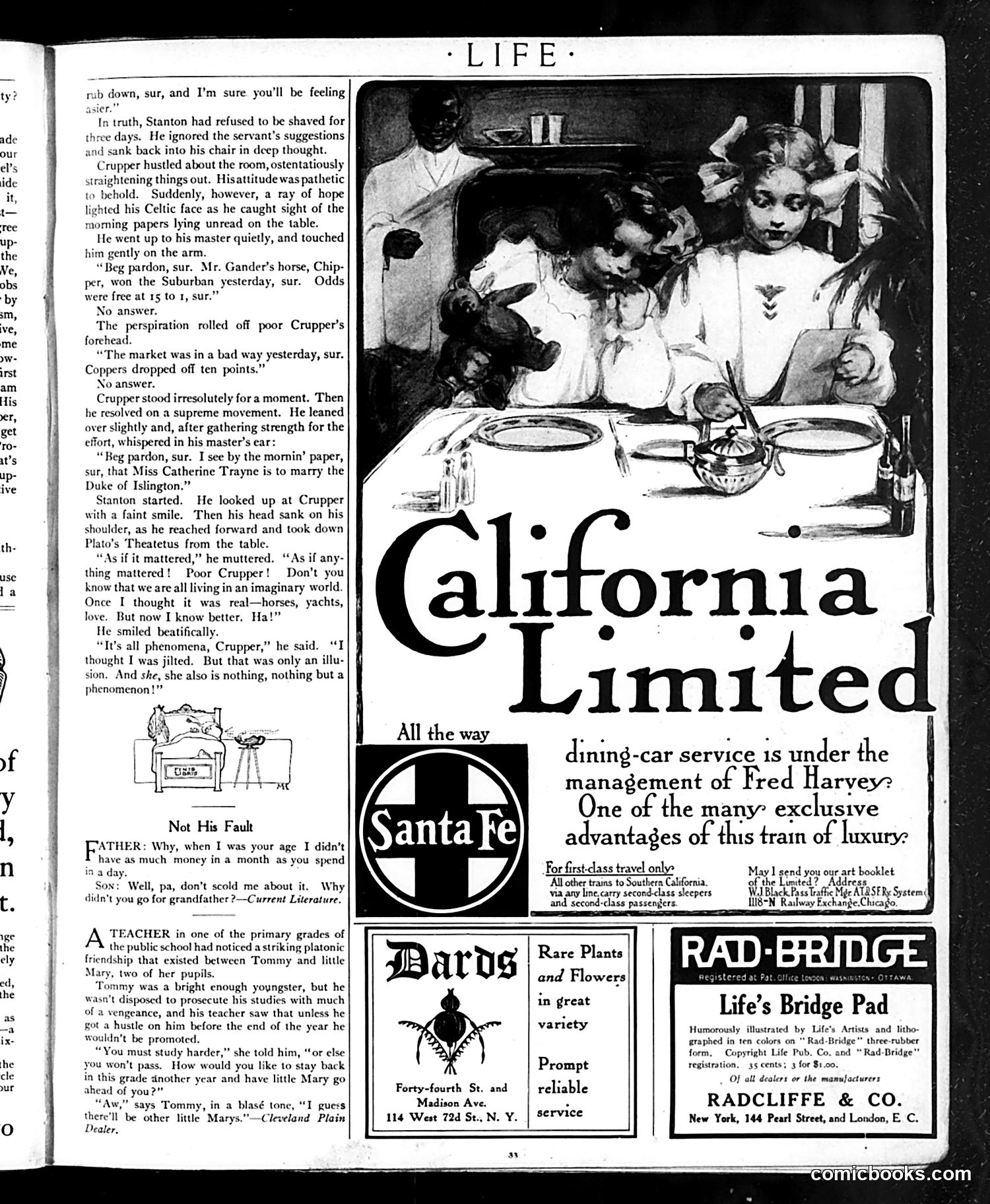
This page contains three distinct pieces: **Main Story/Cartoon**: A narrative about a wealthy man named Stanton who has become philosophically detached from life's concerns after being jilted by a woman named Miss Catherine Trayne. His servant Crupper tries unsuccessfully to engage him with news (a horse winning at odds, market crashes) until mentioning Trayne's engagement to a Duke—which momentarily shocks Stanton. However, Stanton then retreats into philosophical nihilism, dismissing all phenomena (including the woman and his own heartbreak) as illusions. The satire mocks wealthy men who adopt trendy philosophical detachment as emotional armor. **Two Short Jokes**: One about a father-son money dispute; another about a teacher trying to motivate a boy named Tommy by threatening he'll be held back while his friend Mary advances—Tommy responds indifferently that "there'll be other little Marys," satirizing boyish callousness. **Advertisements**: Santa Fe railroad's "California Limited" luxury train service, Dard's flowers, and Radcliffe's "Life's Bridge Pad" (a humorous notepad). The page is primarily satirical social commentary typical of *Life* magazine's content.
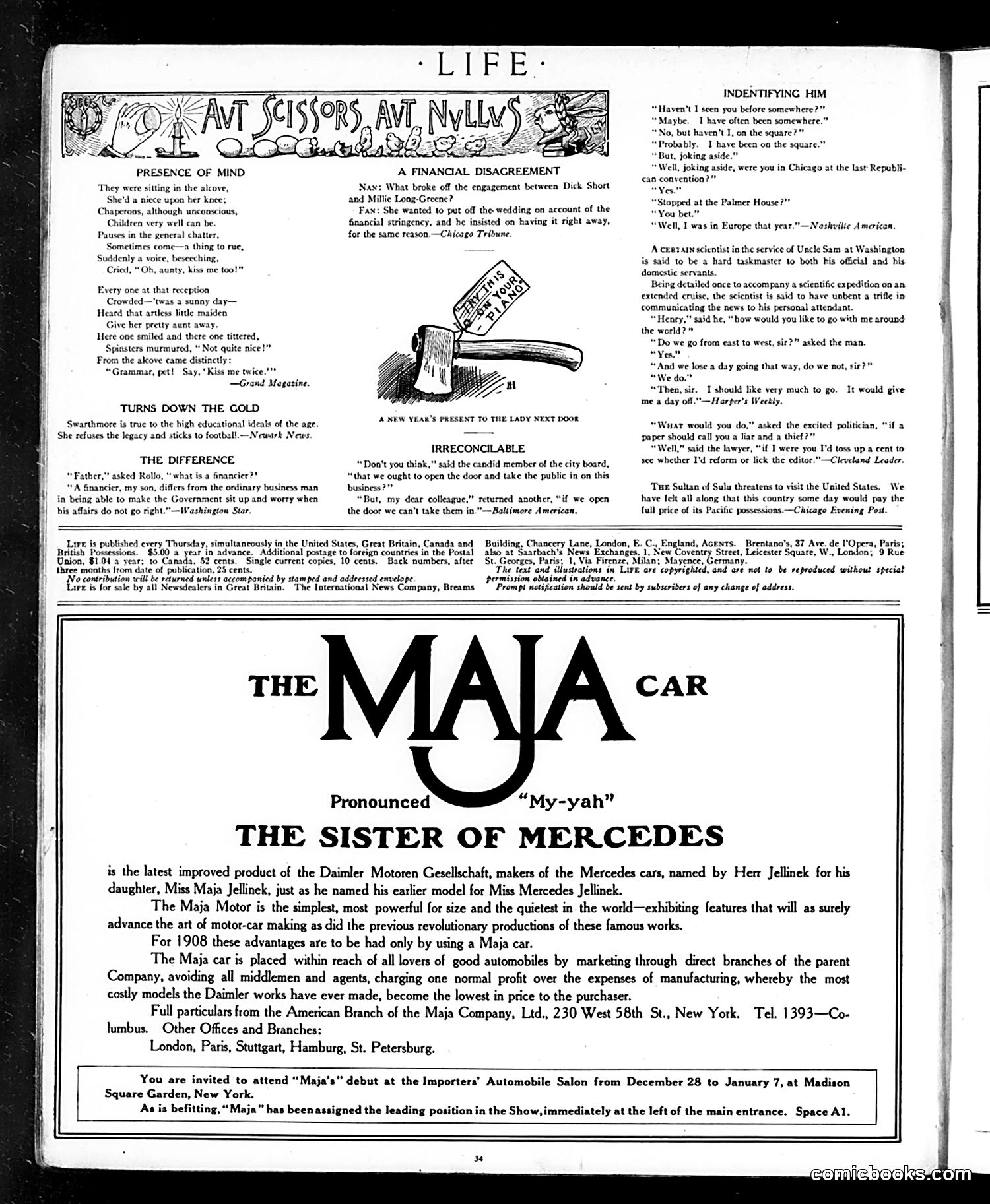
This page from **Life** magazine (a satirical publication, not the photo magazine) contains multiple short humorous pieces typical of early 20th-century American humor. **Key Content:** The cartoons and jokes satirize social awkwardness, financial hypocrisy, and political incompetence: - "Presence of Mind" mocks propriety when a child's innocent request exposes an aunt kissing her in front of chaperons - "The Difference" jokes that financiers differ from businessmen by their power to worry the government - "A Financial Disagreement" plays on the 1907-08 financial crisis: a couple disagrees on postponing their wedding due to economic stringency - "Irreconcilable" satirizes political corruption—officials can't reform if the public witnesses their dealings The page also contains a full-page **advertisement for the Maja automobile**, marketed as "sister of Mercedes," emphasizing direct sales and affordability. The humor reflects concerns about propriety, economic instability, and governmental accountability characteristic of the Progressive Era.
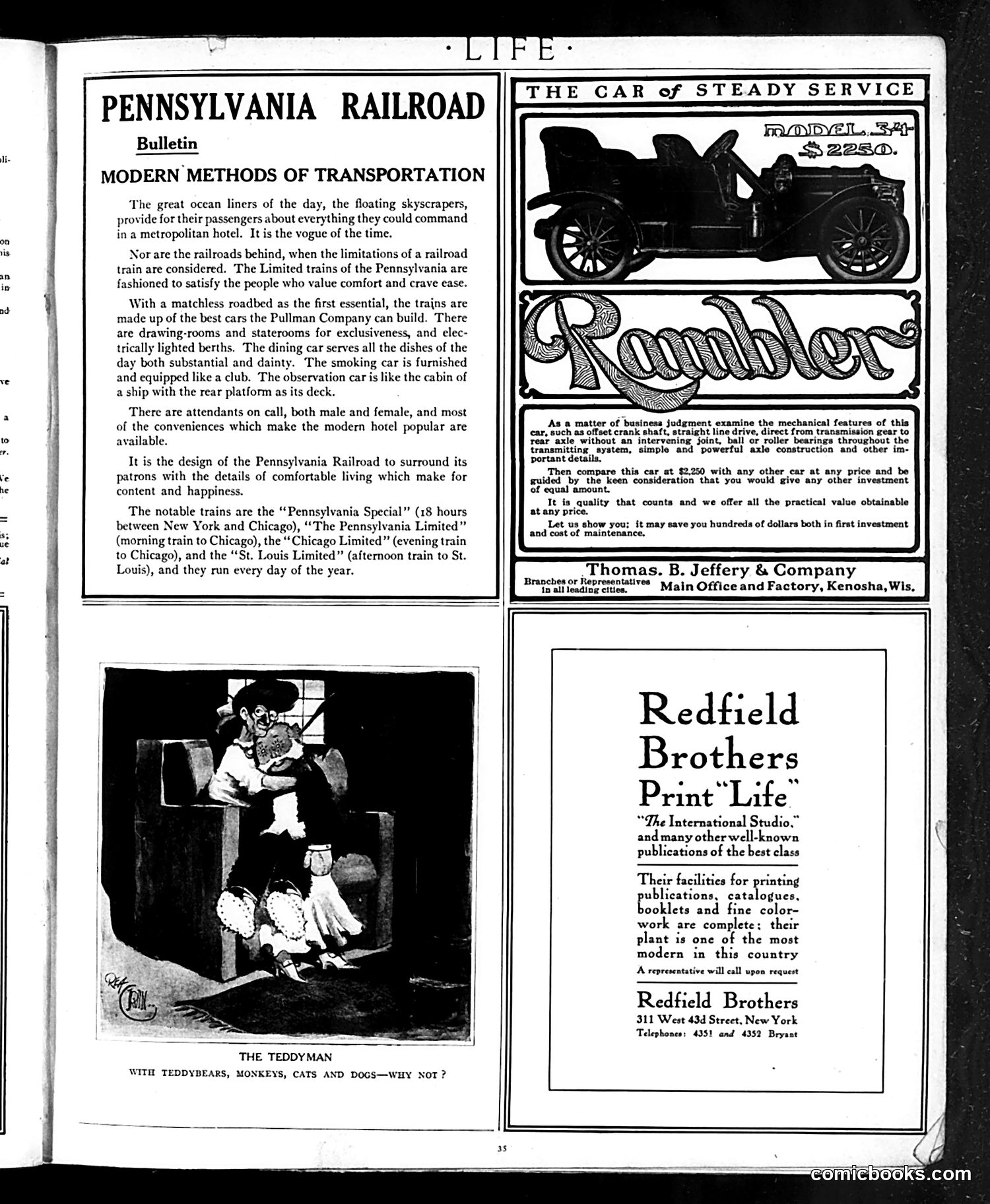
This page is primarily **advertising** for Pennsylvania Railroad service and various companies. The cartoon titled "The Teddyman" depicts a figure surrounded by stuffed animals—teddy bears, monkeys, cats, and dogs—in what appears to be a train car or similar space. The joke likely references **President Theodore "Teddy" Roosevelt**, whose nickname inspired the "teddy bear" craze that swept America in the early 1900s. The cartoon humorously suggests equipping train cars with children's toys and animals for passenger comfort—a satirical exaggeration of the luxury amenities the Pennsylvania Railroad advertises throughout the page. The caption's question "Why not?" implies mock-serious consideration of adding such whimsical comfort features to modern rail travel, poking fun at the era's obsession with passenger comfort and the commercialization of the "teddy bear" phenomenon associated with Roosevelt's popularity.
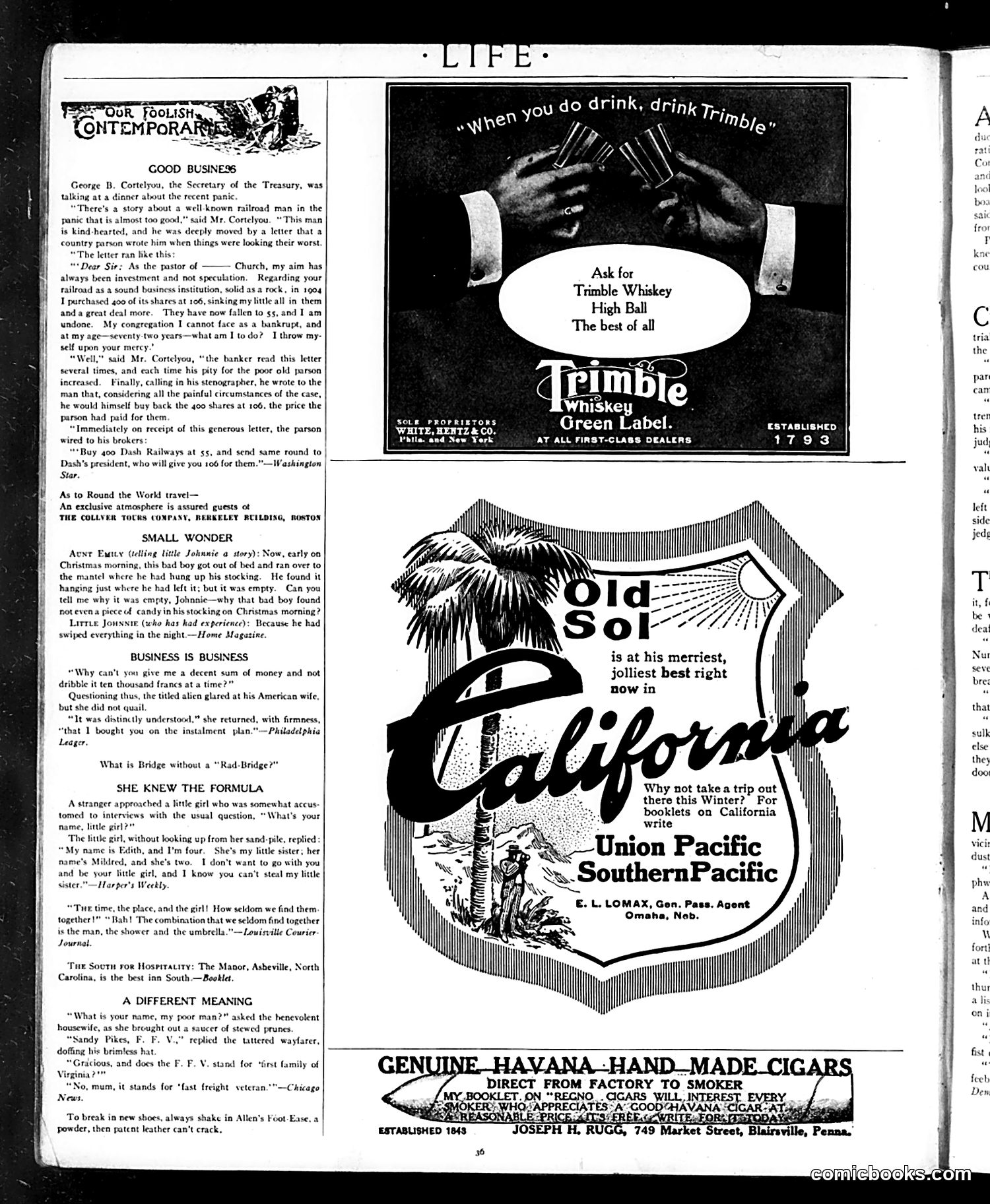
This page contains primarily **advertisements and humorous anecdotes** rather than political cartoons. The main content includes: **"Good Business"** — A story about Treasury Secretary George B. Cortelyou recounting how a railroad executive exploited a desperate pastor's letter during a financial panic. The parson, ruined by stock losses, received what appeared to be charity (the executive buying back shares at original price), but the parson immediately resold them at profit to the same executive. The satire targets **financial dishonesty during the 1907 panic** and the gap between wealthy industrialists' charitable pretenses and actual mercenary practices. The remaining items are brief, unrelated jokes about marriage, naming conventions, and social awkwardness. **Advertisements** dominate the lower half, promoting Trimble Whiskey, California travel, and Havana cigars—typical period marketing with no satirical content. The page reflects early 1900s American concerns about banking panics, stock market manipulation, and the vulnerability of middle-class investors like clergymen.
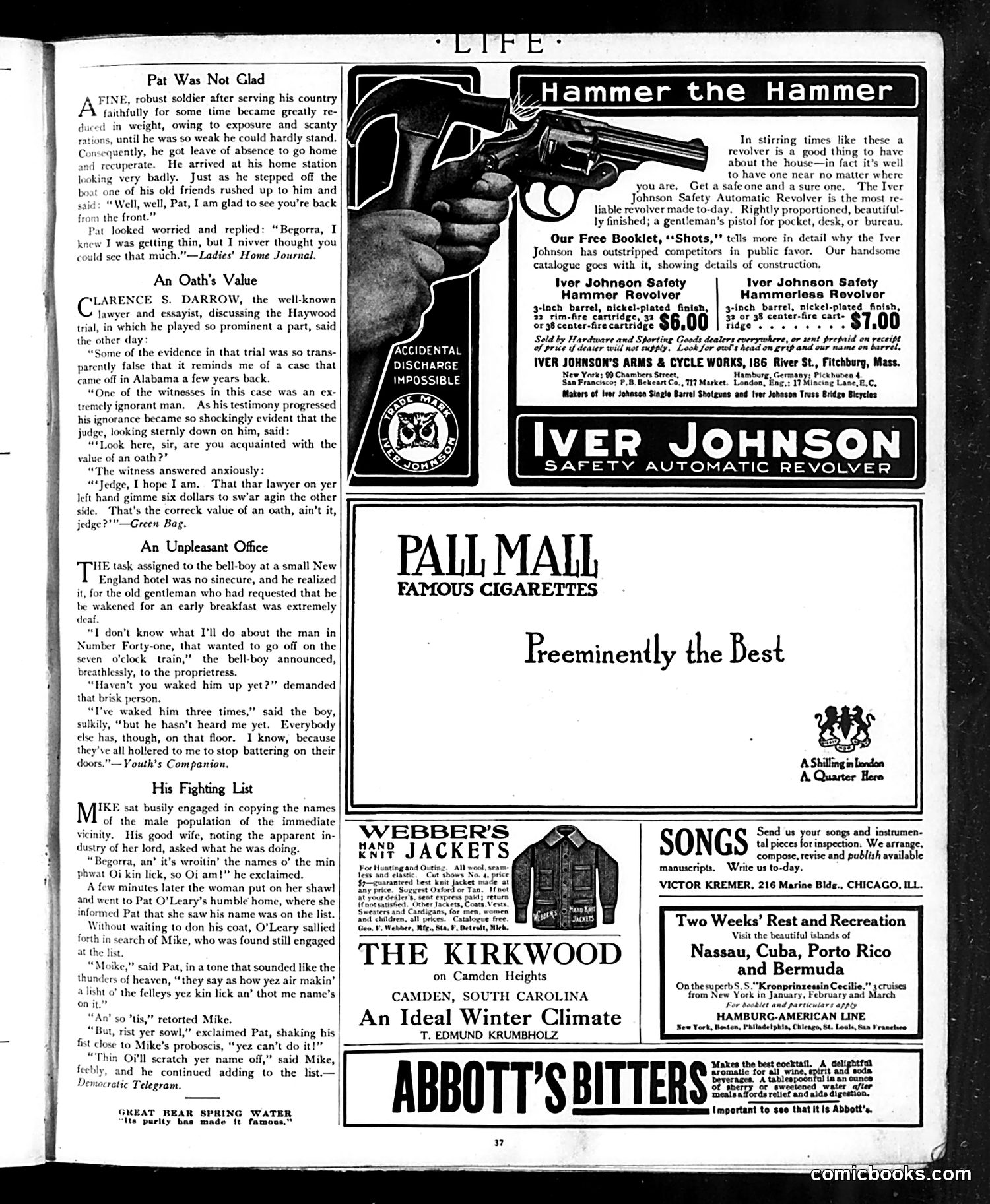
This page contains three short humorous anecdotes rather than political cartoons: 1. **"Pat Was Not Glad"**: A joke about an Irish soldier (Pat) who returns home from military service severely weakened. His friend is shocked by his poor appearance, but Pat misinterprets the concern as surprise he's returned at all—missing the point entirely. It's gentle ethnic humor typical of the era. 2. **"An Oath's Value"**: A legal anecdote about an ignorant witness in an Alabama trial who reveals he was bribed ($6) to testify falsely, then claims this sum represents the "correct value of an oath." It satirizes corruption and ignorance in the judicial system. 3. **"An Unpleasant Office"**: A hotel humor piece where a bell-boy has repeatedly failed to wake a deaf guest for his train, but succeeded in waking everyone else on the floor with his loud knocking. The page is primarily **advertising**: Iver Johnson revolvers dominate the right side, with additional ads for cigarettes, hand jackets, travel, and patent medicines. This reflects Life's business model as a satirical publication funded heavily by commercial advertisements.
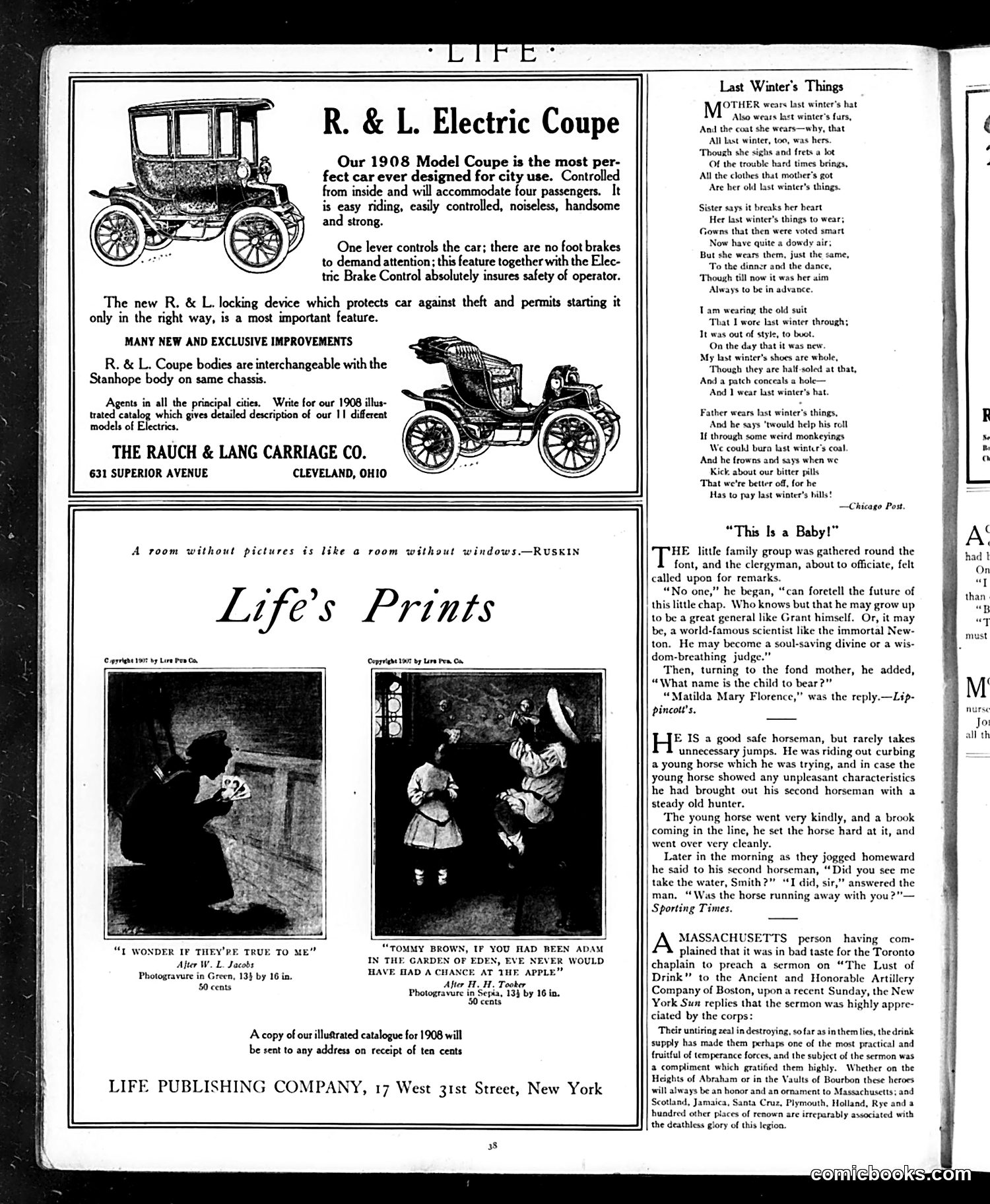
This page is primarily **advertising and light humor content** rather than political satire. The top features an ad for the **R. & L. Electric Coupe**, an early automobile (1908) emphasizing safety features like electric brakes and anti-theft locks—selling points for wealthy city dwellers unfamiliar with cars. Below are two unrelated sections: **"Life's Prints,"** showcasing photogravure artwork for sale, and several **humorous anecdotes**: 1. A poem about wearing last winter's clothing during economic hard times, suggesting financial strain among the middle class. 2. A brief joke about naming a baby "Matilda Mary Florence"—the humor relies on the clergyman's grand predictions contrasting with an ordinary name. 3. A horseman anecdote about jumping a brook. The page reflects early 1900s concerns: automobile adoption, economic anxiety, and genteel leisure pursuits. There's no obvious political cartoon or satire here—mainly consumer advertising mixed with light domestic humor typical of *Life* magazine's content.
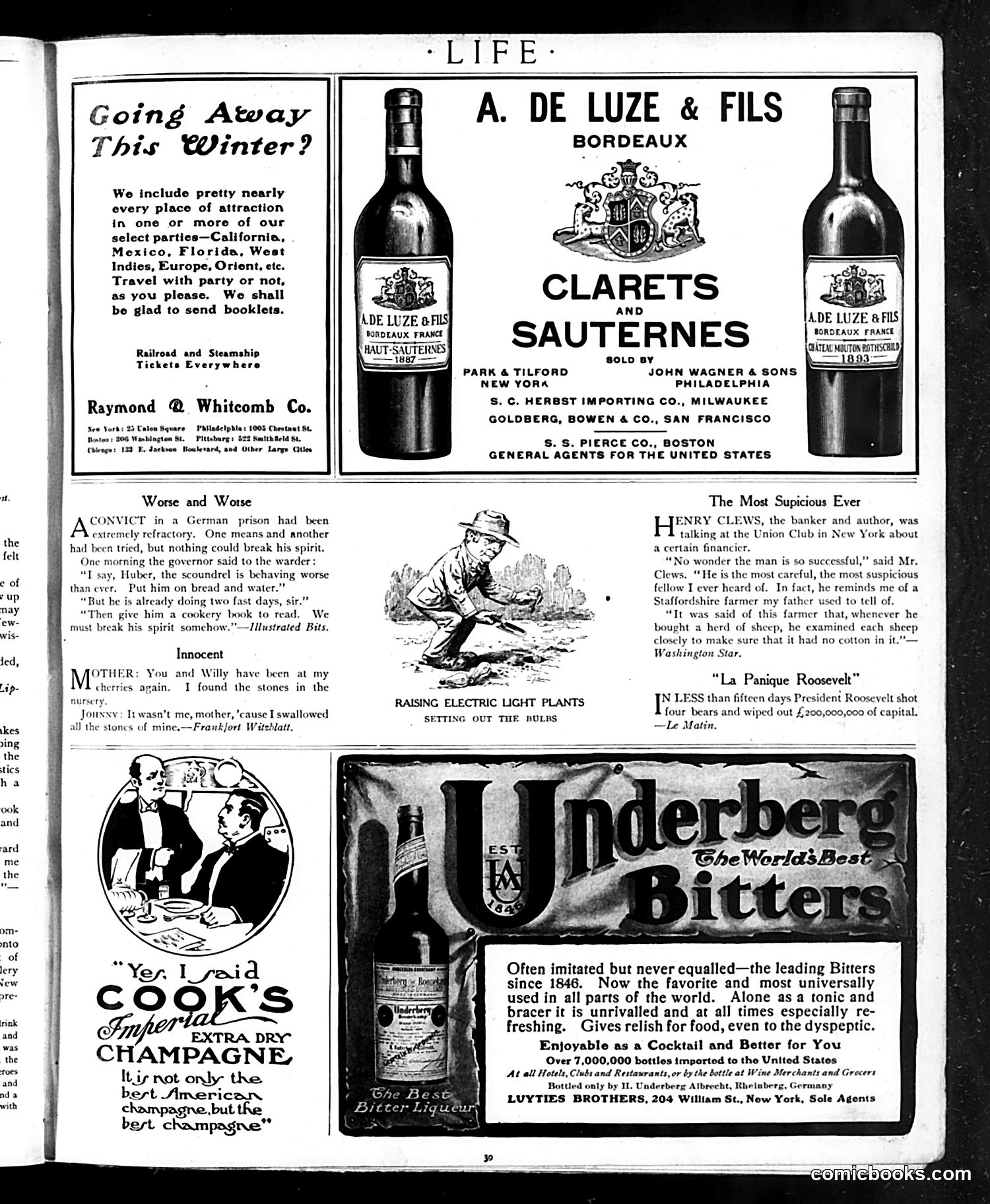
This page is primarily **advertisements** for luxury goods (wine, champagne, bitters) and travel services, interspersed with brief humor pieces and jokes. The cartoon content includes: 1. **"Worse and Worse"**: A joke about a German prison guard trying to break a convict's spirit by giving him a cookery book—implying reading about food while imprisoned is torture. 2. **"Innocent"**: A child's excuse for eating cherries, claiming he swallowed the stones so there's no evidence. 3. **"The Most Suspicious Ever"**: Banker Henry Clews tells an anecdote about a paranoid financier resembling a Staffordshire farmer who inspected sheep for hidden cotton—satirizing excessive suspicion in business. 4. **"La Panique Roosevelt"**: A French jab at President Theodore Roosevelt, mocking that he shot four bears and simultaneously wiped out $200 million in capital in fifteen days—likely referencing market panic or economic concerns during his presidency. The page reflects early 20th-century American satirical humor and transatlantic commentary on political figures.
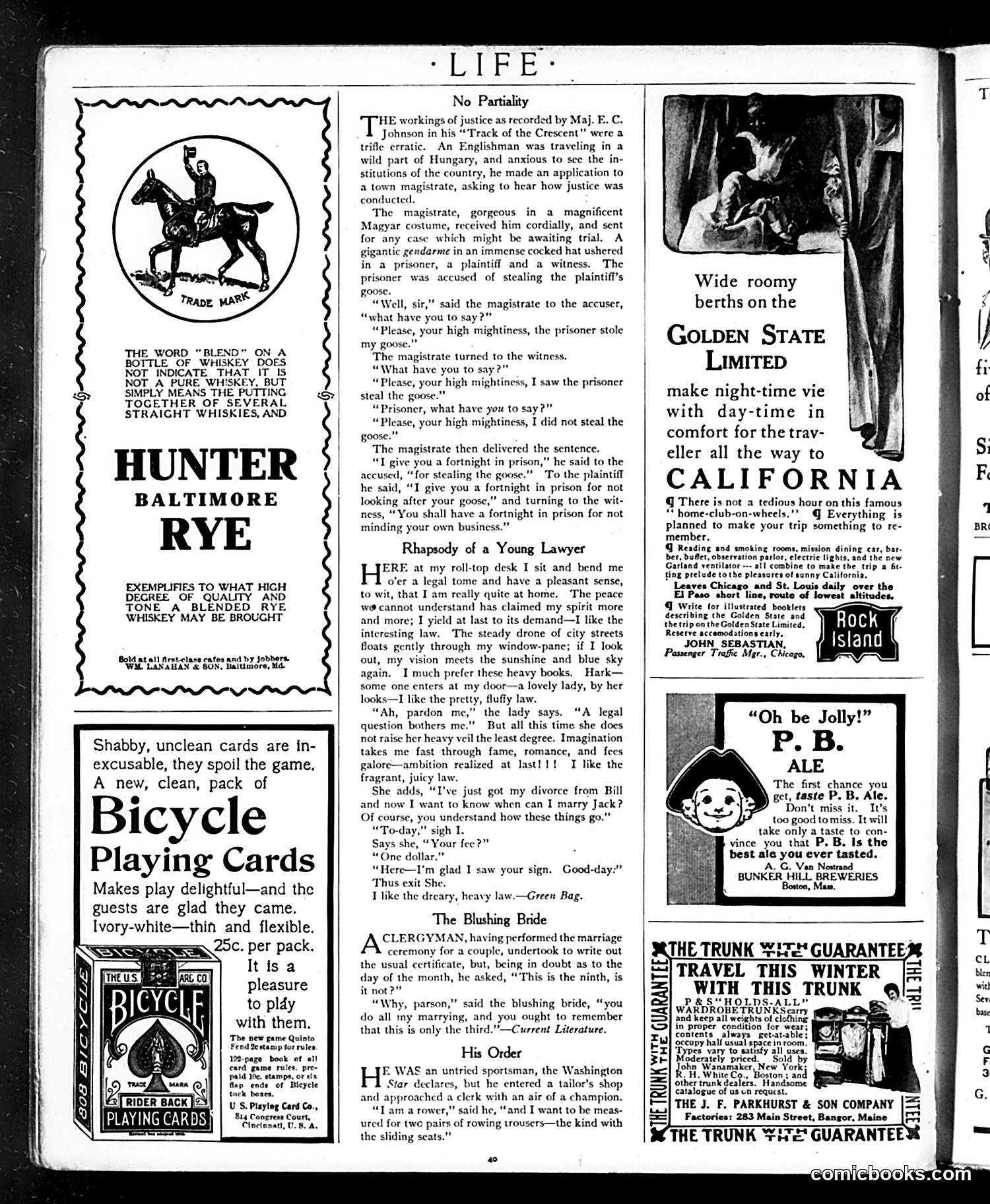
This page contains three distinct satirical pieces: **"No Partiality"** recounts a Hungarian justice anecdote mocking arbitrary judicial systems. A magistrate punishes a prisoner for stealing a goose, but then—absurdly—also sentences the complaining victim and the witness to equal prison time, demonstrating comically biased "impartiality" where everyone gets punished regardless of actual guilt or innocence. **"Rhapsody of a Young Lawyer"** satirizes a young attorney's romantic fantasies. A mysterious veiled woman consults him about remarriage timing, sparking his imagination about fame and fortune—until she pays only one dollar and leaves, deflating his dreams. The satire mocks lawyers' mercenary daydreaming. **"The Blushing Bride"** jokes about a clergyman performing multiple marriages for the same woman. When asked the date, he's corrected: this is only her *third* marriage, not her ninth—implying she's a serial bride. The remaining content is period advertising for whiskey, playing cards, and travel services—typical of Life's commercial pages.
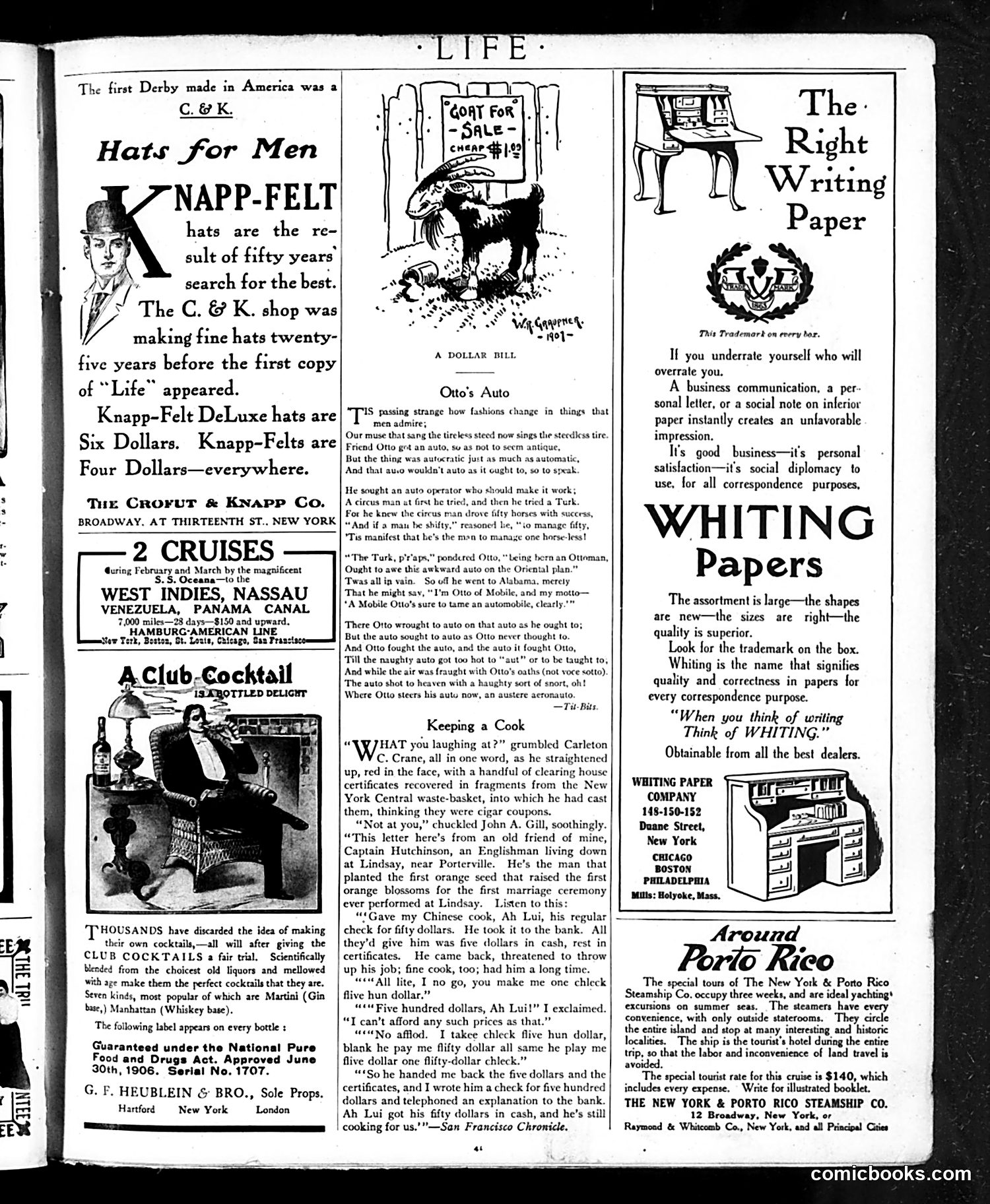
This page contains two humorous pieces satirizing early-20th-century American life. **"Otto's Auto"** is a lengthy comic poem mocking the automobile as a stubborn, temperamental machine. Otto tries various operators—a circus man, a Turk—to control his car, eventually moving to Alabama. The joke: despite all efforts, the auto remains uncontrollable, ultimately exploding while Otto becomes an "austere aeronauto" (involuntarily airborne). This satirizes the automobile's unreliability and the comedy of human attempts to master emerging technology. **"Keeping a Cook"** depicts a Chinese cook demanding a five-hundred-dollar check instead of fifty dollars in cash. The cook's broken English ("flive hun dollar") and the situation—where a bank's shortage of cash forces the employer into an absurd wage negotiation—satirizes banking inefficiency and labor disputes. The humor relies on ethnic stereotype, common in period satire, but the real target is the employer's awkward predicament. Both pieces mock modern inconveniences: unreliable machines and labor troubles.
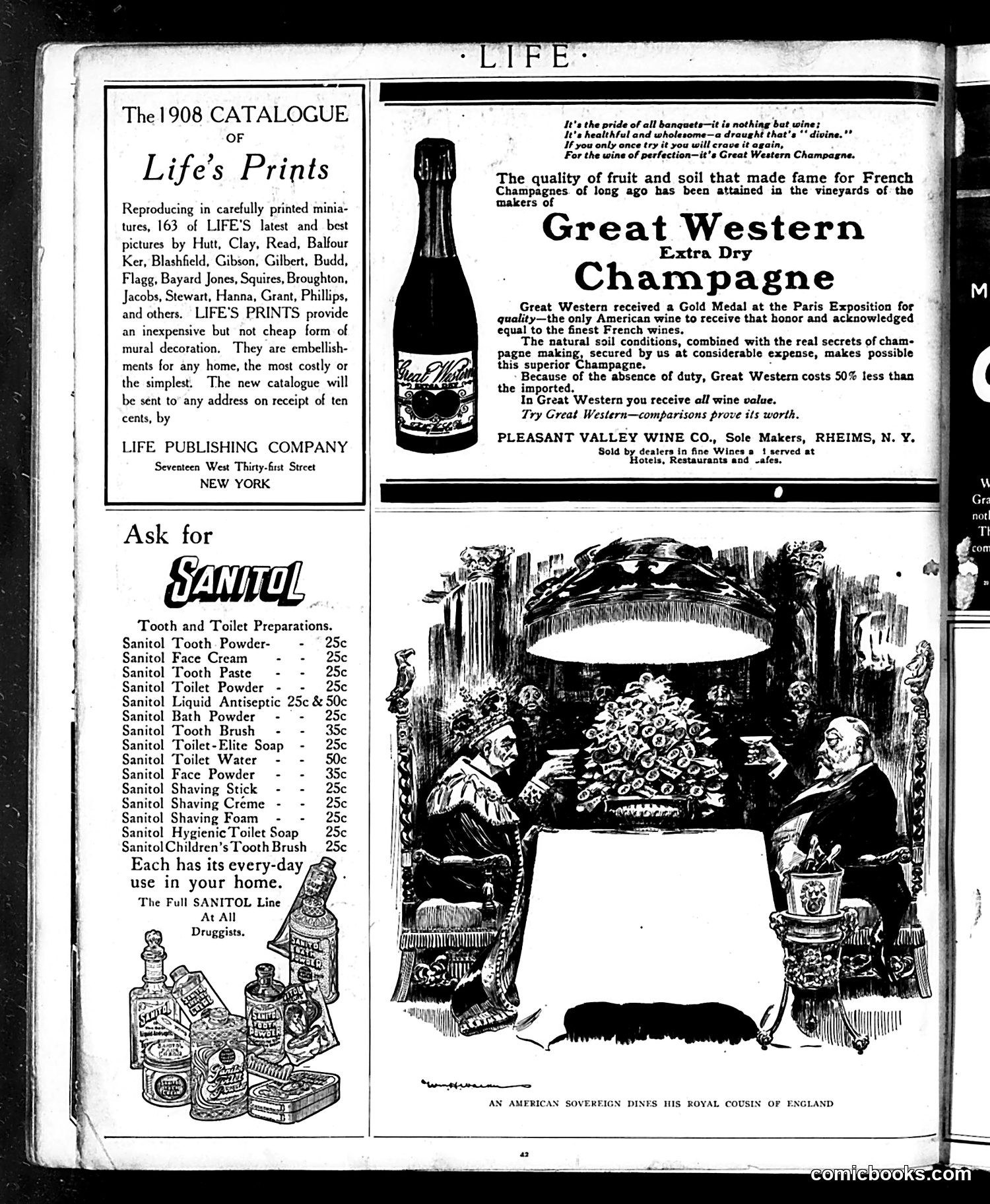
This page is primarily **advertising and catalog promotion**, not political satire. The left side advertises Life Publishing Company's print catalog and Sanitol toiletries. The right features a Great Western Champagne ad. The main illustration—captioned "An American Sovereign Dines His Royal Cousin of England"—depicts two men dining in an ornate setting. This appears to reference **American-British relations** circa 1908, likely alluding to visits or diplomatic exchanges between American and British elites during the Theodore Roosevelt era, when such "cousin" relationships were rhetorically emphasized. The humor is gentle social commentary: an American businessman (the "sovereign") hosts British royalty, suggesting America's rising economic power and social confidence. The lavish décor and formal setting underscore themes of American prosperity. The champagne ad's emphasis that Great Western is "equal to the finest French wines" and costs "50% less than imported" reinforces the broader message: America's industrial and agricultural capabilities now rival—and economically surpass—established European powers.
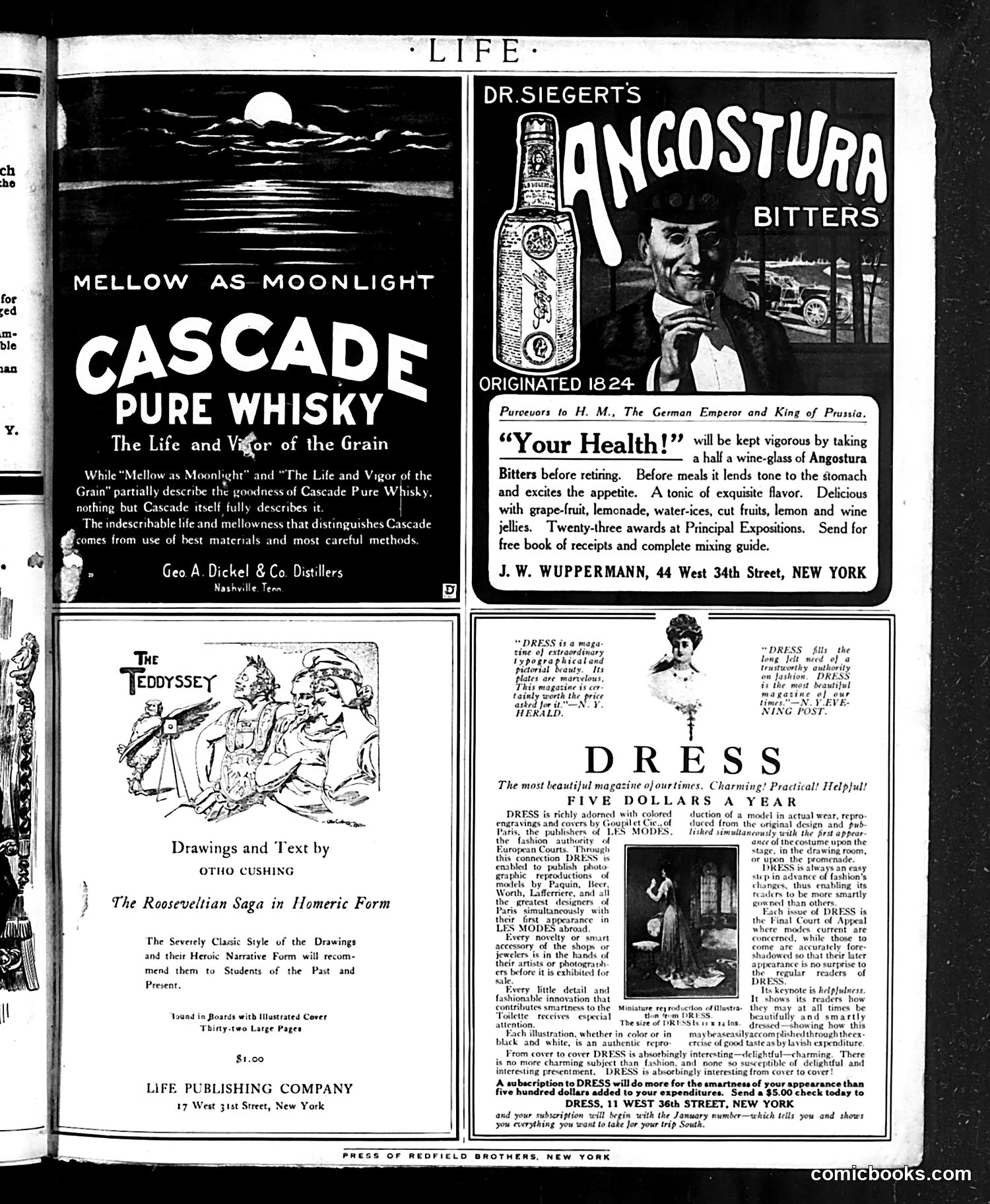
This page is primarily **advertising**, not satire or political commentary. It contains four distinct ads: 1. **Cascade Pure Whisky** (top left): Appeals to refined taste with "mellow as moonlight" imagery, emphasizing quality materials and careful distillation from Nashville distillers. 2. **Angostura Bitters** (top right): Markets a medicinal tonic, claiming it maintains vigor and aids digestion. The text references royalty ("Purveyors to H.M., The German Emperor and King of Prussia"), a common credibility strategy in early 20th-century advertising. 3. **The Teddysey** (bottom left): Promotes a book of drawings by Otho Cushing depicting "The Rooseveltian Saga in Homeric Form"—likely satirical illustrations about Theodore Roosevelt, presented as classical heroic narrative. 4. **Dress Magazine** (bottom right): Advertises a fashion publication emphasizing practical style advice and photographs of haute couture designs from Paris. The page reflects turn-of-the-century consumer culture and advertising strategies targeting affluent readers.
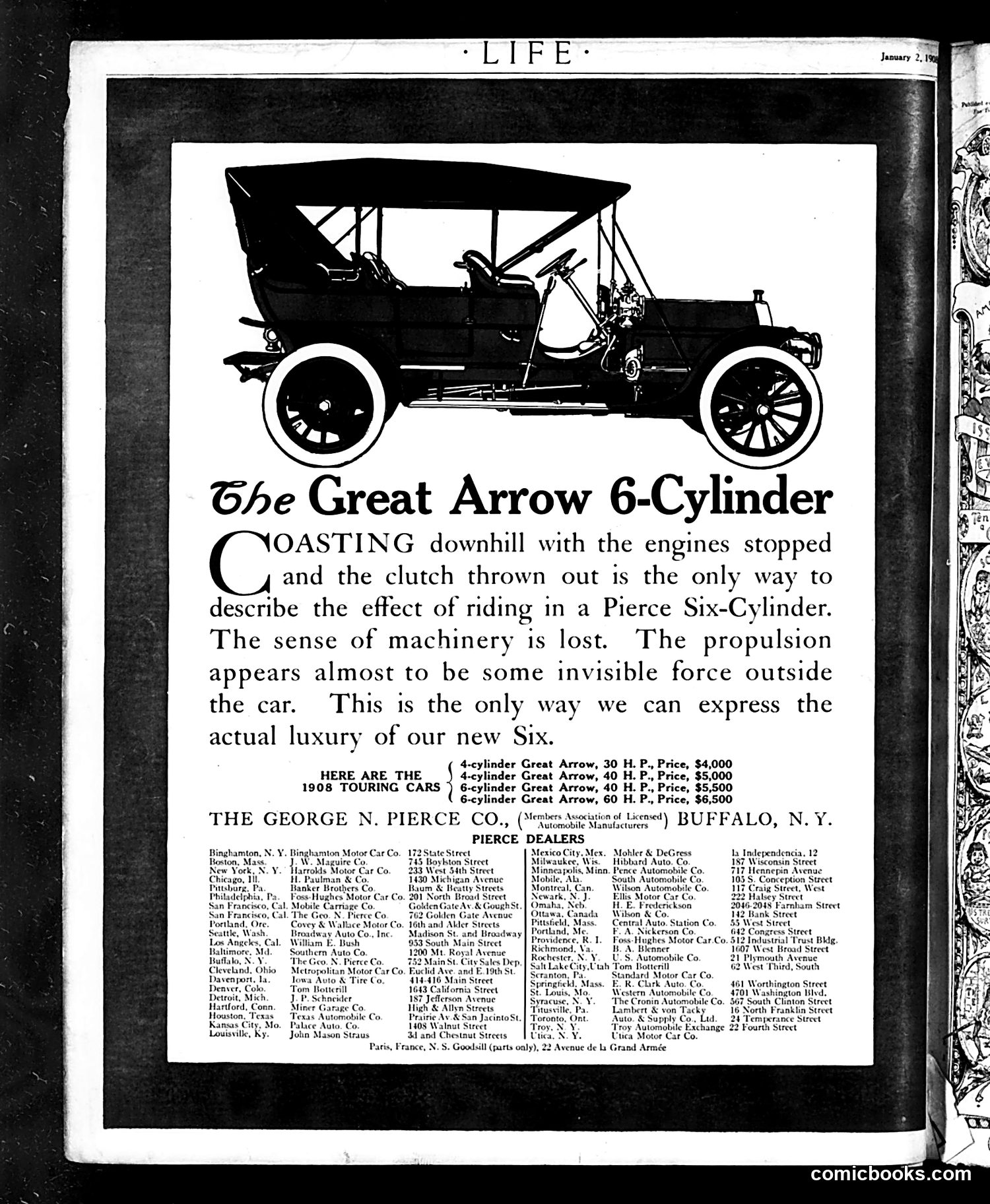
This is a straightforward **automobile advertisement**, not satire or political commentary. It promotes the Pierce Great Arrow, a luxury car manufactured by the George N. Pierce Company of Buffalo, New York, circa 1908. The ad uses hyperbolic language to market the car's smoothness and power: the copywriter claims that coasting downhill with the engine off is "the only way" to describe the driving experience—suggesting the car runs so smoothly that the machinery feels invisible. This was an appealing luxury feature for wealthy early-automobile buyers. The page lists multiple car models with varying horsepower (30-60 H.P.) and prices ($4,000-$6,500—substantial sums in 1908), along with an extensive network of Pierce dealers across America and internationally, demonstrating the brand's market reach and prestige.