
Life, 1908-01-02 · page 19 of 44
Life — January 2, 1908 — page 19: what you’re looking at
What you’re looking at
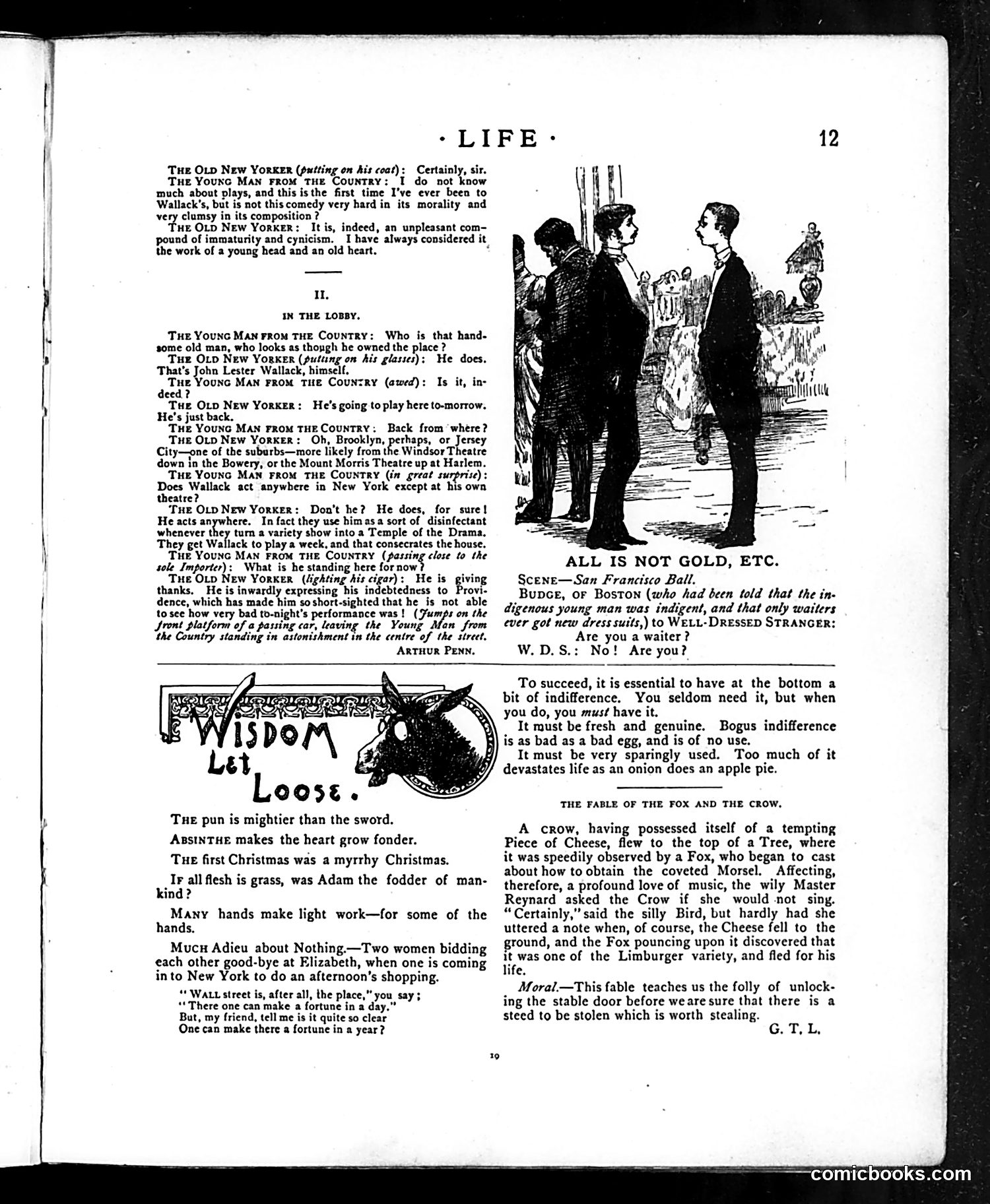
This page satirizes **John Lester Wallack**, a prominent 19th-century theater owner and actor. The main dialogue mocks his omnipresence in New York theater: though he owns Wallack's Theatre, he supposedly performs everywhere—even in disreputable variety shows and suburban theaters in Brooklyn and Jersey City—functioning as "disinfectant" to legitimize low-quality performances. The humor targets both Wallack's ego (he's so nearsighted he can't see his own bad performances) and the pretension of theater culture itself. A visiting country man expresses naive admiration, while the worldly Old New Yorker deflates it with caustic commentary. The secondary cartoon ("All Is Not Gold") jokes about class assumptions: a well-dressed stranger at a San Francisco ball is mistaken for a waiter by someone from Boston, then reverses the assumption—satirizing how appearance masks true identity or status. The page also includes aphorisms and "The Fable of the Fox and the Crow," which warns against gullibility through a corrupted classic tale.
📄 Transcribed text from this page (OCR, searchable)
Machine-transcribed from the original scan — historical spelling and the odd misread are preserved.
THE OLD New YorkER (putting on his coat): Certainly, sir. Tue Younc MAN FROM THE Country: I do not know much about plays, and this isthe first time I’ve ever been to ‘Wallack’s, but is not this comedy very hard in its morality and clumsy in its composition ? 'HE OLD New Yorker: It is, indeed, an unpleasant com- pound of immaturity and cynicism. I have always considered it the work of a young head and an old heart. ‘ IL IN THE LOBBY, THe Younc MAN FROM THE Country: Who is that hand- some old man, who looks as though he owned the place ? , Tue OLD New Yorker (futung on his glasses); He does. That's John Lester Wallack, himself, dean ‘OUNG MAN FROM THE COUNTRY (awed): Is it, in- je Tue Orv New Yorker: He's going to play here to-morrow. He's just back. THE YounG MAN FRoM THECOUNTRY: Back from ‘where? Tue Op New Yorker: Oh, Brooklyn, perhaps, or Jersey City—one of the suburbs—more likely from ‘the Windsor Theatre down in the Bowery, or the Mount Morris Theatre up at Harlem. Tue Younc MAN FROM THE COUNTRY (in great ise) Does Wallack act anywhere in New York except at his own theatre? ‘THe OLp New Yorker: Don't he? He does, for sure! | He acts anywhere. In fact they use himasa sort of disinfectant | whenever t! ey turn & variety show into a Temple of the Drama. They get Wallack to play a week, and that consecrates the house. } Tue Younc MAN FROM THE Country (passing close to the | sole Importer): What is he standing here for now Tue OLp New Yorker (lighting his cigar): He is giving thanks, He is inwardly expressing his indebtedness to Provi- dence, which has made him so short-sighted that he is not able to see how very bad to-night’s performance was! (Jumps on the Sront platform of a passing car, leaving the Young Man from the Country standing in astonishment in the centre of the street. ARTHUR PENN, *LIFE-: it ; unde ALL IS NOT GOLD, ETC. Scene—San Francisco Ball. Bunce, or Boston (who had been told that the in- digenous young man was indigent, and that only waiters ever got new dress suits,) to WELL-DRESSED STRANGER: Are you a waiter? W.D.S.: No! Are you? Tne pun is mightier than the sword. ABSINTHE makes the heart grow fonder. Tue first Christmas was a myrrhy Christmas. Tr all flesh is grass, was Adam the fodder of man- kind? Many hands make light work—for some of the hands. Mucu Adieu about Nothing—Two women bidding each other good-bye at Elizabeth, when one is coming in to New York to do an afternoon's shopping. WALL street is, after all, the place,” you say; “* There one can make a fortune in a day.” But, my friend, tell me is it quite so clear One can make there a fortune in a year? bit of indifference. To succeed, it is essential to have at the bottom a You seldom need it, but when you do, you must have it. It must be fresh and genuine. Bogus indifference is as bad as a bad egg, and is of no use. It must be very sparingly used. Too much of it devastates life as an onion does an apple pie. THE FABLE OF THE FOX AND THE CROW. A crow, having possessed itself of a tempting Piece of Cheese, flew to the top of a Tree, where it was speedily observed by a Fox, who began to cast about how to obtain the coveted Morsel. Affecting, therefore, a profound love of music, the wily Master Reynard asked the Crow if she would not sing. “Certainly,” said the silly Bird, but hardly had she uttered a note when, of course, the Cheese fell to the ground, and the Fox pouncing upon it discovered that it was one of the Limburger variety, and fled for his life. Moral.—This fable teaches us the folly of unlock- ing the stable door before weare sure that there is a steed to be stolen which is worth stealing. G. T, L, —comicbooks.com