
Life, 1908-01-02 · page 14 of 44
Life — January 2, 1908 — page 14: what you’re looking at
What you’re looking at
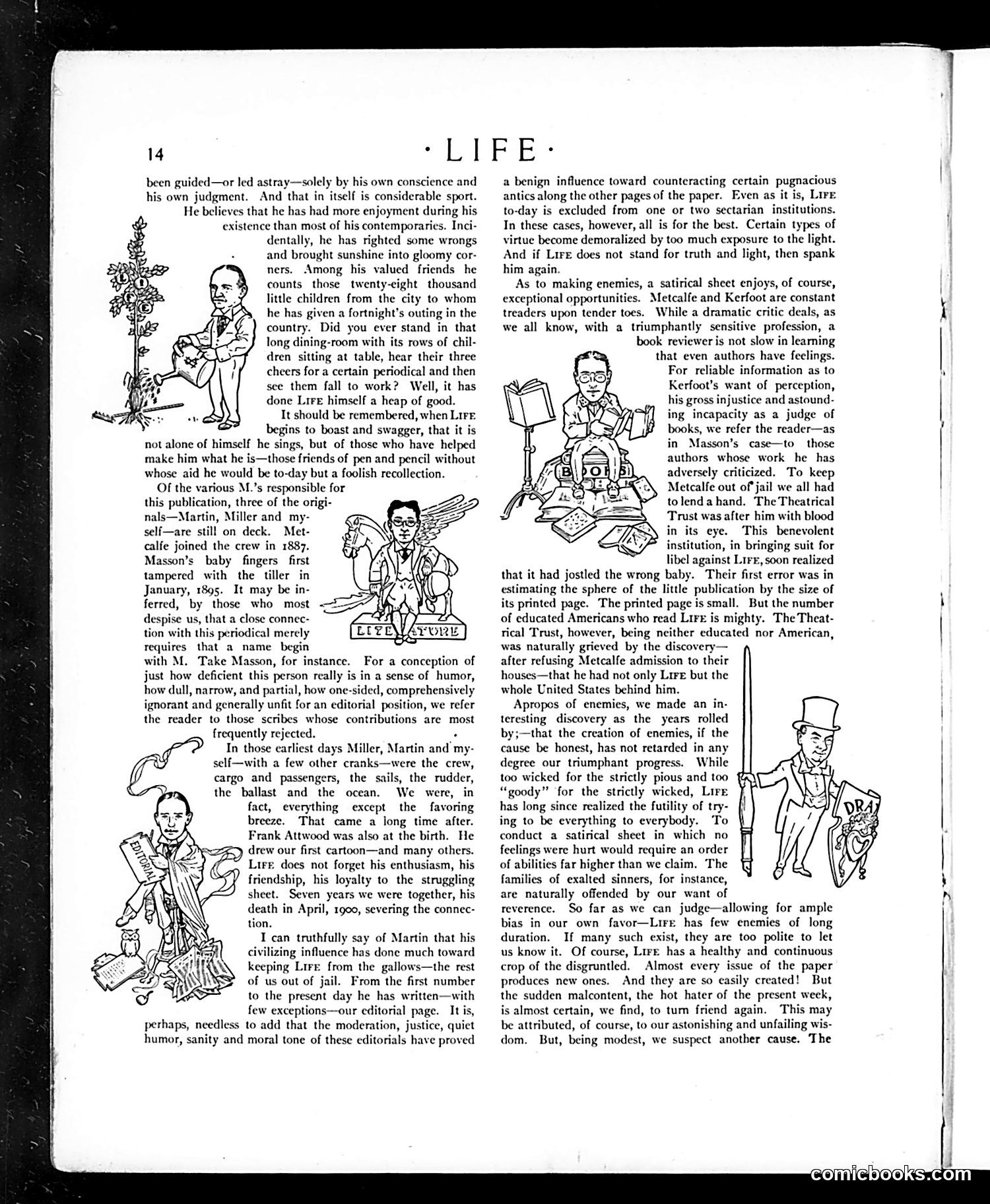
This page is a self-congratulatory editorial about *Life* magazine itself, written by one of its founders. The text celebrates the publication's satirical mission and credits its key contributors. The cartoons illustrate the magazine's staff and history. They show figures labeled as the original creators—Martin, Miller, and the author—depicted as the ship's crew that built *Life*. Additional illustrations reference Frank Attwood (an early cartoonist), and figures like Metcalfe and Kerfoot, who are credited as drama and book critics known for "treading upon tender toes" with their sharp reviews. The satire targets both the magazine's internal dynamics (mocking staff members' fitness for editorial work) and its external enemies—religious institutions that banned it, authors wounded by negative reviews, and the Theatrical Trust, which apparently opposed their drama critic. The overall tone is boastful yet self-aware, celebrating *Life*'s role as an irreverent voice that deliberately provokes powerful institutions.
📄 Transcribed text from this page (OCR, searchable)
Machine-transcribed from the original scan — historical spelling and the odd misread are preserved.
4 *LIFE- been guided—or led astray—solely by his own conscience and his own judgment. And that in itself is considerable sport. He believes that he has had more enjoyment during his existence than most of his contemporaries. Inci- dentally, he has righted some wrongs and brought sunshine into gloomy cor- ners. Among his valued friends he counts those twenty-eight thousand little children from the city to whom he has given a fortnight’s outing in the country. Did you ever stand in that long dining-room with its rows of chil- dren sitting at table, hear their three cheers for a certain periodical and then see them fall to work? Well, it has done Lire himself a heap of good. It should be remembered, when Lire. begins to boast and swagger, that it is not alone of himself he sings, but of those who have helped make him what he is—those friends of pen and pencil without whose aid he would be to-day but a foolish recollection. Of the various M.’s responsib! this publication, three of the origi nals—Martin, Miller and my- self—are still on deck. Met- calfe joined the crew in 1887. Masson’s baby fingers first tampered with the tiller in January, 1895. It may be in- ferred, by those who most despise us, that a close connec- tion with this periodical merely requires that a name begin with M, Take Masson, for instance. For a conception of just how deficient this person really is in a sense of humor, how dull, narrow, and partial, how one-sided, comprehensively ignorant and generally unfit for an editorial position, we refer the reader to those scribes whose contributions are most frequently rejected. . In those earliest days Miller, Martin and my- self—with a few other cranks—were the crew, cargo and passengers, the sails, the rudder, the ballast and the ocean. We were, in fact, everything except the favoring \ breeze. That came a long time after. Ww) Frank Attwood was also at the birth. He drew our first cartoon—and many others. Lire does not forget his enthusiasm, his friendship, his loyalty to the struggling sheet. Seven years we were together, his death in April, 1900, severing the connec- tion. I can truthfully say of Martin that his civilizing influence has done much toward keeping Lire from the gallows—the rest of us out of jail. From the first number to the present day he has written—with few exceptions—our editorial page. It is, perhaps, needless to add that the moderation, justice, quiet humor, sanity and moral tone of these editorials have proved a benign influence toward counteracting certain pugnacious antics along the other pages of the paper. Even as it is, Lire to-day is excluded from one or two sectarian institutions. In these cases, however, all is for the best. Certain types of virtue become demoralized by too much exposure to the light. And if Lire does not stand for truth and light, then spank him again. As to making enemies, a satirical sheet enjoys, of course, exceptional opportunities. Metcalfe and Kerfoot are constant treaders upon tender toes. While a dramatic critic deals, as we all know, with a triumphantly sensitive profession, a book reviewer is not slow in learning that even authors have feelings. For reliable information as to Kerfoot’s want of perception, his gross injustice and astound- ing incapacity as a judge of books, we refer the reader—as in Masson’s case—to those authors whose work he has adversely criticized. To keep Metcalfe out of*jail we all had tolenda hand. The Theatrical Trust was after him with blood in its eye. This benevolent institution, in bringing suit for libel against Lire, soon realized that it had jostled the wrong baby. Their first error was in estimating the sphere of the little publication by the size of its printed page. The printed page is small. But the number of educated Americans who read Lire is mighty. The Theat- rical Trust, however, being neither educated nor American, was naturally grieved by the discovery— after refusing Metcalfe admission to their houses—that he had not only Lire but the whole United States behind him. Apropos of enemies, we made an in- teresting discovery as the years rolled by;—that the creation of enemies, if the cause be honest, has not retarded in any degree our triumphant progress. While too wicked for the strictly pious and too “goody” ‘for the strictly wicked, Lire has long since realized the futility of try- ing to be everything to everybody. To conduct a satirical sheet in which no feelings were hurt would require an order of abilities far higher than we claim. The families of exalted sinners, for instance, are naturally offended by our want of reverence. So far as we can judge—allowing for ample bias in our own favor—LirE has few enemies of long duration. If many such exist, they are too polite to let us know it. Of course, Ltre has a healthy and continuous crop of the disgruntled. Almost every issue of the paper produces new ones. And they are so easily created! But the sudden malcontent, the hot hater of the present week, is almost certain, we find, to tum friend again. This may be attributed, of course, to our astonishing and unfailing wis- dom. But, being modest, we suspect another cause. The ST