
Life, 1908-01-02 · page 24 of 44
Life — January 2, 1908 — page 24: what you’re looking at
What you’re looking at
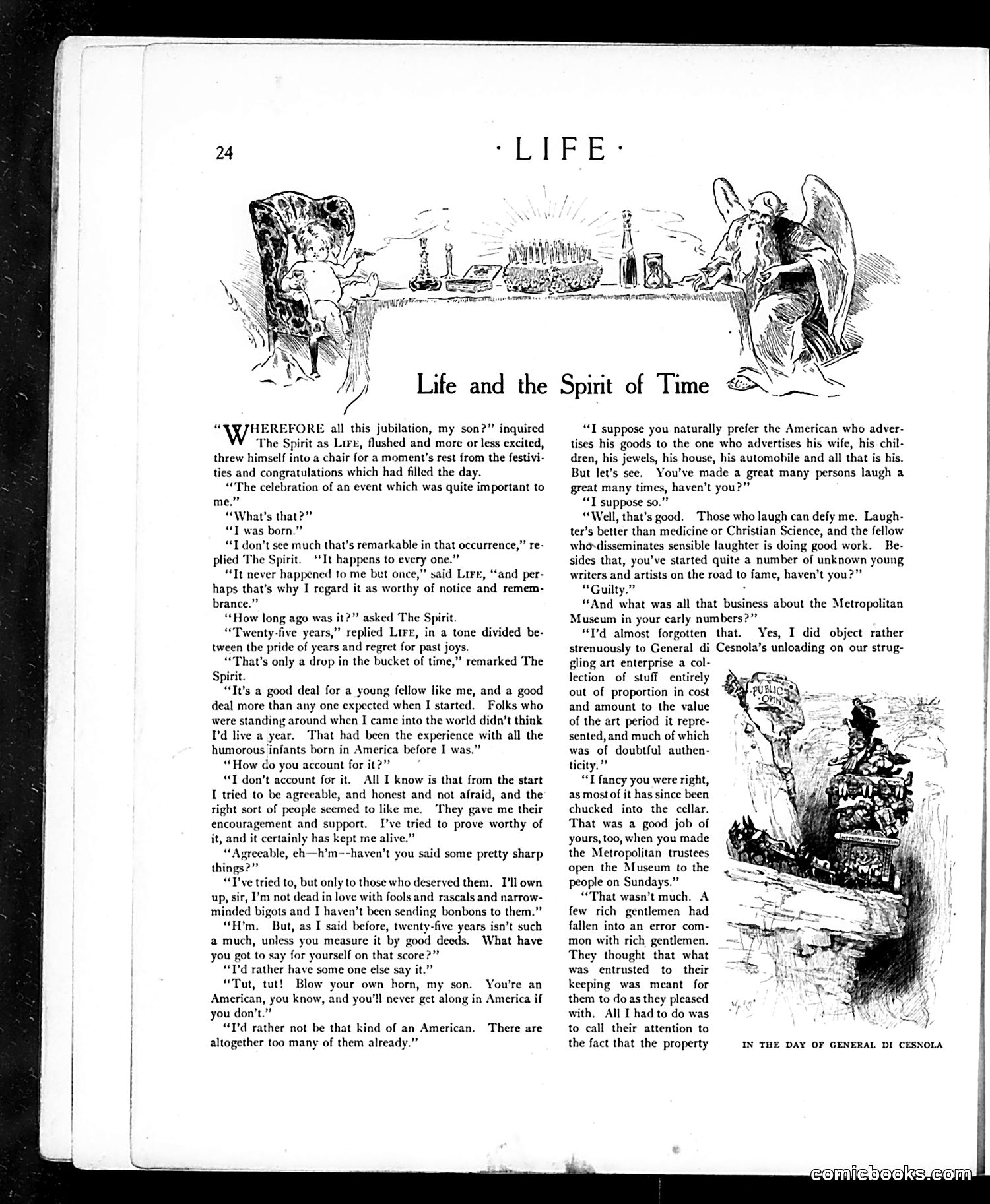
This is a dialogue between personified *Life* (the magazine) and *The Spirit of Time*, celebrating Life's 25th anniversary. The conversation defends the magazine's editorial mission and past interventions. Key references: **The Metropolitan Museum controversy**: Life objected to General Luigi Palma di Cesnola (the Met's director) acquiring a costly art collection of dubious authenticity—much later discarded. Life also advocated for opening the Museum to the public on Sundays, then restricted to wealthy patrons. **Life's self-image**: The magazine positions itself as a force for good—promoting laughter, supporting unknown writers and artists, and holding institutions accountable while avoiding self-promotion. **American values critique**: The Spirit chides Life for not "blowing its own horn" like typical Americans, but Life refuses, claiming there are already too many self-aggrandizers. The cartoon illustrates Life's perceived role: a moral watchdog for American cultural institutions and social progress, guided by humor rather than sanctimony.
📄 Transcribed text from this page (OCR, searchable)
Machine-transcribed from the original scan — historical spelling and the odd misread are preserved.
« HEREFORE all this jubilation, my son?” inquired The Spirit as Lire, flushed and more or less excited, threw himself into a chair for a moment's rest from the festivi- ties and congratulations which had filled the day. “The celebration of an event which was quite important to me.” “What's that?” “T was born.” “don’t sce much that’s remarkable in that occurrence,” re plied The Spirit. “It happens to every one.” “Tt never happened to me but once,” said Lire, “and per- haps that’s why I regard it as worthy of notice and remem- brance.”” “How long ago was it?” asked The Spirit. “Twenty-five years,” replied Lire, in a tone divided be- tween the pride of years and regret for past joys. “That’s only a drop in the bucket of time,” remarked The Spirit. “It’s a good deal for a young fellow like me, and a good deal more than any one expected when I started. Folks who were standing around when I came into the world didn’t think I'd live a year. That had been the experience with all the humorous infants born in America before I was.” “How do you account for it?” “T don’t account for it. All I know is that from the start I tried to be agreeable, and honest and not afraid, and the right sort of people seemed to like me. ‘They gave me their encouragement and support. I’ve tried to prove worthy of it, and it certainly has kept me alive.” “Agreeable, eh—h’m--haven’t you said some pretty sharp things?” “T’ve tried to, but only to those who deserved them. I'll own up, sir, I’m not dead in love with fools and rascals and narrow- minded bigots and I haven’t been sending bonbons to them.” “H'm. But, as I said before, twenty-five years isn’t such a much, unless you measure it by good deeds. What have you got to say for yourself on that score?” “T'd rather have some one else say it. “Tut, tut! Blow your own horn, my son. You're an American, you know, and you'll never get along in America if you don't.” “I'd rather not be that kind of an American. There are altogether too many of them already.” Life and the Spirit of Time “I suppose you naturally prefer the American who adver- tises his goods to the one who advertises his wife, his chil- dren, his jewels, his house, his automobile and all that is his. But let’s see. You've made a great many persons laugh a great many times, haven’t you?” “I suppose so.” “Well, that’s good. ‘Those who laugh can defy me. Laugh- ter’s better than medicine or Christian Science, and the fellow whovdisseminates sensible laughter is doing good work. Be- sides that, you’ve started quite a number of unknown young writers and artists on the road to fame, haven’t you?” “Guilty.” . “And what was all that business about the Metropolitan Museum in your carly numbers?” “T’d almost forgotten that. Yes, I did object rather strenuously to General di Cesnola’s unloading on our strug- gling art enterprise a col- lection of stuff entirely out of proportion in cost and amount to the value of the art period it repre- sented, and much of which was of doubtful authen- ticity.” “T fancy you were right, as most of it has since been chucked into the cellar. That was a good job of yours, too, when you made the Metropolitan trustees open the Museum to the people on Sundays.” “That wasn’t much. A few rich gentlemen had fallen into an error com- mon with rich gentlemen. They thought that what was entrusted to their keeping was meant for them to doas they pleased with. All I had to do was to call their attention to the fact that the property IN THE DAY OF GENERAL DI CESNOLA