
Life, 1908-01-02 · page 25 of 44
Life — January 2, 1908 — page 25: what you’re looking at
What you’re looking at
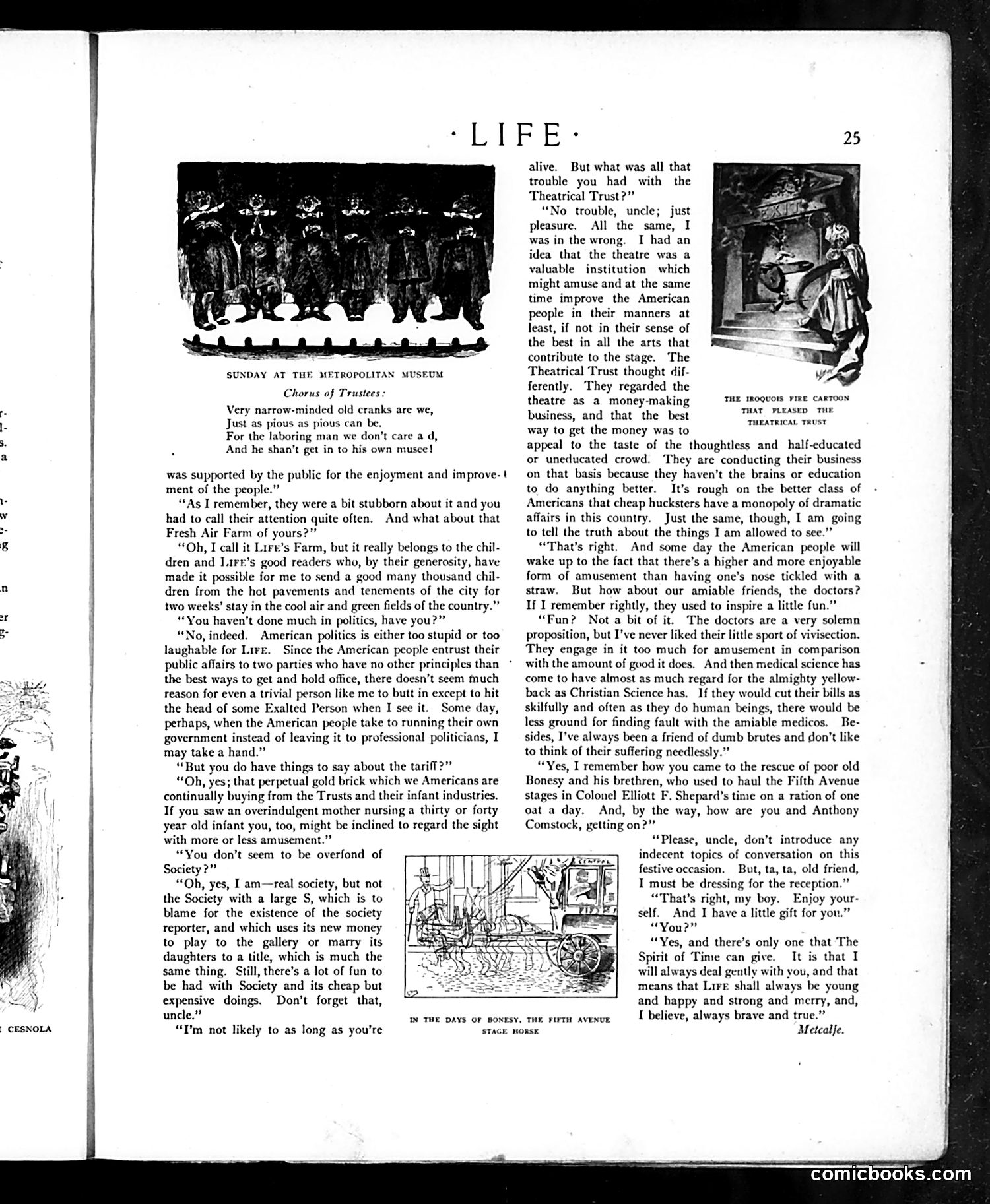
This page features a satirical interview with Life's editor, presented as a dialogue. The main cartoon ("Sunday at the Metropolitan Museum") shows museum trustees depicted as "narrow-minded old cranks" who exclude working-class visitors, satirizing wealthy institutions' gatekeeping despite public funding. The interview critiques several targets: 1. **The Theatrical Trust** — a monopoly controlling American theater, condemned for appealing to "thoughtless and half-educated" audiences with cheap entertainment rather than improving theatrical art 2. **American politics** — dismissed as too stupid to merit serious commentary, controlled by professional politicians rather than the people 3. **High society** — mocked for using new money to pursue titles and social status through convenient marriages 4. **The medical profession** — criticized for overusing vivisection (animal testing) for amusement rather than genuine scientific advancement The satirist positions himself as a gadfly targeting institutions that exploit or fail the American public, particularly working-class people and those seeking genuine culture or education.
📄 Transcribed text from this page (OCR, searchable)
Machine-transcribed from the original scan — historical spelling and the odd misread are preserved.
a |. SUNDAY AT THE METROPOLITAN MUSEUM Chorus of Trustees: Very narrow-minded old cranks are we, Just as pious as pious can be. For the laboring man we don’t care a d, And he shan’t get in to his own musce! was supported by the public for the enjoyment and improve-t ment of the people.” “(As I remember, they were a bit stubborn about it and you had to call their attention quite often. And what about that Fresh Air Farm of yours?” “Oh, I call it Lire’s Farm, but it really belongs to the chil- dren and I.1Fr’s good readers who, by their generosity, have made it possible for me to send a good many thousand chil- dren from the hot pavements and tenements of the city for two weeks’ stay in the cool air and green fields of the country.” “You haven’t done much in politics, have you?” “No, indeed. American politics is either too stupid or too laughable for Lire. Since the American people entrust their public affairs to two parties who have no other principles than the best ways to get and hold office, there doesn’t seem much reason for even a trivial person like me to butt in except to hit the head of some Exalted Person when I see it. Some day, perhaps, when the American people take to running their own government instead of leaving it to professional politicians, I may take a hand.” “But you do have things to say about the tariff?” “Oh, yes; that perpetual gold brick which we Americans are continually buying from the Trusts and their infant industries. If you saw an overindulgent mother nursing a thirty or forty year old infant you, too, might be inclined to regard the sight with more or less amusement.” “You don’t seem to be overfond of Society ?”” “Oh, yes, I am—real society, but not the Society with a large S, which is to blame for the existence of the society reporter, and which uses its new money to play to the gallery or marry its daughters to a title, which is much the same thing. Still, there’s a lot of fun to be had with Society and its cheap but ‘LIF E- alive. But what was all that trouble you had with the Theatrical Trust?” “No trouble, uncle; just pleasure. All the same, I was in the wrong. I had an idea that the theatre was a valuable institution which might amuse and at the same time improve the American people in their manners at least, if not in their sense of the best in all the arts that contribute to the stage. The Theatrical Trust thought dif- ferently. ‘They regarded the theatre as a money-making business, and that the best way to get the money was to appeal to the taste of the thoughtless and half-educated or uneducated crowd. They are conducting their business on that basis because they haven't the brains or education to do anything better. It’s rough on the better class of Americans that cheap hucksters have a monopoly of dramatic affairs in this country. Just the same, though, I am going to tell the truth about the things I am allowed to see.” “That's right. And some day the American people will wake up to the fact that there’s a higher and more enjoyable form of amusement than having one’s nose tickled with a straw. But how about our amiable friends, the doctors? If I remember rightly, they used to inspire a little fun.” “Fun? Not a bit of it. The doctors are a very solemn proposition, but I’ve never liked their little sport of vivisection. They engage in it too much for amusement in comparison with the amount of good it does. And then medical science has come to have almost as much regard for the almighty yellow- back as Christian Science has. If they would cut their bills as skilfully and often as they do human beings, there would be less ground for finding fault with the amiable medicos. Be- sides, I’ve always been a friend of dumb brutes and don’t like to think of their suffering needlessly.” “Yes, I remember how you came to the rescue of poor old Bonesy and his brethren, who used to haul the Fifth Avenue stages in Colonel Elliott F. Shepard’s time on a ration of one oat a day. And, by the way, how are you and Anthony Comstock, getting on?” “Please, uncle, don’t introduce any indecent topics of conversation on this festive occasion. But, ta, ta, old friend, I must be dressing for the reception.” “That's right, my boy. Enjoy your- self. And I have a little gift for you.” “You?” “Yes, and there’s only one that The Spirit of Time can give. It is that I will always deal gently with you, and that means that Lire shall always be young THE IROQUOIS YIRE CARTOON THAT PLEASED THE THEATRICAL TRUST expensive doings. Don’t forget that, uncle. IN THE DAYS OF BONESY, THE FIFTH AVENUE stack nosse Metcalje, “I'm not likely to as long as you're and happy and strong and merry, and, I believe, always brave and true.” comicbooks.com