
Life, 1908-01-02 · page 12 of 44
Life — January 2, 1908 — page 12: what you’re looking at
What you’re looking at
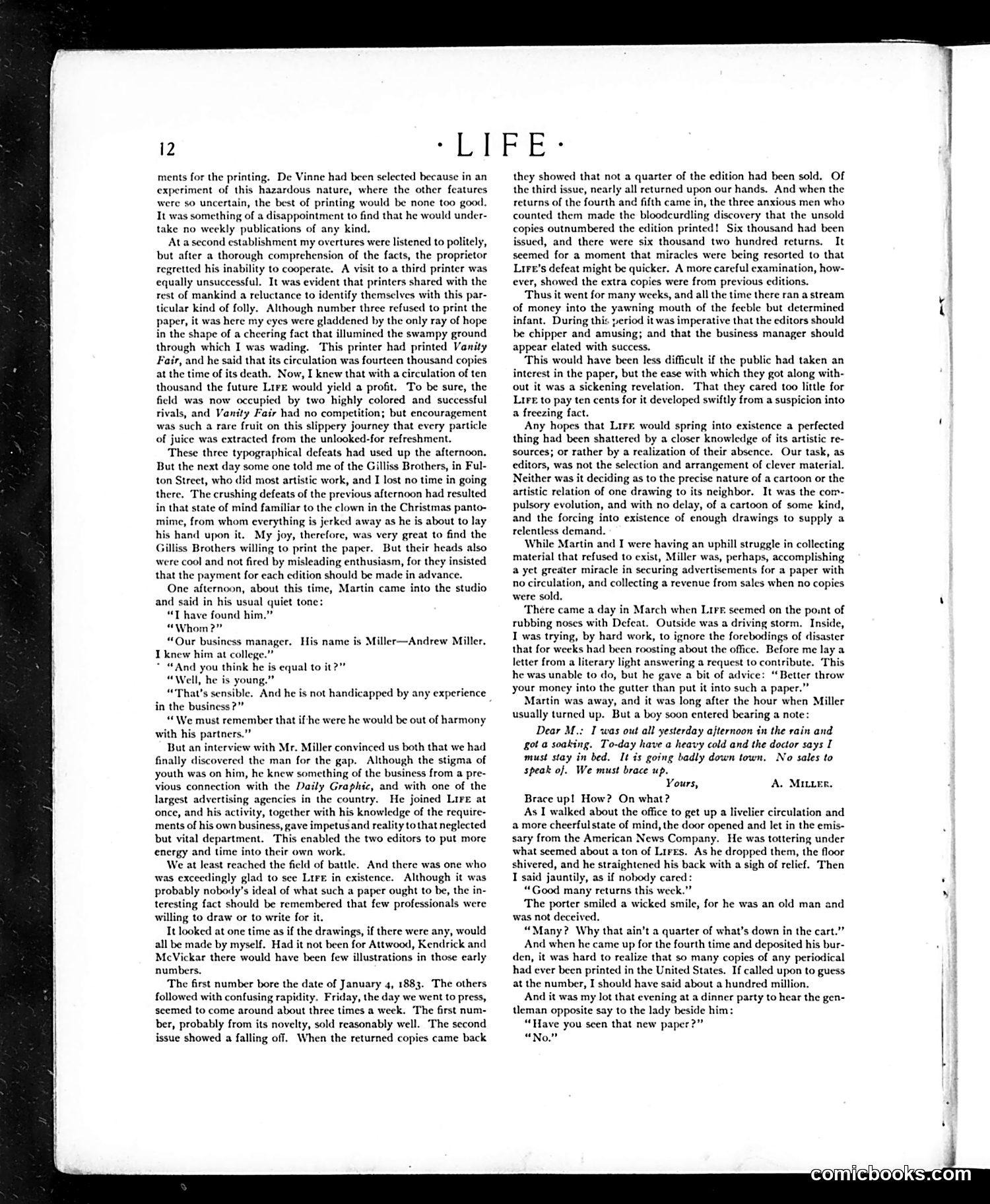
This page is primarily **text-based editorial content**, not a cartoon page. It discusses the early operational challenges of *Life* magazine itself—specifically the difficulty finding a suitable printer for the publication's demanding technical requirements. The narrative describes practical business struggles: printer selection, production delays, and circulation challenges. It mentions Andrew Miller joining as a business partner and references securing advertisements to sustain the fledgling publication. The page includes a brief letter from a reader ("A. Miller") complaining about delivery issues during bad weather, to which the editor responds dismissively. **No political satire or caricatures are visible on this page.** It's a behind-the-scenes account of *Life's* founding operations, offering historical insight into late-19th-century magazine publishing logistics rather than contemporary social commentary.
📄 Transcribed text from this page (OCR, searchable)
Machine-transcribed from the original scan — historical spelling and the odd misread are preserved.
12 -LIFE- ments for the printing. De Vinne had been selected because in an experiment of this hazardous nature, where the other features were so uncertain, the best of printing would be none too good. It was something of a disappointment to find that he would under- take no weekly publications of any kind. Atasecond establishment my overtures were listened to politely, but after a thorough comprehension of the facts, the proprietor regretted his inability to cooperate. A visit to a third printer was equally unsuccessful. It was evident that printers shared with the rest of mankind a reluctance to identify themselves with this par- ticular kind of folly. Although number three refused to print the paper, it was here my eyes were gladdened by the only ray of hope in the shape of a cheering fact that illumined the swampy ground through which I was wading. This printer had printed Vanity Fair, and he said that its circulation was fourteen thousand copies at the time of its death, Now, I knew that with a circulation of ten thousand the future Lire would yield a profit. To be sure, the ficld was now occupied by two highly colored and successful ivals, and Vanity Fair had no competition; but encouragement was such a rare fruit on this slippery journey that every particle of juice was extracted from the unlooked-for refreshment. These three typographical defeats had used up the afternoon. But the next day some one told me of the Gilliss Brothers, in Ful- ton Street, who did most artistic work, and I lost no time in going there. The crushing defeats of the previous afternoon had resulted in that state of mind familiar to the clown in the Christmas panto- mime, from whom everything is jerked away as he is about to lay his hand upon it. My joy, therefore, was very great to find the Gilliss Brothers willing to print the paper. But their heads also were cool and not fired by misleading enthusiasm, for they insisted that the payment for each edition should be made in advance. One afternoon, about this time, Martin came into the studio and said in his usual quiet tone: “T have found him.” “Whom?” “Our business man: I knew him at college.’ * “And you think he is equal to it?” “Well, he is youn; nsible. And he is not handicapped by any experience in the business?” “We must remember that if he were he would be out of harmony with his partners.”” But an interview with Mr. Miller convinced us both that we had. finally discovered the man for the gap. Although the stigma of youth was on him, he knew something of the business from a pre- vious connection with the Daily Graphic, and with one of the largest advertising agencies in the country. He joined Lire at once, and his activity, together with his knowledge of the require- ments of his own business, gave impetus and reality tothat neglected but vital department. This enabled the two editors to put more energy and time into their own work. We at least reached the field of battle. And there was one who was exceedingly glad to sce Ltre in existence. Although it was probably nobody's ideal of what such a paper ought to be, the in- teresting fact should be remembered that few professionals were willing to draw or to write for it. It looked at one time as if the drawings, if there were any, would all be made by myself. Had it not been for Attwood, Kendrick and McVickar there would have been few illustrations in those early numbers. ‘The first number bore the date of January 4, 1883. The others followed with confusing rapidity. Friday, the day we went to press, ger. His name is Miller-—Andrew Miller. seemed to come around about three times a week. The first num- ber, probably from its novelty, sold reasonably well. ‘The second issue showed a falling off. When the returned copies came back they showed that not a quarter of the edition had been sold. Of the third issue, nearly all returned upon our hands. And when the returns of the fourth and fifth came in, the three anxious men who counted them made the bloodcurdling discovery that the unsold copies outnumbered the edition printed! Six thousand had been issued, and there were six thousand two hundred returns. It seemed for a moment that miracles were being resorted to that Lire’s defeat might be quicker. A more careful examination, how- ever, showed the extra copies were from previous editions. Thus it went for many weeks, and all the time there ran a stream. of money into the yawning mouth of the feeble but determined infant. During this period it was imperative that the editors should be chipper and amusing; and that the business manager should appear elated with success. This would have been less difficult if the public had taken an interest in the paper, but the ease with which they got along with- out it was a sickening revelation. That they cared too little for Lire to pay ten cents for it developed swiftly from a suspicion into a freezing fact. Any hopes that Lrrr would spring into existence a perfected thing had been shattered by a closer knowledge of its artistic re- sources; or rather by a realization of their absence. Our task, as editors, was not the selection and arrangement of clever material. Neither was it deciding as to the precise nature of a cartoon or the artistic relation of one drawing to its neighbor. It was the com- pulsory evolution, and with no delay, of a cartoon of some kind, and the forcing into existence of enough drawings to supply a relentless demand. While Martin and I were having an uphill struggle in collecting material that refused to exist, Miller was, perhaps, accomplishing a yet greater miracle in securing advertisements for a paper with no circulation, and collecting a revenue from sales when no copies were sold. ‘There came a day in March when Lirr seemed on the posnt of rubbing noscs with Defeat. Outside was a driving storm. Inside, I was trying, by hard work, to ignore the forebodings of disaster that for weeks had been roosting about the office. Before me lay a letter from a literary light answering a request to contribute. ‘This he was unable to do, but he gave a bit of advice: “ Better throw your money into the gutter than put it into such a paper.” Martin was away, and it was long after the hour when Miller usually turned up. But a boy soon entered bearing a note: Dear M.: I was out all yesterday ajternoon in the rain and gota soaking. To-day have a heavy cold and the doctor says I must stay in bed. It is going badly down town. No sales to speak of. We must brace up. Yours, A. Minter. Brace up! How? On what? As I walked about the office to get up a livelier circulation and a more cheerful state of mind, the door opened and let in the emis- sary from the American News Company. He was tottering under what seemed about a ton of Lires. As he dropped them, the floor shivered, and he straightened his back with a sigh of relief. Then I said jauntily, as if nobody cared: “Good many returns this week.” The porter smiled a wicked smile, for he was an old man and was not deceived. “Many? Why that ain’t a quarter of what’s down in the cart.” And when he came up for the fourth time and deposited his bur- den, it was hard to realize that so many copies of any periodical had ever been printed in the United States. If called upon to guess at the number, I should have said about a hundred million. And it was my lot that evening at a dinner party to hear the gen- tleman opposite say to the lady beside him: “Have you scen that new paper?” “No.” mx