
Life, 1908-01-02 · page 17 of 44
Life — January 2, 1908 — page 17: what you’re looking at
What you’re looking at
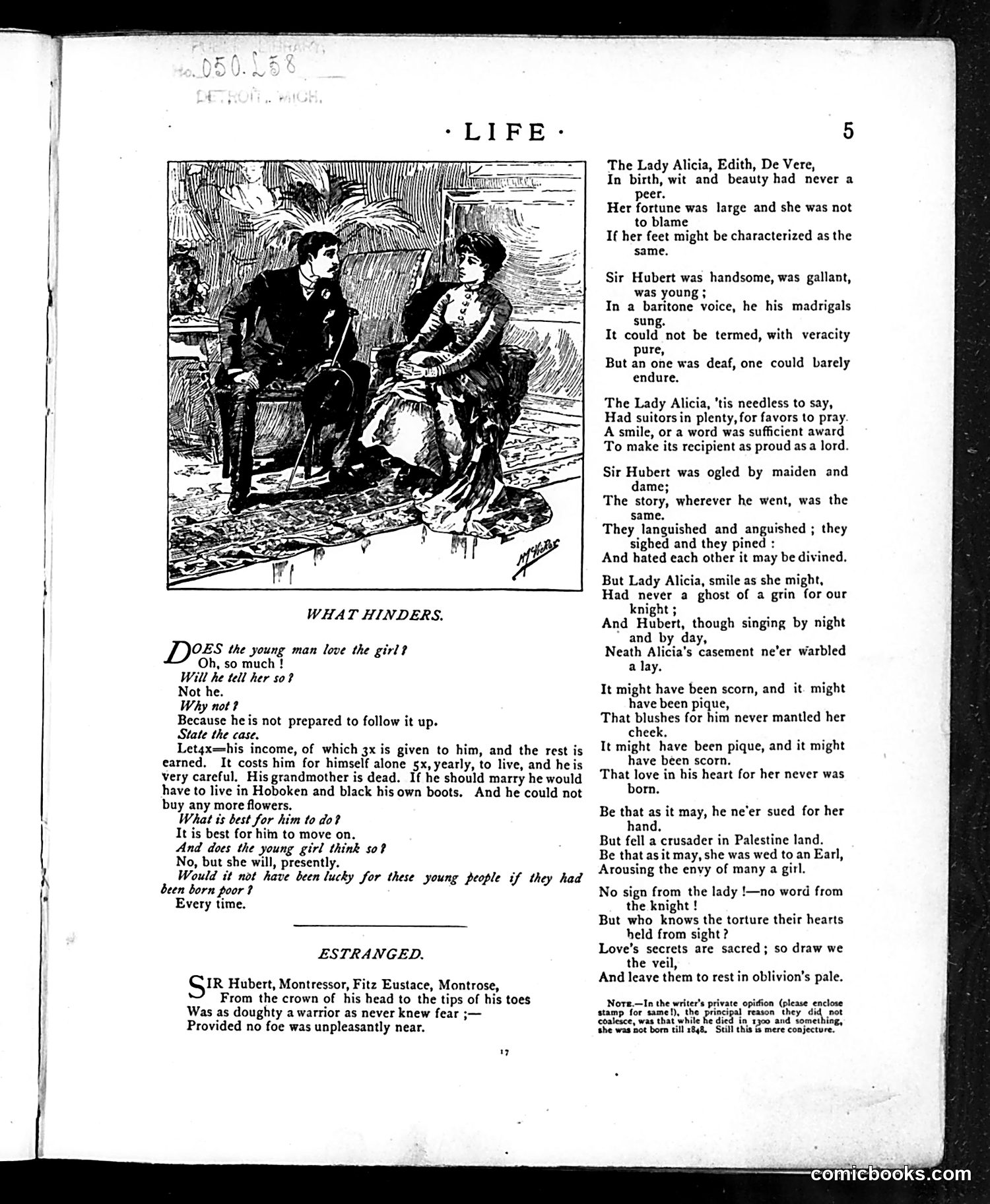
This page presents a satirical narrative poem about thwarted romance between Sir Hubert and Lady Alicia. The accompanying illustration shows the two figures in an interior setting, depicting their emotional distance. **The Satire's Point:** The dialogue section "What Hinders" uses mathematical logic to explain why Sir Hubert cannot propose marriage despite his feelings. He earns income *3x* but spends *5x* yearly on himself alone—meaning marriage would force him into poverty in Hoboken, required to black his own boots. The satire mocks Victorian economic barriers to romance: two people clearly attracted to each other remain separated purely by financial constraints. **The Irony:** The poem's conclusion reveals both characters eventually marry others, their unspoken feelings forever buried. The note at page's bottom suggests the writer blames this outcome on economic hardship rather than lack of affection. This critiques how 19th-century class anxieties and financial realities prevented genuine emotional connection from developing into marriage.
📄 Transcribed text from this page (OCR, searchable)
Machine-transcribed from the original scan — historical spelling and the odd misread are preserved.
5 The Lady Alicia, Edith, De Vere, In birth, wit and beauty had never a peer. Her fortune was large and she was not to blame If her feet might be characterized as the same. Sir Hubert was handsome, was gallant, was young ; In a baritone voice, he his madrigals sung, It could not be termed, with veracity pure, But an one was deaf, one could barely endure. The Lady Alicia, ‘tis needless to say, Had suitors in plenty, for favors to pray. A smile, or a word was sufficient award To make its recipient as proud asa lord. Sir Hubert was ogled by maiden and dame; The story, wherever he went, was the same. They languished and anguished ; they sighed and they pined : And hated each other it may be divined. But Lady Alicia, smile as she might, Had never a ghost of a grin for our knight ; WHAT HINDERS: And Hubert, though singing by night . and by day, Does the young man love the girl? Neath Alicia's casement ne'er warbled Oh, so much ! a lay. Will he tell her so? Not he. It might have been scorn, and it. might Why not? have been pique, That blushes for him never mantled her Because heis not prepared to follow it up. State the case. Letgx=his income, of which 3x is given to him, and the rest is earned, It costs him for himself alone 5x, yearly, to live, and heis very careful. His grandmother is dead. If he should marry he would cheek, It might have been pique, and it might have been scorn. That love in his heart for her never was have to live in Hoboken and black his own boots. And he could not born. ne hate in de? Be that as it may, he ne’er sued for her It is best for him to move on. B hand. der in Palestine land. And does the young girl think so? nt fell a crosades tn Palestine land: No, but she will, presently. Be that as it may, she was wed to an Earl, , , Z - e Would it not have been lucky for these young people if they had ‘Arousing the enyy.of many’a.gir. been born poor ? No sign from the lady !—no word from Every time. the knight ! But who knows the torture their hearts held from sight? ESTRANGED. Love's secrets are sacred; so draw we * the veil, . Si SR Hubert, Montressor, Fitz Eustace, Montrose, And leave them to rest in oblivion's pale. From the crown of his head to the tips of his toes Nore.—In the writer's private opitfion (please enclose Was as doughty a warrior as never knew fear ;— stamp for same!), the ‘Princinel teason they did’ act Provided no foe was unpleasantly near. SS san iveoseee”