
Life, 1908-01-02 · page 5 of 44
Life — January 2, 1908 — page 5: what you’re looking at
What you’re looking at
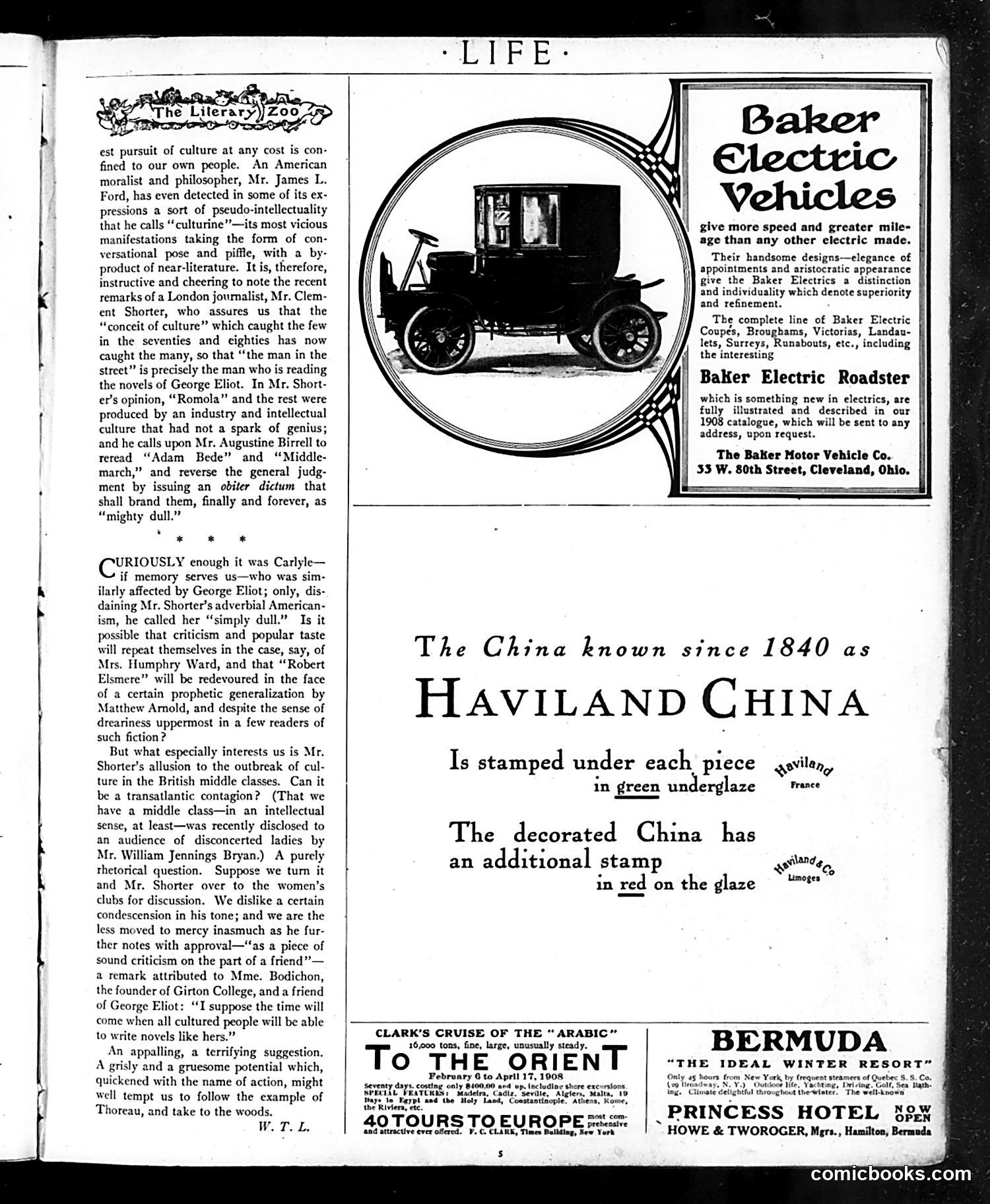
This page is primarily **advertising and literary commentary** rather than political satire. The main content—"The Literary Zoo"—is an essay critiquing American culture's relationship with intellectualism. It references journalist **Mr. James L. Ford** and London journalist **Mr. Shorter**, debating whether popular taste in literature (citing George Eliot's works) represents genuine culture or mere pretension. The piece questions whether middle-class audiences truly appreciate serious fiction or simply follow trends. The advertisements dominate: **Baker Electric Vehicles** (early automobiles), **Haviland China** (fine dishware), and travel promotions for **Europe** and **Bermuda**. The satirical thrust is mild—essentially mocking cultural pretension rather than targeting specific political figures or events.
📄 Transcribed text from this page (OCR, searchable)
Machine-transcribed from the original scan — historical spelling and the odd misread are preserved.
RO vr est pursuit of culture at any cost is con- fined to our own people. An American moralist and philosopher, Mr. James L. Ford, has even detected in some of its ex- pressions a sort of pseudo-intellectuality that he calls “‘culturine”’—its most vicious manifestations taking the form of con- versational pose and piffle, with a by- product of near-literature. It is, therefore, instructive and cheering to note the recent remarks of a London journalist, Mr. Clem- ent Shorter, who assures us that the “conceit of culture” which caught the few in the seventies and eighties has now caught the many, so that “the man in the street” is precisely the man who is reading the novels of George Eliot. In Mr. Short- er’s opinion, “Romola” and the rest were produced by an industry and intellectual culture that had not a spark of genius; and he calls upon Mr. Augustine Birrell to reread “Adam Bede” and “Middle- march,” and reverse the general judg- ment by issuing an obiter dictum that shall brand them, finally and forever, as “mighty dull.’” a ee) URIOUSLY enough it was Carlyle— if memory serves us—who was sim- ilarly affected by George Eliot; only, dis- daining Mr. Shorter’s adverbial American- ism, he called her “simply dull.” Is it possible that criticism and popular taste will repeat themselves in the case, say, of Mrs. Humphry Ward, and that “Robert Elsmere” will be redevoured in the face of a certain prophetic generalization by Matthew Amold, and despite the sense of dreariness uppermost in a few readers of such fiction ? But what especially interests us is Mr. Shorter’s allusion to the outbreak of cul- ture in the British middle classes. Can it be a transatlantic contagion? (That we have a middle class—in an intellectual sense, at least—was recently disclosed to an audience of disconcerted ladies by Mr. William Jennings Bryan.) A purely thetorical question. Suppose we turn it and Mr. Shorter over to the women’s clubs for discussion. We dislike a certain condescension in his tone; and we are the less moved to mercy inasmuch as he fur- ther notes with approval—‘‘as a piece of sound criticism on the part of a friend”— a remark attributed to Mme. Bodichon, the founder of Girton College, and a friend of George Eliot: ‘I suppose the time will come when all cultured people will be able to write novels like hers.” An appalling, a terrifying suggestion. A grisly and a gruesome potential which, quickened with the name of action, might well tempt us to follow the example of Thoreau, and take to the woods. W.T. L. ‘Baker Electric Vehicles give more speed and greater mile- age than any other electric made. Their handsome designs—elegance of appointments and aristocratic appearance give the Baker Electrics a distinction and individuality which denote superiority and refinement. The complete line of Baker Electric Coupes, Broughams, Victorias, Landau- lets, Surreys, Runabouts, etc., including the interesting Baker Electric Roadster | which is something new in electrics, are fully illustrated and described in our 1908 catalogue, which will be sent to any address, upon request. The Baker Motor Vehicle Co. 55 W. 80th Street, Cleveland, Ohio. The China known since 1840 as HAVILAND CHINA Is stamped under each piece aovilany, in green underglaze Brenes The decorated China has an additional stamp in red on the glaze alan, ender, Limoges “ enty sfrente nays ta Harpt and the tloly “land, jera, ete. 40 TOURS TO EUROPE wrevessive and attractive ever offered. ¥. CLARK’S CRUISE OF THE “ ARABIC” To THE ORIENT February 6 to April 17, 1908 days conting only 8100.00 ard up, including share excerstons eATU Madel Seville, Algiers, Malta, 10 ‘oastantinoples Athens, Kome, CLANK, Times Ballding, Bew York BERMUDA “THE IDEAL WINTER RESORT” Ont hours from New York by frequent steamers of Ques 8.8. Co. rf NY.) Ov hen “e. Golt, Sea liath whut throughout ihe-wister’ ‘The welktncon _ PRINCESS HOTEL 68x ~ HOWE & TWOROGER, Mgrs., Hamilton, Bermuda comicbooks.com