
Life, 1908-01-02 · page 32 of 44
Life — January 2, 1908 — page 32: what you’re looking at
What you’re looking at
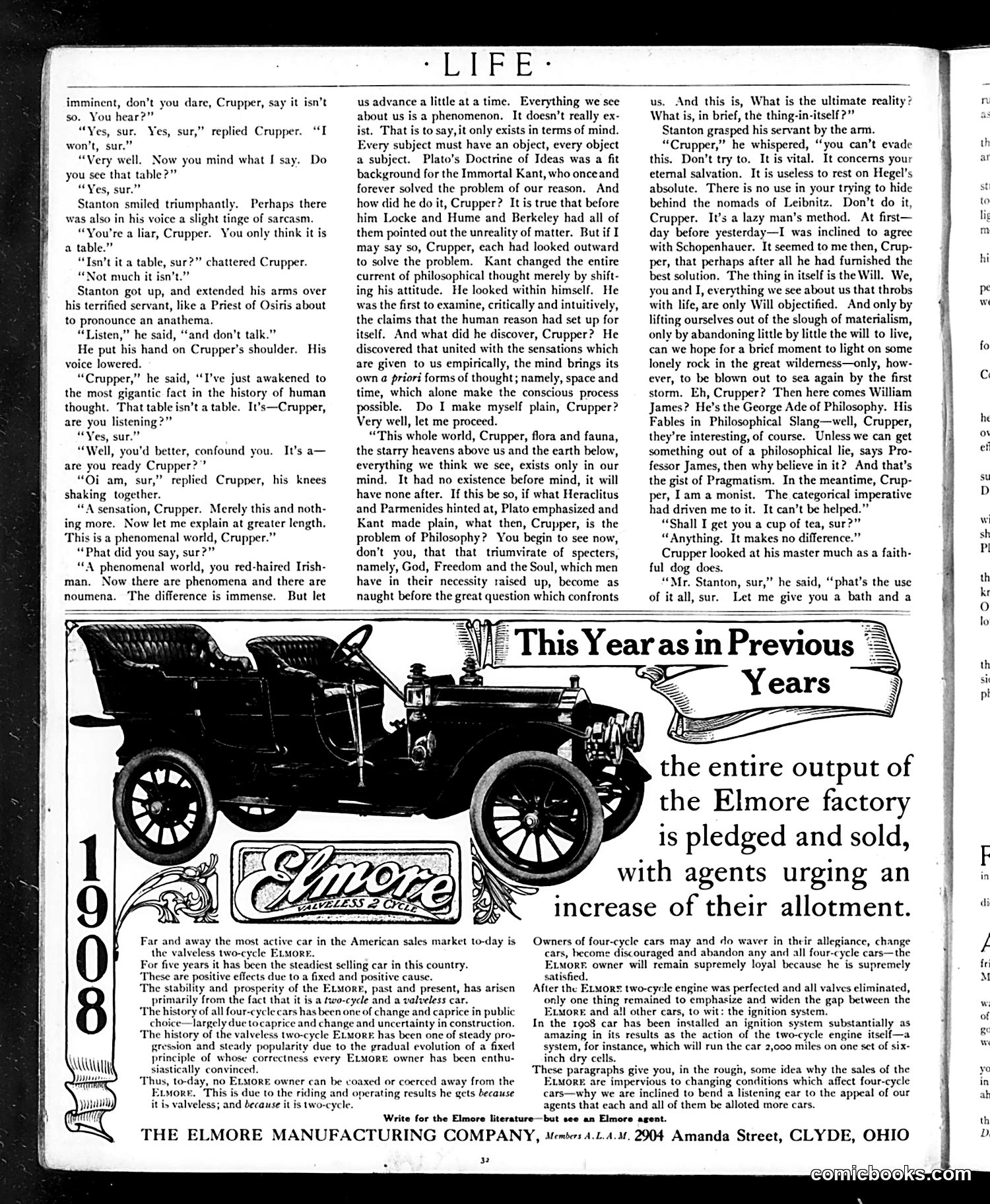
This is a satirical dialogue mocking **philosophical pedantry and pseudo-intellectualism**. A character named Stanton lectures his terrified Irish servant Crupper on German Idealist philosophy—Plato, Kant, Hegel, and Schopenhauer—using increasingly abstract jargon to prove a table "isn't really a table" but merely a "phenomenon" existing only in the mind. The satire targets: 1. **Pretentious intellectuals** who weaponize dense philosophy to confuse ordinary people 2. **The absurdity of pure idealism**—the notion that material reality doesn't exist independently of perception 3. **Class dynamics**: the servant's bewilderment and fear emphasize how such discourse serves to dominate rather than enlighten The humor lies in Stanton's escalating absurdity: he's using heavyweight philosophical concepts to deny the obvious reality of furniture, then connects this somehow to the servant's "eternal salvation." The accompanying **Elmore automobile ad** appears unrelated to the satire.
📄 Transcribed text from this page (OCR, searchable)
Machine-transcribed from the original scan — historical spelling and the odd misread are preserved.
RIE imminent, don’t you dare, Crupper, say it isn’t so. You hear?” “Yes, sur. Yes, sur,” won't, “Very well. Now you mind what I say. Do you see that table?” “Yes, sur.” Stanton smiled triumphantly. Perhaps there was also in his voice a slight tinge of sarcasm. “You're a liar, Crupper. You only think it is a table.” “Isn't it a table, sur?” chattered Crupper. “Not much it isn’t.” Stanton got up, and extended his arms over his terrified servant, like a Priest of Osiris about to pronounce an anathema. “Listen,” he said, ‘‘and don’t talk.” He put his hand on Crupper’s shoulder. His voice lowered. “Crupper,” he said, “I’ve just awakened to the most gigantic fact in the history of human thought. That table isn’t a table. It’s—Crupper, are you listening?” “Yes, sur.” “Well, you’d better, confound you. are you ready Crupper?” “Oi am, sur,” replied Crupper, his knees shaking together. “A sensation, Crupper. Merely this and noth- ing more. Now let me explain at greater length, s is a phenomenal world, Crupper.” “Phat did you say, sur?” “A phenomenal world, you red-haired Irish- man. Now there are phenomena and there are The difference is immense. But let replied Crupper. “I I's a— noumena. us advance a little ata time. Everything we see about us is a phenomenon. It doesn’t really ex- ist. That is to say, it only exists in terms of mind. Every subject must have an object, every object a subject. Plato’s Doctrine of Ideas was a fit background for the Immortal Kant, who once and forever solved the problem of our reason. And how did he do it, Crupper? It is true that before him Locke and Hume and Berkeley had all of them pointed out the unreality of matter. But if I may say so, Crupper, each had looked outward to solve the problem. Kant changed the entire current of philosophical thought merely by shift- ing his attitude. He looked within himself. He was the first to examine, critically and intuitively, the claims that the human reason had set up for itself. And what did he discover, Crupper? He discovered that united with the sensations which are given to us empirically, the mind brings its own a priori forms of thought; namely, space and time, which alone make the conscious process possible. Do I make myself plain, Crupper? Very well, let me proceed. “This whole world, Crupper, flora and fauna, the starry heavens above us and the earth below, everything we think we see, exists only in our mind. It had no existence before mind, it will have none after. If this be so, if what Heraclitus and Parmenides hinted at, Plato emphasized and Kant made plain, what then, Crupper, is the problem of Philosophy? You begin to see now, don’t you, that that triumvirate of specters, namely, God, Freedom and the Soul, which men have in their necessity raised up, become as naught before the c great question which confronts us. And this is, What is the ultimate reality? What is, in brief, the thing-in-itself ?” Stanton grasped his servant by the arm. “Crupper,” he whispered, “you can’t evade this. Don’t try to. It is vital. It concems your eternal salvation. It is useless to rest on Hegel’s absolute. There is no use in your trying to hide behind the nomads of Leibnitz. Don’t do it, Crupper. It’s a lazy man’s method. At first— day before yesterday—I was inclined to agree with Schopenhauer. It seemed to me then, Crup- per, that perhaps after all he had furnished the best solution, The thing in itself is the Will. We, you and I, everything we see about us that throbs with life, are only Will objectified. And only by lifting ourselves out of the slough of materialism, only by abandoning little by little the will to live, can we hope for a brief moment to light on some lonely rock in the great wilderness—only, how- ever, to be blown out to sea again by the first storm. Eh, Crupper? Then here comes William James? He's the George Ade of Philosophy. His Fables in Philosophical Slang—well, Crupper, they’re interesting, of course. Unless we can get something out of a philosophical lie, says Pro- fessor James, then why believe in it? And that’s the gist of Pragmatism. In the meantime, Crup- per, [ama monist. The categorical imperative had driven me to it. It can’t be helped.” “Shall I get you a cup of tea, sur?” “Anything. It makes no difference.” Crupper looked at his master much as a faith- ful dog does. “Mr, Stanton, sur,” he said, “phat’s the use of it all, sur. Let me give you a bath and a the entire output of the Elmore factory is pledged and sold, with agents urging an increase of their allotment. Fa the most active car in the American sales market to-day is the valveless two-cycle ELMORE. For five years it has been the steadiest selling car in this country. ‘These are positive effects due to a fixed and posit The stability and prosperity of the ELMore, past and present, has arisen _primarily from the fact that it is a two-cycle and a valveless car. ory of all four-cycle cars has been one of change and caprice in public cand change and uncertainty in construction. The history of the valve $s two-cycle ELMORE has been one of steady pro- ession'and steady popularity due to the gradual evolution of a fixed principle of whose correctness every ELMORE owner has been enthu- siastically convinced. rhus, to-day, no ELMore owner can be voa MORE. This is due to the riding and o it iy valveless; and because it is two-cycle. ced of coerced away from the ting results he gets because 2 Owners of four-cycle cars may and do waver in their allegiance, change cars, become discouraged and abandon any and alll four-cycle cars—the ELMorr. owner will remain supremely loyal because he is supremely satisfied, After the ELwors two-cycle engine was perfected and all valves eliminated, only one thing remained to emphasize and widen the gap between the ELMore and all other cars, to wit: the ignition system. In the 1908 car has been installed an ignition system substantially as amazing in its results as the action of the two-cycle engine itself—a system, for instance, which will run the car 2,000 miles on one set of six- inch dry cells. ‘These paragraphs give you, in the rough, some idea why the sales of the ELMore. are impervious to changing conditions which affect four-cycle cars—why we are inclined to bend a listening car to the appeal of our agents that each and all of them be alloted more cars. Write for the Elmore literature—but see an Elmore agent. THE ELMORE MANUFACTURING COMPANY, Menters 4.1.4.1. 2904 Amanda Street, CLYDE, OHIO ar