
Life, 1908-01-02 · page 15 of 44
Life — January 2, 1908 — page 15: what you’re looking at
What you’re looking at
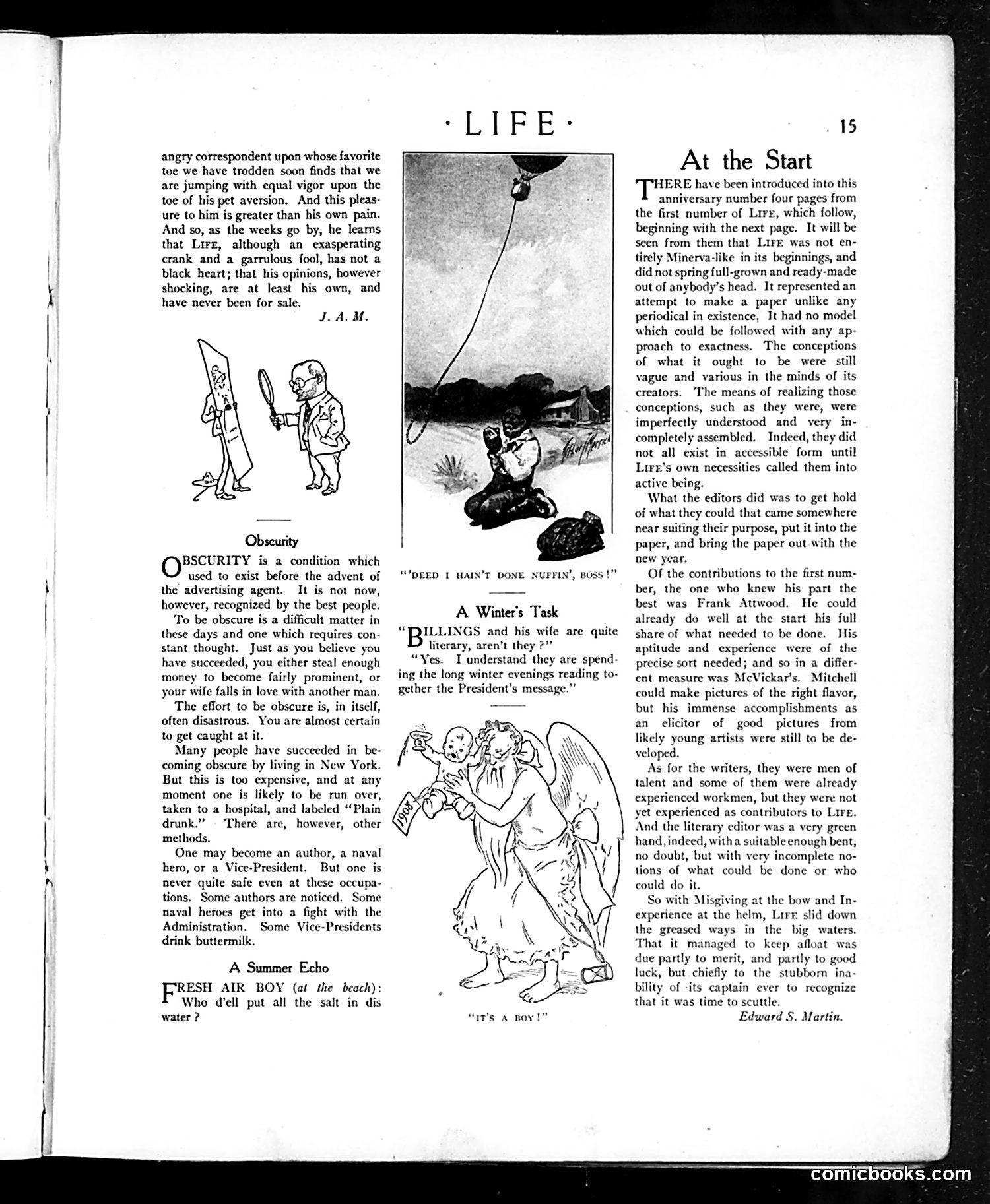
This page contains several satirical pieces typical of *Life* magazine's humor: **"Obscurity"** mocks the impossibility of remaining obscure in modern America. The essay humorously argues that attempting to hide from public notice inevitably fails—whether through scandal (stealing money, infidelity) or prominence (becoming an author, naval hero, or Vice-President). The joke satirizes American society's obsession with publicity and celebrity. **"A Summer Echo"** is a brief racial stereotype joke featuring a Black child at the beach, using dialect humor common to the era's offensive comedic conventions. **"A Winter's Task"** jokes about a couple reading President Theodore Roosevelt's message aloud during winter evenings—gently mocking both the tedium of presidential rhetoric and the pretensions of "literary" couples. The page primarily introduces *Life*'s inaugural issue, explaining the magazine's experimental, unpolished origins with various talented contributors still learning their roles. Edward S. Martin's editorial suggests *Life* began without a clear model or unified vision.
📄 Transcribed text from this page (OCR, searchable)
Machine-transcribed from the original scan — historical spelling and the odd misread are preserved.
angry correspondent upon whose favorite toe we have trodden soon finds that we are jumping with equal vigor upon the toe of his pet aversion. And this pleas- ure to him is greater than his own pain. And so, as the weeks go by, he leams that Lire, although an exasperating crank and a garrulous fool, has not a black heart; that his opinions, however shocking, are at least his own, and have never been for sale. J.A.M. Obscurity BSCURITY is a condition which used to exist before the advent of the advertising agent. It is not now, however, recognized by the best people. To be obscure is a difficult matter in these days and one which requires con- stant thought. Just as you believe you have succeeded, you either steal enough money to become fairly prominent, or your wife falls in love with another man. The effort to be obscure is, in itself, often disastrous. You are almost certain to get caught at it. Many people have succeeded in be- coming obscure by living in New York. But this is too expensive, and at any moment one is likely to be run over, taken to a hospital, and labeled “Plain drunk.” — There are, however, other methods. One may become an author, a naval hero, or a Vice-President. But one is never quite safe even at these occupa- tions. Some authors are noticed. Some naval heroes get into a fight with the Administration. Some Vice-Presidents drink buttermilk. A Summer Echo 'RESH AIR BOY (at the beach): Who d’ell put all the salt in dis water ? “DEED I HAIN'T DONE NUFFIN’, Boss!” A Winter's Task “Bu LINGS and his wife are quite jterary, aren’t they ?”” “Yes. I understand they are spend- ing the long winter evenings reading to- gether the President’s message.”’ “17's A Boy!” 15 At the Start 'HERE have been introduced into this anniversary number four pages from the first number of Lire, which follow, beginning with the next page. It will be seen from them that Lire was not en- tirely Minerva-like in its beginnings, and did not spring full-grown and ready-made out of anybody’s head. It represented an attempt to make a paper unlike any periodical in existence, It had no model which could be followed with any ap- proach to exactness. The conceptions of what it ought to be were still vague and various in the minds of its creators. ‘The means of realizing those conceptions, such as they were, were imperfectly understood and very in- completely assembled. Indeed, they did not all exist in accessible form until Lire’s own necessities called them into active being. What the editors did was to get hold of what they could that came somewhere near suiting their purpose, put it into the paper, and bring the paper out with the new year. Of the contributions to the first num- ber, the one who knew his part the best was Frank Attwood. He could already do well at the start his full share of what needed to be done. His aptitude and experience were of the precise sort needed; and so in a differ- ent measure was McVickar’s. Mitchell could make pictures of the right flavor, but his immense accomplishments as an clicitor of good pictures from likely young artists were still to be de- veloped. As for the writers, they were men of talent and some of them were already experienced workmen, but they were not yet experienced as contributors to Lire. And the literary editor was a very green hand, indeed, witha suitable enough bent, no doubt, but with very incomplete no- tions of what could be done or who could do it. So with Misgiving at the bow and In- experience at the helm, Lr lid down the greased w: in the big waters. That it managed to keep afloat was due partly to merit, and partly to good luck, but chiefly to the stubborn ina- bility of -its captain ever to recognize that it was time to scuttle. Edward S. Martin, Ccomicboo! s.com