
Life, 1908-01-02 · page 28 of 44
Life — January 2, 1908 — page 28: what you’re looking at
What you’re looking at
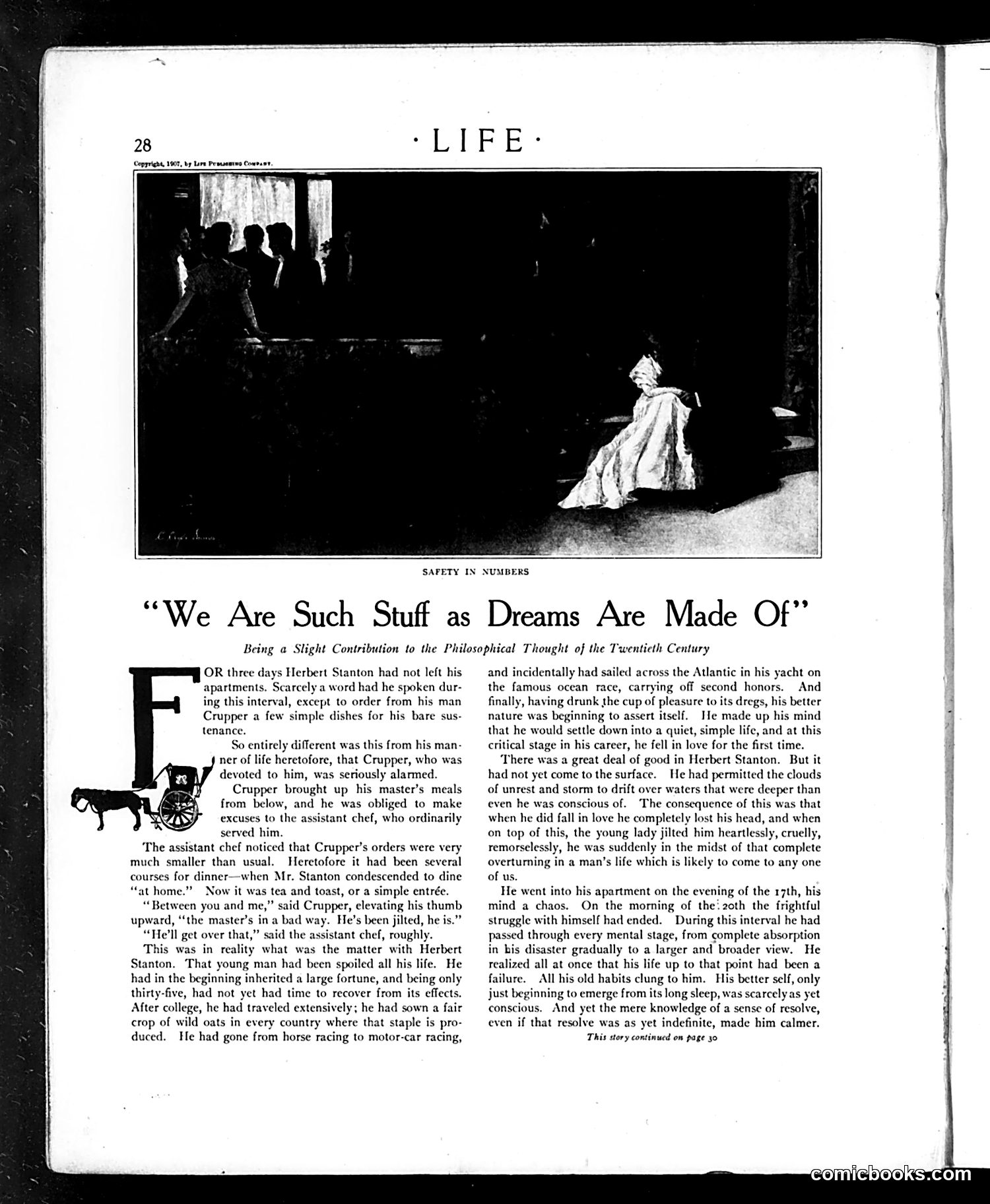
This is the opening installment of a serialized short story about Herbert Stanton, a wealthy, idle man who experiences a spiritual crisis after being jilted by a young woman. The narrative contrasts his empty, pleasure-seeking life—racing horses, motor cars, yachting—with an emerging "better nature." The illustration titled "Safety in Numbers" shows a woman in an elegant white dress isolated in the lower right, observed from a distance by silhouetted figures in shadow above—visually representing her social prominence or the attention she commands, possibly depicting the woman who rejected the protagonist. The subtitle describes this as "a slight contribution to the philosophical thought of the twentieth century," suggesting gentle satire of contemporary ideas about personal transformation and moral awakening. The story explores themes of wealth, dissolution, and redemption that appealed to Life's educated readership in 1907.
📄 Transcribed text from this page (OCR, searchable)
Machine-transcribed from the original scan — historical spelling and the odd misread are preserved.
28 Copyright, 1007, by Lire Preuentes Couvest SAFETY IN NUMBERS “We Are Such Stuff as Dreams Are Made Of” Being a Slight Contribution to the Philosophical Thought of the Twentieth Century OR three days Herbert Stanton had not left his apartments. Scarcely a word had he spoken dur- ing this interval, except to order from his man Crupper a few simple dishes for his bare sus- tenance. So entirely different was this from his man- ner of life heretofore, that Crupper, who was devoted to him, was seriously alarmed. Crupper brought up his master’s meals from below, and he was obliged to maki excuses to the assistant chef, who ordinarily served him. ‘The assistant chef noticed that Crupper’s orders were very much smaller than usual. Heretofore it had been several courses for dinner—when Mr. Stanton condescended to dine “at home.” Now it was tea and toast, or a simple entrée. “Between you and me,” said Crupper, elevating his thumb upward, ‘‘the master’s ina bad way. He’s been jilted, he is.” “He'll get over that,” said the assistant chef, roughly. This was in reality what the matter with Herbert Stanton. That young man had been spoiled all his life. He had in the beginning inherited a large fortune, and being only thirty-five, had not yet had time to recover from its effects. After college, he had traveled extensively; he had sown a fair crop of wild oats in every country where that staple is pro- duced. He had gone from horse racing to motor-car racing, and incidentally had sailed across the Atlantic in his yacht on the famous ocean race, carrying off second honors. And finally, having drunk the cup of pleasure to its dregs, his better nature was beginning to assert itself. Ie made up his mind that he would settle down into a quiet, simple life, and at this critical stage in his career, he fell in love for the first time. ‘There was a great deal of good in Herbert Stanton. But it had not yet come to the surface. He had permitted the clouds of unrest and storm to drift over waters that were deeper than even he was conscious of. ‘The consequence of this was that when he did fall in love he completely lost his head, and when on top of this, the young lady jilted him heartlessly, cruelly, remorsclessly, he was suddenly in the midst of that complete overtuming in a man’s life which is likely to come to any one of us. He went into his apartment on the evening of the 17th, his mind a chaos. On the morning of the: 2oth the frightful struggle with himself had ended. During this interval he had passed through every mental stage, from complete absorption in his disaster gradually to a larger and broader view. He realized all at once that his life up to that point had been a failure. All his old habits clung to him. His better self, only just beginning to emerge from its long sleep, was scarcely as yet conscious. And yet the mere knowledge of a sense of resolve, even if that resolve was as yet indefinite, made him calmer. This story continued om page 30