
Life, 1908-01-02 · page 30 of 44
Life — January 2, 1908 — page 30: what you’re looking at
What you’re looking at
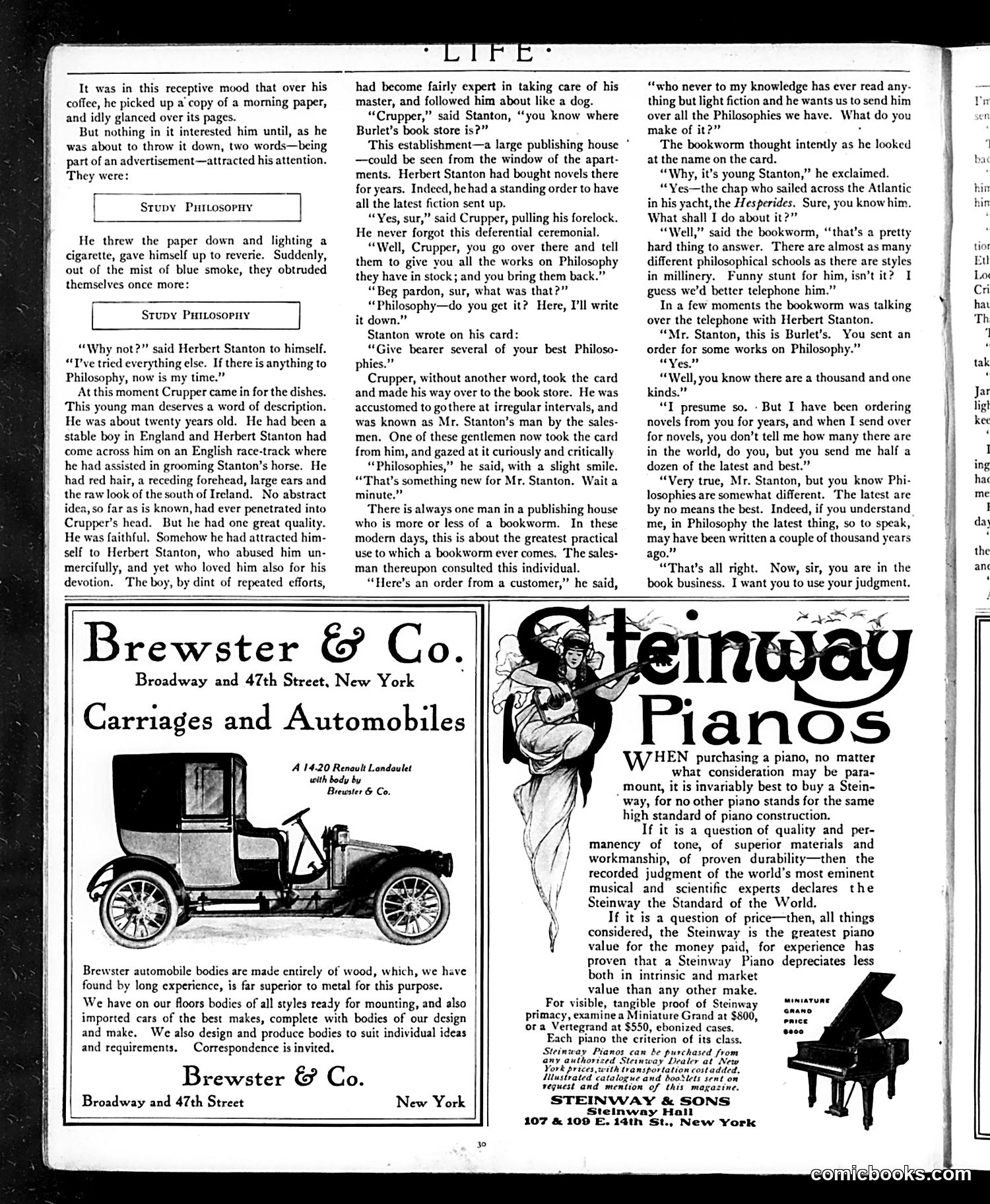
This is a humorous short story (not a political cartoon) satirizing casual intellectual pretension. The protagonist, wealthy Herbert Stanton, impulsively decides to pursue philosophy after seeing an advertisement for "Study Philosophy" in a newspaper. He orders his simple Irish servant Crupper to buy "all the works on Philosophy" from a bookstore. The satire targets two groups: the frivolous rich man who treats serious intellectual study as a passing whim (like ordering novels), and the practical bookstore clerk who recognizes the absurdity of someone with Stanton's frivolous background suddenly demanding philosophy books without guidance. The joke centers on the impossibility of the request—philosophy encompasses thousands of conflicting schools and texts—exposing Stanton's superficial approach to self-improvement. The humor derives from the clash between casual wealth and the genuine difficulty of philosophical study.
📄 Transcribed text from this page (OCR, searchable)
Machine-transcribed from the original scan — historical spelling and the odd misread are preserved.
It was in this receptive mood that over his coffee, he picked up a’ copy of a morning paper, and idly glanced over its pages. But nothing in it interested him until, as he was about to throw it down, two words—being part of an advertisement—attracted his attention. They were: Stupy Puttosopny He threw the paper down and lighting a cigarette, gave himself up to reverie. Suddenly, out of the mist of blue smoke, they obtruded themselves once more: Stupy PutLosopny “Why not?” said Herbert Stanton to himself. “T’ve tried everything else. If there is anything to Philosophy, now is my time.” At this moment Crupper came in for the dishes. ‘This young man deserves a word of description. He was about twenty years old. He had been a stable boy in England and Herbert Stanton had come across him on an English race-track where he had assisted in grooming Stanton’s horse. He had red hair, a receding forehead, large ears and the raw look of the south of Ireland. No abstract idea, so far as is known, had ever penetrated into Crupper’s head. But he had one great quality. He was faithful. Somehow he had attracted him- self to Herbert Stanton, who abused him un- mercifully, and yet who loved him also for his devotion, The boy, by dint of repeated efforts, had become fairly expert in taking care of his master, and followed him about like a dog. “Crupper,” said Stanton, “you know where Burlet’s book store is?” This establishment—a large publishing house * —could be scen from the window of the apart- ments. Herbert Stanton had bought novels there for years. Indeed, hehad a standing order to have all the latest fiction sent up. “Yes, sur,” said Crupper, pulling his forelock. He never forgot this deferential ceremonial. “Well, Crupper, you go over there and tell them to give you ail the works on Philosophy they have in stock; and you bring them back.” “Beg pardon, sur, what was that?” “Philosophy—do you get it? Here, I’ll write it down.” Stanton wrote on his card: “Give bearer several of your best Philoso- phies.”” Crupper, without another word, took the card and made his way over to the book store. He was accustomed to gothere at irregular intervals, and was known as Mr. Stanton’s man by the sales- men. One of these gentlemen now took the card from him, and gazed at it curiously and critically “Philosophies,” he said, with a slight smile. “That’s something new for Mr. Stanton. Wait a minute.” ‘There is always one man in a publishing house who is more or less of a bookworm. In these modern days, this is about the greatest practical use to which a bookworm ever comes. The sales- man thereupon consulted this individual. “‘Here’s an order from a customer,” he said, “‘who never to my knowledge has ever read any- thing but light fiction and he wants us to send him over all the Philosophies we have. What do you make of it?” The bookworm thought intently as = looked at the name on the card. “Why, it’s young Stanton,” he exclaimed. “Yes—the chap who sailed across the Atlantic s yacht, the Hesperides. Sure, you know him. What shall I do about it?” “Well,” said the bookworm, “that’s a pretty hard thing to answer. There are almost as many different philosophical schools as there are styles in millinery. Funny stunt for him, isn’t it? I guess we'd better telephone him.” In a few moments the bookworm was talking over the telephone with Herbert Stanton. “Mr. Stanton, this is Burlet’s. You sent an order for some works on Philosophy.” “Yes. “Well, you know there are a thousand and one kinds.” “I presume so. - But I have been ordering novels from you for years, and when I send over for novels, you don’t tell me how many there are in the world, do you, but you send me half a dozen of the latest and best.” “Very true, Mr. Stanton, but you know Phi- losophies are somewhat different. The latest are by no means the best. Indeed, if you understand me, in Philosophy the latest thing, so to speak, may have been written a couple of thousand years “ny hat’s all right. Now, sir, you are in the book business. I want you to use your judgment. | Brewster & Co. Broadway and 47th Street, New York Carriages and Automobiles cae ee SAL “{ nos HEN purchasing a piano, no matter A 14-20 Renault Londaulet with body by Brewster & Co. Brewster automobile bodies are made entirely of wood, which, we have found by long experience, is far superior to metal for this purpose. We have on our floors bodies of all styles ready for mounting, and also imported cars of the best makes, complete with bodies of our design and make. We also design and produce bodies to suit individual ideas and requirements. Correspondence is invited. Brewster & Co. Broadway and 47th Street New York what consideration may be para- _ Mount, it is invariably best to buy a Stein- way, for no other piano stands for the same high standard of piano construction. If it is a question of quality and per- manency of tone, of superior materials and workmanship, of proven durability—then the \ / / recorded judgment of the world’s most eminent \ / musical and scientific experts declares the X Steinway the Standard of the World. \ If it is a question of price—then, all things y considered, the Steinway is the greatest piano value for the money paid, for experience has proven that a Steinway Piano depreciates less both in intrinsic and market value than any other make. For visible, tangible proof of Steinway primacy, examine a Miniature Grand at $800, ora Vertegrand at $550, ebonized cases. Each piano the criterion of its class. Steinway Pianot can be purchased from any authorized Sternway Dealer at York prices,with transportation costadded. Mlustrated catalogue and boosiets sent on request and mention of this magazine. STEINWAY & SONS Steinway Hall 107 & 109 E. 14th St., New York Mumiavune