
A complete issue · 44 pages · 1907
Life — October 17, 1907
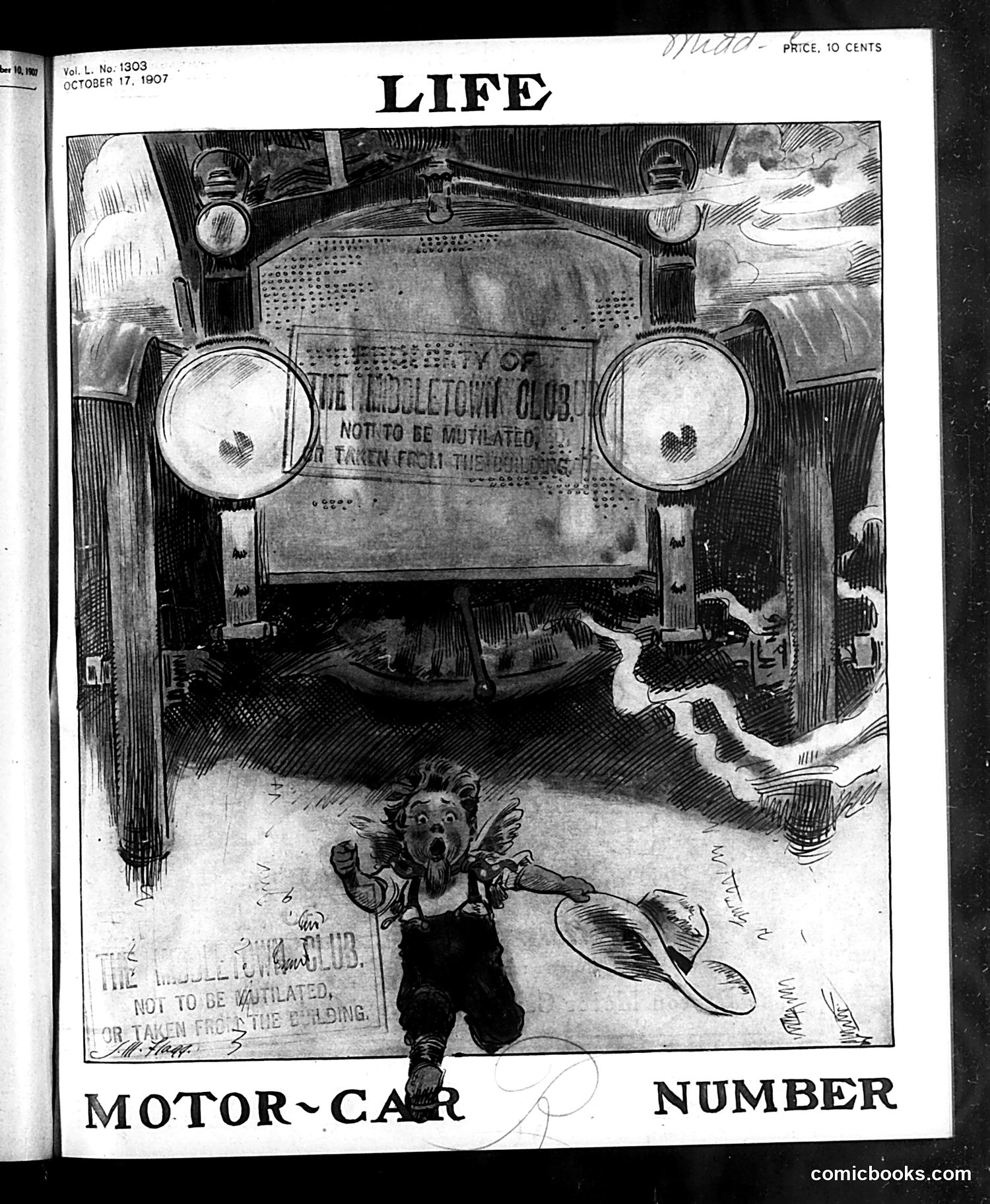
This cartoon depicts a cherub or cupid-like figure lying beneath an early automobile, appearing crushed or run over. The car displays text reading "THE MIDDLETOWN OIL" and warns "NOT TO BE MUTILATED OR TAKEN FROM THIS BUILDING." The satire targets the dangers of automobiles in the early 1900s. The cherub—traditionally representing innocence, love, or life itself—lies destroyed under the vehicle, suggesting that cars symbolized destruction of these values or posed serious public safety hazards. This reflects contemporary anxieties about automobiles, which were novel, unregulated, and caused frequent fatal accidents. The cartoon mocks both the vehicles themselves and the warning signs attempting to protect company property, implying that machines posed greater danger to human life than corporations cared about protecting their assets.
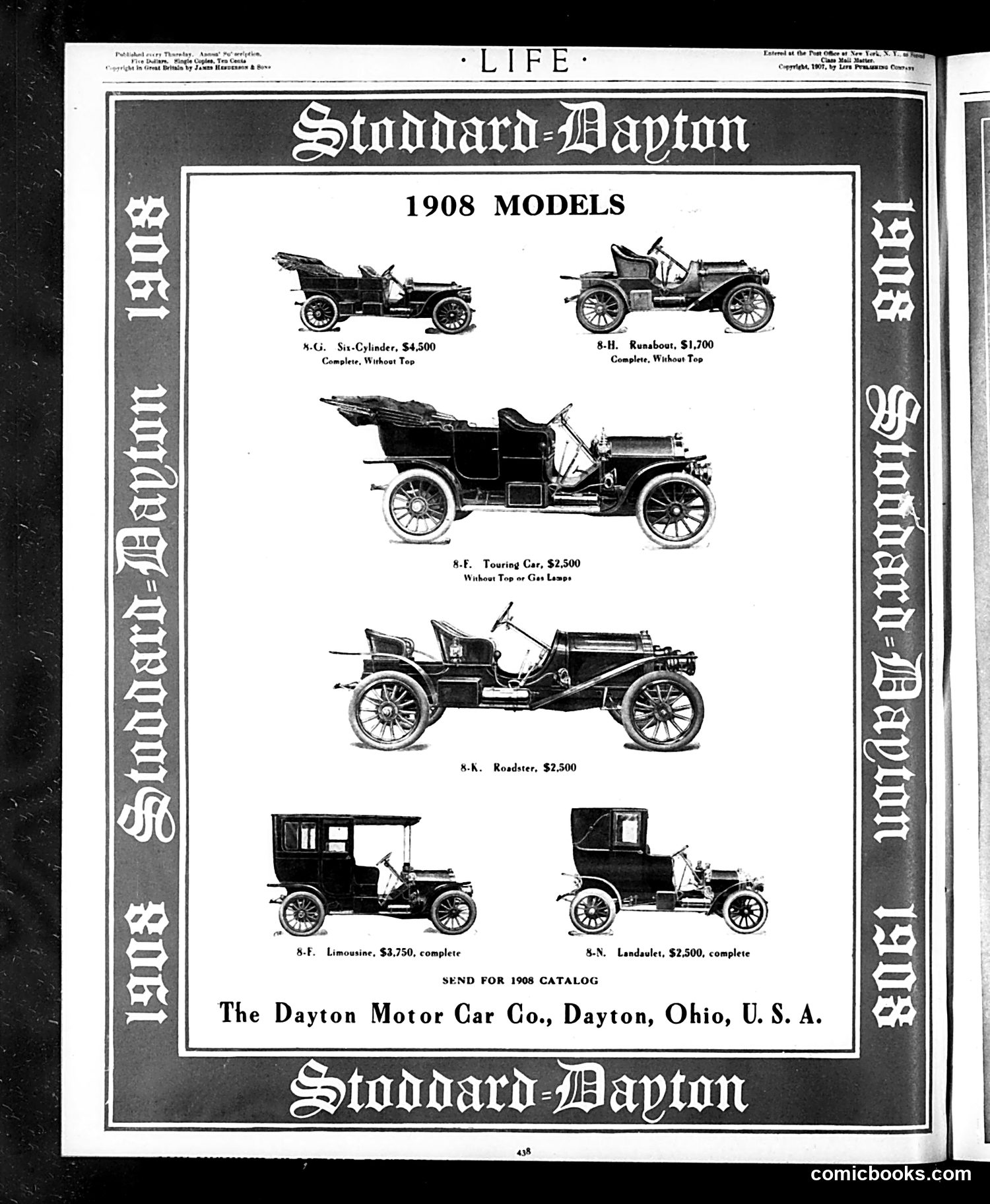
This page is **not a cartoon or satire** — it is a straightforward advertisement for Standard-Dayton automobiles from 1908. The page displays six vehicle models with prices and descriptions: - 6-cylinder touring car ($4,500) - Runabout ($1,700) - Touring car ($2,500) - Roadster ($2,500) - Limousine ($3,750) - Landaulet ($2,500) The decorative border reads "Immensely Popular" and features the Standard-Dayton branding. At bottom, it directs readers to "SEND FOR 1908 CATALOG" and identifies the manufacturer as The Dayton Motor Car Co. in Dayton, Ohio. This is purely commercial content — an early automobile manufacturer showcasing their product line to Life magazine's readers.
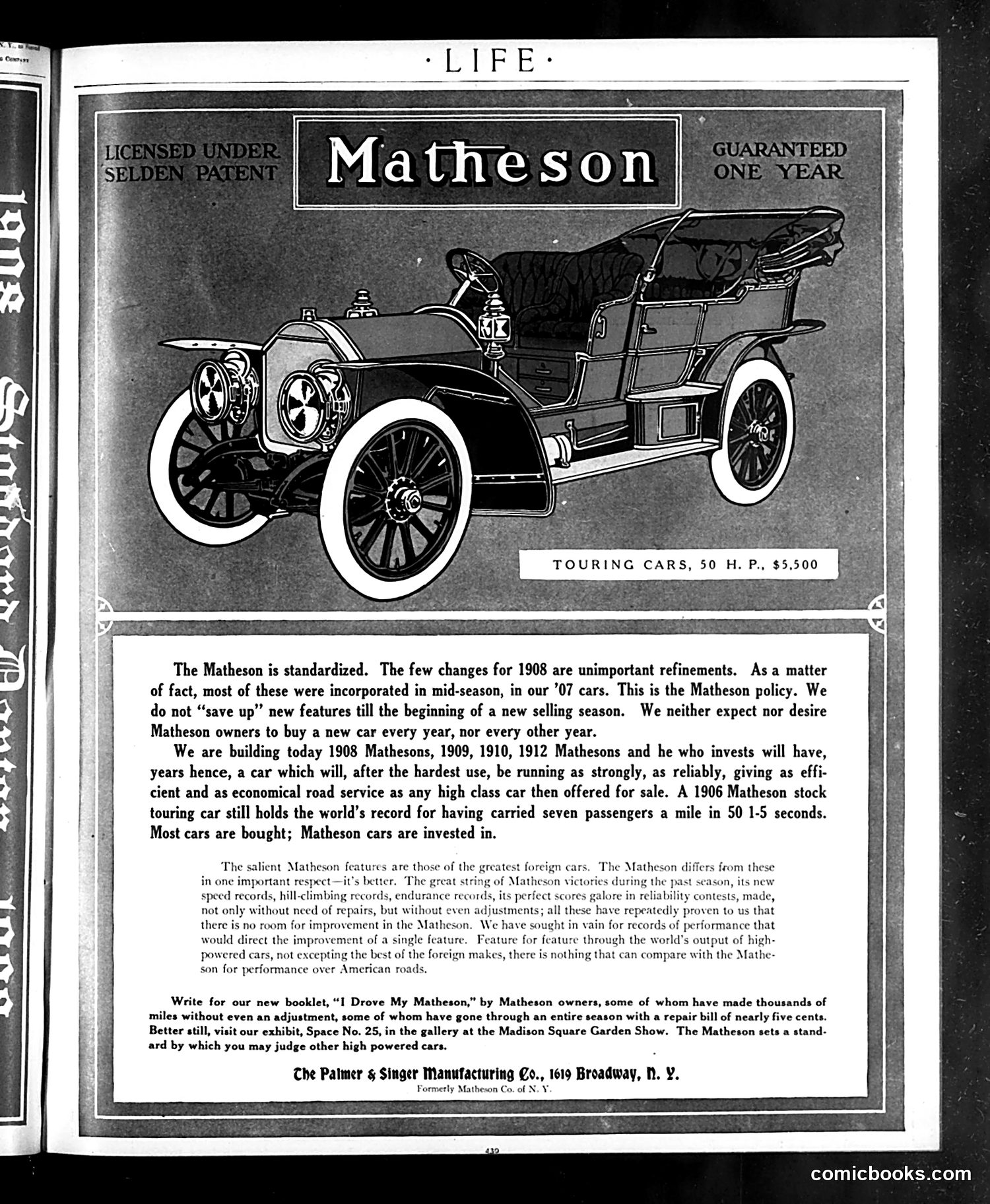
This is **not a satirical cartoon** but rather a straightforward **automobile advertisement** from Life magazine's early 1900s era. The page advertises the Matheson touring car (50 horsepower, $5,500), manufactured by Palmer & Singer Manufacturing Co. in New York. The ad emphasizes the car's reliability and durability, claiming a 1906 Matheson set a record carrying seven passengers a mile in 50 seconds. The marketing pitch targets wealthy buyers seeking vehicles proven through racing victories and reliability contests rather than those wanting yearly model upgrades. The ad invites readers to visit their Madison Square Garden showroom and request a booklet titled "I Drove My Matheson," featuring testimonials from owners who reportedly drove thousands of miles with minimal maintenance. This reflects early automotive manufacturing when reliability and performance records were primary sales tools.
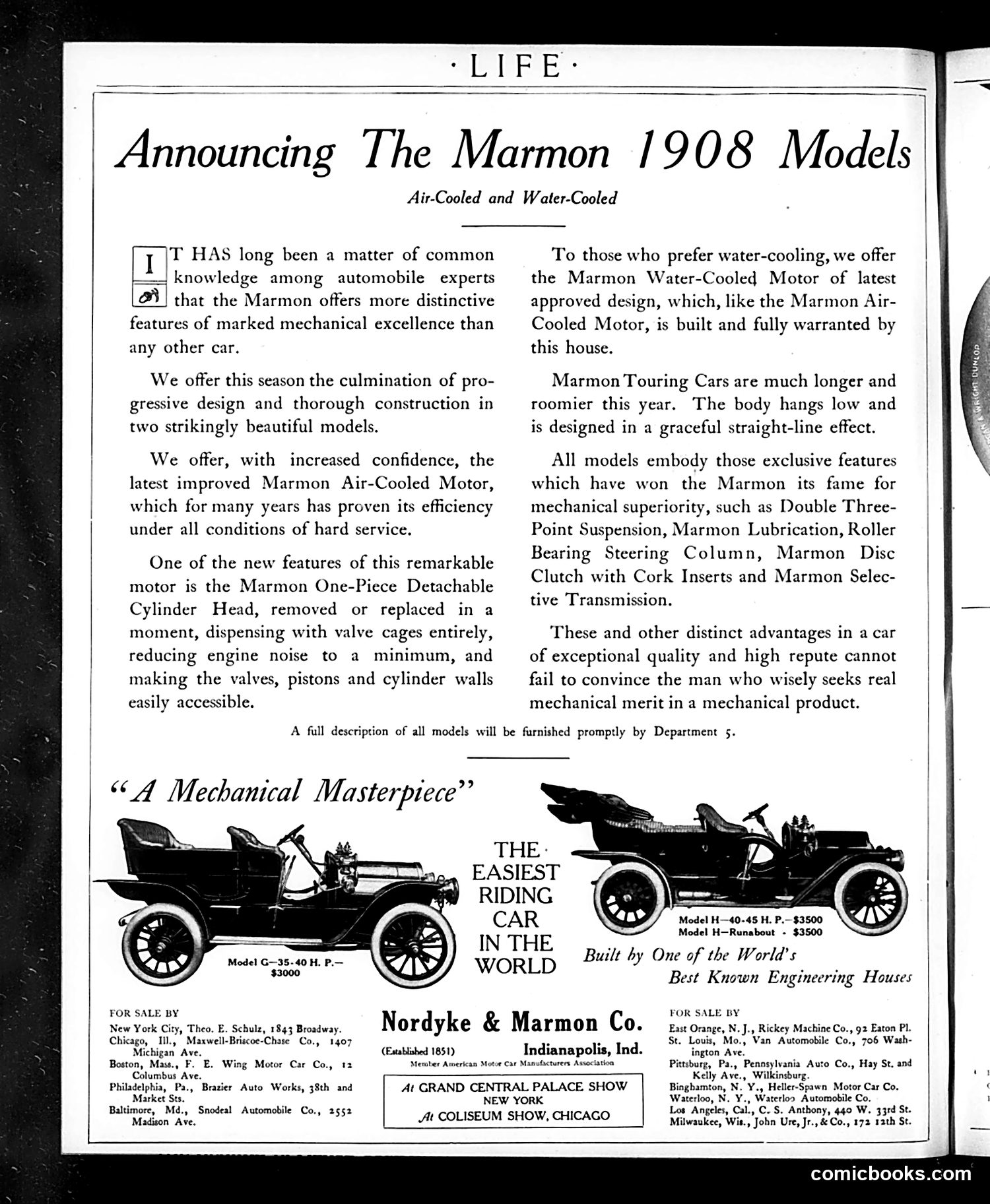
This is primarily **advertising content**, not satire or political commentary. The page announces the 1908 Marmon automobile models, featuring both air-cooled and water-cooled engines. The two illustrations show touring cars manufactured by Nordyke & Marmon Co. of Indianapolis. The text emphasizes mechanical innovations: a new detachable cylinder head, double three-point suspension, roller bearing steering column, and selective transmission. The phrase "A Mechanical Masterpiece" and "The Easiest Riding Car in the World" reflect early automotive marketing language emphasizing engineering superiority—a common sales approach when automobiles were still luxury goods for affluent buyers. Sales locations listed across major American cities indicate national distribution. This represents straightforward product advertising rather than satirical commentary.
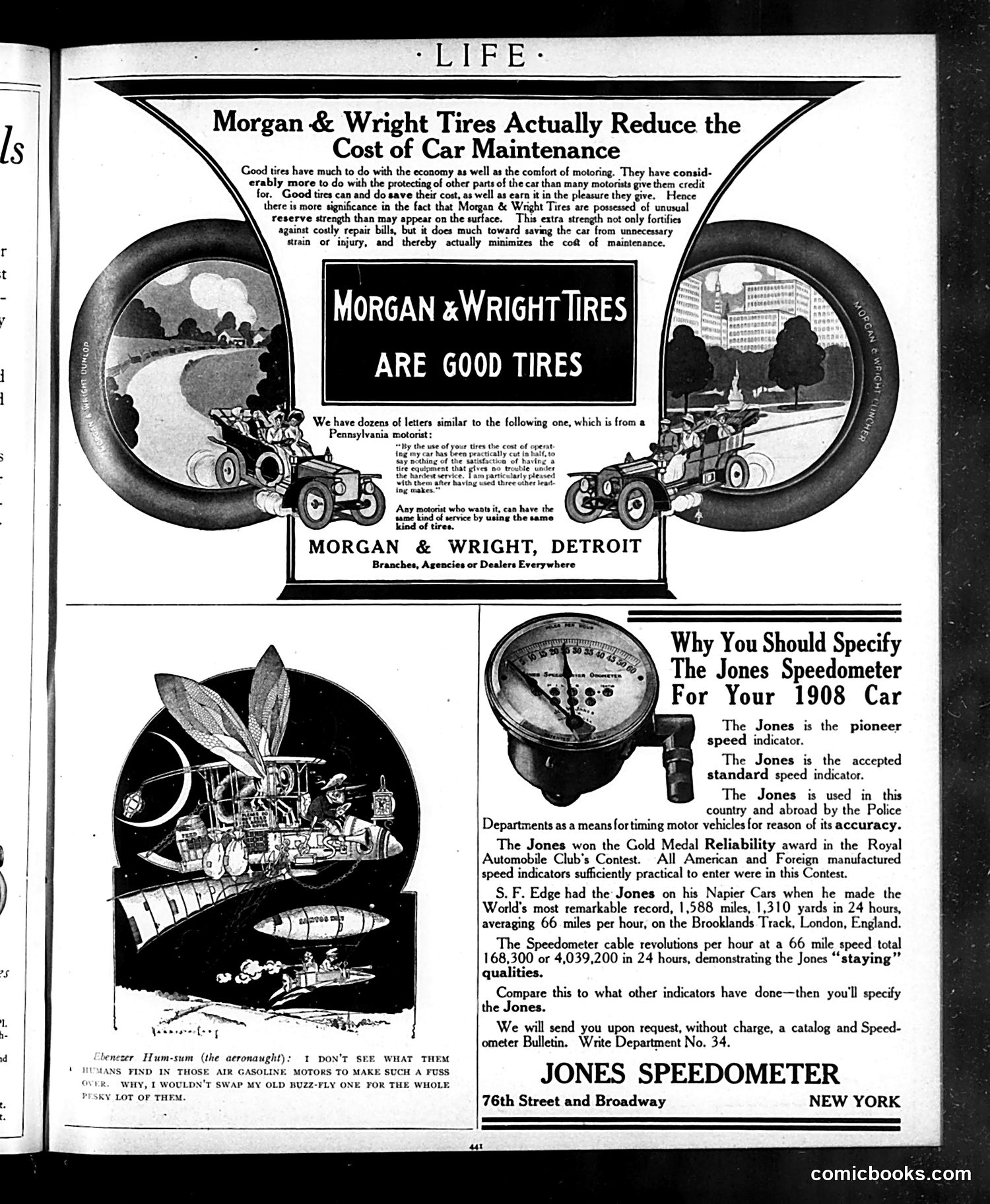
This page contains **two separate advertisements** rather than satirical cartoons. The **top ad** for Morgan & Wright Tires uses a humorous visual metaphor—two giant tires framing a miniature racing car—to argue that quality tires reduce car maintenance costs by protecting the vehicle from damage. The implicit joke is that good tires are so important they dwarf the car itself. The **bottom ad** for Jones Speedometer is straightforward promotional copy listing the product's credentials (used by police, won medals, set speed records). The accompanying cartoon labeled "Hentzau" (apparently a signature) shows an engine and appears unrelated to speedometers—its humor is unclear without more context. Both ads target early 1900s automobile owners concerned with reliability and performance.
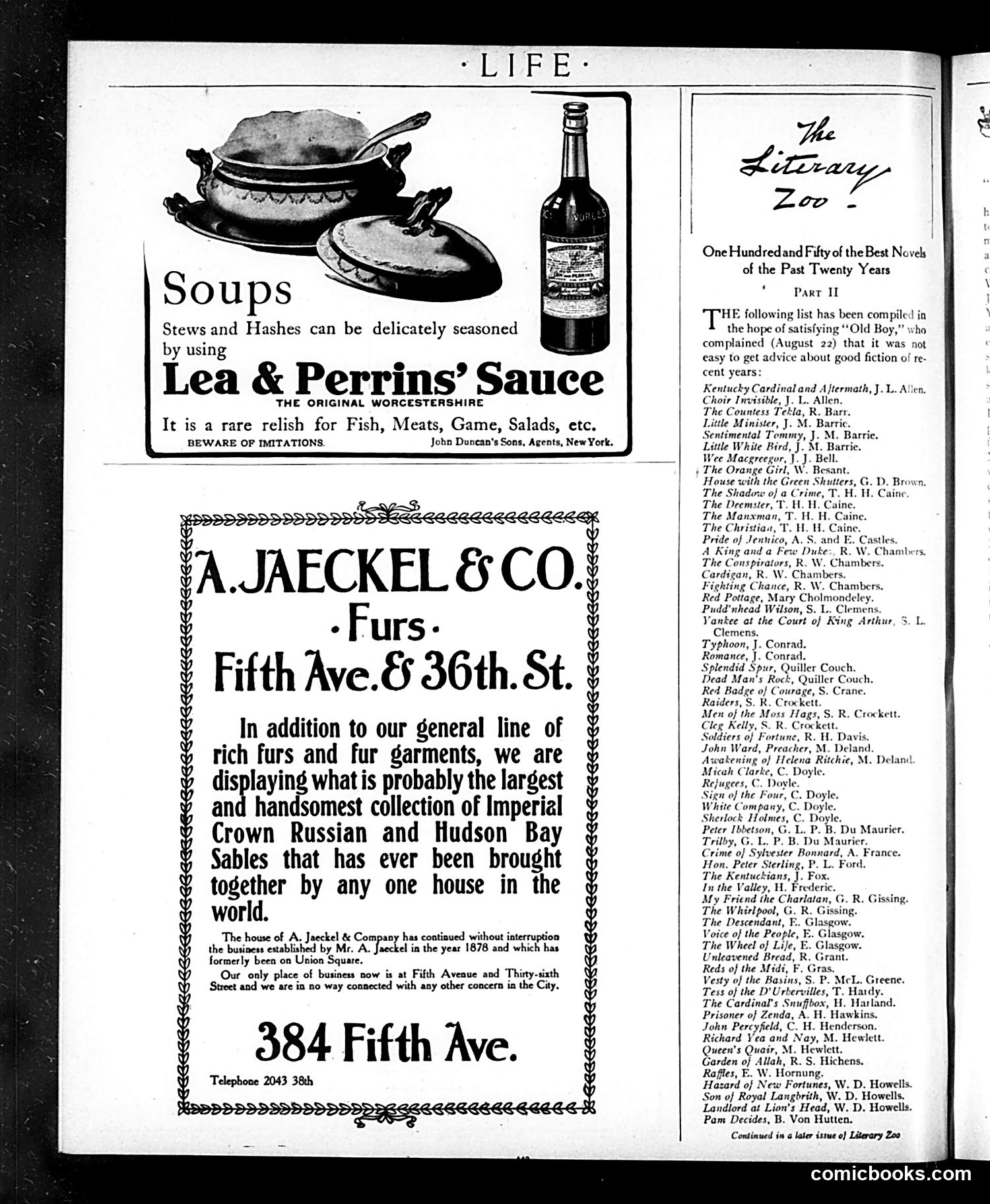
This page contains primarily **advertisements rather than political cartoons or satire**. The upper half features ads for Lea & Perrins' Worcestershire Sauce (promoting their product for seasoning soups and stews) and A. Jaeckel & Co. furs, advertising their Fifth Avenue showroom and their collection of Imperial Russian sables. The right column presents "The Literary Zoo," which appears to be a book list—"One Hundred and Fifty of the Best Novels of the Past Twenty Years, Part II." It's a straightforward compilation of novel titles and authors rather than satirical commentary. There is **no political cartoon visible** on this page. The content reflects typical early-20th-century Life magazine advertising and editorial material, with no apparent satire or social commentary to decode for modern readers.
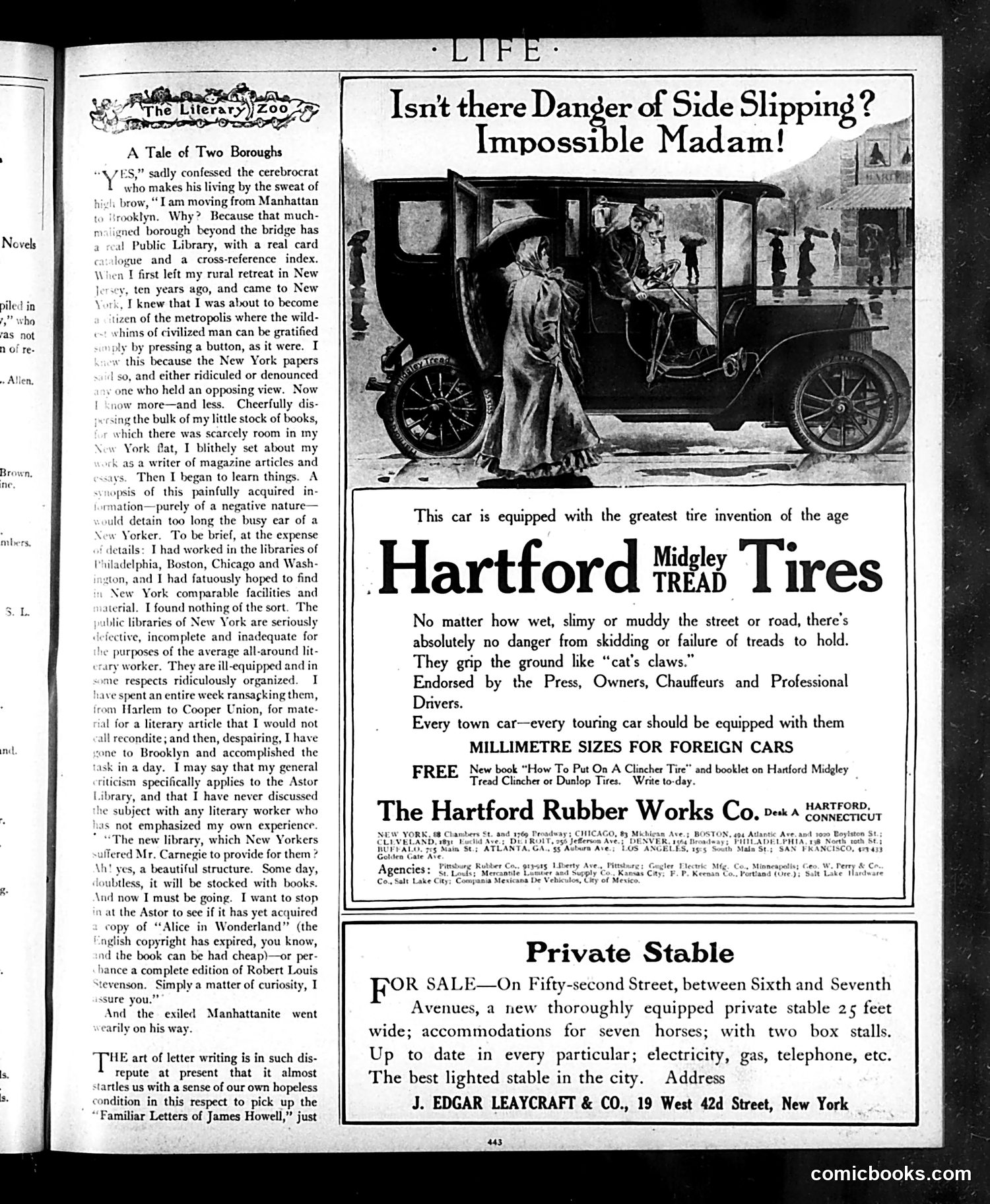
This page is primarily **advertising**, not political satire. The main image shows a car on a wet street with a woman passenger expressing concern: "Isn't there Danger of Side Slipping? Impossible Madam!" The ad promotes Hartford Midgley Tread Tires, claiming they prevent skidding on wet or muddy roads by gripping "like a cat's claws." The humor is gentle and era-appropriate: it depicts a reassuring male driver confidently dismissing a woman's safety concerns about automobile traction—reflecting early-20th-century gender dynamics where men were portrayed as knowledgeable about mechanical matters while women were anxious passengers. The advertisement includes endorsements from "Press, Owners, Chauffeurs and Professional Drivers" and notes tire sizes for foreign cars.
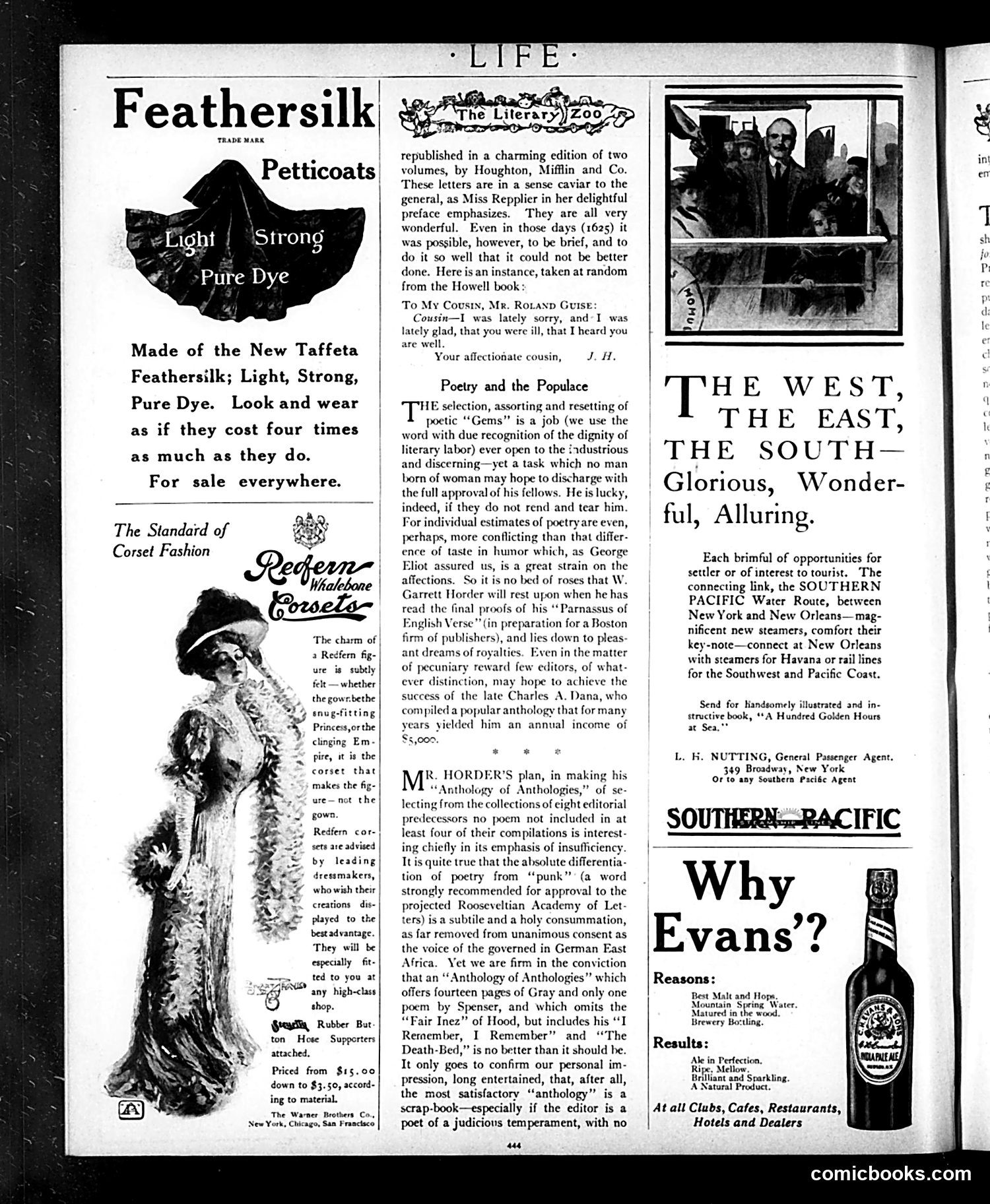
This page is primarily **advertising and literary content** rather than political satire. The left side features ads for Feathersilk petticoats and Redfern corsets, showcasing the fashion industry's marketing to women. The center discusses "The Literary Zoo"—a book review praising republished Howell letters and examining anthologies of poetry. The right side advertises travel via Southern Pacific steamships connecting New York to New Orleans and Pacific ports, emphasizing exotic destinations ("The West, The East, The South"). The only cartoon-like element is an **illustration of a woman in period dress** accompanying the Redfern corset ad, likely meant to demonstrate fashionable silhouette rather than convey satire. This appears to be a typical early 20th-century *Life* magazine page mixing consumer advertising with cultural commentary—not primarily satirical content.
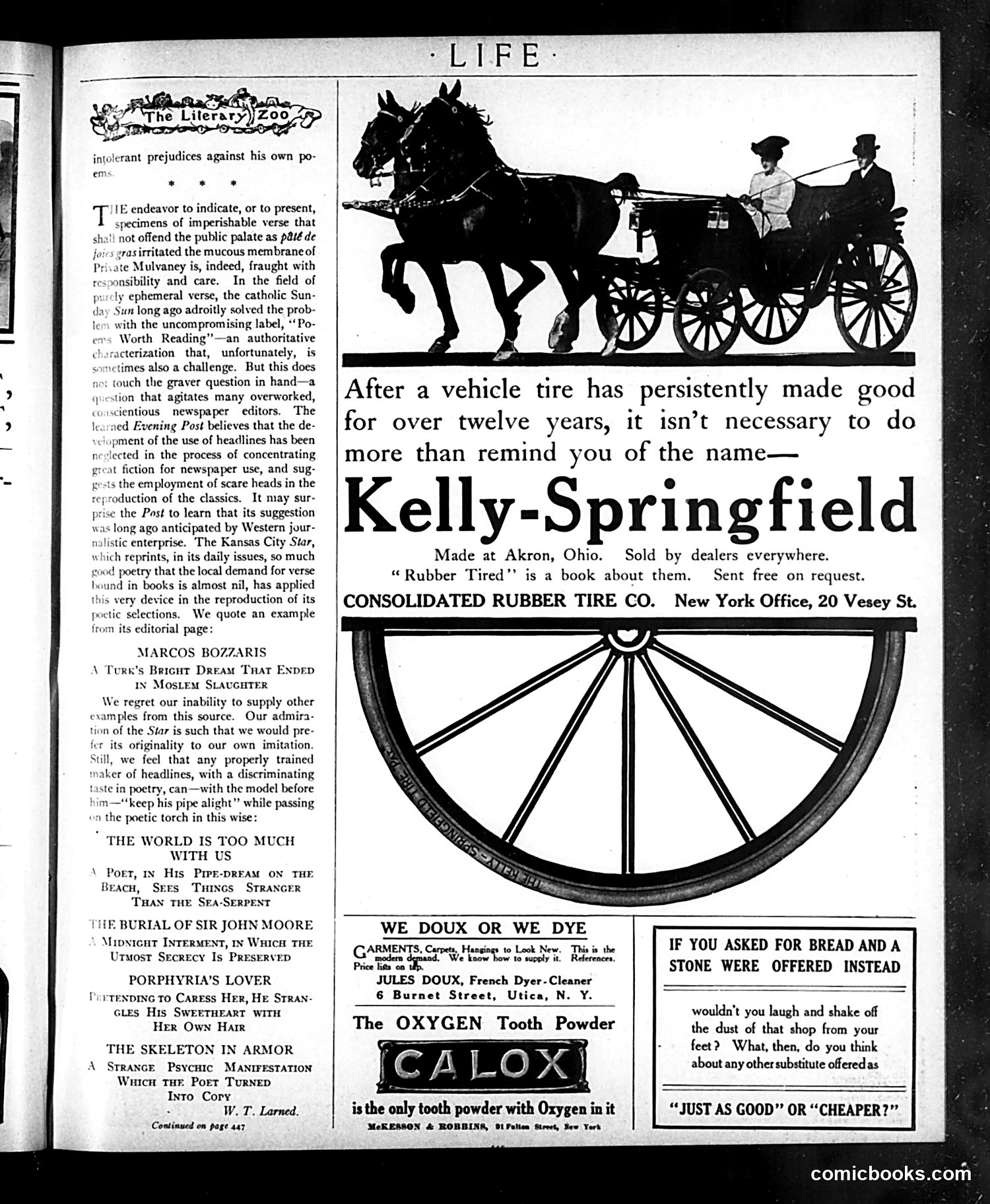
This is primarily an **advertising page** from Life magazine, not a political cartoon. The dominant content is a Kelly-Springfield tire advertisement featuring a horse-drawn carriage, emphasizing the tire's durability ("over twelve years"). Below are smaller product ads for: - **Calox Oxygen Tooth Powder** - **Jules Doux French Dyer-Cleaner** - A humorous boxed advertisement playing on consumer skepticism: "If You Asked for Bread and a Stone Were Offered Instead" — a rhetorical device questioning why customers accept inferior substitute products when better alternatives exist. The left column contains editorial content from "The Literary Zoo," discussing poetry and literary magazines, unrelated to the advertisements. This page reflects early 20th-century advertising strategy: using humor and consumer psychology to build brand loyalty and distinction.
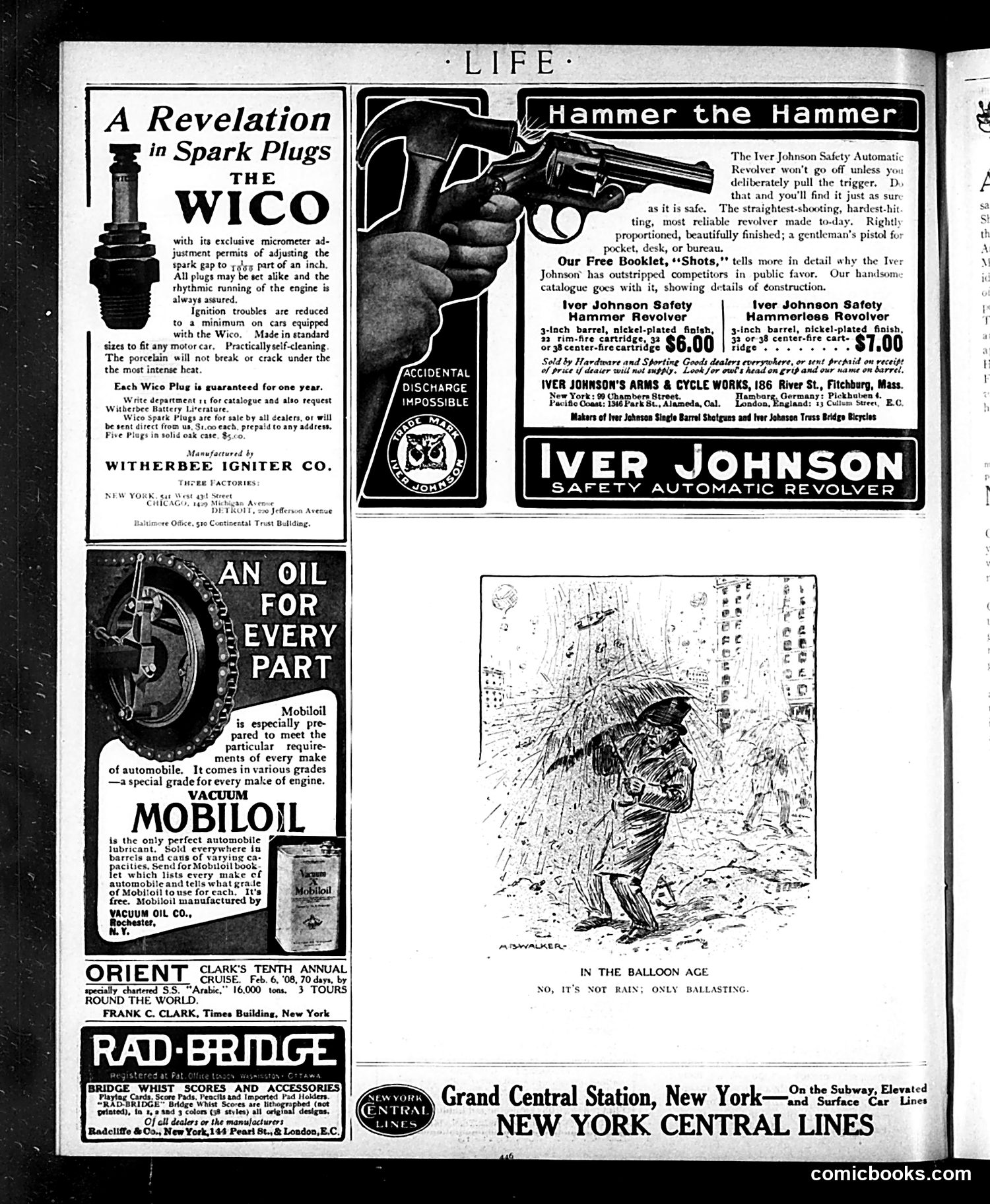
This Life magazine page is primarily **advertising**, not editorial content. The main advertisements are for: 1. **WICO spark plugs** - automotive ignition products 2. **Iver Johnson Safety Automatic Revolver** - featuring a prominent illustration of a hand holding the gun, with text emphasizing its safety features and "accidental discharge impossible" claim 3. **Mobiloil** - motor oil 4. **Orient Tours** - cruise ship services 5. **Rad-Bridge** - bridge equipment The only cartoon on the page is titled **"In the Balloon Age"** (lower right), depicting a figure with an umbrella in heavy rain with the caption "No, it's not rain; only ballasting." This appears to be a humorous reference to hot air balloon operations, where ballast (weight) must be dropped to control altitude. The page reflects early 20th-century American consumer culture and automotive advertising.
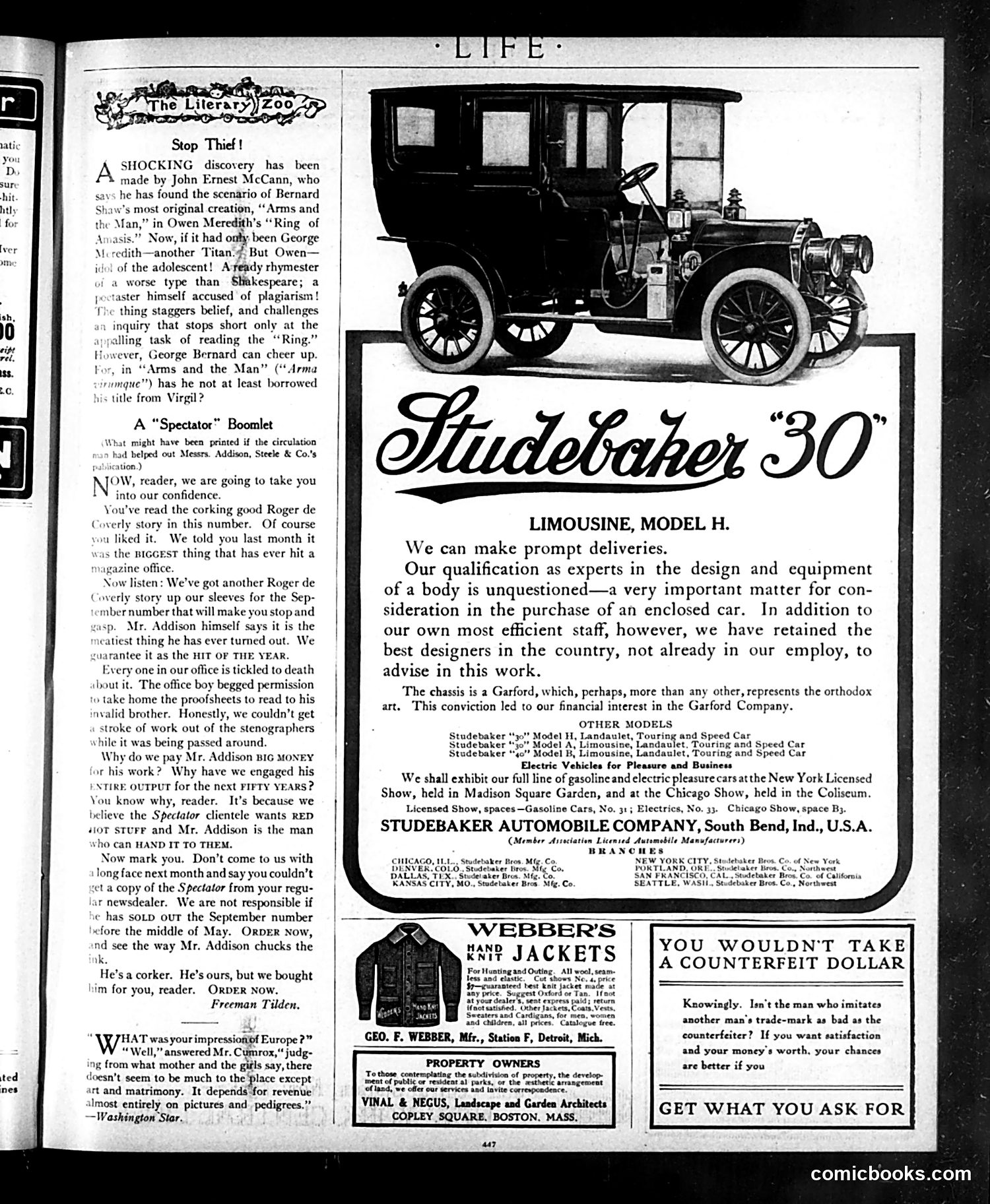
This page is primarily **advertising and editorial content**, not political satire. The main feature is a full-page advertisement for the **Studebaker "30" automobile** (Limousine, Model H), emphasizing prompt delivery and expert body design. The left column contains editorial commentary titled "Stop Thief!" discussing playwright George Bernard Shaw's alleged plagiarism from classical sources—a lighthearted literary critique rather than political satire. Below the Studebaker ad are smaller advertisements for **Webber's hand-knit jackets** and a "counterfeiting" joke ad promoting honest goods ("You Wouldn't Take a Counterfeit Dollar"). The page reflects early 20th-century consumer culture and advertising conventions rather than containing political cartoons or satire requiring historical context for modern readers.
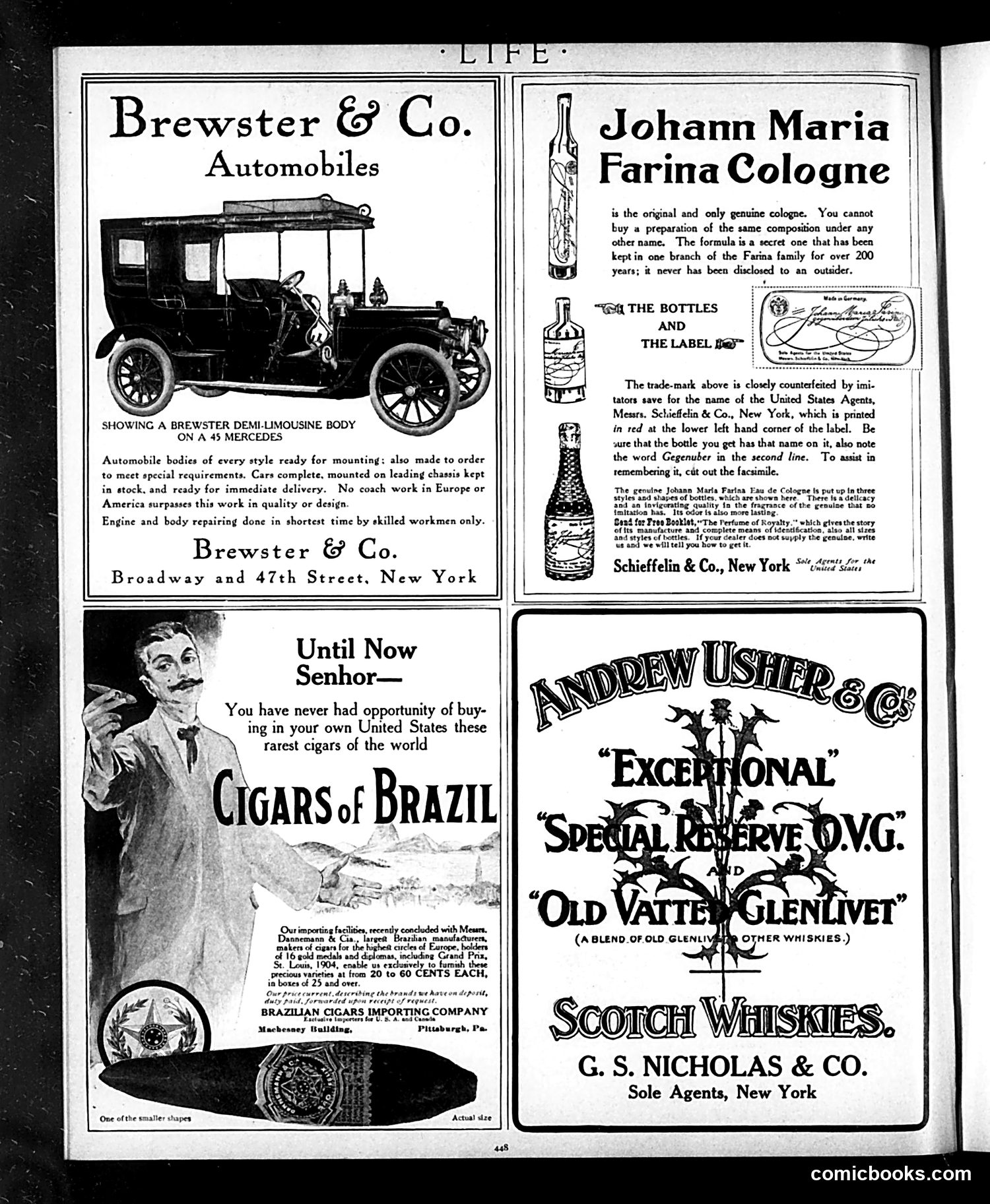
This page is primarily **advertising**, not satirical content. It contains four commercial advertisements: 1. **Brewster & Co. Automobiles** - showcasing a luxury "demi-limousine" automobile body for the Mercedes chassis, positioned as high-end American craftsmanship. 2. **Johann Maria Farina Cologne** - emphasizing authenticity and brand protection against counterfeits, with warnings about identifying genuine bottles. 3. **Brazilian Cigars** - featuring a caricatured Brazilian man ("Senhor"), advertising imported cigars as a novelty product newly available in the United States. 4. **Andrew Usher & Co. Scotch Whiskies** - promoting premium whisky brands. The page reflects early 20th-century consumer culture and marketing targeting wealthy Americans. The Brazilian cigar ad uses ethnic caricature typical of period advertising conventions.
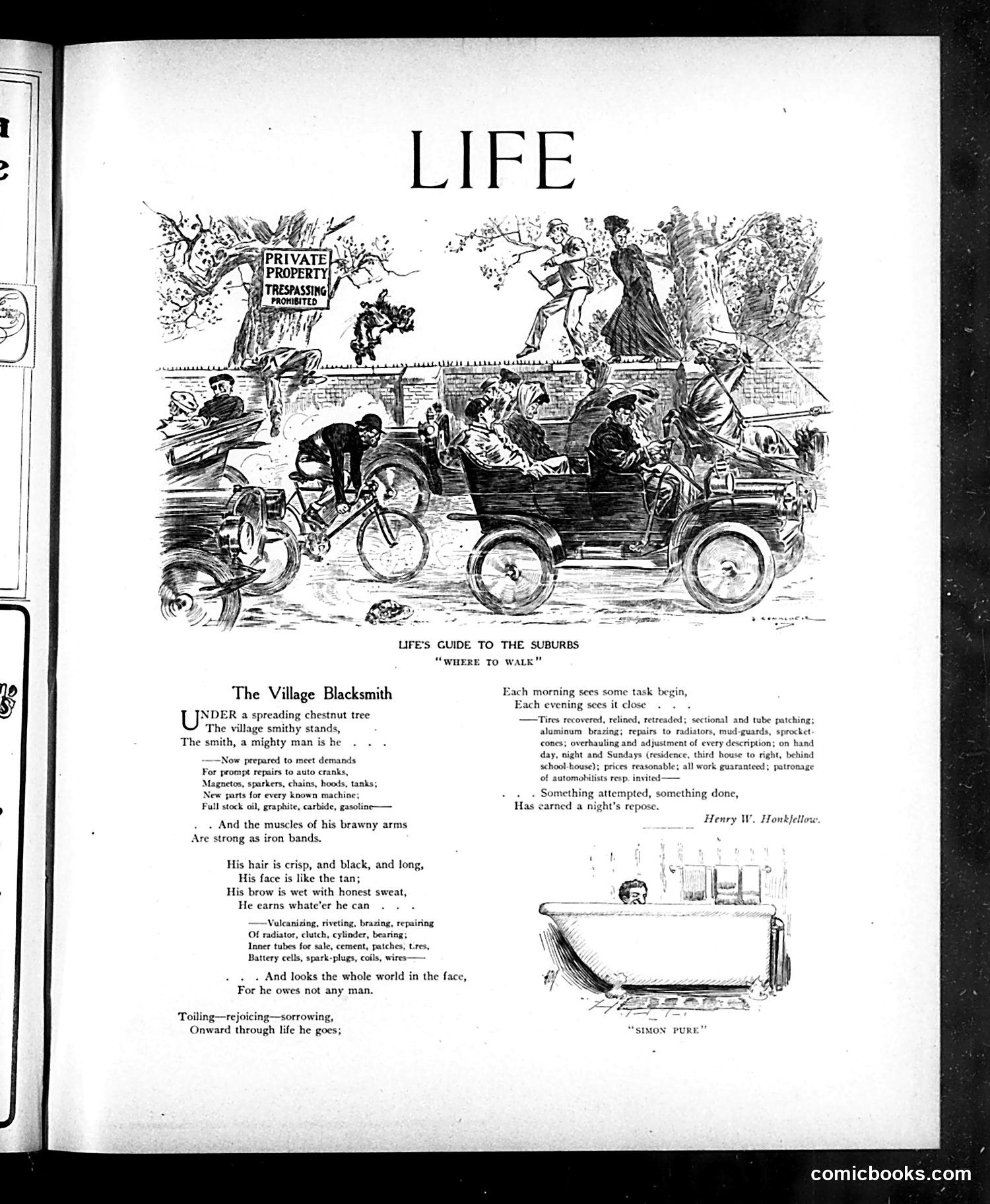
This page satirizes suburban life and the emerging automobile culture. The main illustration depicts a chaotic suburban scene with early automobiles, bicycles, and pedestrians sharing space near a "Private Property/No Trespassing" sign and a brick wall—suggesting tension between public access and private ownership in developing suburbs. "The Village Blacksmith" poem (left) ironically contrasts the traditional craftsman with modern auto repair work, mocking how the blacksmith's trade has transformed into servicing automobiles and their components. The cartoon ridicules suburban infrastructure unprepared for mixed traffic, property disputes, and the displacement of traditional skills by mechanization. The small illustration labeled "Simon Pure" (bottom right) appears unrelated or provides additional satirical commentary.
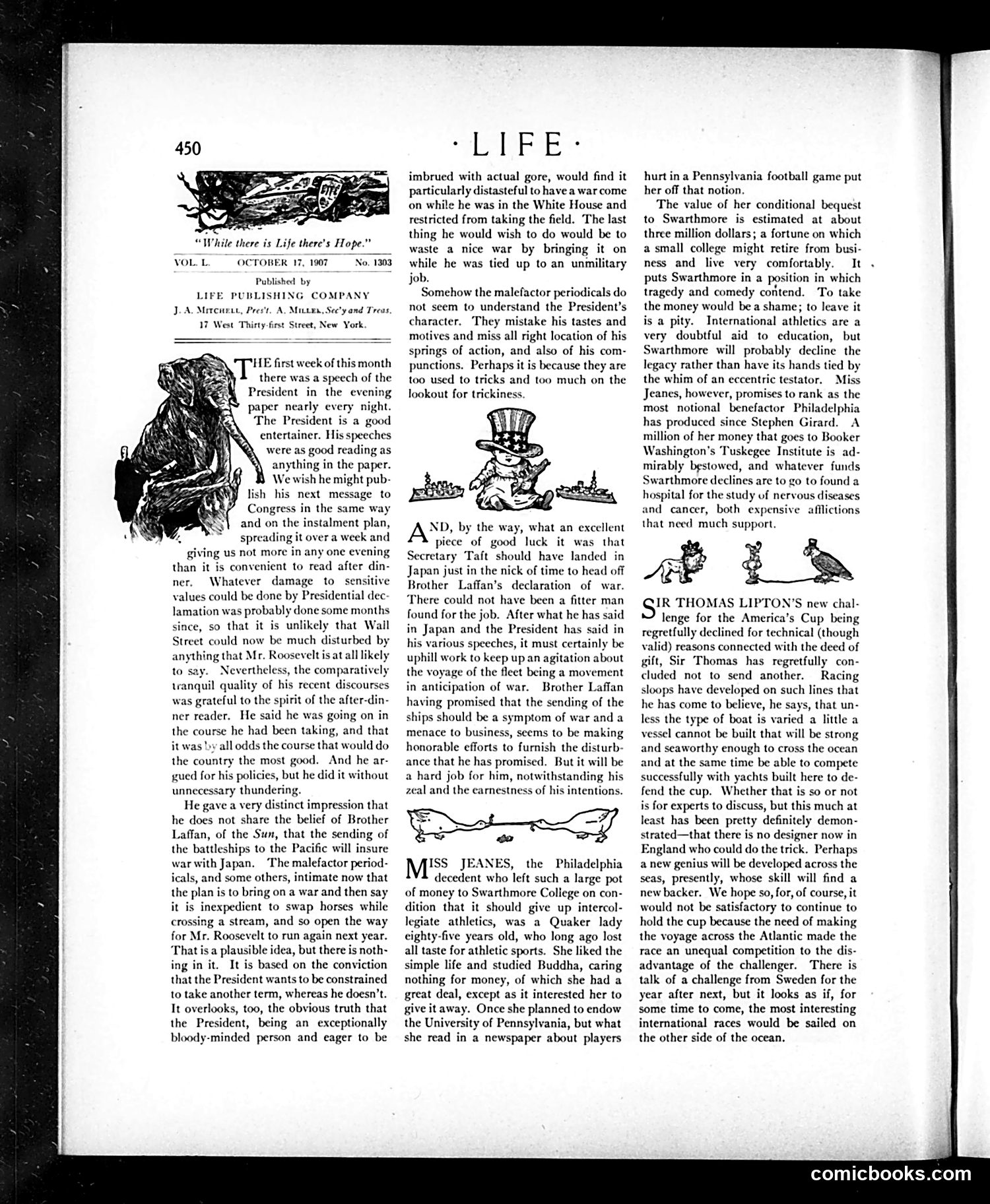
This page lampoons President Theodore Roosevelt and press critics of his administration. The main editorial mocks "malefactor periodicals"—hostile newspapers like the Sun (run by "Brother Laffan")—that falsely claim Roosevelt is manufacturing a war with Japan as political cover to seek another term. Life's editor argues this misreads Roosevelt's character: he's actually too eager for real military action to waste a genuine war opportunity while confined to the presidency. The piece defends Secretary of War William Howard Taft's diplomatic mission to Japan as successfully defusing warmongering rhetoric. The editorial portrays Roosevelt as straightforward and warlike (sarcastically: "exceptionally bloody-minded"), not duplicitously scheming—thus the newspapers' conspiracy theories about the Pacific Fleet's voyage miss the mark. A separate brief notes Miss Jeanes, a wealthy Philadelphia Quaker philanthropist, whose bequest to Swarthmore College required eliminating intercollegiate athletics. Life finds irony in her Quaker asceticism ending the university's sports programs.
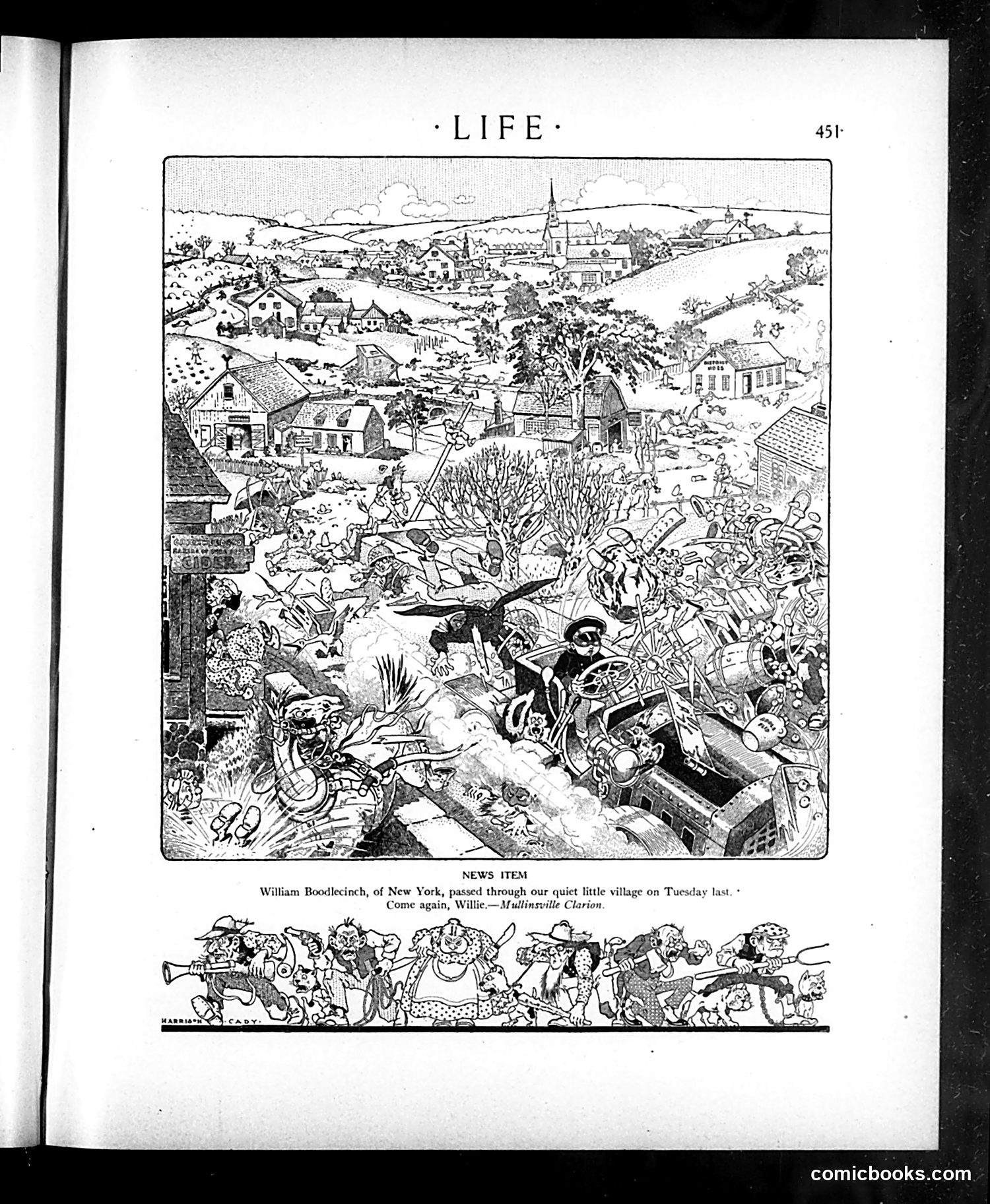
This is a satirical cartoon depicting the chaotic disruption caused by a single visitor to a quiet rural village. The "News Item" reports that William Boodlecinch from New York passed through on Tuesday, with the local paper's polite invitation to "come again." However, the large illustration shows the village in complete mayhem—machinery overturned, people scattered in disarray, agricultural equipment displaced, and general pandemonium throughout the landscape. The satire contrasts the newspaper's courteous, understated tone with the visual reality of devastation. The joke appears to target urban visitors to rural America: a brash New Yorker's mere presence causes such disruption that the polite local paper can only sarcastically invite him back. It satirizes both urbanites' disruptive nature and small-town journalism's restrained politeness.
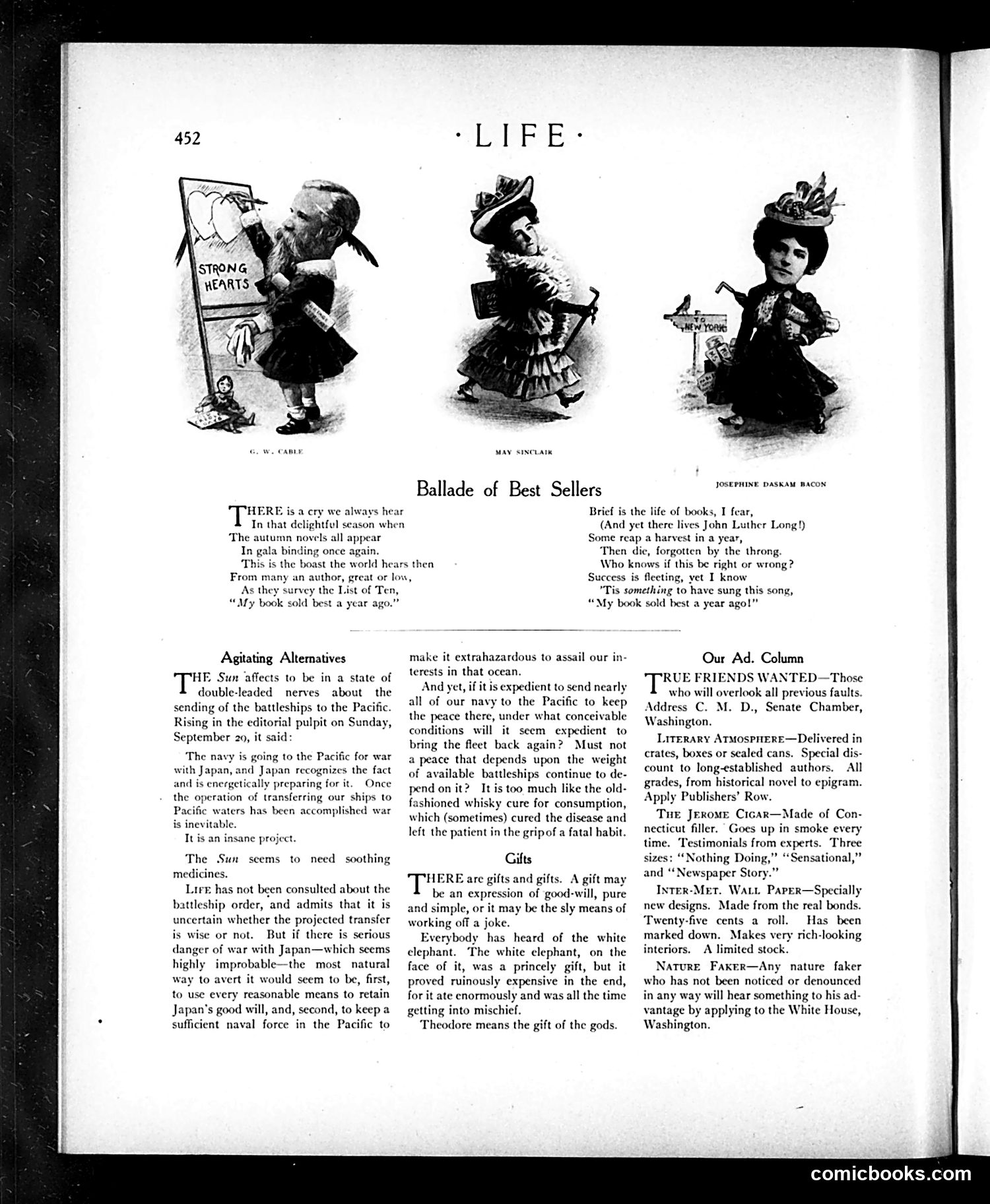
This page satirizes early 1900s American literary culture and naval policy through three distinct pieces. **The cartoons** (top) show three female authors labeled with names like "Strong Hearts"—likely representing popular women writers of the period whose autumn novels dominate bestseller lists. The satire mocks authors constantly boasting that "my book sold best a year ago," suggesting fleeting commercial success and literary pretension. **"Agitating Alternatives"** critiques newspaper editorial anxiety about sending battleships to the Pacific, apparently in response to tensions with Japan. Life ridicules the *Sun* newspaper's contradictory position: warning war is inevitable while simultaneously urging retention of Japan's goodwill and naval strength—a logical impossibility Life compares to treating consumption with whisky (temporary fix, permanent damage). **The advertisements** are satirical fake classifieds mocking publishers, authors, and cigars—including a jab at "Nature Fakers" (writers of fabricated nature stories) to "apply to the White House," likely referencing contemporary President Theodore Roosevelt's known criticism of such literary fraud. The overall tone is witty mockery of American cultural and political pretension.
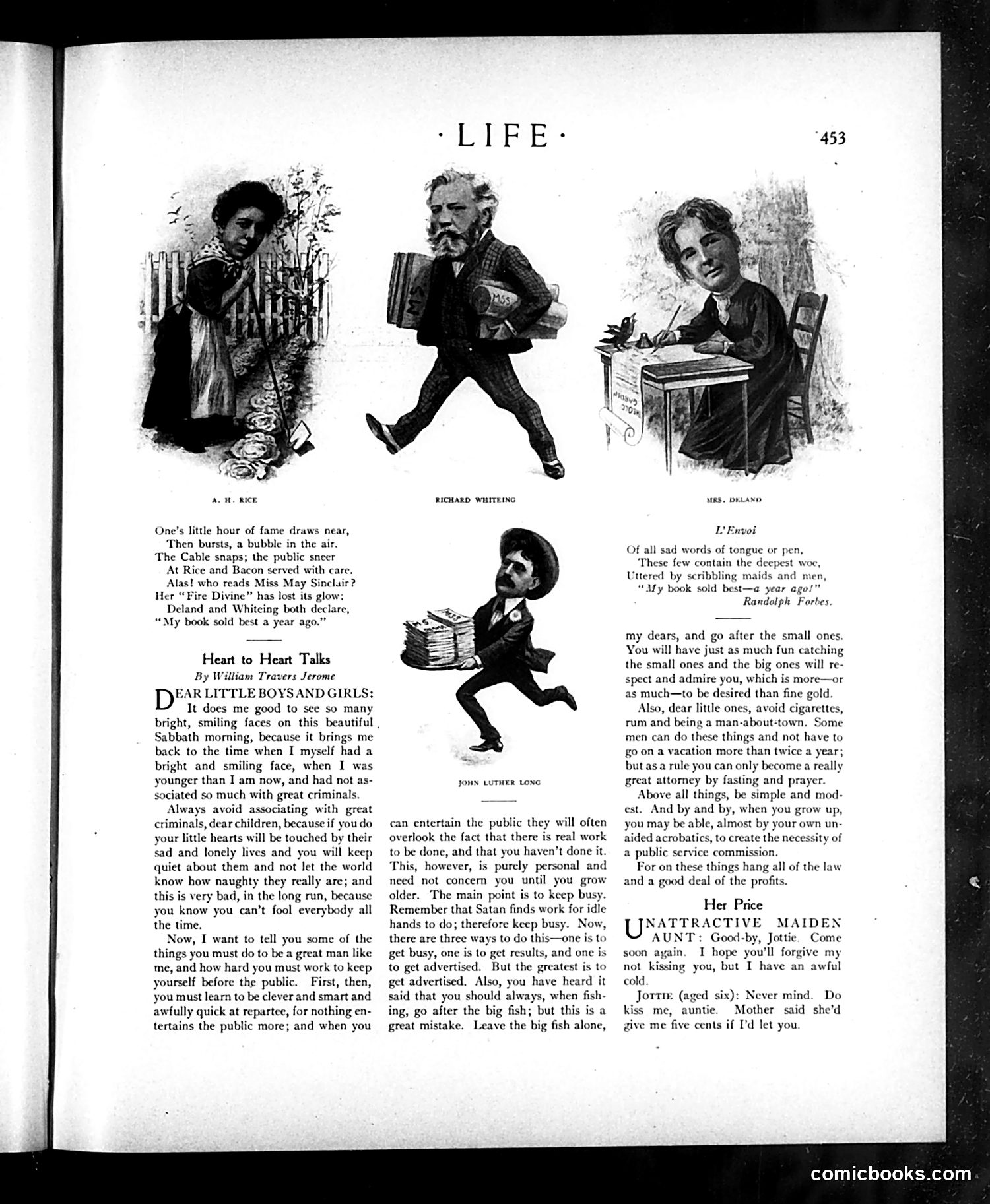
This page satirizes literary celebrity and the fleeting nature of fame. The top section mocks authors whose recent success has already faded—A.H. Rice, Richard Whiteing, and Mrs. Deland appear as caricatures with accompanying verse. The joke is that each claims "My book sold best a year ago," suggesting their moment in the spotlight has passed and they're desperately clinging to past glory. William Travers Jerome's "Heart to Heart Talks" column parodies self-help advice for ambitious young people. Jerome (appearing to be a public figure) cynically instructs children to prioritize publicity over actual accomplishment, avoid associating with criminals (oddly specific), and pursue "small fish" (minor fame) rather than genuine achievement. The satire mocks both celebrity culture and manipulative self-promotion. The "L'Envoi" poem reinforces this theme of literary disappointment. The page's final anecdote shows a child extracting payment for tolerating an aunt's cold kiss—a darkly comic ending about transactional relationships.
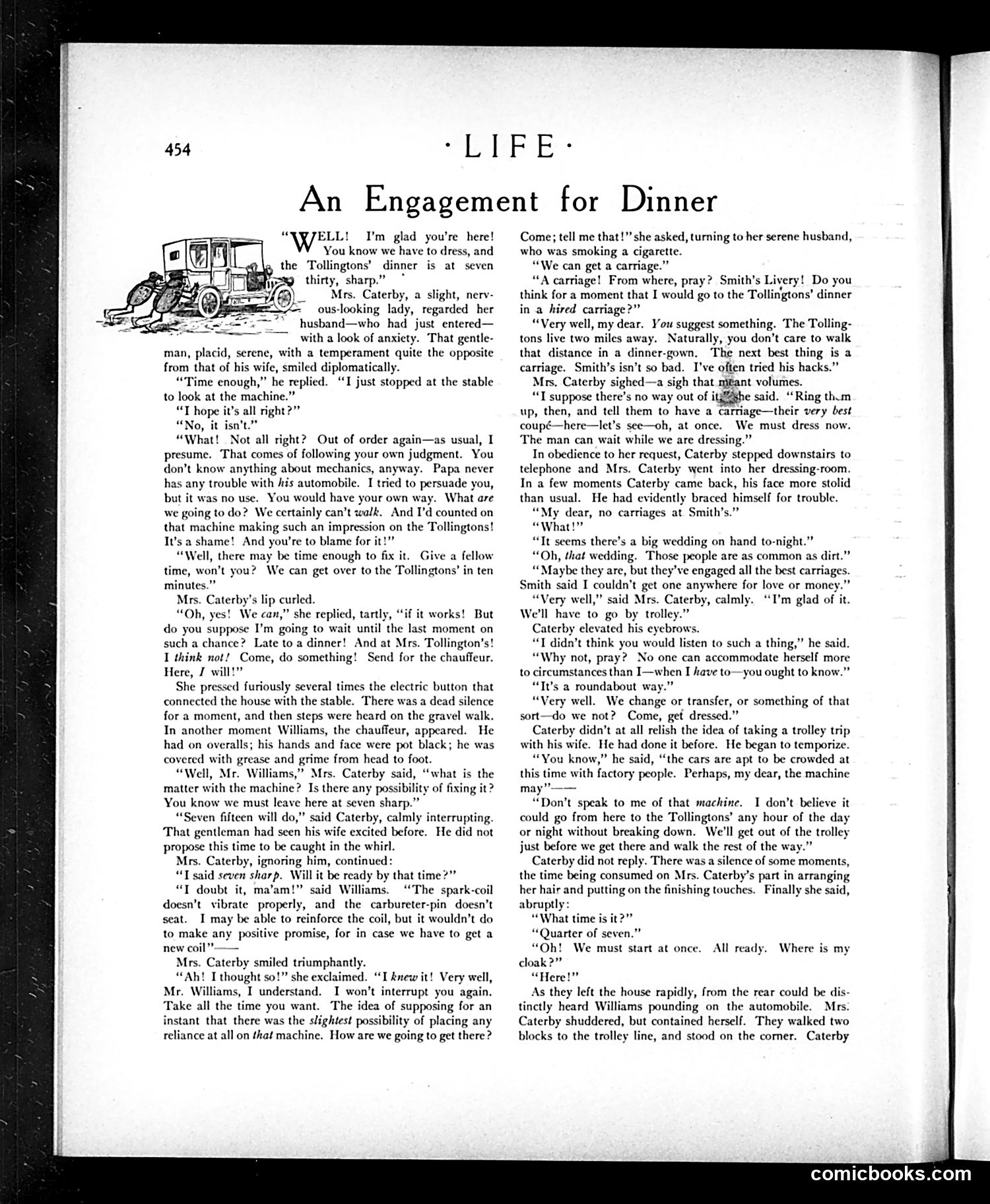
This satirical story mocks the anxieties of early 1900s upper-middle-class social life. Mrs. Caterby frets obsessively about attending a dinner party at the prestigious Tollingtons' home, while her placid husband remains unruffled. The humor centers on **automobile anxiety**: the newly-fashionable automobile breaks down (a common occurrence), forcing them to resort to hiring a carriage—deeply embarrassing to Mrs. Caterby, who views it as socially degrading. Her status anxiety is exposed as she panics over appearances, while her husband's calm acceptance suggests the absurdity of her concerns. The greasy chauffeur Williams, covered in grease and grime, represents the messy reality of early car ownership—these unreliable machines required constant mechanical attention. The satire critiques how the newly wealthy flaunt their automobiles as status symbols, only to be humiliated when mechanical failure forces them back to "common" transportation.
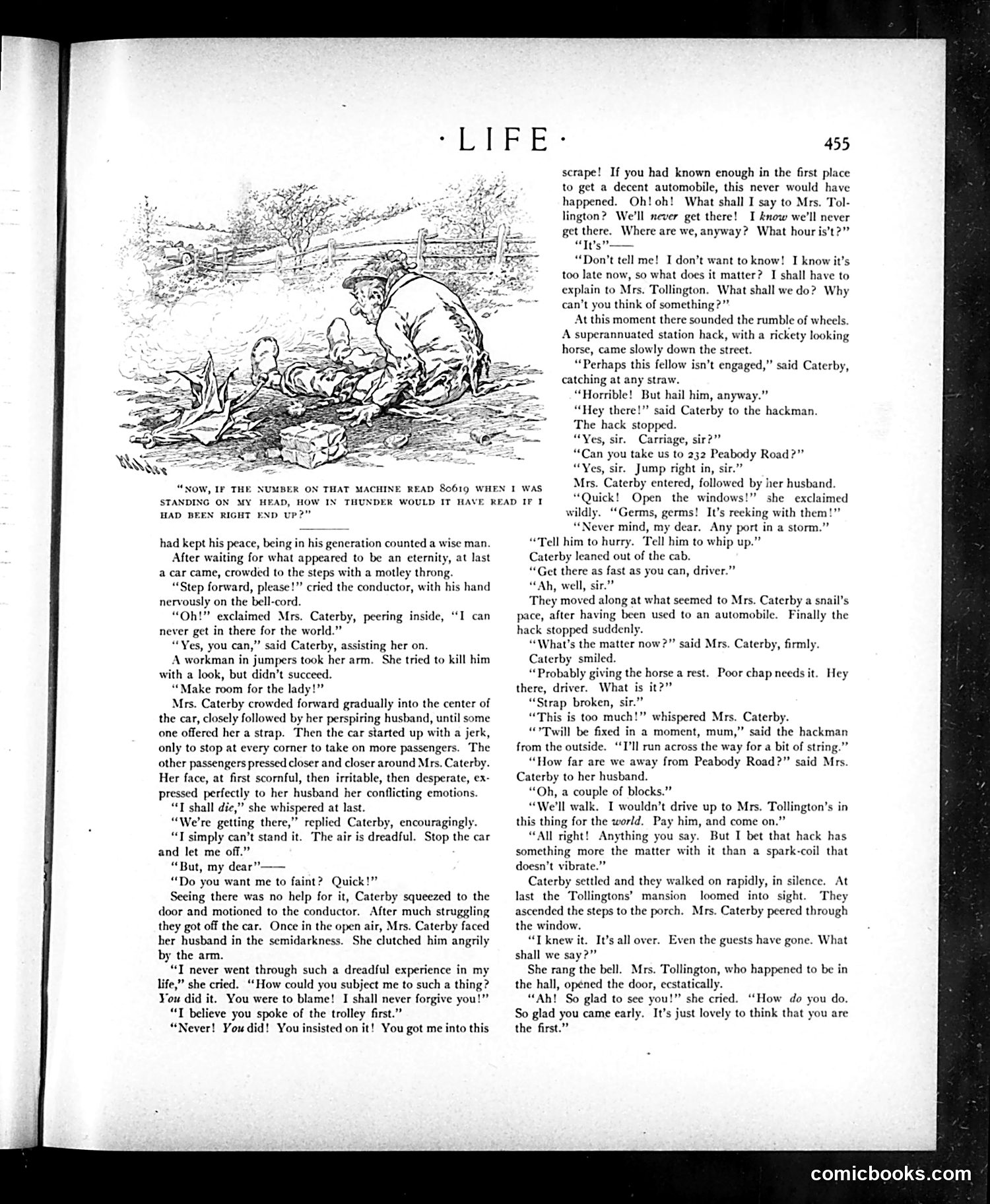
This page satirizes the anxieties of early 20th-century urban travel through Mrs. Caterby's increasingly hysterical journey. After insisting on taking a crowded trolley car (against her husband's preference), she experiences claustrophobia, germs, and delays—then blames him entirely. When they abandon the trolley for an old-fashioned horse-drawn hack, she discovers it's slower and equally problematic (broken strap). The humor lies in her contradiction: she despises modern mass transit's crowding yet nostalgic transportation's incompetence, while remaining oblivious to her own role in the disaster. The cartoon (top left) illustrates their trolley predicament. The satire targets upper-class women's expectations of comfort and their tendency to shift blame—a common Life magazine theme mocking both new technology's growing pains and changing social dynamics.
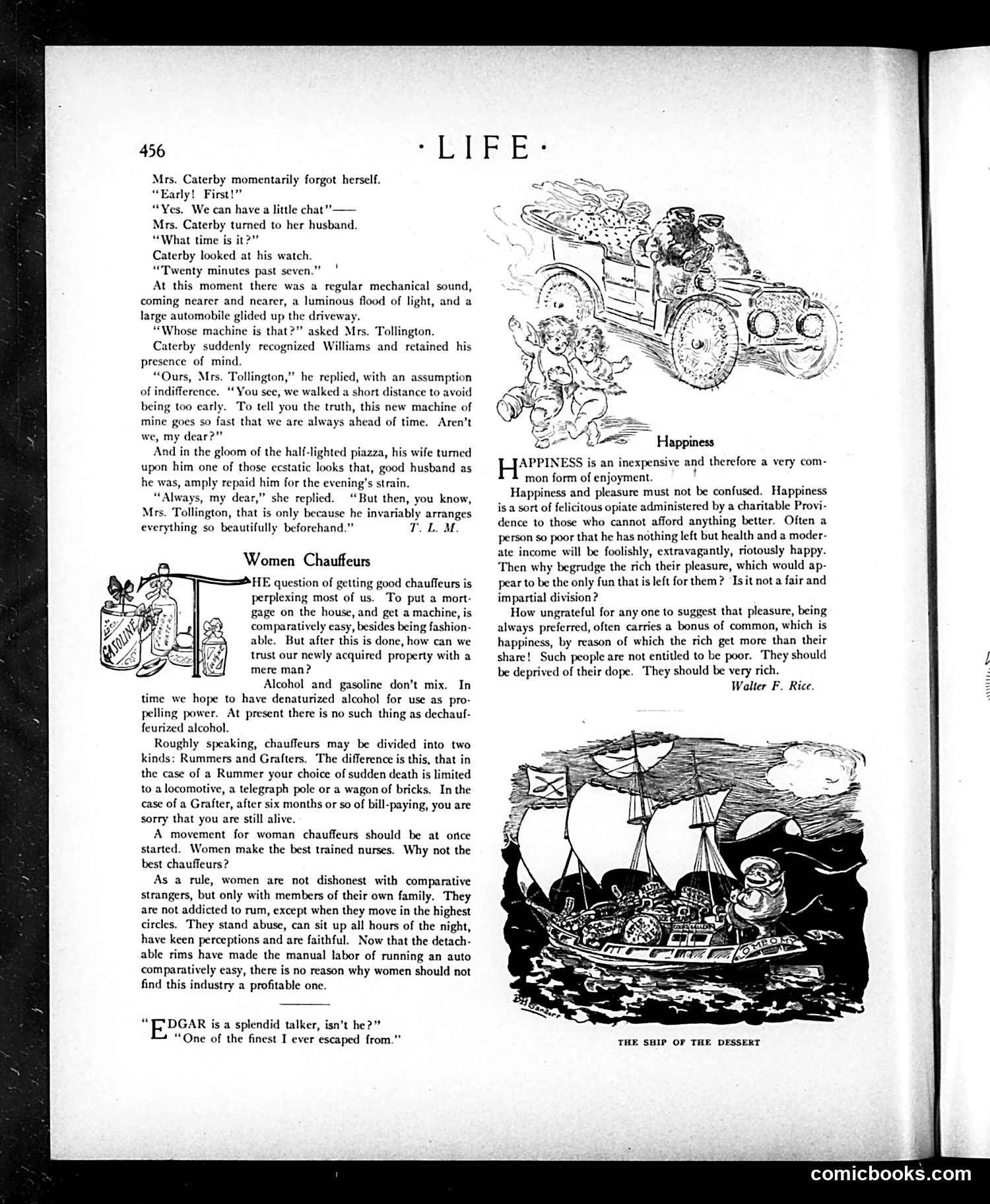
**The Main Cartoon Story** (top): A husband (Caterby) is caught in an embarrassing lie when an automobile suddenly arrives at his home during a visit from the Tollingtons. He'd claimed he and his wife walked to avoid arriving too early, but the car is obviously theirs. He quickly improvises that the automobile is his and that it's so fast they're always ahead of schedule. His wife plays along perfectly. **The Satire**: This mocks the early automobile era's status anxiety—owning a car was fashionable and expensive, making people eager to display it, yet also creating awkward social situations where one might need to explain automotive behavior or ownership. **"Women Chauffeurs" Essay**: A humorous argument advocating women as automobile drivers, contrasting them favorably to male chauffeurs (divided into "Rummers"—drunkards causing accidental deaths—and "Grafters"—embezzlers). The piece sardonically suggests women are naturally suited: honest, hardworking, and now that manual labor is reduced, perfectly capable. **The Philosophy Section** on "Happiness": Argues that happiness (contentment) differs from pleasure, and that the poor enjoy happiness while the rich enjoy only pleasure—suggesting an ironic social critique about wealth and satisfaction.
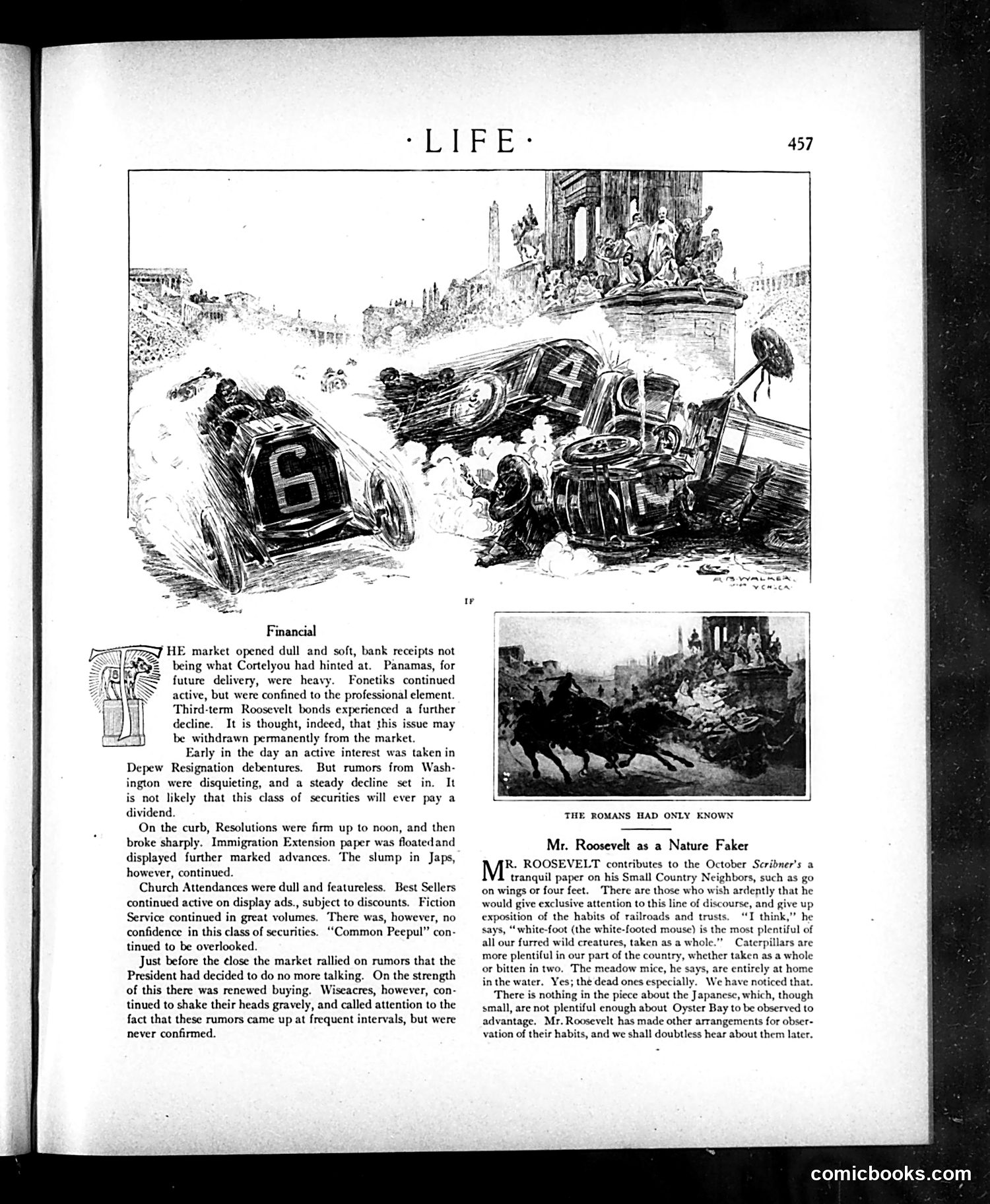
**The Financial Section (top cartoon):** A satirical "stock market report" disguised as financial news. It mocks contemporary political and economic anxieties through mock-securities: "Third-term Roosevelt bonds" (declining—Roosevelt's potential third presidency was controversial), "Depew Resignation debentures" (referencing Chauncey Depew's political resignation), and "Immigration Extension paper" with a "slump in Japs" (reflecting anti-Japanese sentiment of the era). The crashed racing cars illustrate market volatility. **"Mr. Roosevelt as a Nature Faker" (bottom section):** Satirizes President Theodore Roosevelt's recent *Scribner's* article on wildlife. The piece criticizes Roosevelt's nature observations as inaccurate while sarcastically suggesting he focus on animals rather than his controversial trust-busting and railroad regulation policies. The veiled reference to "Japanese" and "Oyster Bay" (his home) suggests Roosevelt's hawkish foreign policy regarding Japan, implying his "observation" of Japanese behavior may be equally dubious.
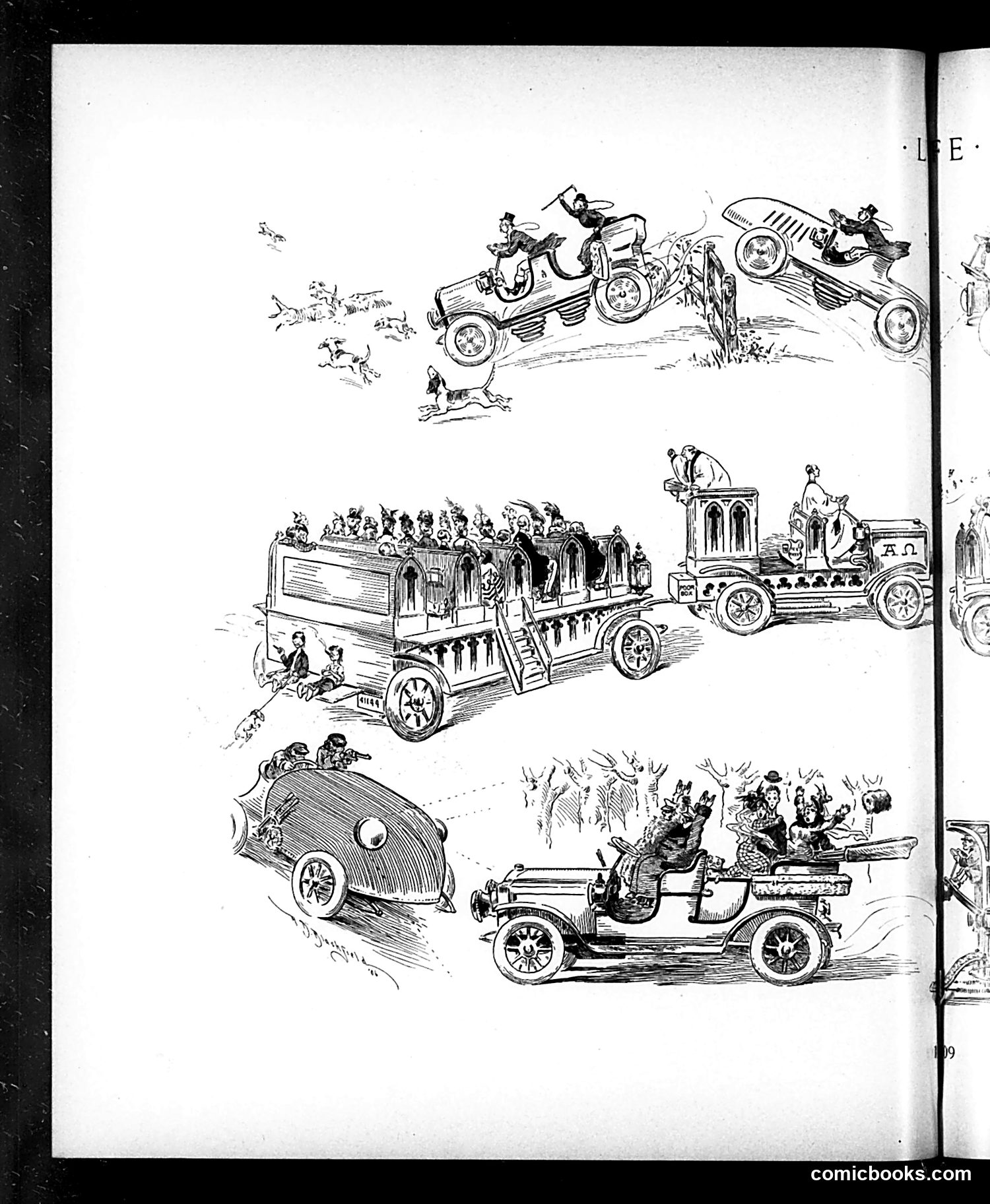
I can see this page contains satirical illustrations of early automobiles in various comic scenarios, but the OCR text provided is too corrupted to read any actual content or captions that would explain the specific satire. From the images alone, I can observe: the drawings depict early motorcars in exaggerated, comedic situations—including cars being chased by dogs, elaborate decorated vehicles carrying crowds, and what appears to be a fish-shaped automobile. These seem to mock the novelty and absurdity of early motorcar culture. However, without legible text identifying specific figures, events, or the intended targets of the satire, I cannot accurately explain what particular social or political commentary these cartoons make. To properly analyze this Life magazine page's meaning for a modern reader, I would need clearer OCR text or additional context about the publication date and issue.
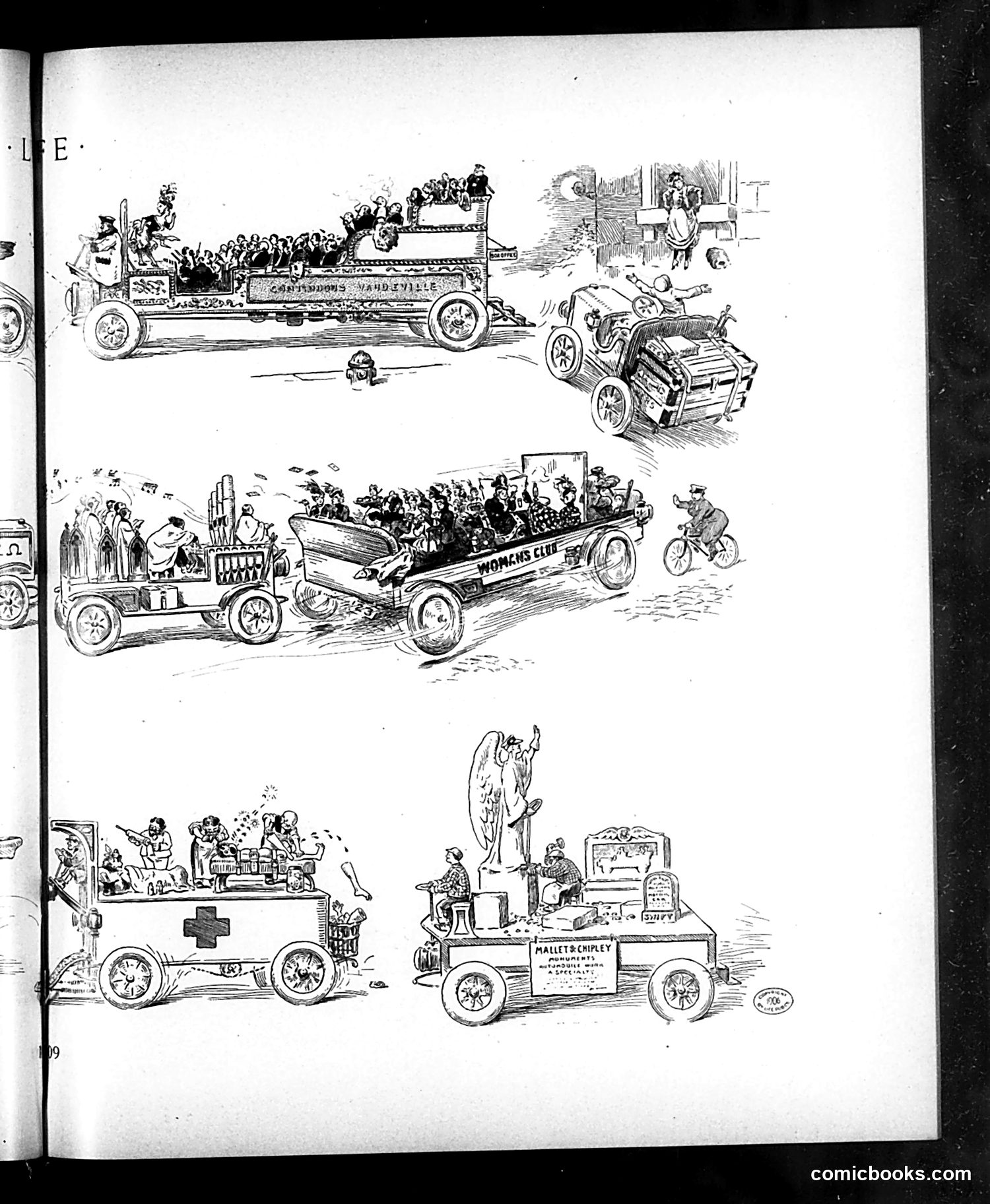
This page depicts **motorized parade floats** — vehicles carrying groups of people in elaborate processions. The cartoons satirize early 20th-century **promotional spectacles and public celebrations**. The floats represent different organizations: one labeled "Workers Club" and another appearing to reference a medical or charitable institution (visible cross symbol). The drawings mock the **excess and absurdity** of these elaborate motorized displays — crowded with passengers, ornately decorated, and somewhat unwieldy. The humor seems directed at how organizations used these novelty vehicles for public visibility and recruiting, often appearing chaotic or ridiculous. A small motorcycle figure appears to mock the spectacle's pretensions. Without OCR text visible, the exact satirical targets remain unclear, but this reflects **early automobile culture and mass-participation events** of the 1910s-1920s era.
This page documents Life magazine's legal victory against the Theatrical Trust—a powerful monopoly controlling American theater. The cartoon "The Decision of the Court of Appeals" depicts Lady Justice delivering a "solar plexus blow" to Life, using boxing metaphors to describe a court ruling. **The Context:** Life had criticized the Theatrical Trust's leadership, including members of the Jewish faith. The Trust's lawyers countered by accusing Life of antisemitic "Jew-baiting" rather than addressing the substantive conspiracy charges. The Court of Appeals ruled against Life on these emotional grounds, avoiding the actual legal questions about monopolistic practices. **The Point:** Life protests this decision as a threat to press freedom and public interest. The editorial argues the court prioritized defending the Trust's Jewish members over examining evidence of theatrical monopoly abuse. Life asserts it will continue fearless criticism despite this setback—defending both journalistic integrity and the public's right to information about corporate malfeasance. The page also announces Malcolm Stewart's prize-winning cartoon for next week's issue.
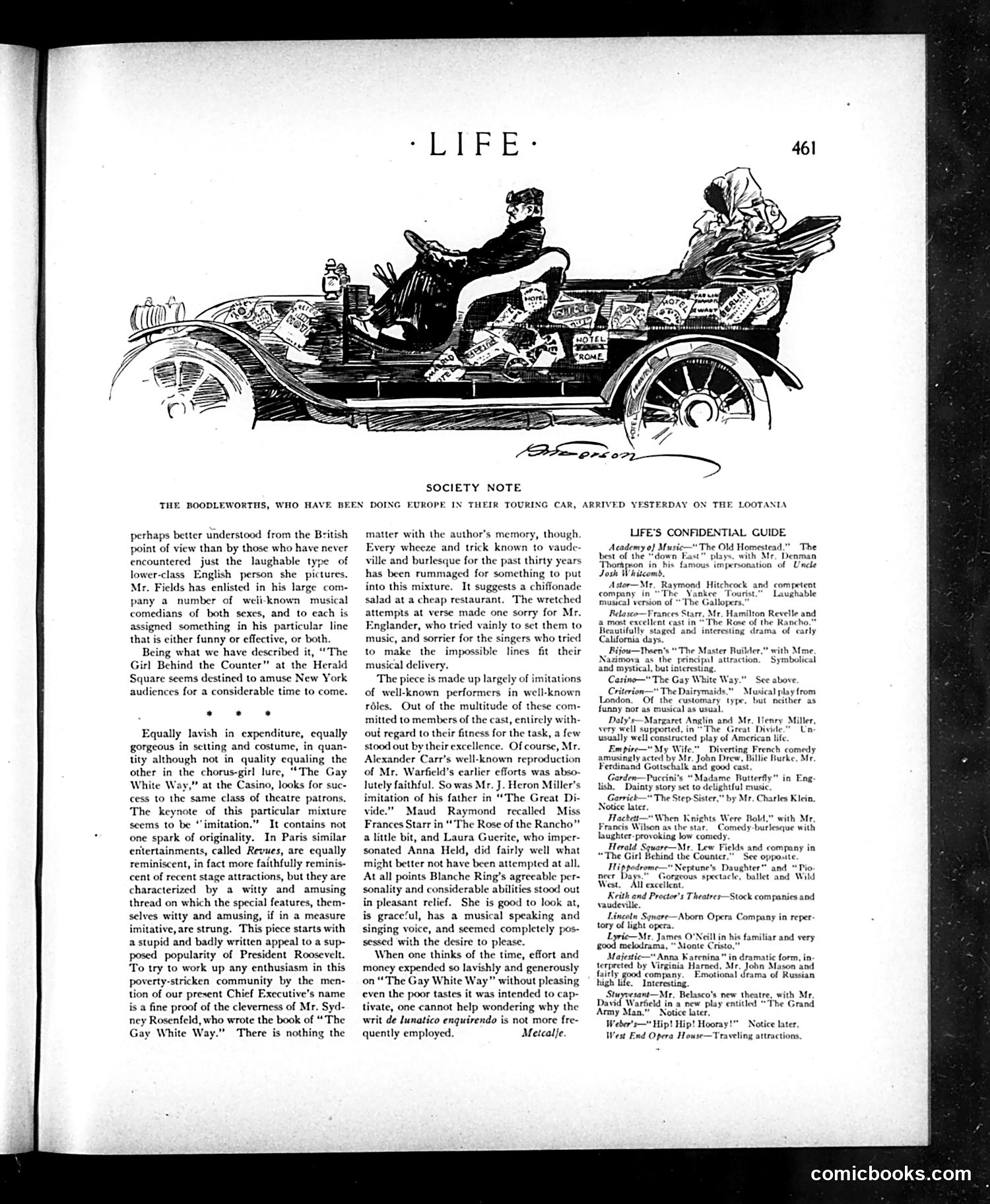
The main illustration depicts the "Boodleworths," wealthy American tourists touring Europe in an automobile—a cutting satirical commentary on the nouveau riche class. The cartoon mocks American upper-class pretension: the ostentatiously loaded vehicle, the woman's affected pose, and the general air of conspicuous consumption represent Life's critique of Americans who traveled abroad to flaunt wealth rather than appreciate culture. The accompanying text reviews theatrical productions, particularly criticizing "The Gay White Way" at the Casino as derivative and pandering. The review attacks the show's lazy reliance on President Roosevelt's name for appeal and its slavish imitation of French *Revues* without wit. This reflects Life's recurring theme: lampooning both wealthy Americans' superficiality and commercial entertainment's cynical exploitation of public taste. The cartoon and review together satirize American cultural and economic aspirations of the period.
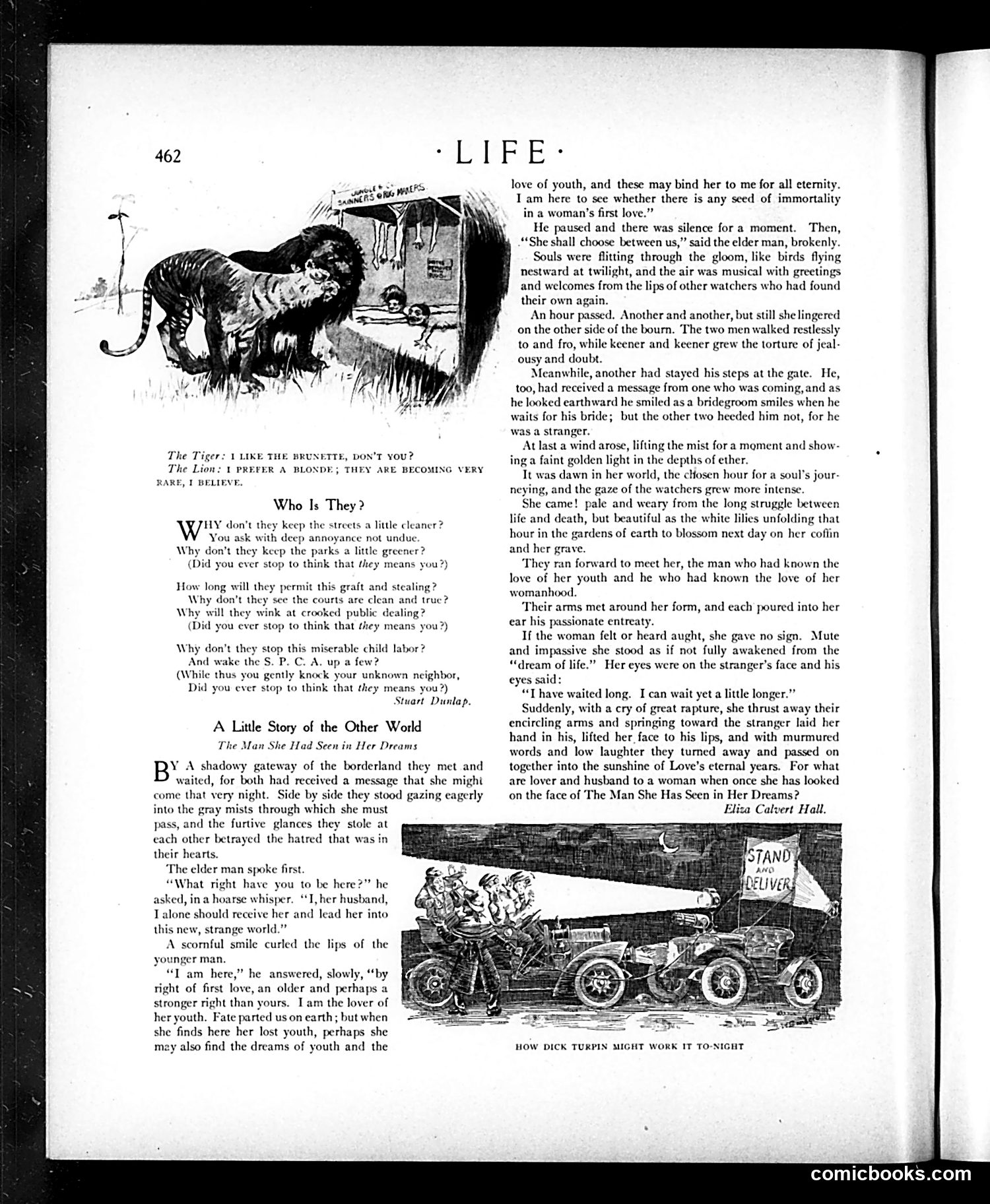
**"Who Is They?"** (left column): This is social satire by Stuart Dunlap attacking civic indifference. The poem asks rhetorical questions about urban problems—dirty streets, graft, child labor—then repeatedly reveals the answer: "they" means *you*, the reader. It's a critique of citizens who complain about social ills while refusing personal responsibility for reform. The message: stop blaming abstract authorities and recognize your own civic duty. **"A Little Story of the Other World"** (right column): A sentimental afterlife narrative by Eliza Calvert Hall about a woman choosing between two suitors in the afterlife—her first love (youth) versus her husband (maturity)—but ultimately selecting a third man she "has seen in her dreams." The illustration showing "How Dick Turpin Might Work It To-Night" appears unrelated advertising content. Both pieces reflect early 20th-century American concerns: civic responsibility and romantic idealism.
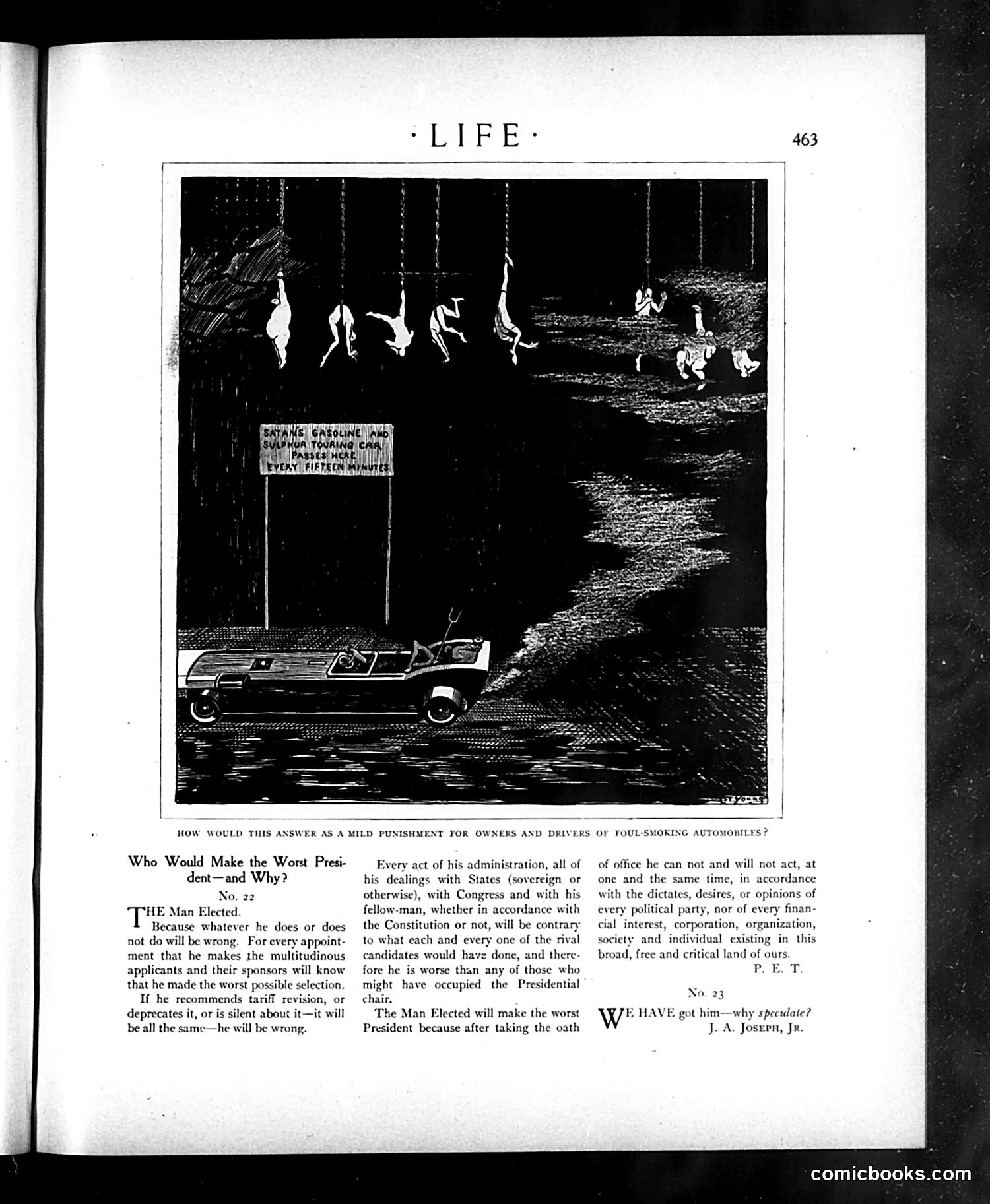
**The Cartoon (Top):** A surreal nighttime scene depicts nude figures swinging from vines in a forest while a convertible automobile passes below with smoke billowing from it. The caption poses a satirical "mild punishment" question about foul-smelling automobiles. **The Text (Bottom):** Two opinion pieces debate what kind of president would be worst. "No. 22" argues the elected president will inevitably disappoint everyone because every decision contradicts someone's interests—no action can simultaneously satisfy all political parties and factions. "No. 23" offers a sardonic counterargument: why speculate about hypothetical bad presidents when "we've got him"—implying the current elected president is already proving to be the worst. **Context:** This appears critical of early 20th-century American political divisiveness and partisan conflict. The cartoon's surreal imagery mocking automobile pollution suggests contemporary anxieties about modern technology, while the debates reflect cynicism about presidential governance and the impossibility of satisfying a fractious electorate.
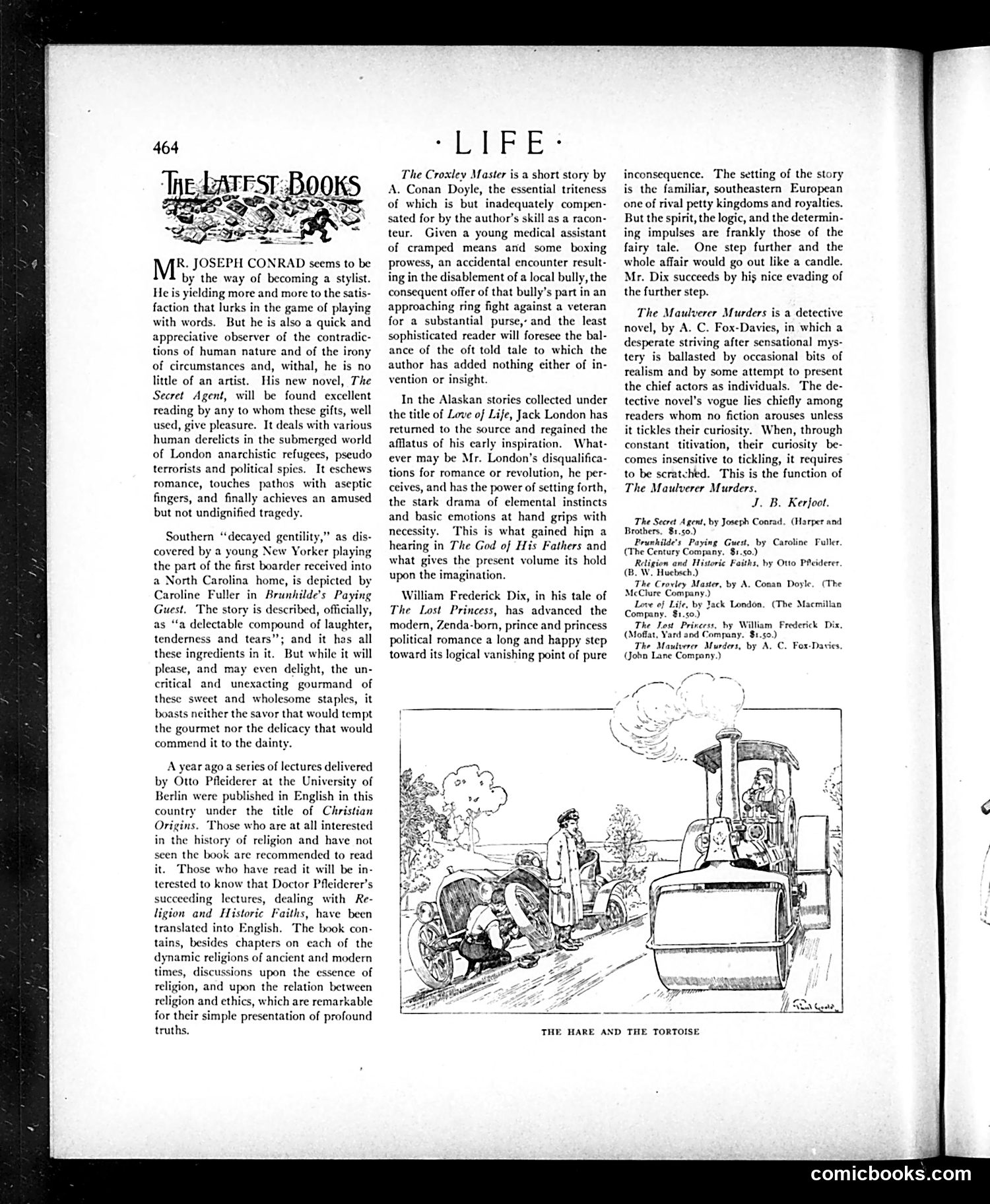
This page is primarily a book review section from *Life* magazine. The single cartoon at the bottom illustrates Aesop's fable "The Hare and the Tortoise"—a timeless moral tale about slow-and-steady perseverance defeating overconfident speed. The image shows a modern motorcar (appearing to represent the hare's speed/arrogance) encountering a tortoise on a country road. The joke updates the ancient fable to the early 20th century by replacing the original foot race with automotive technology—the modern "hare" relies on a mechanical advantage, yet the tortoise remains unmoved, suggesting that no amount of technological progress can overcome fundamental truths about character and effort. The cartoon likely serves as a visual counterpoint to the surrounding book reviews, perhaps ironically commenting on literary trends or human nature—themes central to the reviewed novels by Conrad, London, and others discussed on this page.
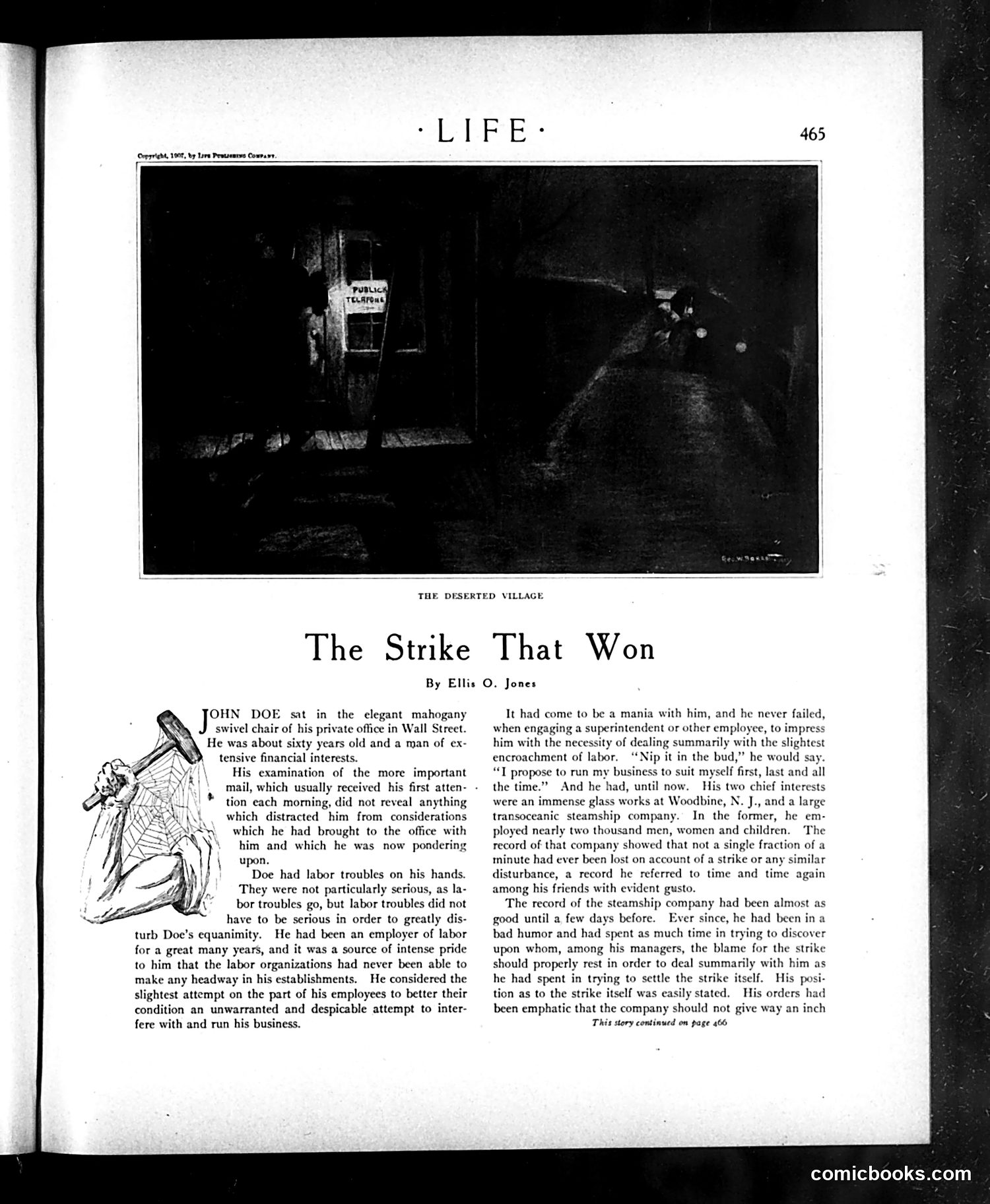
This is the opening of a short story (not a political cartoon) from Life magazine, circa 1907. The narrative concerns John Doe, a wealthy Wall Street businessman who owns a glass works and steamship company. Doe is portrayed as an authoritarian employer with anti-labor views—he considers any worker attempt to improve conditions "despicable" interference in his business. The story's setup establishes the conflict: Doe has successfully prevented strikes at his glass factory for years but now faces labor trouble at his steamship company. His rigid, dismissive stance toward workers' concerns ("Nip it in the bud") sets up what appears to be a comeuppance narrative. The image shows a darkened street scene labeled "The Deserted Village," likely foreshadowing economic or social consequences of labor disputes. The story appears designed to critique anti-labor business attitudes prevalent among Gilded Age industrialists.
This page is primarily **narrative text** from a serialized story about John Doe, an industrialist confronting labor strikes at his operations. **The Plot**: Doe, a company owner, learns of unexpected labor troubles at his Woodbine facility while rushing to catch a train. He dismisses his manager Reynolds as "namby-pamby" and "too considerate," confident he can quickly resolve any labor dispute. **Key Social Context**: The story satirizes turn-of-the-century industrial attitudes. Doe boasts about defeating child-labor legislation and employing 1,200 children, viewing reform concerns as "nonsense." He patronizingly insists child labor is economically necessary. **The Satire**: Life mocks wealthy industrialists' arrogance and paternalism—Doe's certainty that he alone understands labor relations, his contempt for reformers, and his disconnection from worker grievances. The narrative setup suggests his complacency will soon be shattered by actual labor unrest. **Unclear**: The specific historical strike or incident being referenced isn't identified on this page.
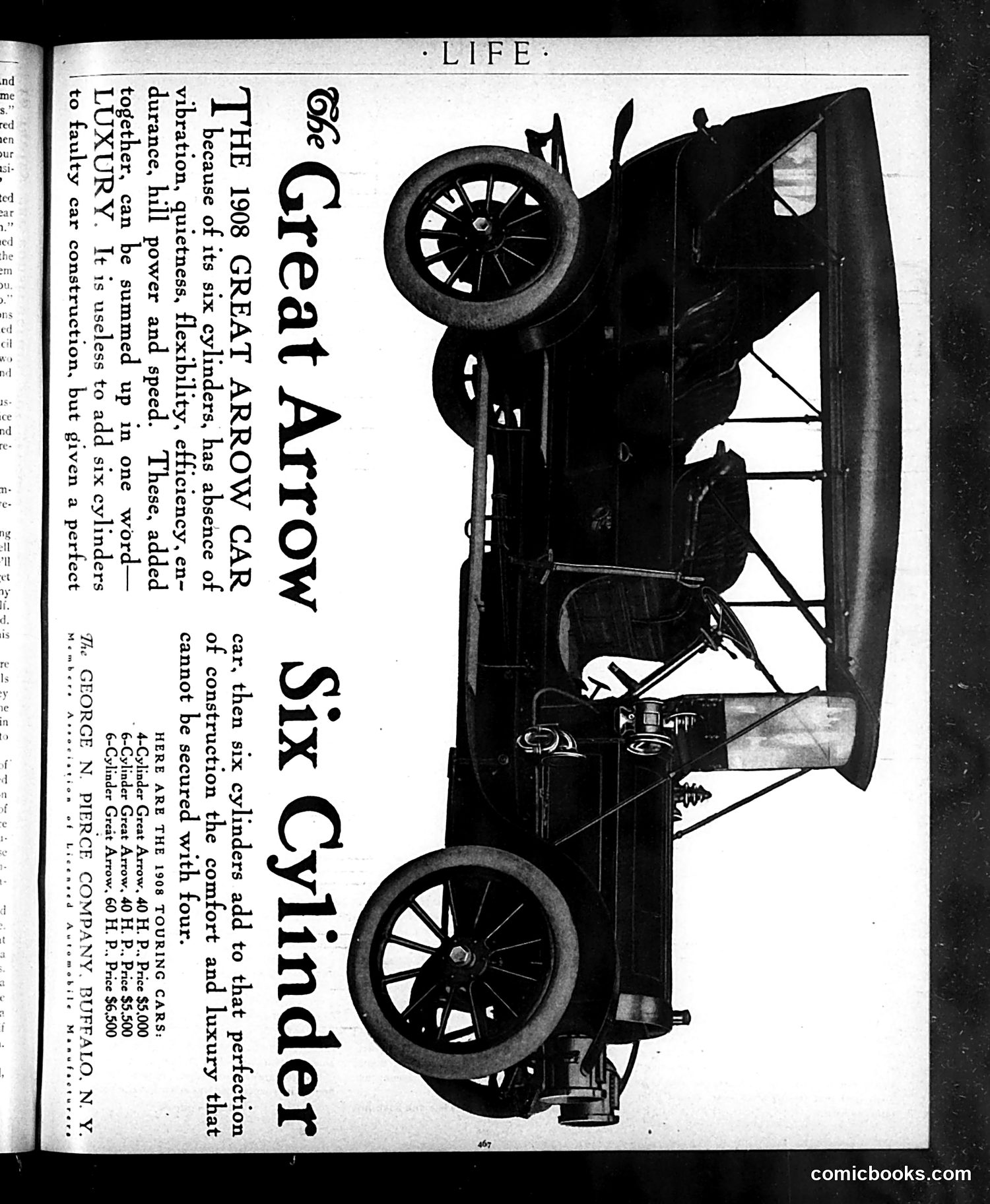
This is a **1908 automobile advertisement**, not a political cartoon. The page promotes the Great Arrow Six Cylinder car, manufactured by the George N. Pierce Company of Buffalo, New York. The advertisement features a side-view photograph of the 1908 Great Arrow automobile, shown as a luxury touring car with an open cabin and prominent wheels. The marketing pitch emphasizes the car's six-cylinder engine as providing superior comfort and smoothness compared to four-cylinder models—both cost $5,000-$6,500, making these luxury vehicles for the wealthy. The sales argument reflects early automotive technology: six cylinders were relatively new and marketed as eliminating vibration and providing "flexibility" and "luxury." This represents the nascent automobile industry's competition during the early 20th century, when cars remained expensive status symbols rather than mass-market transportation.
This page contains **two separate advertisements** and the beginning of a **fictional story** about child labor. **The Advertisements:** - Northern Motor Car Company promotes their 1908 automobile, emphasizing reliability and low maintenance costs - Hayes Tailor-Made Undersuits advertises custom-fitted men's underwear ($7.50-$30.00) **The Story:** The narrative depicts a moral conflict between a factory owner (Doe) and three boys who want to leave work to attend a circus parade. The boys argue their case with innocent logic: other children without jobs get to attend, they've voted democratically, and they'll work better after recreation. **The Social Context:** This appears to satirize early-1900s child labor practices and paternalistic employer attitudes. The story presents sympathetic child workers challenging an authority figure's claims about "sacred property rights" and business demands. The approaching circus—audible but unseen—represents temptation and the normal childhood pleasures these working children are denied. The satire lies in the boys' rational arguments exposing the hollowness of the employer's justifications for denying them basic human recreation.
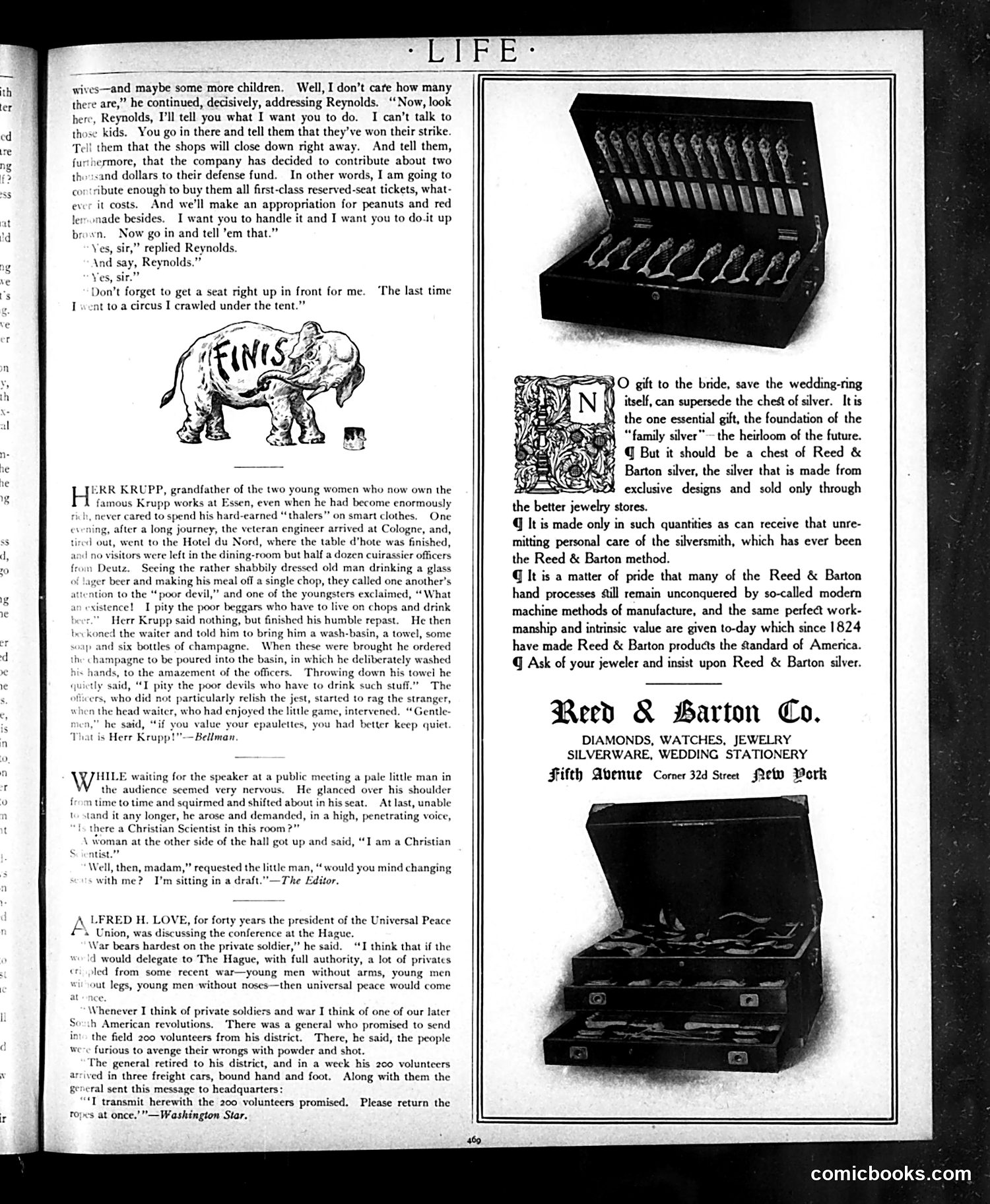
This page contains three separate humorous anecdotes typical of Life's satirical style: 1. **The Circus Strike Story**: A wealthy industrialist (unnamed) decides to end a workers' strike by buying the striking children circus tickets and peanuts—a patronizing gesture that treats serious labor concerns as entertainment rather than addressing legitimate grievances. 2. **The Herr Krupp Anecdote**: A story about the German industrial magnate humbling snobbish military officers by washing his hands in champagne after they mock his humble meal, implying he's wealthy enough to waste expensive champagne on his hands. 3. **Peace Conference Anecdotes**: Two brief jokes about pacifism—one mocking a Christian Scientist's complaint about drafts, another about a general cynically fulfilling a volunteer quota by sending disabled war veterans in freight cars. The page also contains a **Reed & Barton silverware advertisement** featuring a chest of silver flatware and what appears to be a jewelry box. The humor reflects early 20th-century attitudes toward labor disputes, wealth, and militarism.
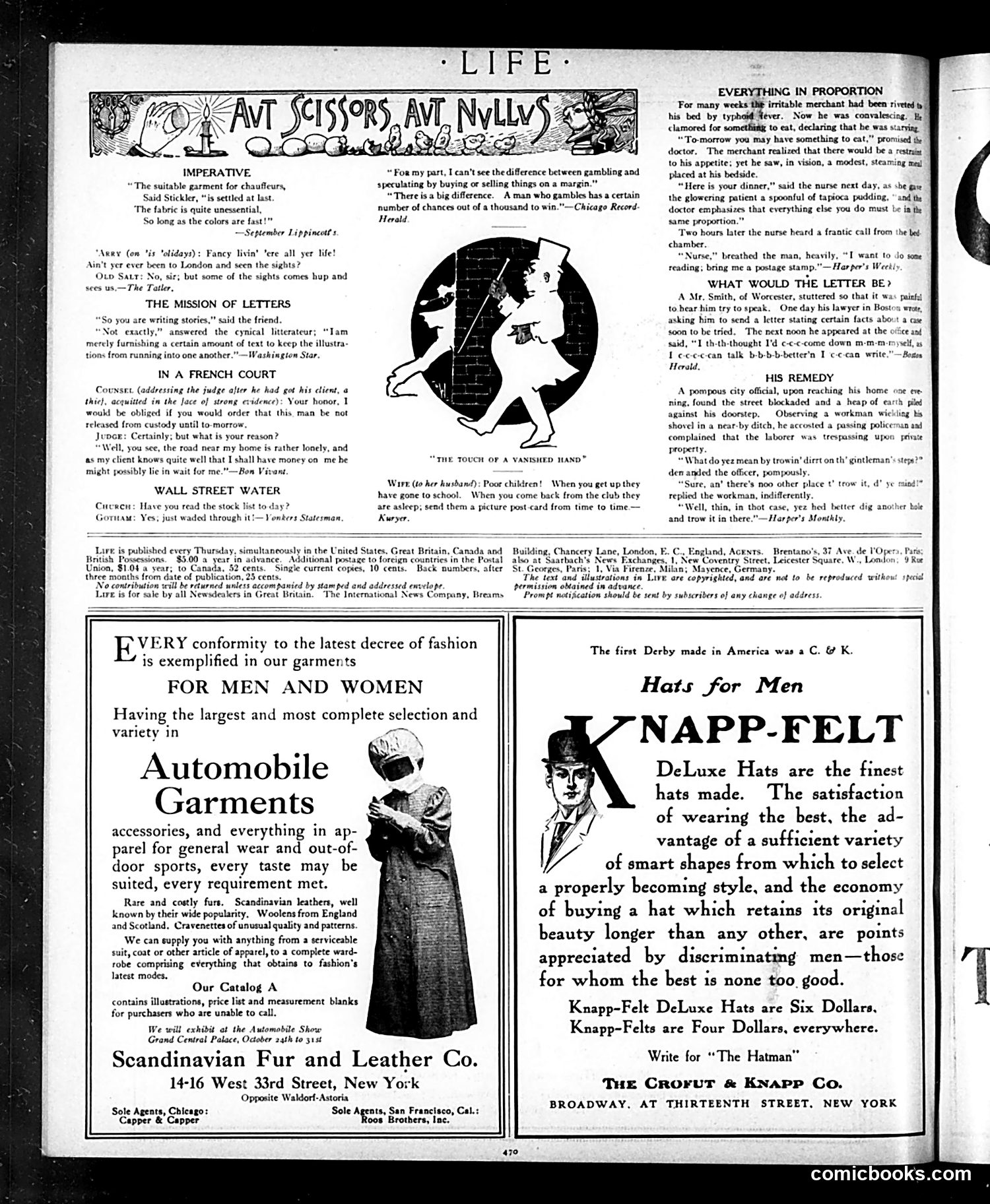
This page contains multiple brief satirical cartoons and jokes typical of early 20th-century Life magazine humor. **The main cartoon** ("The Touch of a Vanished Hand") depicts a husband neglecting his children—leaving before they wake, returning after they sleep—and suggests he send postcards instead of spending time with them. It satirizes wealthy absentee fathers prioritizing social club life over family duties. **Other jokes mock contemporary social absurdities:** - A chauffeur's uniform matters only if colors are "fast" (won't fade)—ridiculing superficial fashion standards - A cynical writer admits stories are just "text to keep illustrations from running together"—satirizing commercialism in publishing - A French lawyer wants his acquitted client jailed overnight to protect himself from robbery - A recovering typhoid patient receives only tapioca in "proportion" to his illness, then absurdly asks for a postage stamp to read **The advertisements** promote automobile garments and Knapp-Felt hats, typical period products. The humor relies on irony, exaggeration, and brief punch lines—standard for Life's satirical commentary on modern life, wealth, and pretension.
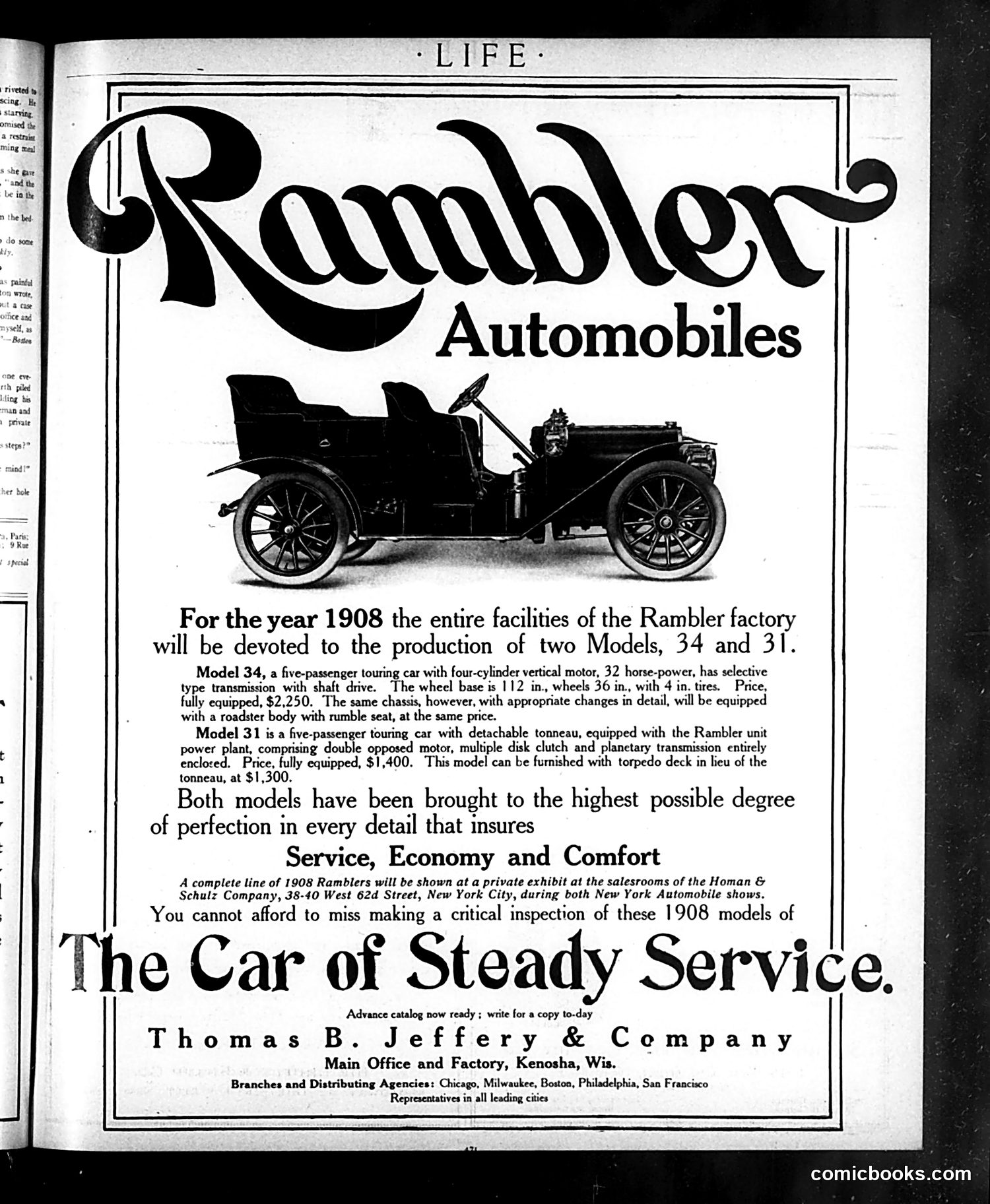
This page is **not a political cartoon or satire**—it's a full-page advertisement for Rambler automobiles, published in *Life* magazine circa 1908. The ad promotes two 1908 Rambler models (34 and 31) manufactured by Thomas B. Jeffery & Company in Kenosha, Wisconsin. Model 34 is a five-passenger touring car priced at $2,250; Model 31, with a detachable tonneau, costs $1,400. Both emphasize "Service, Economy and Comfort." The decorative typography and side-profile illustration of an open-air automobile are typical of early 20th-century automotive advertising design. The ad directs readers to a private exhibit at a New York showroom during automobile shows and offers an advance catalog. This represents how *Life* magazine monetized through advertising while maintaining its satirical editorial content elsewhere in the publication.
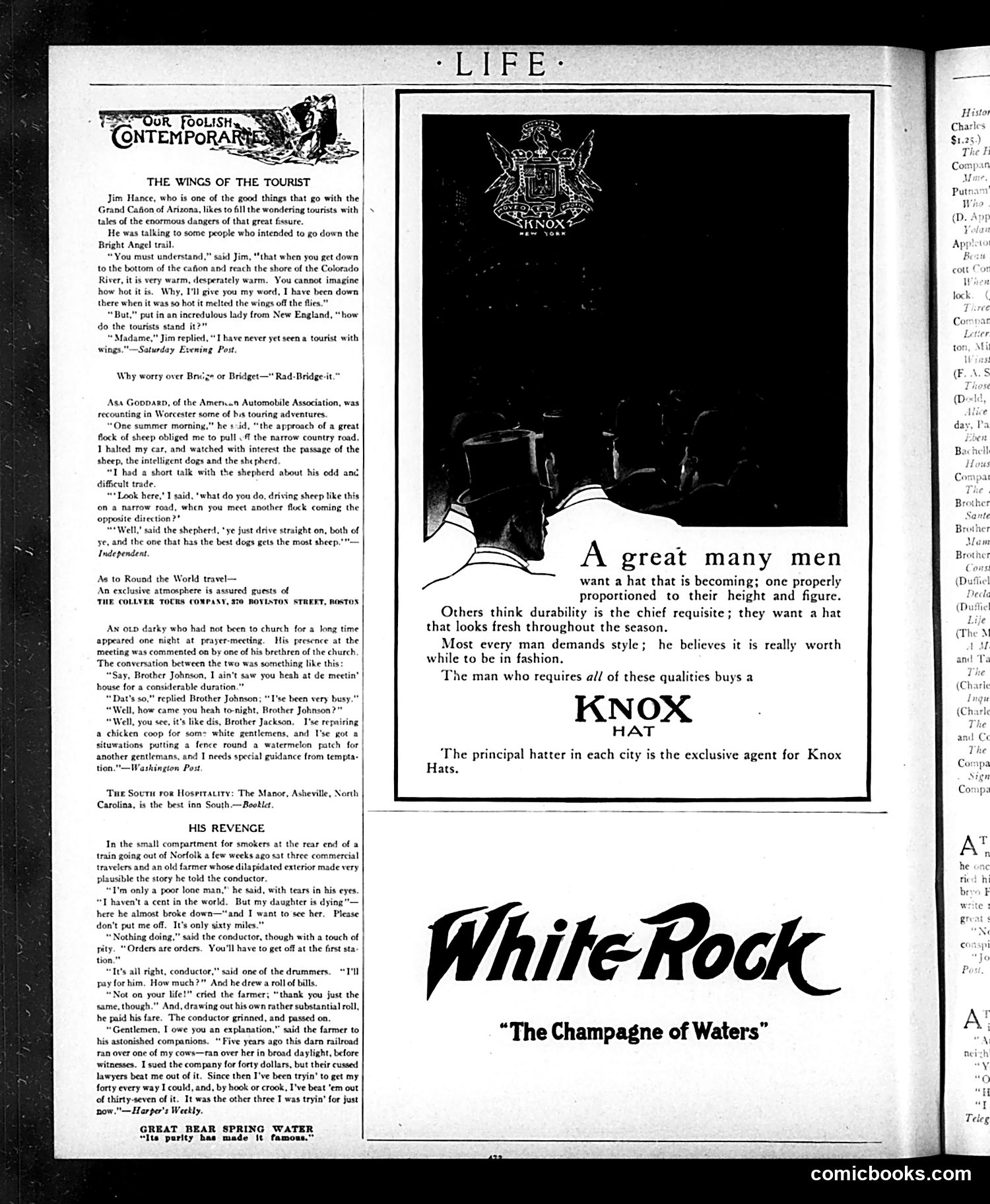
This page consists primarily of humorous anecdotes rather than political cartoons. The main pieces satirize American tourist culture and rural/working-class life: **"The Wings of the Tourist"** mocks credulous tourists visiting the Grand Canyon through a tall tale: a guide claims Arizona heat is so extreme it "melted the wings off the flies," then quips he's "never yet seen a tourist with wings"—implying tourists are foolish enough to believe anything. **"Why Worry over Bridget"** presents another anecdote about sheep herding, poking fun at rural simplicity and dialect humor (typical of early 20th-century publications). **"His Revenge"** tells of a poor farmer who initially appears to need charity but reveals he's actually wealthy—pranking the railroad company by paying his own fare after they initially refused him passage. The page's humor relies on period stereotypes: gullible tourists, comedic African American vernacular, and rural/working-class characters outsmarting urban sophisticates. These anecdotes reflect early-1900s American attitudes toward class and regional differences.
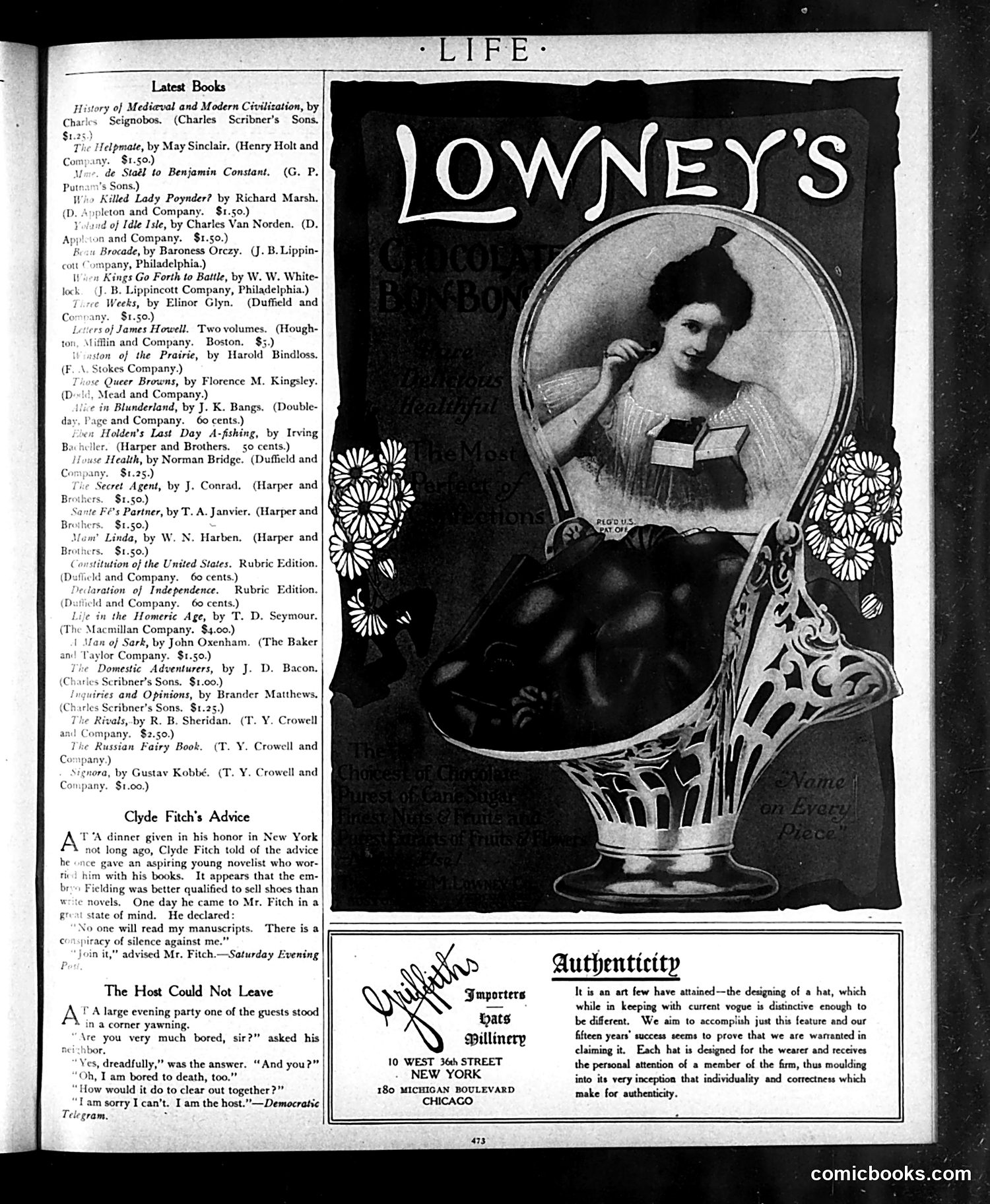
This page is primarily a **book review section and advertisements**, not a political cartoon. The left column lists "Latest Books"—new publications from publishers like Scribner's and Harper & Brothers, with prices ranging 50 cents to $4. Notable titles include works by May Sinclair and Elinor Glyn. Below that are two brief **humorous anecdotes**: one about playwright Clyde Fitch advising a struggling novelist to embrace rejection, and another joke about bored party guests where the host cannot leave his own event. The right side features a **Lowney's Chocolate advertisement** showing an elegant woman reading, framed in decorative art nouveau styling with flowers. Below it is a **Phillipps hat advertisement** emphasizing artisanal design and personalized craftsmanship. This is typical of Life's mixed content model: literary and consumer advertising alongside light social humor—reflecting early 1900s magazine conventions targeting educated, affluent readers.
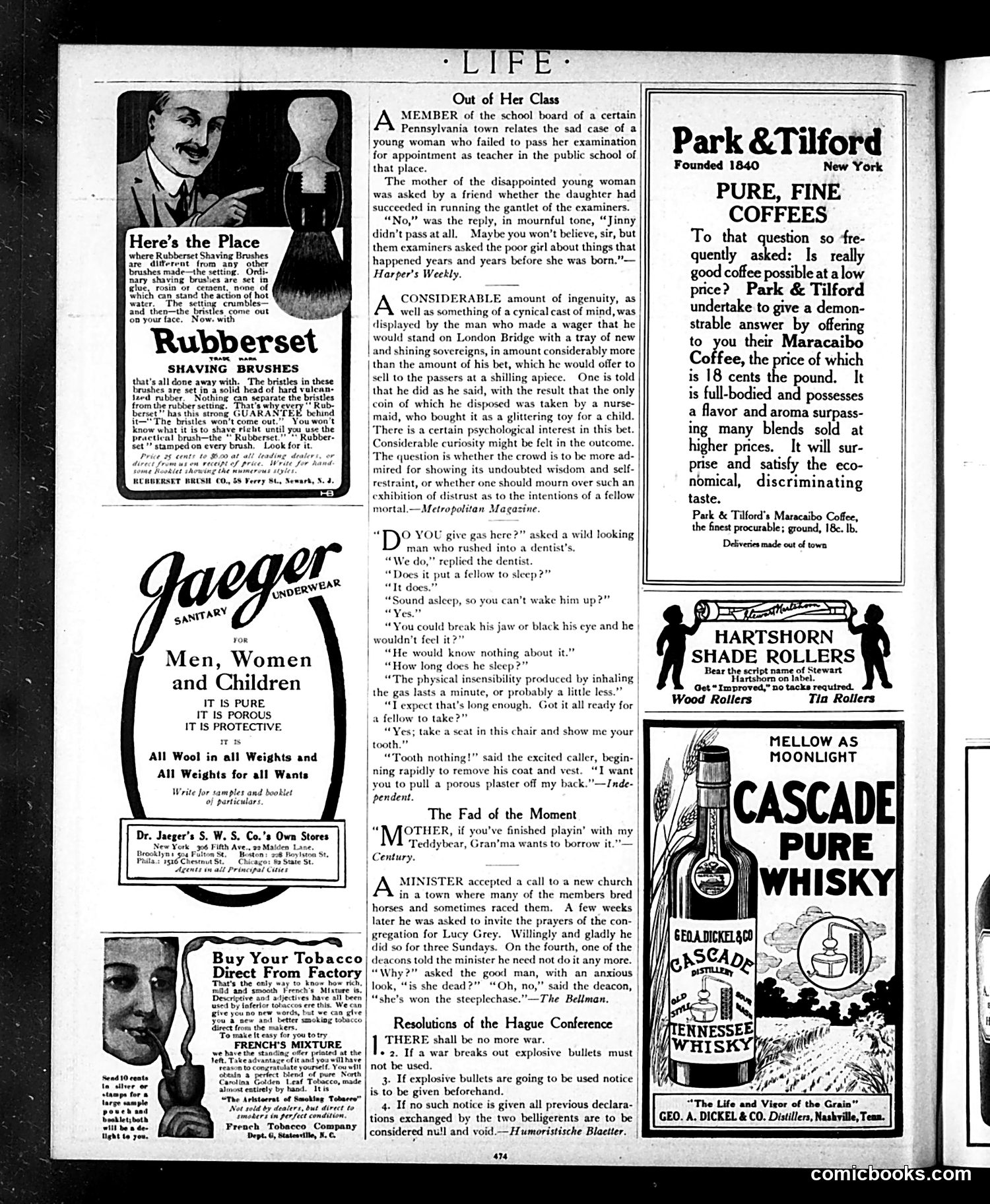
This page from *Life* magazine (a 19th-century satirical publication, not the modern photo magazine) contains several humorous anecdotes and advertisements typical of the era. The main cartoons/stories satirize human nature and social absurdities: 1. **"Out of Her Class"**: Mocks an overly rigorous school examination system where examiners questioned a young woman about historical events predating her birth—absurdist humor about bureaucratic incompetence. 2. **The London Bridge Sovereigns Story**: Satirizes public distrust and cynicism—a man attempts to sell genuine coins for cheap but can't convince anyone of their authenticity, reflecting broader social skepticism. 3. **The Dentist Joke**: A man rushes in asking about anesthesia, but reveals he actually wants help removing a porous plaster from his back—wordplay humor based on misunderstanding "gas." 4. **The Steeplechase Prayer**: A minister prays for a horse named Lucy Grey for three weeks; a deacon tells him to stop—she won the race, so prayers are no longer needed. Satirizes superstition and religious practice. The page is primarily **advertising-driven**, featuring product promotions alongside these brief humorous pieces.
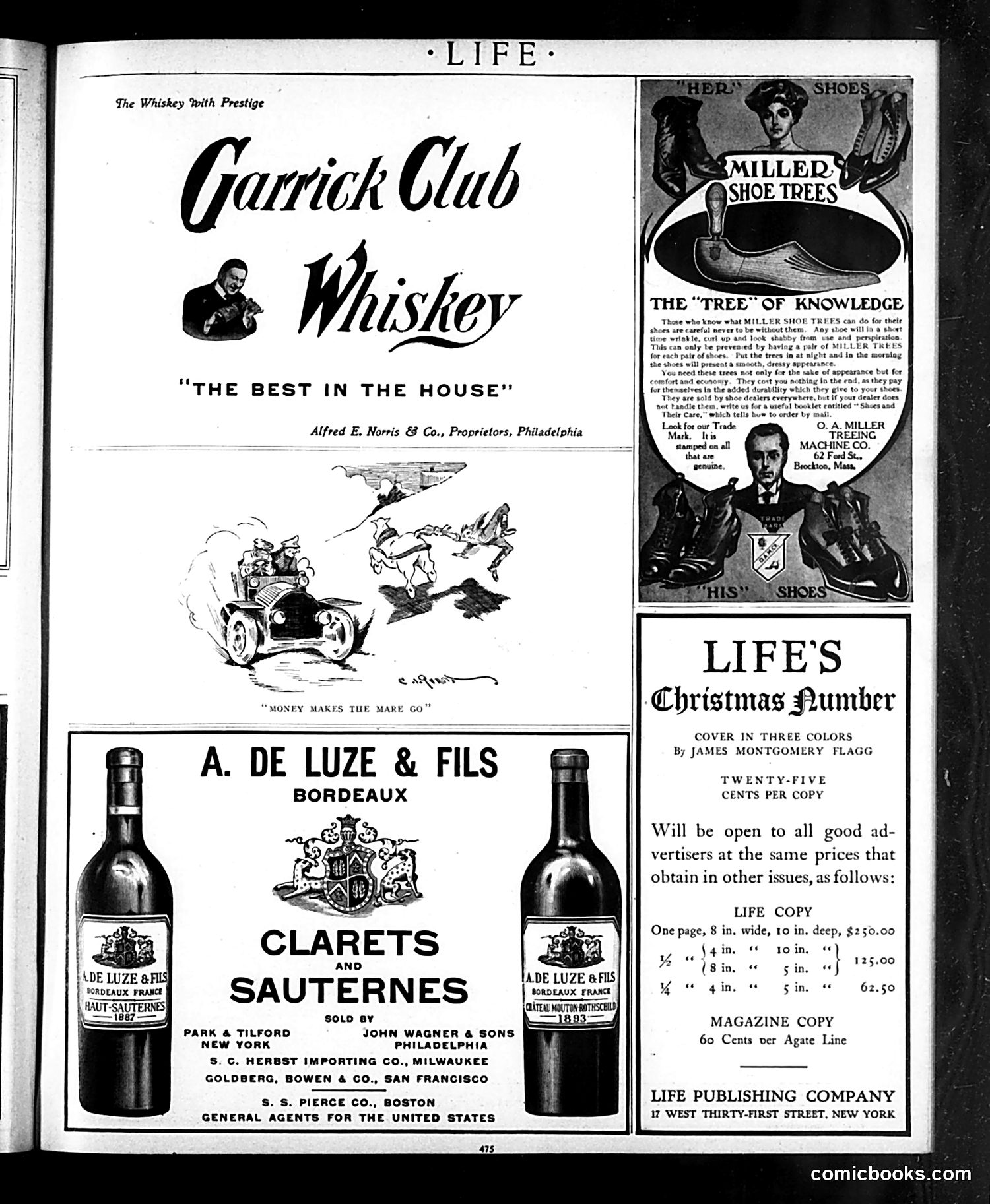
This page consists primarily of **advertisements** rather than editorial content. The main cartoon, titled "Money Makes the Mare Go," depicts a whimsical scene of figures in/around an early automobile, illustrating the saying that money enables movement or success—a reference to the popular phrase about wealth's power. The page advertises three products: **Garrick Club Whiskey** (Philadelphia), **A. De Luze & Fils wines** (French clarets and sauternes), and **Miller Shoe Trees** (a device inserted in shoes to maintain their shape). The shoe trees ad notably features a portrait of O.A. Miller himself. The bottom section announces **Life's Christmas Number**, priced at 25 cents, with cover art by James Montgomery Flagg, and provides advertising rates for potential clients. The content reflects early 20th-century consumer culture, with emphasis on luxury goods (French wines, quality whiskey, shoe care products) marketed to affluent readers of Life magazine.
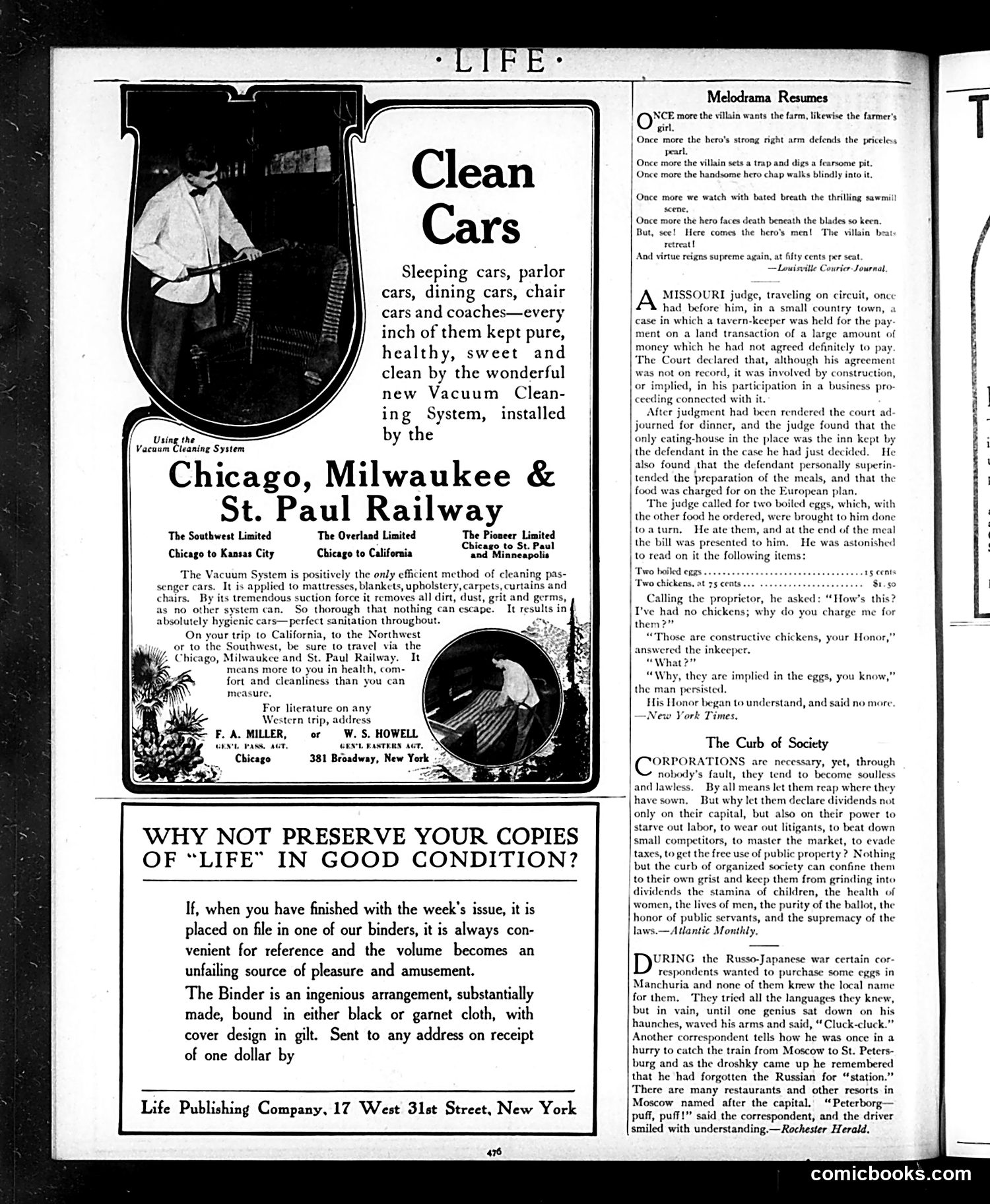
This page contains three distinct pieces of satirical content: **"Clean Cars" Advertisement**: A railroad company advertisement for the Chicago, Milwaukee & St. Paul Railway, promoting their new vacuum cleaning system for passenger cars. This is straightforward advertising rather than satire. **"Melodrama Resumes" Poem**: A humorous verse mocking the predictable tropes of silent-film melodramas—the villain coveting the farm and heroine, the hero's narrow escapes from death traps (sawmills), and villainous retreats. It satirizes the formulaic, overwrought plots audiences paid fifty cents to witness. **"The Curb of Society" Story**: A legal anecdote mocking judicial hypocrisy. A judge rules that a tavern-keeper owes money based on "constructive" agreement (implied by conduct). Later, that same judge is charged for "constructive chickens" (implied in eggs) by the defendant—a direct satire exposing the absurdity of the judge's own legal reasoning when turned against him. The page juxtaposes popular entertainment satire with legal/social commentary.
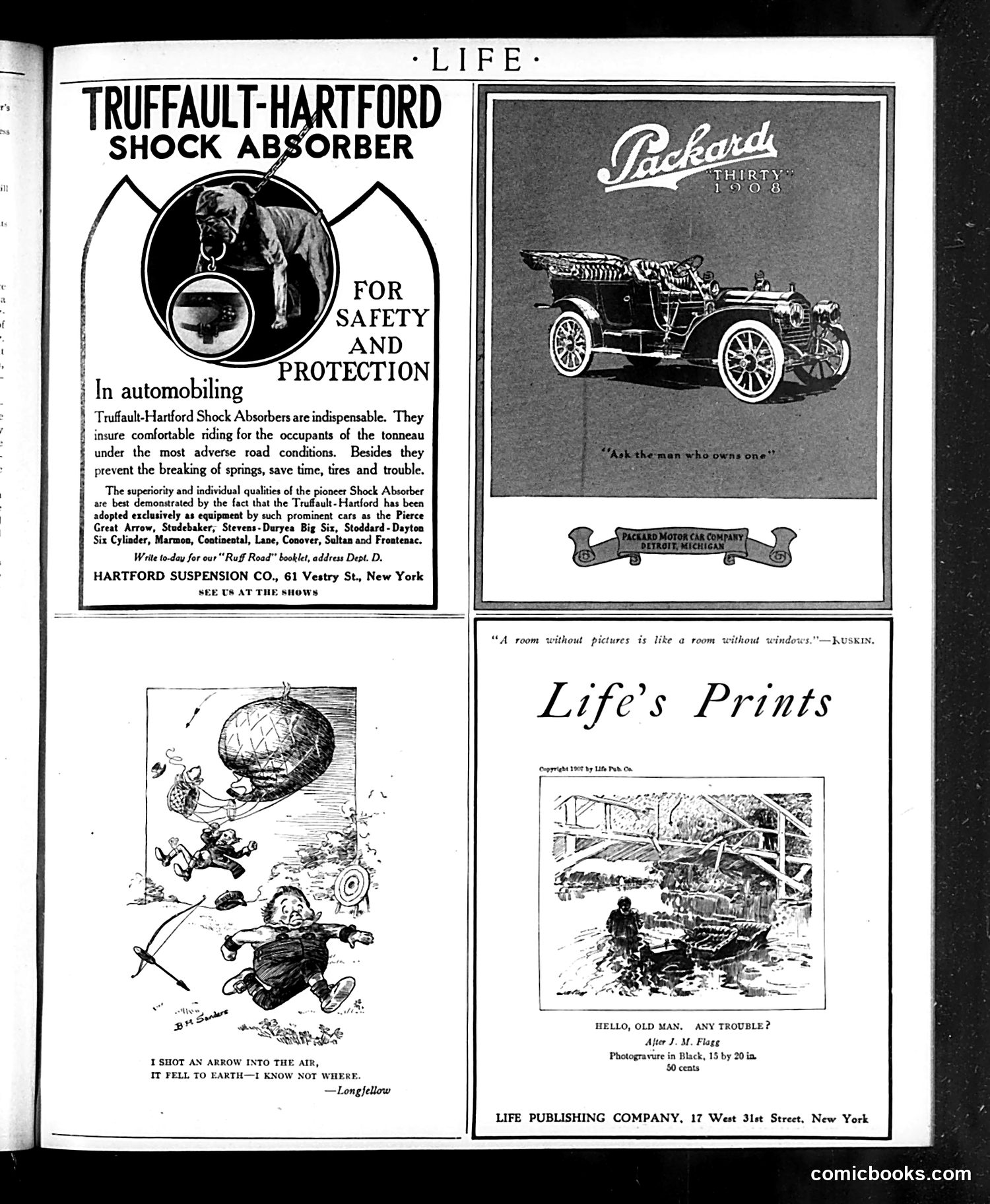
This page contains **primarily advertisements and art prints rather than political satire**. The top left advertises Truffault-Hartford shock absorbers, emphasizing automobile safety and comfort—a practical pitch to early motorists concerned with rough roads. The top right showcases a Packard automobile, using the aspirational tagline "Ask the man who owns one." The lower half features "Life's Prints"—reproductions of artwork available for purchase. The visible print, "Hello, Old Man. Any Trouble?" by J.M. Flagg, depicts a figure offering assistance to someone in distress, likely in a humorous or sentimental context typical of early-20th-century illustration. The page's small cartoon (bottom left) shows figures with a balloon and arrow, captioned with a Longfellow quote—a whimsical rather than political image. Overall, this appears to be a commercial/editorial page mixing consumer advertising with cultural content rather than satirical commentary.
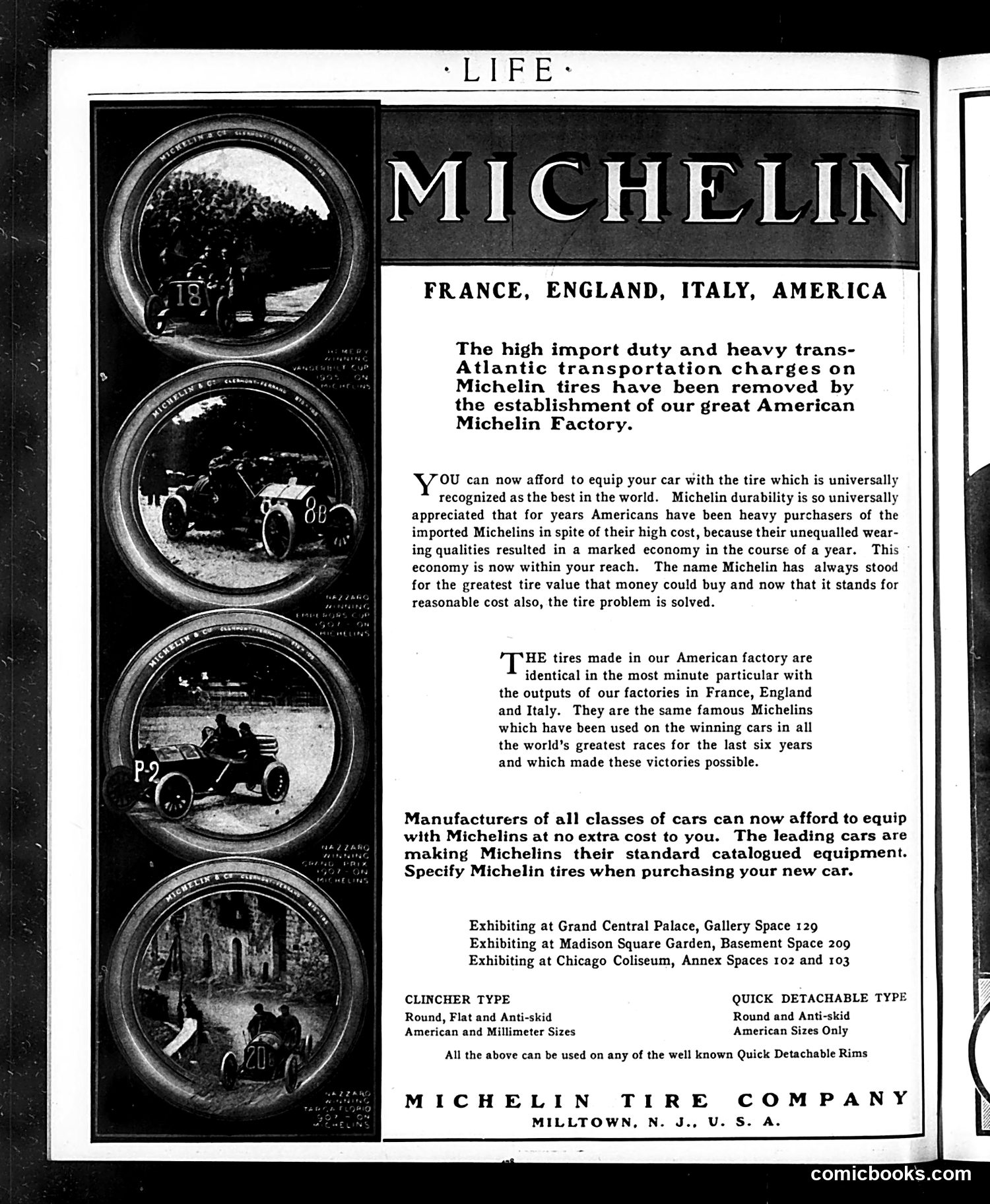
This is not a cartoon or satire—it's a **full-page advertisement** for Michelin tires published in *Life* magazine. The page announces Michelin's new American factory in Milltown, New Jersey, which eliminates import duties and shipping costs that previously made French-made Michelin tires expensive for American consumers. The four circular images on the left show racing scenes and vintage automobiles, emphasizing the brand's prestige through association with winning race cars. The ad's central pitch: Michelin tires—previously a luxury import—are now affordable domestically without sacrificing quality. The text claims American-made Michelins are "identical" to French, English, and Italian versions and references the tires' proven performance in "the world's greatest races." This reflects early 20th-century industrial nationalism: foreign luxury goods becoming accessible through domestic manufacturing, framed as both economic victory and democratic progress (quality goods "now within your reach").
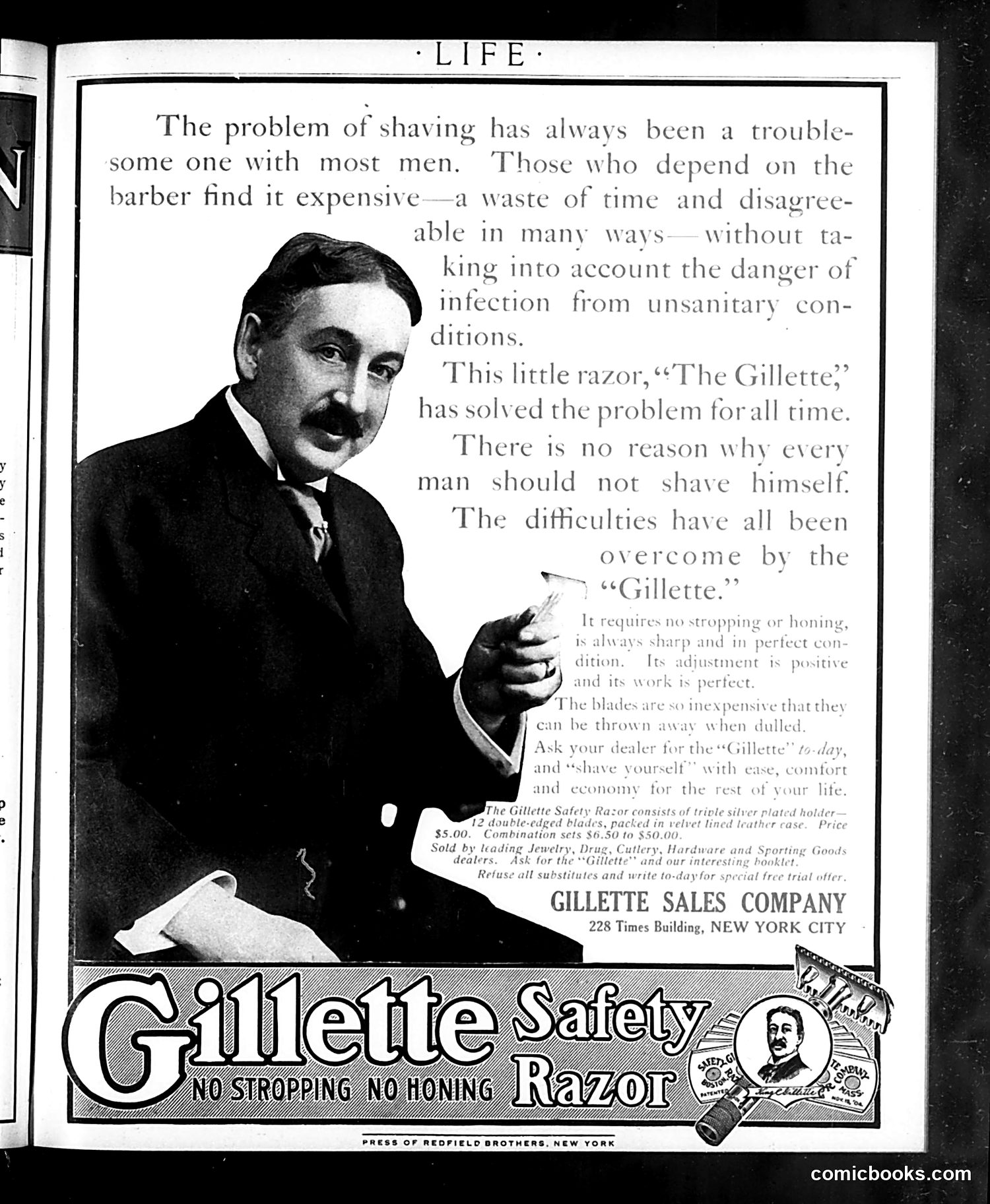
This is primarily a **product advertisement**, not a political cartoon. It features a well-dressed man holding a Gillette Safety Razor, promoting it as a solution to shaving problems. The ad addresses practical concerns of the era: barber visits were expensive, time-consuming, and posed infection risks from unsanitary conditions—a genuine health concern in the early 20th century before modern hygiene standards. The advertisement's appeal is democratic: "There is no reason why every man should not shave himself." This positions the Gillette razor as enabling male independence and self-sufficiency while saving money. The razor's design innovations—no stropping or honing required, disposable blades—are highlighted as major conveniences. Prices range from $5 to $50 depending on the holder material. This reflects the era's broader marketing strategy: selling consumer products as solutions to everyday problems while appealing to masculine self-reliance and economic prudence.
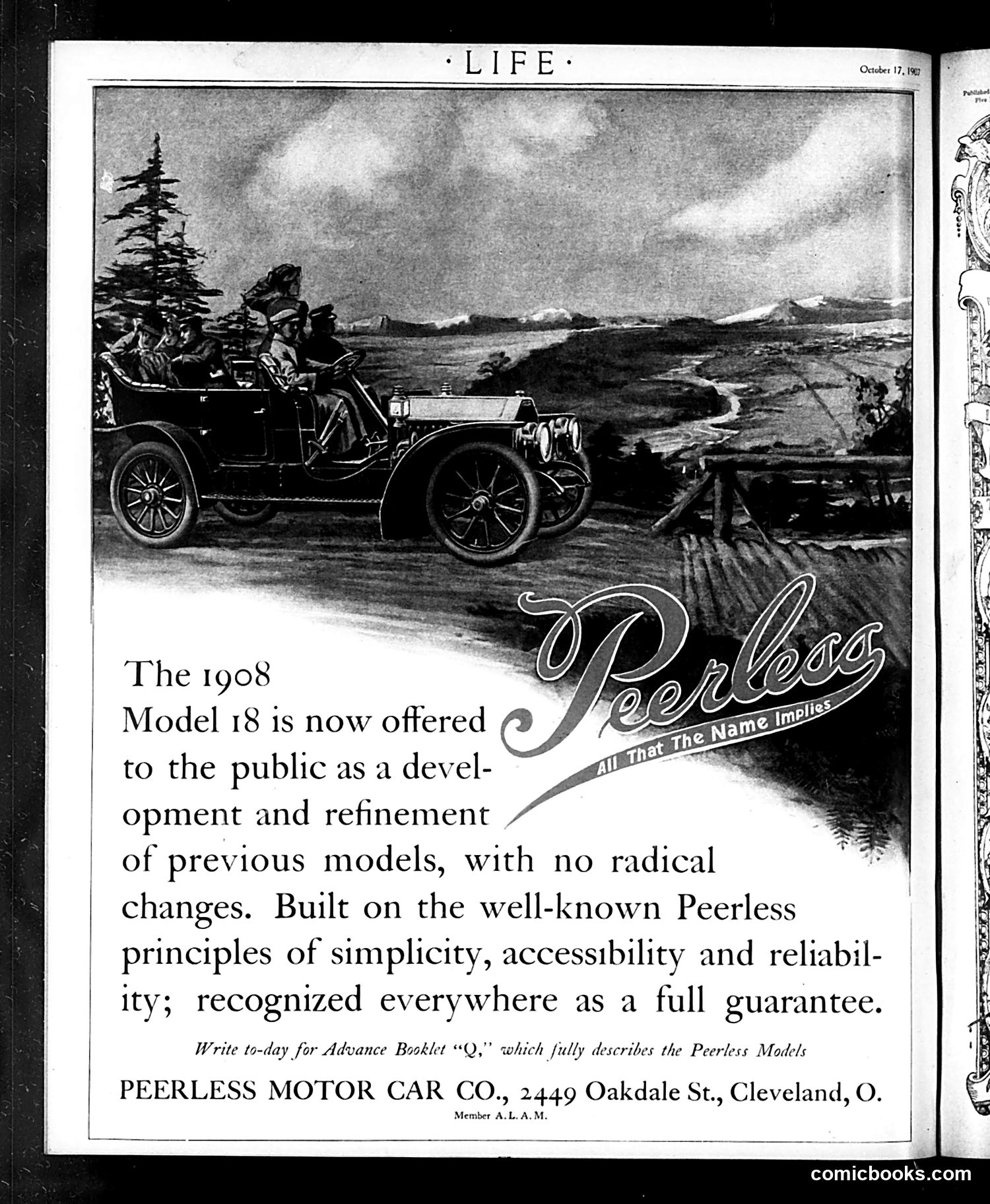
This is primarily a **car advertisement**, not a political cartoon. It's a full-page ad from *Life* magazine (October 17, 1907) promoting the Peerless Motor Car Company's 1908 Model 18. The image shows an early automobile with passengers on a scenic road, emphasizing the vehicle's reliability and refinement. The tagline "All That The Name Implies" suggests Peerless's established reputation. The advertisement targets affluent readers by emphasizing the car's principles of "simplicity, accessibility and reliability"—marketing language designed to appeal to early motorists. The scenic backdrop implies leisure and freedom, key selling points for automobiles in this era when car ownership was still a luxury. This reflects early 1900s car marketing, when automobile companies advertised in high-end magazines like *Life* to reach wealthy potential buyers.