
Life, 1907-10-17 · page 33 of 44
Life — October 17, 1907 — page 33: what you’re looking at
What you’re looking at
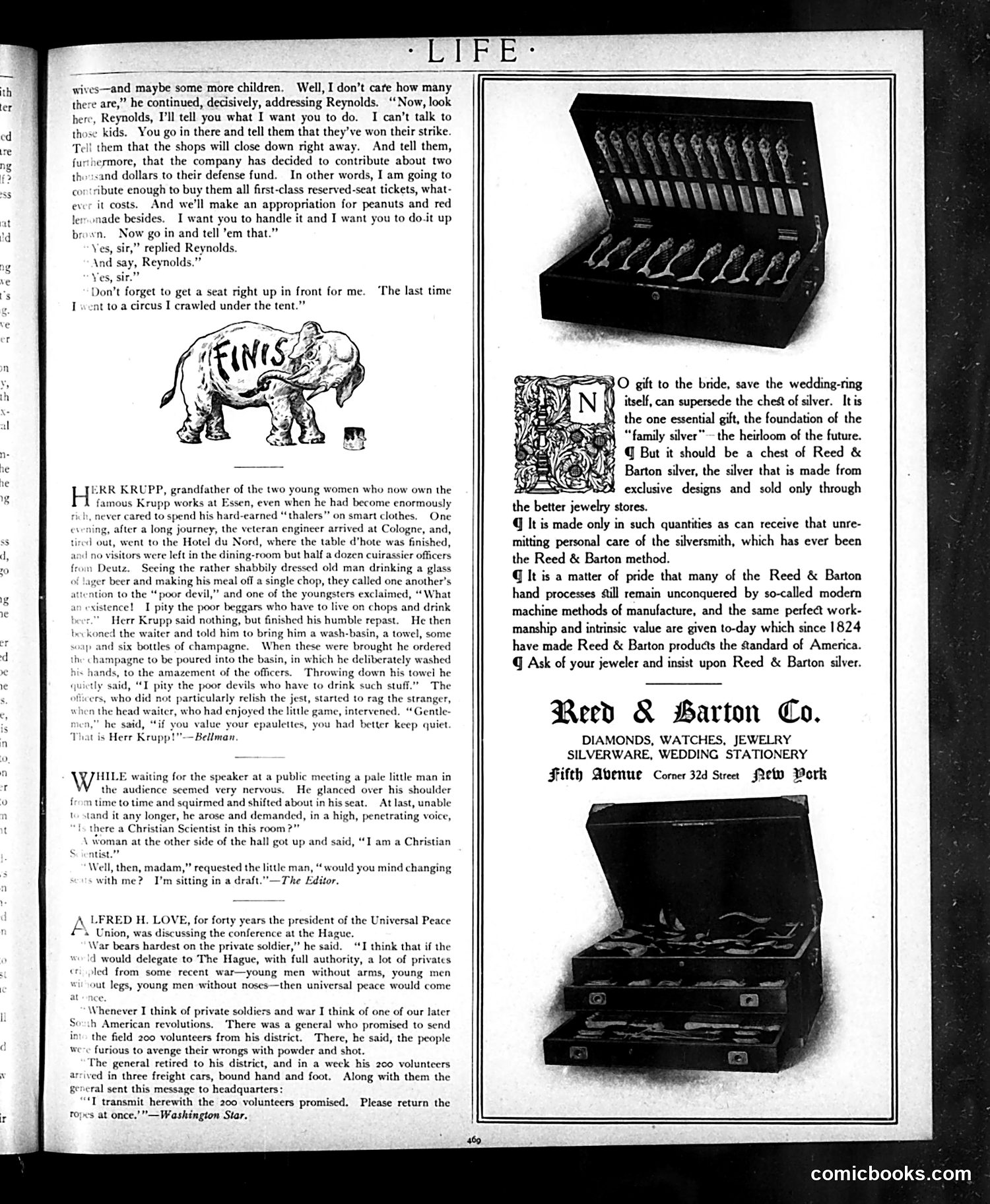
This page contains three separate humorous anecdotes typical of Life's satirical style: 1. **The Circus Strike Story**: A wealthy industrialist (unnamed) decides to end a workers' strike by buying the striking children circus tickets and peanuts—a patronizing gesture that treats serious labor concerns as entertainment rather than addressing legitimate grievances. 2. **The Herr Krupp Anecdote**: A story about the German industrial magnate humbling snobbish military officers by washing his hands in champagne after they mock his humble meal, implying he's wealthy enough to waste expensive champagne on his hands. 3. **Peace Conference Anecdotes**: Two brief jokes about pacifism—one mocking a Christian Scientist's complaint about drafts, another about a general cynically fulfilling a volunteer quota by sending disabled war veterans in freight cars. The page also contains a **Reed & Barton silverware advertisement** featuring a chest of silver flatware and what appears to be a jewelry box. The humor reflects early 20th-century attitudes toward labor disputes, wealth, and militarism.
📄 Transcribed text from this page (OCR, searchable)
Machine-transcribed from the original scan — historical spelling and the odd misread are preserved.
cat v r wives—and maybe some more children. Well, I don’t cafe how many there are,” he continued, decisively, addressing Reynolds. ‘Now, look here, Reynolds, I’ll tell you what I want you to do. I can’t talk to those kids. You go in there and tell them that they’ve won their strike. Tell them that the shops will close down right away. And tell them, furthermore, that the company has decided to contribute about two thevsand dollars to their defense fund. In other words, I am going to contribute enough to buy them all first-class reserved-seat tickets, what- ever it costs. And we'll make an appropriation for peanuts and red lernonade besides. I want you to handle it and I want you to do.it up brown. Now go in and tell ’em that.” Ves, sir,” replied Reynolds. \nd say, Reynolds.” Yes, sir.” Don’t forget to get a seat right up in front for me. The last time T went to a circus I crawled under the tent.” ERR KRUPP, grandfather of the two young women who now own the H famous Krupp works at Essen, even when he had become enormously never cared to spend his hard-earned “‘thalers” on smart clothes, One sing, after a long journey, the veteran engineer arrived at Cologne, and, out, went to the Hotel du Nord, where the table d’hote was finished, no visitors were left in the dining-room but half a dozen cuirassier officers » Deutz. Seeing the rather shabbily dressed old man drinking a glass ager beer and making his meal off a single chop, they called one another's ation to the “poor devil,” and one of the youngsters exclaimed, “What existence! I pity the poor beggars who have to live on chops and drink Herr Krupp said nothing, but finished his humble repast. He then the waiter and told him to bring him a wash-basin, a towel, some d six bottles of champagne. When these were brought he ordered champagne to be poured into the basin, in which he deliberately washed < hands, to the amazement of the officers. Throwing down his towel he tly said, “I pity the poor devils who have to drink such stuff.” The ers, who did not particularly relish the jest, started to rag the stranger, ven the head waiter, who had enjoyed the little game, intervened. “Gentle- r he said, “tif you value your epaulettes, you had better keep quiet ‘That is Herr Krupp!"—Bellman a pale little man in the audience scemed very nervous. janced over his shoulder 1 time to time and squirmed and shifted about in his seat. At last, unable tand it any longer, he arose and demanded, in a high, penetrating voice, here a Christian Scientist in this room?” \ Woman at the other side of the hall got up and said, “I am a Christian Well, then, madam,” requested the little man, “would you mind changing with me? I'm sitting in a draft." —The Editor. ALFRED H. LOVE, for forty years the president of the Universal Peace 4 Union, was discussing the conference at the Hague. War bears hardest on the private soldier,” he said. “I think that if the 1 would delegate to The Hague, with full authority, a lot of privates Jed from some recent war—young men without arms, young men out legs, young men without noses—then universal peace would come Whenever I think of private soldiers and war I think of one of our later h American revolutions. ‘There was a general who promised to send the field 200 volunteers from his district. There, he said, the people furious to avenge their wrongs with powder and shot. The general retired to his district, and in a weck his 2co volunteers rcived in three freight cars, bound hand and foot. Along with them the cral sent this message to headquarters: ‘I transmit herewith the 200 volunteers promised. Please return the Tones at once.’”—Washington Star. O gift to the bride, save the wedding-ring itself, can supersede the chest of silver. Itis the one essential gift, the foundation of the “family silver” — the heirloom of the future. @ But it should be a chest of Reed & Barton silver, the silver that is made from exclusive designs and sold only through the better jewelry stores. @ It is made only in such quantities as can receive that unre- mitting personal care of the silversmith, which has ever been the Reed & Barton method. @ It is a matter of pride that many of the Reed & Barton hand processes still remain unconquered by so-called modern machine methods of manufacture, and the same perfe@ work- manship and intrinsic value are given to-day which since 1824 have made Reed & Barton products the standard of America. @ Ask of your jeweler and insist upon Reed & Barton silver. Reed & Harton Co. DIAMONDS, WATCHES, JEWELRY SILVERWARE, WEDDING STATIONERY Fifth Avene Corner 32d Stree Mew Pork comicbooks.com