
Life, 1907-10-17 · page 26 of 44
Life — October 17, 1907 — page 26: what you’re looking at
What you’re looking at
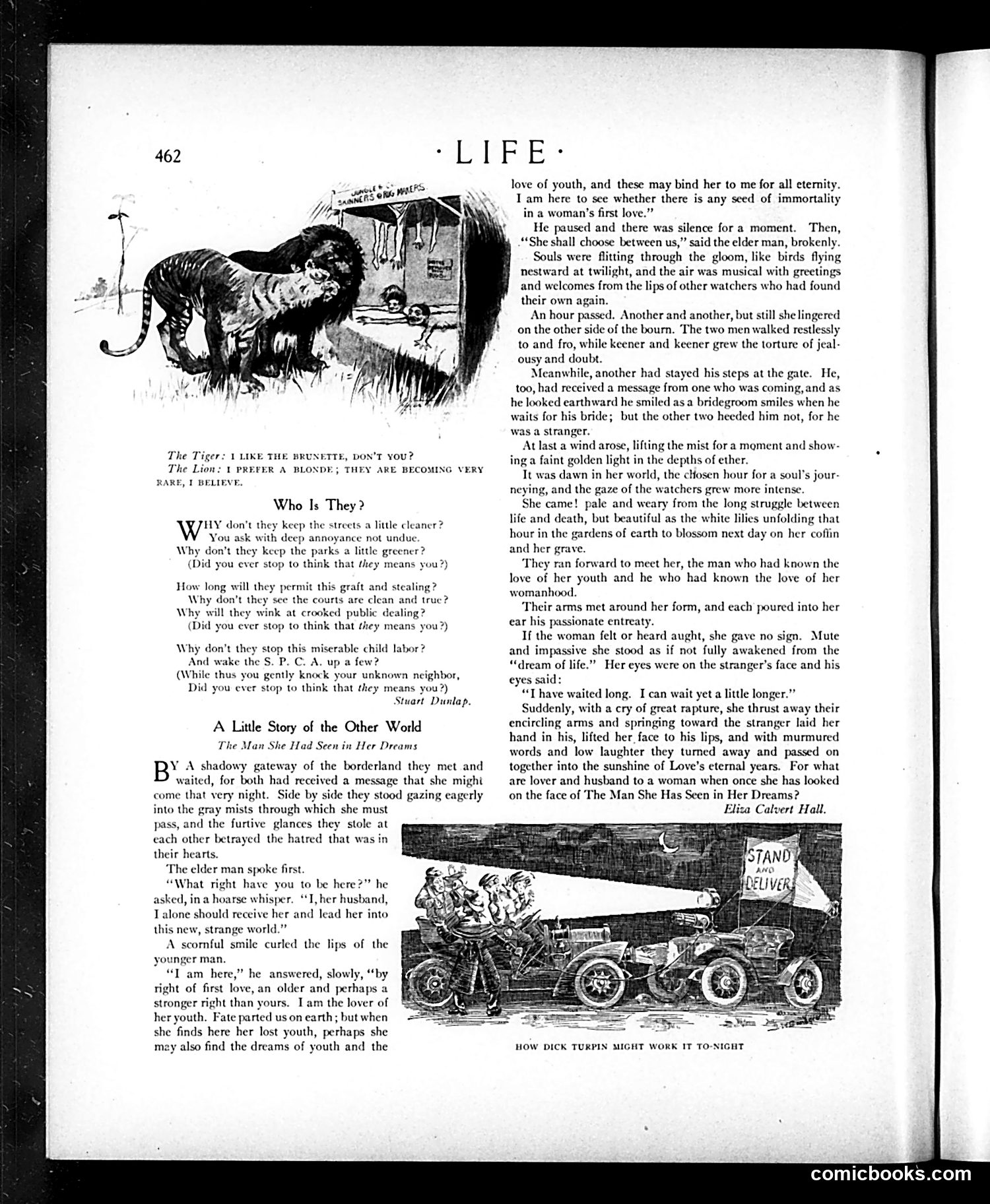
**"Who Is They?"** (left column): This is social satire by Stuart Dunlap attacking civic indifference. The poem asks rhetorical questions about urban problems—dirty streets, graft, child labor—then repeatedly reveals the answer: "they" means *you*, the reader. It's a critique of citizens who complain about social ills while refusing personal responsibility for reform. The message: stop blaming abstract authorities and recognize your own civic duty. **"A Little Story of the Other World"** (right column): A sentimental afterlife narrative by Eliza Calvert Hall about a woman choosing between two suitors in the afterlife—her first love (youth) versus her husband (maturity)—but ultimately selecting a third man she "has seen in her dreams." The illustration showing "How Dick Turpin Might Work It To-Night" appears unrelated advertising content. Both pieces reflect early 20th-century American concerns: civic responsibility and romantic idealism.
📄 Transcribed text from this page (OCR, searchable)
Machine-transcribed from the original scan — historical spelling and the odd misread are preserved.
le hes * "he Lion: 1 PREFER A BLONDE; THEY ARE BECOMING VERY RARE, I BELIEVE. Who Is They ? HY don’t they keep the streets a little cleaner? You ask with deep annoyance not undue Why don’t they keep the parks a little greener? (Did you ever stop to think that diey me How long will they permit this graft and stealing? Why don’t they see the courts are clean and truc? Why will they wink at crooked public dealing? (Did you ever stop to think that they means y Why don’t they stop this miserable child labor? And wake the S. P. C. A. up a few? (While thus you gently knock your unknown neighbor, Did you ever stop to think that dey means you?) Stuart Dunlap. A Little Story of the Other World The Man She Had Seen in Her Dreams Y A shadowy gateway of the borderland they met and waited, for both had received a message that she mighi come that very night. Side by side they stood gazing into the gray mists through which she must pass, and the furtive glances they stole at each other betrayed the hatred that was in their hearts. ‘The elder man spoke first. “What right have you to be here?” he asked, ina hoarse whisper. “I, her husband, Talone should receive her and lead her into this new, strange world.” A scornful smile curled the lips of the younger man. “Tam here,” he answered, slowly, “by right of first love, an older and perhaps a stronger right than yours. Iam the lover of her youth. Fate parted us on earth; but when love of youth, and these may bind her to me for all eternity. I am here to see whether there is any seed of immortality in a woman’s first love.” He paused and there was silence for a moment. Then, “She shall choose between us,” said the elder man, brokenly. Souls were flitting through the gloom, like birds flying nestward at twilight, and the air was musical with greetings and welcomes from the lips of other watchers who had found their own again. An hour passed. Another and another, but still she lingered on the other side of the bourn. The two men walked restlessly to and fro, while keener and keener grew the torture of jeal- ousy and doubt. Meanwhile, another had stayed his steps at the gate. He, too, had received a message from one who was coming, and as he looked earthward he smiled as a bridegroom smiles when he waits for his bride; but the other two heeded him not, for he was a stranger. At last a wind arose, lifting the mist for a moment and show- ing a faint golden light in the depths of ether. It was dawn in her world, the cHosen hour for a soul's jour- neying, and the gaze of the watchers grew more intense. She came! pale and weary from the long struggle between life and death, but beautiful as the white lilies unfolding that hour in the gardens of earth to blossom next day on her cofiin and her grave. They ran forward to mect her, the man who had known the love of her youth and he who had known the love of her womanhood. Their arms met around her form, and each poured into her ear his passionate entreaty. If the woman felt or heard aught, she no sign. Mute and impassive she stood as if not fully awakened from the “dream of life.” Her eyes were on the stranger’s face and his eyes said: “Thave waited long. I can wait yet a little longer.” Suddenly, with a cry of great rapture, she thrust away their encircling arms and springing toward the stranger laid her hand in his, lifted her face to his lips, and with murmured words and low laughter they turned away and passed on together into the sunshine of Love’s eternal years. For what are lover and husband to a woman when once she has looked on the face of The Man She Has Seen in Her Dreams? Eliza Calvert Hall. she finds here her lost youth, perhaps she mey also find the dreams of youth and the HOW DICK TURPIN MIGHT WORK IT TO-NIGHT comicbooks.com