
Life, 1907-10-17 · page 24 of 44
Life — October 17, 1907 — page 24: what you’re looking at
What you’re looking at
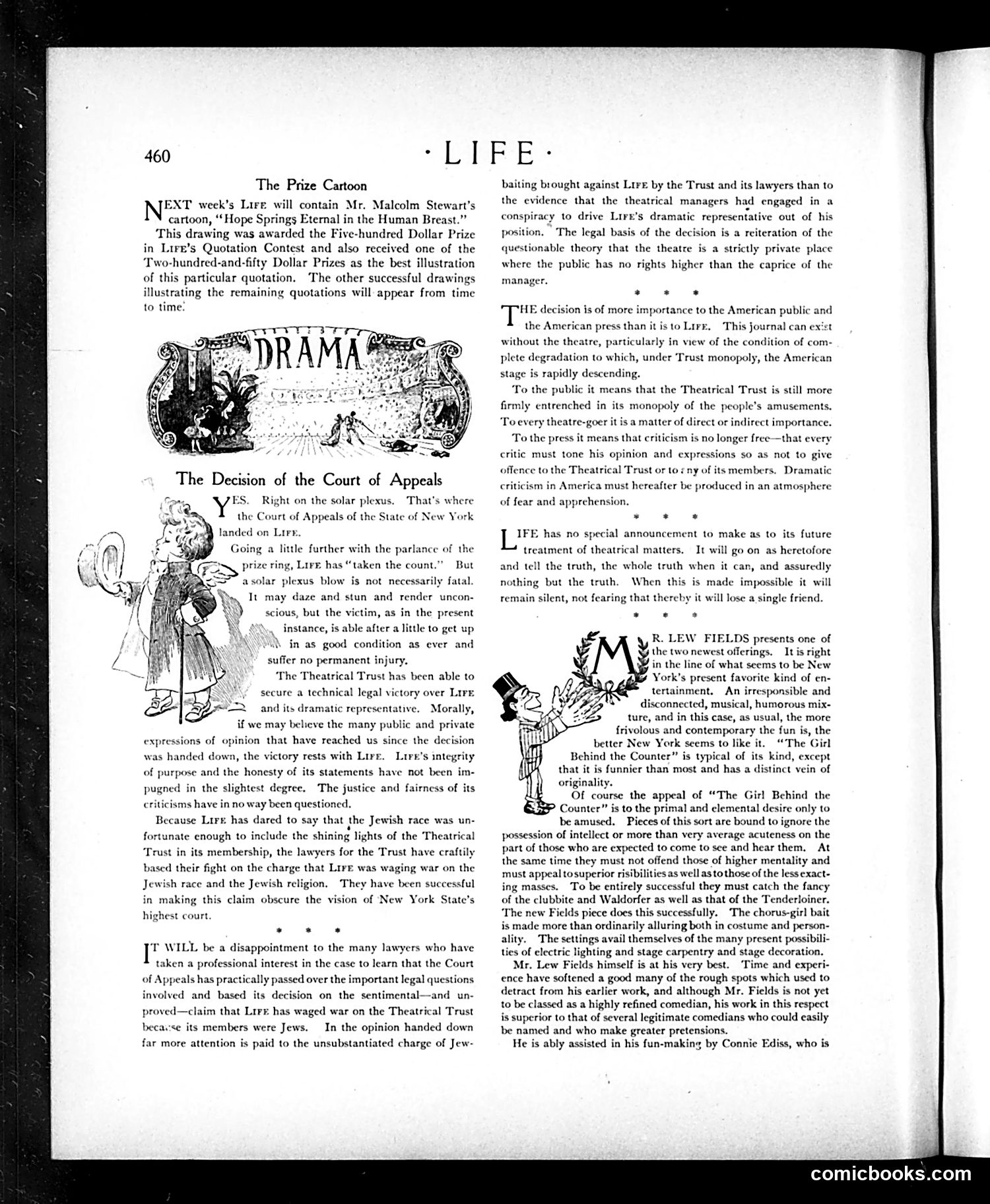
This page documents Life magazine's legal victory against the Theatrical Trust—a powerful monopoly controlling American theater. The cartoon "The Decision of the Court of Appeals" depicts Lady Justice delivering a "solar plexus blow" to Life, using boxing metaphors to describe a court ruling. **The Context:** Life had criticized the Theatrical Trust's leadership, including members of the Jewish faith. The Trust's lawyers countered by accusing Life of antisemitic "Jew-baiting" rather than addressing the substantive conspiracy charges. The Court of Appeals ruled against Life on these emotional grounds, avoiding the actual legal questions about monopolistic practices. **The Point:** Life protests this decision as a threat to press freedom and public interest. The editorial argues the court prioritized defending the Trust's Jewish members over examining evidence of theatrical monopoly abuse. Life asserts it will continue fearless criticism despite this setback—defending both journalistic integrity and the public's right to information about corporate malfeasance. The page also announces Malcolm Stewart's prize-winning cartoon for next week's issue.
📄 Transcribed text from this page (OCR, searchable)
Machine-transcribed from the original scan — historical spelling and the odd misread are preserved.
460 The Prize Cartoon EXT week’s Lire will contain Mr. Malcolm Stewart's cartoon, ‘Hope Springs Eternal in the Human Breast.” This drawing was awarded the Five-hundred Dollar Prize in Ltre’s Quotation Contest and also received one of the ‘Two-hundred-and-fifty Dollar Prizes as the best illustration of this particular quotation. The other successful drawings illustrating the remaining quotations will appear from time to time: The Decision of the Court of Appeals ys Right on the solar plexus, That's where the Court of Appeals of the State of New Y landed on Lire. Going a little further with the parlance of the prize ring, Lire has “taken the count.” But asolar plexus blow is not necessarily fatal It may daze and stun and render uncon- scious, but the victim, as in the present instance, is able after a little to get up ok in as good condition as ever and suffer no permanent injury. ‘The Theatrical Trust has been able to secure a technical legal victory over Lire 2 and its dramatic representative. Morally, if we may believe the many public and private expressions of opinion that have reached us since the decision was handed down, the victory rests with Lire. Lrre’s integrity of purpose and the honesty of its statements have not been im- pugned in the slightest degree. The justice and fairness of its criticisms have in no way been questioned, Because Lirt has dared to say that the Jewish race was un- fortunate enough to include the shining lights of the Theatrical ‘Trust in its membership, the lawyers for the Trust have craftily based their fight on the charge that Lire was waging war on the They hav in making this claim obscure the vision of New York State’s Jewish race and the Jewish religion. been successful highest court. * 2 6 'T WILL be a disappointment to the taken a professional interest in the case to learn that the Court many lawyers who have of Appeals has practically passed over the important legal questions involved and based its decision on the sentimental—and un- proved—claim that Lrre has waged war on the Theatrical Trust becas:se its members were Jews. In the opinion handed down far more attention is paid to the unsubstantiated charge of Jew- + ARE" © baiting brought against Lire. by the Trust and its lawyers than to the evidence that the theatrical managers had engaged in a conspiracy to drive Live's dramatic representative out of his position, The legal basis of the decision is a reiteration of the questionable theory that the theatre is a strictly private place where the public has no rights higher than the caprice of the manager. * 8 * HE decision is of more importance to the American public and the American press than it is to Lire. without the the plete degradation to which, under Trust monopoly, the American ‘This journal can exist particularly in view of the condition of com- stage is rapidly descending. To the public it means that the Theatrical Trust is still more firmly entrenched in its monopoly of the people’s amusements. ‘To every theatre-goer it is a matter of direct or indirect importance. To the press it means that criticism is no longer free—that every critic must tone his opinion and expressions so as not to give offence to the Theatrical Trust or to: ny of its members. Dramatic criticism in America must hereafter be produced in an atmosphere of fear and apprehension, » 6 8 IFE has no special announcement to make as to its future treatment of theatrical matters, and tell the truth, the whole truth when it can, and assuredly It will go on as heretofore nothing but the truth. When this is made impossible it will remain silent, not fearing that thereby it will lose a single friend. 7 8 6 y BLEW FIELDS presents one of the two newest offerings. It is right in the line of what seems to be New York's present favorite kind of en- tertainment. An irresponsible and disconnected, musical, humorous mix- ture, and in this case, as usual, the more frivolous and contemporary the fun is, the better New York scems to like it. “The Girl Behind the Counter” is typical of its kind, except that it is funnier than most and has a distinct vein of originality. Of course the appeal of “The Girl Behind the Counter” is to the primal and clemental desire only to be amused. Pieces of this sort are bound to ignore the possession of intellect or more than very average acuteness on the part of those who are expected to come to see and hear them, At the same time they must not offend those of higher mentality and must appeal tosuperior risibilities as well as to those of the less exact- ing masses. To be entirely successful they must catch the fancy of the clubbite and Waldorfer as well as that of the Tenderloiner. ‘The new Fields piece does this successfully. ‘The chorus-girl bait is made more than ordinarily alluring both in costume and person- ality, ‘The settings avail themselves of the many present possibili- ties of electric lighting and stage carpentry and stage decoration. Mr. Lew Fields himself is at his very best. ‘Time and experi- ence have softened a good many of the rough spots which used to detract from his earlier work, and although Mr. Fields is not yet to be classed as a highly refined comedian, his work in this respect is superior to that of several legitimate comedians who could easily be named and who make greater pretensions. He is ably assisted in his fun-making by Connie Ediss, who is comicbooks.com