
Life, 1907-10-17 · page 32 of 44
Life — October 17, 1907 — page 32: what you’re looking at
What you’re looking at
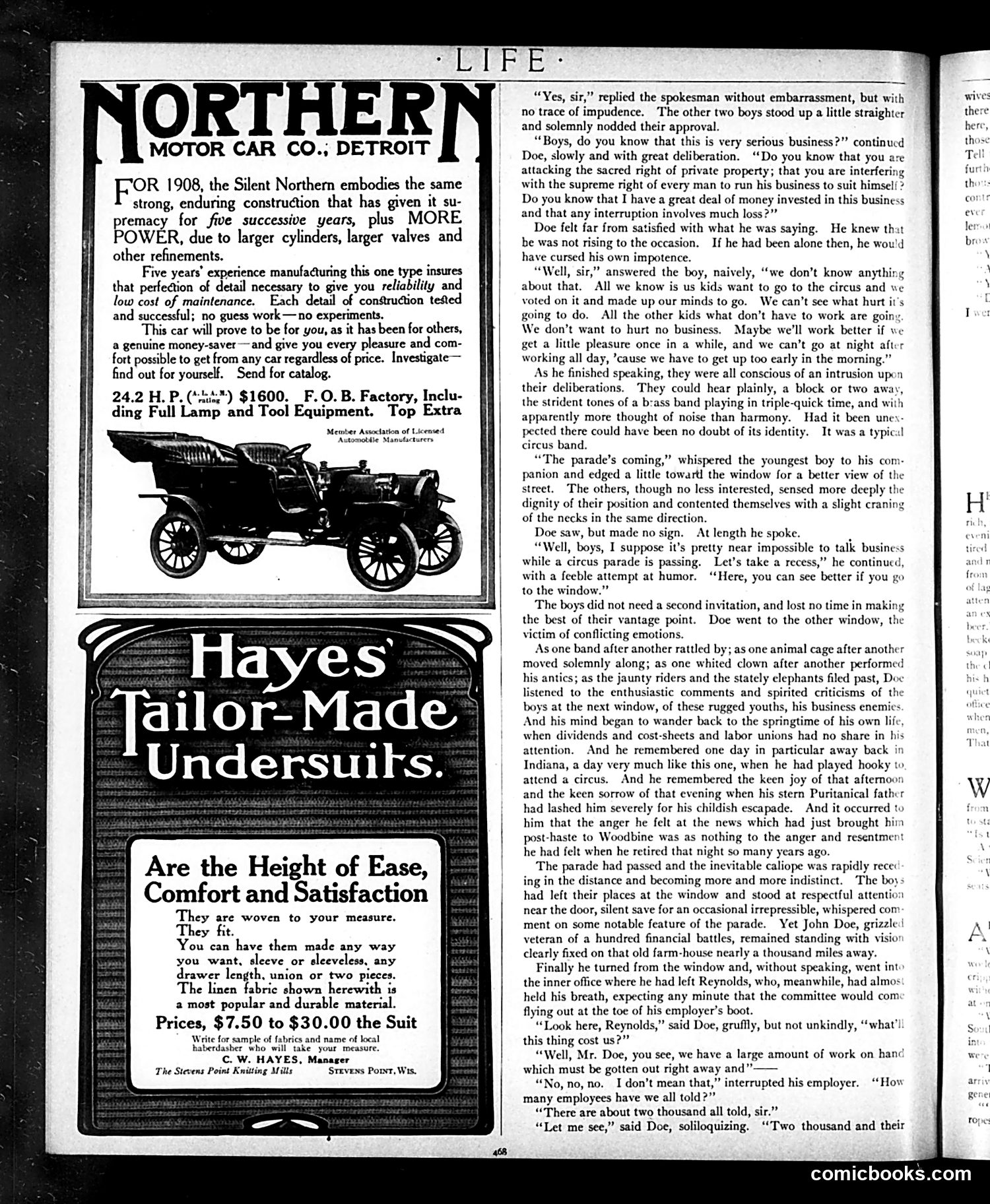
This page contains **two separate advertisements** and the beginning of a **fictional story** about child labor. **The Advertisements:** - Northern Motor Car Company promotes their 1908 automobile, emphasizing reliability and low maintenance costs - Hayes Tailor-Made Undersuits advertises custom-fitted men's underwear ($7.50-$30.00) **The Story:** The narrative depicts a moral conflict between a factory owner (Doe) and three boys who want to leave work to attend a circus parade. The boys argue their case with innocent logic: other children without jobs get to attend, they've voted democratically, and they'll work better after recreation. **The Social Context:** This appears to satirize early-1900s child labor practices and paternalistic employer attitudes. The story presents sympathetic child workers challenging an authority figure's claims about "sacred property rights" and business demands. The approaching circus—audible but unseen—represents temptation and the normal childhood pleasures these working children are denied. The satire lies in the boys' rational arguments exposing the hollowness of the employer's justifications for denying them basic human recreation.
📄 Transcribed text from this page (OCR, searchable)
Machine-transcribed from the original scan — historical spelling and the odd misread are preserved.
MOTOR CAR CO.; DETROIT ‘OR 1908, the Silent Northern embodies the same strong, enduring construction that has given it su- remacy for five successive years, plus MORE OWER, due to larger cylinders, larger valves and other refinements. Five years’ experience manufacturing this one type insures that perfection of detail necessary to give you reliability and low cost of maintenance. Each detail of construction tefted and successful; no guess work—no experiments. This car will prove to be for you, as it has been for others, a genuine money-saver —and give you every pleasure and com- fort possible to get from any car regardless of price. Investigate— find out for yourself. Send for catalog. 24.2 H.P. (“it:") $1600. F.O.B. Factory, Inclu- ding Full Lamp and Tool Equipment. Top Extra Member Assoclation of Licensed ‘Automobile Manufacturers / \e ) ailor-Made Undersulfs. © if { | | | Are the Height of Ease, Comfort and Satisfaction They are woven to your measure. They fit. You can have them made any way you want, sleeve or sleeveless, any drawer length, union or two pieces. The linen fabric shown herewith is a most popular and durable material. Prices, $7.50 to $30.00 the Suit Write for sample of fabrics and name of local haberdasber who will take your measure. Cc. W. HAYES, Manager The Stevens Point Knitting Mills ‘Stevens Porst, Wis. “Yes, sir,” replied the spokesman without embarrassment, but with no trace of impudence. The other two boys stood up a little straighter and solemnly nodded their approval. “Boys, do you know that this is very serious business?” continued Doe, slowly and with great deliberation. ‘Do you know that you are attacking the sacred right of private property; that you are interfering with the supreme right of every man to run his business to suit himself? Do you know that I have a great deal of money invested in this business and that any interruption involves much loss?” Doe felt far from satisfied with what he was saying. He knew that be was not rising to the occasion. If he had been alone then, he wou!d have cursed his own impotence. “Well, sir,” answered the boy, naively, ‘we don’t know anything about that. All we know is us kids want to go to the circus and we voted on it and made up our minds to go. We can’t sce what hurt going to do. All the other kids what don’t have to work are goiny. We don’t want to hurt no business. Maybe we'll work better if we get a little pleasure once in a while, and we can’t go at night after working all day, ’cause we have to get up too early in the morning.” As he finished speaking, they were all conscious of an intrusion upon their deliberations. They could hear plainly, a block or two away, the strident tones of a b:ass band playing in triple-quick time, and wit apparently more thought of noise than harmony. Had it been unes- pected there could have been no doubt of its identity. It was a typic:! circus band. “The parade’s coming,” whispered the youngest boy to his com: panion and edged a little towartl the window for a better view of th street. The others, though no less interested, sensed more deeply th dignity of their position and contented themselves with a slight craning of the necks in the same direction. Doe saw, but made no sign. At length he spoke. . “Well, boys, I suppose it’s pretty near impossible to talk business while a circus parade is passing. Let’s take a recess,” he continued, with a feeble attempt at humor. “Here, you can see better if you go to the window.” The boys did not need a second invitation, and lost no time in making the best of their vantage point. Doe went to the other window, the victim of conflicting emotions. As one band after another rattled by; as one animal cage after another moved solemnly along; as one whited clown after another performed his antics; as the jaunty riders and the stately hants filed past, Doe listened to the enthusiastic comments and spirited criticisms of th boys at the next window, of these rugged youths, his business enemies. And his mind began to wander back to the springtime of his own life when dividends and cost-sheets and labor unions had no share in his attention. And he remembered one day in particular away back in Indiana, a day very much like this one, when he had played hooky to attend a circus. And he remembered the keen joy of that afternoon and the keen sorrow of that evening when his stern Puritanical father had lashed him severely for his childish escapade. And it occurred to him that the anger he felt at the news which had just brought hii post-haste to Woodbine was as nothing to the anger and resentment he had felt when he retired that night so many years ago. ‘The parade had passed and the inevitable caliope was rapidly rece: ing in the distance and becoming more and more indistinct. The boys had left their places at the window and stood at respectful attention near the door, silent save for an occasional irrepressible, whispered com ment on some notable feature of the parade. Yet John Doe, grizzle:! veteran of a hundred financial battles, remained standing with visio: clearly fixed on that old farm-house nearly a thousand miles away. Finally he turned from the window and, without speaking, went int the inner office where he had left Reynolds, who, meanwhile, had almos held his breath, expecting any minute that the committee would com flying out at the toe of his employer’s boot. “Look here, Reynolds,” said Doe, grufily, but not unkindly, “what’!! this thing cost us?” “Well, Mr. Doe, you see, we have a large amount of work on hanc which must be gotten out right away and’”’7—— “No, no, no. I don’t mean that,” interrupted his employer. “How many employees have we all told?” “There are about two thousand all told, sir.” “Let me see,” said Doe, soliloquizing. ‘‘Two thousand and their comicbooks.com