
Life, 1907-10-17 · page 20 of 44
Life — October 17, 1907 — page 20: what you’re looking at
What you’re looking at
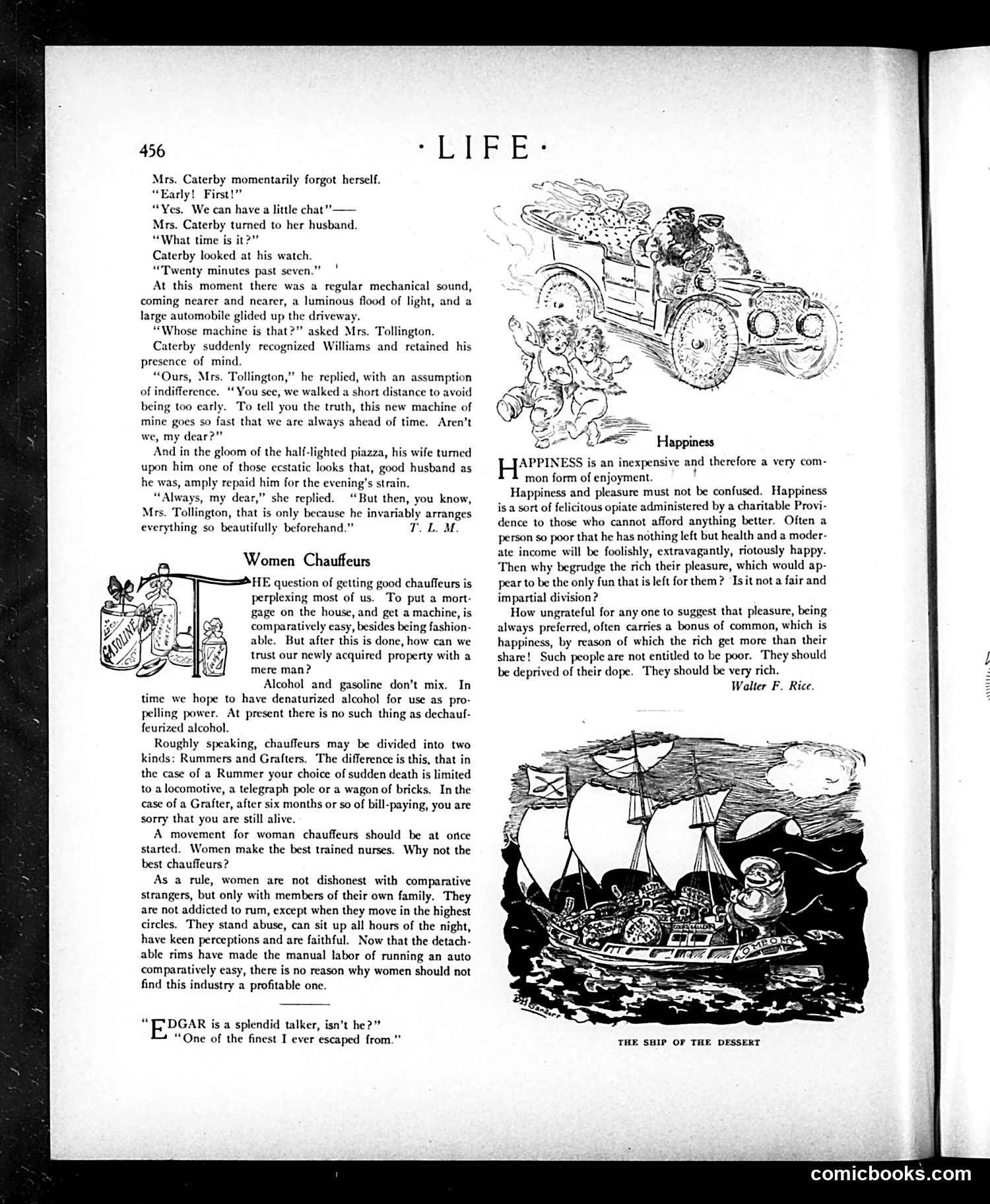
**The Main Cartoon Story** (top): A husband (Caterby) is caught in an embarrassing lie when an automobile suddenly arrives at his home during a visit from the Tollingtons. He'd claimed he and his wife walked to avoid arriving too early, but the car is obviously theirs. He quickly improvises that the automobile is his and that it's so fast they're always ahead of schedule. His wife plays along perfectly. **The Satire**: This mocks the early automobile era's status anxiety—owning a car was fashionable and expensive, making people eager to display it, yet also creating awkward social situations where one might need to explain automotive behavior or ownership. **"Women Chauffeurs" Essay**: A humorous argument advocating women as automobile drivers, contrasting them favorably to male chauffeurs (divided into "Rummers"—drunkards causing accidental deaths—and "Grafters"—embezzlers). The piece sardonically suggests women are naturally suited: honest, hardworking, and now that manual labor is reduced, perfectly capable. **The Philosophy Section** on "Happiness": Argues that happiness (contentment) differs from pleasure, and that the poor enjoy happiness while the rich enjoy only pleasure—suggesting an ironic social critique about wealth and satisfaction.
📄 Transcribed text from this page (OCR, searchable)
Machine-transcribed from the original scan — historical spelling and the odd misread are preserved.
456 Mrs. Caterby momentarily forgot herself. “Early! First!” “Yes. We can have a little chat’—— Mrs. Caterby turned to her husband. “What time is it?” Caterby looked at his watch. “Twenty minutes past se’ At this moment there was a regular mechanical sound, coming nearer and nearer, a luminous flood of light, and a large automobile glided up the driveway. “Whose machine is that?” asked Mrs. Tollington. Caterby suddenly recognized Williams and retained his presence of mind. “Ours, Mrs. Tollington,” he replied, with an assumption of indifference. “You see, we walked a short distance to avoid being too carly. To tell you the truth, this new machine of mine goes so fast that we are always ahead of time. Aren’t we, my dear?” And in the gloom of the half-lighted piazza, his wife tumed upon him one of those ecstatic looks that, good husband as he was, amply repaid him for the evening’s strain. “Always, my dear,” she replied. “But then, you know, Mrs. Tollington, that is only because he invariably arranges everything so beautifully beforehand.” T. Mf. Women Chauffeurs HE question of getting good chauffeurs is perplexing most of us. To put a mort- gage on the house, and get a machine, is comparatively easy, besides being fashion- able, But after this is done, how can we trust our newly acquired property with a mere man? Alcohol and gasoline don’t mix. In time we hope to have denaturized alcohol for use as pro- pelling power. At present there is no such thing as dechauf- feurized alcohol. Roughly speaking, chauffeurs may be divided into two kinds: Rummers and Grafters. The difference is this, that in the case of a Rummer your choice of sudden death is limited to a locomotive, a telegraph pole or a wagon of bricks. In the case of a Grafter, after six months or so of bill-paying, you are sorry that you are still alive. A movement for woman chauffeurs should be at orice started. Women make the best trained nurses. Why not the best chauffeurs? As a rule, women are not dishonest with comparative strangers, but only with members of their own family. They are not addicted to rum, except when they move in the highest circles. They stand abuse, can sit up all hours of the night, have keen perceptions and are faithful. Now that the detach- able rims have made the manual labor of running an auto comparatively easy, there is no reason why women should not find this industry a profitable one. “EDGAR is a splendid talker, isn’t he?” “One of the finest I ever escaped from.” APPINESS is an inexpensive and therefore a very com- mon form of enjoyment. ! Happiness and pleasure must not be confused. Happiness is a sort of felicitous opiate administered by a charitable Provi- dence to those who cannot afford anything better. Often a person so poor that he has nothing left but health and a moder- ate income will be foolishly, extravagantly, riotously happy. Then why begrudge the rich their pleasure, which would ap- pear to be the only fun that is left for them? ‘Isit not a fair and impartial division? How ungrateful for any one to suggest that pleasure, being always preferred, often carries a bonus of common, which is happiness, by reason of which the rich get more than their share! Such people are not entitled to be poor. They should be deprived of their dope. They should be very rich, Walter F. Rice. THE SHIP OF THE DESSERT comicbooks.com