
Life, 1907-10-17 · page 19 of 44
Life — October 17, 1907 — page 19: what you’re looking at
What you’re looking at
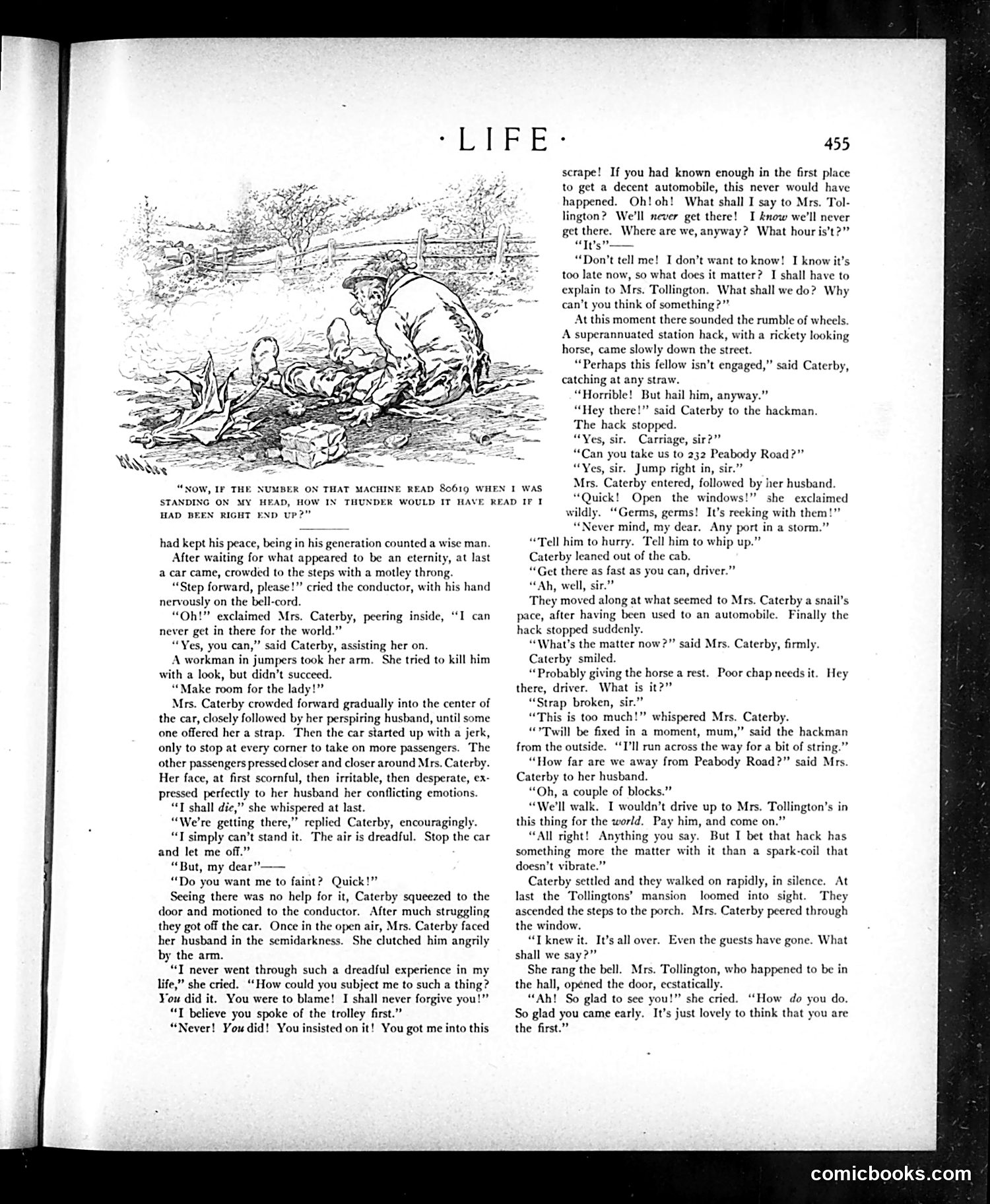
This page satirizes the anxieties of early 20th-century urban travel through Mrs. Caterby's increasingly hysterical journey. After insisting on taking a crowded trolley car (against her husband's preference), she experiences claustrophobia, germs, and delays—then blames him entirely. When they abandon the trolley for an old-fashioned horse-drawn hack, she discovers it's slower and equally problematic (broken strap). The humor lies in her contradiction: she despises modern mass transit's crowding yet nostalgic transportation's incompetence, while remaining oblivious to her own role in the disaster. The cartoon (top left) illustrates their trolley predicament. The satire targets upper-class women's expectations of comfort and their tendency to shift blame—a common Life magazine theme mocking both new technology's growing pains and changing social dynamics.
📄 Transcribed text from this page (OCR, searchable)
Machine-transcribed from the original scan — historical spelling and the odd misread are preserved.
“ESTEE * 455 HAD BEEN RIGHT END UP?” had kept his peace, being in his generation counted a wise man. After waiting for what appeared to be an eternity, at last a car came, crowded to the steps with a motley throng. “Step forward, please!” cried the conductor, with his hand nervously on the bell-cord. “Oh!” exclaimed Mrs. Caterby, peering inside, “I can never get in there for the world.” “Yes, you can,” said Caterby, assisting her on. A workman in jumpers took her arm. She tried to kill him with a look, but didn’t succeed. “Make room for the lady!” Mrs. Caterby crowded forward gradually into the center of the car, closely followed by her perspiring husband, until some one offered her a strap. Then the car started up with a jerk, only to stop at every corner to take on more passengers. The other passengers pressed closer and closer around Mrs. Caterby. Her face, at first scornful, then irritable, then desperate, ex- pressed perfectly to her husband her conflicting emotions. “T shall die,” she whispered at last. “We're getting there,” replied Caterby, encouragingly. “T simply can’t stand it. The air is dreadful. Stop the car and let me off.” “But, my dear”—— “Do you want me to faint? Quick!” Seeing there was no help for it, Caterby squeezed to the door and motioned to the conductor. After much struggling they got off the car. Once in the open air, Mrs. Caterby faced her husband in the semidarkness. She clutched him angrily by the arm. “I never went through such a dreadful experience in my life,” she cried. ‘How could you subject me to such a thing? You did it. You were to blame! I shall never forgive you!” “T believe you spoke of the trolley first.” “Never! You did! You insisted on it! You got me into this NOW, IF THE NUMBER ON THAT MACHINE READ 80619 WHEN I WAS ING ON MY HEAD, HOW IN THUNDER WOULD IT HAVE READ IF I scrape! If you had known enough in the first place to get a decent automobile, this never would have happened. Oh! oh! What shall I say to Mrs. Tol- lington? We'll never get there! I know we'll never get there. Where are we, anyway? What hour is’t?”” “It's” — “Don’t tell me! I don’t want to know! I know it’s too late now, so what does it matter? I shall have to explain to Mrs. Tollington. What shall we do? Why can’t you think of something?” At this moment there sounded the rumble of wheels. A superannuated station hack, with a rickety looking horse, came slowly down the street. “Perhaps this fellow isn’t engaged,” said Caterby, catchii “Horrible! But hail him, anyway.” “Hey there!” said Caterby to the hackman. The hack stopped. “Yes, sir. Carriage, sir?” “Can you take us to 232 Peabody Road?” “Yes, sir. Jump right in, sir.” Mrs. Caterby entered, followed by her husband. “Quick! Open the windows!’” she exclaimed wildly. ‘Germs, germs! It’s reeking with them!” “Never mind, my dear. Any port in a storm.” Tell him to hurry. Tell him to whip up.” Caterby leaned out of the cab. “Get there as fast as you can, driver.” “Ah, well, sir.” They moved along at what seemed to Mrs. Caterby a snail's pace, after having been used to an automobile. Finally the hack stopped suddenly. “What's the matter now?” said Mrs. Caterby, firmly. Caterby smiled. “Probably giving the horse a rest. Poor chap needs it. Hey there, driver. What is it?” “Strap broken, sir.” “This is too much!” whispered Mrs. Caterby. ‘Twill be fixed in a moment, mum,” said the hackman from the outside. “T’ll run across the way for a bit of string.” “How far are we away from Peabody Road?” said Mrs. Caterby to her husband. “Oh, a couple of blocks.” “We'll walk. I wouldn’t drive up to Mrs. Tollington’s in this thing for the world. Pay him, and come on.” “All right! Anything you say. But I bet that hack has something more the matter with it than a spark-coil that doesn’t vibrate.” Caterby settled and they walked on rapidly, in silence. At last the Tollingtons’ mansion loomed into sight. They ascended the steps to the porch. Mrs. Caterby peered through the window. “T knew it. It’s all over. Even the guests have gone. What shall we say?” She rang the bell. Mrs. Tollington, who happened to be in the hall, opened the door, ecstatically. “Ah! So glad to see you!” she cried. “How do you do. So glad you came early. It’s just lovely to think that you are the first.” comicbooks.com