
Life, 1907-10-17 · page 18 of 44
Life — October 17, 1907 — page 18: what you’re looking at
What you’re looking at
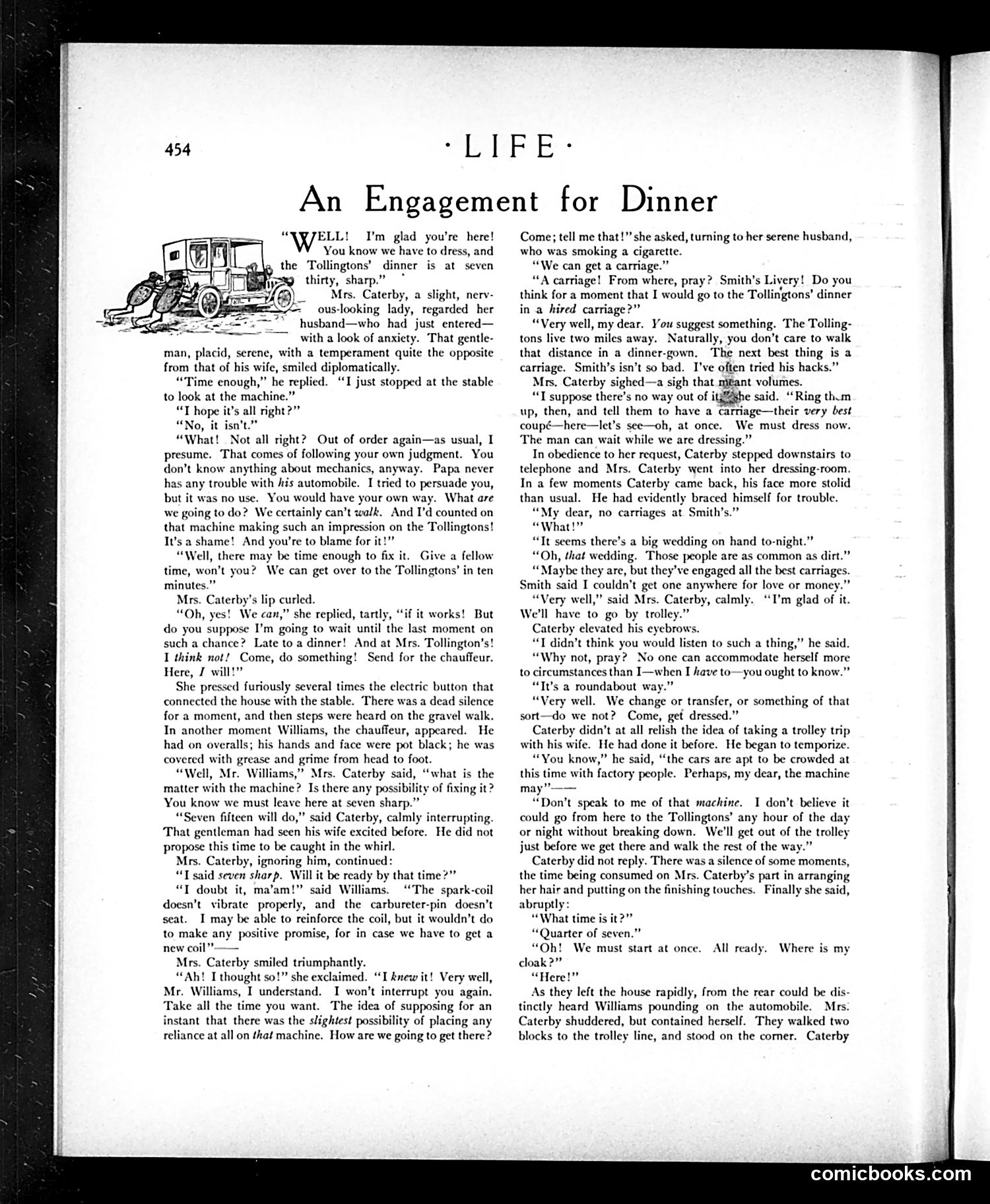
This satirical story mocks the anxieties of early 1900s upper-middle-class social life. Mrs. Caterby frets obsessively about attending a dinner party at the prestigious Tollingtons' home, while her placid husband remains unruffled. The humor centers on **automobile anxiety**: the newly-fashionable automobile breaks down (a common occurrence), forcing them to resort to hiring a carriage—deeply embarrassing to Mrs. Caterby, who views it as socially degrading. Her status anxiety is exposed as she panics over appearances, while her husband's calm acceptance suggests the absurdity of her concerns. The greasy chauffeur Williams, covered in grease and grime, represents the messy reality of early car ownership—these unreliable machines required constant mechanical attention. The satire critiques how the newly wealthy flaunt their automobiles as status symbols, only to be humiliated when mechanical failure forces them back to "common" transportation.
📄 Transcribed text from this page (OCR, searchable)
Machine-transcribed from the original scan — historical spelling and the odd misread are preserved.
EFPE An Engagement for Dinner ELL! I’m glad you're here! You know we have to dress, and the Tollingtons’ dinner is at seven xg thirty, sharp.” ee Mrs. Caterby, a slight, nerv- aN ous-looking lady, regarded her husband—who had just entered— with a look of anxiety. That gentle- man, placid, serene, with a temperament quite the opposite from that of his wife, smiled diplomatically. “Time enough,” he replied. “I just stopped at the stable to look at the machine.” “T hope it’s all right?” “No, it isn “What! Not all right? Out of order again—as usual, I presume. That comes of following your own judgment. You don’t know anything about mechanics, anyway. Papa never has any trouble with his automobile. I tried to persuade you, but it was no use. You would have your own way. What are we going to do? We certainly can’t walk. And I'd counted on that machine making such an impression on the Tollingtons! It’s a shame! And you're to blame for it “Well, there may be time enough to fix Give a fellow time, won’t you? We can get over to the Tollingtons’ in ten minutes.” Mrs. Caterby’s lip curled. s can,” she replied, tartly, “if it works! But do you suppose I’m going to wait until the last moment on such a chance? Late to a dinner! And at Mrs. Tollington’s! I think not! Come, do something! Send for the chauffeur. Here, J will!” She pressed furiously several times the electric button that connected the house with the stable. There was a dead silence for a moment, and then steps were heard on the gravel walk. In another moment Williams, the chauffeur, appeared. He had on overalls; his hands and face were pot black; he was covered with grease and grime from head to foot. “Well, Mr. Williams,” Mrs. Caterby said, “what is the matter with the machine? Is there any possibility of fixing it? You know we must leave here at seven sharp.” “Seven fifteen will do,” said Caterby, calmly interrupting. That gentleman had seen his wife excited before. He did not propose this time to be caught in the whirl. Mrs. Caterby, ignoring him, continued: “T said seven sharp. Will it be ready by that time?” “T doubt it, ma’am!” said Williams. “The spark-coil doesn’t vibrate properly, and the carbureter-pin doesn’t seat. I may be able to reinforce the coil, but it wouldn’t do to make any positive promise, for in case we have to get a new coil” —— Mrs. Caterby smiled triumphantly. “Ah! [thought so!” she exclaimed. “I knew it! Very well, Mr. Williams, I understand. I won’t interrupt you again. Take all the time you want. The idea of supposing for an instant that there was the slightest possibility of placing any reliance at all on that machine. How are we going to get there? Come; tell me that!” she asked, turning to her serene husband, who was smoking a cigarette. “We can get a carriage.” “A carriage! From where, pray? Smith's Livery! Do you think for a moment that I would go to the Tollingtons’ dinner in a hired carriage?” “Very well, my dear. You suggest something. The Tolling- tons live two miles away. Naturally, you don’t care to walk that distance in a dinner-gown, The next best thing is a carriage. Smith’s isn’t so bad. I've often tried his hacks.” Mrs. Caterby sighed—a sigh that migant volumes. “T suppose there’s no way out of ingishe said. “Ring thm up, then, and tell them to have a carriage—their very best coupé—here—let’s see—oh, at once. We must dress now. The man can wait while we are dressing.” In obedience to her request, Caterby stepped downstairs to telephone and Mrs. Caterby went into her dressing-room. In a few moments Caterby came back, his face more stolid than usual. He had evidently braced himself for trouble. “My dear, no carriages at Smith’s.” “What!” “Tt seems there’s a big wedding on hand to-night.” “Oh, that wedding. Those people are as common as dirt.” “Maybe they are, but they’ve engaged all the best carriages. Smith said I couldn't get one anywhere for love or money.” “Very well,” said Mrs. Caterby, calmly. ‘I’m glad of it. We'll have to go by trolley. Caterby elevated his eyebrows. “T didn’t think you would listen to such a thing,” he said. “Why not, pray? No one can accommodate herself more to circumstances than I—when I have to—you ought to know.” “Tt’s a roundabout way.” “Very well. We change or transfer, or something of that sort—do we not? Come, get dressed.” Caterby didn’t at all relish the idea of taking a trolley trip with his w He had done it before. He began to temporize. “You know,” he said, “the cars are apt to be crowded at this time with factory people. Perhaps, my dear, the machine may”—— “Don’t speak to me of that machine. I don’t believe it could go from here to the Tollingtons’ any hour of the day or night without breaking down. We'll get out of the trolley just before we get there and walk the rest of the way.” Caterby did not reply. There was a silence of some moments, the time being consumed on Mrs. Caterby’s part in arranging her hair and putting on the finishing touches. Finally she said, abruptly: “What time is it?” “Quarter of seven.” “Oh! We must start at once cloak ?”” “Here!” As they left the house rapidly, from the rear could be dis- tinctly heard Williams pounding on the automobile. Mrs: Caterby shuddered, but contained herself. They walked two blocks to the trolley line, and stood on the corner. Caterby All ready. Where is my comicbooks.com