
Life, 1907-10-17 · page 28 of 44
Life — October 17, 1907 — page 28: what you’re looking at
What you’re looking at
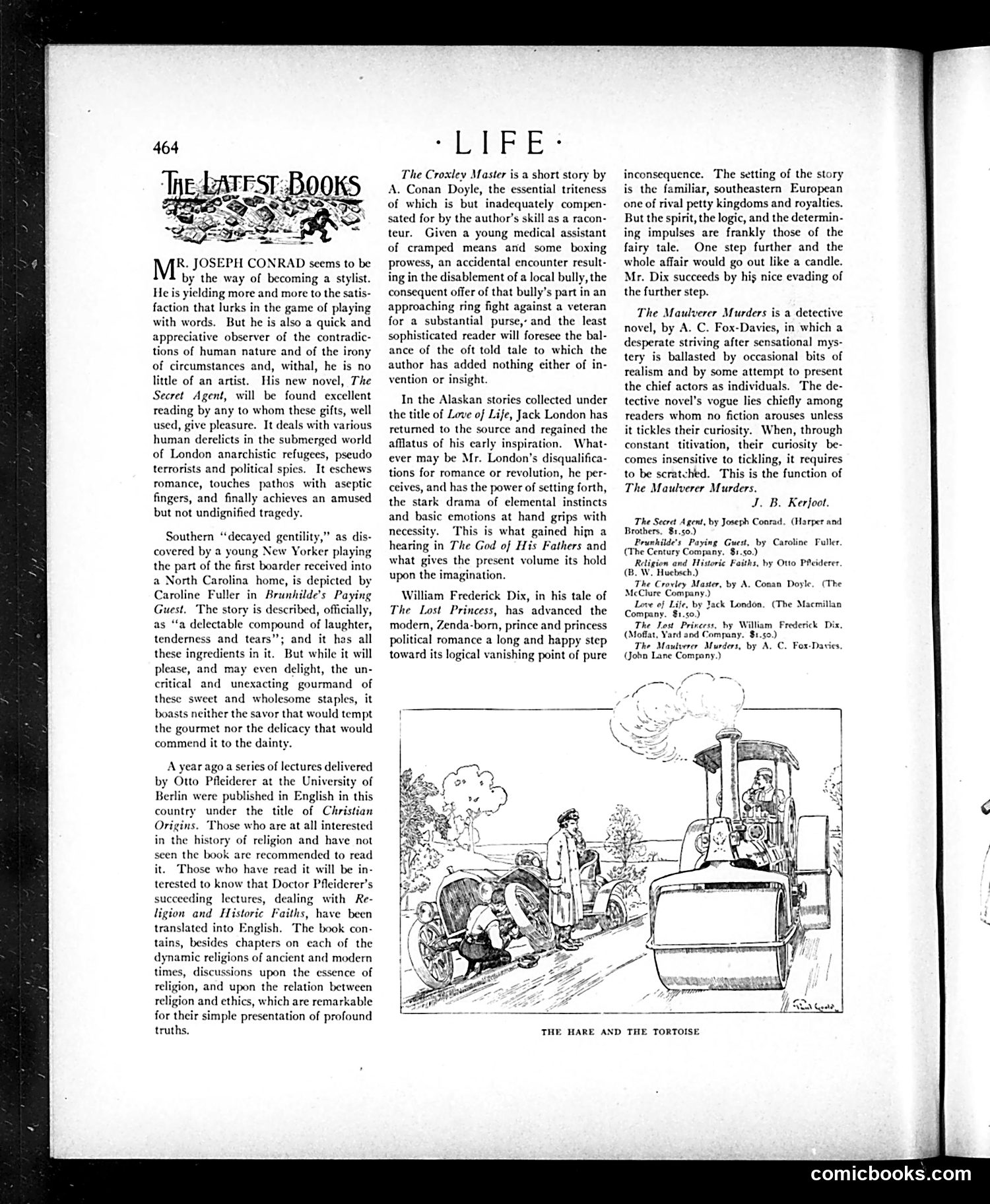
This page is primarily a book review section from *Life* magazine. The single cartoon at the bottom illustrates Aesop's fable "The Hare and the Tortoise"—a timeless moral tale about slow-and-steady perseverance defeating overconfident speed. The image shows a modern motorcar (appearing to represent the hare's speed/arrogance) encountering a tortoise on a country road. The joke updates the ancient fable to the early 20th century by replacing the original foot race with automotive technology—the modern "hare" relies on a mechanical advantage, yet the tortoise remains unmoved, suggesting that no amount of technological progress can overcome fundamental truths about character and effort. The cartoon likely serves as a visual counterpoint to the surrounding book reviews, perhaps ironically commenting on literary trends or human nature—themes central to the reviewed novels by Conrad, London, and others discussed on this page.
📄 Transcribed text from this page (OCR, searchable)
Machine-transcribed from the original scan — historical spelling and the odd misread are preserved.
ME: JOSEPH CONRAD seems to be by the way of becoming a stylist He is yielding more and more to the sati: faction that lurks in the game of playing with words. But he is also a quick and appreciative observer of the contradic- tions of human nature and of the irony of circumstances and, withal, he is no little of an artist. His new novel, The Secret Agent, will be found excellent reading by any to whom these gifts, well used, give pleasure. It deals with various human derelicts in the submerged world of London anarchistic refugees, pseudo terrorists and political spies. It eschews romance, touches pathos with aseptic fingers, and finally achieves an amused but not undignified tragedy. Southern “decayed gentility,” as dis- covered by a young New Yorker playing the part of the first boarder received into a North Carolina home, is depicted by Caroline Fuller in Brunhilde’s Paying Guest, The story is described, officially, as “a delectable compound of laughter, tenderness and tears”; and it has all these ingredients in it. But while it will please, and may even delight, the un- critical and unexacting gourmand of these sweet and wholesome staples, it boasts neither the savor that would tempt the gourmet nor the delicacy that would commend it to the dainty. A year ago a series of lectures delivered by Otto Pfleiderer at the University of Berlin were published in English in this country under the title of Christian Origins. Those who are at all interested in the history of religion and have not seen the book are recommended to read it. Those who have read it will be in- terested to know that Doctor Pfleiderer’s succeeding lectures, dealing with Re- ligion and Historic Faiths, have been translated into English. The book con- son cach of the ynamic religions of ancient and modern times, discussions upon the essence of religion, and upon the relation between religion and ethics, which are remarkable for their simple presentation of profound truths. SSE Es The Croxley Master is a short story by A. Conan Doyle, the essential triteness of which is but inadequately compen- sated for by the author’s skill as a racon- teur. Given a young medical assistant of cramped means and some boxing prowess, an accidental encounter result- ing in the disablement of a local bully, the consequent offer of that bully’s part in an approaching ring fight against a veteran for a substantial purse, and the least sophisticated reader will foresee the bal- ance of the oft told tale to which the author has added nothing cither of in- vention or insight. In the Alaskan stories collected under the title of Love of Life, Jack London has retumed to the source and regained the afflatus of his carly inspiration. What- ever may be Mr. London's disqualifica- tions for romance or revolution, he per- ceives, and has the power of setting forth, the stark drama of elemental instincts and basic emotions at hand grips with necessity. This is what gained him a hearing in The God of His Fathers and what gives the present volume its hold upon the imagination. William Frederick Dix, in his tale of The Lost Princess, has advanced the modern, Zenda-born, prince and princess political romance a long and happy step toward its logical vanishing point of pure inconsequence. The setting of the story is the familiar, southeastern European one of rival petty kingdoms and royalties. But the spirit, the logic, and the determin- ing impulses are frankly those of the fairy tale. One step further and the whole affair would go out like a candle. Mr. Dix succeeds by his nice evading of the further step. The Maulverer Murders is a detective novel, by A. C. Fox-Davies, in which a desperate striving after sensational mys- tery is ballasted by occasional bits of realism and by some attempt to present the chief actors as individuals. The de- tective novel’s vogue lies chiefly among readers whom no fiction arouses unless it tickles their curiosity. When, through constant titivation, their curiosity be- comes insensitive to tickling, it requires to be scratched. This is the function of The Maulverer Murders. J. B. Kerjoot. The Secret Agent, by Joseph Conrad, (Harper and Brothers. $1.50.) Prunhilde’s Paying Guest, by Caroline Fuller. (The Century Company, $1.50.) Religion and Historic Faiths, by Otto Pfeiderer. (B. W. Huebsch.) The Crovley Master, by A. Conan Doyle. McClure Company.) Love of Life, by Jack London. (The Macmillan Company. $1.50.) The Jost Princess, by William Frederick Dix, (Moffat, Yard and Company. $1.50.) The Mautverer Murders, by A. C. Fox-Davies. (ohn Lane Company.) (The THE HARE AND THE TORTOISE comicbooks.com