
Life, 1907-10-17 · page 14 of 44
Life — October 17, 1907 — page 14: what you’re looking at
What you’re looking at
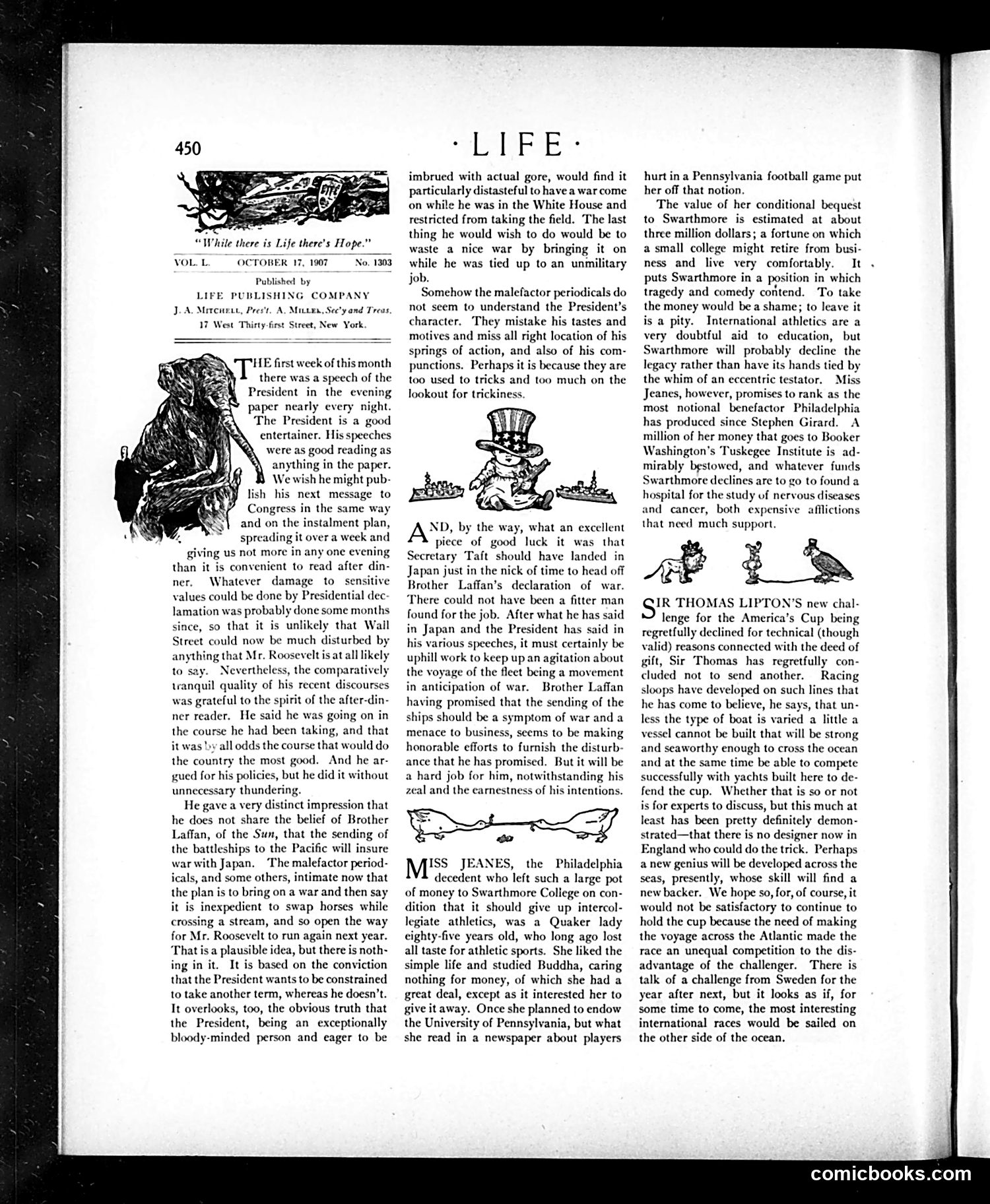
This page lampoons President Theodore Roosevelt and press critics of his administration. The main editorial mocks "malefactor periodicals"—hostile newspapers like the Sun (run by "Brother Laffan")—that falsely claim Roosevelt is manufacturing a war with Japan as political cover to seek another term. Life's editor argues this misreads Roosevelt's character: he's actually too eager for real military action to waste a genuine war opportunity while confined to the presidency. The piece defends Secretary of War William Howard Taft's diplomatic mission to Japan as successfully defusing warmongering rhetoric. The editorial portrays Roosevelt as straightforward and warlike (sarcastically: "exceptionally bloody-minded"), not duplicitously scheming—thus the newspapers' conspiracy theories about the Pacific Fleet's voyage miss the mark. A separate brief notes Miss Jeanes, a wealthy Philadelphia Quaker philanthropist, whose bequest to Swarthmore College required eliminating intercollegiate athletics. Life finds irony in her Quaker asceticism ending the university's sports programs.
📄 Transcribed text from this page (OCR, searchable)
Machine-transcribed from the original scan — historical spelling and the odd misread are preserved.
“While there is Life there’s Hope.” VOL. L. OCTOBER 17, 1907 No. 1303 Published by LIFE PUBLISHING J. A. Mircwent, Pres, AM 17 West Thirty-first S COMPANY HE first week of this month there was a speech of the President in the evening paper nearly every night. ident is a good entertainer. His speeches were as good reading as anything in the paper. We wish he might pub- lish his next message to Congress in the same way and on the instalment plan, spreading it over a week and giving us not more in any one evening than it is convenient to read after din- ner, Whatever damage to sensitive values could be done by Presidential dec lamation was probably done some months since, so that it is unlikely that Wi Street could now be much disturbed by anything that Mr. Roosevelt isat all likely to Nevertheless, the comparatively tranquil quality of his recent discourses was grateful to the spirit of the after-din- ner reader. He said he was going on in the course he had been taking, and that it was by all odds the course that would do the country the most good. And he ar- gued for his policies, but he did it without unnecessary thundering. He gave a very distinct impression that he does not share the belief of Brother Laffan, of the Sun, that the sending of the battleships to the Pacific will insure war with Japan. ‘The malefactor period- icals, and some others, intimate now that the plan is to bring on a war and then say it is inexpedient to swap horses while crossing a stream, and so open the way for Mr. Roosevelt to run again next year. ‘That is a plausible idea, but there is noth- ing in it. It is based on the conviction that the President wants to be constrained to take another term, whereas he doesn’t. It overlooks, too, the obvious truth that the President, being an exceptionally bloody-minded person and eager to be geal leh) imbrued with actual gore, would find it particularly distasteful to have a war come on while he was in the White House and restricted from taking the field. The last thing he would wish to do would be to waste a nice war by bringing it on while he was tied up to an unmilitary job. Somehow the malefactor periodicals do not seem to understand the President’s character. They mistake his tastes and motives and miss all right location of his springs of action, and also of his com- punctions. Perhaps it is because they are too used to tricks and too much on the lookout for trickiness. ND, by the way, what an excellent piece of good luck it was that Secretary Taft should have landed in Japan just in the nick of time to head off Brother Laffan’s declaration of war. There could not have been a fitter man found for the job. After what he has said in Japan and the President has said in his various speeches, it must certainly be uphill work to keep up an agitation about the voyage of the fleet being a movement in anticipation of war. Brother Laffan having promised that the sending of the ships should be a symptom of war and a menace to business, seems to be making honorable efforts to furnish the disturb- ance that he has promised. But it will be a hard job for him, notwithstanding his zeal and the earnestness of his intentions. M'ss JEANES, the Philadelphia decedent who left such a large pot of money to Swarthmore College on con- dition that it should give up intercol- legiate athl was a Quaker lady eighty-five years old, who long ago lost all taste for athletic sports. She liked the simple life and studied Buddha, caring nothing for money, of which she had a great deal, except as it interested her to give it away. Once she planned to endow the University of Pennsylvania, but what she read in a newspaper about players hurt ina Pennsylvania football game put her off that notion. The value of her conditional bequest to Swarthmore is estimated at about three million dollars; a fortune on which a small college might retire from busi- ness and live very comfortably. It puts Swarthmore in a position in which tragedy and comedy contend. To take the money would be a shame; to leave it is a pity. International athletics are a very doubtful aid to education, but Swarthmore will probably decline the legacy rather than have its hands tied by the whim of an eccentric testator. Mis Jeanes, however, promises to rank as the most notional benefactor Philadelphia has produced since Stephen Girard. A million of her money that goes to Booker Washington's Tuskegee Institute is ad- mirably bestowed, and whatever funds Swarthmore declines are to go to found a hospital for the study of nervous dist and cancer, both expensive a that need much support. a 3% IR THOMAS LIPTON’S new chal- lenge for the America’s Cup being regretfully declined for technical (though valid) reasons connected with the deed of gift, Sir Thomas has regretfully con- cluded not to send another. Racing sloops have developed on such lines that he has come to believe, he says, that un- less the type of boat is varied a little a sel cannot be built that will be strong and seaworthy enough to cross the ocean and at the same time be able to compete successfully with yachts built here to de- fend the cup. Whether that is so or not is for experts to discuss, but this much at least has been pretty definitely demon- strated—that th is no designer now in England who could do the trick. Perhaps a new genius will be developed across the seas, presently, whose skill will find a new backer. We hope so, for, of course, it would not be satisfactory to continue to hold the cup because the need of making the voyage across the Atlantic made the race an unequal competition to the dis- advantage of the challenger. There is talk of a challenge from Sweden for the year after next, but it looks as if, for some time to come, the most interesting international races would be sailed on the other side of the ocean. comicbooks.com