
Life, 1907-10-17 · page 40 of 44
Life — October 17, 1907 — page 40: what you’re looking at
What you’re looking at
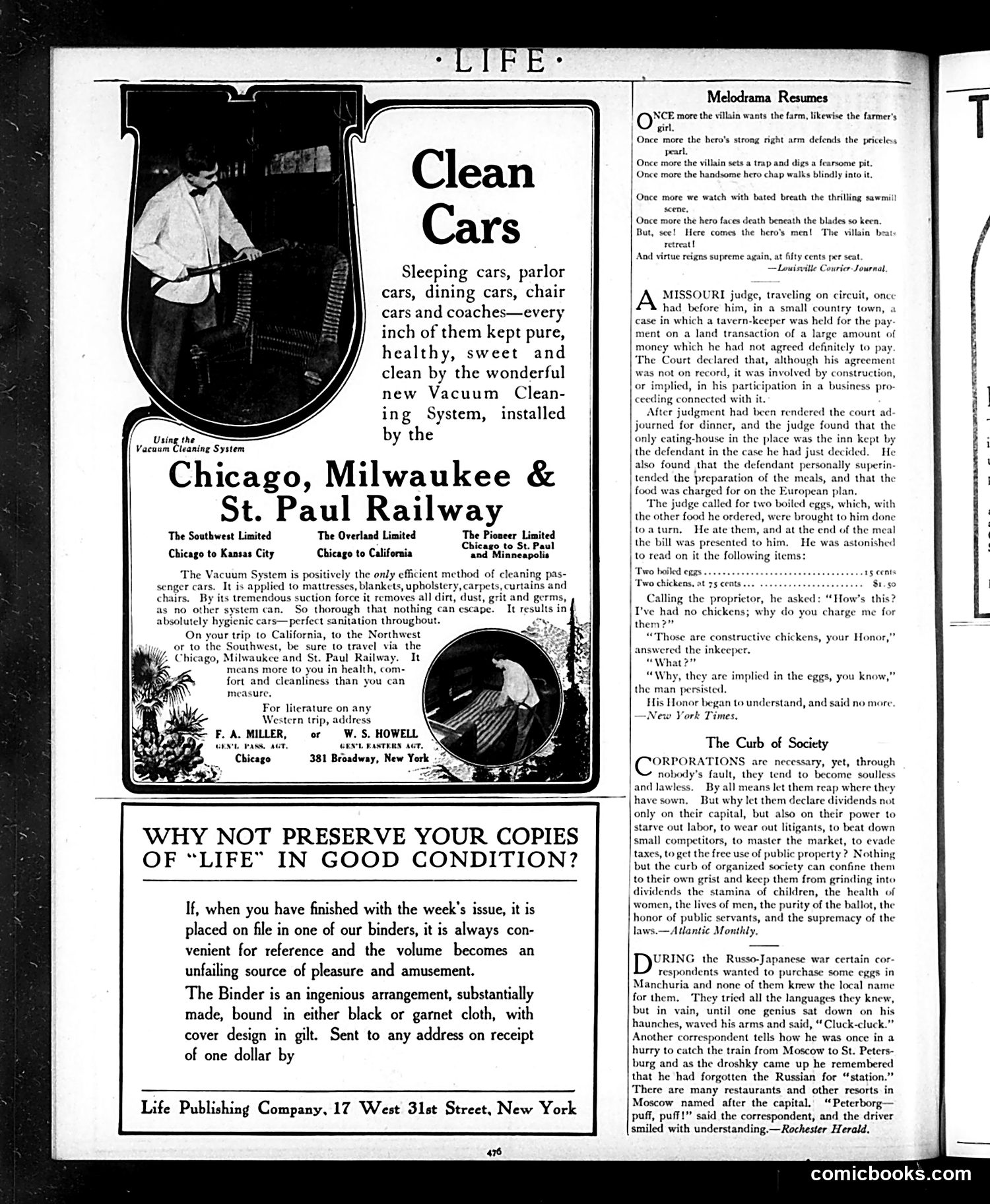
This page contains three distinct pieces of satirical content: **"Clean Cars" Advertisement**: A railroad company advertisement for the Chicago, Milwaukee & St. Paul Railway, promoting their new vacuum cleaning system for passenger cars. This is straightforward advertising rather than satire. **"Melodrama Resumes" Poem**: A humorous verse mocking the predictable tropes of silent-film melodramas—the villain coveting the farm and heroine, the hero's narrow escapes from death traps (sawmills), and villainous retreats. It satirizes the formulaic, overwrought plots audiences paid fifty cents to witness. **"The Curb of Society" Story**: A legal anecdote mocking judicial hypocrisy. A judge rules that a tavern-keeper owes money based on "constructive" agreement (implied by conduct). Later, that same judge is charged for "constructive chickens" (implied in eggs) by the defendant—a direct satire exposing the absurdity of the judge's own legal reasoning when turned against him. The page juxtaposes popular entertainment satire with legal/social commentary.
📄 Transcribed text from this page (OCR, searchable)
Machine-transcribed from the original scan — historical spelling and the odd misread are preserved.
Clean Cars Sleeping cars, parlor cars, dining cars, chair cars and coach every inch of them kept pure, healthy, sweet and clean by the wonderful new Vacuum Clean- ing System, installed Using f by the Chicago, Milwaukee & St. Paul Railway The Southwest Limited The Overland Limited The Pioneer Limited Chicago to Kansas City Chicago to California ee Sacehes ‘The Vacuum System is positively the only efficient method of cleaning pas- senger cars. It is applied to matt blank¢ts, upholstery, carpets, curtains and By its tremendous suction force it removes all di and germs, : So thorough that nothing can escape. It results in t sanitation throughout. On your trip to California, to the Northwest or to the Southwest, be sure to travel via the i . Paul Railway. It For literature on any Western trip, address F.A. MILLER, or —W. S. HOWELL UENML PASS. AGT. CES RASTRRS AGT. Chicago 381 Broadway, New York - WHY NOT PRESERVE YOUR COPIES OF “LIFE” IN GOOD CONDITION? If, when you have finished with the week's issue, it is placed on file in one of our binders, it is always con- venient for reference and the volume becomes an unfailing source of pleasure and amusement. The Binder is an ingenious arrangement, substantially made, bound in either black or garnet cloth, with cover design in gilt. Sent to any address on receipt of one dollar by Life Publishing Company, 17 West 31st Street, New York Melodrama Resumes NCE more the villain wants the farm, likewise the farmer's girl, Once more the hero's strong right arm defends the priceless pearl. Once more the villain sets a trap and digs a fearsome pit. Once more the handsome hero chap walks blindly into it. Once more we watch with bated breath the thrilling sawmill Once more the hero faces death beneath the blades so keen. But, see! Here comes the hero's men! The villain beat retreat! And virtue reigns supreme again, at fifty cents per seat. —Louisvilte Courier Journal MISSOURI judge, traveling on circuit, once | 4° had before him, in a small country town, a case in which a tavern-keeper was held for the pay: ment on a land transaction of a large amount of money which he had not agreed definitely to pay. The Court declared that, although his agreem was not on record, it was involved by construction, ied, in his participation in a business pro- ng connected with it. After judgment had been rendered the court ad journed for dinner, and the judge found that the only cating-house in the place was the inn kept by the defendant in the case he had just decided. He also found that the defendant personally superi |tended the preparation of the meals, and that the food was charged for on the European plan. ‘The judge called for two boiled eggs, which, with | the other food he ordered, were brought to him done Jtoaturn, He ate them, and at the end of the meal | the bill was presented to him. He was astonished to read on it the following items: Two boiled egzs . ascents Two chickens, scents . aoe . + $1.50 Calling the proprietor, he asked: “How's this? I've had no chickens; why do you charge me for | them ?”” “Those are constructive chickens, your Honor,” answered the inkeeper. “What?” “Why, they are implied in the eggs, you know,” the man persisted. His Honor began to understand, and said no more New York Times, The Curb of Society ORPORATIONS are necessary, yet, through nobody's fault, they tend to become soulless and lawless. By all means let them reap where they ~ | have sown, But why let them declare dividends not only on their capital, but also on their power to starve out labor, to wear out litigants, to beat down small competitors, to master the market, to evade taxes, to get the free use of public property ? Nothing but the curb of organized society can confine them | to their own grist and keep them from grinding into dividends the stamina of children, the health of women, the lives of men, the purity of the ballot, the honor of public servants, and the supremacy of the laws.—Adantic Monthly. URING the Russo-Japanese war certain cor- respondents wanted to purchase some eggs in Manchuria and none of them krew the local name for them. ‘They tried all the languages they knew, but in , until one geni haunches, waved his arms and said, “ Cluck-cluck.” Another correspondent tells how he was once in a hurry to catch the train from Moscow to St. Peters- burg and as the droshky came up he remembered that he had forgotten the Russian for “station.” ‘There are many restaurants and other resorts in Moscow named after the capital. ‘Peterborg— puff, puff!” said the correspondent, and the driver smiled with understanding.—Rochester Herald, comicbooks.com