
A complete issue · 48 pages · 1907
Life — August 1, 1907
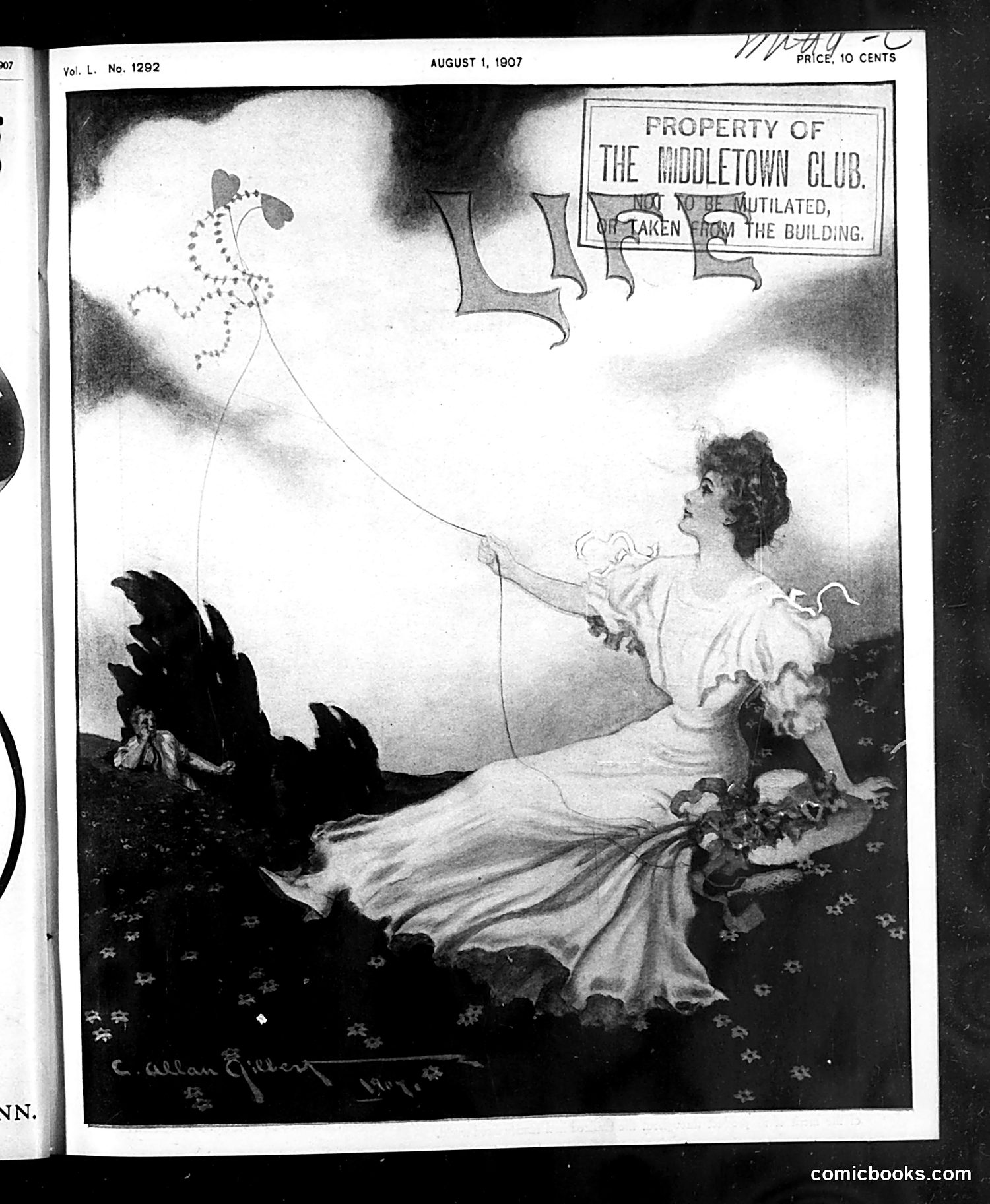
This cartoon depicts a woman in classical dress flying a kite shaped like a man's legs. The image plays on the visual pun of "kite flying"—a period term meaning to spread rumors or false information. The woman appears to be literally "flying" gossip or scandal (represented by the kite), suggesting she is spreading idle talk or unsubstantiated claims. The property stamp identifies this as belonging to the Middletown Club, indicating the cartoon likely satirizes social club gossip culture. The classical artistic style and the woman's elegant dress elevate what is fundamentally commentary on frivolous rumor-spreading among the leisure class. The satire critiques how such institutions perpetuated baseless talk and scandal.
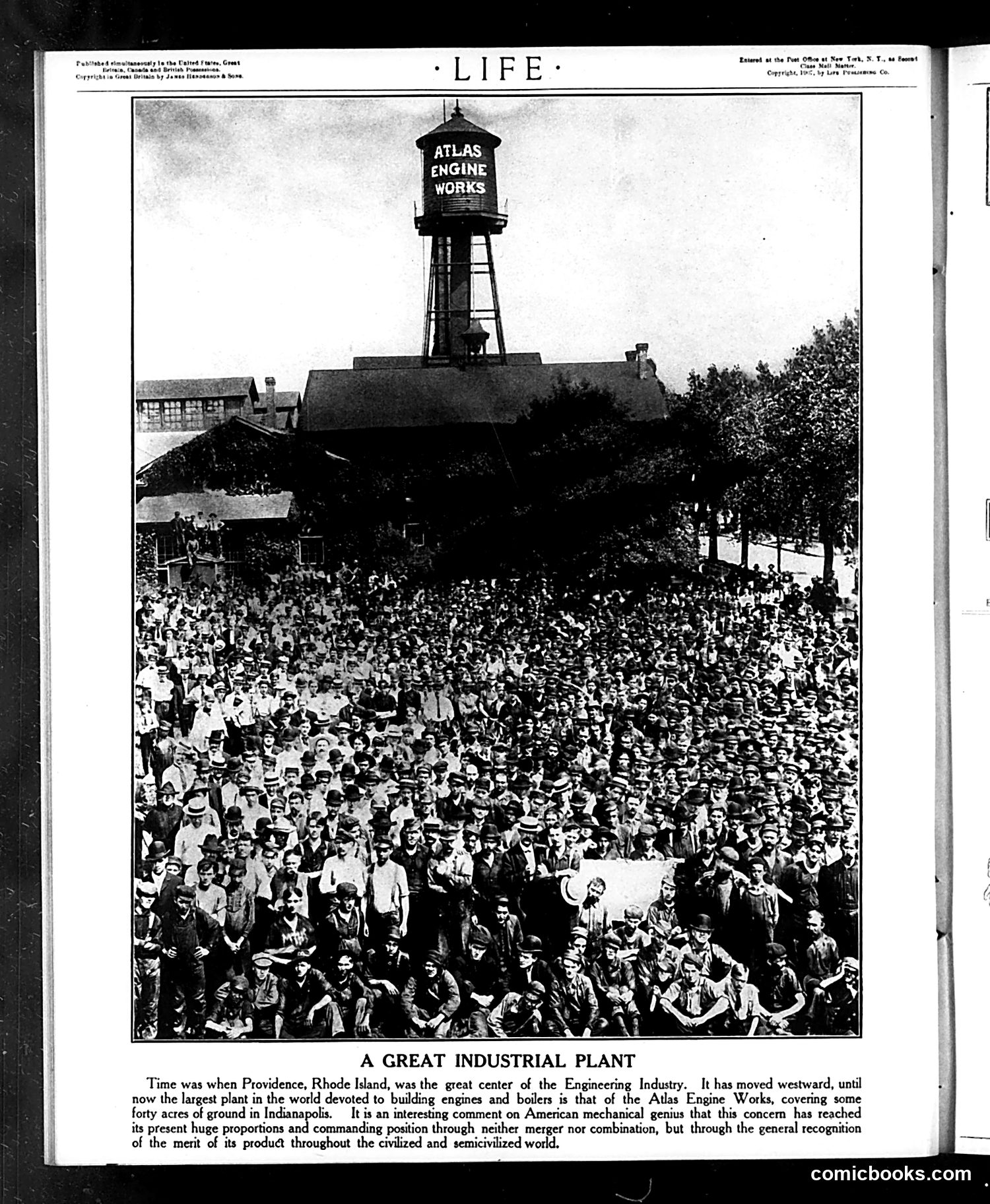
This is not a political cartoon but rather a **promotional photograph and article** celebrating industrial progress. The image shows a massive crowd gathered at the **Atlas Engine Works in Indianapolis**, a major American manufacturing facility devoted to building engines and boilers. The accompanying text praises the plant's growth from Providence, Rhode Island to Indianapolis, noting it now covers "some forty acres" and represents "the largest plant in the world" for its specialized purpose. The article emphasizes American industrial achievement and engineering prowess, positioning the factory as a symbol of national technological superiority. The large water tower bearing "ATLAS ENGINE WORKS" serves as the visual focal point, emphasizing the scale and importance of industrial infrastructure during America's manufacturing boom era.
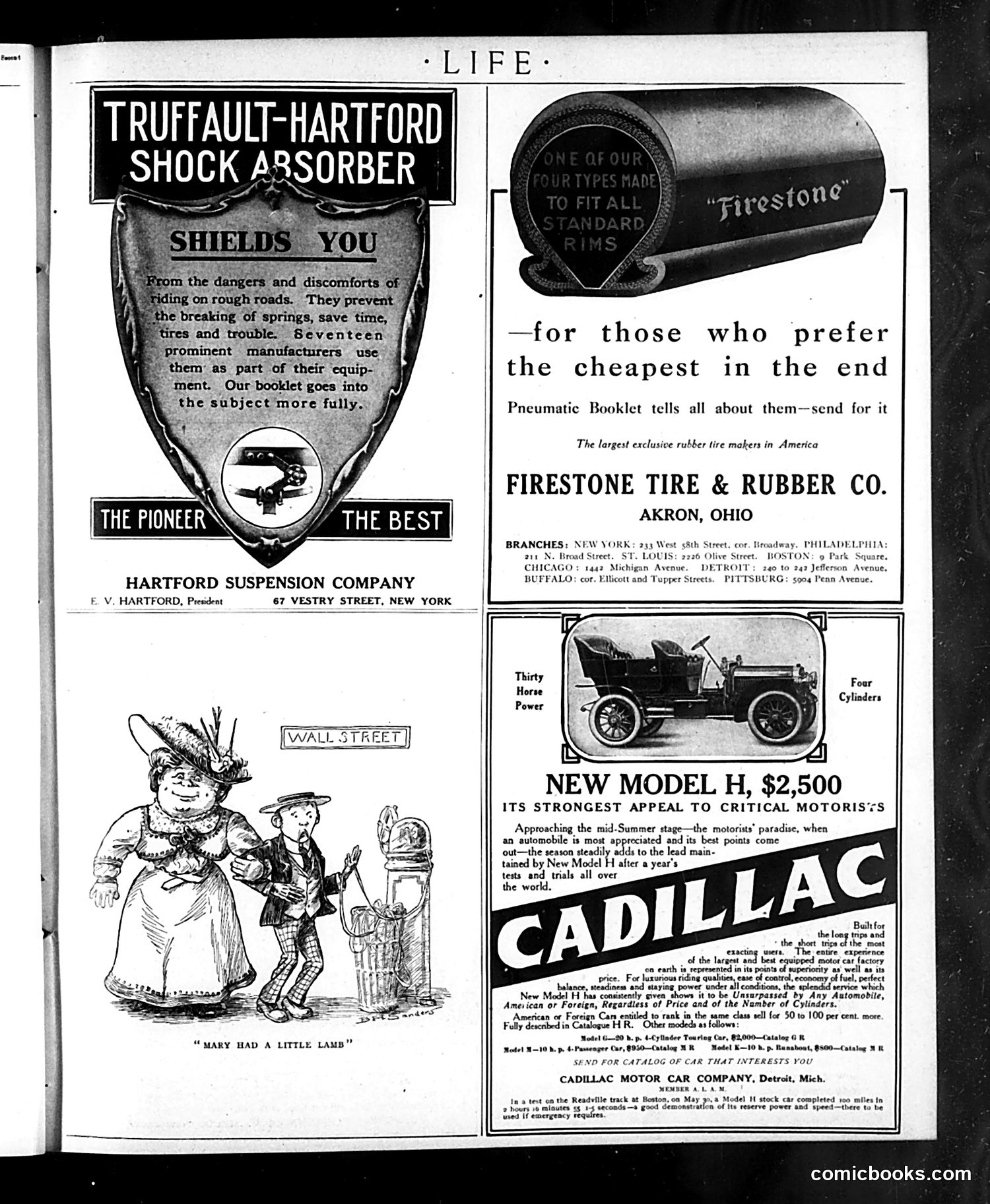
This page is **primarily advertising** with one cartoon element. The ads promote automotive and rubber products typical of the early 1900s (Truffault-Hartford shock absorbers, Firestone tires, and a Cadillac Model H). The only cartoon is titled **"Mary Had a Little Lamb,"** a visual pun on the nursery rhyme. It depicts a well-dressed woman on Wall Street with a small boy and a lamb, satirizing the stock market or financial speculation of the era. The joke appears to reference "lambs"—a period term for naive investors who were easily fleeced. By placing an actual lamb on Wall Street with a child-like figure, the cartoonist mocks gullible market participants who lose money to savvier traders. The cartoon's meaning relies on understanding "lamb" as financial slang for a victim of fraud or manipulation.
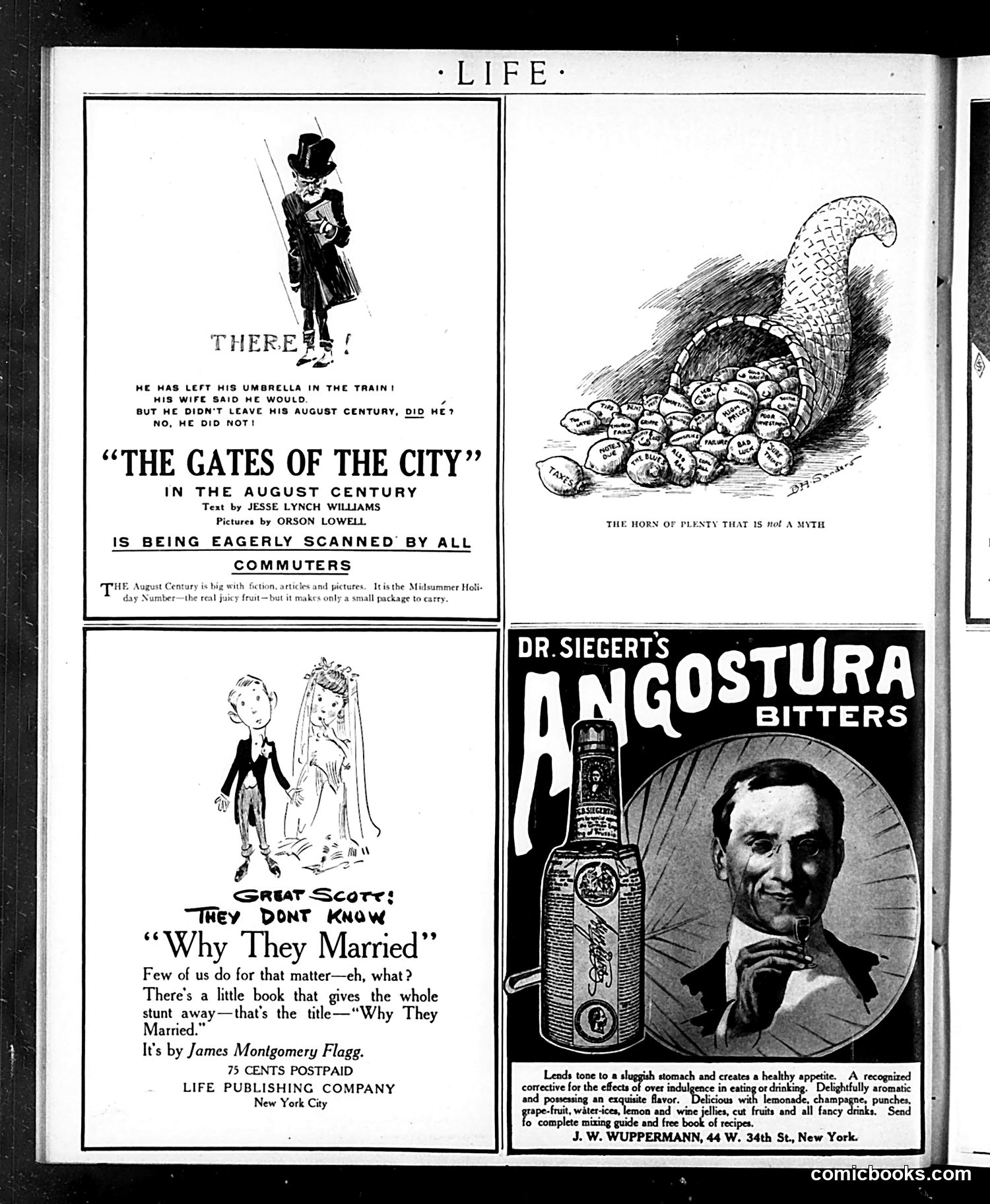
This page mixes editorial content with period advertising. The top left promotes "The Gates of the City," an August Century fiction story about a commuter who forgot his umbrella on a train—satirizing the mundane anxieties of early 20th-century commuter life. The middle-left cartoon, titled "Why They Married," appears to mock marriage itself through a simple visual joke, accompanying James Montgomery Flagg's book advertisement. The top right image of a cornucopia symbolizes agricultural abundance, captioned "The Hoes of Plenty That is not A Myth"—likely promoting American farming productivity. The bottom-right is a Dr. Siegert's Angostura Bitters advertisement, a medicinal digestive product marketed as addressing "over-indulgence in eating or drinking"—reflecting period attitudes toward commercial remedies.
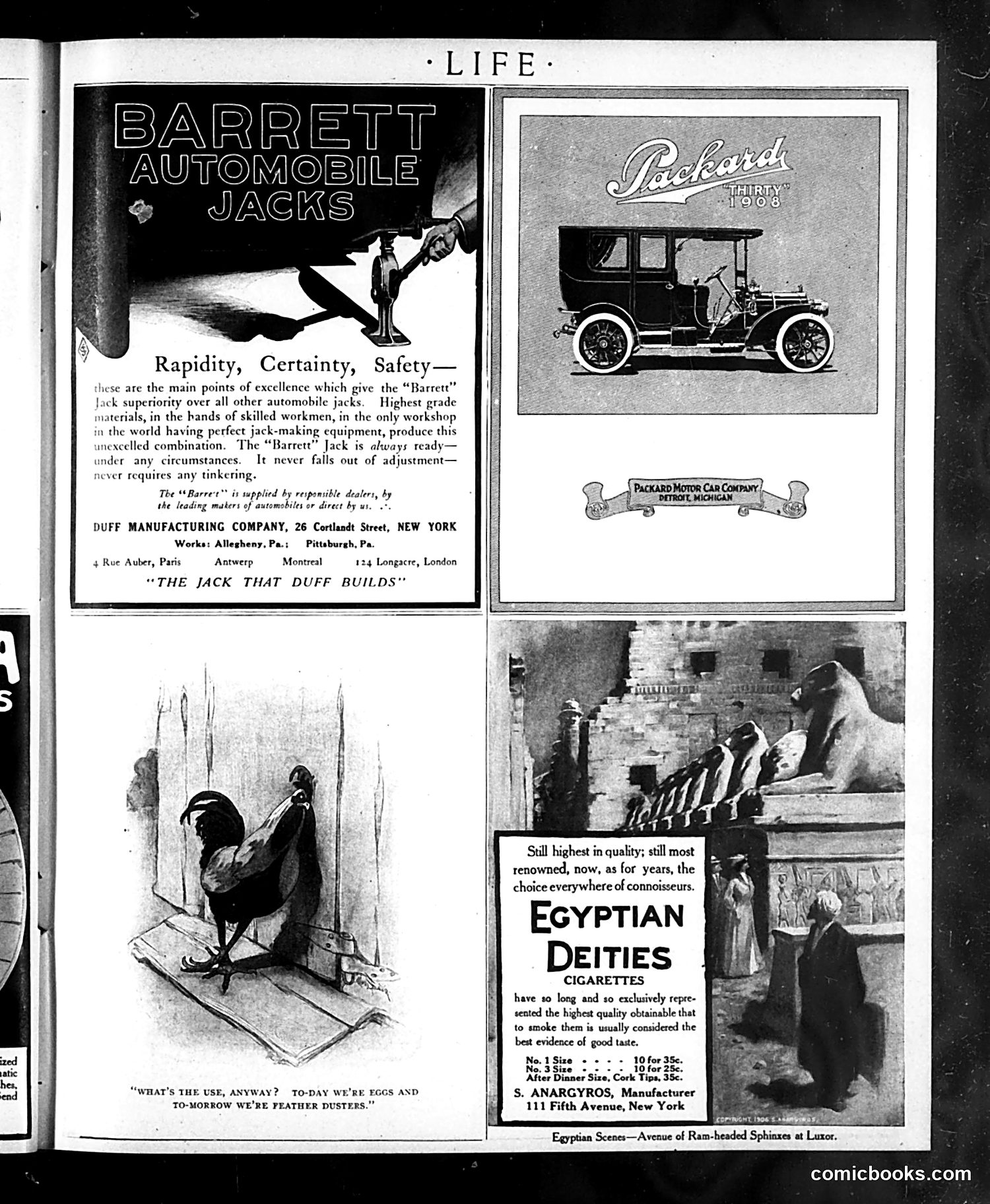
This page is primarily **advertising**, not political satire. It contains four commercial advertisements: 1. **Barrett Automobile Jacks** (top left): Promotes industrial lifting equipment with claims of "Rapidity, Certainty, Safety" 2. **Packard Motor Car, 1908** (top right): Shows an early automobile model 3. **Untitled cartoon** (bottom left): A humorous illustration of a rooster in an awkward pose, captioned "What's the use, anyway? To-day we're eggs and to-morrow we're feather dusters"—a joke about poultry's limited purpose 4. **Egyptian Deities Cigarettes** (bottom right): Promotes cigarettes using Egyptian imagery and monuments as marketing appeal The rooster cartoon is the only satirical element, mocking the bird's fate rather than commenting on politics or society.
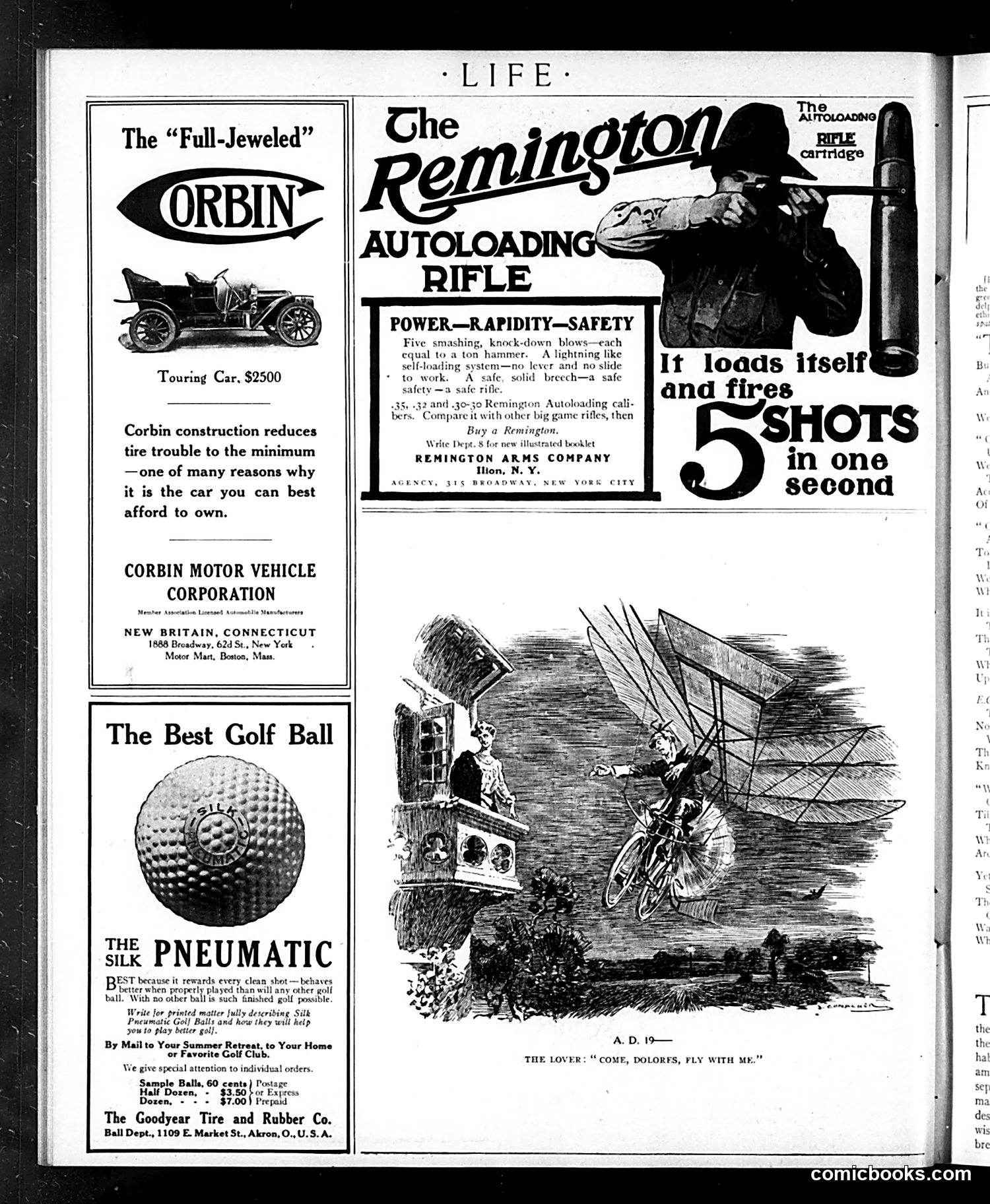
This page is primarily **advertisements** rather than editorial content or political satire. The ads include: - **Orbin automobile** (touring car, $2500) - **Remington autoloading rifle** ("5 shots in one second") - **Silk Pneumatic golf balls** - **Goodyear tires** The one illustration labeled "A.D. 19—'Come, Dolores, Fly with Me'" appears to be a **romantic cartoon** showing a couple on what seems to be a flying bicycle or airship near a lighthouse. This likely represents **early 20th-century humor about technological romance**—the fantasy of modern transportation enabling adventure and courtship. The page reflects early 1900s consumer culture and emerging technologies (automobiles, aviation, firearms). There is no discernible political satire or caricature requiring historical context beyond recognizing the period's commercial preoccupations.
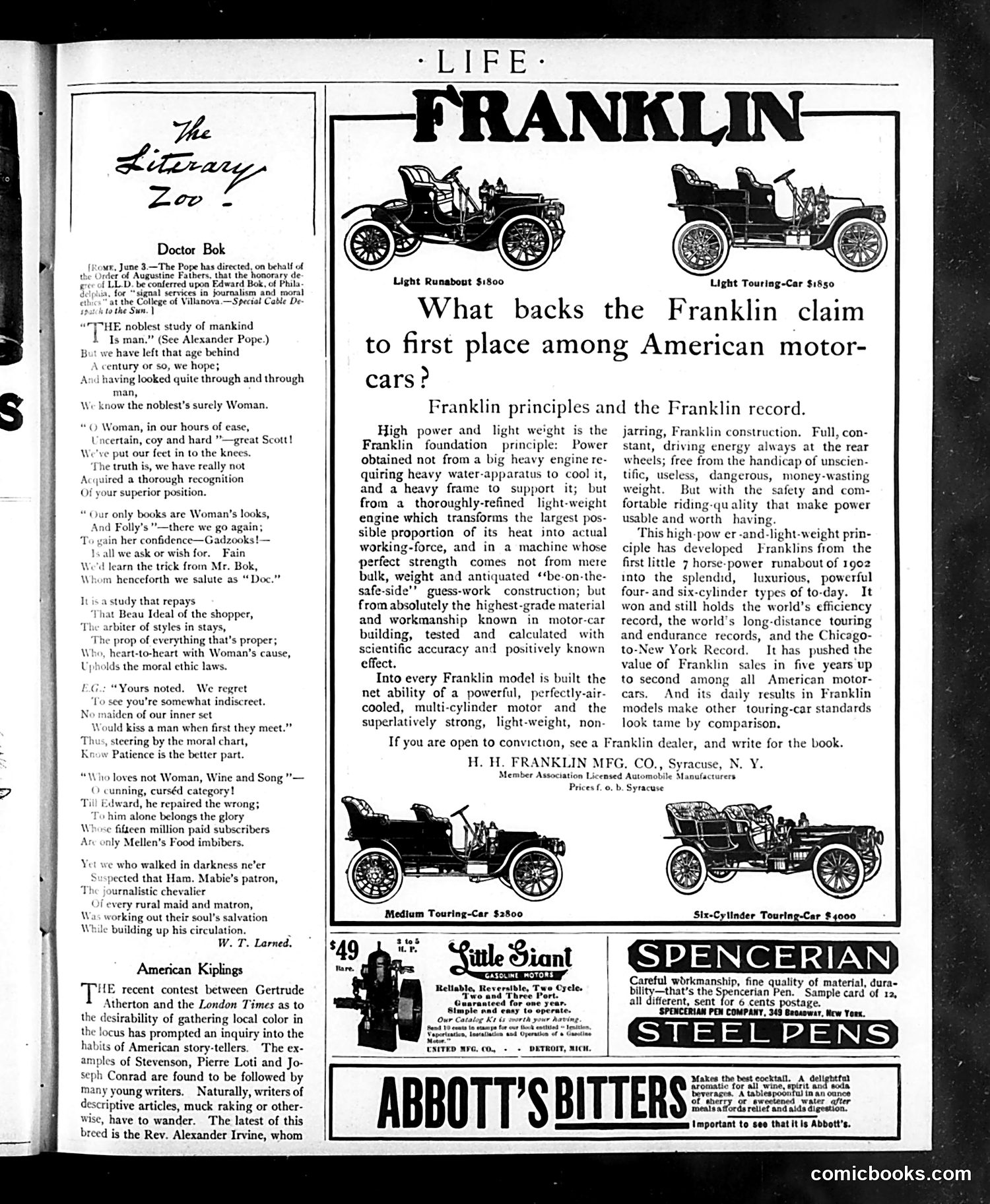
This page is primarily **advertising**, not satire or political commentary. The dominant feature is a large Franklin automobile advertisement (center/right) showcasing four car models with prices ranging from $1,800 to $2,000. The ad emphasizes Franklin's engineering principles: high power, light weight, and air-cooling technology. The left side contains poetry and a brief literary section titled "The Literary Zoo" discussing women in literature, followed by an "American Kiplings" piece about a writing contest. Below the Franklin ad are smaller advertisements for a Little Giant engine, Spencerian Steel Pens, and Abbott's Bitters. **This is primarily a commercial/editorial page rather than political satire.**
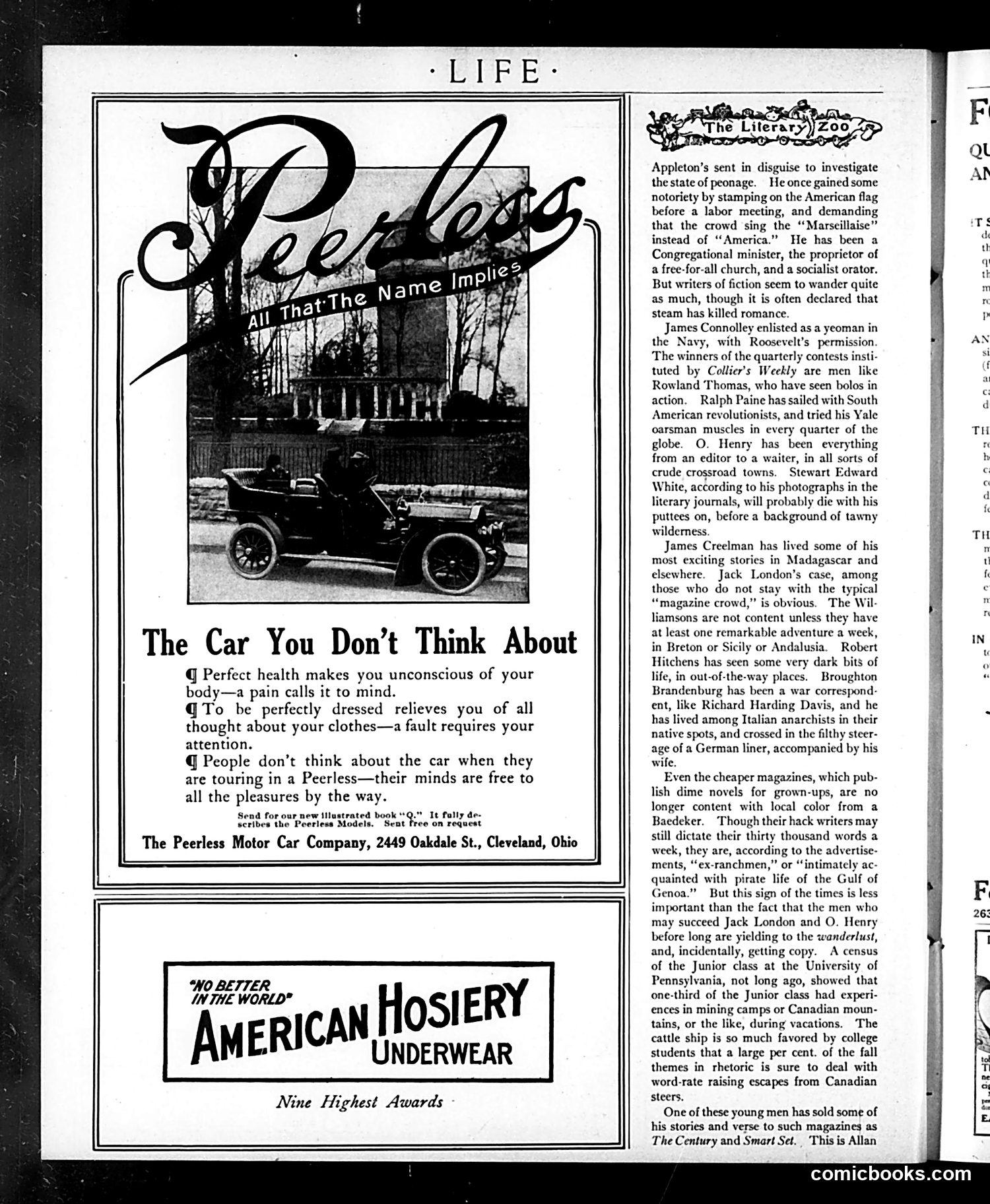
This page contains **primarily advertisements**, not political cartoons. The main content includes: 1. **Peerless Motor Car advertisement** ("The Car You Don't Think About") - promoting automobiles with philosophical messaging about unconscious comfort and freedom 2. **American Hosiery Underwear advertisement** - claiming "Nine Highest Awards" 3. **"The Literary Zoo"** column on the right - a satirical review of contemporary literature and writers, discussing adventure fiction, magazine writing, and authors like Jack London and O. Henry The page reflects early 20th-century consumer culture and publishing trends. The "Literary Zoo" provides social commentary on popular entertainment and class-based reading habits, but this is editorial commentary rather than political satire. The advertisements reveal period attitudes toward modernity and consumer goods.
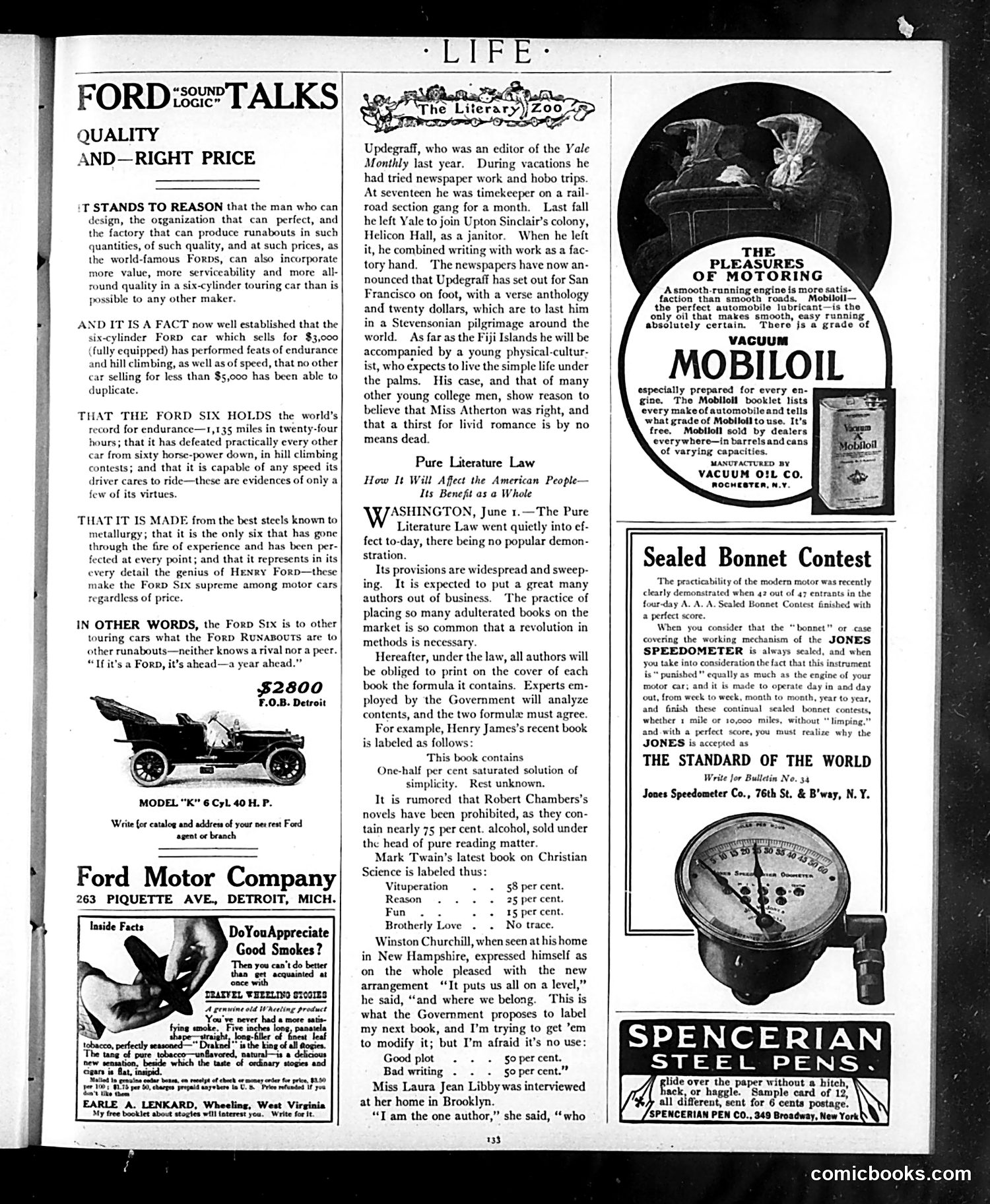
This page is primarily **advertising and commercial content** rather than political satire. The main elements are: **Ford Motor Company Advertisement**: Prominently features the Model K automobile, emphasizing its quality, durability, and affordability at $2,800. The ad uses competitive language ("if it's a Ford, it's ahead") and highlights performance records. **"The Literary Zoo" section**: A brief satirical piece about Updegraff, a Yale Monthly editor, taking various jobs (newspaper work, hobo trips, janitor) before departing for San Francisco. This is gentle, personal satire rather than political commentary. **Other advertisements**: Including Mobiloil, speedometer, and pen company ads. The page reflects early 20th-century consumer culture and marketing, with minimal political content—primarily commercial messaging to Life's affluent readership.
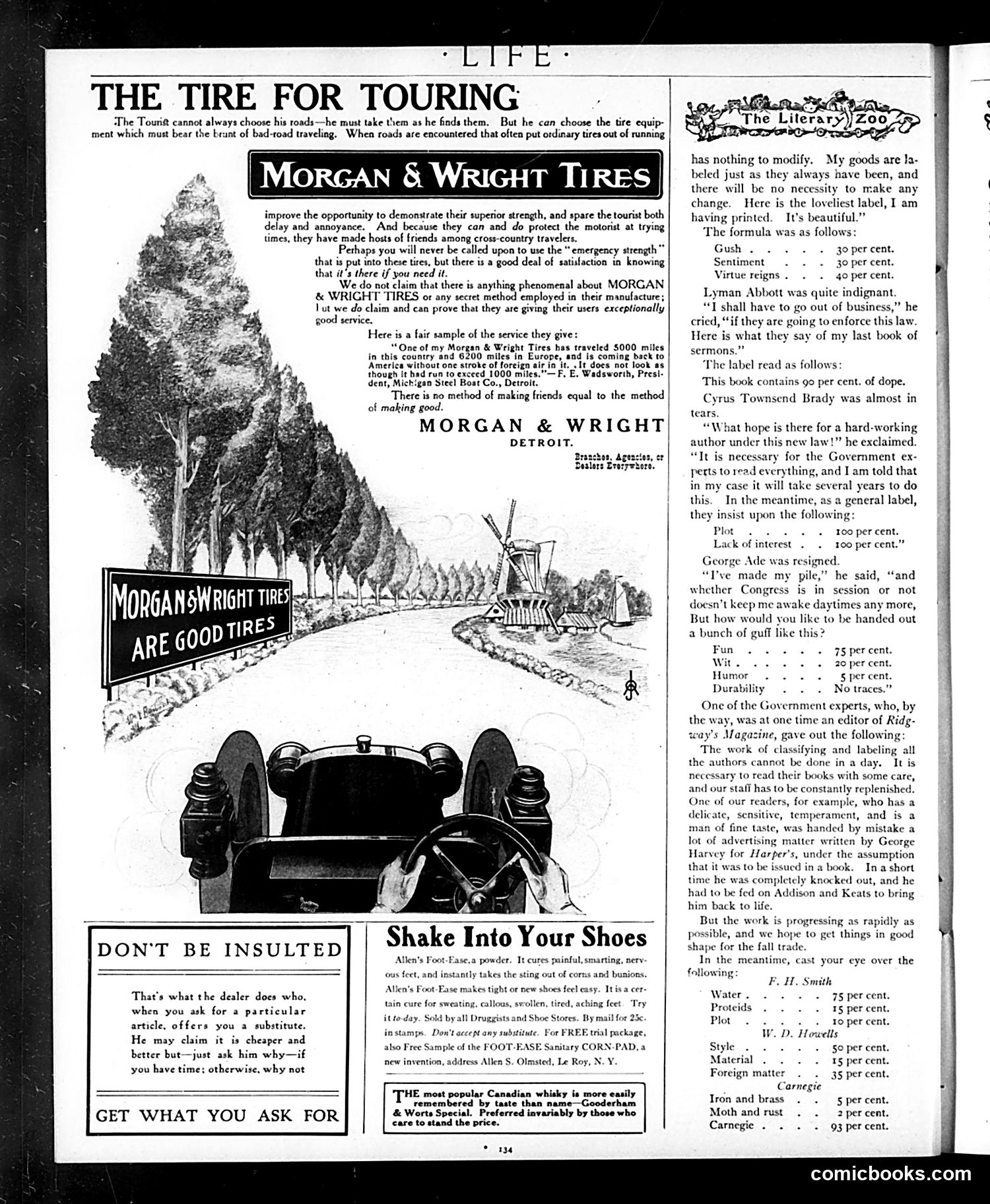
This page combines advertisements with a satirical column titled "The Literary Zoo." The main content is a Morgan & Wright Tires advertisement featuring a scenic road with a windmill, promoting the brand's durability for touring. The right column's "Literary Zoo" discusses authors dealing with new copyright/censorship laws. It mocks several named writers (Lyman Abbott, Cyrus Townsend Brady, George Ade) who must now label their books with ingredient-style percentages of qualities like "Gush," "Sentiment," and "Virtue." The satire critiques both the authors' reactions to regulation and the absurdity of governmental classification systems imposed on creative works. Additional advertisements for Allen's Foot-Ease powder and Canadian whisky appear below.
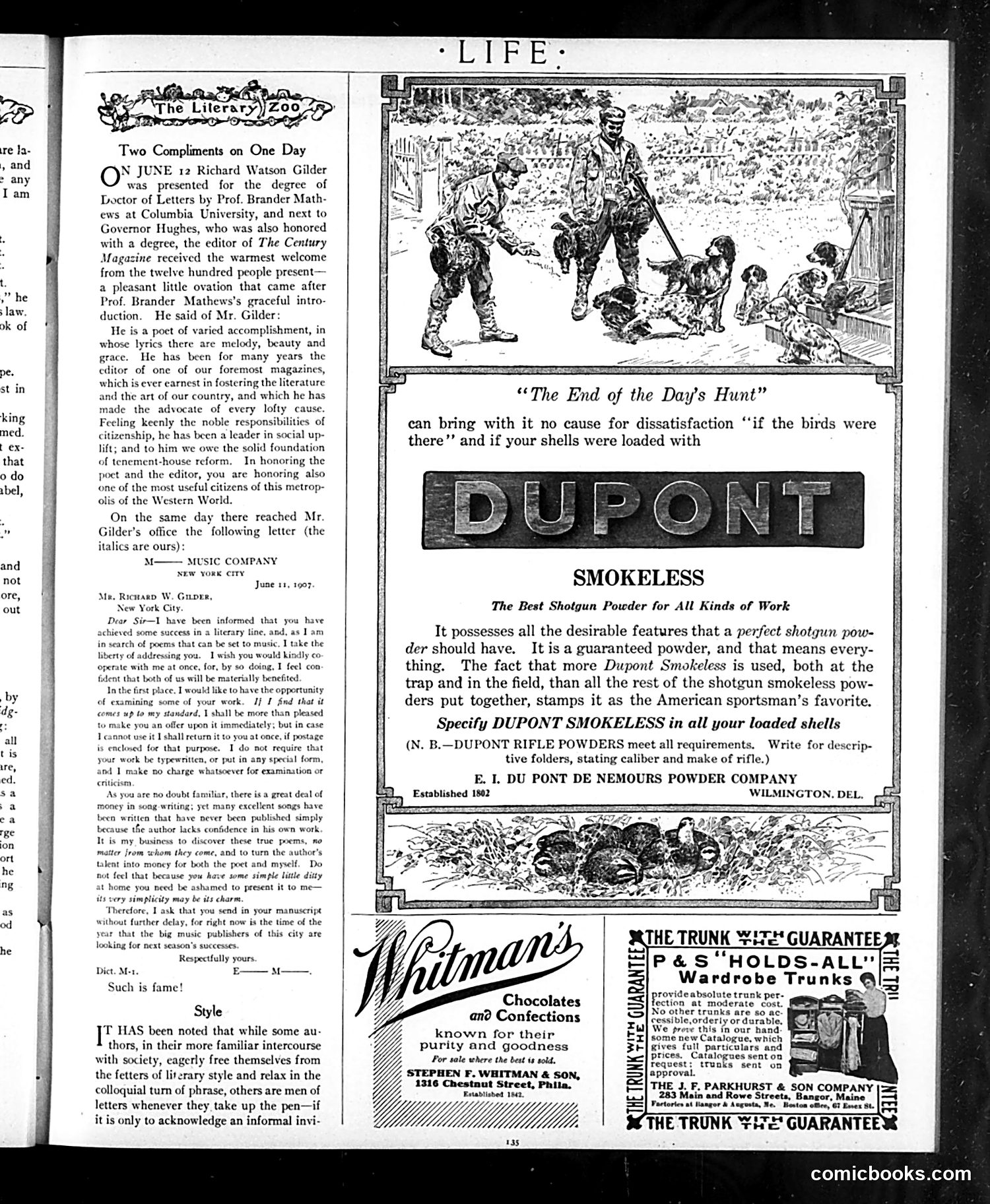
This page is primarily **advertising and editorial content** rather than political satire. The main illustrated feature is titled **"The End of the Day's Hunt,"** showing an adult and children with hunting equipment—a straightforward genre scene promoting **DuPont Smokeless shotgun powder** as reliable ammunition for sportsmen. The left column contains letters praising Richard Watson Gilder, a poet and *Century* Magazine editor, for his literary contributions and civic leadership. Below are advertisements for **Whitman's Chocolates** and **P&S "Holds-All" Wardrobe Trunks.** The page reflects early-1900s American consumer culture and literary establishment values, with no discernible political cartoon or satire present.
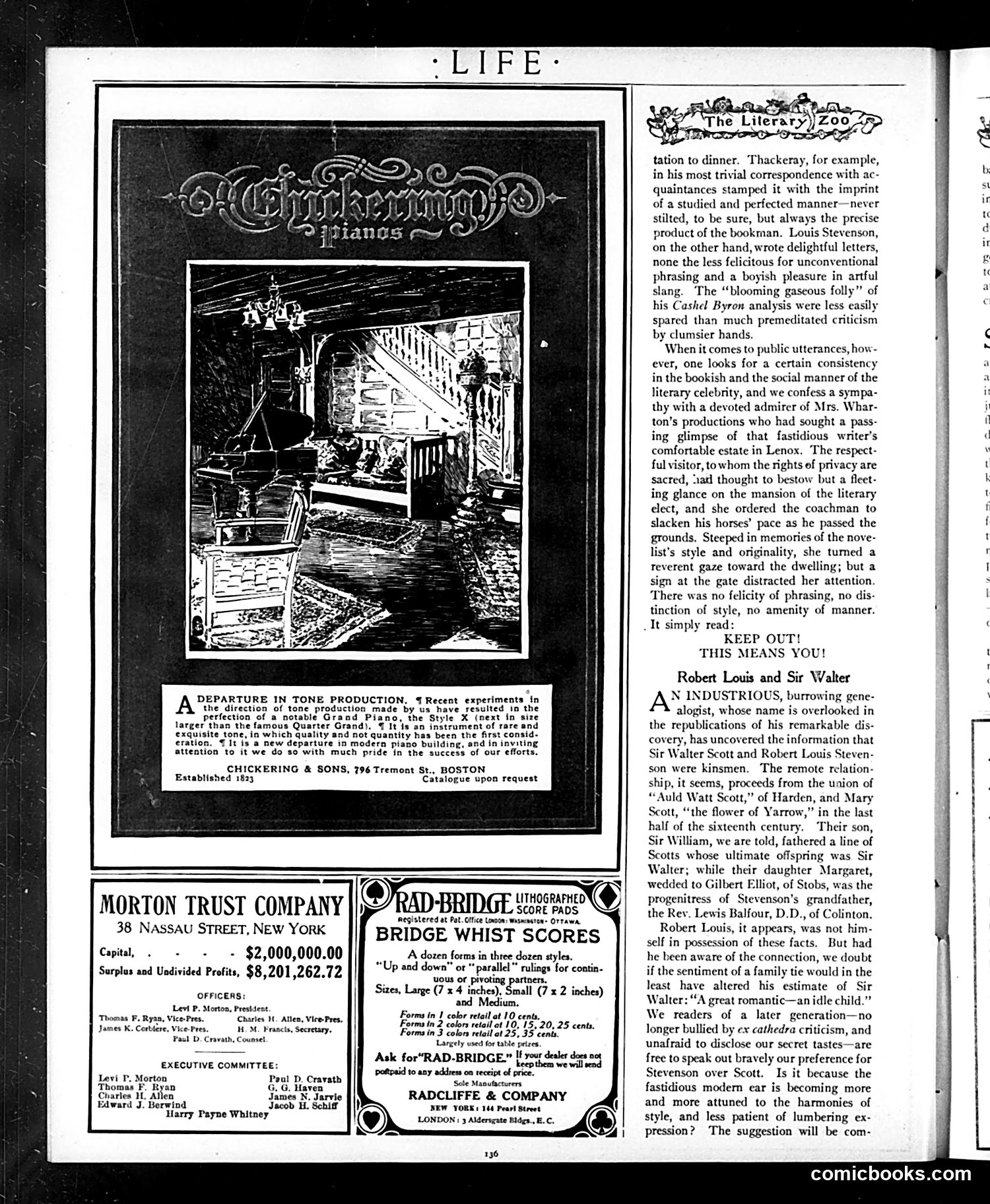
This page is primarily **advertising and literary discussion**, not political satire. The main image shows an advertisement for **Chickering & Sons pianos**, depicting an interior scene with a piano. The text below describes a "departure in tone production" achieved through their new "Style X" piano, emphasizing innovations in sound quality. The right column contains literary commentary titled "The Literary Zoo," discussing correspondence styles of writers like **Thackeray and Louis Stevenson**. It includes a tangential anecdote about **Sir Walter Scott and Robert Louis Stevenson's** family connection, debating whether sentiment about Scott should influence one's appreciation of Stevenson. Additional advertisements appear for **Morton Trust Company**, **Rad-Bridge lithographed score pads**, and **Radcliffe & Company** bridge whist score cards. This is primarily a **commercial and cultural commentary page** rather than political cartooning.
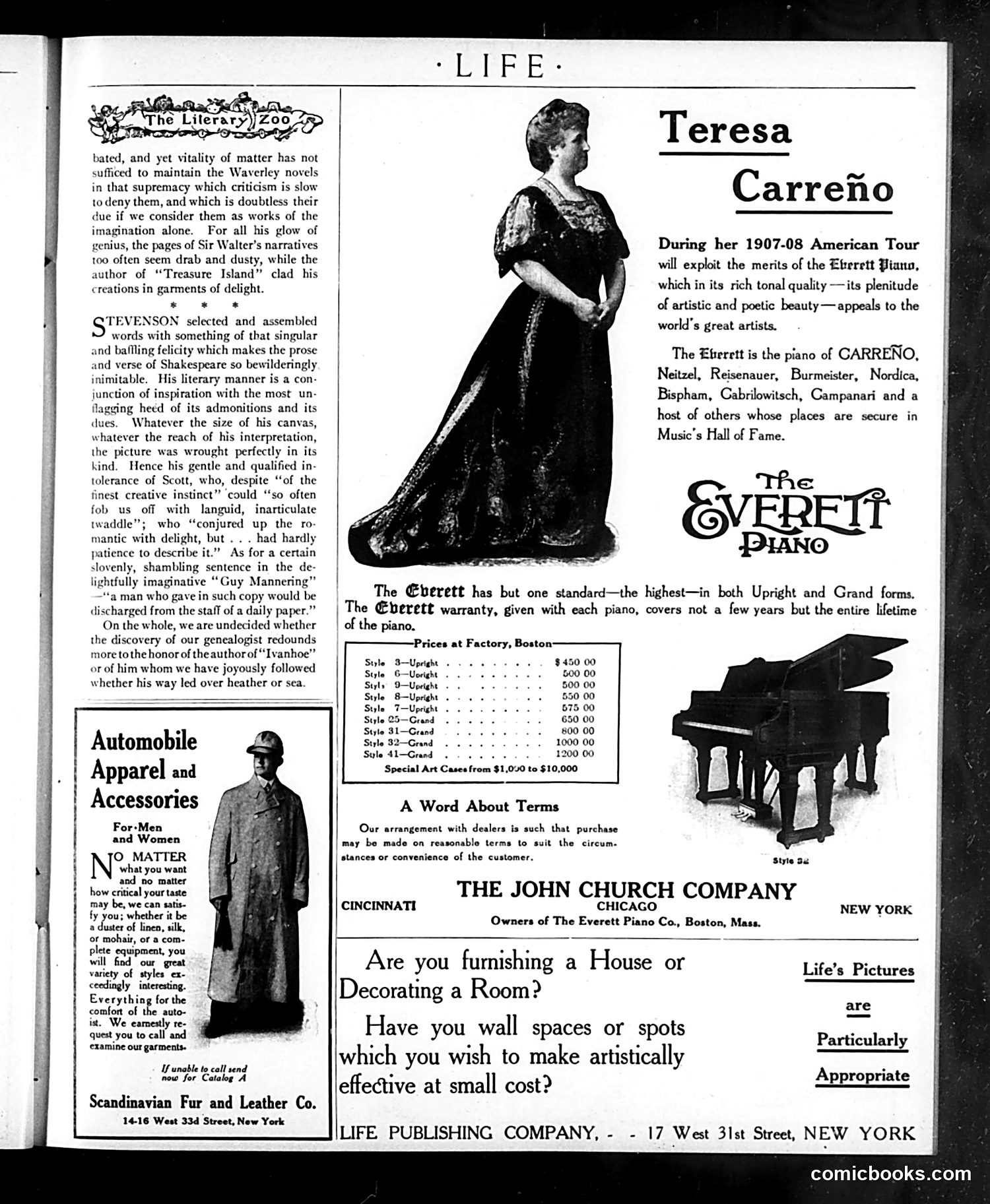
This is primarily a **advertising page** from Life magazine, not a satirical cartoon. The page features: **Main content:** An advertisement for the Everett Piano, prominently featuring Teresa Carreño (a renowned concert pianist) and promoting her 1907-08 American tour. The ad emphasizes the piano's prestige by listing famous musicians who use it. **Secondary advertisements:** - Automobile apparel and accessories from the Scandinavian Fur and Leather Co. - A housing/decoration service from Life Publishing Company **Historical context:** This reflects early 1900s advertising strategies—using celebrity endorsements (Carreño's fame) to market luxury goods to wealthy consumers. The detailed pricing and "reasonable terms" language suggests pianos were significant investments for middle-to-upper-class households. No political satire is present on this page.
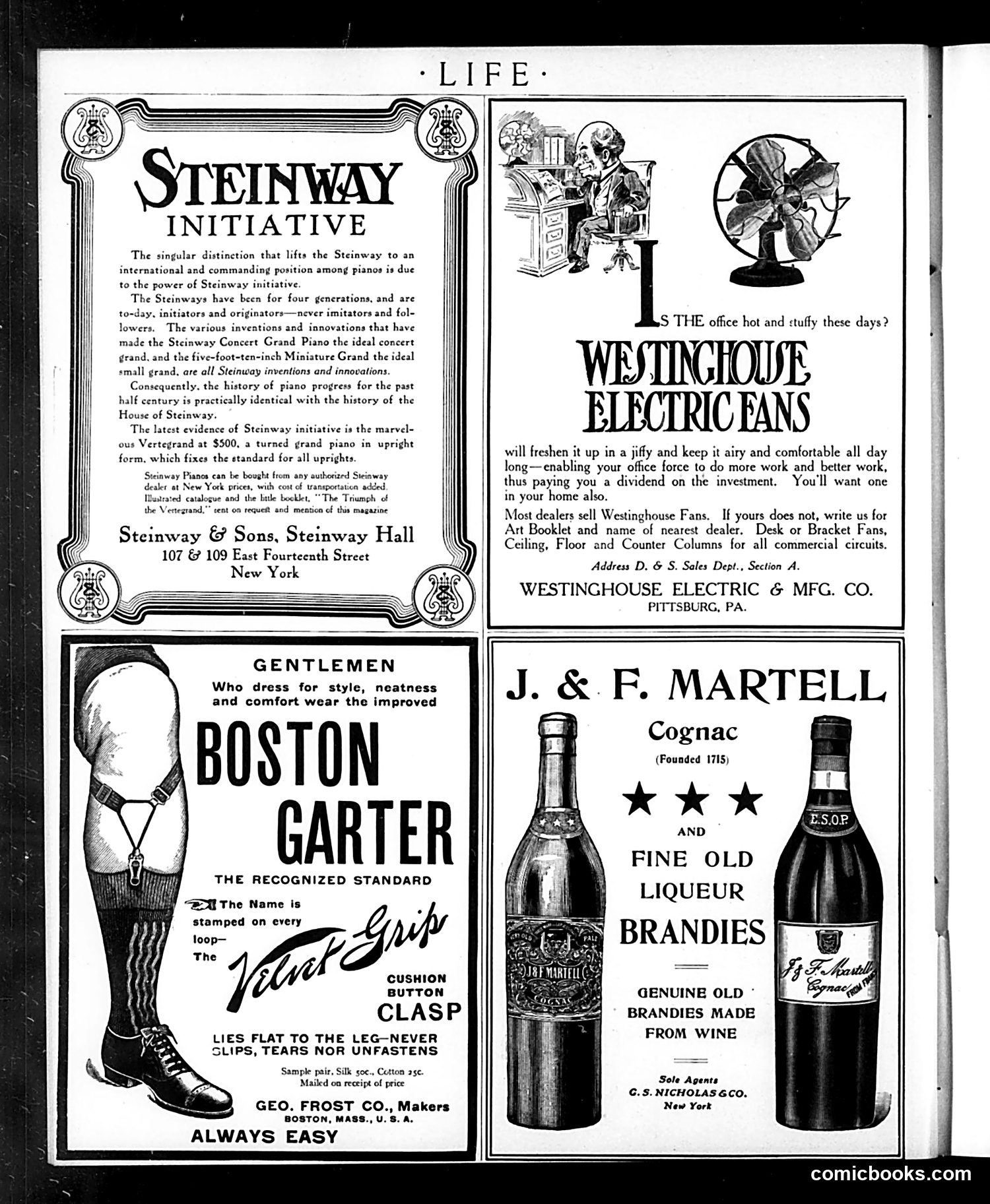
This page contains **no political cartoons or satire**—it is primarily **advertising**. The page features four commercial advertisements from the early 20th century: 1. **Steinway Pianos**: Promotes the company's "initiative" and innovations, highlighting their Concert Grand and new Vertegrand upright model. 2. **Westinghouse Electric Fans**: A small illustration shows a man at a hot, stuffy office desk. The ad promises fans will improve worker productivity and comfort—a practical sales pitch reflecting early industrial workplace concerns. 3. **Boston Garter**: Men's garters with a "velvet grip" cushion clasp, marketed for comfort and durability to gentlemen concerned with style and neatness. 4. **J. & F. Martell Cognac**: Displays two bottles of brandy (three-star and VSOP varieties), marketed as genuine old brandies made from wine. The page represents typical Life magazine content of its era—mixing editorial space with premium advertisements targeting middle and upper-class readers.
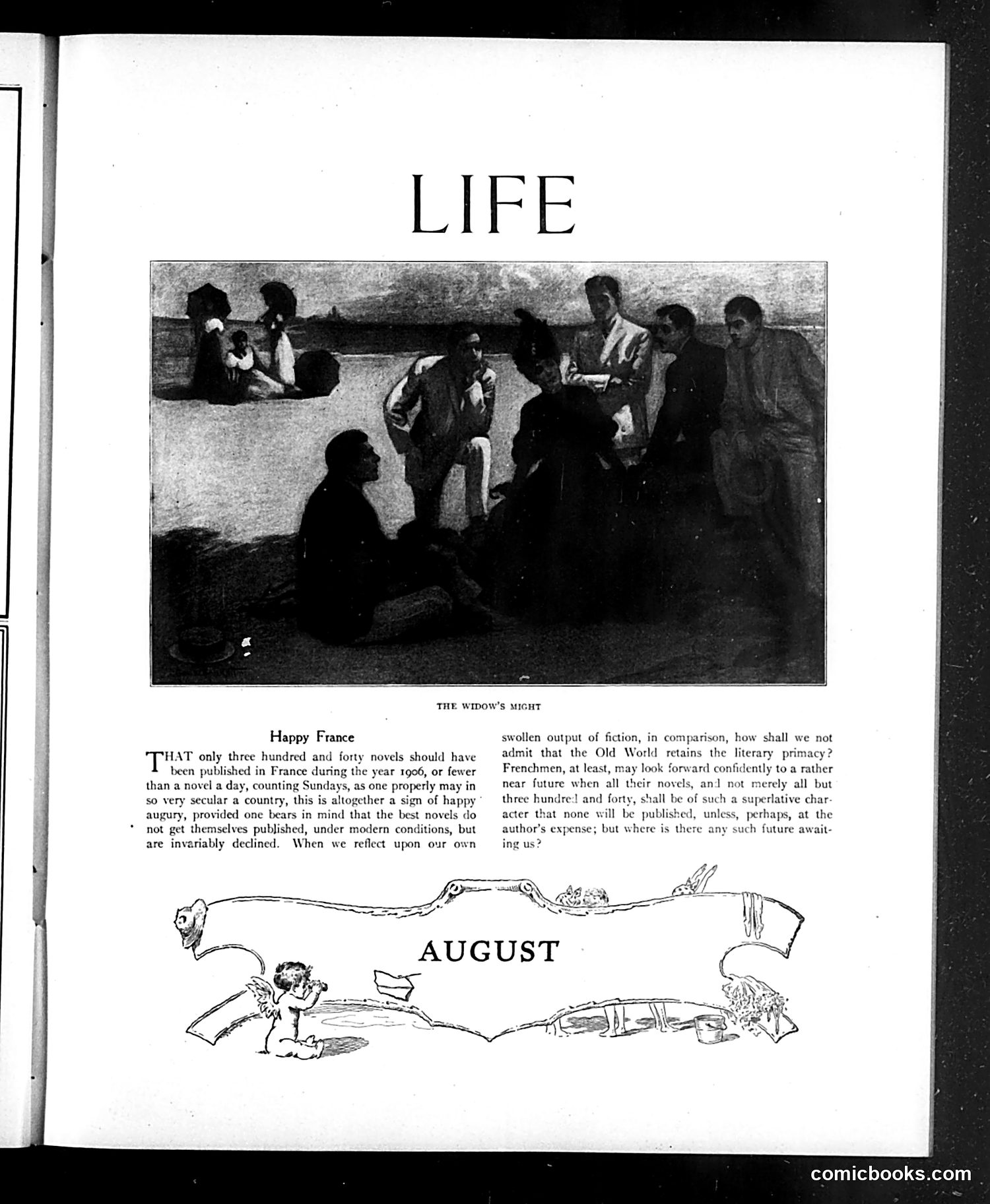
This page satirizes French literary productivity. The text argues that France's publication of only ~340 novels in 1906 (fewer than one per day) actually demonstrates *quality* over quantity—a backhanded compliment suggesting France maintains "literary primacy" despite lower output. The photograph titled "The Widow's Might" (caption unclear in context) appears to show ordinary people gathered outdoors, possibly illustrating the everyday French life that inspires such literature. The satire's point: Life magazine is mockingly praising France's restraint in publishing, implying that fewer, better novels trump the "swollen output of fiction" elsewhere (likely America). The joke assumes readers will recognize the irony—that claiming literary superiority while publishing fewer books is a peculiarly French contradiction worth ridiculing. The August decorative header suggests this is a monthly feature.
This editorial page addresses the conflict between railroads and government regulation. The text discusses railroad companies' dilemma: they fear intrusive state legislatures but also oppose federal regulation—though federal control now seems preferable to the unpredictable patchwork of state laws. The specific example cited is a Texas law requiring trains delayed over twelve hours to be abandoned, forcing California-bound passengers to wait. The author argues such state-level absurdities cannot continue. The small illustrations at bottom-center appear to show cartoon figures in motion (possibly representing the competing forces or confusion of regulation), though specific identities aren't clear from the image. The core argument: while states should retain proper powers, the railroads' interstate nature demands consistent rules. The Supreme Court must eventually clarify where state control ends and federal control begins. The author advocates minimal but necessary government—neither pure laissez-faire nor excessive centralization.
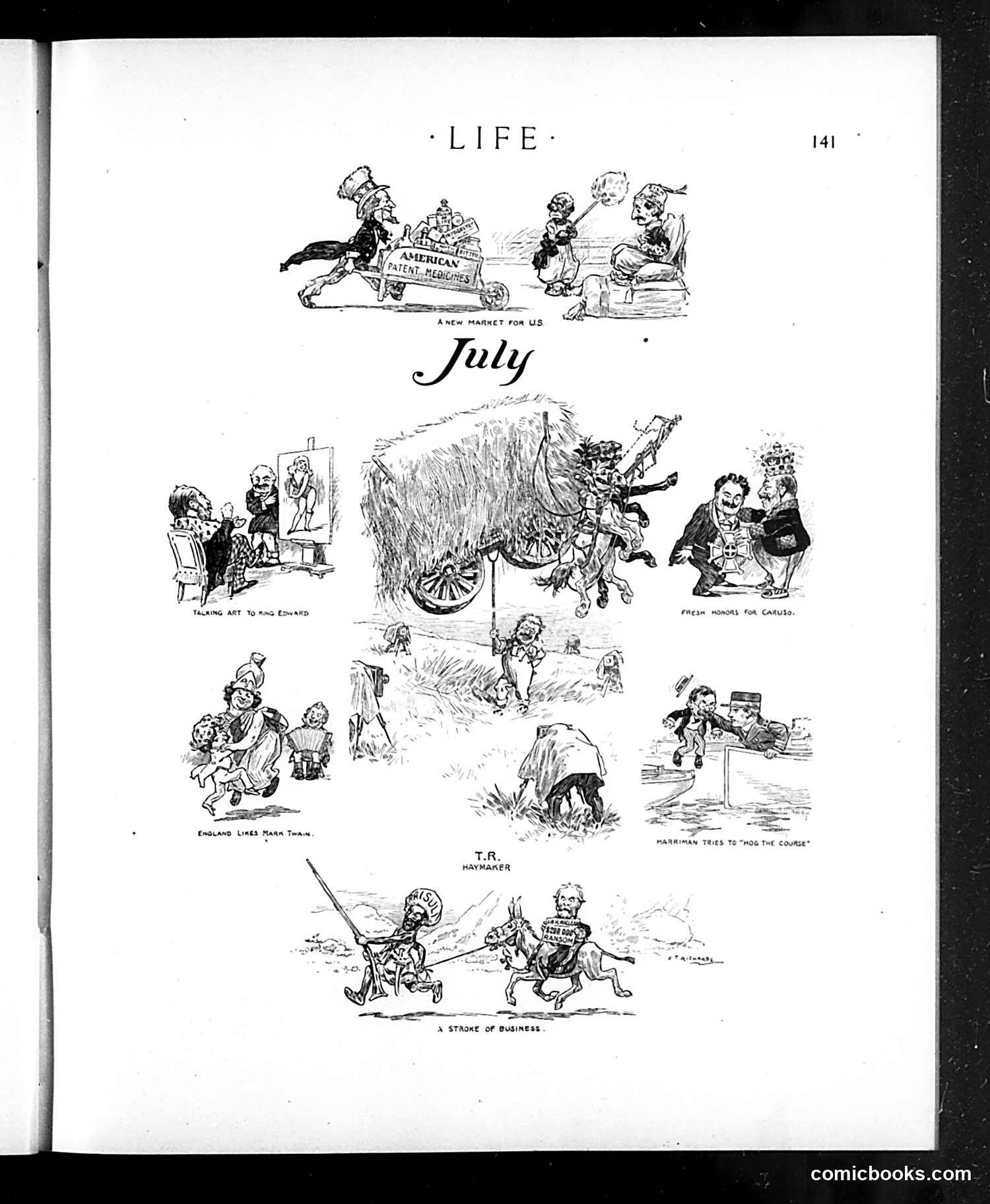
This page contains satirical cartoons depicting various July activities and social commentary. The top cartoon shows "A New Market for U.S." with a figure pushing an "American Patent Medicines" cart—likely mocking the aggressive marketing of patent medicines, a notorious turn-of-century industry known for false health claims. The remaining July vignettes include: "Talking Art to King Edward" (appears to reference King Edward VII), "England Likes Main Tents," "Fresh Morals for Callers," and "Harriman Tries to 'Hog the Course.'" The bottom cartoon, "A Stroke of Business," shows two figures with what appears to be a golf club—possibly satirizing business dealings or financial speculation. The cartoons employ exaggerated caricatures typical of early-1900s Life magazine satire, targeting contemporary social pretensions, commercialism, and leisure activities.
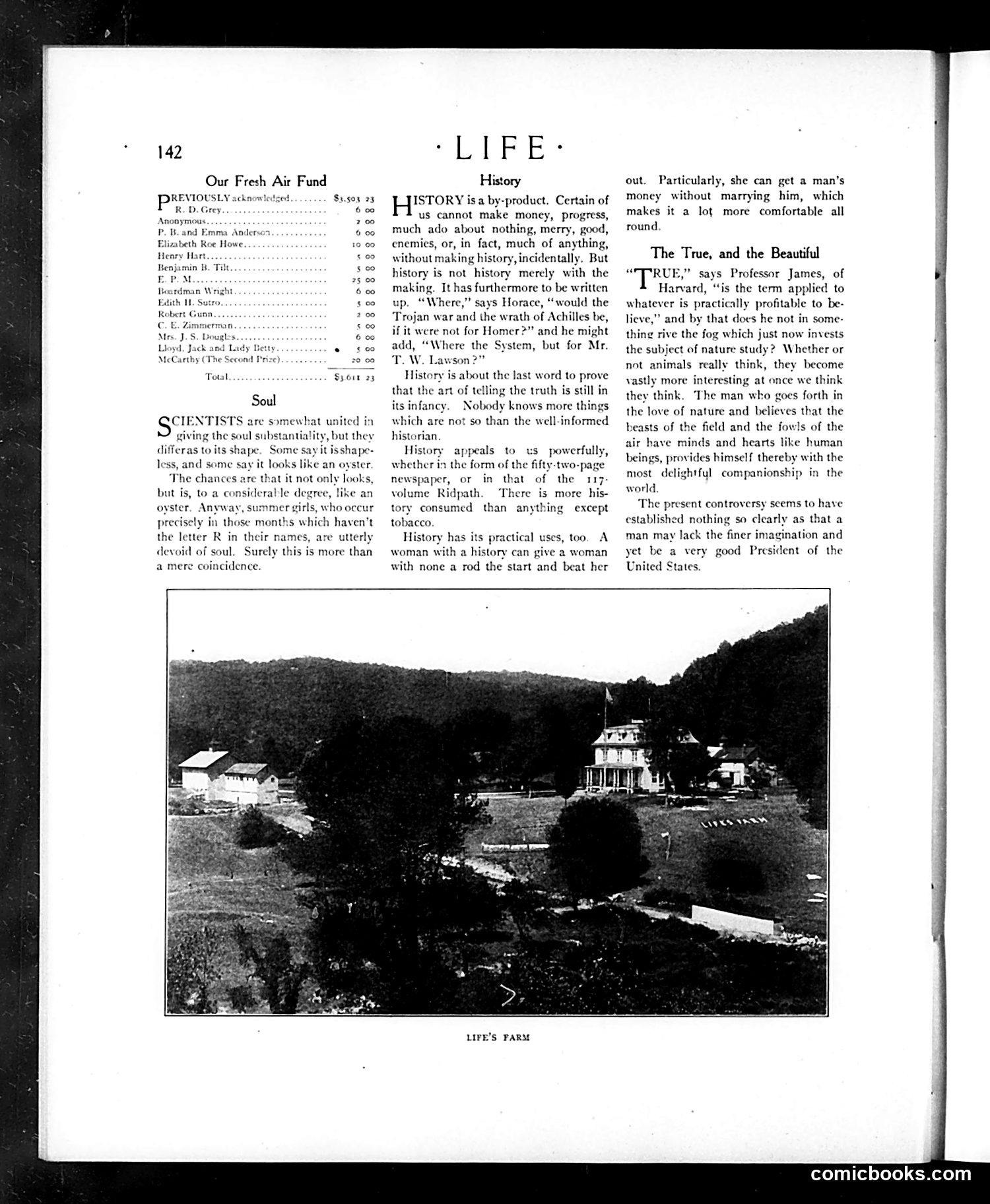
This page contains three satirical sections rather than a traditional cartoon. **"Our Fresh Air Fund"** lists donors to a charitable program, likely mocking wealthy philanthropists' modest contributions. **"Soul"** is a brief humorous essay mocking scientists' attempts to define the soul's physical nature, then pivots to a sexist joke: "summer girls" (unmarried women) lack souls because their names lack the letter "R" (a pun on the old adage about eating oysters only in months with "R"). **"History"** satirizes how history depends on storytellers (referencing Homer and the Trojan War) rather than objective truth, and notes historians often report things "which are not so." It also contains a cynical observation about women: a woman "with a history" (implying sexual scandal or loose morality) could extract money from men without marriage—presenting infidelity as practical advantage. **"The True, and the Beautiful"** references William James's pragmatism, suggesting belief in animal consciousness enriches nature study regardless of truth. The final jab appears directed at Theodore Roosevelt or a contemporary political figure, suggesting refined imagination isn't required for the presidency.
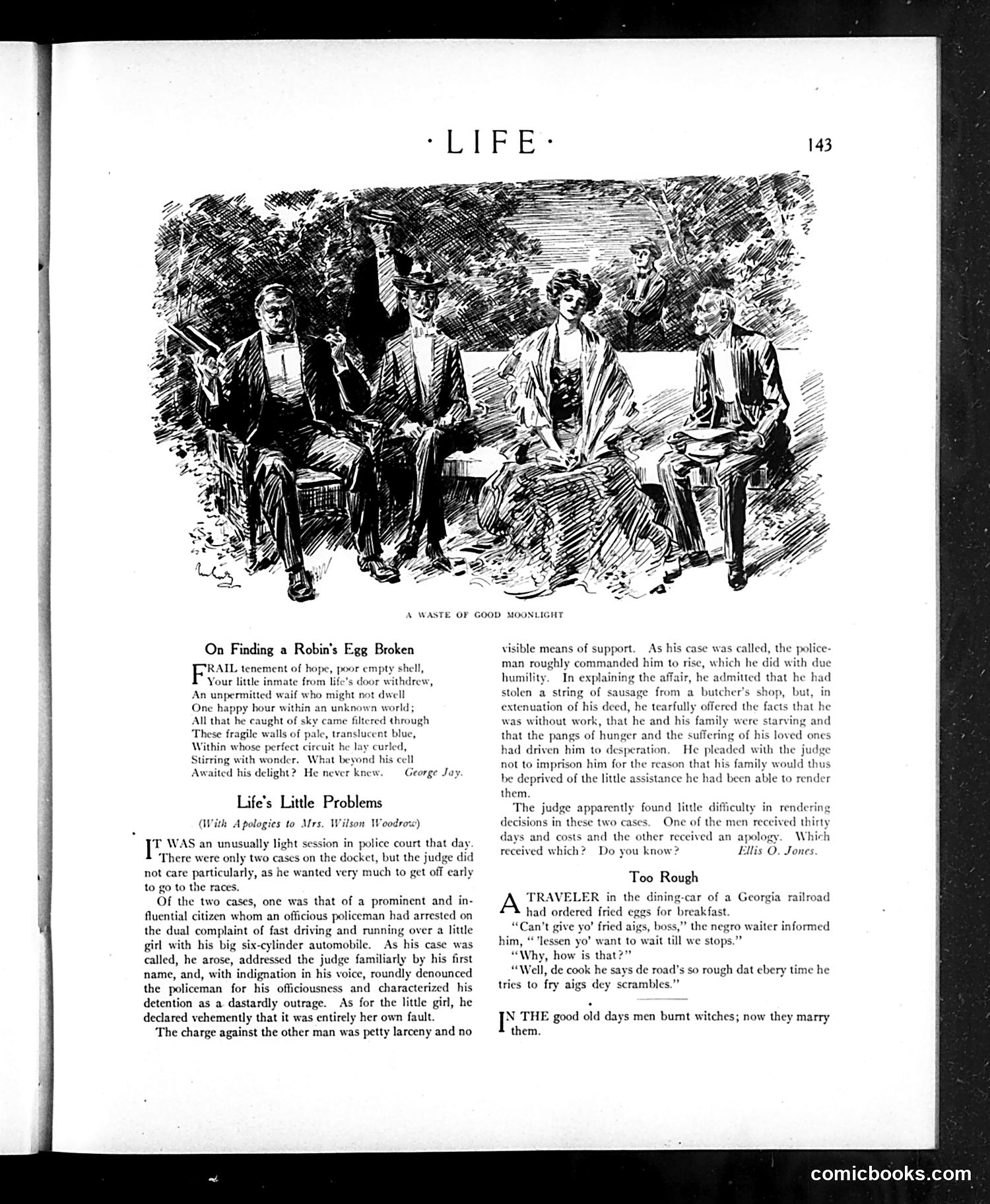
This page contains three distinct pieces of social satire: **"A Waste of Good Moonlight"** is a sentimental poem about a broken robin's egg, using the dead chick as a metaphor for wasted potential and life denied to the poor. **"Life's Little Problems"** is the main satirical piece. It contrasts two men in police court: a wealthy, prominent citizen arrested for reckless driving and hitting a child responds with indignation and blames the victim—and receives an apology. A poor man arrested for stealing sausage to feed his starving family receives thirty days in jail. The piece mocks the obvious hypocrisy of a judicial system that favors the rich and powerful while punishing the desperate poor for survival crimes. The caption asks readers to guess which man received which sentence—the answer being painfully obvious. **"Too Rough"** is a brief comedic anecdote about a Georgia railroad diner where the cook cannot fry eggs because the train's rough ride makes them scramble—a dialect-humor joke typical of the period.
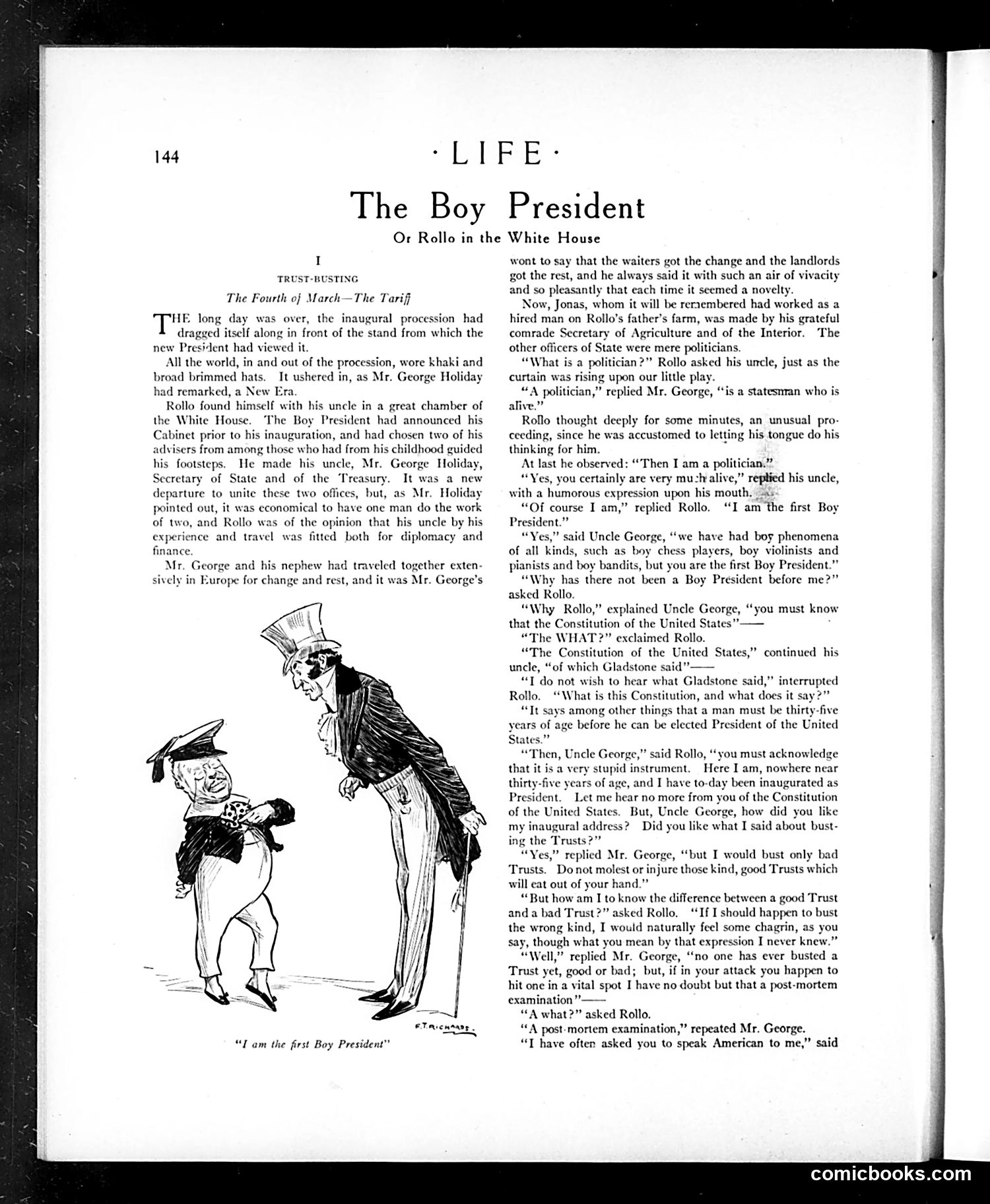
This is a satirical story mocking Theodore Roosevelt's presidency (he became president at 42, relatively young). "Rollo," a naive boy-president, represents Roosevelt's impetuous, reform-minded approach. The cartoon depicts Uncle Sam (the tall figure) with young Rollo, illustrating their power dynamic. The satire targets Roosevelt's famous "trust-busting" campaign—his aggressive antitrust policies. The joke: Uncle George (likely representing conservative Republican advisors) warns Rollo to bust only "bad Trusts" that don't help him, implying Roosevelt's trust-busting was selective and politically motivated rather than principled. Rollo's ignorance of the Constitution and inability to distinguish good from bad trusts mocks Roosevelt as reckless and philosophically shallow—a dangerous child wielding executive power. The piece satirizes Roosevelt's reformist zeal as immature and lacking proper understanding of governance or constitutional limits.
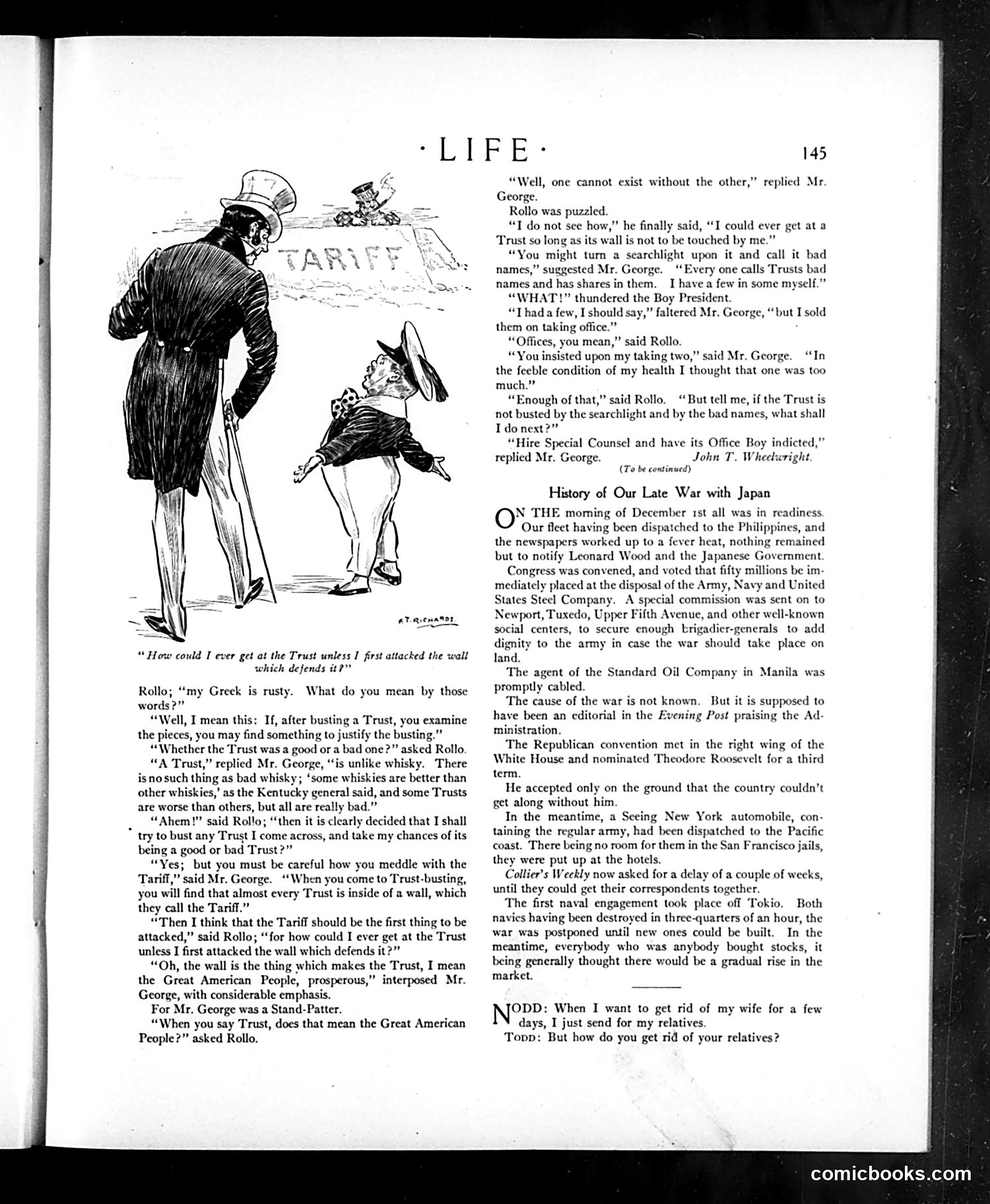
This page contains two satirical pieces from *Life* magazine attacking early 20th-century American politics. **The cartoon** (top) depicts "Mr. George" (likely Henry George, the economist/reformer) debating "Rollo" (possibly representing President Theodore Roosevelt, called "the Boy President" in the text). The satire mocks protectionist Republican politicians who claim to oppose monopolistic "Trusts" while defending the protective tariff that actually enables them. Mr. George represents the "Stand-Patter"—someone who talks tough on trusts but protects them through tariff walls. The absurd dialogue exposes the contradiction: you can't break up trusts without removing tariff protections, yet defenders claim the tariff makes America prosperous. **"History of Our Late War with Japan"** (below) is satirical mock-history ridiculing American imperialism, corporate influence (Standard Oil, U.S. Steel gaining war appropriations), and military excess—commissioning unnecessary generals for "dignity." Both pieces critique corporate-friendly Republican policies masked by reform rhetoric.
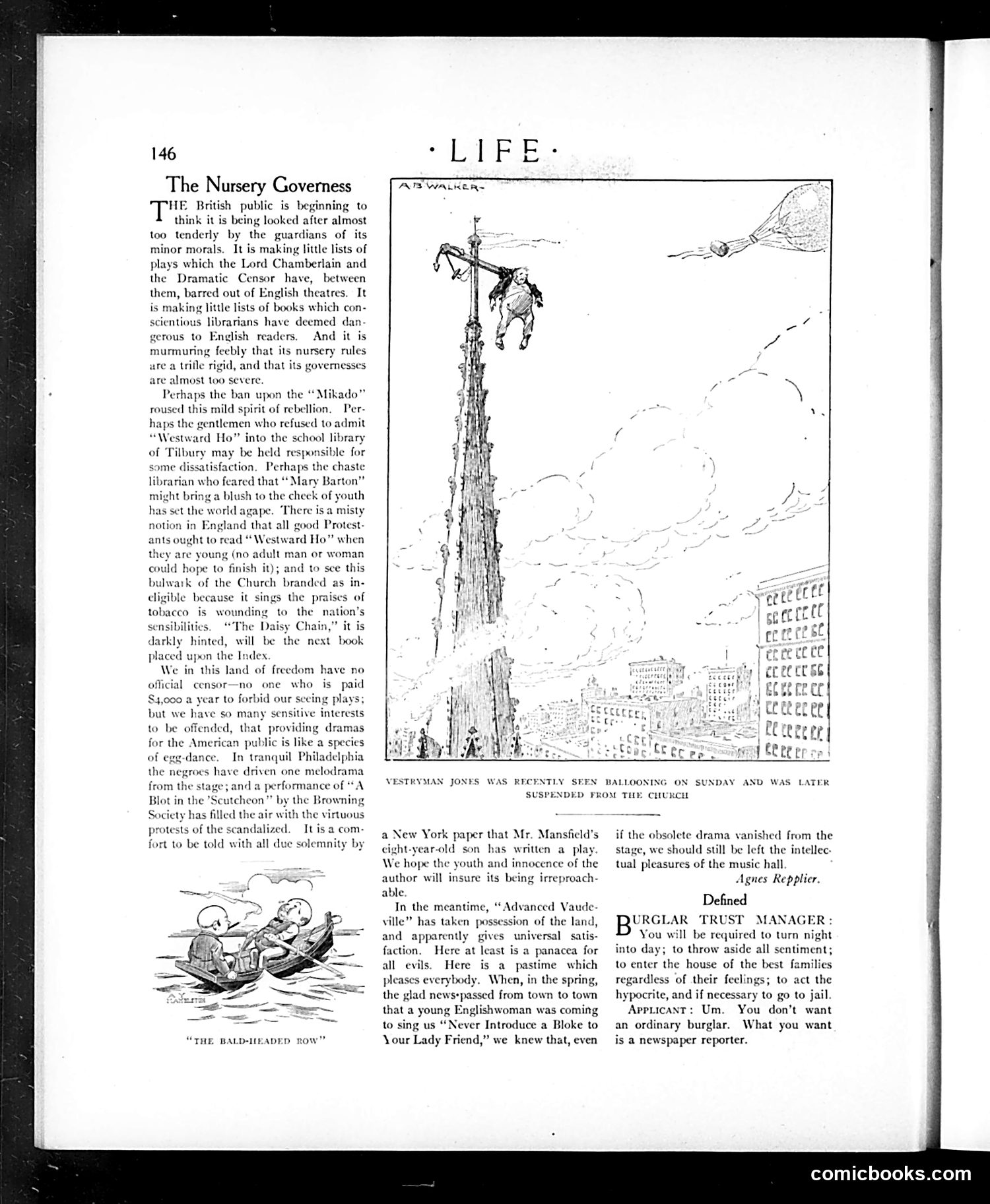
This page satirizes moral censorship in both Britain and America. The main article, "The Nursery Governess," critiques how authorities treat the public like children requiring protection from "dangerous" literature and theater. It references real censorship cases: Britain's banning of "Westward Ho" and "Mary Barton," and American sensitivity that led to removing a melodrama featuring African American performers and objections to Browning Society performances. The top cartoon depicts a man ("Vestryman Jones") suspended from church for the transgression of hot-air ballooning on Sunday—satirizing rigid religious moralism. The bottom cartoon is a "Help Wanted" joke defining a "Burglar Trust Manager" position that requires the ruthlessness of a burglar but claims the applicant should actually be a newspaper reporter—mocking journalists as unethical operatives willing to invade privacy and break rules. Both critique excessive moral gatekeeping.
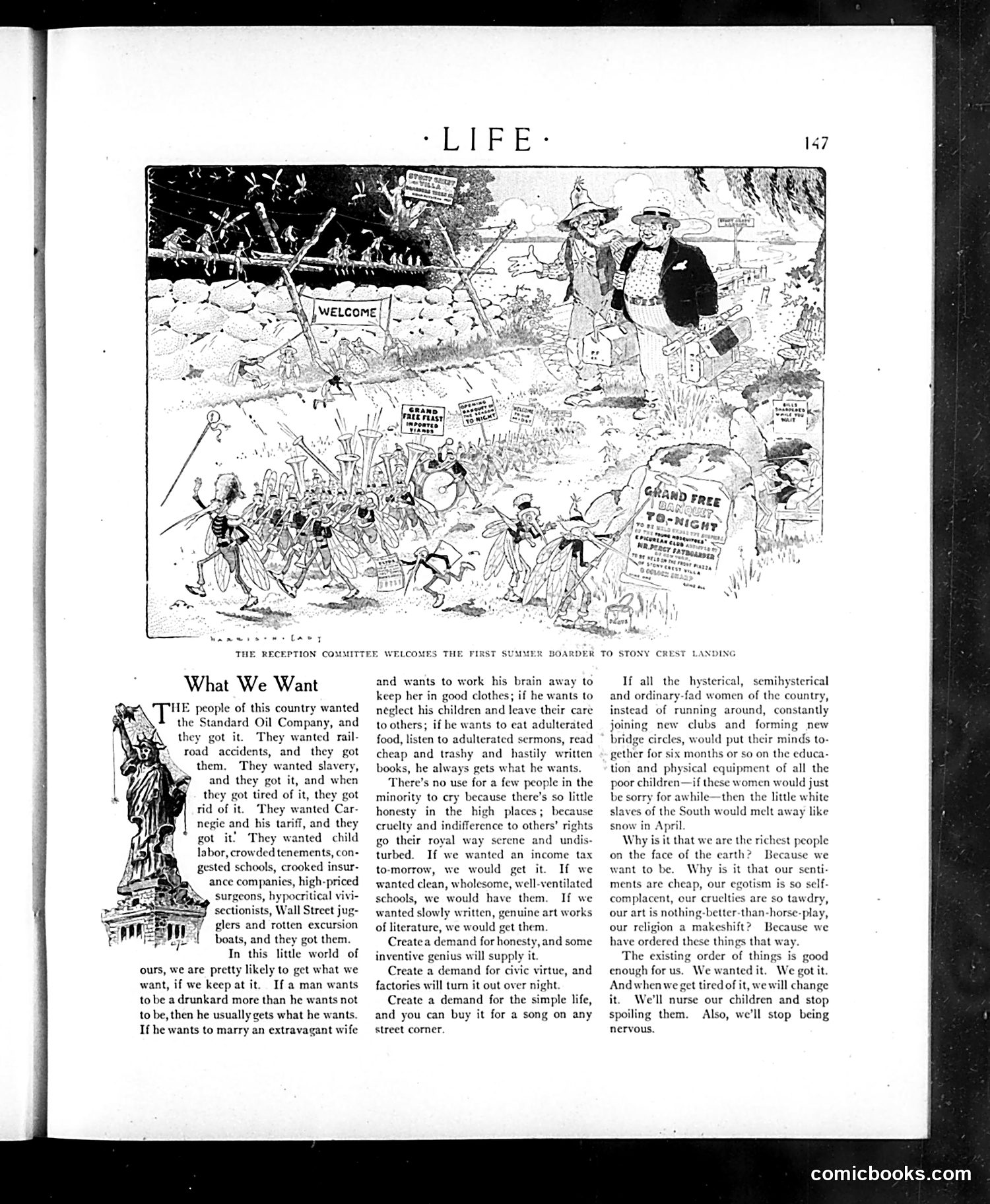
The cartoon depicts a chaotic seaside scene welcoming a summer boarder to "Stony Crest Landing," with townspeople in disarray—likely satirizing the commercialization and social disorder of resort culture. The accompanying essay is a scathing critique of American complacency and materialism. The author argues that Americans get exactly what they deserve because they *want* it: Standard Oil monopolies, railroad accidents, child labor, tenement housing, and corruption in high places. The satire's point: rather than blaming external forces, Americans should recognize their collective complicity. The wealthy are spiritually bankrupt (pursuing shallow clubs and bridge circles instead of helping poor children), and society tolerates mediocrity because it's convenient. The author suggests this can change—but only if Americans genuinely *demand* honesty, virtue, and the "simple life" instead of accepting the status quo. It's a damning indictment of Gilded Age materialism and apathy dressed as social commentary on personal responsibility.
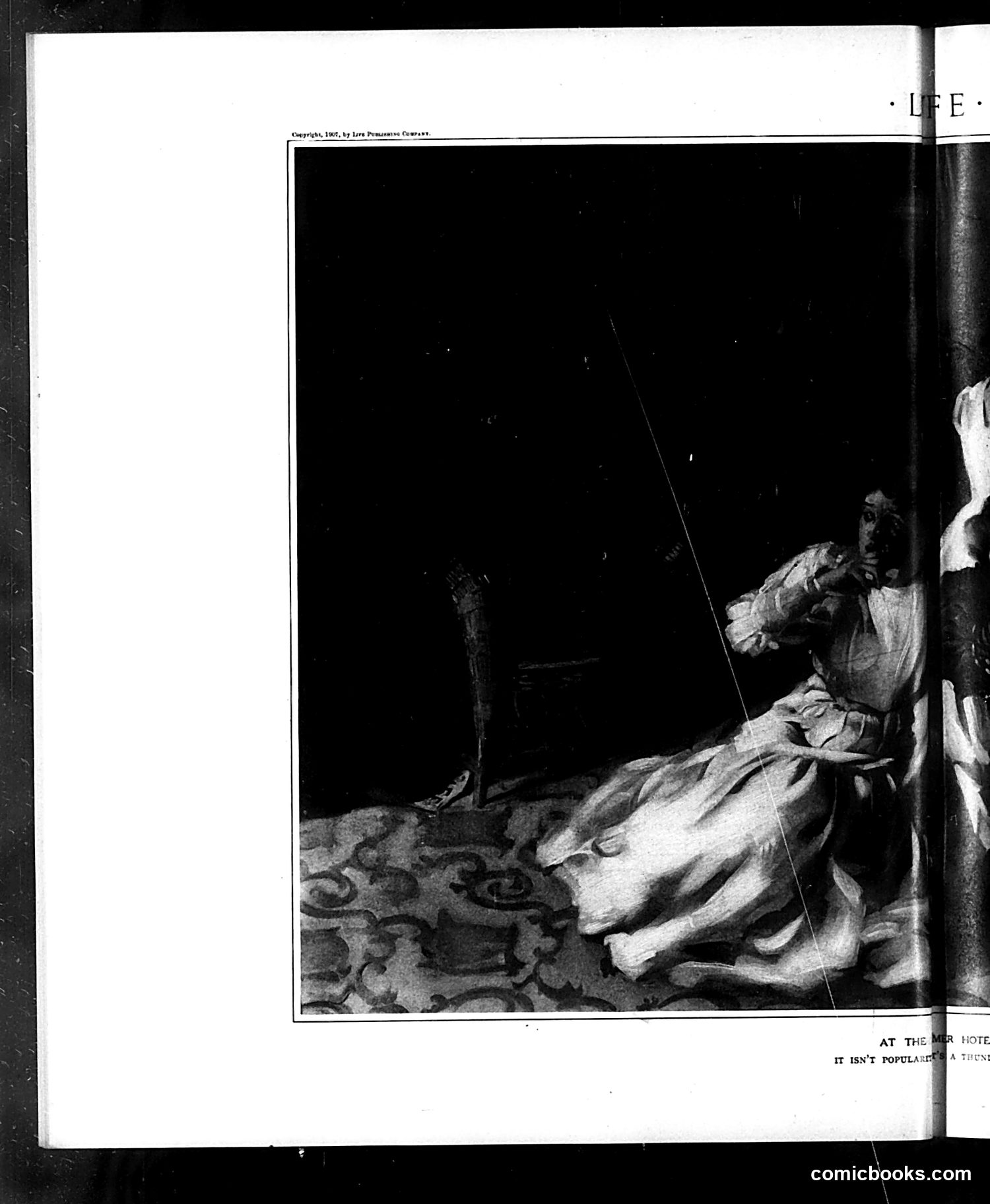
This appears to be a satirical illustration from *Life* magazine showing a figure reclining or resting, with another figure attending to them. The caption reads "AT THE [unclear] NOTE" with partial text "IT ISN'T POPULARES[?]" The OCR is too corrupted to confidently identify the specific political or social reference. The image quality and incomplete caption make it difficult to determine which public figures are depicted or what contemporary event is being satirized. The pose suggests commentary on leisure, illness, or indulgence, but without clearer text or context, identifying the specific targets and satirical point would require speculation beyond what the page supports. The magazine's 1962 copyright indicates this reflects mid-20th century American politics, but the specific satire remains unclear from this fragment.
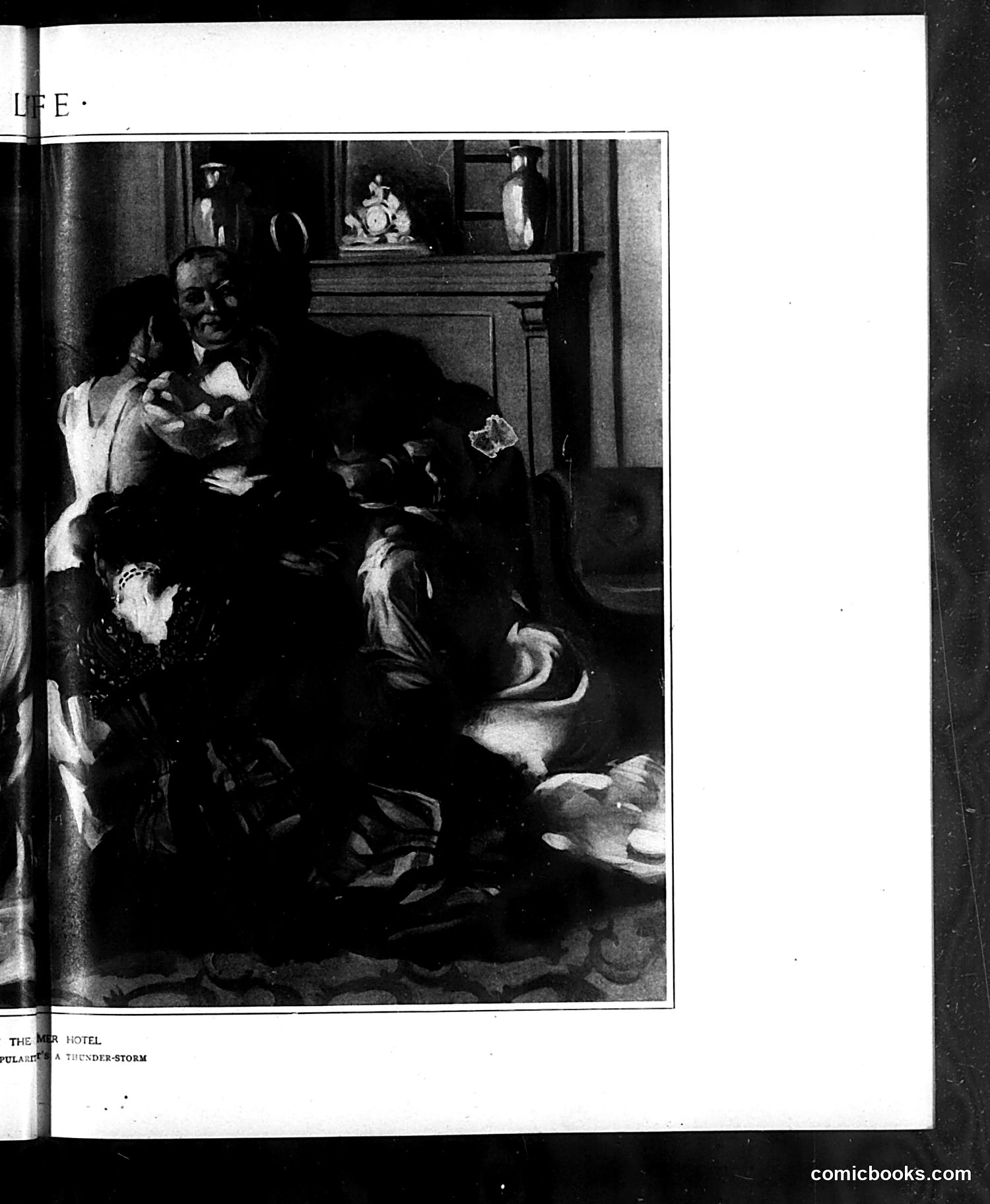
This appears to be a page from *Life* magazine featuring a dramatic indoor scene. The OCR text provides minimal information—only "THE [?] HOTEL" and "PULP[?] A THUNDER-STORM" visible at the bottom. The black-and-white photograph shows a man in formal dress (suit, glasses) seated indoors, with what appears to be multiple figures around him in an agitated or theatrical pose. A mantelpiece with decorative objects is visible in the background. Without clearer text or caption information, I cannot definitively identify the specific political or social reference this satirizes. The dramatic staging and formal setting suggest it may be commenting on a particular scandal, social situation, or public figure of the era, but I cannot accurately specify which without risking inaccuracy.
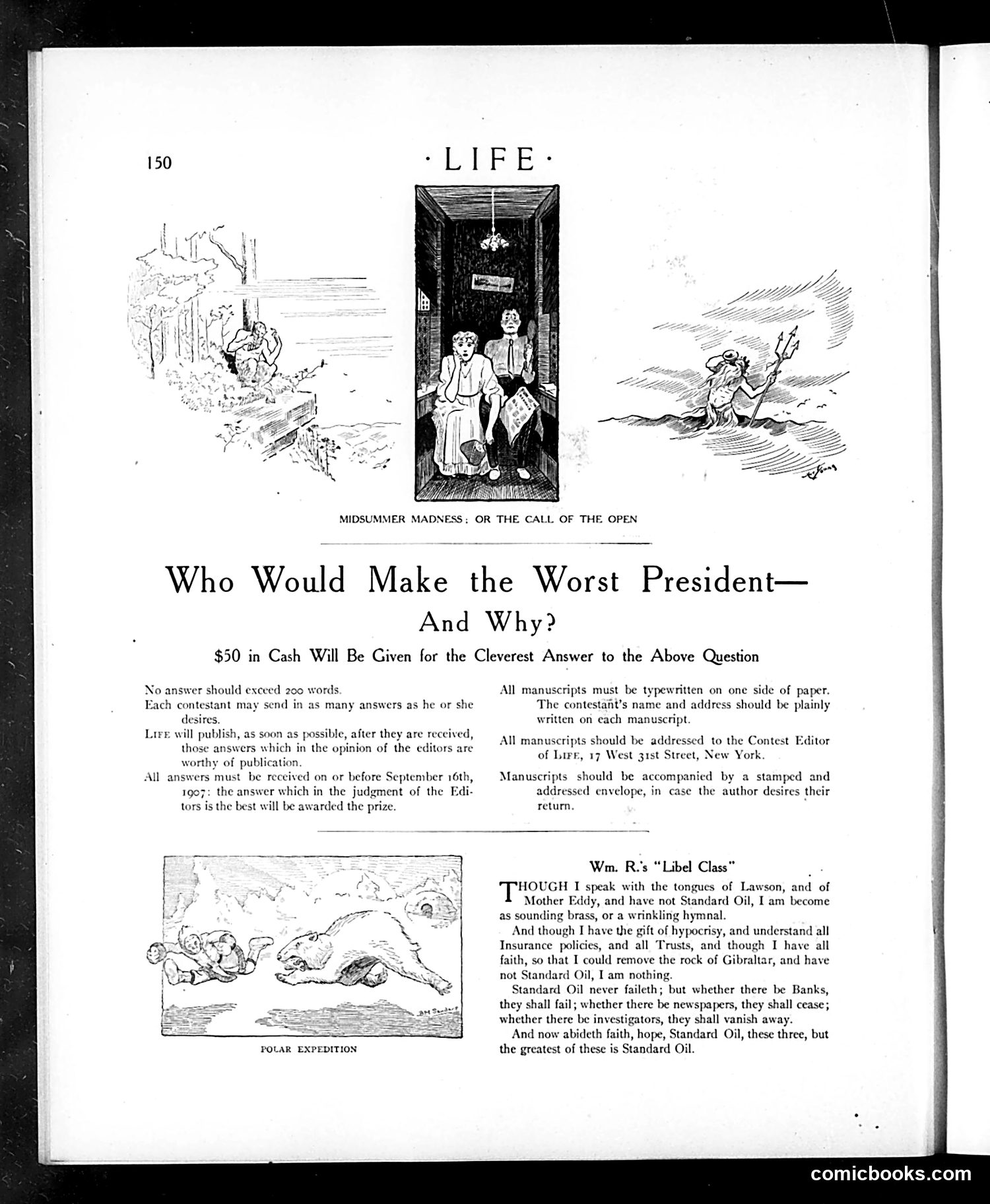
This page announces a $50 contest asking readers "Who Would Make the Worst President—And Why?" The timing (September 16, 1907 deadline) suggests this appeared during Theodore Roosevelt's presidency. The accompanying satirical poem by "Wm. R." mocks Standard Oil's dominance in American life, parodying Biblical language (1 Corinthians 13) to suggest that Standard Oil is more powerful and enduring than banks, newspapers, and government investigators. The references to "Lawson" (likely Thomas Lawson, a muckraking journalist) and "Mother Eddy" (Mary Baker Eddy, Christian Science founder) indicate contemporary figures involved in public controversies. The cartoons—"Midsummer Madness," "Call of the Open," and "Polar Expedition"—appear thematically related to escape or flight, possibly suggesting the absurdity of seeking refuge from America's powerful corporate interests. The satire reflects Progressive Era anxieties about unchecked corporate power.
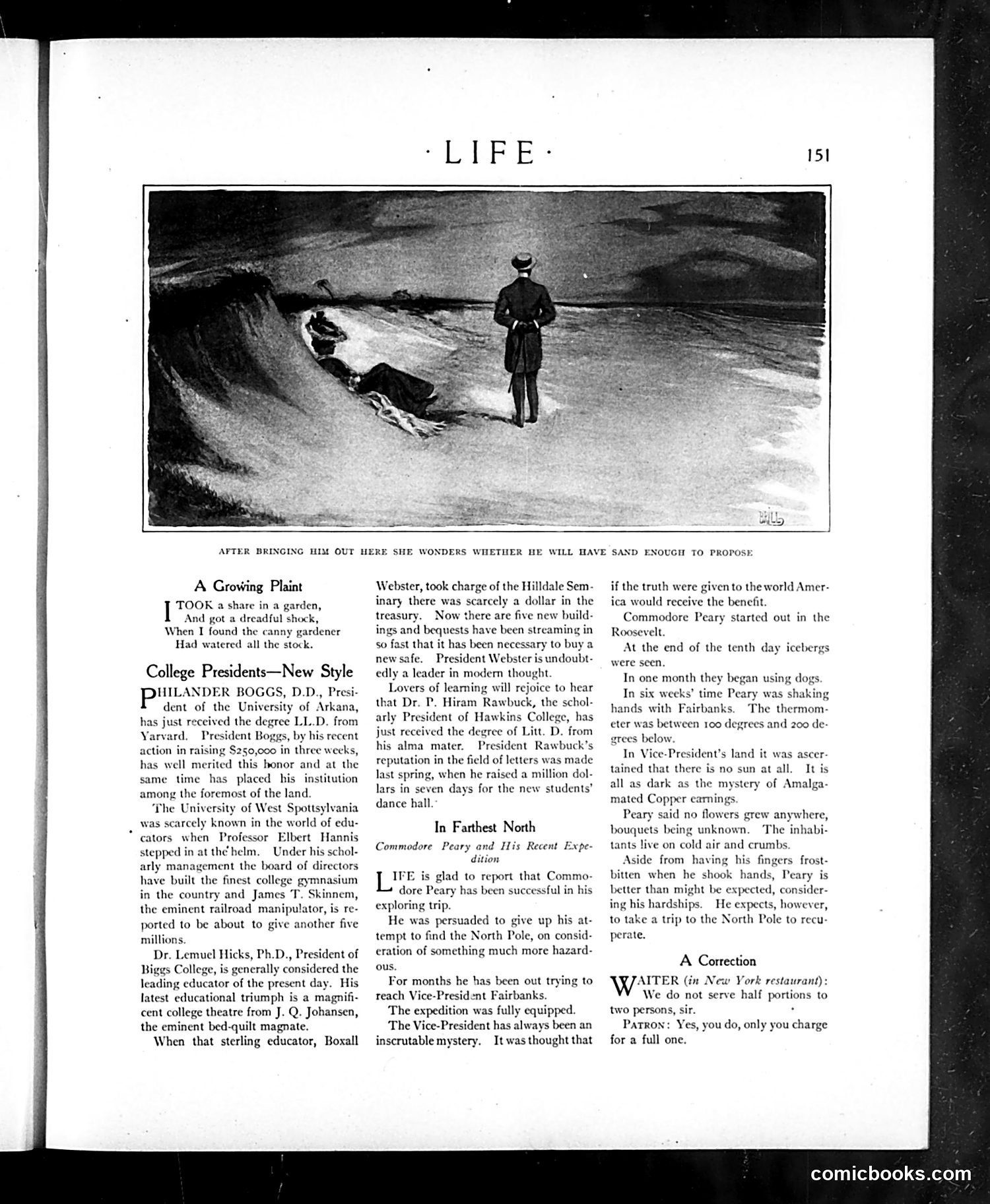
This page contains several satirical pieces mocking early 1900s American institutions: **"College Presidents—New Style"** ridicules university leaders who measure success by fundraising rather than education. The fictional presidents (Boggs, Hannis, Webster, Rawbuck) are praised absurdly for raising money—one raised a million dollars in a week *for a dance hall*. The satire suggests that wealthy donors, not scholarship, now define institutional prestige. This reflects real concerns about commercialization of higher education. **"Commodore Peary and His Recent Expedition"** is a joke about Vice-President James Sherman (identified as "Fairbanks" in the text, likely an OCR error). Finding the VP is humorously presented as harder than reaching the North Pole. The reference to "Amalgamated Copper earnings" suggests mystery/secrecy around corporate finances—possibly alluding to Sherman's business connections. The satire implies the VP is obscure and politically irrelevant. **The illustration** shows a couple on a beach; the caption suggests romantic uncertainty about a proposal.
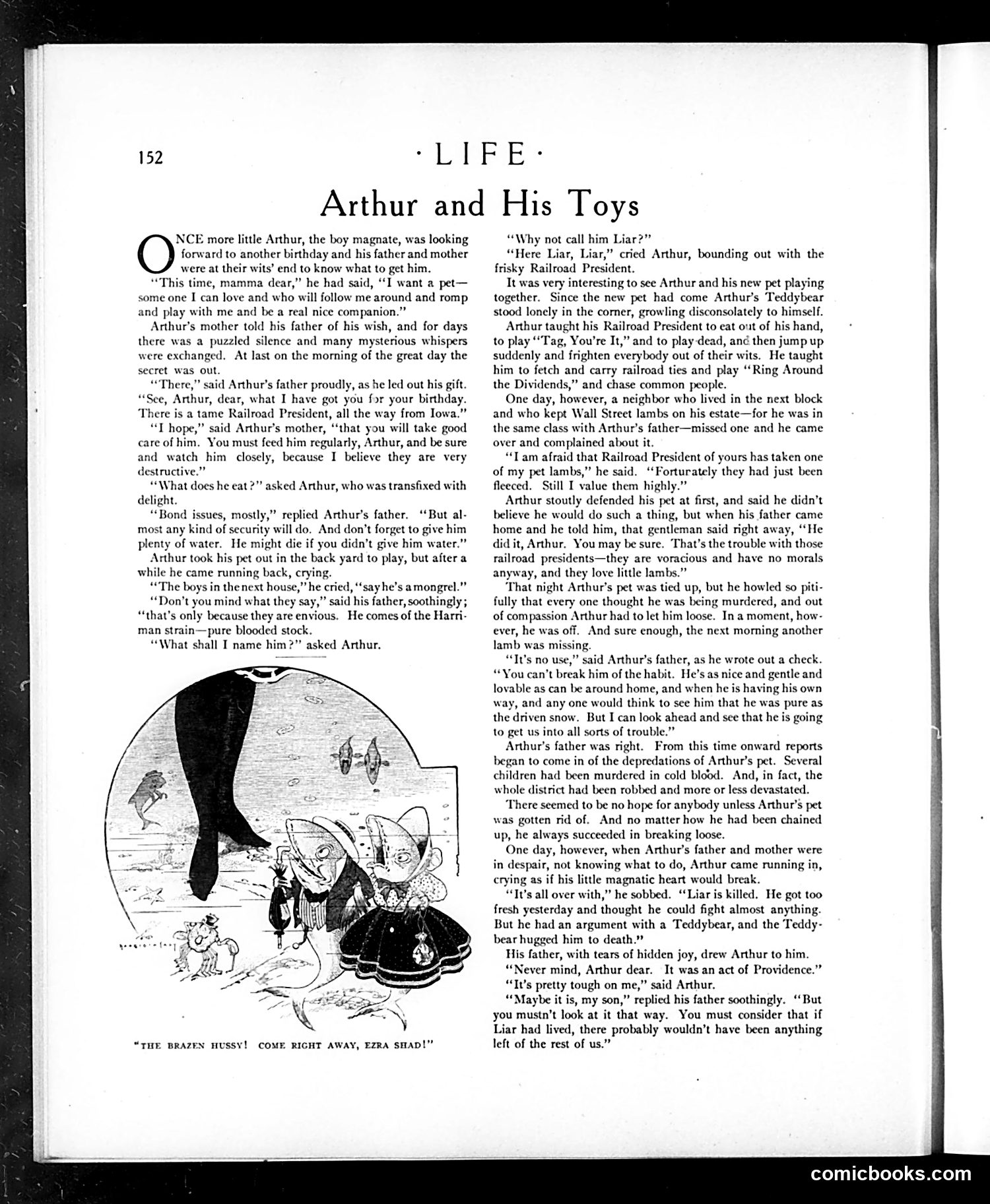
This 1906 Life magazine story satirizes corrupt railroad magnates through the conceit of a boy receiving a "tame Railroad President" as a pet. The railroad executive—named "Liar" and bred from the "Harriman strain"—symbolizes real railroad barons like E.H. Harriman who dominated American industry. The satire works by treating the railroad president as a dangerous animal: he eats "bond issues," is inherently destructive and immoral ("they are voracious and have no morals"), and cannot be reformed despite appearing genteel. His killing of neighboring lambs (the common people being "fleeced") represents how railroad monopolies victimized ordinary citizens through predatory practices. The cartoon criticizes both the railroad oligarchy itself and the wealthy fathers who enabled their power. It's satire aimed at exposing corporate corruption and exploitation during the Progressive Era.
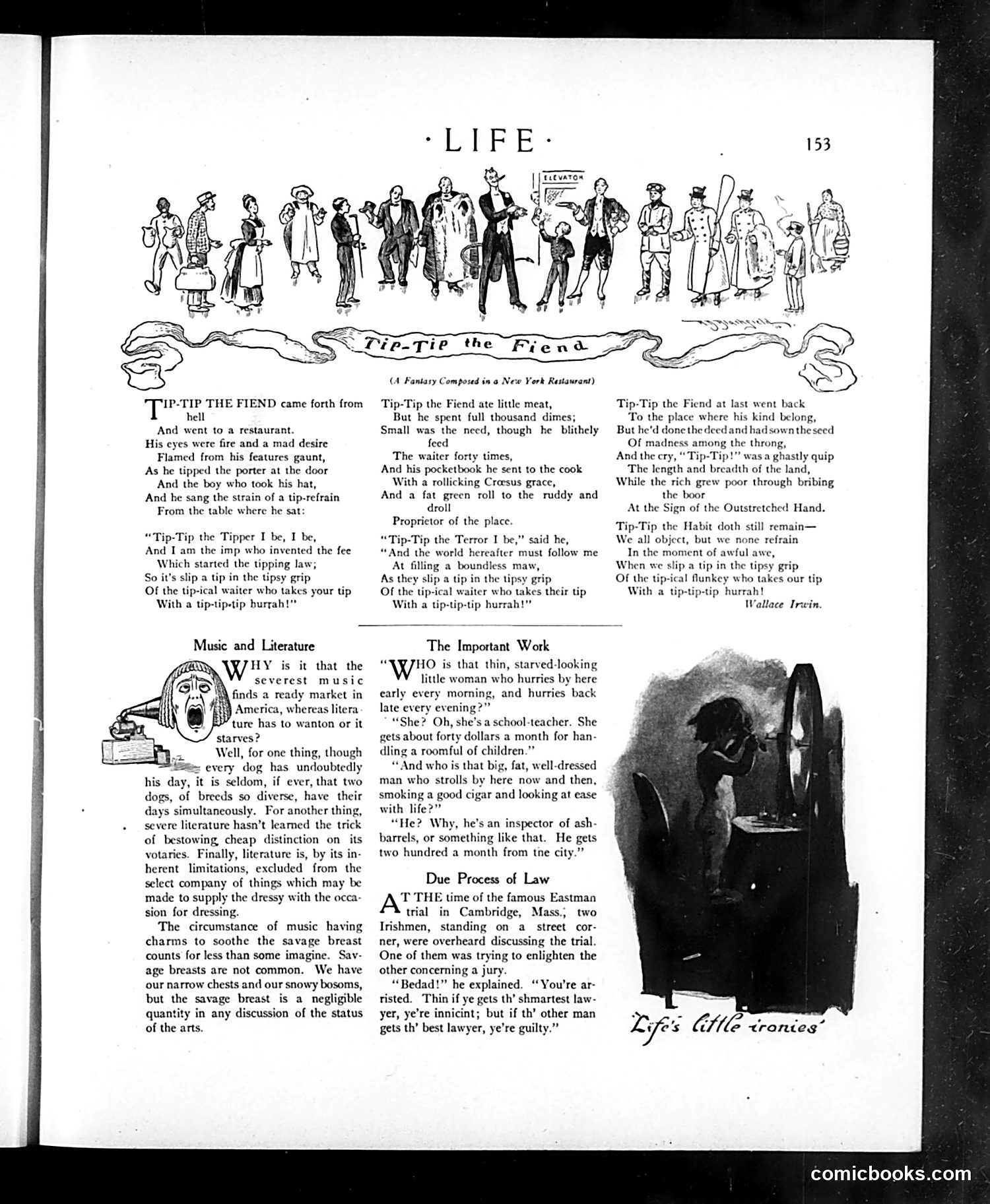
This page contains three distinct satirical pieces critiquing American social practices and inequities: **"Tip-Tip the Fiend"** (main narrative poem with illustrations): A fantasy mocking the American tipping culture. The demon "Tip-Tip" personifies the tipping system itself, portrayed as a corrupting force spreading through restaurants. The satire suggests tipping has become excessive and obligatory—a parasitic "law" extracting money from diners. The verse ridicules how restaurant workers extract tips while the wealthy grow poor paying bribes to service staff. **"Music and Literature"**: Commentary on why popular music thrives while serious literature struggles in America. The piece argues music offers "cheap distinction" to wealthy patrons seeking social status, while literature lacks comparable appeal to the fashionable classes. **"Due Process of Law"**: A brief Irish-immigrant dialogue joke about jury trials, suggesting the outcome depends solely on which lawyer is better—implying justice is arbitrary rather than based on actual guilt or innocence. All three pieces target economic inequality, social pretense, and systemic unfairness in early-20th-century America.
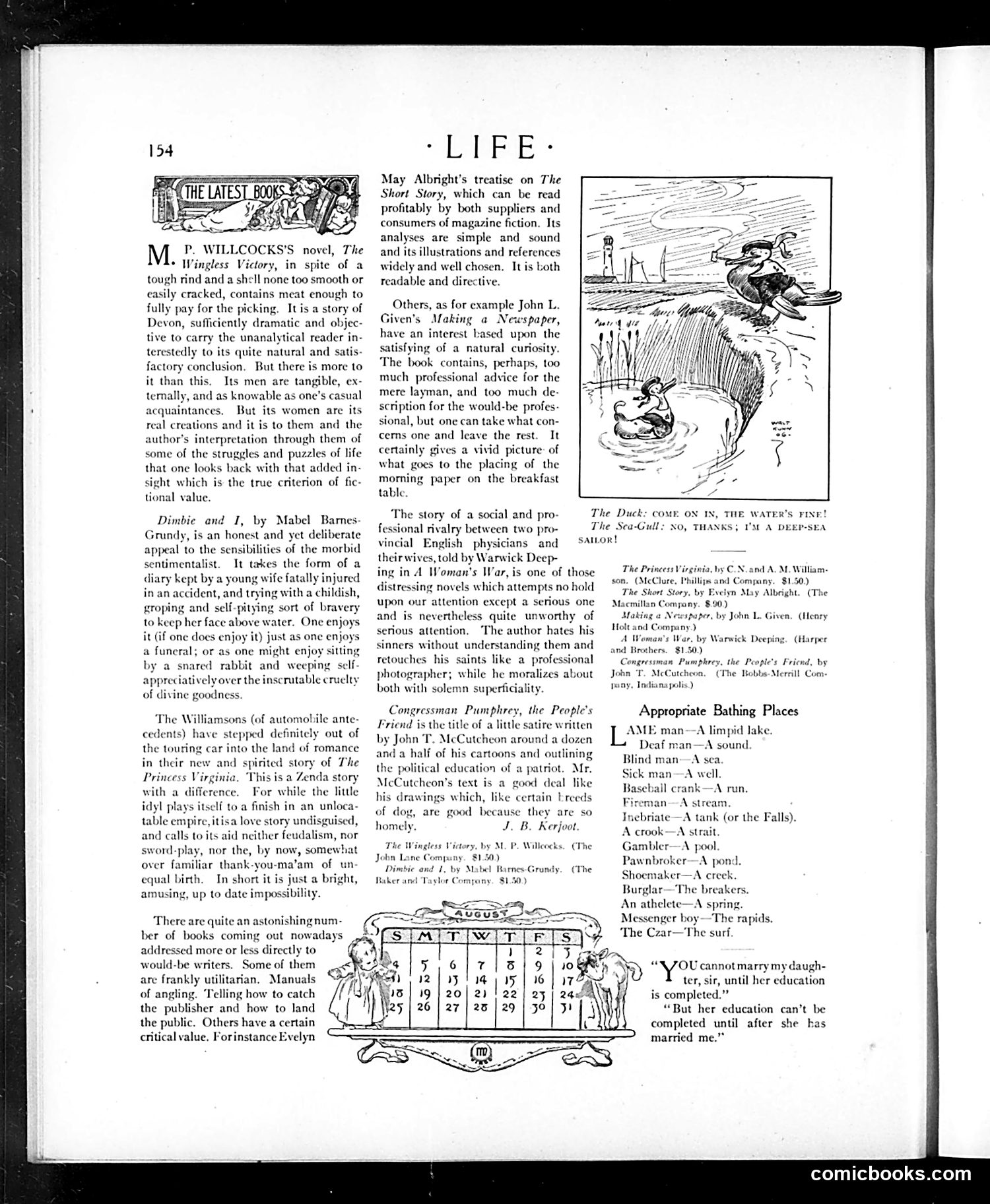
This page contains book reviews and a cartoon. The main cartoon shows "The Sea-Gull"—a duck refusing assistance from a sailor with the caption "NO, THANKS; I'M A DEEP-SEA SAILOR!" The joke relies on wordplay: the duck claims to be a "deep-sea sailor" when actually it's just a waterfowl, playing on the absurdity of the bird's pretension and self-importance. The page reviews several contemporary novels, criticizing their quality. Notably, it praises female characters in some works while dismissing "Woman's War" as moralistic drivel where the author "hates his sinners" and "retouches his saints like a professional photographer"—satirizing superficial moral posturing in literature. The final section lists humorous "Appropriate Bathing Places" for various professions (e.g., "Fireman—A stream"), functioning as light social satire about occupational stereotypes.
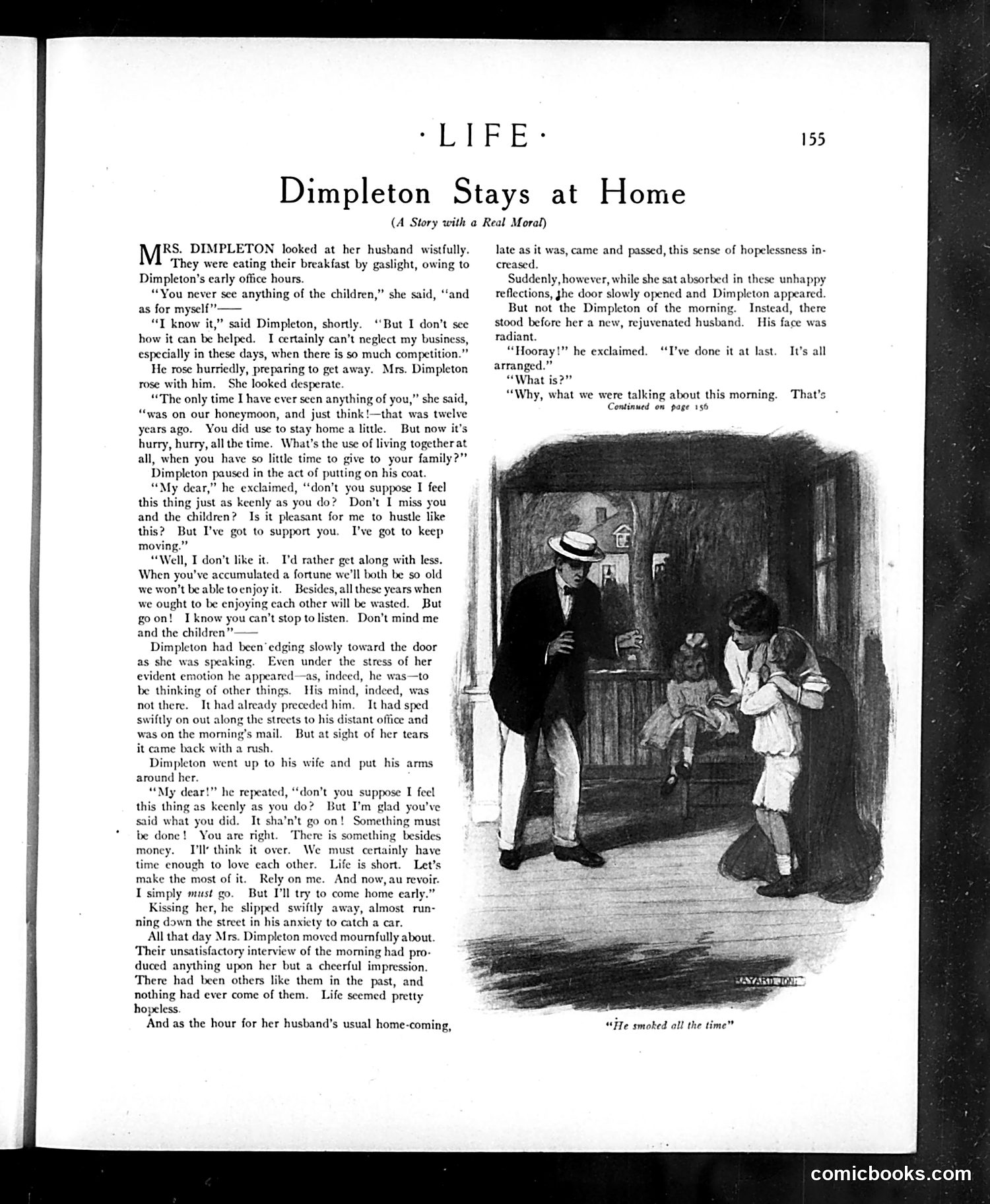
This satirical story illustrates the tension between industrial-era ambition and family life. Mr. Dimpleton, a businessman, works obsessively, claiming competition demands it. His wife protests that he's absent from their children and marriage—they've barely spent time together since their honeymoon twelve years prior. When confronted with her unhappiness, Dimpleton promises change, claiming "something must be done," then immediately rushes off to work anyway. The illustration shows him departing despite his professed commitment. The satire targets the hypocrisy of men who verbally acknowledge family importance while their actions prioritize business relentlessly. The caption "'He smoked all the time'" (visible in the illustration) reinforces the portrait of distracted domesticity—even when present, he's mentally absent. The story's "real moral" critiques how modern commercial competition erodes family bonds, with Dimpleton's promises ringing hollow.
This page presents a domestic comedy satirizing middle-class hypocrisy and marital dishonesty. Mr. Dimpleton claims to be taking time off work to bond with his family and become a "home-loving" husband. However, the satire reveals his true nature: he immediately retreats to smoke cigars secretly in the library, lying to his wife that he only smokes one cigar daily when he actually smokes ten. The joke exposes the performative nature of domesticity—Dimpleton pretends to embrace family life while maintaining his actual habits through deception. His wife, Mrs. Dimpleton, remains oblivious, accepting his transparent lies about office exhaustion justifying his Sabbath cigar consumption. The humor targets the gap between Victorian ideals of devoted husbandhood and the reality of men prioritizing personal habits and leisure over genuine domestic engagement. It's a critique of masculine dishonesty within marriage and the compartmentalization of domestic versus "real" life.
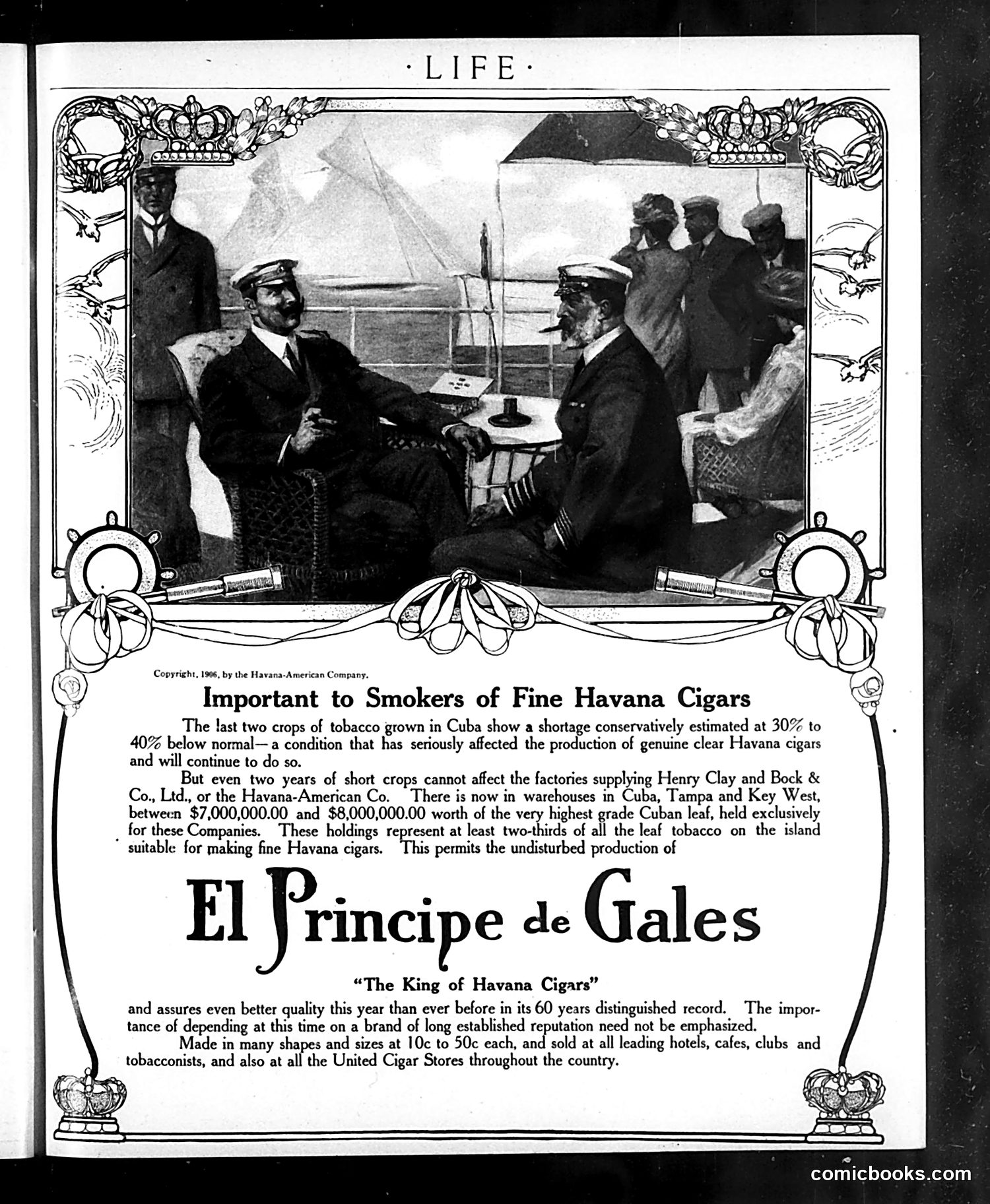
This is primarily a **cigar advertisement**, not political satire. The page features an illustration of what appear to be naval or business officials in conversation aboard a ship, framed with decorative maritime elements. The ad addresses a real economic concern: Cuban tobacco crop failures (30-40% shortage) that threatened Havana cigar production around 1906. The manufacturers of "El Príncipe de Gales" (The King of Havana Cigars) use this crisis as a marketing opportunity, claiming exclusive access to $7-8 million worth of premium Cuban leaf stored in Cuba, Tampa, and Key West—representing two-thirds of the island's suitable tobacco. The message: while competitors will suffer shortages, this brand's established reputation and stockpiles guarantee quality and availability. The nautical imagery suggests reliability and established trade networks. This reflects early 20th-century American prosperity and access to Cuban resources before the 1959 revolution ended such trade.
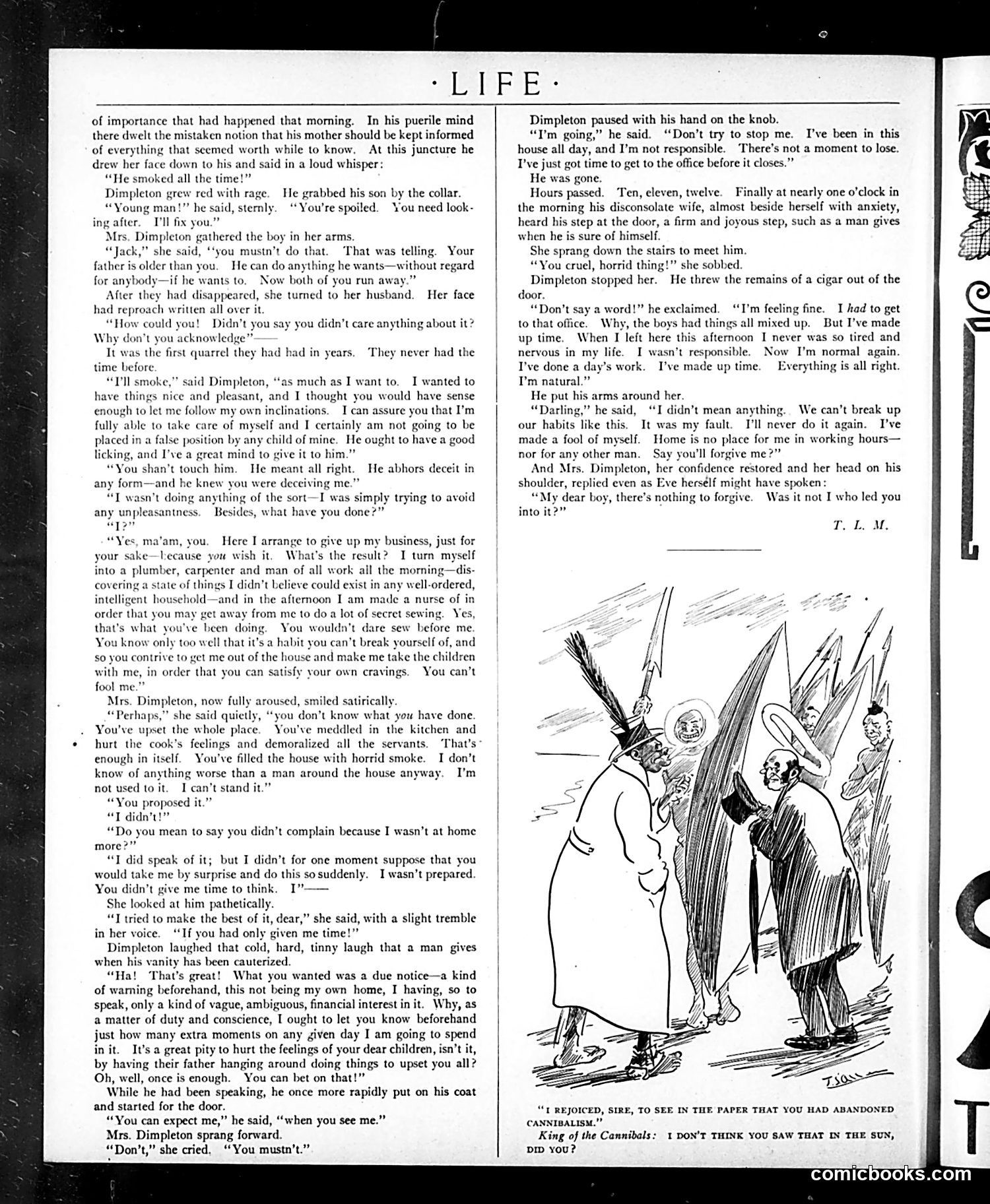
This cartoon illustrates the story's conclusion, depicting a domestic dispute resolved through absurdist humor. The sketch shows figures in what appears to be a tropical or primitive setting, captioned with dialogue about "abandoning cannibalism" and seeing something in a newspaper. The joke likely satirizes the central marital conflict: Mr. Dimpleton's attempt to participate in household life backfired so spectacularly that the couple has fled civilization entirely. The "cannibals" reference suggests they've regressed to primitive society—the ultimate consequence of his well-intentioned but disastrous domestic intervention. This reflects *Life* magazine's satirical stance on gender roles and marriage: the story mocks both Dimpleton's bumbling incompetence at "women's work" and Mrs. Dimpleton's manipulative resistance to his presence. The cartoon's punchline suggests that domestic chaos is so destructive that escape to savagery seems preferable—a darkly comic commentary on American middle-class marriage.
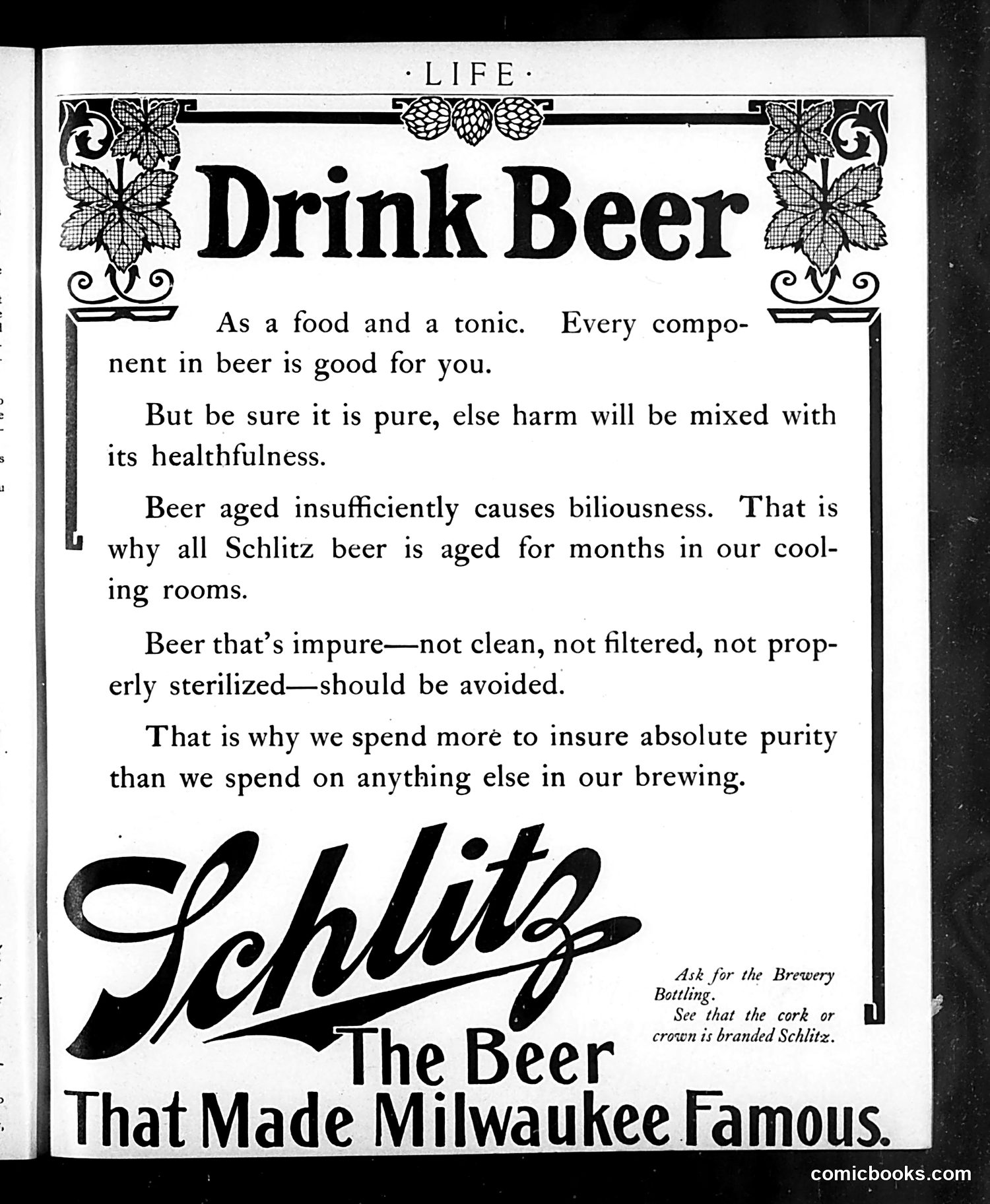
This is a **Schlitz beer advertisement**, not satire or political commentary. It appears in *Life* magazine and promotes beer as a health product—common marketing in the early 20th century before modern food and drug regulations. The ad makes health claims now considered absurd: beer as "food and a tonic" with beneficial components. It emphasizes **purity and aging** as Schlitz's competitive advantage, claiming superior filtration and sterilization prevent "biliousness" (digestive upset). The tagline "The Beer That Made Milwaukee Famous" references the city's prominent brewing industry. The decorative hop illustrations reinforce the brewing theme. A note instructs buyers to verify authenticity via branded corks or crowns—suggesting counterfeit beer was a concern. Modern readers would recognize this as predatory health marketing that exploited lack of FDA oversight, presenting alcohol as medicinal rather than intoxicating.
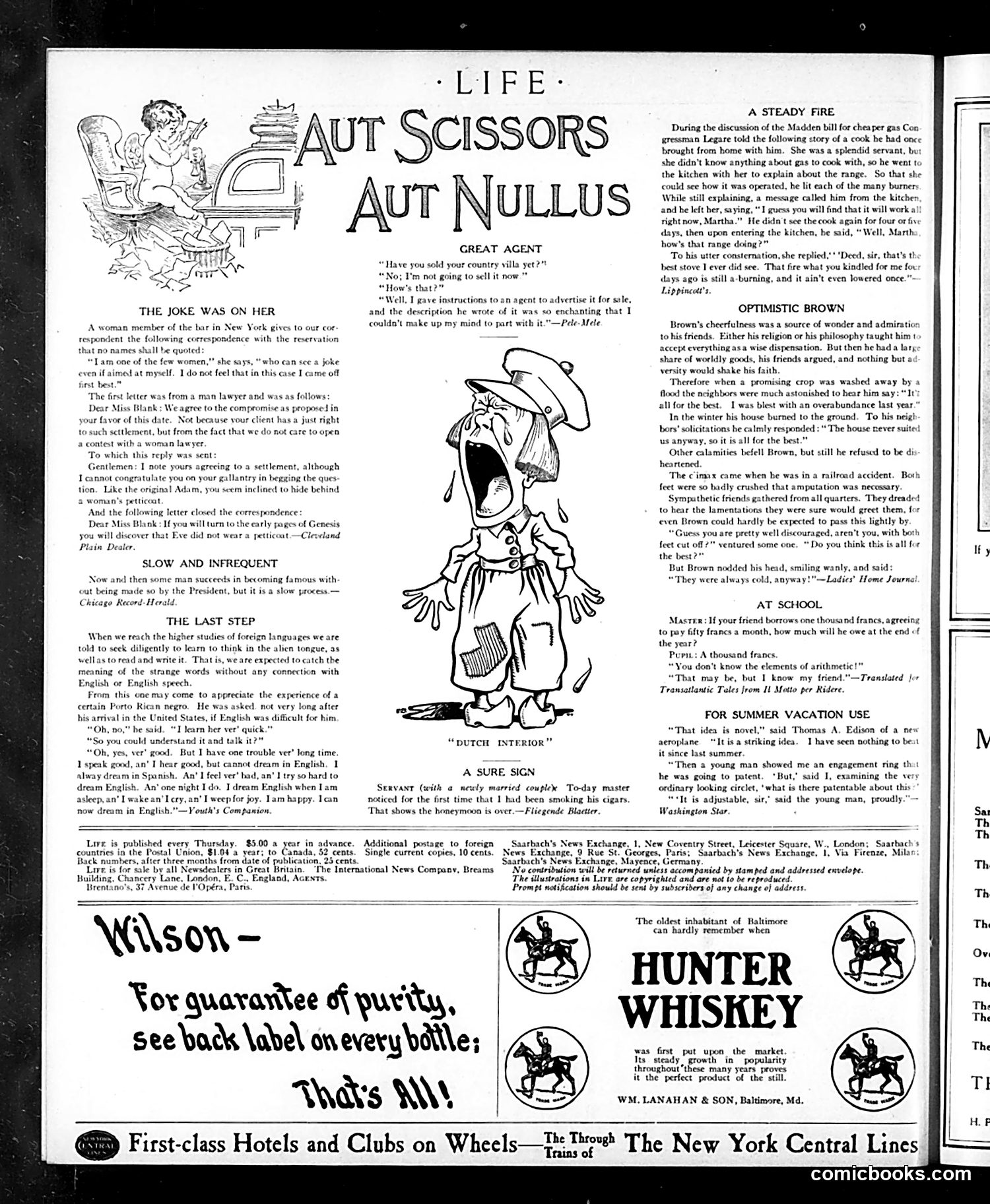
This page contains several short humorous anecdotes and advertisements from Life magazine (an early 20th-century American satirical publication, distinct from the later photo-magazine). The main cartoon depicts "Dutch Interior"—a character with exaggerated features illustrating a story about a cook who misunderstands instructions about a gas stove, leaving all burners lit for days thinking the initial fire must continue burning. Other brief satirical pieces mock: - **"The Joke Was on Her"**: A witty exchange between a male lawyer and female lawyer about gender and legal compromise, using Biblical references (Eve's petticoat) - **Language barriers**: A Porto Rican immigrant's struggle to dream in English rather than Spanish - **Real estate agents**: Their flowery advertising language that discourages sales The satire targets common social attitudes of the era: skepticism toward women professionals, immigration difficulties, and commercial dishonesty. The humor relies on misunderstandings and verbal irony typical of early 1900s Life magazine's style.
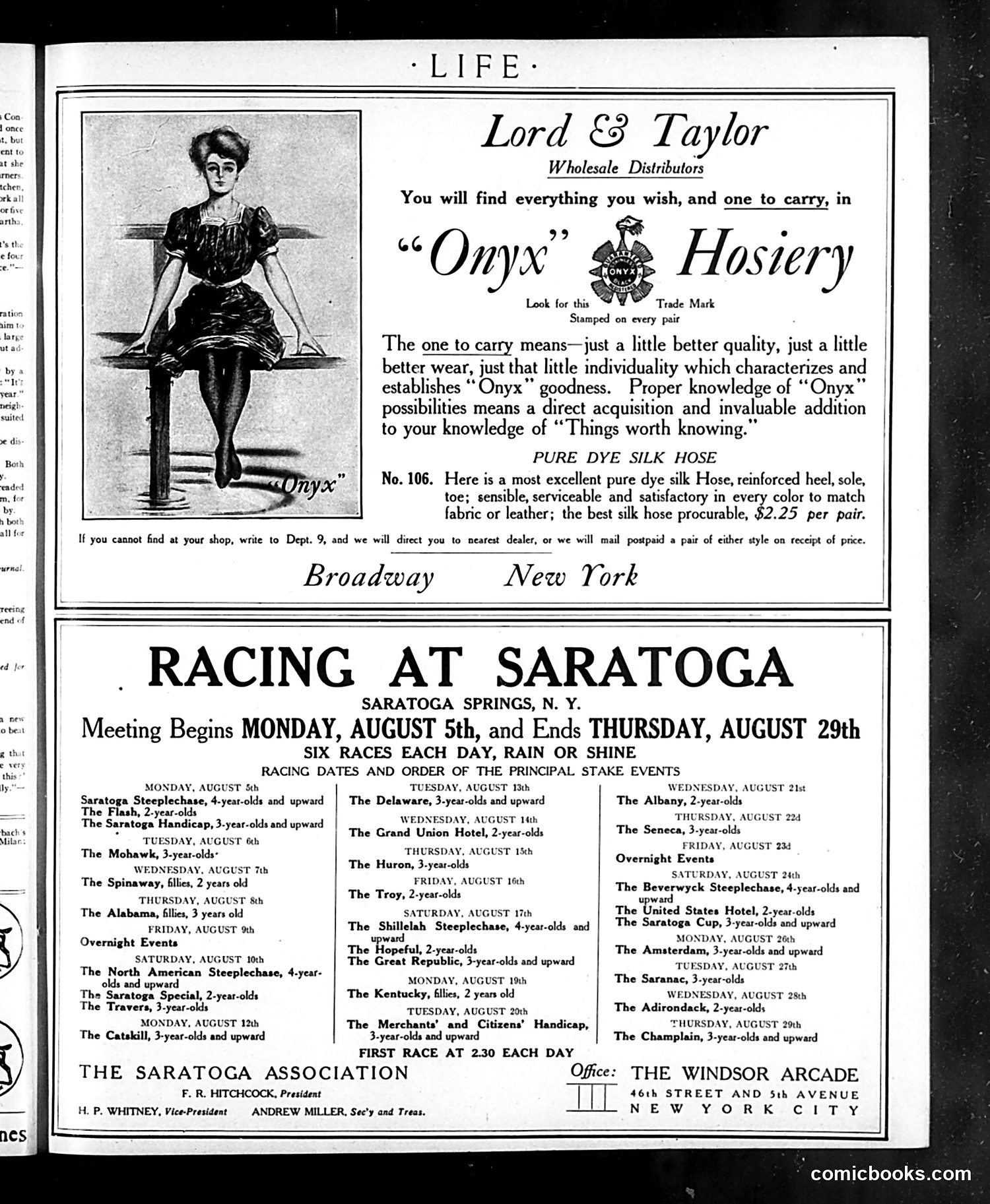
This page contains no cartoons or satire—it's primarily **advertising and event promotion** from an early 20th-century *Life* magazine issue. The top half advertises **"Onyx" brand silk hosiery** distributed by Lord & Taylor, featuring an elegant woman in period dress. The ad emphasizes quality and exclusivity ("things worth knowing"), targeting affluent consumers. The $2.25 price point was premium for the era. The bottom half announces the **Saratoga Springs horse racing season** (August 5-29), listing stakes races and their dates. This reflects *Life*'s audience: wealthy urbanites interested in luxury goods and leisure activities like thoroughbred racing. Saratoga Springs was—and remains—a prestigious racing destination and vacation spot for the American elite. The page reflects early 1900s consumer culture and upper-class recreation, with no political commentary visible.
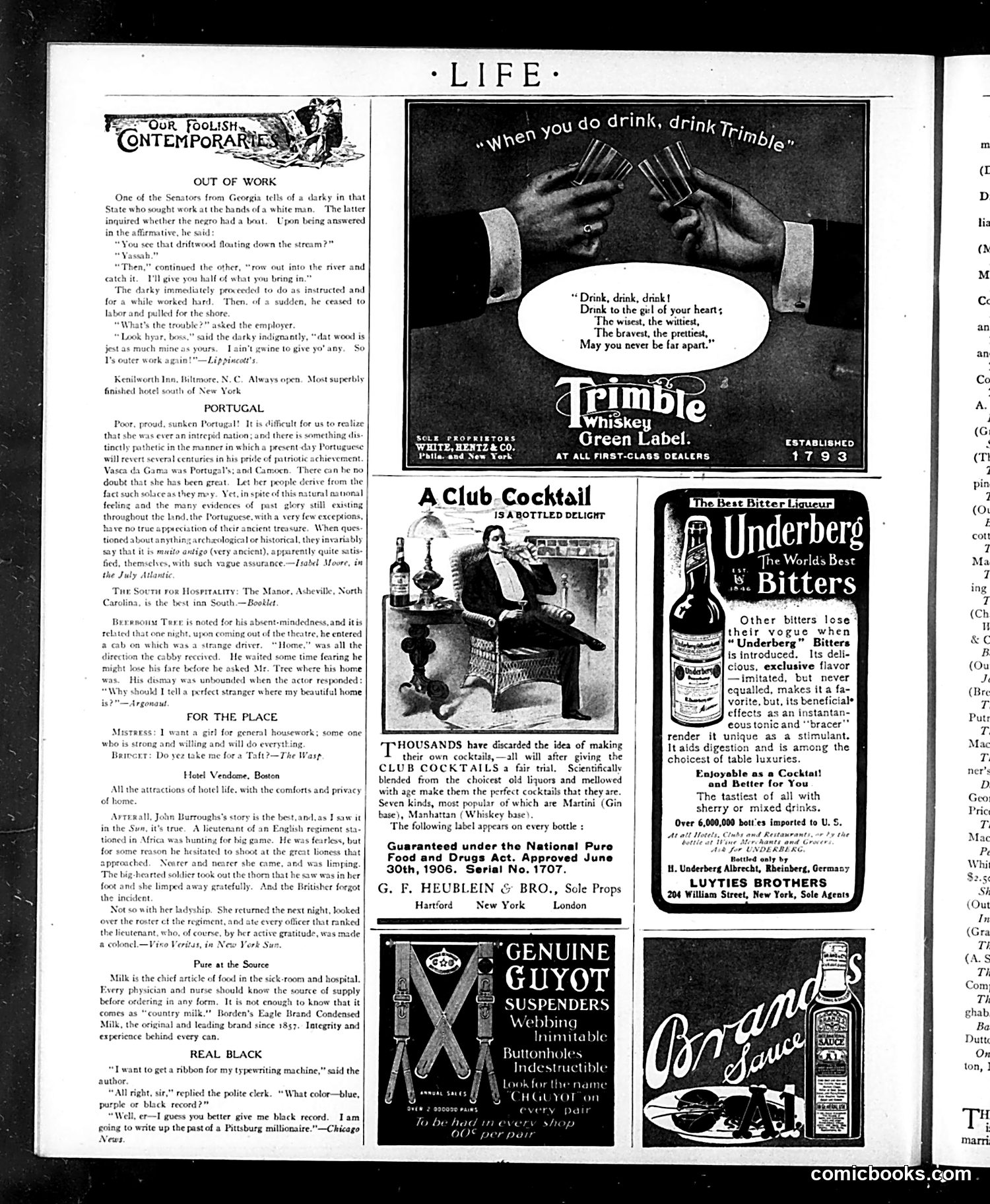
This page contains satirical articles and period advertisements (circa 1906, based on dates visible). **The main satire** is "Out of Work," a racist anecdote attributed to a Georgia Senator. It depicts a Black man seeking employment, agreeing to split driftwood finds with a white employer, then abandoning the work—the implied "joke" being a racist stereotype about Black workers' unreliability. This reflects early-20th-century American prejudice normalized in mainstream publications. **The other articles** are lighter social humor: absurdist stories about absent-minded Professor Tare, a woman requesting "black record" ribbon for her typewriter to document a millionaire's past, and travel observations about Portugal. **The advertisements** promote alcohol (Trimble Whiskey, Club Cocktails, Underberg Bitters)—products that would soon face Prohibition (1920-1933). The ads use period marketing language emphasizing scientific blending and purity. The page exemplifies how *Life* magazine mixed sophisticated satire with deeply offensive racial content, reflecting mainstream attitudes of its era.
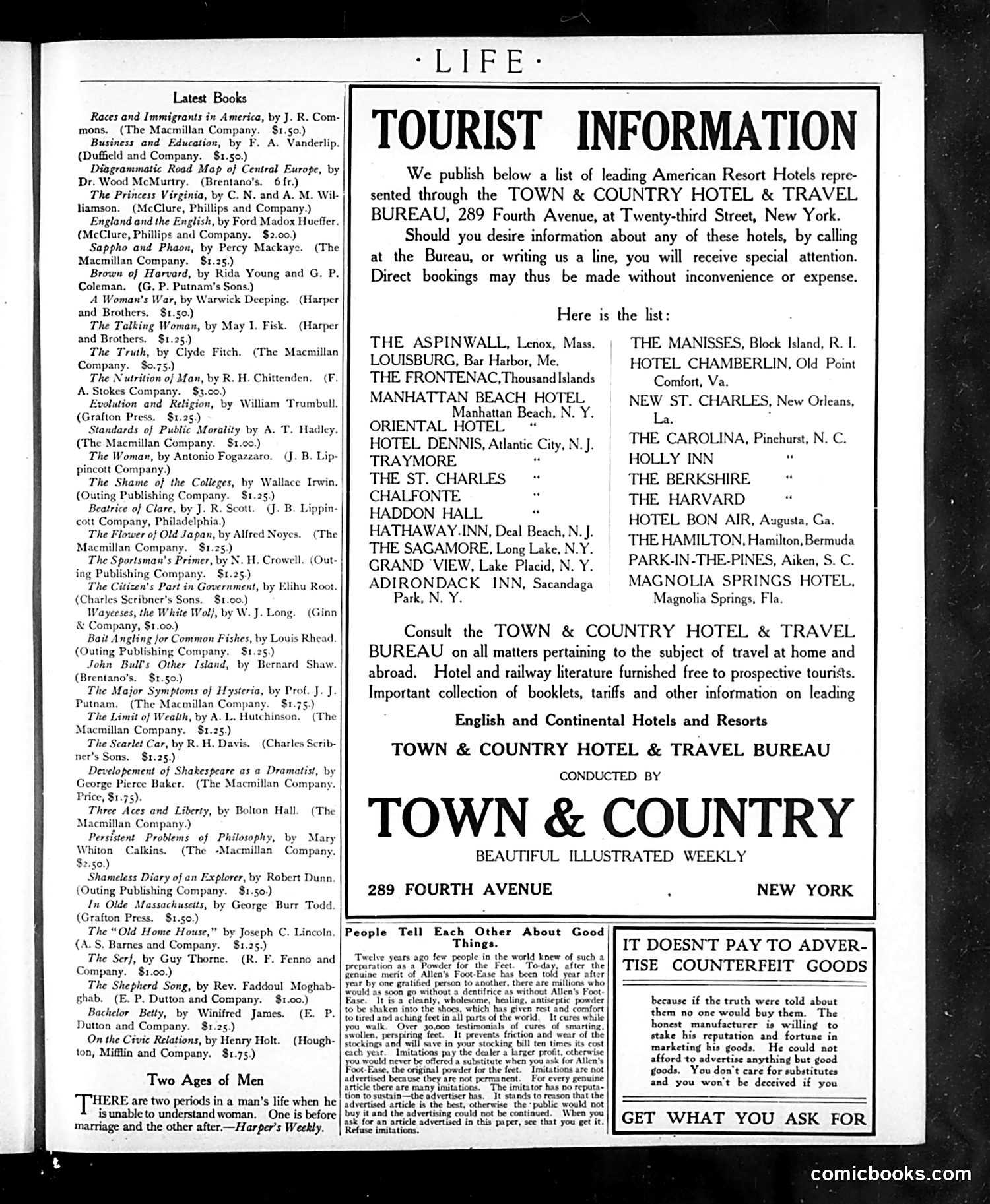
This page is primarily **advertising and book listings** rather than satirical cartoons. The content includes: **Left side:** A "Latest Books" section listing newly published volumes from major publishers (Macmillan, Harper, Scribner's, etc.), covering diverse topics from immigration to philosophy to fiction. **Center/Right:** A "Tourist Information" advertisement for the Town & Country Hotel & Travel Bureau, listing prominent American resort hotels of the era (Manhattan Beach Hotel, Oriental Hotel, etc.). **Bottom:** A single brief humorous observation titled "Two Ages of Men" — a one-liner from Harper's Weekly joking that men cannot understand women either before or after marriage. This is gentle domestic satire typical of early 1900s magazines, not political commentary. **Bottom right:** An advertisement warning against counterfeit goods, emphasizing authenticity. The page reflects early 20th-century concerns: leisure travel, education, and traditional gender-based humor.
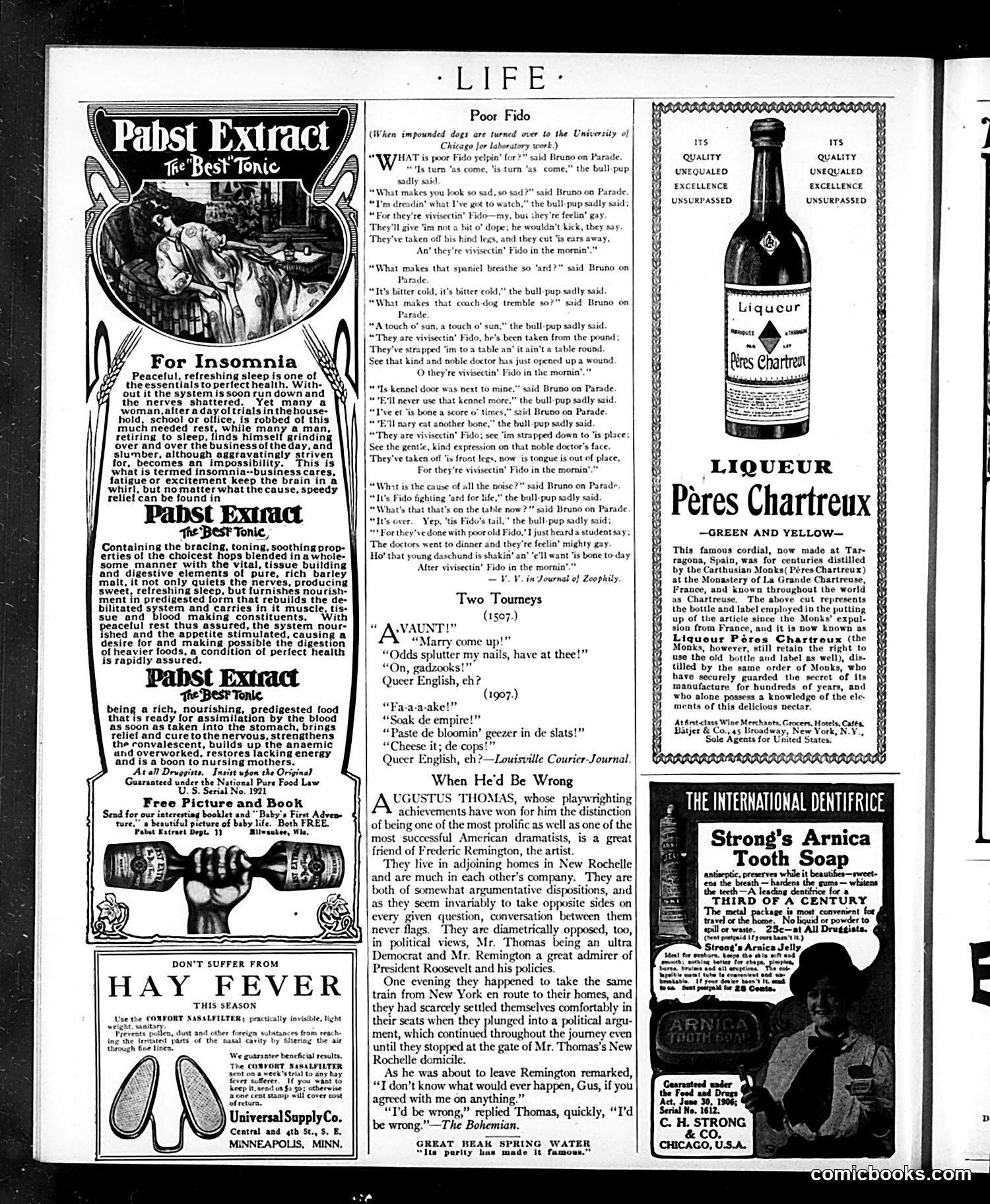
This poem satirizes animal experimentation by depicting street dogs lamenting a companion named Fido who's been impounded and subjected to vivisection (live animal dissection) at the University of Chicago's laboratory. The narrator is Bruno, a street dog, conversing with other dogs about Fido's fate: amputation of limbs, ear removal, and surgical procedures. The repeated refrain "they're vivisectin' Fido in the mornin'" emphasizes the horror matter-of-factly, using working-class dialect for emotional impact. The satire works through stark contrast—the dogs' simple, innocent attachment to Fido versus the clinical brutality of laboratory science. By giving voice to the animals and showing their grief, the poem argues vivisection is cruel and indefensible, even if framed as scientific progress. The page juxtaposes this anti-vivisection message with advertisements, creating ironic commentary on commercial versus humanitarian values.
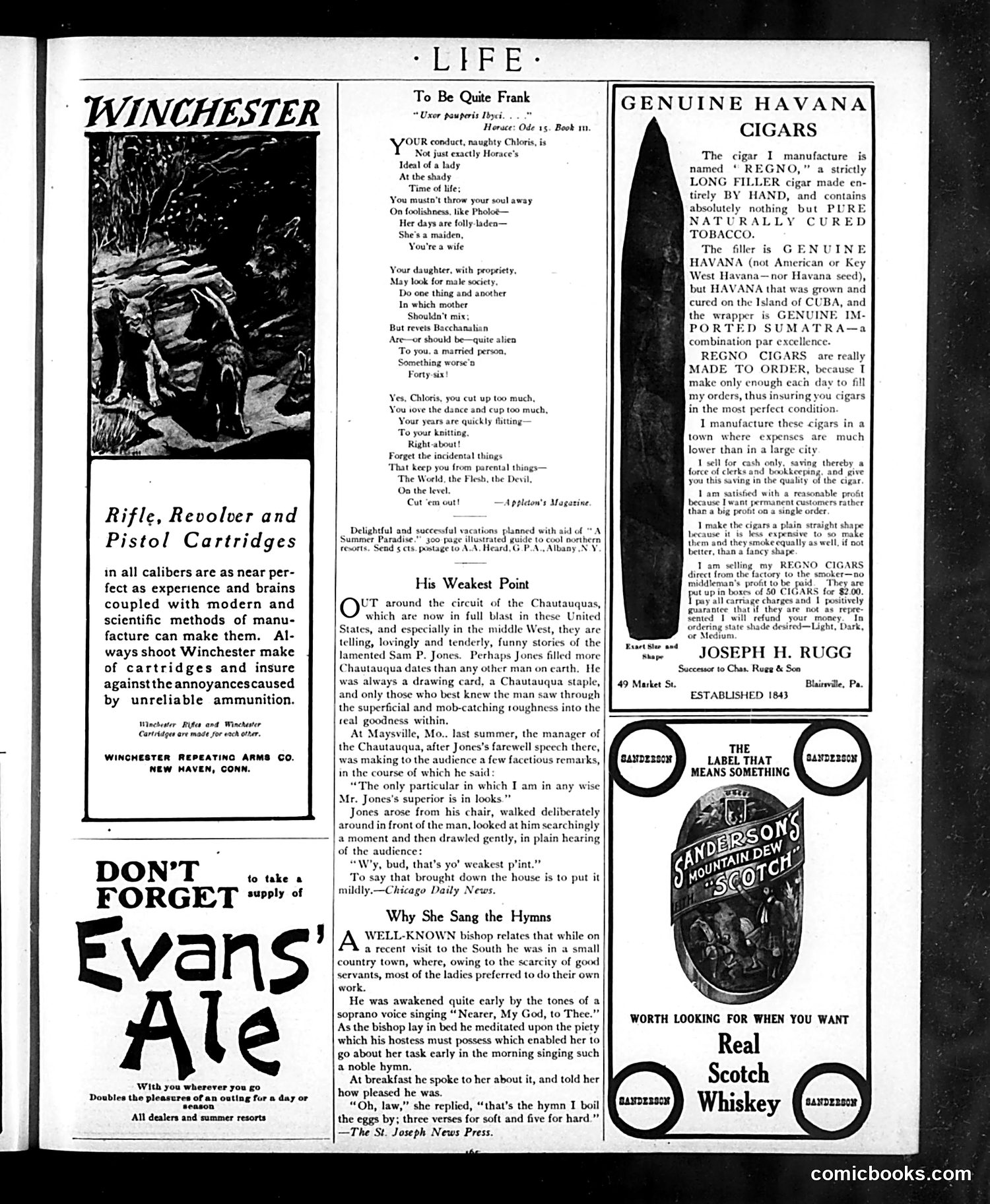
This page is primarily **advertising with interspersed humor pieces**, typical of early 20th-century Life magazine. **The advertisements** promote Winchester ammunition, Evans Ale, and Regno cigars—products marketed to middle and upper-class men. **The humor pieces** include: 1. **"To Be Quite Frank"**—A versified moral lecture (adapted from Horace) chiding a married woman named Chloris for behaving too wildly at social events instead of focusing on motherhood and propriety. The satire mocks sanctimonious Victorian moralizing about women's conduct. 2. **"His Weakest Point"**—An anecdote about evangelist Sam P. Jones, appearing at Chautauqua lecture circuits. When a manager compliments Jones only for his looks, Jones deadpans a comeback, deflating the manager's shallow observation. 3. **"Why She Sang the Hymns"**—A domestic humor piece where a bishop assumes a woman singing hymns at dawn reflects deep piety, only to learn she uses the hymn's verses as a timer for boiling eggs—deflating sentimental assumptions about religiosity. All three pieces use ironic deflation of pretense as their comedic strategy.
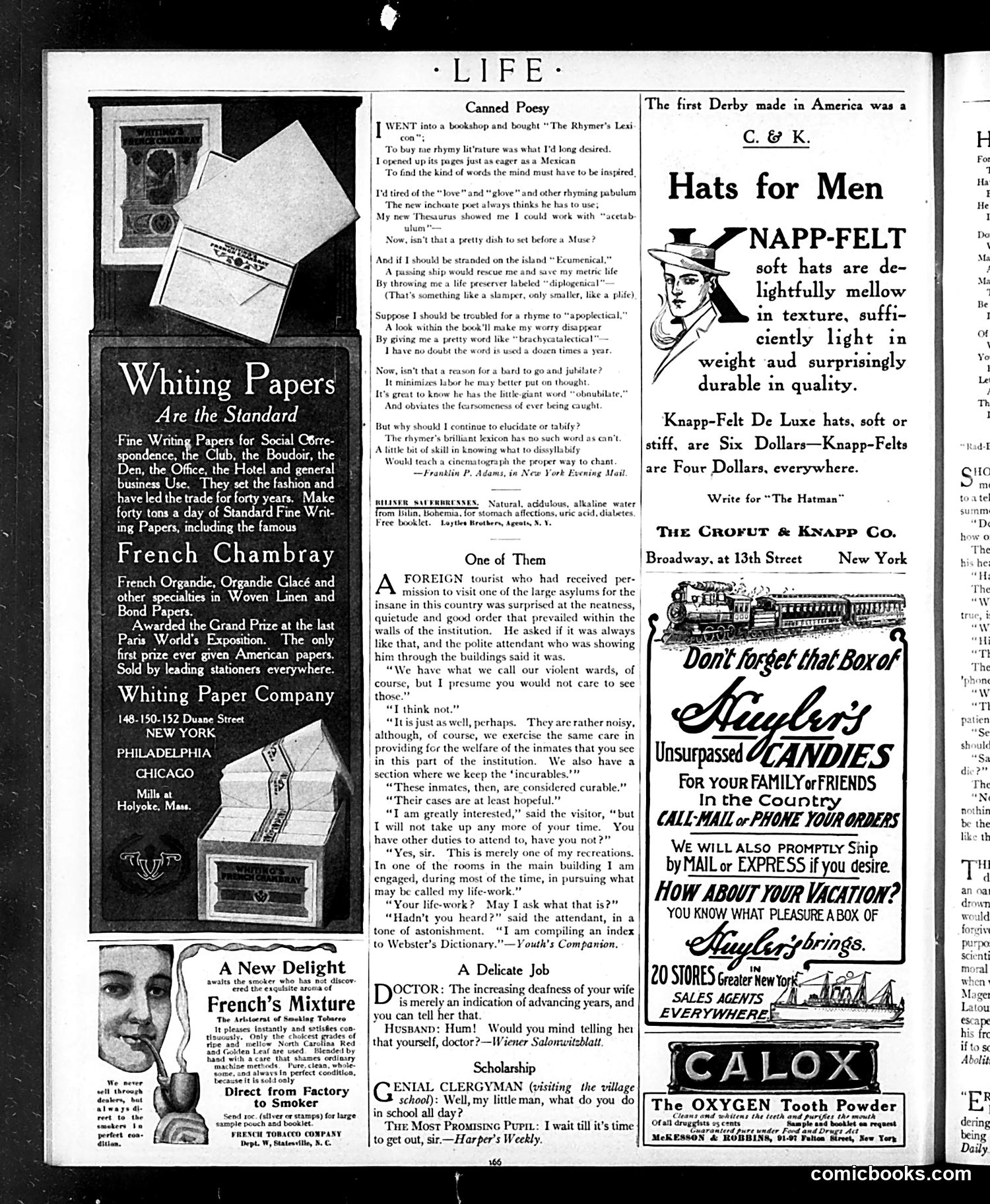
This page is primarily **advertisements** interspersed with **humorous short pieces** typical of Life magazine's satirical approach. The main content includes: **"Canned Poesy"** — a satirical poem mocking how poets use rhyming dictionaries to solve creative problems mechanically. The joke: a writer buys a rhyming lexicon to avoid genuine composition, finding absurd words like "obambilate" that technically rhyme but are nonsensical. **"One of Them"** — a darkly comic dialogue where a visitor tours an asylum and learns the attendant's "life-work" is compiling an index to Webster's Dictionary—implying the attendant himself may be institutionalized, making the joke about who truly belongs in the asylum. **"A Delicate Job"** — a brief joke about a doctor advising a husband on his wife's increasing deafness, with the husband requesting the doctor deliver the bad news himself. The advertisements (Whiting Papers, French's tobacco, Napp-Felt hats, Styler's candies, Calox tooth powder) show early 20th-century product marketing targeting middle-class consumers.
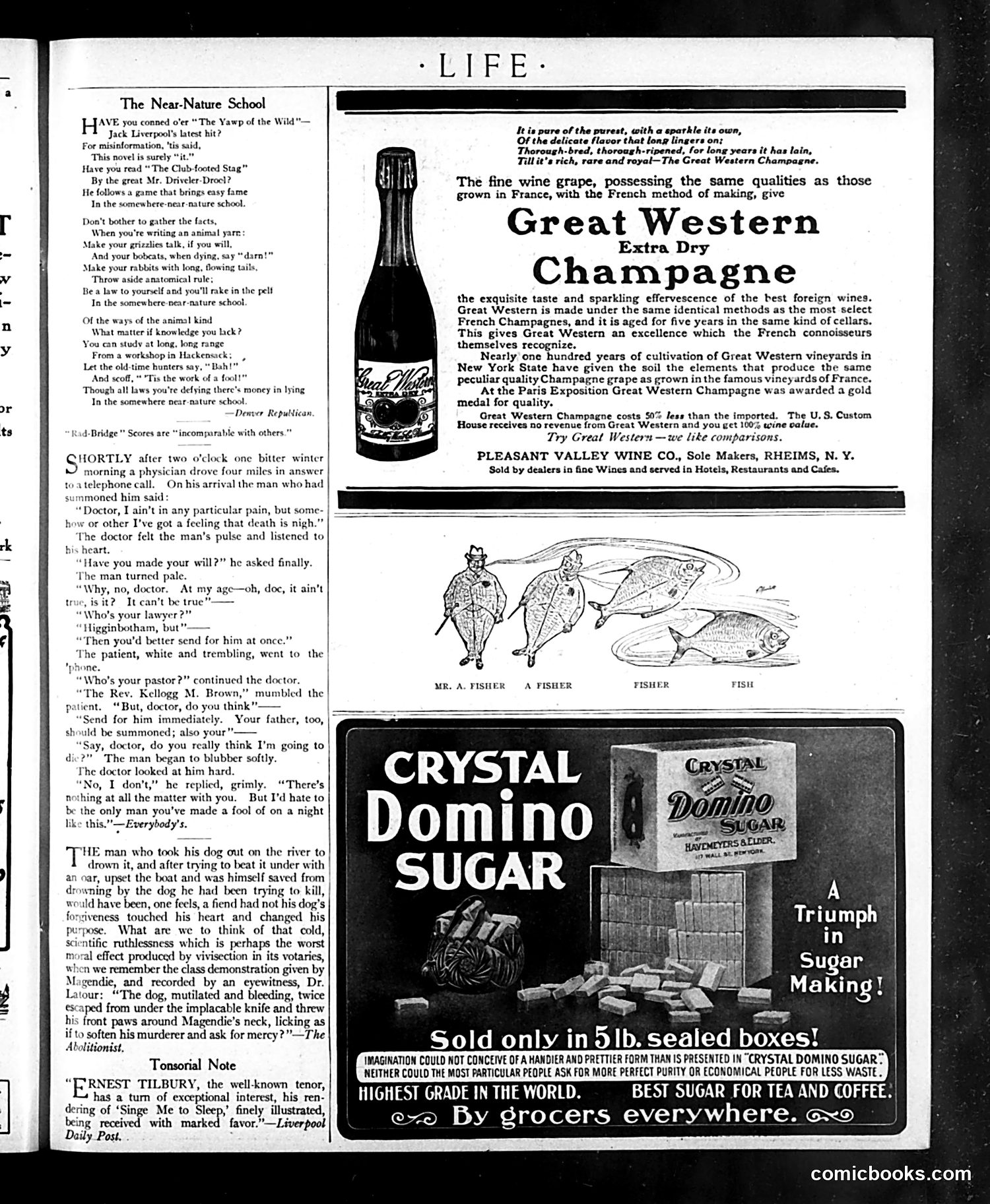
This poem mocks a literary trend of the era: adventure and animal stories written by authors with no genuine knowledge of nature or animals. The satire targets writers like "Jack Liverpool" (likely a pseudonym for a real popular author) who produced bestselling "near-nature" fiction despite ignoring anatomical accuracy and factual research. The joke is that these authors could write from anywhere—even "a workshop in Hackensack" (New Jersey)—inventing absurd details (rabbits with "long, flowing tails," animals speaking dialogue) while completely disregarding scientific truth. Yet they profited handsomely ("rake in the pel"). The satire criticizes both the authors' dishonesty and readers' gullibility, suggesting that profit mattered more than authenticity in popular publishing. This reflects turn-of-the-century tensions between literary realism and commercial entertainment.
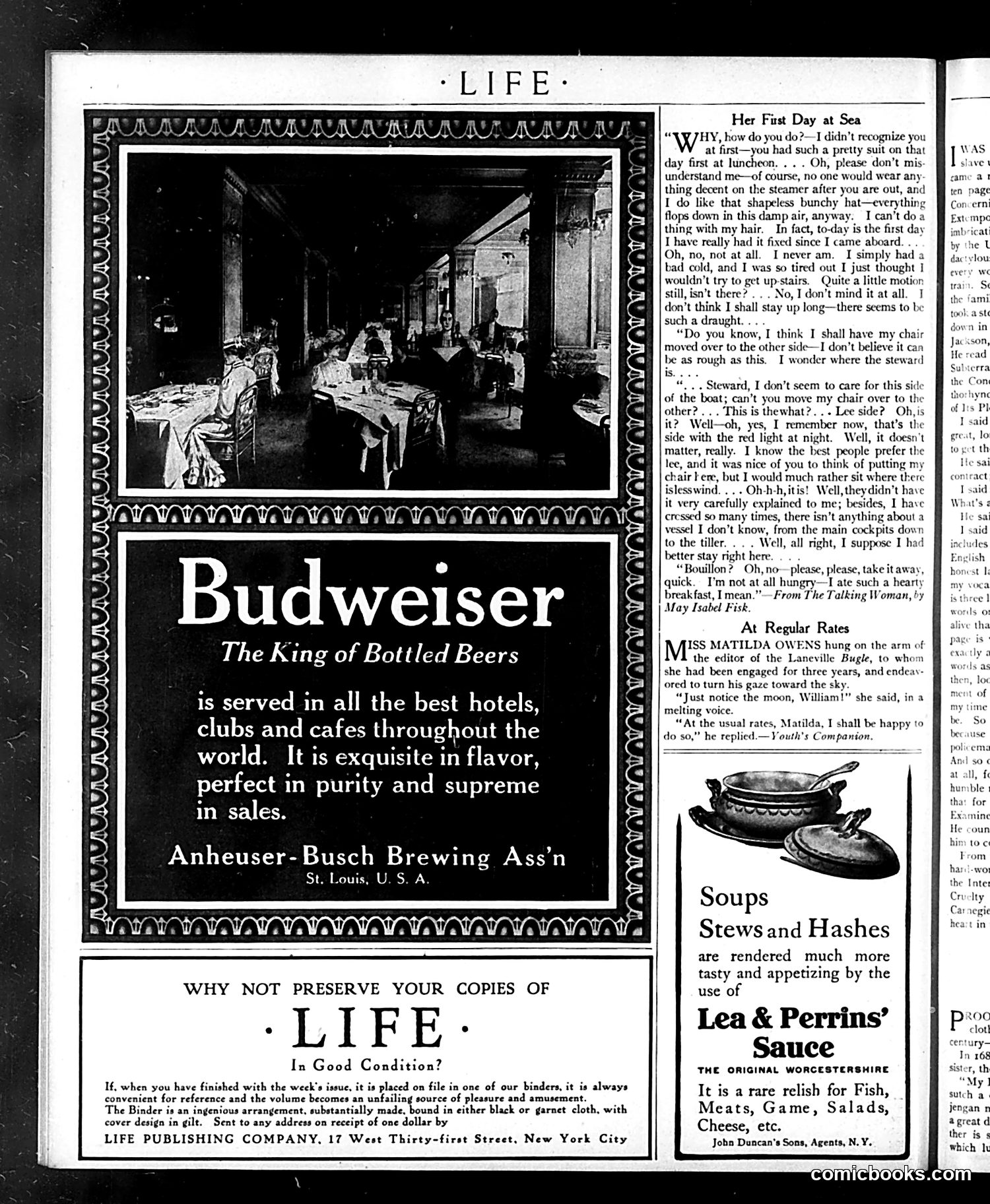
This page mixes advertising with light social humor typical of early 20th-century Life magazine. **Main Content:** "Her First Day at Sea" is a humorous monologue capturing upper-class women's shipboard etiquette anxieties. The joke centers on the speaker's awkward, contradictory complaints—she simultaneously critiques another woman's appearance while defending her own disheveled state, reveals physical discomfort she claims not to mind, and nitpicks cabin placement despite claiming indifference. The humor lies in exposing social pretense and the gap between what wealthy travelers *say* versus what they actually care about (appearance, comfort, status). **Advertisements:** The page also features a Budweiser beer ad, a Life magazine binder promotion, and a Lea & Perrins sauce advertisement—typical commercial content for the era. **"At Regular Rates":** A brief joke about a newspaper editor who treats his fiancée's romantic gestures as billable work, satirizing editorial penny-pinching. No political cartoons appear on this page; the humor is purely social satire.
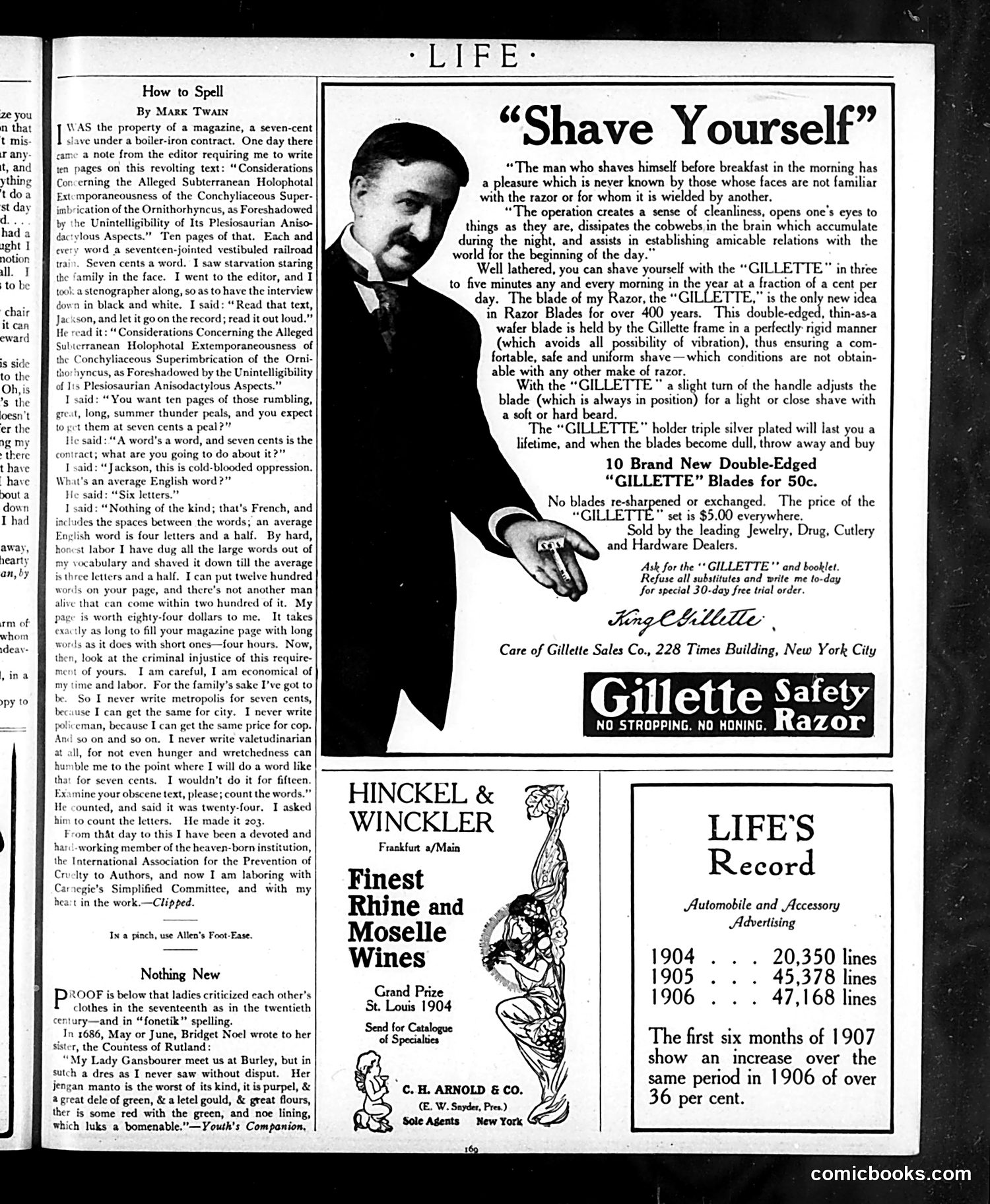
This page contains **Mark Twain's humorous essay "How to Spell"** (left column), a **Gillette Safety Razor advertisement** (center), and miscellaneous other content. **Twain's piece** satirizes publisher exploitation of writers. He describes negotiating with a magazine editor who demands ten pages on an absurdly complex scientific topic for seven cents per word. Twain argues his efficient writing (short words) deserves higher pay, since filling a page takes equal labor regardless of word length. The joke targets editorial cheap-skate practices and the economic desperation of professional writers. The **Gillette ad** uses the "Shave Yourself" theme to promote self-reliance and modernity—shaving alone saves money and time versus barber visits. It's positioned as practical efficiency, mirroring Twain's own theme about economizing labor. The page also includes brief period items about 17th-century fashion complaints and wine advertising—typical Life magazine miscellany from this era (appears to be early 1900s based on the Gillette promotion and advertising statistics shown).
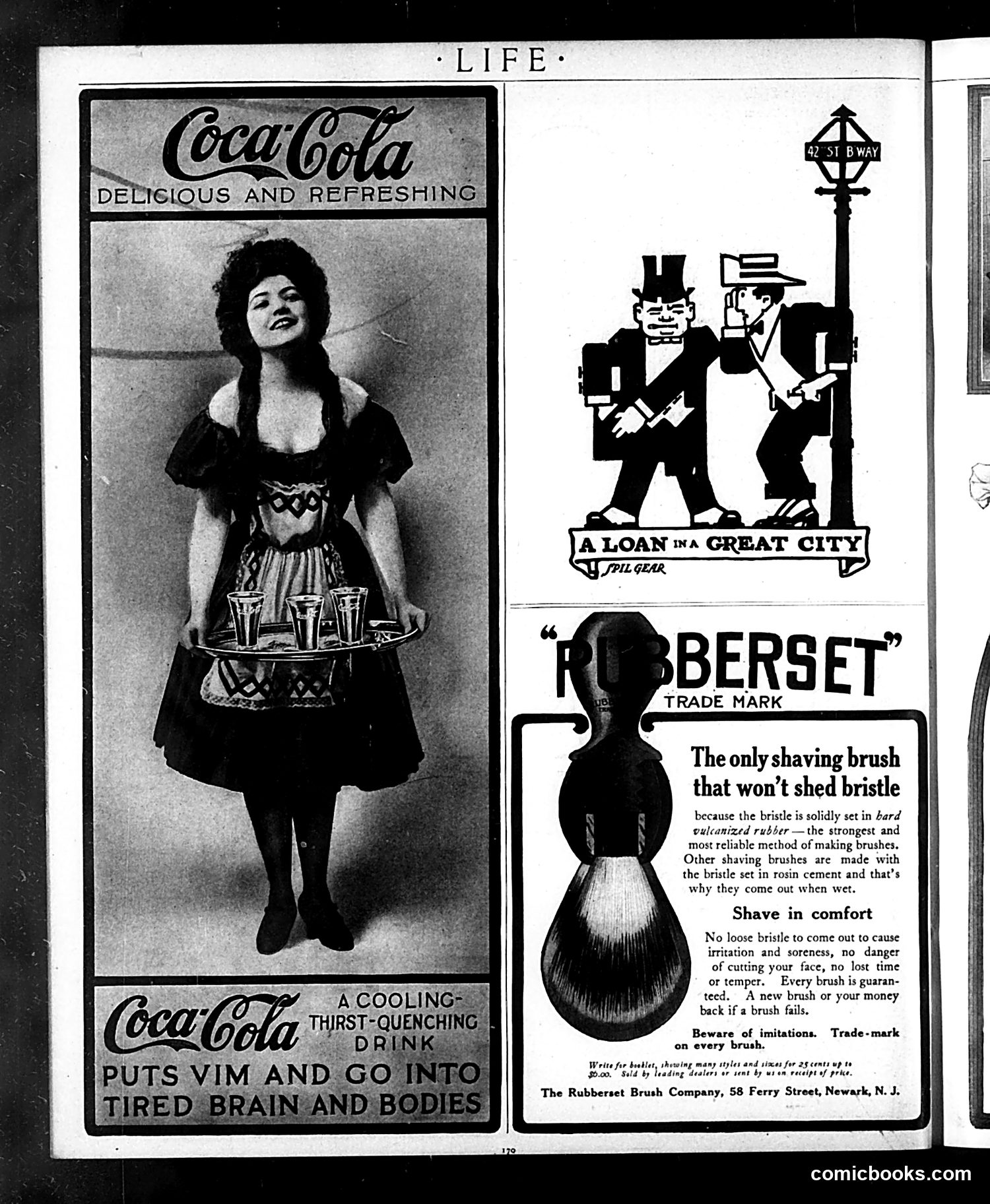
This page contains **two advertisements**, not political cartoons: 1. **Coca-Cola ad** (left): Features a woman in theatrical/servant costume holding Coca-Cola glasses. The tagline claims the drink "puts vim and go into tired brain and bodies"—a typical early 20th-century patent-medicine-style claim about beverages providing energy and mental stimulation. 2. **Rubberset Shaving Brush ad** (right): Markets brushes with vulcanized rubber bristle-setting, claiming superiority over competitors' rosin-cement methods that shed bristles when wet. It promises comfort and durability, with a money-back guarantee. The small cartoon "A Loan in a Great City" (top right) appears unrelated—a separate editorial cartoon about urban lending, featuring two men at a street sign. These are **commercial advertisements**, not satire. The page demonstrates early 20th-century advertising techniques: exaggerated health claims and technical superiority arguments.
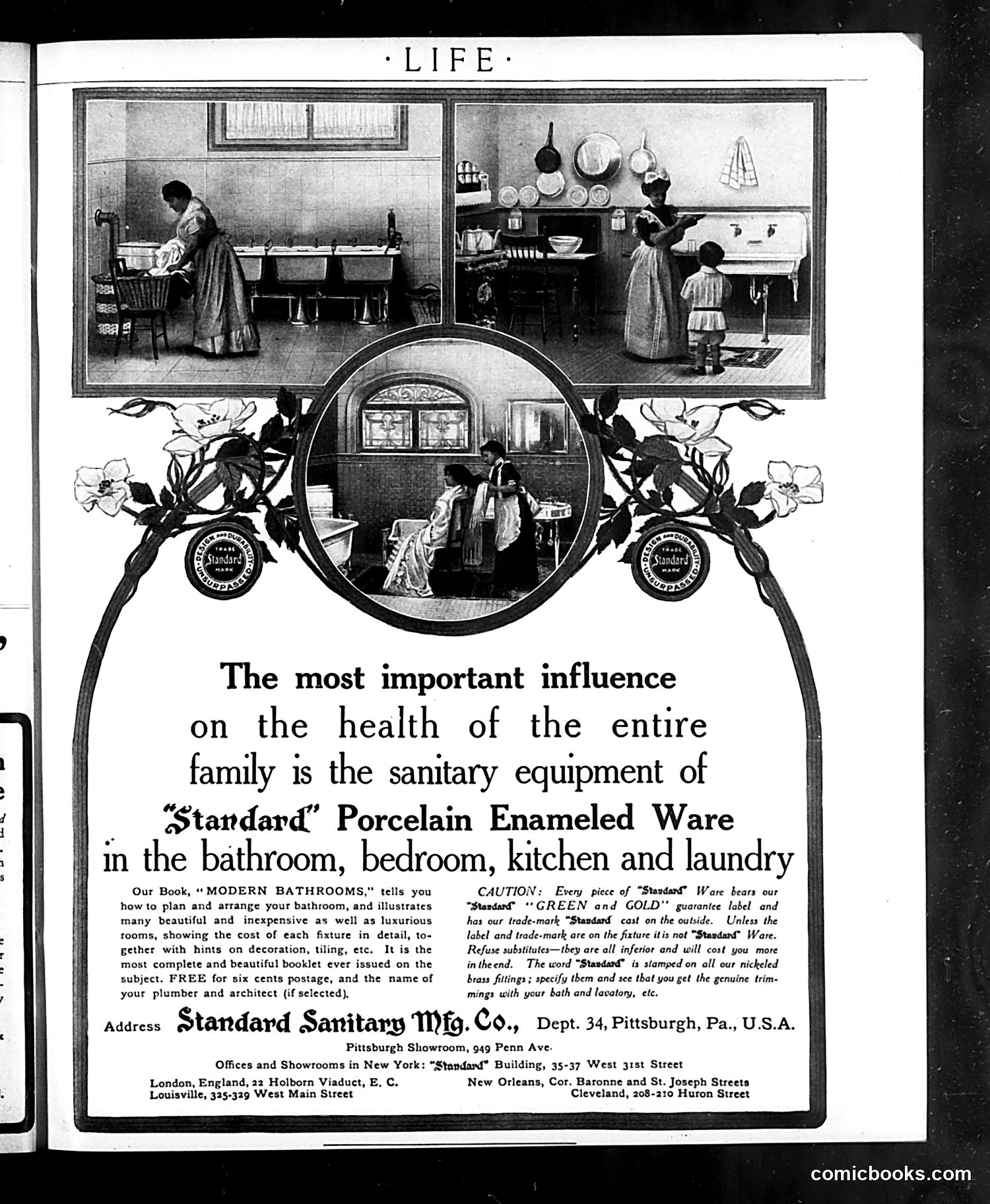
This is primarily an **advertisement, not satire or political commentary**. It's a Standard Sanitary Manufacturing Company product pitch from Life magazine. The page uses multiple domestic scenes (top panels showing women in kitchens and bathrooms) and a central circular vignette to visually emphasize that modern plumbing fixtures are essential to family health. The decorative floral elements and framing devices are typical period advertising design. The "message" is straightforward marketing: Standard's porcelain enameled ware is presented as a health necessity. The cautionary text warns against counterfeits, emphasizing buyers should verify the "GREEN and GOLD" guarantee label. This reflects early 20th-century advertising strategy linking consumer products to family welfare and modernity. There is no satirical critique visible—this is genuine commercial promotion using Life's platform to reach affluent readers who could afford bathroom renovations.
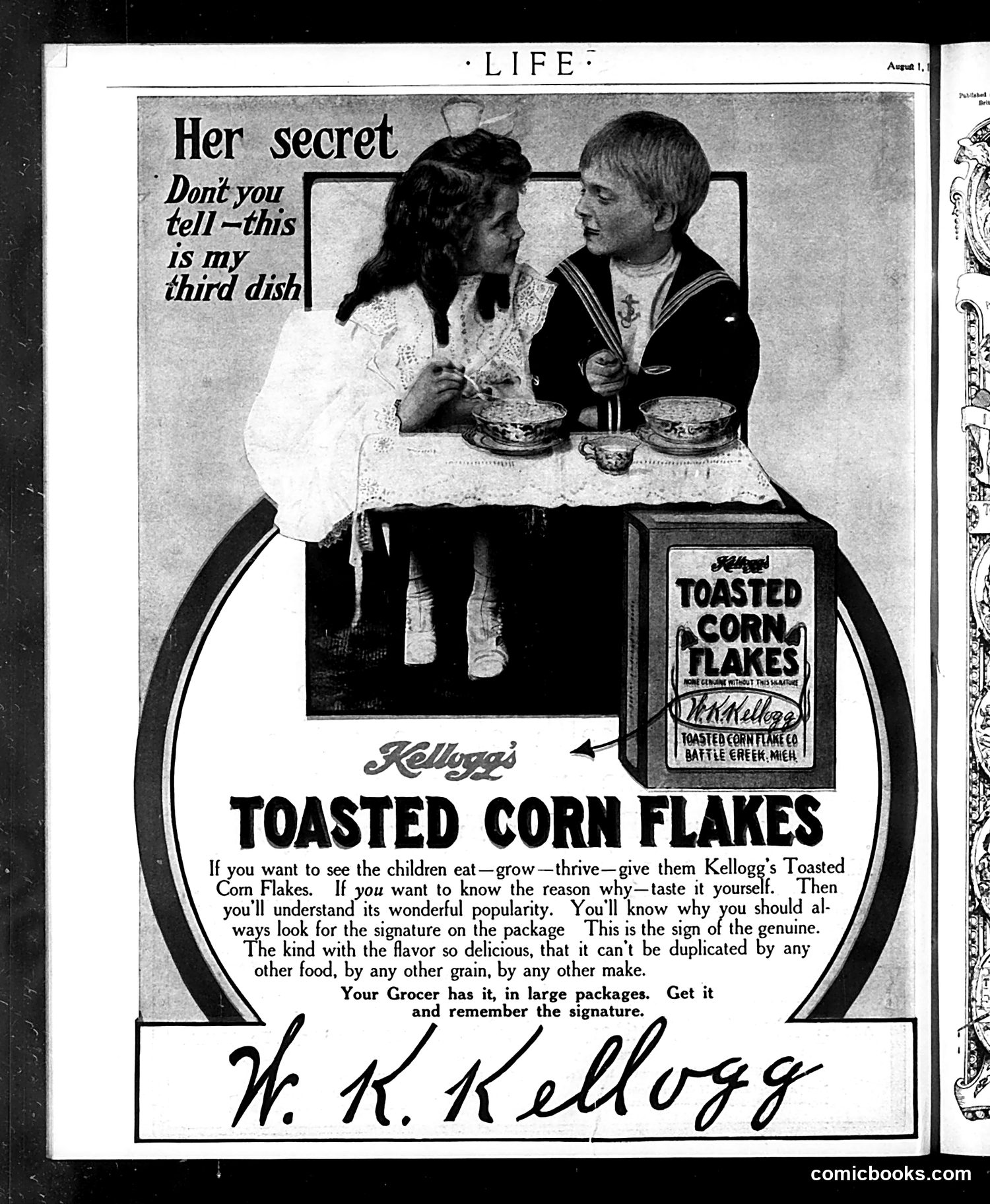
This is a **product advertisement**, not political satire. The page features a Kellogg's cereal ad from Life magazine (dated August 1, based on the header). The image shows a woman and man at a dining table with the tagline "Her secret—Don't you tell—this is my third dish," implying the cereal is so delicious he'll want multiple servings. This plays on the common advertising trope of women keeping "secrets" about their cooking. The ad emphasizes: - Product superiority (claims competitors can't duplicate the flavor) - Brand authenticity (look for W.K. Kellogg's signature on packaging) - Children's health benefits ("eat—grow—thrive") - Wide availability ("Your Grocer has it") The humor is mild domestic comedy about appetite, not political commentary. This reflects early 20th-century advertising style: celebrity endorsement through implied domestic expertise, emphasis on a woman's role in family nutrition, and appeals to both health and pleasure.