
Life, 1907-08-01 · page 29 of 48
Life — August 1, 1907 — page 29: what you’re looking at
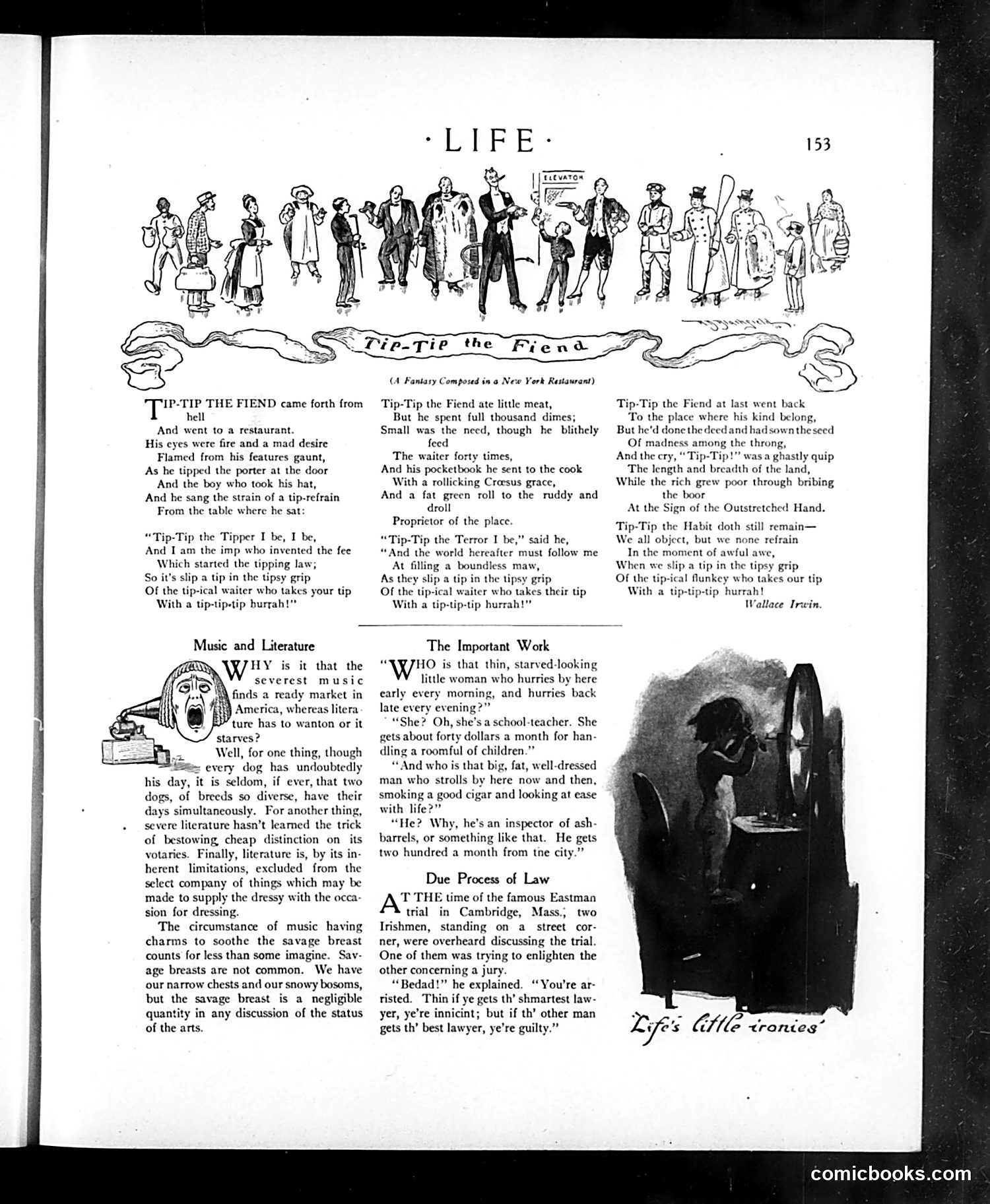
What you’re looking at
This page contains three distinct satirical pieces critiquing American social practices and inequities: **"Tip-Tip the Fiend"** (main narrative poem with illustrations): A fantasy mocking the American tipping culture. The demon "Tip-Tip" personifies the tipping system itself, portrayed as a corrupting force spreading through restaurants. The satire suggests tipping has become excessive and obligatory—a parasitic "law" extracting money from diners. The verse ridicules how restaurant workers extract tips while the wealthy grow poor paying bribes to service staff. **"Music and Literature"**: Commentary on why popular music thrives while serious literature struggles in America. The piece argues music offers "cheap distinction" to wealthy patrons seeking social status, while literature lacks comparable appeal to the fashionable classes. **"Due Process of Law"**: A brief Irish-immigrant dialogue joke about jury trials, suggesting the outcome depends solely on which lawyer is better—implying justice is arbitrary rather than based on actual guilt or innocence. All three pieces target economic inequality, social pretense, and systemic unfairness in early-20th-century America.
📄 Transcribed text from this page (OCR, searchable)
Machine-transcribed from the original scan — historical spelling and the odd misread are preserved.
T" -TIP THE FIEND came forth from hell And went to a restaurant. His cyes were fire and a mad desire Flamed from his features gaunt, As he tipped the porter at the door And the boy who took his hat, And he sang the strain of a tip-refrain From the table where he sat: “Tip-Tip the Tipper I be, I be, And I am the imp who invented the fee Which started the tipping law; So it’s slip a tip in the tipsy grip Of the tip-ical waiter who take: With a tip-tip-ip burrah!"" your tip (A Fantasy Composed in a New York Restaurant) Tip-Tip the Fiend ate little meat, But he spent full thousand dimes; Small was the need, though he blithely feed The waiter forty times, And his pocketbook he sent to the cook With a rollicking Croesus grace, And a fat green roll to the ruddy and droll Proprictor of the place. Cip-Tip the Terror I be,” said he, nd the world hereafter must follow me At filling a boundless maw As they slip a tip in the tipsy g tip-ical w: Music and Literature HY is it that the severest music S\ finds a ready market in a America, whereas litera BY” ture has to wanton or it starves? Well, for one thing, though every dog has undoubtedly his day, it is seldom, if ever, that two dogs, of breeds so diverse, have their days simultaneously. For another thing, severe literature hasn’t leamed the trick of bestowing cheap distinction on its votaries. Finally, literature is, by its in- herent limitations, excluded from the select company of things which may be made to supply the dressy with the occa- sion for dressing. The circumstance of music having charms to soothe the savage breast counts for less than some imagine. Sav- age breasts are not common. We have our narrow chests and our snowy bosoms, but the savage breast is a negligible quantity in any discussion of the status of the arts. The Important Work HO is that thin, starved-looking little woman who hurries by here early every morning, and hurries back late every evening?” “She? Oh, she’s a school-teacher. She gets about forty dollars a month for han- dling a roomful of children.” “And who is that big, fat, well-dressed man who strolls by here now and then, smoking a good cigar and looking at ease with life?” “He? Why, he’s an inspector of ash- barrels, or something like that. He gets two hundred a month from tie city.” Due Process of Law THE time of the famous Eastman trial in Cambridge, Mass.; two Irishmen, standing on a_ street cor- ner, were overheard discussing the trial. One of them was trying to enlighten the other concerning a jury. “Bedad!” he explained. “You're ar- risted. Thin if ye gets th’ shmartest law- yer, ye’re innicint; but if th’ other man gets th’ best lawyer, ye’re guilty Tip-Tip the Fiend at last went sea To the place where his kind belong, But he'd done the deed and had sown the seed Of madness among the throng, And the cry, “Tip-Tip!” was a ghastly quip The length and breadth of the land, While the rich grew poor through bribing the boor At the Sign of the Outstretched Hand. Tip-Tip the Habit doth still remain— We all object, but we none refrain In the moment of awful awe, When we slip a tip in the tipsy grip Of the tip-ical Nunkey who ti With a tip-tip-tip hurrah! Wallace Irwin. Lys Chile <ranies’ comicbooks.com