
Life, 1907-08-01 · page 32 of 48
Life — August 1, 1907 — page 32: what you’re looking at
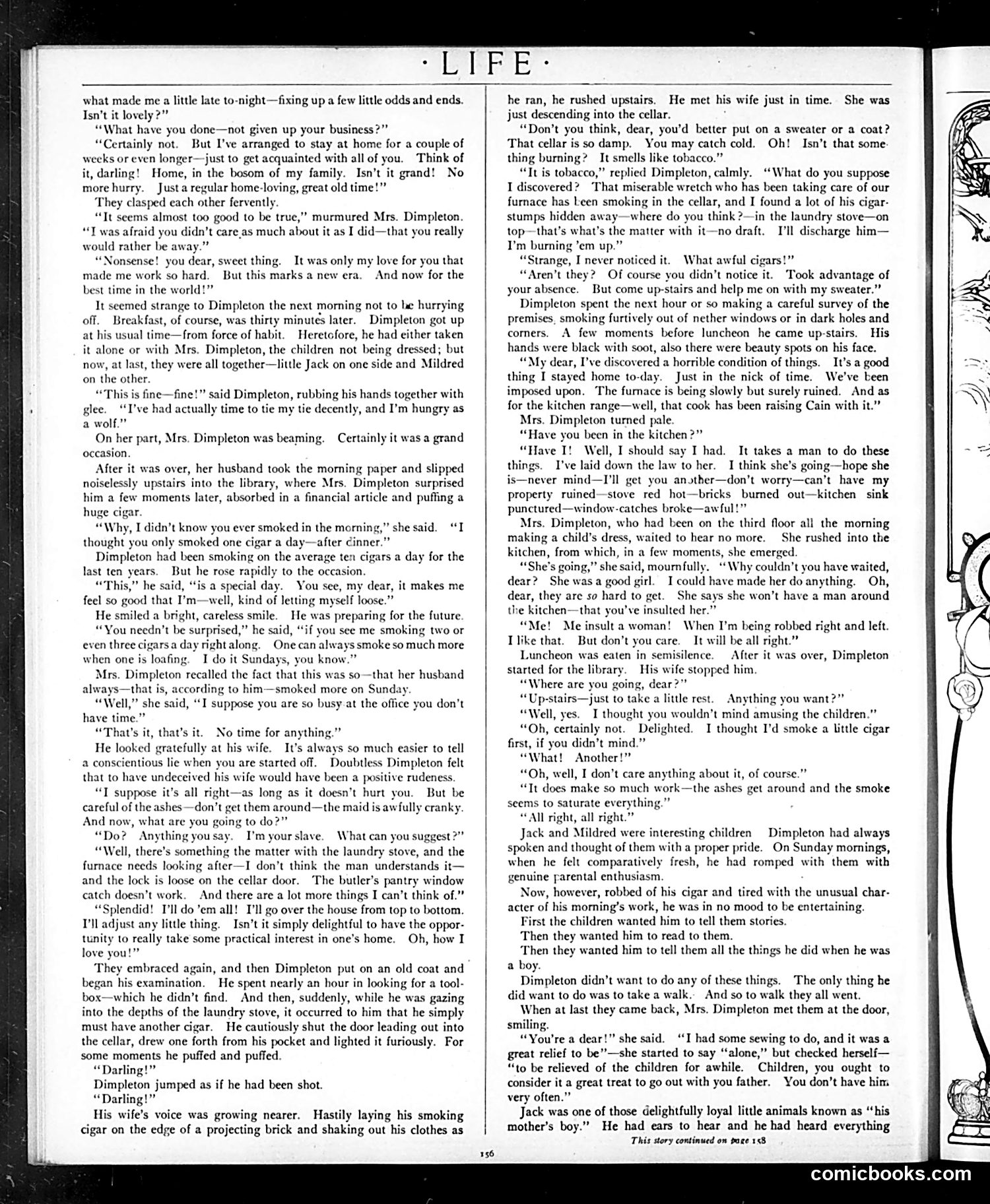
What you’re looking at
This page presents a domestic comedy satirizing middle-class hypocrisy and marital dishonesty. Mr. Dimpleton claims to be taking time off work to bond with his family and become a "home-loving" husband. However, the satire reveals his true nature: he immediately retreats to smoke cigars secretly in the library, lying to his wife that he only smokes one cigar daily when he actually smokes ten. The joke exposes the performative nature of domesticity—Dimpleton pretends to embrace family life while maintaining his actual habits through deception. His wife, Mrs. Dimpleton, remains oblivious, accepting his transparent lies about office exhaustion justifying his Sabbath cigar consumption. The humor targets the gap between Victorian ideals of devoted husbandhood and the reality of men prioritizing personal habits and leisure over genuine domestic engagement. It's a critique of masculine dishonesty within marriage and the compartmentalization of domestic versus "real" life.
📄 Transcribed text from this page (OCR, searchable)
Machine-transcribed from the original scan — historical spelling and the odd misread are preserved.
REE what made me a little late to-night—fixing up a few little odds and ends. Isn't it lovely?” “What have you done—not given up your business?” “Certainly not. But I’ve arranged to stay at home for a couple of weeks or even longer—just to get acquainted with all of you. ‘Think of it, darling! Home, in the bosom of my family. Isn’t it grand! No more hurry. Just a regular home-loving, great old time!” They clasped each other fervently. “Tt seems almost too good to be true,” murmured Mrs. Dimpleton. “T was afraid you didn’t care,as much about it as I did—that you really would rather be away.”” “Nonsense! you dear, sweet thing. It was only my love for you that made me work so hard. But this marks a new era. And now for the best time in the world!” It seemed strange to Dimpleton the next morning not to he hurrying off. Breakfast, of course, was thirty minutes later. Dimpleton got up at his usual time—from force of habit. Heretofore, he had either taken it alone or with Mrs. Dimpleton, the children not being dressed; but now, at last, they were all together—little Jack on one side and Mildred ‘on the other. “This is fine—fine!” said Dimpleton, rubbing his hands together with glee. “I've had actually time to tie my tie decently, and I’m hungry as a wolf.” On her part, Mrs. Dimpleton was beaming. Certainly it was a grand occasion. After it was over, her husband took the moming paper and slipped noiselessly upstairs into the library, where Mrs. Dimpleton surprised him a few moments later, absorbed in a financial article and puffing a huge cigar. “Why, I didn’t know you ever smoked in the morning,” she said. “I thought you only smoked one cigar a day—after cinner.”” Dimpleton had been smoking on the average ten cigars a day for the last ten years. But he rose rapidly to the occasion. “This,” he said, “is a special day. You my dear, it makes me feel so good that I’m—well, kind of letting myself loose.” He smiled a bright, careless smile. He was preparing for the future. “You needn’t be surprised,” he said, “if you see me smoking two or even three cigarsa day rightalong. One can always smoke so much more when one is loafing. I do it Sundays, you know. Mrs. Dimpleton recalled the fact that this was so—that her husband always—that is, according to him—smoked more on Sunday. “Well,” she said, “I suppose you are so busy-at the office you don’t have time.” “That’s it, that’s it. No time for anything.” He looked gratefully at his wife. It’s always so much easier to tell a conscientious lie when you are started off. Doubtless Dimpleton felt that to have undeceived his wife would have been a positive rudeness. “T suppose it’s all right—as long as it doesn’t hurt you. But be careful of the ashes—don’t get them around—the maid is awfully cranky. And now, what are you going to do?” “Do? Anything yousay. I’m yourslave. What can you suggest?” “Well, there's something the matter with the laundry stove, and the furnace needs looking after—I don’t think the man understands it— and the lock is loose on the cellar door. The butler’s pantry window catch doesn’t work. And there are a lot more things I can’t think of.” “Splendid! I'll do ’em all! I'll go over the house from top to bottom. T'll adjust any little thing. Isn’t it simply delightful to have the oppor- tunity to really take some practical interest in one’s home. Oh, how I love you!” They embraced again, and then Dimpleton put on an old coat and began his examination. He spent nearly an hour in looking for a tool- box—which he didn’t find, And then, suddenly, while he was gazing into the depths of the laundry stove, it occurred to him that he simply must have another cigar. He cautiously shut the door leading out into the cellar, drew one forth from his pocket and lighted it furiously. For some moments he puffed and puffed. “Darling!” Dimpleton jumped as if he had been shot. “Darling!” His wife's voice was growing nearer. Hastily laying his smoking cigar on the edge of a projecting brick and shaking out his clothes as he ran, he rushed upstairs. He met his wife just in time. She was just descending into the cellar. “Don’t you think, dear, you’d better put on a sweater or a coat? That cellar is so damp. You may catch cold. Oh! Isn’t that some. thing burning? It smells like tobacco.” “Tt is tobacco,” replied Dimpleton, calmly. “What do you suppose I discovered? That miserable wretch who has been taking care of our furnace has Leen smoking in the cellar, and I found a lot of his cigar- stumps hidden away—where do you think ?—in the laundry stove—on top—that’s what's the matter with it—no draft. I'll discharge him— I’m burning ’em up.” “Strange, I never noticed it. What awful cigars!” “Aren't they? Of course you didn’t notice it. Took advantage of your absence. But come up-stairs and help me on with my sweater.” Dimpleton spent the next hour or so making a careful survey of the premises, smoking furtively out of nether windows or in dark holes and corners. A few moments before luncheon he came up-stairs. His hands were black with soot, also there were beauty spots on his face. “My dear, I’ve discovered a horrible condition of things. It’s a good thing I stayed home to-day. Just in the nick of time. We've been imposed upon. The furnace is being slowly but surely ruined. And as for the kitchen range—well, that cook has been raising Cain with it.” Mrs. Dimpleton turned pale. “Have you been in the kitchen?” “Have I! Well, I should say I had. It takes a man to do these things. I've laid down the law to her. I think she’s going—hope she is—never mind—I’ll get you another—don’t worry—can’t have my property ruined—stove red hot—bricks burned out—kitchen sink punctured—window-catches broke—awful!” Mrs. Dimpleton, who had been on the third floor all the morning making a child’s dress, waited to hear no more. She rushed into the kitchen, from which, in a few moments, she emerged. “She's going,” she said, mournfully. ‘* Why couldn’t you have waited, dear? She was a good girl. I could have made her do anything. Oh, dear, they are so hard to get. She says she won’t have a man around the kitchen—that you’ve insulted her.” “Me! Me insult a wor When I'm being robbed right and left. Tlike that. But don’t you care. It will be all right.” Luncheon was eaten in semisilence. After it was over, Dimpleton started for the library. His wife stopped him. “Where are you going, dear?” “Up-stairs—just to take a little rest. Anything you want?” “Well, yes. T thought you wouldn’t mind amusing the children.” “Oh, certainly not. Delighted. I thought I’d smoke a little cigar first, if you didn’t mind.” “What! Another!”” “Oh, well, I don’t care anything about it, of course.” “Tt does make so much work—the ashes get around and the smoke seems to saturate everything.” “All right, all right.” Jack and Mildred were interesting children Dimpleton had always spoken and thought of them with a proper pride. On Sunday mornings, when he felt comparatively fresh, he had romped with them with genuine parental enthusiasm. Now, however, robbed of his cigar and tired with the unusual char- acter of his morning’s work, he was in no mood to be entertaining. rst the children wanted him to tell them stories. Then they wanted him to read to them. Then they wanted him to tell them all the things he did when he was a boy. Dimpleton didn’t want to do any of these things. The only thing he did want to do was to take a walk. And so to walk they all went. When at last they came back, Mrs. Dimpleton met them at the door, smiling. “You're a dear!” she said. ‘I had some sewing to do, and it was a great relief to be’”’—she started to say “alone,” but checked herself— “to be relieved of the children for awhile. Children, you ought to consider it a great treat to go out with you father. You don’t have him very often.” Jack was one of those delightfully loyal little animals known as ‘‘his mother’s boy.” He had ears to hear and he had heard everything This story continued on page 198 comicbooks.com