
Life, 1907-08-01 · page 28 of 48
Life — August 1, 1907 — page 28: what you’re looking at
What you’re looking at
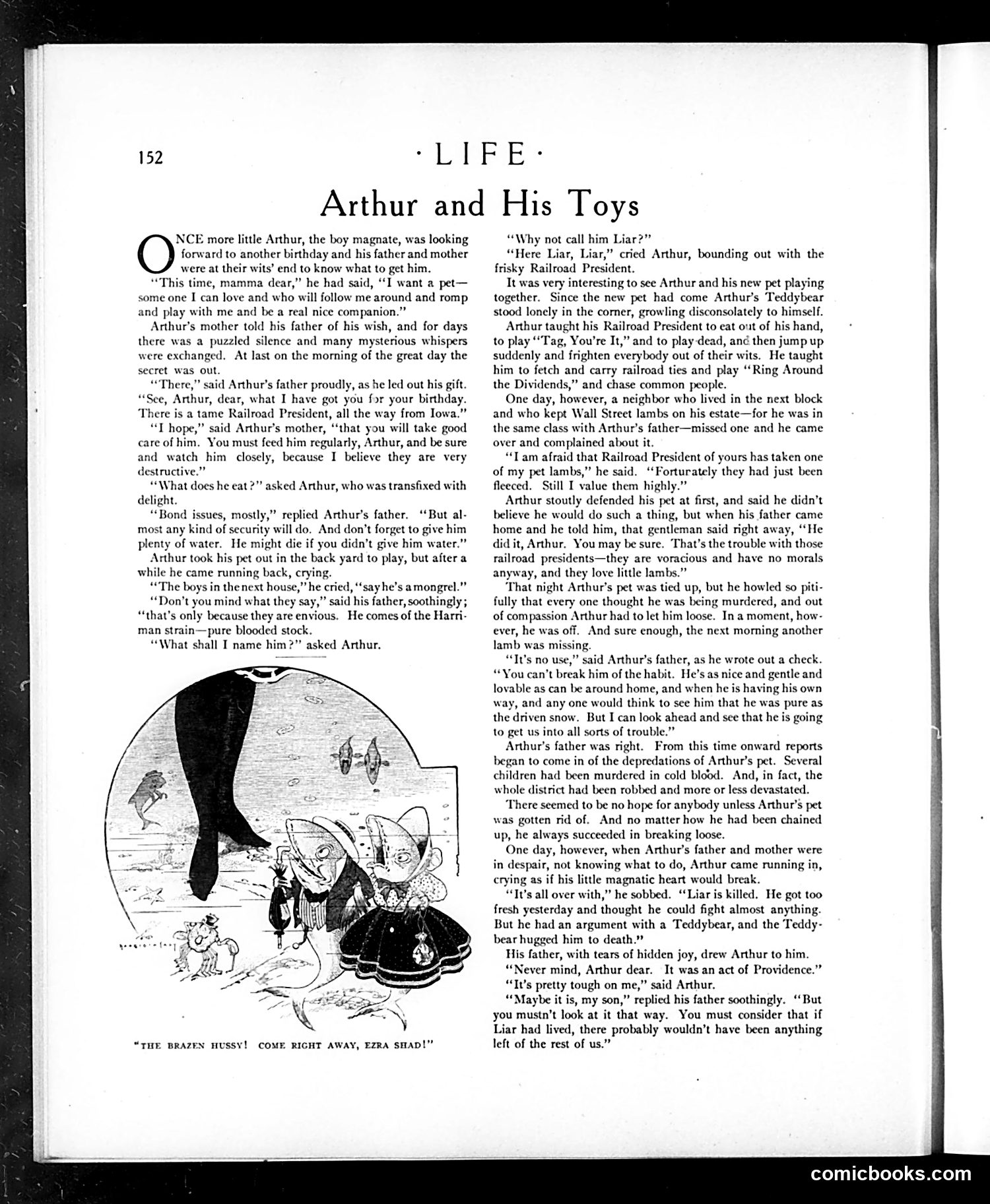
This 1906 Life magazine story satirizes corrupt railroad magnates through the conceit of a boy receiving a "tame Railroad President" as a pet. The railroad executive—named "Liar" and bred from the "Harriman strain"—symbolizes real railroad barons like E.H. Harriman who dominated American industry. The satire works by treating the railroad president as a dangerous animal: he eats "bond issues," is inherently destructive and immoral ("they are voracious and have no morals"), and cannot be reformed despite appearing genteel. His killing of neighboring lambs (the common people being "fleeced") represents how railroad monopolies victimized ordinary citizens through predatory practices. The cartoon criticizes both the railroad oligarchy itself and the wealthy fathers who enabled their power. It's satire aimed at exposing corporate corruption and exploitation during the Progressive Era.
📄 Transcribed text from this page (OCR, searchable)
Machine-transcribed from the original scan — historical spelling and the odd misread are preserved.
L TPE Arthur and His Toys forward to another birthday and his father and mother were at their wits’ end to know what to get him. his time, mamma dear,” he had said, “I want a pet— some one I can love and who will follow me around and romp and play with me and be a real nice companion.” Arthur’s mother told his father of his wish, and for days there was a puzzled silence and many mysterious whispers were exchanged. At last on the morning of the great day the secret was out. “There,” said Arthur’s father proudly, as he led out his gift. rthur, dear, what I have got you for your birthday. There is a tame Railroad President, all the way from Iowa.” “T hope,” said Arthur's mother, “that you will take good care of him. You must feed him regularly, Arthur, and be sure and watch him closely, because I believe they are very destructive.” “What does he eat ?” asked Arthur, who was transfixed with delight. “Bond issues, mostly,’ most any kind of security will do. On more little Arthur, the boy magnate, was looking replied Arthur's father. “But al- And don’t forget to give him plenty of water. He might die if you didn't give him water.” Arthur took his pet out in the back yard to play, but after a while he came running back, crying. “The boys in thenext house,” he cried, “say he’s amongrel.” “Don't you mind what they say,” said his father, soothingly; “that’s only because they are envious. He comes of the Harri- man strain—pure blooded stock. “What shall T name him?” asked Arthur, “THE BRAZEN HUSSY! COME RIGHT AWAY, EZRA SHAD!" “Why not call him Liar?” “Here Liar, Liar,” cried Arthur, bounding out with the frisky Railroad President. It was very interesting to see Arthur and his new pet playing together. Since the new pet had come Arthur’s Teddybear stood lonely in the comer, growling disconsolately to himself. Arthur taught his Railroad President to eat out of his hand, to play “Tag, You’re It,” and to play-dead, and then jump up suddenly and frighten everybody out of their wits. He taught him to fetch and carry railroad ties and play “Ring Around the Dividends,” and chase common people. One day, however, a neighbor who lived in the next block and who kept Wall Street lambs on his estate—for he was in the same class with Arthur’s father—missed one and he came over and complained about it. “Tam afraid that Railroad President of yours has taken one of my pet lambs,” he said. ‘Forturately they had just been fleeced. Still I value them highly.” Arthur stoutly defended his pet at first, and said he didn’t believe he would do such a thing, but when his father came home and he told him, that gentleman said right away, “He did it, Arthur. You may be sure. That’s the trouble with those railroad presidents—they are voracious and have no morals anyway, and they love little lambs.” ‘That night Arthur’s pet was tied up, but he howled so piti- fully that every one thought he was being murdered, and out of compassion Arthur had to let him loose. In a moment, how- ever, he was off. And sure enough, the next morning another lamb was missing. “It’s no use,” said Arthur’s father, as he wrote out a check. “You can't break him of the habit. He’s as nice and gentle and lovable as can be around home, and when he is having his own way, and any one would think to sce him that he was pure as the driven snow. But I can look ahead and sce that he is going to get us into all sorts of trouble.” Arthur's father was right. From this time onward reports began to come in of the depredations of Arthur’s pet. Several children had been murdered in cold blood. And, in fact, the whole district had been robbed and more or less devastated. ‘There seemed to be no hope for anybody unless Arthur’s pet was gotten rid of. And no matter how he had been chained up, he always succeeded in breaking loose. One day, however, when Arthur's father and mother were in despair, not knowing what to do, Arthur came running in, crying as if his little magnatic heart would break. “It’s all over with,” he sobbed. “Liar is killed. He got too fresh yesterday and thought he could fight almost anything. But he had an argument with a Teddybear, and the Teddy- bear hugged him to death.” His father, with tears of hidden joy, drew Arthur to him. “Never mind, Arthur dear. It was an act of Providence.” “It’s pretty tough on me,” said Arthur, “Maybe it is, my son,” replied his father soothingly. “But you mustn’t look at it that way. You must consider that if Liar had lived, there probably wouldn’t have been anything left of the rest of us.’”” comicbooks.com