
Life, 1907-08-01 · page 31 of 48
Life — August 1, 1907 — page 31: what you’re looking at
What you’re looking at
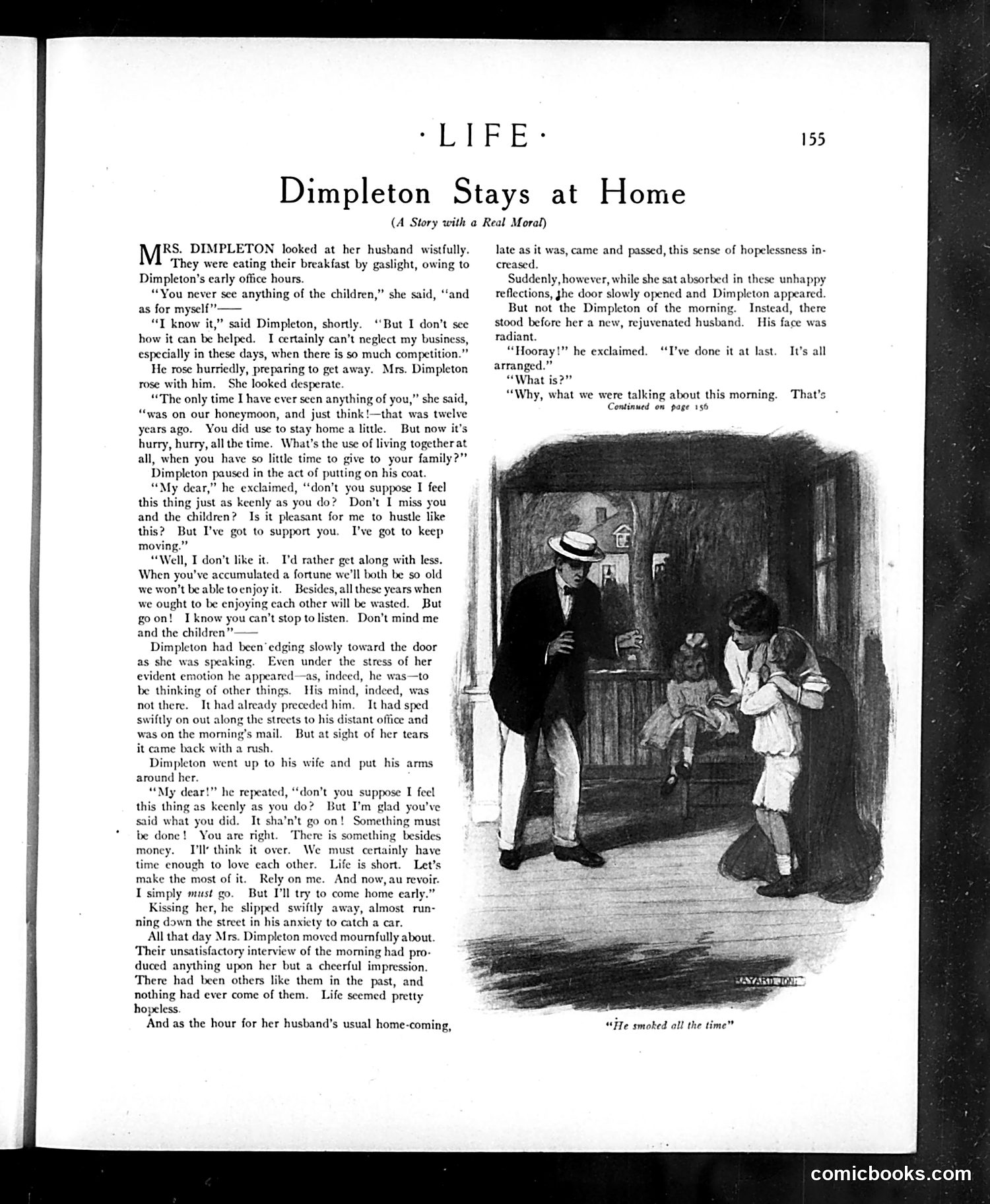
This satirical story illustrates the tension between industrial-era ambition and family life. Mr. Dimpleton, a businessman, works obsessively, claiming competition demands it. His wife protests that he's absent from their children and marriage—they've barely spent time together since their honeymoon twelve years prior. When confronted with her unhappiness, Dimpleton promises change, claiming "something must be done," then immediately rushes off to work anyway. The illustration shows him departing despite his professed commitment. The satire targets the hypocrisy of men who verbally acknowledge family importance while their actions prioritize business relentlessly. The caption "'He smoked all the time'" (visible in the illustration) reinforces the portrait of distracted domesticity—even when present, he's mentally absent. The story's "real moral" critiques how modern commercial competition erodes family bonds, with Dimpleton's promises ringing hollow.
📄 Transcribed text from this page (OCR, searchable)
Machine-transcribed from the original scan — historical spelling and the odd misread are preserved.
“LIFE « Dimpleton Stays at Home (A Story with @ Real Moral) RS. DIMPLETON looked at her husband wistfully. ‘They were eating their breakfast by gaslight, owing to Dimpleton’s early office hours. “You never see anything of the children,” she said, ‘and as for myself”. “TI know it,” said Dimpleton, shortly. ‘But I don’t see how it can be helped. I certainly can’t neglect my busi especially in these days, when there is so much competition.’ He rose hurriedly, preparing to get away. Mrs. Dimpleton rose with him, She looked desperate. “The only time I have ever seen anything of you,” she said, “was on our honeymoon, and just think!—that was twelve years ago. You did use to stay home a little. But now it’s hurry, hurry, all the time. What's the use of living together at all, when you have so little time to give to your family?” Dimpleton paused in the act of putting on his coat. “My dear,” he exclaimed, “don’t you suppose I feel this thing just as keenly as you do? “Don’t I miss you and the children? Is it pleasant for me to hustle like this? But I’ve got to support you. I’ve got to keep moving.” “Well, I don’t like it. I'd rather get along with less. When you've accumulated a fortune we'll both be so old we won't be able toenjoy it. Besides, all these years when we ought to be enjoying each other will be wasted. But goon! I know you can’t stop to listen. Don’t mind me and the children” Dimpleton had been’edging slowly toward the door as she was speaking. en under the stress of her evident emotion he appeared—as, indeed, he was—to be thinking of other things. His mind, indeed, was not there. It had already preceded him. It had sped swiftly on out along the streets to his distant office and was on the moming’s mail. But at sight of her tears it came back with a rush. Dimpleton went up to his wife and put his arms around her. “My dear!” he repeated, “don't you suppose I feel this thing as keenly as you do? But I'm glad you've said what you did. It sha’n’t go on! Something must be done! You are right. There is something besides money. I'll think it over. We must certainly have time enough to love cach other. Life is short. Let’s make the most of it. Rely on me. And now, au revoir. I simply must go. But I'll try to come home early.” Kissing her, he slipped swiftly away, almost. run- ning down the street in his anxiety to catch a car. All that day Mrs. Dimpleton moved mournfully about. Their unsatisfactory interview of the morning had pro- duced anything upon her but a cheerful impression. There had been others like them in the past, and nothing had ever come of them. Life seemed pretty hopeless. And as the hour for her husband’s usual home-coming, late as it was, came and passed, this sense of hopelessness in- creased. Suddenly, however, while she sat absorbed in these unhappy reflections, ghe door slowly opened and Dimpleton appeared. But not the Dimpleton of the morning. Instead, there stood before her a new, rejuvenated husband. His face was radiant. “Hooray!” he exclaimed. “I’ve done it at last. It’s all arranged.” “What is?” “Why, what we were talking about this morning. That's Continued on page 156 “Fe smoked all the time” comicbooks.com