
Life, 1907-08-01 · page 30 of 48
Life — August 1, 1907 — page 30: what you’re looking at
What you’re looking at
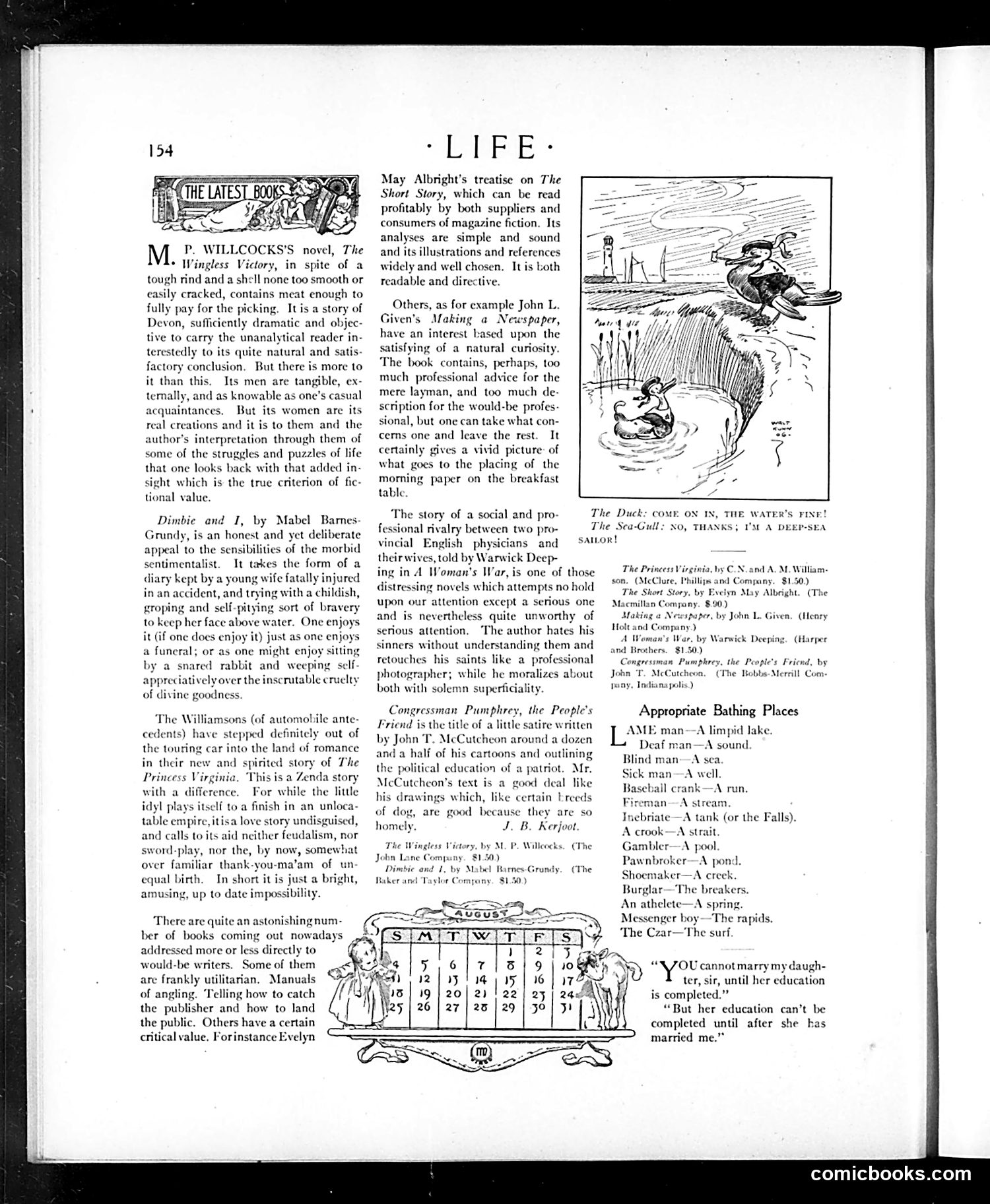
This page contains book reviews and a cartoon. The main cartoon shows "The Sea-Gull"—a duck refusing assistance from a sailor with the caption "NO, THANKS; I'M A DEEP-SEA SAILOR!" The joke relies on wordplay: the duck claims to be a "deep-sea sailor" when actually it's just a waterfowl, playing on the absurdity of the bird's pretension and self-importance. The page reviews several contemporary novels, criticizing their quality. Notably, it praises female characters in some works while dismissing "Woman's War" as moralistic drivel where the author "hates his sinners" and "retouches his saints like a professional photographer"—satirizing superficial moral posturing in literature. The final section lists humorous "Appropriate Bathing Places" for various professions (e.g., "Fireman—A stream"), functioning as light social satire about occupational stereotypes.
📄 Transcribed text from this page (OCR, searchable)
Machine-transcribed from the original scan — historical spelling and the odd misread are preserved.
+ Wingless Victory, in spite of a tough rind and a shell none too smooth or easily cracked, contains meat enough to fully pay for the picking. It isa story of Devon, sufficiently dramatic and objec- tive to carry the unanalytical reader in- terestedly to its quite natural and satis- factory conclusion. But there is more to it than this. Its men are tangible, ex- temally, and as knowable as one’s casual acquaintances. But its women are its real creations and it is to them and the thor’s interpretation through them of some of the struggles and puzzles of life that one looks back with that added in- sight which is the true criterion of fic- tional value. Dimbie and I, by Mabel Barne: Grundy, is an honest and yet deliberate ( \ s of the morbid sentimentalist. It takes the form of a diary kept by a young wife fatally injured in an accident, and trying with a childish, groping and self-pitying sort of | y to keep her face above water. Onc enjoys it (if one does enjoy it) just as one enjoy a funeral; or as one might enjoy s by a snared rabbit and weeping s appreciatively over the inscrutable cruelty of divine goodness. The Williamsons (of automobile ante- cedents) have stepped definitely out of the touring car into the land of romance in their new and spirited story of The Princess Virginia. This is a Zenda story with a difference. For while the litle idyl plays itself to a finish in an unloca- table empire, itisa love story undisguised, and calls to its aid neither feudalism, nor sword-play, nor the, by now, somewhat over familiar thank-you-ma’am of un equal birth. In short it is just a bright, amusing, up to date impossibility. There are quite an astonishing num- ber of books coming out nowadays addressed more or less directly to would-be writers. Some of them are frankly utilitarian, Manuals of angling. ‘Telling how to catch the publisher and how to land the public. Others have a certain ESE May Albright’s treatise on The Short Story, which can be read profitably by both suppliers and consumers of magazine fiction. Its analyses are simple and sound and its illustrations and references widely and well chosen. It is both readable and directiv Others, as for example John L. Given’s Making a Newspaper, have an interest kased upon the satisfying of a natural curiosity, The book contains, perhaps, too much professional advice for the mere layman, and too much de. scription for the would-be profes sional, but one can take what con- cerns one and leave the rest. It certainly gives a vivid picture: of what goes to the placing of the morning paper on the breakfast table The story of a social and pro- The Sea-Gull: NO, THANKS; UM A DEE! SAILOR! fessional rivalry between two pro- vincial English physicians and their wives, told by Warwick Deep- ing in « Woman's War, is one of those distressing novels which attempts no hold upon our attention except a serious one and is nevertheless quite unworthy of serious attention, ‘The author hates his sinners without understanding them and retouches his saints like a professional photographer; while he moralizes about both with solemn superficiality. Congressman Pumphrey, the People’s Friend is the title of a little satire written by John T. McCutcheon around a dozen and a half of his cartoons and outlining the political education of a patriot. Mr. McCutcheon’s text is a good deal like his drawings which, like certain Ereeds of dog, are good because they J. B. Kerjoot. igtess Victory, by M. P. Willcocks. ny. $1.50) 1. by Mabel re so (The Harnes-Grundy, (The Duck: COME ON IN, THE WATER'S FINE! Ml A. M. William. $1.50) (The The Princess Virginia, by CN (McClure, Phillips and Company The Short Story, by Evelyn May Albeight ‘Macmilla Making Hott and C Newspaper, by John L. Given, (Henry mpany:) n's War, by Wa ms. $1.50) an Pumphrey, the People's Friend, by (The Bobbs-Merrill Com- wick Dee (Harper congress John T way, Indiana polis.) McCutcheoa, Appropriate Bathing Places ME man--A limpid lake. Deaf man—A sound. Blind man—A sea Sick man —A well. A run. A stream, A tank (or the F A strait. \ pool A pond. Inebriate A crook Gambler Pawnbroker Shoemaker—A creek. Burglar—The breakers. An athelete—A sprin Messenger boy—The rapids. he surf J “YOU cannot marry my daugh- ter, sir, until her education is completed.” “But her education can’t be completed until after she has married me.” critical value. Forinstance Evelyn comicbooks.com