
Life, 1907-08-01 · page 34 of 48
Life — August 1, 1907 — page 34: what you’re looking at
What you’re looking at
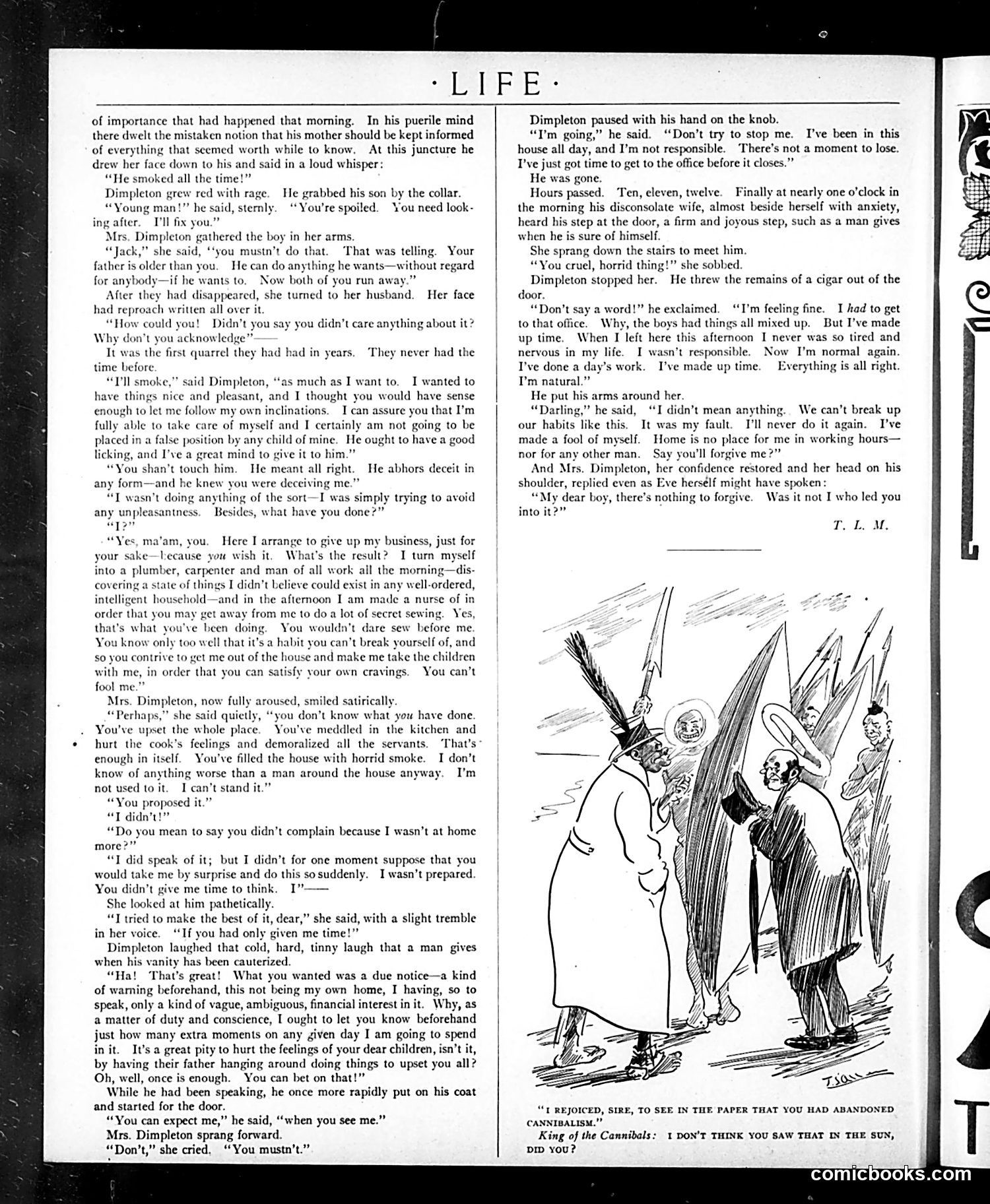
This cartoon illustrates the story's conclusion, depicting a domestic dispute resolved through absurdist humor. The sketch shows figures in what appears to be a tropical or primitive setting, captioned with dialogue about "abandoning cannibalism" and seeing something in a newspaper. The joke likely satirizes the central marital conflict: Mr. Dimpleton's attempt to participate in household life backfired so spectacularly that the couple has fled civilization entirely. The "cannibals" reference suggests they've regressed to primitive society—the ultimate consequence of his well-intentioned but disastrous domestic intervention. This reflects *Life* magazine's satirical stance on gender roles and marriage: the story mocks both Dimpleton's bumbling incompetence at "women's work" and Mrs. Dimpleton's manipulative resistance to his presence. The cartoon's punchline suggests that domestic chaos is so destructive that escape to savagery seems preferable—a darkly comic commentary on American middle-class marriage.
📄 Transcribed text from this page (OCR, searchable)
Machine-transcribed from the original scan — historical spelling and the odd misread are preserved.
eLibelss of importance that had happened that moming. In his puerile mind there dwelt the mistaken notion that his mother should be kept informed of everything that seemed worth while to know, At this juncture he drew her face down to his and said in a loud whisper: “He smoked all the time!” Dimpleton grew red with rage. He grabbed his son by the collar. “Young man!” he said, sternly. ‘You're spoiled. You need look- ing after. I'll fix you.” Mrs. Dimpleton gathered the boy in her arms. “Jack,” she said, ‘‘you mustn’t do that. That was telling. Your father is older than you. He can do anything he wants—without regard for anybody—if he wants to. Now both of you run away.” After they had disappeared, she turned to her husband. Her face had reproach written all over it “How could you! Didn't you say you didn’t care anything about it? Why don’t you acknowledge” It was the first quarrel they had had in years. ‘They never had the time before. “Tl smoke,” said Dimpleton, “as much as I want to. I wanted to have things nice and pleasant, and I thought you would have sense enough to let me follow my own inclinations. I can assure you that I’m fully able to take care of myself and I certainly am not going to be placed in a false position by any child of mine. He ought to have a good licking, and I've a great mind to give it to him.” “You shan’t touch him. He meant all right. He abhors deceit in and he knew you were deceiving me.” sn’t doing anything of the sort—I was simply trying to avoid antness. Besides, what have you done?” “Yes, ma'am, you. Here I arrange to give up my business, just for your sake—Lecause you wish it. What's the result? I turn myself into a plumber, carpenter and man of all work all the morning—dis- covering a state of things I didn’t believe could exist in any well-ordered, intelligent household—and in the afternoon I am made a nurse of in order that you may get away from me to do a lot of secret sewing. Yes, 's what you've heen doing. You wouldn't dare sew before me. You know only too well that it’s a habit you can’t break yourself of, and so you contrive to get me out of the house and make me take the children with me, in order that you can satisfy your own cravings. You can’t fool me. Mrs. Dimpleton, now fully aroused, smiled satirically. “Perhaps,” she said quietly, “you don’t know what you have done. You've upset the whole place. You've meddled in the kitchen and hurt the cook’s feelings and demoralized all the servants. ‘That's enough in itself. You've filled the house with horrid smoke. I don’t know of anything worse than a man around the house anyway. I'm not used to it. I can’t stand it.” “You proposed it.” “T didn’t!” “Do you mean to say you didn’t complain because I wasn’t at home more?” “I did speak of it; but I didn’t for one moment suppose that you would take me by surprise and do this so suddenly. I wasn’t prepared You didn’t give me time to think. I”—— She looked at him pathetically. “T tried to make the best of it, dear,” she said, with a slight tremble in her voice. “If you had only given me time!” Dimpleton laughed that cold, hard, tinny laugh that a man gives when his vanity has been cauterized. “Ha! ‘That’s great! What you wanted was a due notice—a kind of warning beforehand, this not being my own home, I having, so to speak, only a kind of vague, ambiguous, financial interest in it. Why, as a matter of duty and conscience, I ought to let you know beforehand just how many extra moments on any given day I am going to spend in it. It’s a great pity to hurt the feelings of your dear children, isn’t it, by having their father hanging around doing things to upset you all? Oh, well, once is enough. You can bet on that!” While he had been speaking, he once more rapidly put on his coat and started for the door. “You can expect me,” he said, “when you see me.” Mrs. Dimpleton sprang forward. “Don’t,” she cried, ‘You mustn’t.”” Dimpleton paused with his hand on the knob. “I’m going,” he said. ‘Don’t try to stop me. I’ve been in this house all day, and I’m not responsible. ‘There's not a moment to lose. I’ve just got time to get to the office before it closes.” He was gone. Hours passed. ‘Ten, eleven, twelve. Finally at nearly one o'clock in the morning his disconsolate wife, almost beside herself with anxiety, heard his step at the door, a firm and joyous step, such as a man gives when he is sure of himself. She sprang down the stairs to meet him. “You cruel, horrid thing!” she sobbed. Dimpleton stopped her. He threw the remains of a cigar out of the door. “Don’t say a word!” he exclaimed. “I’m feeling fine. I had to get to that office. Why, the boys had things all mixed up. But I’ve made up time. When I left here this afternoon I never was so tired and nervous in my life. I wasn’t responsible. Now I’m normal again. I've done a day’s work. I’ve made up time. Everything is all right. I’m natural.” rms around her. he said, ‘I didn’t mean anything. We can’t break up our habits like this. It was my fault. I'll never do it again. I’ve made a fool of myself. Home is no place for me in working hours— nor for any other man. Say you'll forgive me?” And Mrs. Dimpleton, her confidence restored and her head on his shoulder, replied even as Eve hersélf might have spoken: “My dear boy, there’s nothing to forg Y into it?” “1 REJOICED, SIRE, TO SEE IN THE PAPER THAT YOU HAD ABANDONED CANNIBALISM.” King of the Cannibals: 1 DON'T THINK YOU SAW THAT IN THE SUN, Dip you? comicbooks.com