
Life, 1907-08-01 · page 43 of 48
Life — August 1, 1907 — page 43: what you’re looking at
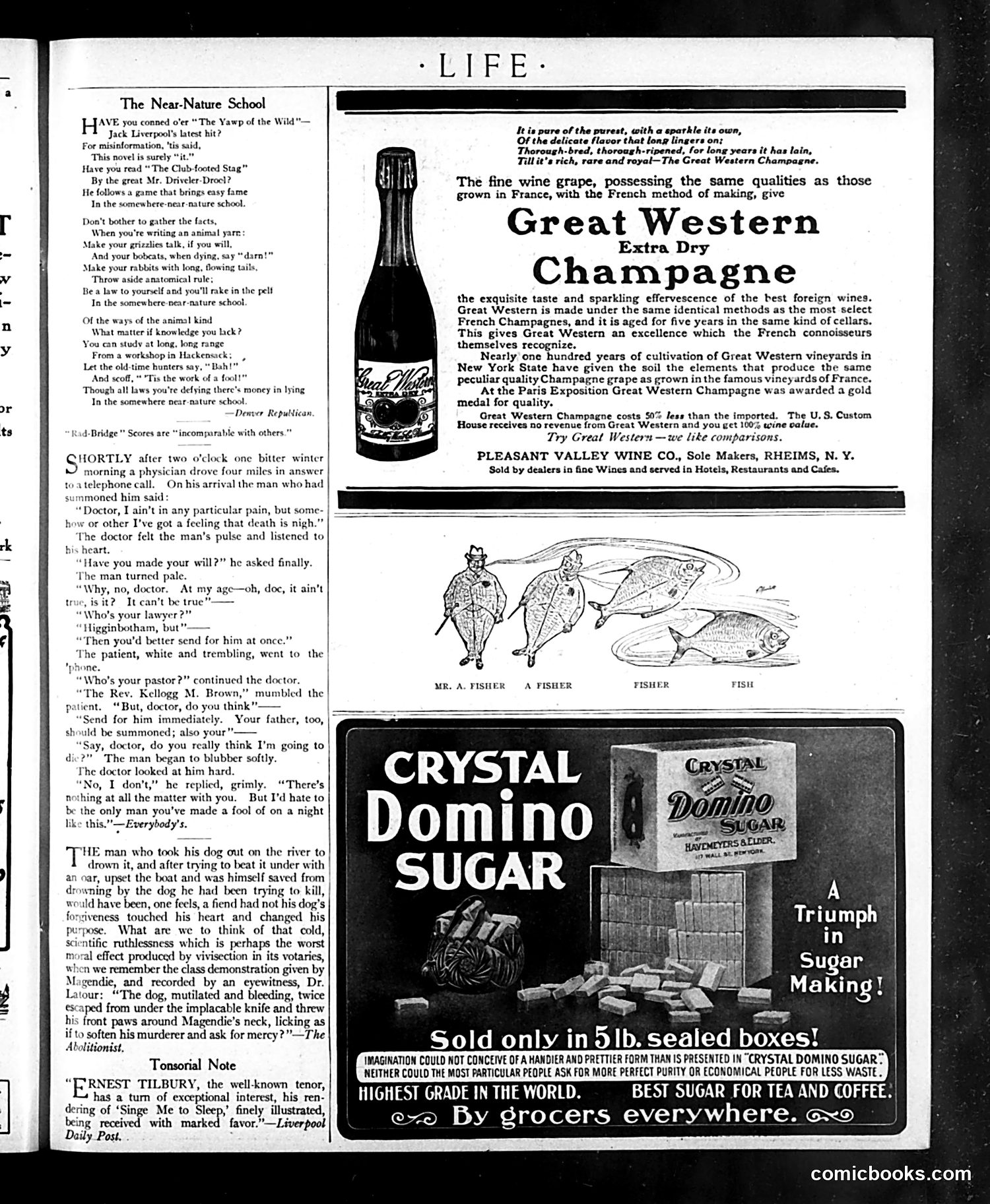
What you’re looking at
This poem mocks a literary trend of the era: adventure and animal stories written by authors with no genuine knowledge of nature or animals. The satire targets writers like "Jack Liverpool" (likely a pseudonym for a real popular author) who produced bestselling "near-nature" fiction despite ignoring anatomical accuracy and factual research. The joke is that these authors could write from anywhere—even "a workshop in Hackensack" (New Jersey)—inventing absurd details (rabbits with "long, flowing tails," animals speaking dialogue) while completely disregarding scientific truth. Yet they profited handsomely ("rake in the pel"). The satire criticizes both the authors' dishonesty and readers' gullibility, suggesting that profit mattered more than authenticity in popular publishing. This reflects turn-of-the-century tensions between literary realism and commercial entertainment.
📄 Transcribed text from this page (OCR, searchable)
Machine-transcribed from the original scan — historical spelling and the odd misread are preserved.
Ne The Near-Nature School AVE you conned o'er “The Yawp of the Wild" — Jack Liverpool's latest hit? For misinformatior This novel is surely “it.” Have you read “ The Club-footed Stag” By the great Mr. Driveler-Drocl? He follows a game that brings easy fame In the somewhere-near-nature school. Don't bother to gather the facts, When you're writing an animal yare Make your grizzlies talk, if you will, And your bobcats, when dying, say “darn!” Make your rabbits with long, flowing tails, ‘Throw aside anatomical rule; Be a law to yourself and you'll rake in the pel In the somewhere-near-nature school Of the ways of the animal kind What matter if knowledge you lick? You can study at long, long range From a workshop in Hackensack; Let the old-time hunters say, “Bah! And scoff," "Tis the work of a fool! Though all laws you're defying there's money in lying In the somewhere near-nature school. Denver Republican. Rad-Bridge " Scores are “incomparable with others.” CHORTLY after two o'clock one bitter winter © morning a physician drove four miles in answer toatelephone call. On his arrival the man who had summoned him said: “Doctor, I ain’t in any particular pain, but some how of other I’ve got a feeling that death is nigh.” The doctor felt the man's pulse and listened to his heart. “Have you made your will?” he asked finally. The man turned pale. “Why, no, doctor. At my age—oh, doe, it ain't truc, is it? It can't be true”— your lawyer?” botham, but "”— hen you'd better send for him at once.” one. “Who's your pastor?” continued the doctor. “The Rev. Kellogg M. Brown,” mumbled the “But, doctor, do you think” Send for him immediately. Your father, too, |~ ild be summoned; also your" — y, doctor, do you really think I’m going to ‘The man began to blubber softly. The doctor looked at him hard. 0, I don't,” he replicd, grimly. “There's nothing at all the matter with you, But I’d hate to be the only man you've made a fool of on a night like this.’ “ee man who took his dog out on the river to | drown it, and after trying to beat it under with an oar, upset the boat and was himself saved from drowning by the dog he had been trying to kill, would have been, one feels, a fiend had not his dog’s forgiveness touched his heart and changed his purpose. What are we to think of that cold, scientific ruthlessness which is perhaps the worst moral effect produced by vivisection in its votaries, when we remember the class demonstration given by Magendie, and recorded by an eyewitness, Dr. Latour: “The dog, mutilated and bleeding, twice escaped from under the implacable knife and threw his front paws around Magendie’s neck, licking as if to soften his murderer and ask for mercy?” —The Abolitionist, Tonsorial Note “E'RNEST TILBURY, the well-known tenor, has a tum of exceptional interest, his ren- dering of ‘Singe Me to Sleep,’ finely illustrated, being received with. marked: favor.” —Liverpool Daily Post, : It is pure of the purest, with a sparkle its own, Of the delicate flavor that long lingers on: Thorough-bred, thoroagh-ripened, for long years it has lain, Till it's rich, rare and royal—The Great Western Champagne. The fine wine grape, possessing the same qualities as those grown in France, with the French method of making, give Great Western Extra Dry Champagne the exquisite taste and sparkling effervescence of the best foreign wines. Great Western is made under the same identical methods as the most select French Champagnes, and it is aged for five years in the same kind of cellars. This gives Great Western an excellence which the French connoisseurs themselves recognize. Nearly one hundred years of cultivation of Great Western vineyards in New York State have given the soil the elements that produce the same peculiar quality Champagne grape as grown in the famous vineyards of France. At the Paris Exposition Great Western Champagne was awarded a gold medal for quality. Great Western Champagne costs $0% less than the imported. The U.S. Custom House receives no revenue from Great Western and you get 100% wine value. Try Great Western —we like comparisons. PLEASANT VALLEY WINE CO., Sole Makers, RHEIMS, N. Y. Sold by dealers in fine Wines and served in Hotels, Restaurants and Cafes. MR. A. FISHER A FISHER FISHER CRYSTAL Domino tal if | a a a Sold only in 5|b. sealed boxes! | IMAGINATION COULD NOT CONCEIVE OF A HANDIER AND PRETTIER FORM THAN IS PRESENTED IN “CRYSTAL DOMINO SUGAR” NEITHER COULD THE MOST PARTICULAR PEOPLE ASK FOR MORE PERFECT PURITY OR ECONOMICAL PEOPLE FOR LESS WASTE. HIGHEST GRADE INTHE WORLD. BEST SUGAR FOR TEA AND COFFEE. | exe By grocers everywher comicbooks.com