
Life, 1907-08-01 · page 16 of 48
Life — August 1, 1907 — page 16: what you’re looking at
What you’re looking at
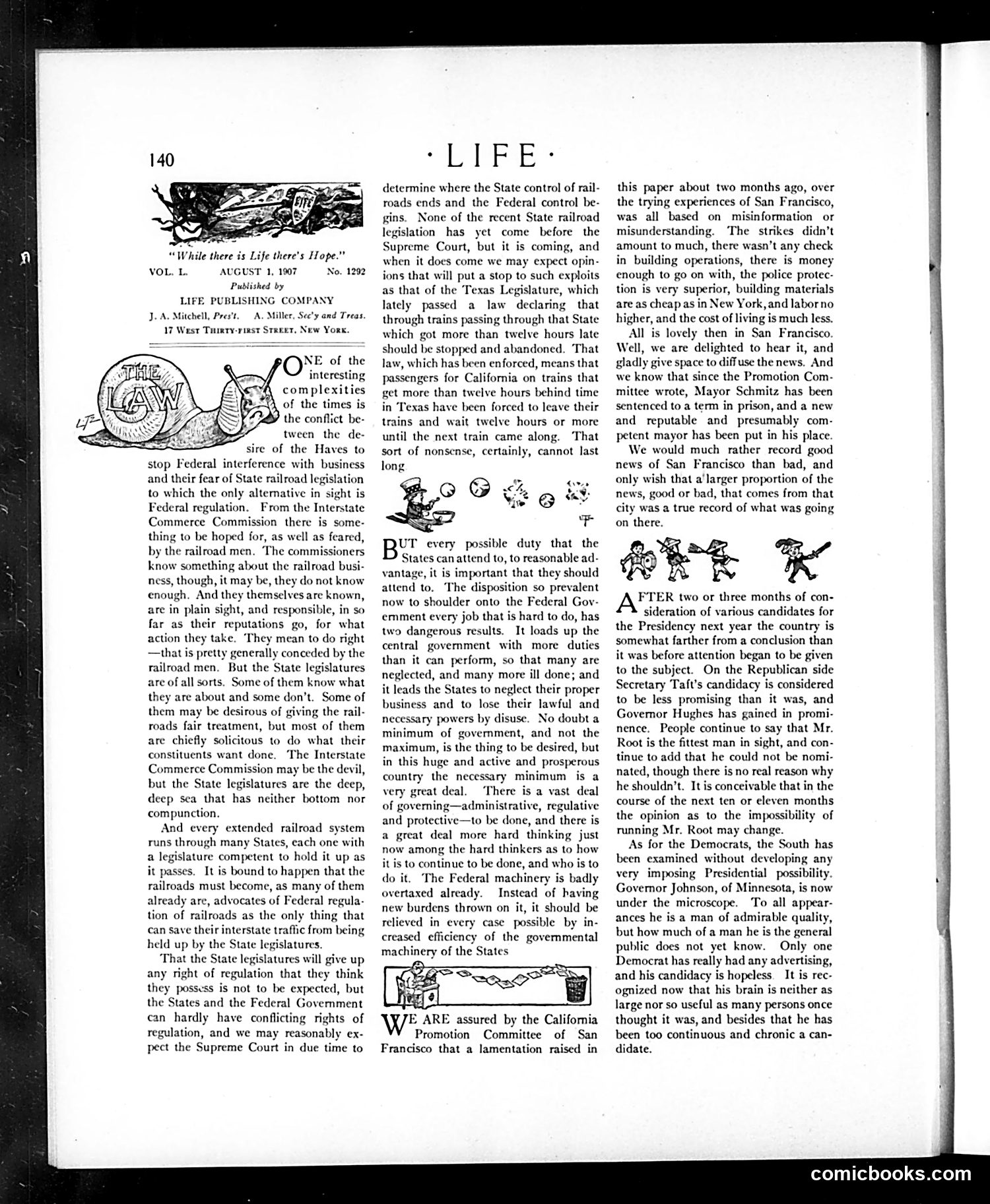
This editorial page addresses the conflict between railroads and government regulation. The text discusses railroad companies' dilemma: they fear intrusive state legislatures but also oppose federal regulation—though federal control now seems preferable to the unpredictable patchwork of state laws. The specific example cited is a Texas law requiring trains delayed over twelve hours to be abandoned, forcing California-bound passengers to wait. The author argues such state-level absurdities cannot continue. The small illustrations at bottom-center appear to show cartoon figures in motion (possibly representing the competing forces or confusion of regulation), though specific identities aren't clear from the image. The core argument: while states should retain proper powers, the railroads' interstate nature demands consistent rules. The Supreme Court must eventually clarify where state control ends and federal control begins. The author advocates minimal but necessary government—neither pure laissez-faire nor excessive centralization.
📄 Transcribed text from this page (OCR, searchable)
Machine-transcribed from the original scan — historical spelling and the odd misread are preserved.
“While there is Life there's Hope.” VOL. L. AUGUST 1, 1907 No. 1292 Published by LIFE PUBLISHING COMPANY J. A. Mitchell, Pres’t. 17 West Taiety-rigst Street, N A. Miller, Sec'y and Treas. of the times is the conflict be- tween the de- sire of the Haves to stop Federal interference with business and their fear of State railroad legislation to which the only alternative in sight is Federal regulation. From the Interstate Commerce Commission there is some- thing to be hoped for, as well as feared, by the railroad men, The commissioners know something about the railroad busi- ness, though, it may be, they do not know enough. And they themselves are known, are in plain sight, and responsible, in so far as their reputations go, for what action they take. They mean to do right —that is pretty generally conceded by the railroad men. But the State legislatures are of all sorts. Some of them know what they are about and some don’t. Some of them may be desirous of giving the rail- roads fair treatment, but most of them are chiefly solicitous to do what their constituents want done. The Interstate Commerce Commission may be the devil, but the State legislatures are the deep, deep sea that has neither bottom nor compunction. And every extended railroad system runs through many States, each one with a legislature competent to hold it up as it passes, It is bound to happen that the railroads must become, as many of them already are, advocates of Federal regula- tion of railroads as the only thing that can save their interstate traffic from being held up by the State legislatures, ‘That the State legislatures will give up any right of regulation that they think they possess is not to be expected, but the States and the Federal Government can hardly have conflicting rights of regulation, and we may reasonably ex- pect the Supreme Court in due time to “LIF E* determine where the State control of rail- roads ends and the Federal control be- gins. None of the recent State railroad legislation has yet come before the Supreme Court, but it is coming, and when it does come we may expect opin- ions that will put a stop to such exploits as that of the Texas Legislature, which lately passed a law declaring that through trains passing through that State which got more than twelve hours late should be stopped and abandoned. That law, which has been enforced, means that passengers for California on trains that get more than twelve hours behind time in Texas have been forced to leave their trains and wait twelve hours or more until the next train came along. That sort of nonsen: y, cannot last long every possible duty that the States can attend to, to reasonable ad- vantage, it is important that they should attend to, The disposition so prevalent now to shoulder onto the Federal Gov- emment every job that is hard to do, has two dangerous results. It loads up the central government with more duties than it can perform, so that many are neglected, and many more ill done; and it leads the States to neglect their proper business and to lose their lawful and necessary powers by disuse. No doubt a minimum of government, and not the maximum, is the thing to be desired, but in this huge and active and prosperous country the necessary minimum is a very great deal. here is a vast deal of governing—administrative, regulative and protective—to be done, and there is a great deal more hard thinking just now among the hard thinkers as to how it is to continue to be done, and who is to do it, The Federal machinery is badly overtaxed already. Instead of having new burdens thrown on it, it should be relieved in every case possible by in- creased efficiency of the governmental machinery of the States ARE assured by the California Promotion Committee of San Francisco that a lamentation raised in this paper about two months ago, over the trying experiences of San Francisco, was all based on misinformation or misunderstanding. The strikes didn’t amount to much, there wasn’t any check in building operations, there is money enough to go on with, the police protec- tion is very superior, building materials are as cheap as in New York, and laborno higher, and the cost of living is much less. All is lovely then in San Francisco. Well, we are delighted to hear it, and gladly give space to diffuse the news. And we know that since the Promotion Com- mittee wrote, Mayor Schmitz has been sentenced to a term in prison, and a new and reputable and presumably com- petent mayor has been put in his place. We would much rather record good news of San Francisco than bad, and only wish that a'larger proportion of the news, good or bad, that comes from that city was a true record of what was going on there. ORE K FTER two or three months of con- sideration of various candidates for the Presidency next year the country is somewhat farther from a conclusion than it was before attention began to be given to the subject. On the Republican side Secretary Taft’s candidacy is considered to be less promising than it was, and Governor Hughes has gained in promi- nence. People continue to say that Mr. Root is the fittest man in sight, and con- tinue to add that he could not be nomi- nated, though there is no real reason why he shouldn’t. It is conceivable that in the course of the next ten or eleven months the opinion as to the impossibility of running Mr. Root may change. As for the Democrats, the South has been examined without developing any very imposing Presidential possibilit; Govemor Johnson, of Minnesota, is now under the microscope. To all appear- ances he is a man of admirable quality, but how much of a man he is the general public does not yet know. Only one Democrat has really had any advertising, and his candidacy is hopeless. It is ree ognized now that his brain is neither as large nor so useful as many persons once thought it was, and besides that he has been too continuous and chronic a can- didate. comicbooks.com