
Life, 1907-08-01 · page 19 of 48
Life — August 1, 1907 — page 19: what you’re looking at
What you’re looking at
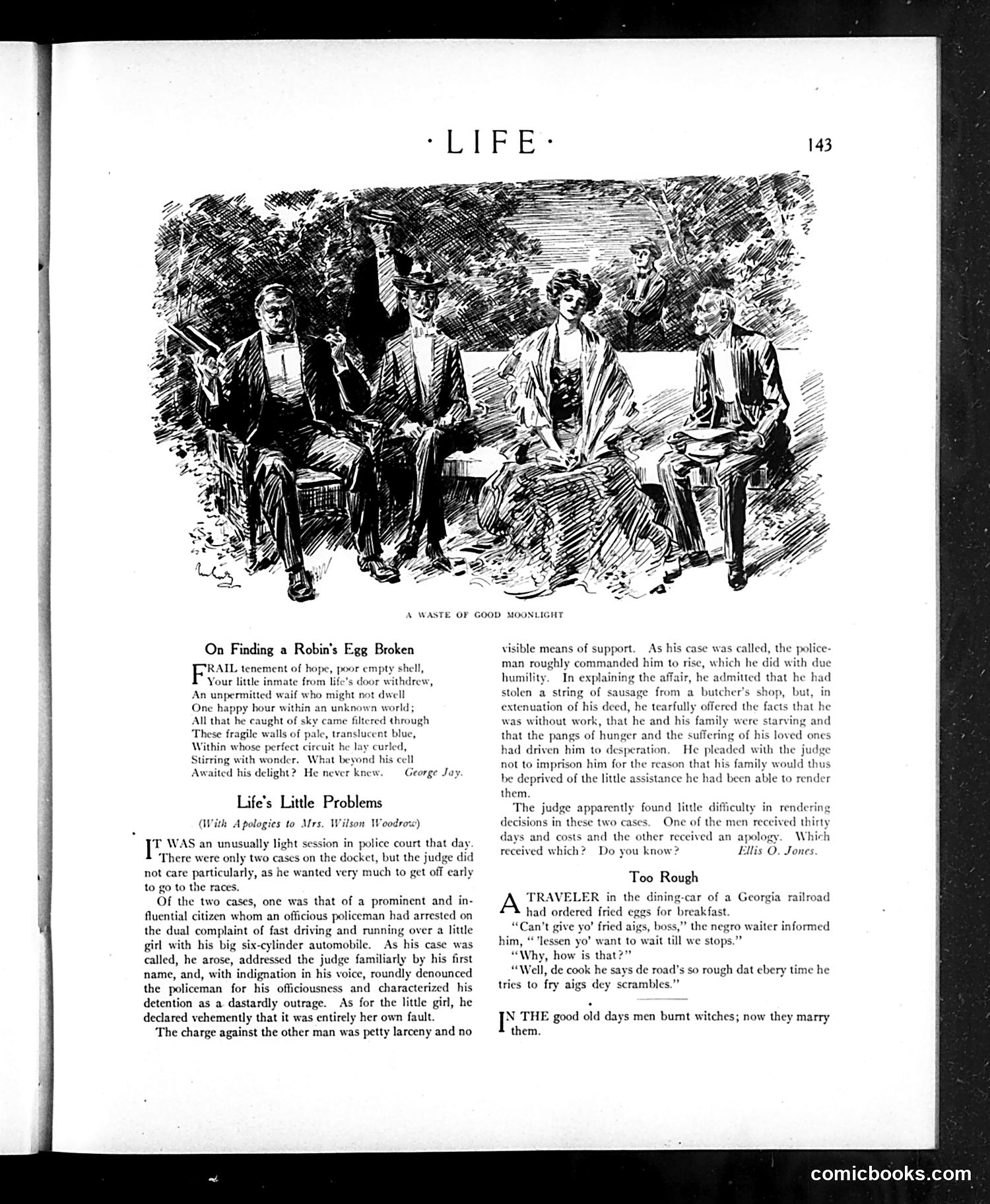
This page contains three distinct pieces of social satire: **"A Waste of Good Moonlight"** is a sentimental poem about a broken robin's egg, using the dead chick as a metaphor for wasted potential and life denied to the poor. **"Life's Little Problems"** is the main satirical piece. It contrasts two men in police court: a wealthy, prominent citizen arrested for reckless driving and hitting a child responds with indignation and blames the victim—and receives an apology. A poor man arrested for stealing sausage to feed his starving family receives thirty days in jail. The piece mocks the obvious hypocrisy of a judicial system that favors the rich and powerful while punishing the desperate poor for survival crimes. The caption asks readers to guess which man received which sentence—the answer being painfully obvious. **"Too Rough"** is a brief comedic anecdote about a Georgia railroad diner where the cook cannot fry eggs because the train's rough ride makes them scramble—a dialect-humor joke typical of the period.
📄 Transcribed text from this page (OCR, searchable)
Machine-transcribed from the original scan — historical spelling and the odd misread are preserved.
A WASTE OF GOOD MOONLIGHT On Finding a Robin's Egg Broken RAIL tenement of hope, poor empty shell, Your little inmate from life's door withdrew, An unpermitted waif who might not dwell One happy hour within an unknown world; All that he caught of sky came filtered through These fragile walls o} translucent blue, Within whose perfect circuit he lay curled, Stirring with wonder. What beyond his cell Awaited his delight? He never knew, — George Jay. Life’s Little Problems (With Apologies to Mrs. Wilson Woodrow) T WAS an unusually light session in police court that day There were only two cases on the docket, but the judge did not care particularly, as he wanted very much to get off early to go to the races. Of the two cases, one was that of a prominent and in- fluential citizen whom an officious policeman had arrested on the dual complaint of fast driving and running over a litte girl with his big six-cylinder automobile. As his case was called, he arose, addressed the judge familiarly by his first name, and, with indignation in his voice, roundly denounced the policeman for his officiousness and characterized his detention as a dastardly outrage. As for the little girl, he declared vehemently that it was entirely her own fault. The charge against the other man was petty larceny and no As his case was called, the police- man roug hich he did with due humility. In expla mitted that he h stolen a string of sausage from a butcher’s shop, bu extenuation of his deed, he tearfully offered the facts that he was without work, that he and his family were starvi id that the pangs of hunger and the suffering of his loved o had driven him to desperation, He pleaded with the judge not to imprison him for the reason that his family would th be deprived of the little assistance he had been able to render them. The judge apparently found little difficulty in rendering decisions in these two cases. One of the men received thirty days and costs and the other received an apology. Which received which? Do you know? Ellis O. Jones Too Rough TRAVELER in the dining-car of a Georgia railroad had ordered fried eggs for breakfast “Can't give yo’ fried a .”” the negro waiter informed him, “ ‘lessen yo’ want to wait till we stops.” “Why, how is that?” “Well, de cook he sa tries to fry aigs dey visible means of support. de road’s so rough dat ebery time he ambles.”” [8,THE good old days men burnt witches; now they marry them. comicbooks.com