
Life, 1907-08-01 · page 21 of 48
Life — August 1, 1907 — page 21: what you’re looking at
What you’re looking at
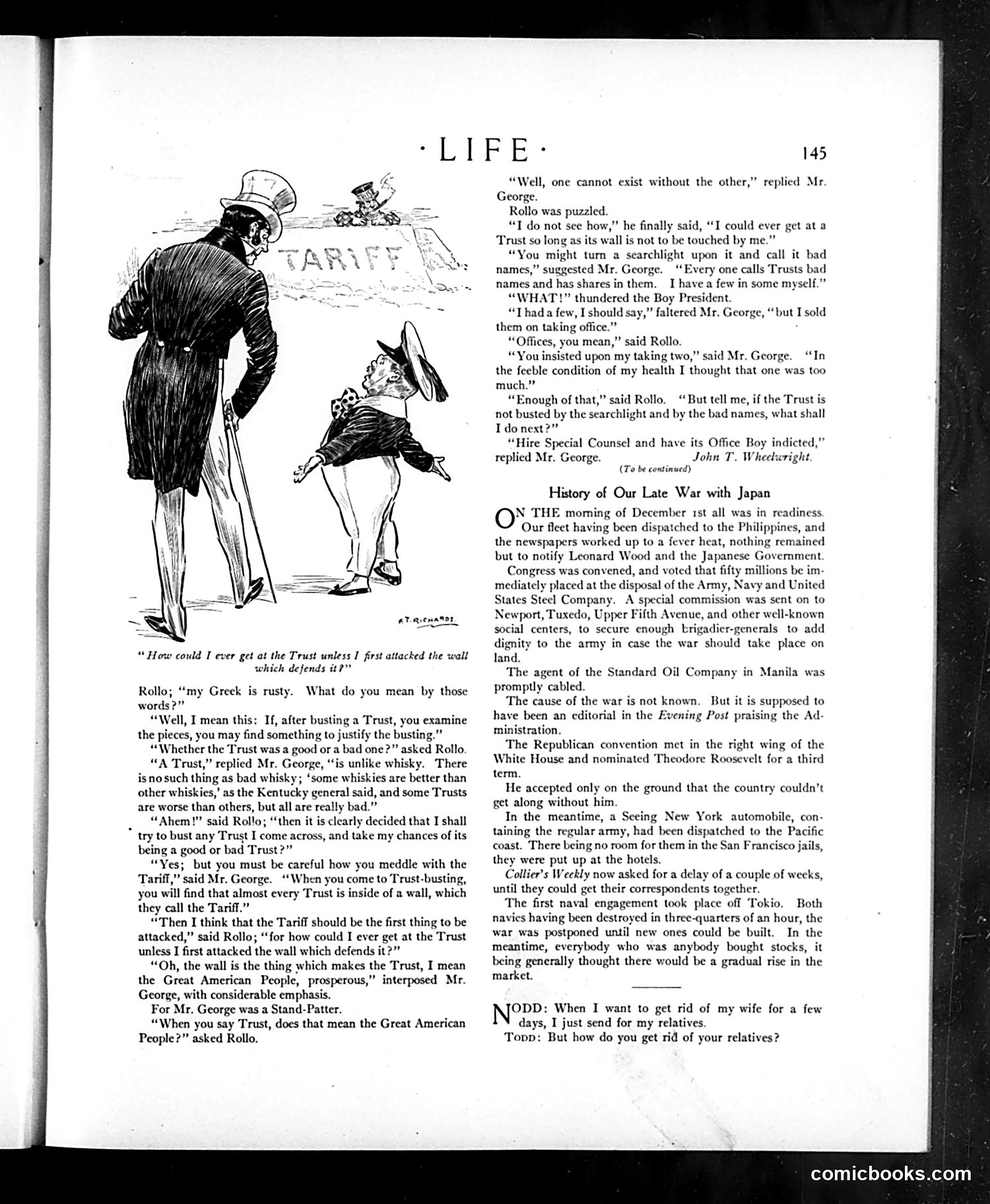
This page contains two satirical pieces from *Life* magazine attacking early 20th-century American politics. **The cartoon** (top) depicts "Mr. George" (likely Henry George, the economist/reformer) debating "Rollo" (possibly representing President Theodore Roosevelt, called "the Boy President" in the text). The satire mocks protectionist Republican politicians who claim to oppose monopolistic "Trusts" while defending the protective tariff that actually enables them. Mr. George represents the "Stand-Patter"—someone who talks tough on trusts but protects them through tariff walls. The absurd dialogue exposes the contradiction: you can't break up trusts without removing tariff protections, yet defenders claim the tariff makes America prosperous. **"History of Our Late War with Japan"** (below) is satirical mock-history ridiculing American imperialism, corporate influence (Standard Oil, U.S. Steel gaining war appropriations), and military excess—commissioning unnecessary generals for "dignity." Both pieces critique corporate-friendly Republican policies masked by reform rhetoric.
📄 Transcribed text from this page (OCR, searchable)
Machine-transcribed from the original scan — historical spelling and the odd misread are preserved.
‘LIFE * 145 AT RICHARD, “ How could I ever get at the Trust unless I first attacked the wall which defends it?” Rollo; “my Greek is rusty. words ?”” “Well, I mean this: If, after busting a Trust, you examine the pieces, you may find something to justify the busting.” “Whether the Trust was a good or a bad one?” asked Rollo. “A Trust,” replied Mr. George, “is unlike whisky. There is no such thing as bad whisky; ‘some whiskies are better than other whiskies,’ as the Kentucky gencral said, and some Trusts are worse than others, but all are really bad.” “Ahem!” said Rollo; “then it is clearly decided that I shall try to bust any Trust I come across, and take my chances of its being a good or bad Trust?” “Yes; but you must be careful how you meddle with the Tariff,” said Mr. George. ‘When you come to Trust-busting, you will find that almost every Trust is inside of a wall, which they call the Tariff.” “Then I think that the Tariff should be the first thing to be attacked,” said Rollo; ‘‘for how could I ever get at the Trust unless I first attacked the wall which defends it?” “Oh, the wall is the thing which makes the Trust, I mean the Great American People, prosperous,” interposed Mr. George, with considerable emphasis. For Mr. George was a Stand-Patter. “When you say Trust, does that mean the Great American People?” asked Rollo. What do you mean by those “Well, one cannot exist without the other,” replied Mr. George. Rollo was puzzled. “T do not see how,” he finally said, ‘I could ever get at a Trust so long as its wall is not to be touched by me.”” “You might turn a searchlight upon it and call it bad names,” suggested Mr. George. “Every one calls Trusts bad names and has shares in them. I have a few in some myself.” “WHAT!” thundered the Boy President. “Thada few, I should say,” faltered Mr. George, “but I sold them on taking office.” “Offices, you mean,” said Rollo. “You insisted upon my taking two,” said Mr. George. “In the feeble condition of my health I thought that one was too much.” “Enough of that,” said Rollo. “But tell me, if the Trust is not busted by the searchlight and by the bad names, what shall Ido next?” “Hire Special Counsel and have its Office Boy indicted,” replied Mr. George. John T. Wheelwright (To be continued) History of Our Late War with Japan N THE moming of December 1st all was in readiness. Our fleet having been dispatched to the Philippines, and the newspapers worked up to a fever heat, nothing remained but to notify Leonard Wood and the Japanese Government Congress was convened, and voted that fifty millions be im- mediately placed at the disposal of the Army, Navy and United States Steel Company. A special commission was sent on to Newport, Tuxedo, Upper Fifth Avenue, and other well-known social centers, to secure enough brigadier-generals to add dignity to the army in case the war should take place on land. ‘The agent of the Standard Oil Company in Manila was promptly cabled. The cause of the war is not known. But it is supposed to have been an editorial in the ning Post praising the Ad- ministration. The Republican convention met in the right wing of the White House and nominated Theodore Roosevelt for a third term. He accepted only on the ground that the country couldn’t get along without him. In the meantime, a Seeing New York automobile, con- taining the regular army, had been dispatched to the Pacific coast. There being no room for them in the San Francisco jails, they were put up at the hotels, Collier's Weekly now asked for a delay of a couple of weeks, until they could get their correspondents together. The first naval engagement took place off Tokio. Both navies having been destroyed in three-quarters of an hour, the war was postponed until new ones could be built. In the meantime, everybody who was anybody bought stocks, it being generally thought there would be a gradual rise in the market. NODD: When I want to get rid of my wife for a few days, I just send for my relatives. Topp: But how do you get rid of your relatives? comicbooks.com