A complete issue · 48 pages · 1907
Life — April 4, 1907
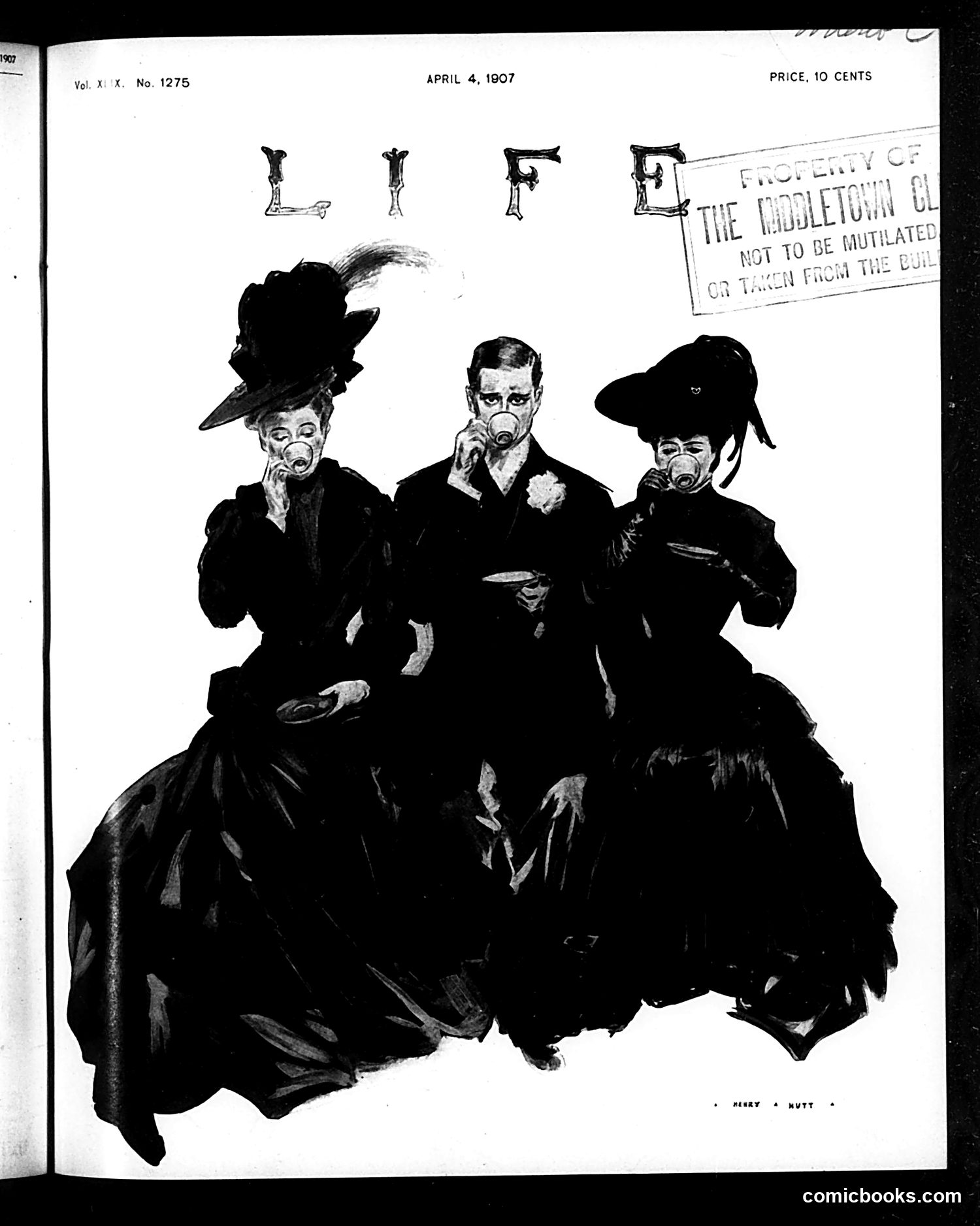
This satirical cover depicts three figures wearing gas masks, suggesting concern about air pollution or contamination. The title "LIFE" appears above them in decorative letters. The cartoon likely comments on urban pollution or health hazards in early 1900s America—a period of rapid industrialization. The three figures, dressed formally in Edwardian attire, are holding handkerchiefs to their faces despite already wearing masks, emphasizing the severity of the problem. The stamp on the right indicates this was property of "The Middletown Library" and warns against mutilation or removal. Without additional context, the specific individuals caricatured cannot be identified with certainty, but the satire clearly targets the environmental or health crisis affecting American cities at this time.
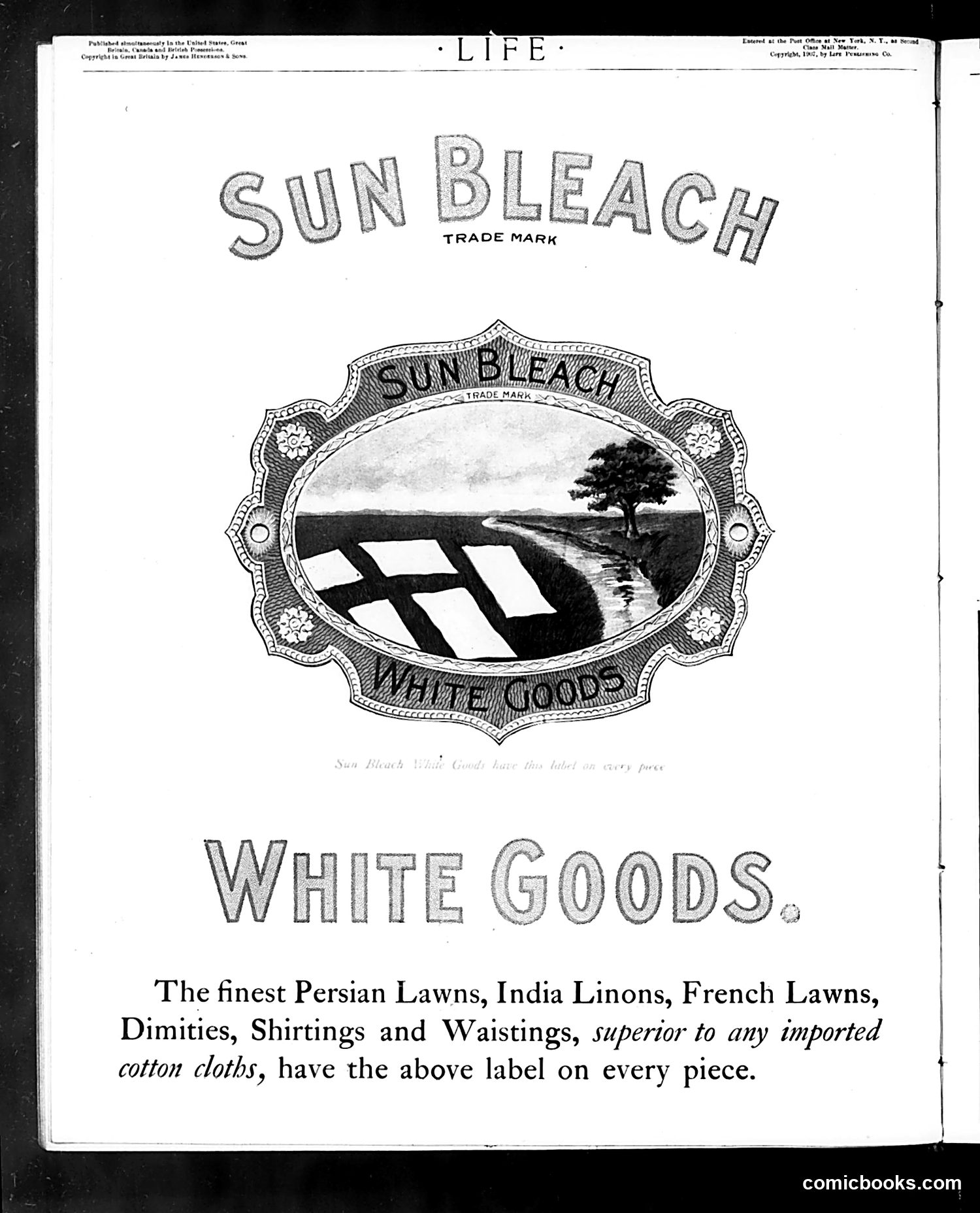
This page is primarily a **commercial advertisement**, not satire or political commentary. It advertises "Sun Bleach," a trade-marked product for whitening textiles. The ornate label features a pastoral landscape with clotheslines displaying white fabric, emphasizing the product's bleaching capability. The text promotes "Persian Lawns, India Linons, French Lawns, Dimities, Shirtings and Waistings" as superior to imported cotton cloths when treated with Sun Bleach. This reflects early 20th-century marketing strategy: the decorative badge design and pastoral imagery appealed to consumers' desires for quality and purity. The emphasis on superiority to "imported" goods suggests nationalist or protectionist sentiment, common in American advertising of this era. There is no apparent satirical content—this is straightforward product promotion.
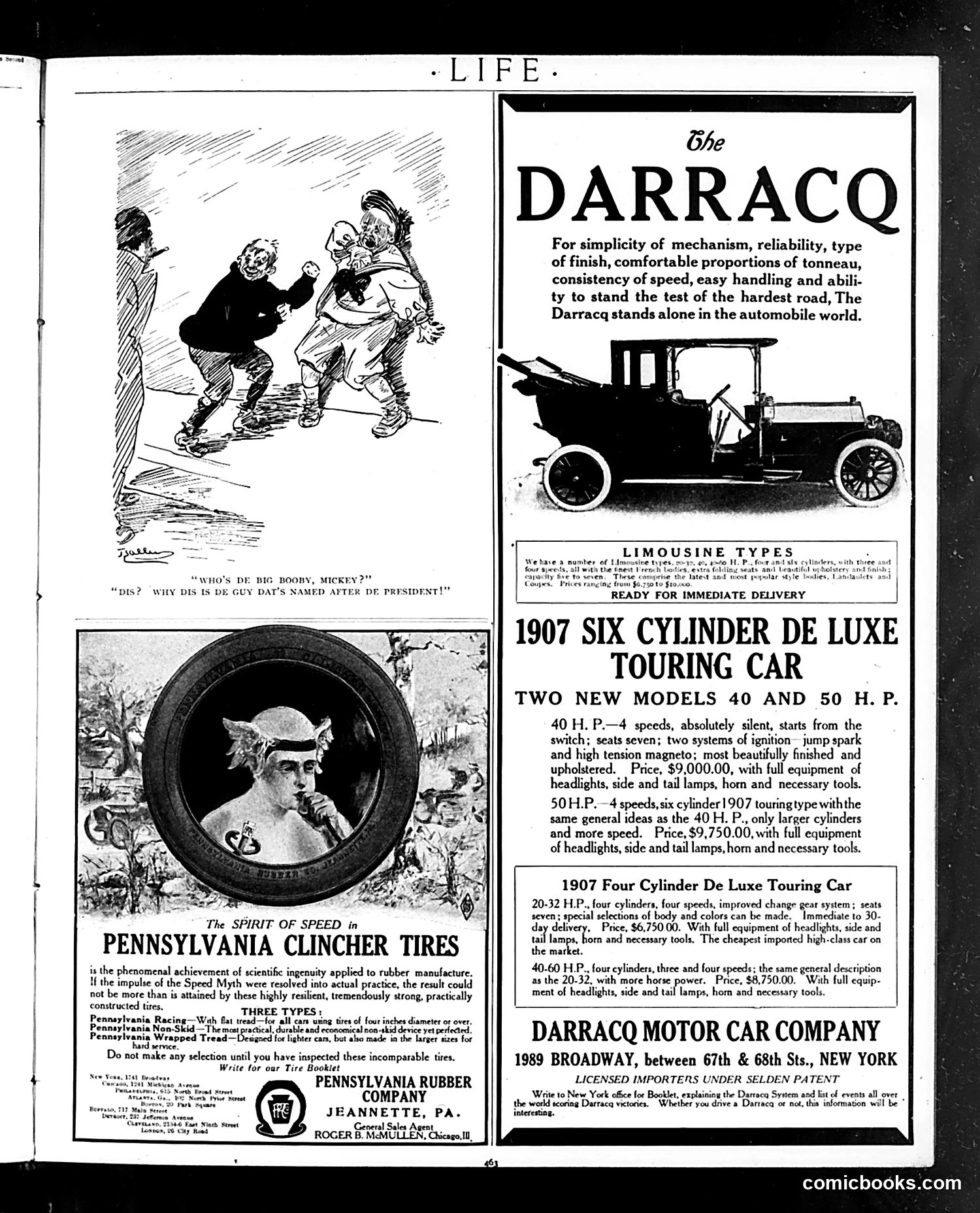
This page is primarily **advertising content** for automobiles (Darracq motor cars) and Pennsylvania rubber tires, interspersed with satirical cartoons. The top cartoon depicts children playing, with dialogue: "WHO'S DE BIG BOOBY, MICKEY?" / "DIS? WHY DIS IS DE GUY DAT'S NAMED AFTER DE PRESIDENT!" This appears to reference **Theodore Roosevelt**, likely mocking either his prominence in public discourse or a specific policy. The joke relies on calling someone a "booby" (fool) while attributing the name to the president—typical of early 1900s satirical humor targeting political figures. The page otherwise contains product advertisements with technical specifications and pricing for luxury automobiles and tires, reflecting the emerging automobile industry's marketing push to American consumers.
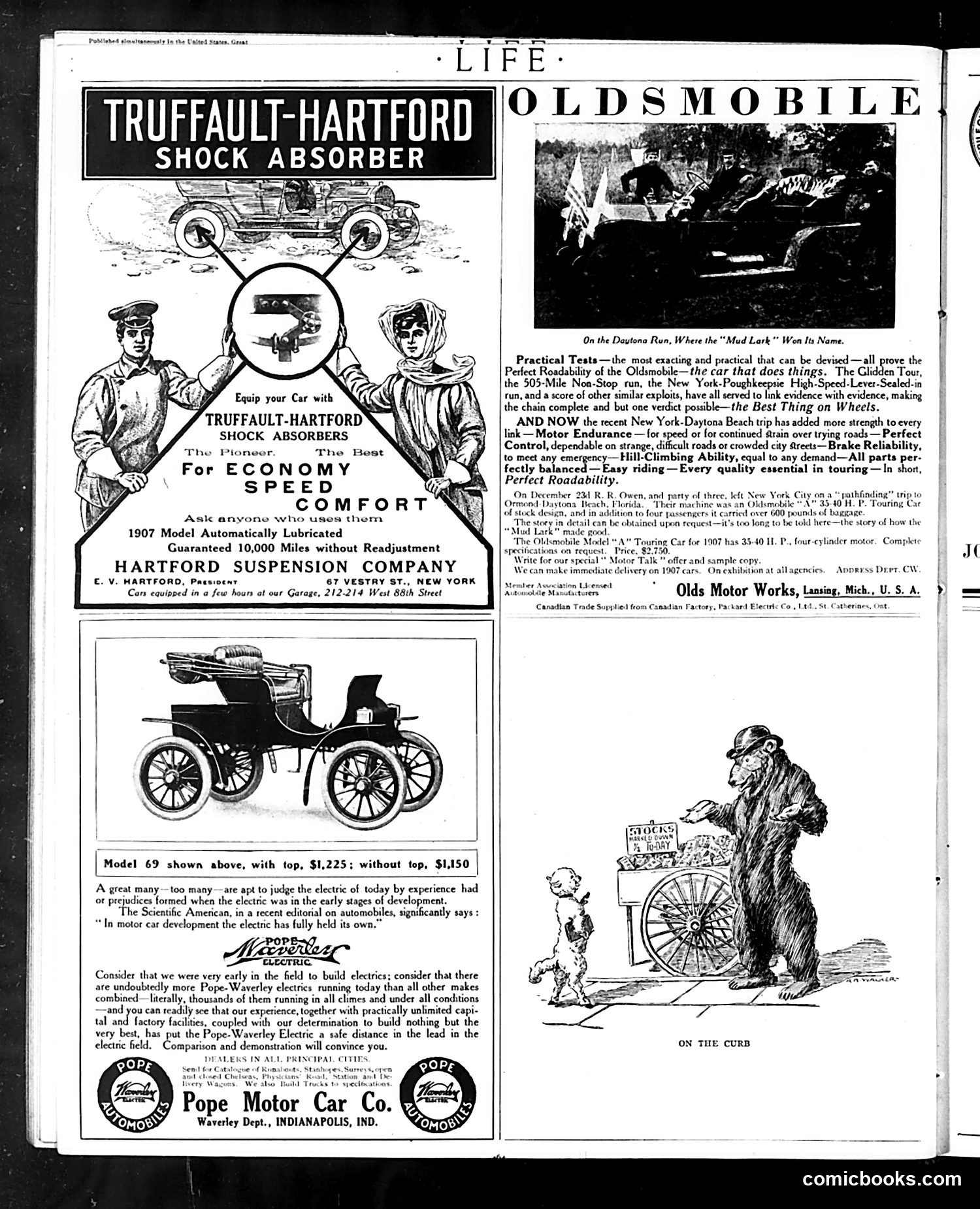
This page is primarily **automobile advertising** rather than political satire. The left side features ads for the Truffault-Hartford Shock Absorber and Pope Motor Car Company's electric vehicles. The right side advertises Oldsmobile automobiles. The only cartoon appears at bottom right, titled "ON THE CURB," showing what appears to be a street vendor or working-class figure with a child, likely depicting economic hardship or poverty. However, without clearer image resolution or additional context, the specific satirical point remains unclear. The page's main content emphasizes early 1900s automotive technology and marketing—shock absorbers, electric cars, and the emerging automobile industry's competitive claims about reliability and comfort.
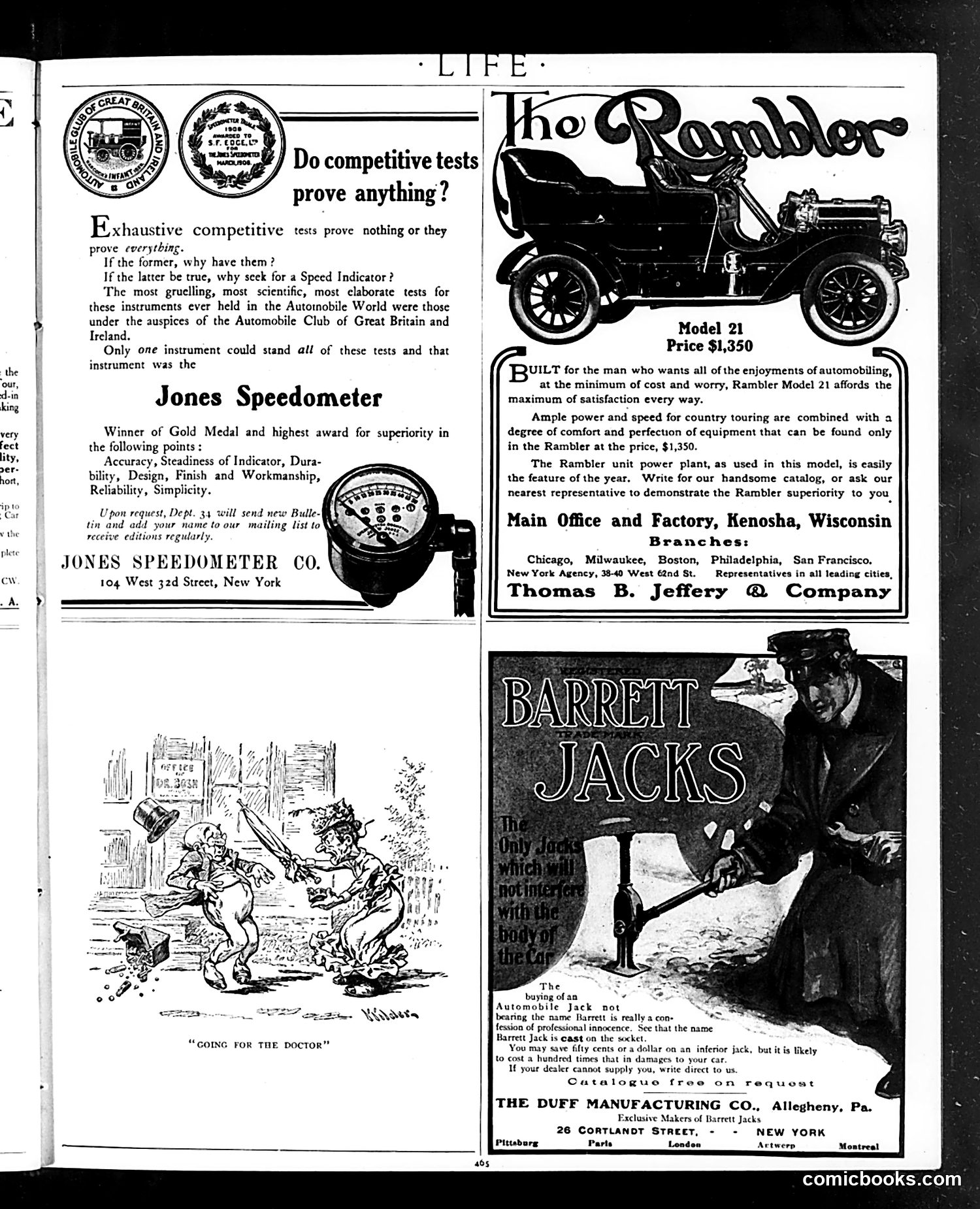
This page is primarily **automobile advertisements** (The Rambler, Barrett Jacks) with one small satirical cartoon at bottom left. The cartoon "Going for the Doctor" depicts two cartoon characters in exaggerated distress, apparently rushing or scrambling. The style suggests early 1900s slapstick humor. Without additional context visible on the page, the specific satirical point is **unclear**—it could reference medical emergencies, quack doctors, or general social anxiety of the era, but the image alone doesn't reveal the intended target or joke to a modern viewer. The cartoon's placement among automotive ads suggests it's filler content rather than the page's primary focus.
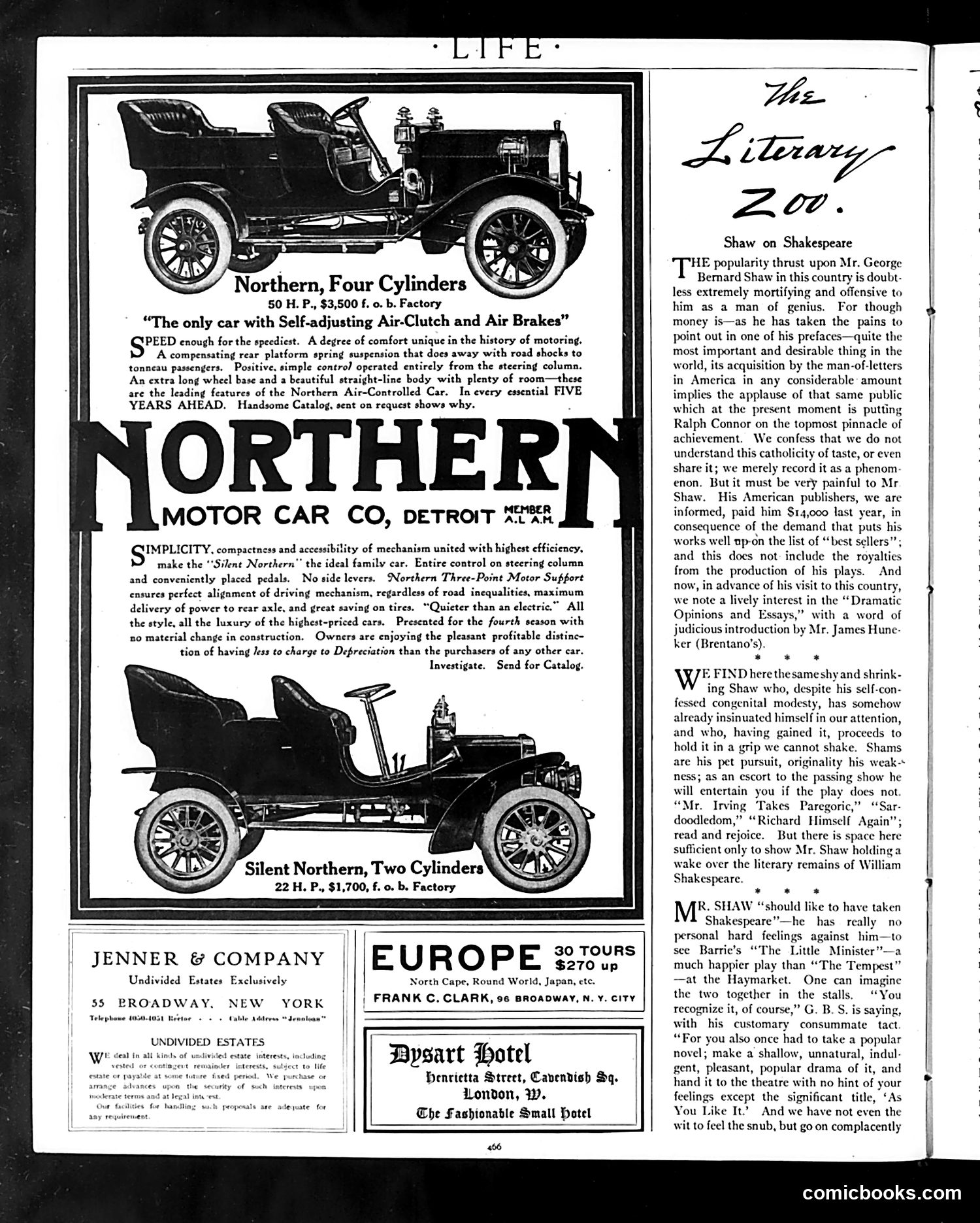
This page is primarily **advertising**, not satire or political commentary. The left side features two Northern Motor Car advertisements showcasing their automobile models—a four-cylinder and two-cylinder version—emphasizing features like self-adjusting air-clutch and air brakes. The right column contains **"The Literary Zoo,"** a brief essay by James Huneker about George Bernard Shaw's popularity in America. The piece is complimentary but slightly mocking, noting Shaw's "shy and shrinking" nature contrasts with his public celebrity. Huneker humorously references Shaw's plays like "Mr. Irving Takes Tangoism" and suggests Shaw might enjoy lighter literature. Below are smaller advertisements for real estate, European tours, and a London hotel. The page reflects early 20th-century magazine content mixing commercial and cultural commentary.
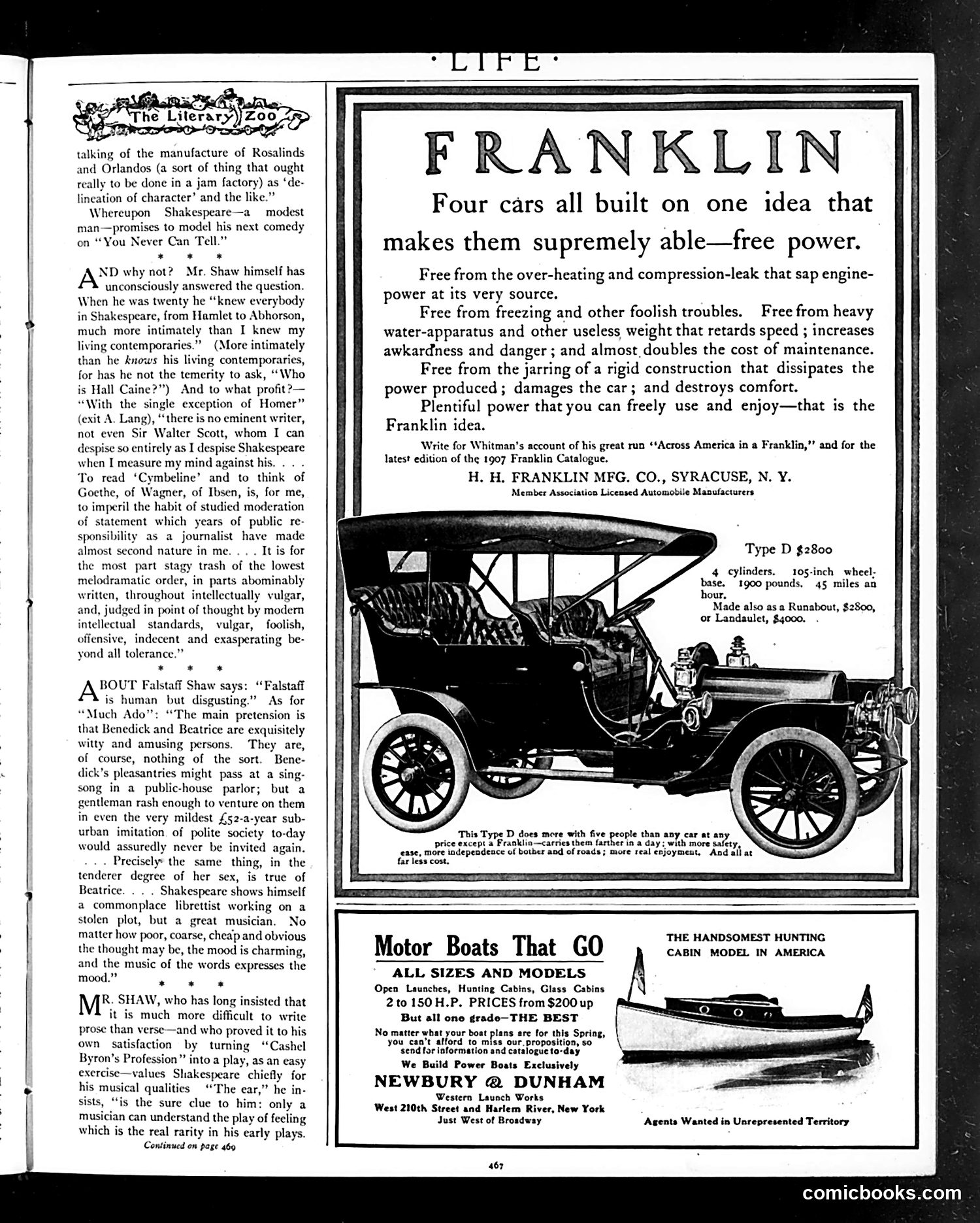
This page is primarily **advertising and literary criticism**, not political satire. The left column features "The Literary Zoo," discussing Shakespeare adaptations and theatrical performance. The author criticizes contemporary stage productions as intellectually shallow—"vulgar, foolish, offensive"—arguing that modern sensibilities have compromised artistic standards. The right side contains two advertisements: one for **Franklin automobiles** (emphasizing "free power" and reliability) and another for **motor boats by Newbury & Dunham**. The only visual humor appears subtle—the contrast between high-minded literary discussion and commercial product promotion on the same page, though this likely wasn't intentional satire but rather standard magazine layout of the era. No specific political figures or events are referenced. The content reflects early-20th-century concerns about commercialism versus artistic integrity.
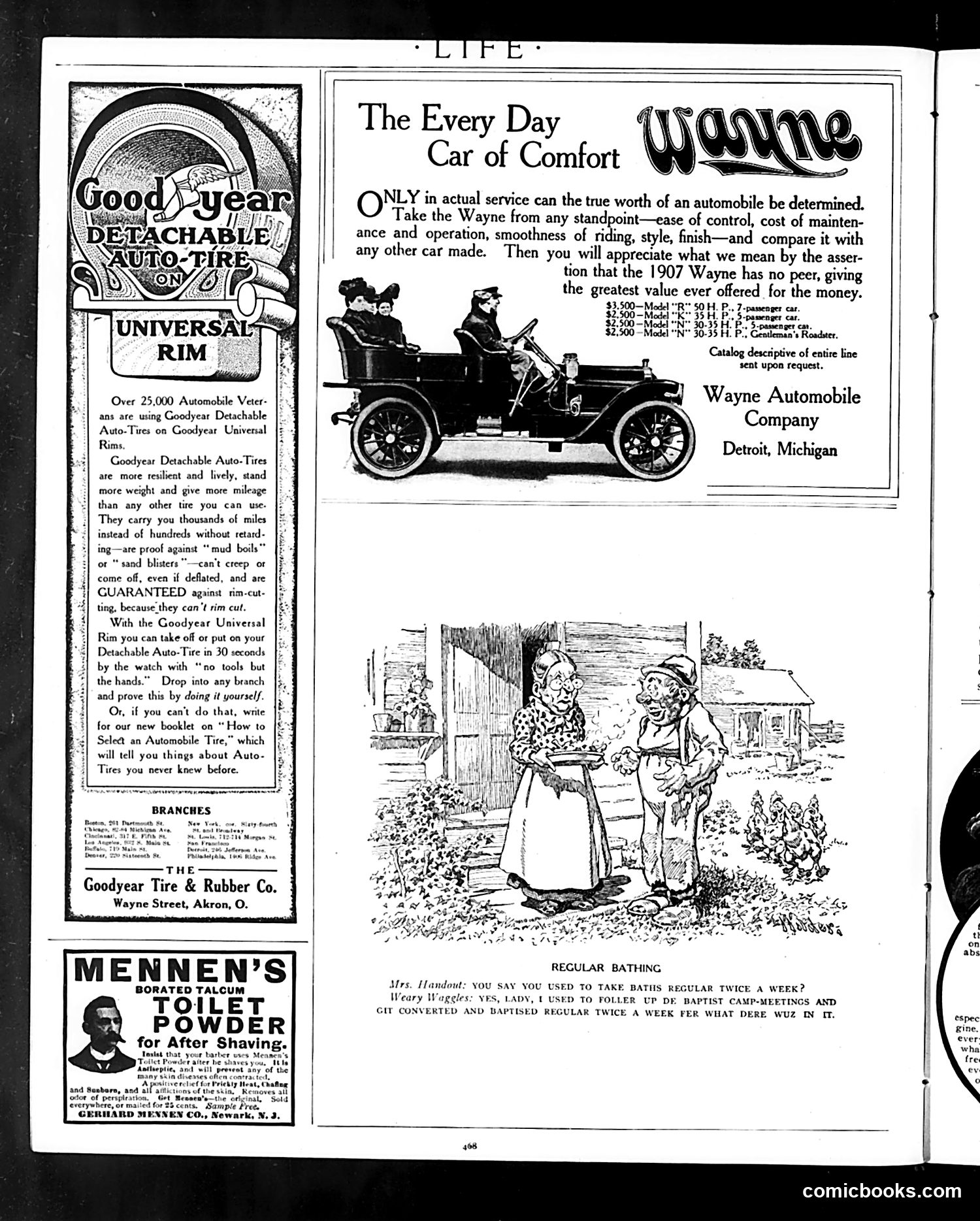
This page consists primarily of **advertisements** rather than political satire or comics. The main advertisements are: - **Goodyear Detachable Auto-Tire** (left): Promotes tire durability and ease of replacement - **Wayne Automobile** (center-right): Showcases the 1907 Wayne car model with specifications - **Mennen's Borated Talcum Powder** (bottom-left): A shaving product advertisement The only illustrated humor appears to be a small cartoon titled "Regular Bathing" (bottom-right), depicting a domestic scene between Mrs. Wandot and Mrs. Woggle discussing bathing habits. The dialogue suggests nostalgia for older bathing customs versus modern conveniences. This is a typical early 1900s *Life* magazine page mixing advertisements with light domestic humor.
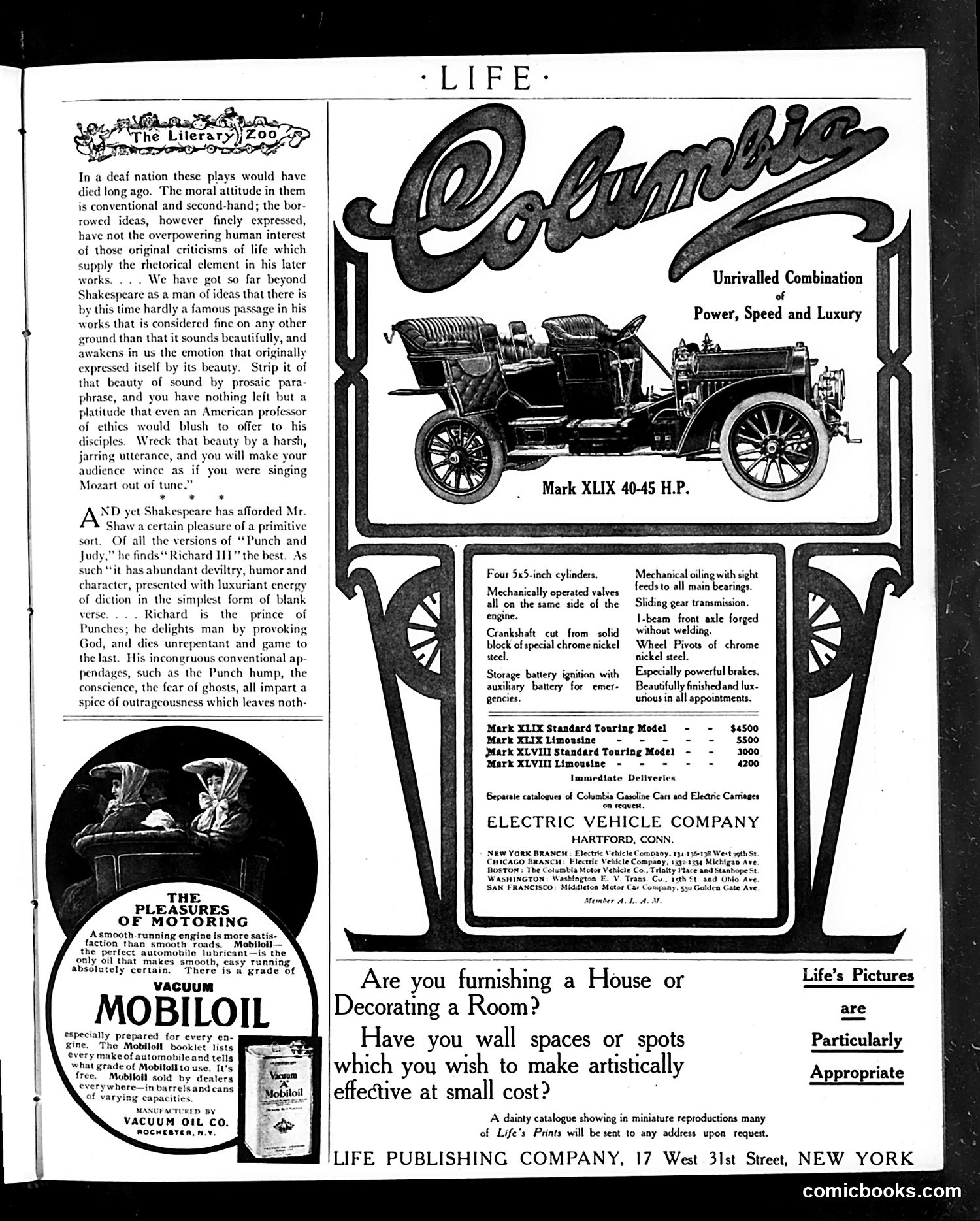
This page is primarily **advertising** rather than satire or political commentary. The main content includes: 1. **Literary discussion** (left column): A passage debating Shakespeare's merit, particularly regarding "Punch and Judy" and "Richard III," discussing the aesthetic versus moral value of his works. 2. **Car advertisement** (center): A Pombile Mark XLIX automobile advertised as offering "Power, Speed and Luxury" with technical specifications and pricing ($4500-$4200). Made by the Electric Vehicle Company of Hartford, Connecticut. 3. **Mobiloil lubricant ad** (lower left): Promoting vacuum-grade motor oil as essential for smooth engine operation. 4. **Life Publishing notice** (bottom): Advertising miniature art reproductions available from Life Publishing Company. The page reflects early 20th-century consumer culture, blending high cultural discourse with emerging automotive and product advertising.
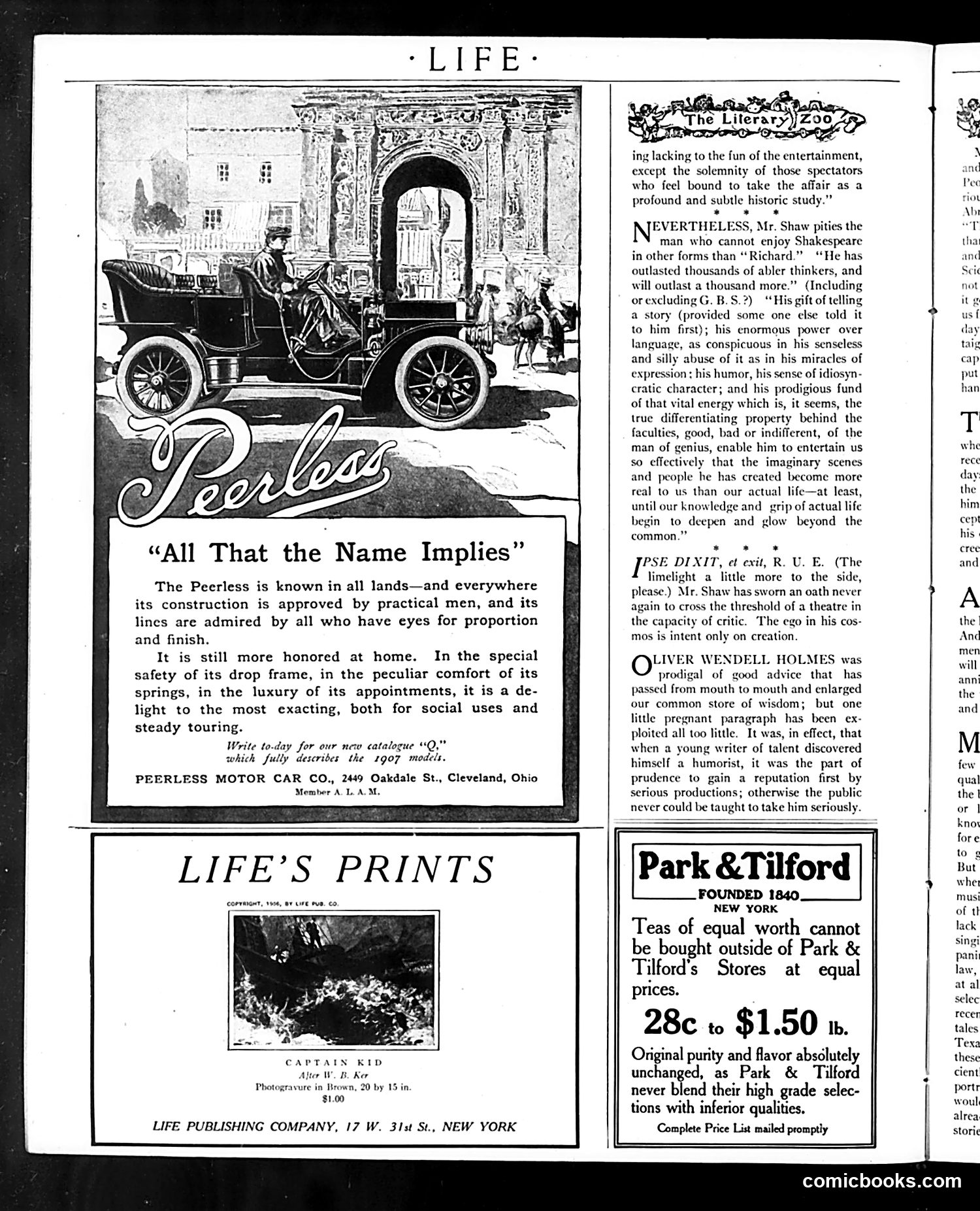
This page is primarily **advertising**, not satire or political commentary. The main content features a **Peerless Motor Car advertisement** showing an early 1900s automobile with passengers in front of an ornate building. The ad emphasizes the car's safety, comfort, and suitability for "social uses and steady touring." Below are smaller advertisements: **Life's Prints** (photogravure art reproductions) and **Park & Tilford** (a tea company founded 1840), highlighting their product quality and pricing. On the right, text discusses **Bernard Shaw's theatrical works**, praising his ability to create compelling characters and entertainment value—this appears to be editorial content rather than advertising. The page represents typical early 20th-century magazine layout mixing commercial advertisements with cultural commentary.
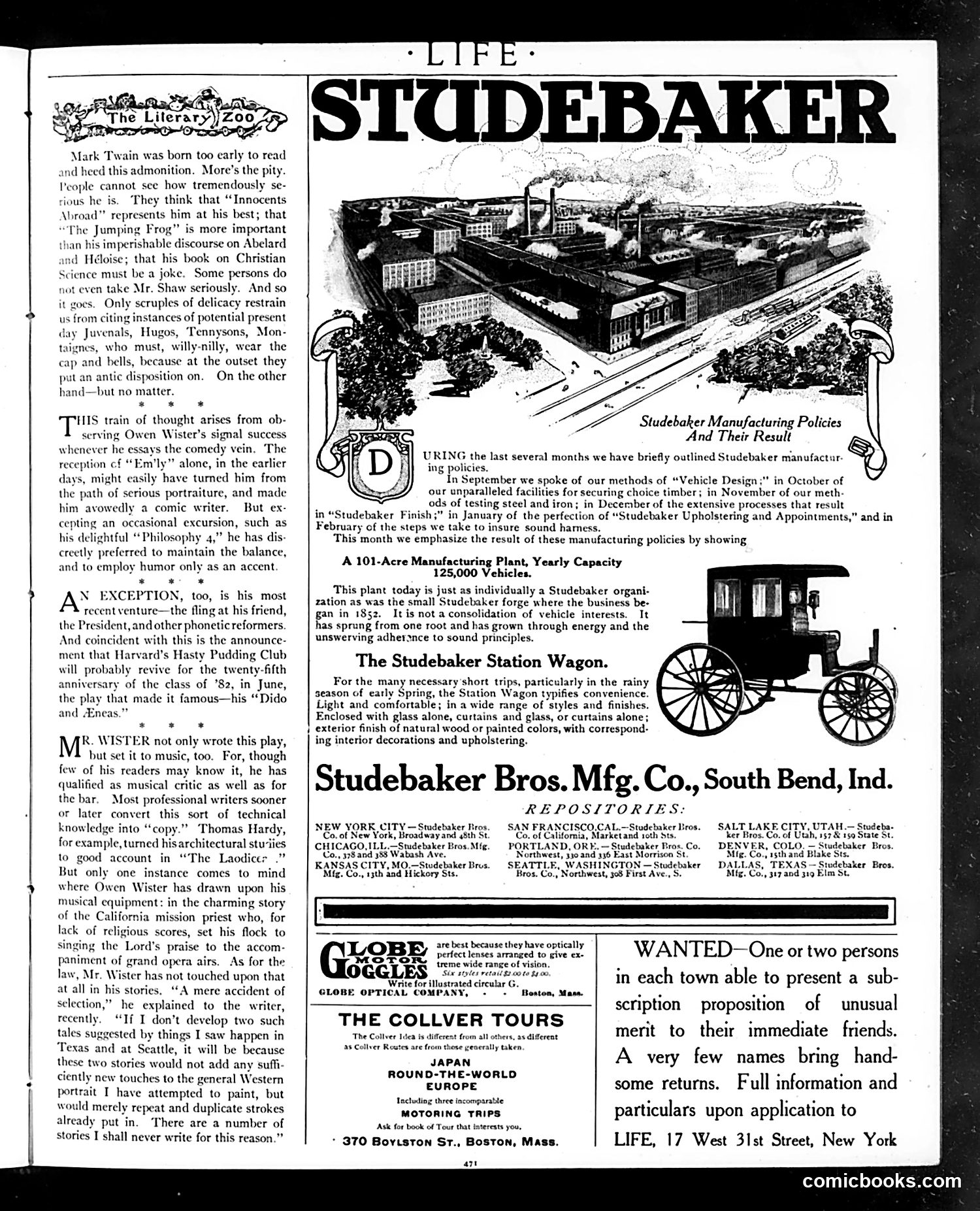
This page is primarily **advertising and editorial content**, not political satire. The main feature is a large advertisement for **Studebaker Bros. Manufacturing Company** of South Bend, Indiana, promoting their automobiles and "Station Wagon" vehicles. The ad emphasizes their 101-acre manufacturing plant with 125,000 vehicle yearly capacity. The left column contains "The Literary Zoo," a brief commentary on Mark Twain's early literary works, arguing that his comedic writings are undervalued compared to his serious works. The author suggests people dismiss Twain's humor while overlooking the satirical depth beneath it. This appears to be an early 20th-century magazine page mixing automobile industry promotion with literary criticism—not a political cartoon page.
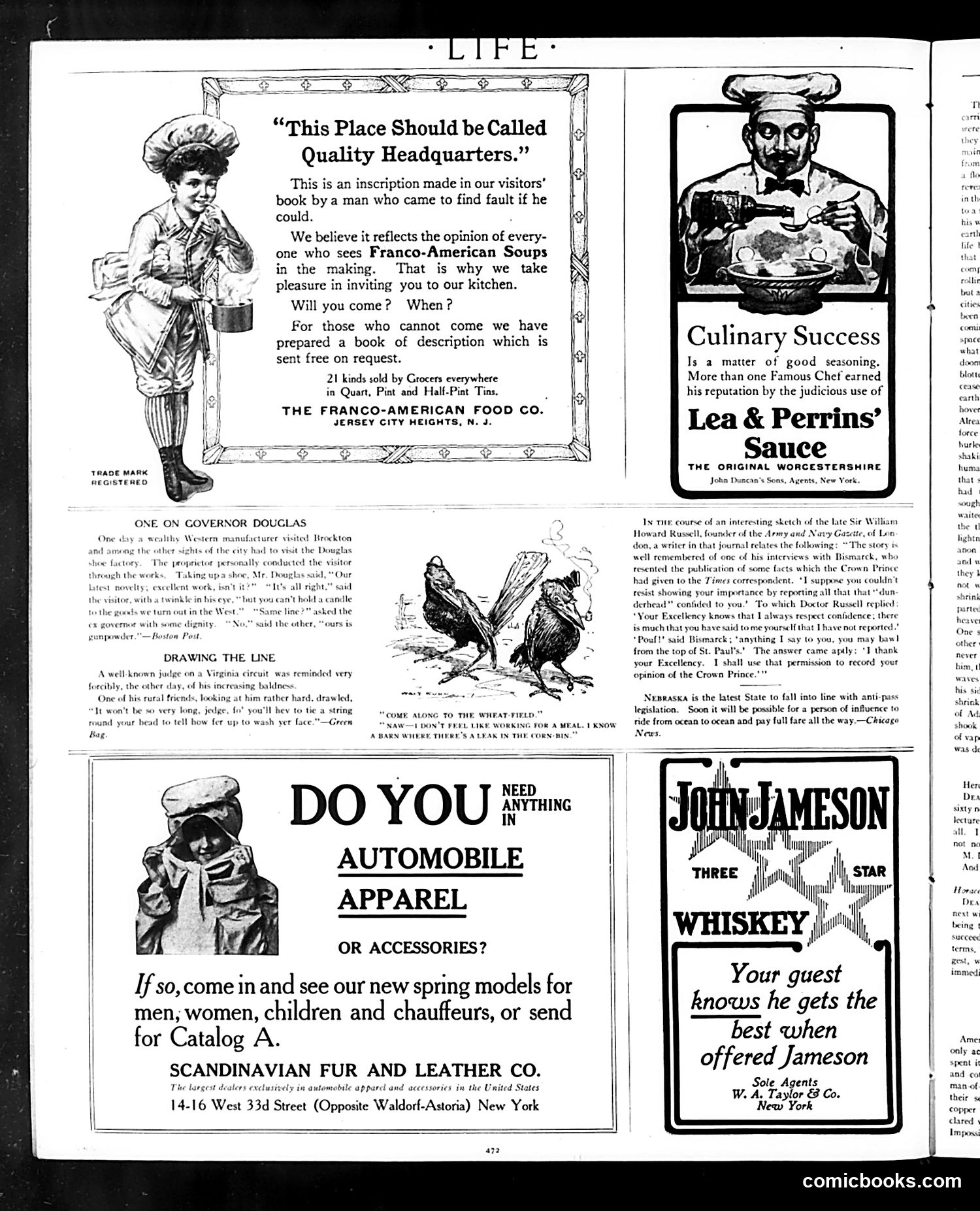
This page is primarily **advertising content** rather than editorial cartoons or satire. It contains four commercial advertisements: 1. **Franco-American Soups** - invites readers to visit their kitchen, emphasizing quality control 2. **Lea & Perrin's Sauce** - features a chef endorsing the product 3. **Scandinavian Fur and Leather Co.** - advertises automobile apparel and accessories 4. **John Jameson Whiskey** - promotes their "Three Star" product The small editorial pieces include "One on Governor Douglas" (a brief anecdote) and "Drawing the Line" (a humorous Virginia judge story), but these are minor text features among the dominant advertising. The illustrated figures are generic mascots/spokespeople rather than political caricatures—a cook, a chef, and an automobile driver—typical of early 20th-century commercial imagery.
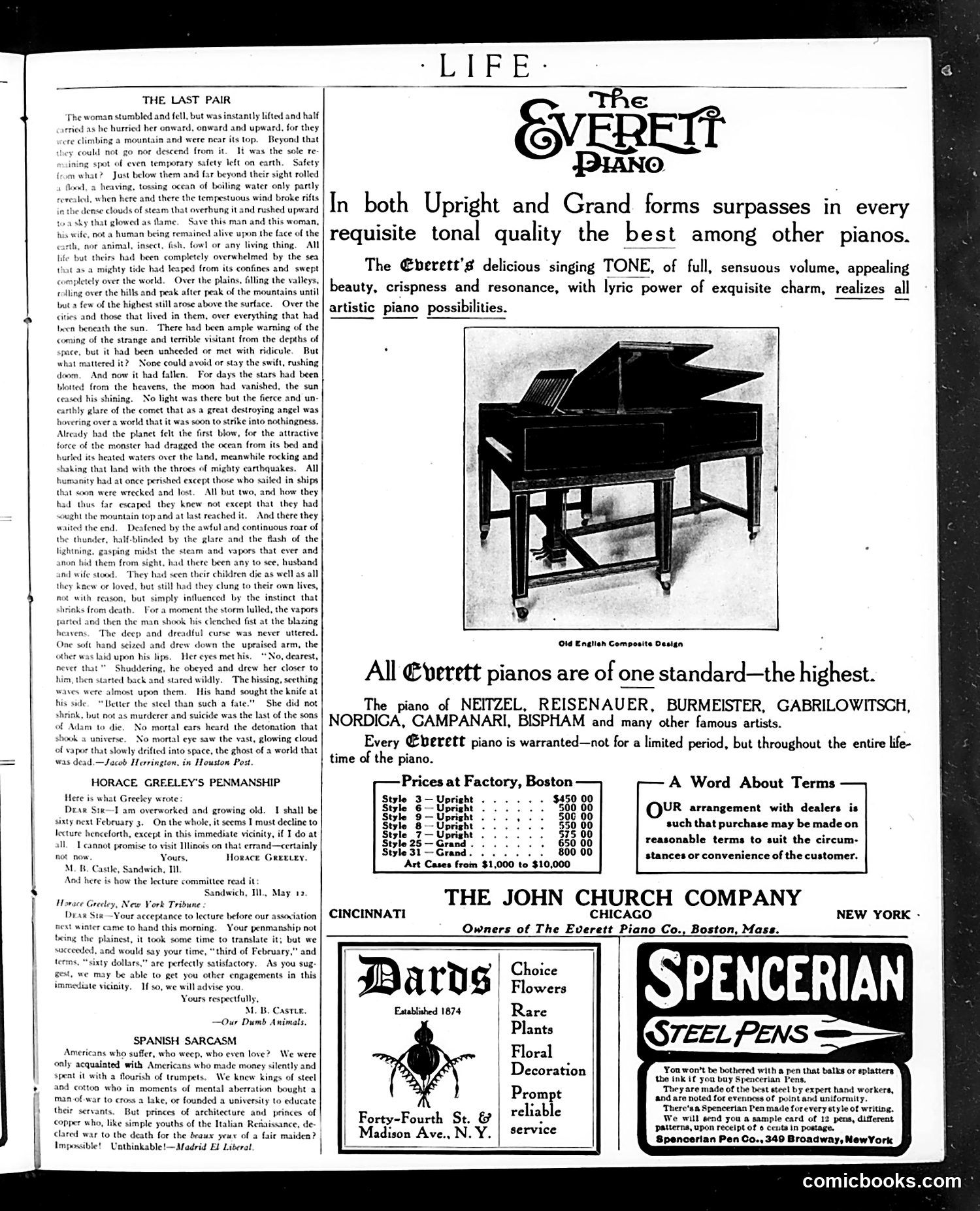
This page is primarily **advertising and editorial content**, not satirical cartoons. The main feature is a advertisement for **Everett pianos**, prominently displayed with an image of a grand piano and detailed sales information. The text emphasizes the piano's superior "tonal quality" and "singing tone." The left column contains two brief literary pieces: "The Last Pair" (a melancholic short story about a couple during an apocalyptic flood) and sections titled "Horace Greeley's Penmanship" and "Spanish Sarcasm" that appear to be humorous observations or anecdotes. The bottom portion features advertisements for **Dard's flowers and plants** (New York), **Spencerian Steel Pens** (New York), and information about **The John Church Company**, piano dealers in Cincinnati and New York. There is **no political cartoon or satire visible** on this page. It functions as a standard magazine page mixing editorial content with period advertising.
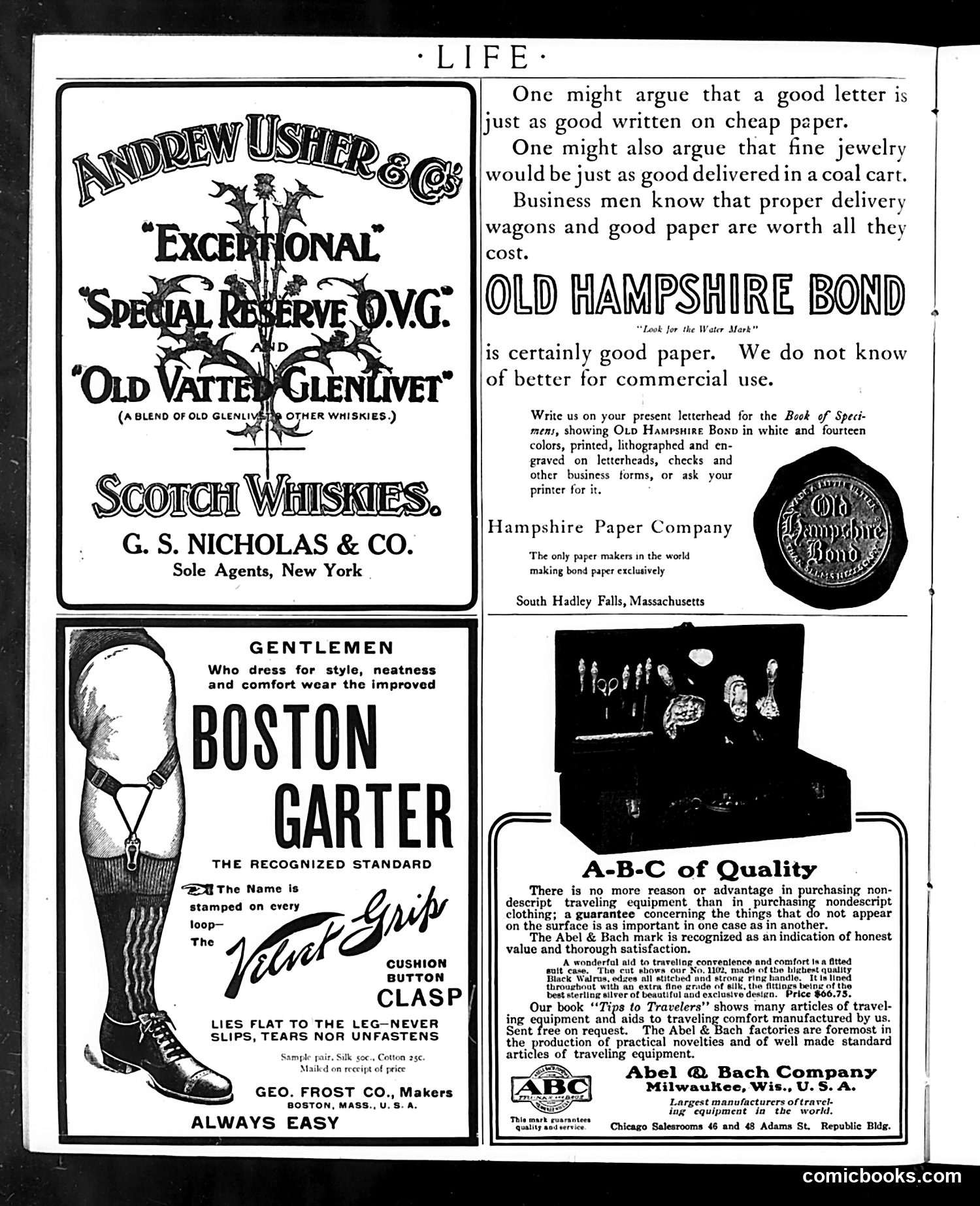
This page contains **no political cartoons or satire**—it is entirely **commercial advertising**. The four ads promote: 1. **Andrew Usher whisky** (top left): Scottish whisky sold through New York agents, emphasizing brand prestige. 2. **Hampshire Bond paper** (top right): Argues that quality matters in business correspondence—good paper and delivery reflect professionalism, just as fine jewelry shouldn't arrive in a coal cart. 3. **Boston Garter** (bottom left): Men's garters featuring a "velvet grip" and cushion button; advertised as comfortable and secure ("never slips, tears nor unfastens"). 4. **Abel & Bach traveling equipment** (bottom right): Promotes a luxury leather suitcase ($66.75) with silk lining and silver fittings, emphasizing quality craftsmanship and reliability. The page reflects early 20th-century consumer culture, targeting affluent gentlemen through appeals to status, quality, and respectability. There is no satirical content to interpret.
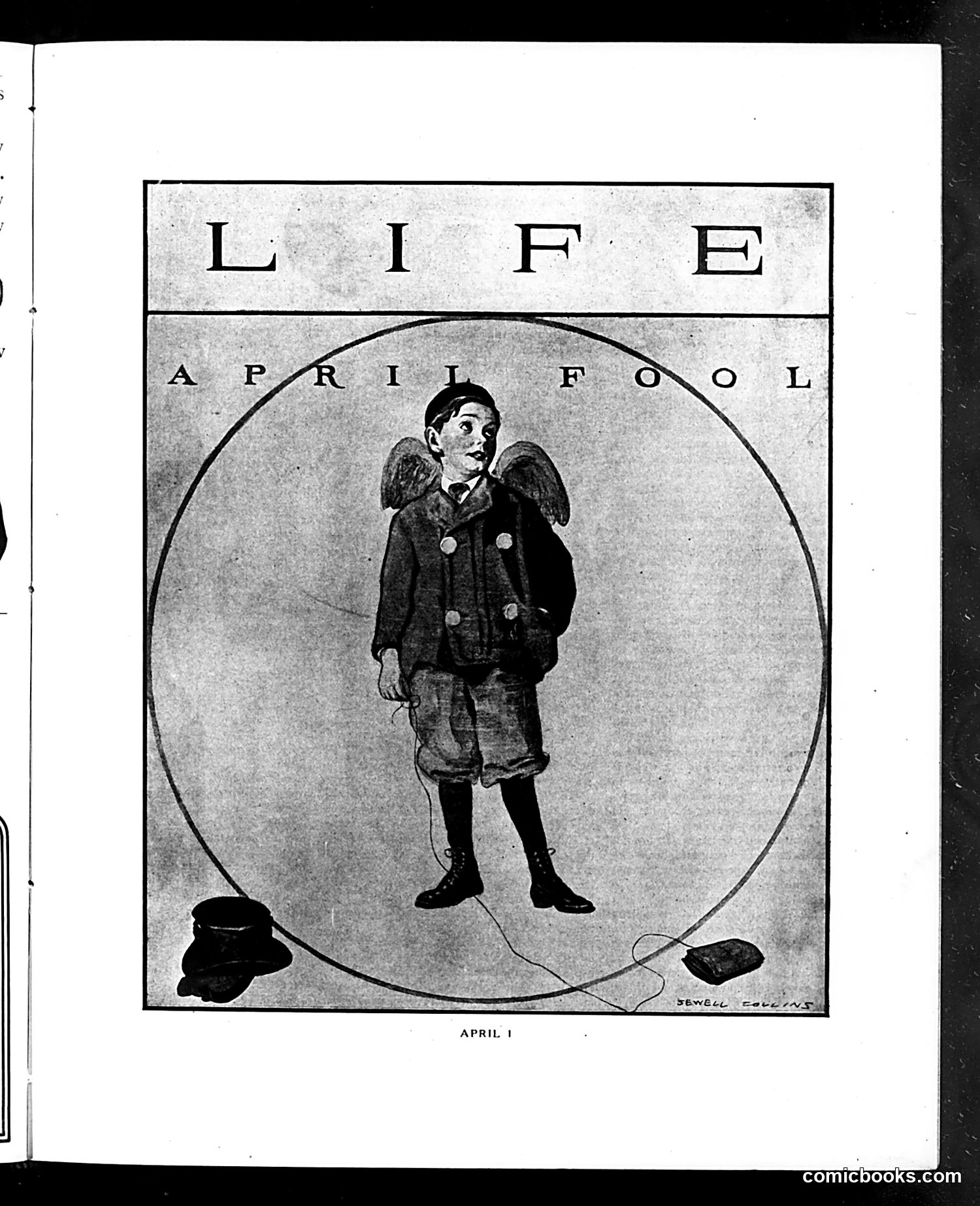
This is an **April Fools' Day illustration** from *Life* magazine. The image shows a young boy with small wings, dressed in a coat with buttons and shorts, standing within a circle. He holds what appears to be a hat in one hand and possibly a shoe in the other. The text "A PRIL FOOL" arcs above the figure, making clear this is satirical April 1st content. The boy's cherubic wings suggest he represents either a foolish "angel" or Cupid—appropriate mischief-maker figures for April Fools' Day humor. The illustration is credited to Sewell Collins. Without additional context, the specific satirical target remains unclear, though the image likely mocked some contemporary figure or social trend through this absurd, winged characterization.
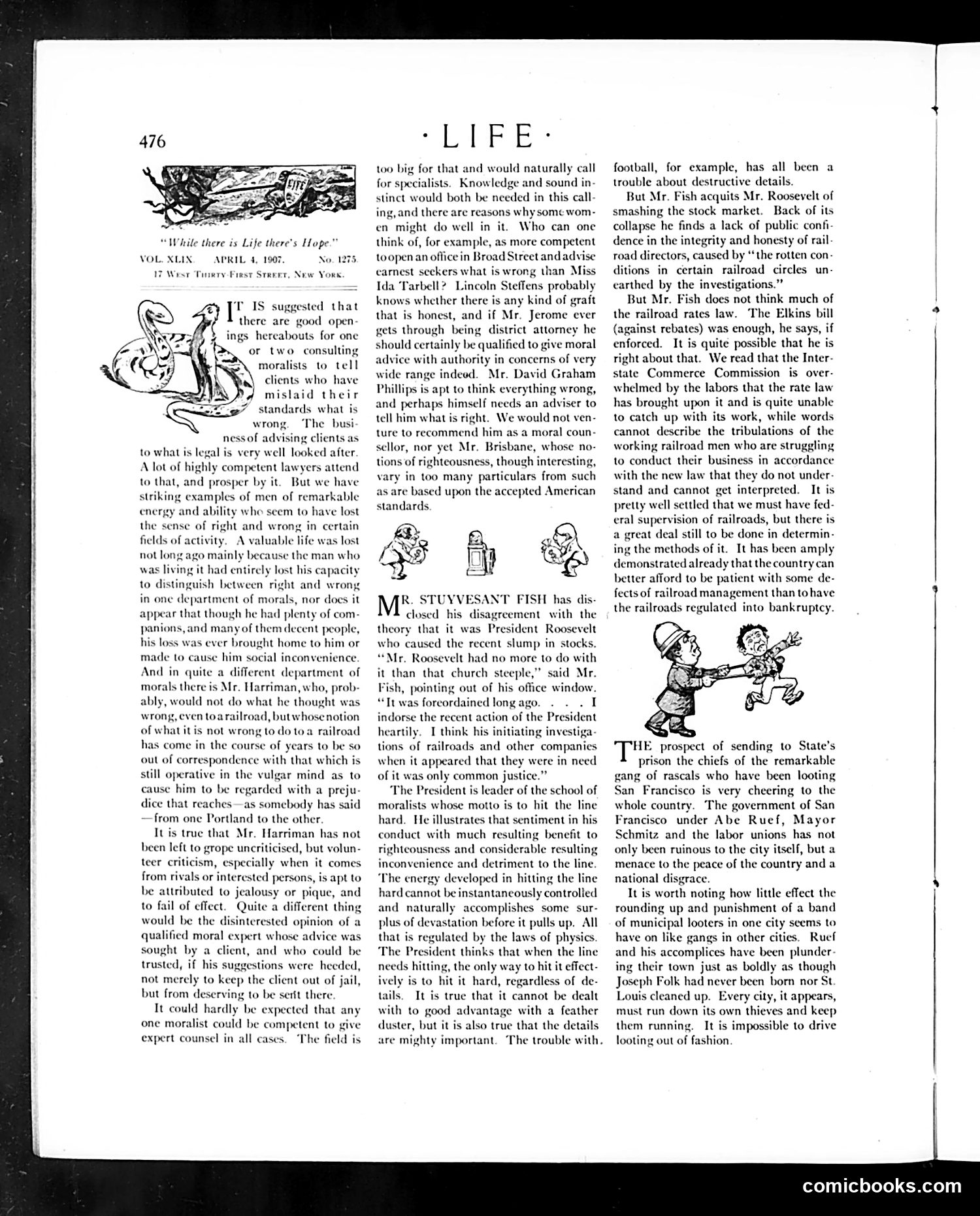
This page satirizes the moral failings of wealthy businessmen, particularly railroad magnates like **E.H. Harriman** (referenced in the text). The article proposes tongue-in-cheek that America needs specialized "moral consultants"—experts who could advise clients on ethical conduct. The satire names figures like **Ida Tarbell** (muckraking journalist who exposed Standard Oil), **Lincoln Steffens** (corruption investigator), and **David Graham Phillips** as hypothetically qualified moral advisors, contrasting them with amoral railroad executives. **Stuyvesant Fish** (railroad executive) is quoted defending President **Theodore Roosevelt's** stock-market criticism and recent railroad investigations as justified moral action. The cartoon ridicules how wealthy industrialists have lost moral compass while remaining legally untouched—they need not just lawyers, but moral guidance. It reflects Progressive Era outrage at corporate malfeasance and corruption among the Gilded Age elite.
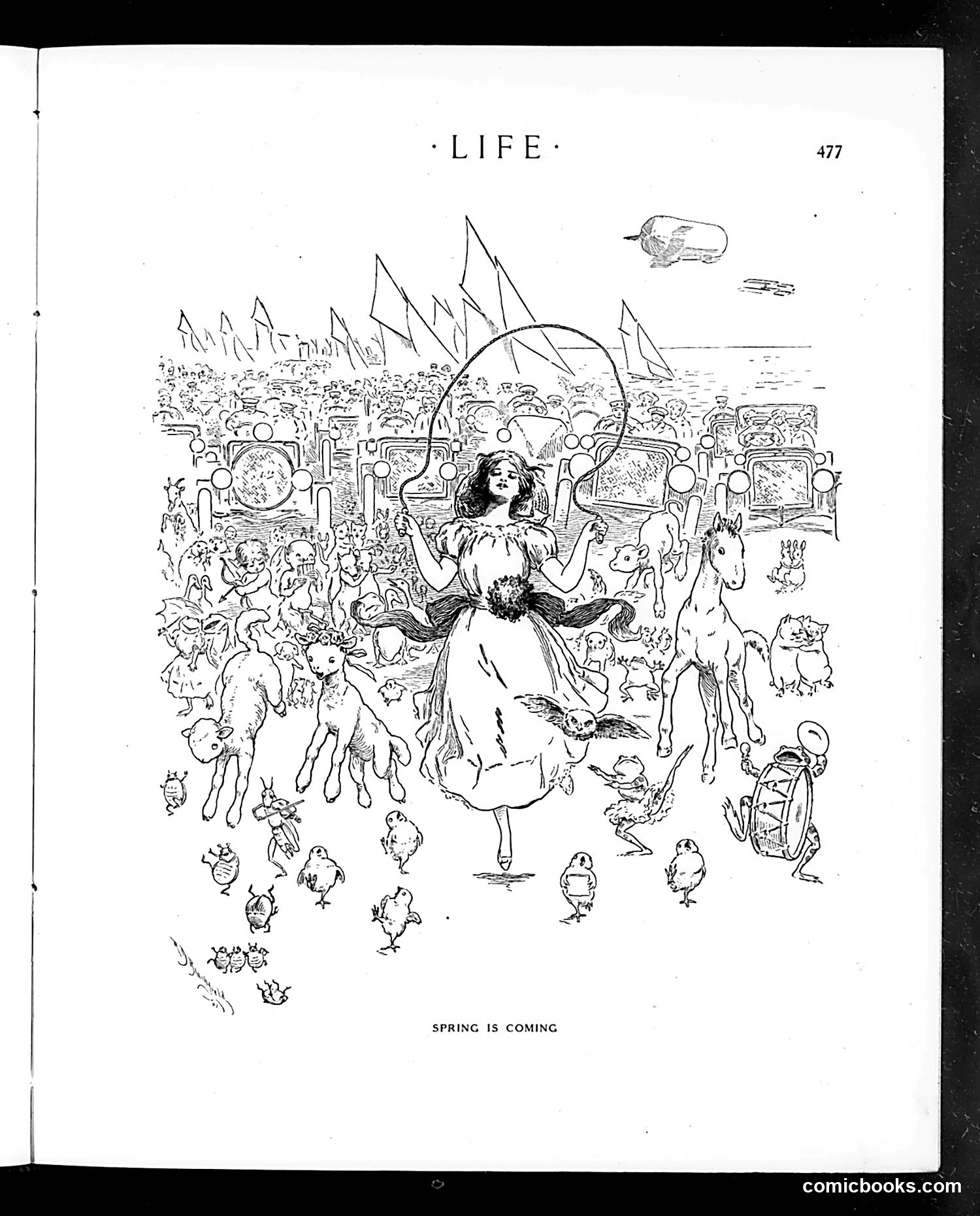
This illustration depicts a woman in classical dress, playing a harp, surrounded by a chaotic mass of animals, creatures, and fantastical beings. The composition suggests spring's arrival awakening nature—a traditional artistic theme. The woman appears to represent spring or nature personified. The dense crowd of animals, mythological creatures, cherubs, and various beings suggests fertility, renewal, and the teeming life that emerges seasonally. In the background are sailing ships and what appears to be a coastal or maritime setting. The satire likely mocks the romanticized, overly-elaborate artistic treatments of spring's arrival common to the era, presenting an absurdly crowded, chaotic vision that undercuts sentimental seasonal imagery. The specific social commentary, if any, remains unclear without additional historical context.
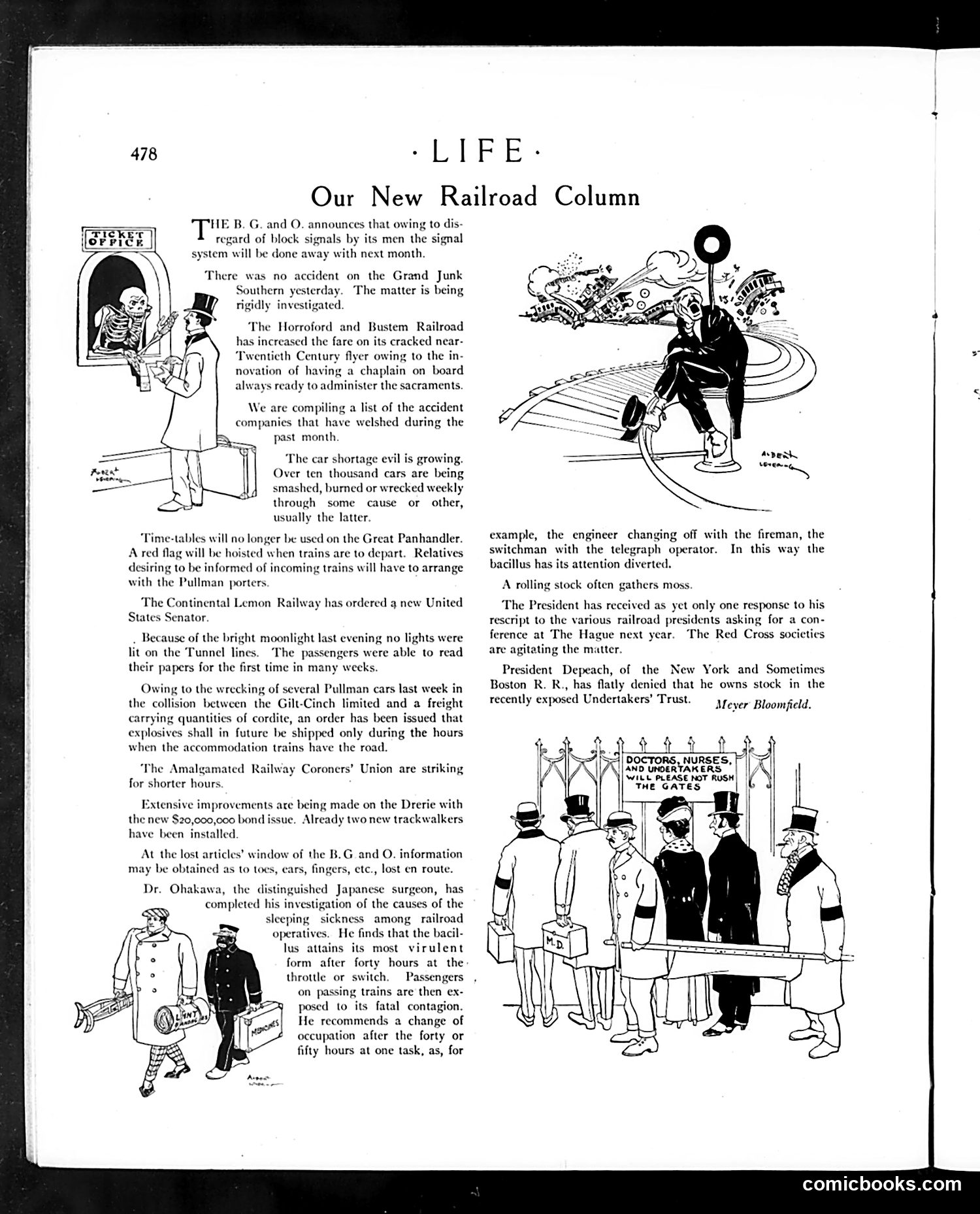
This satirical column mocks the American railroad industry's endemic safety failures and corruption in the early 20th century. Through absurdist humor, it exposes real systemic problems: **Key targets include:** - Reckless disregard for safety signals causing frequent wrecks - Massive numbers of destroyed cars (10,000+ weekly) - Fare increases justified by dubious innovations (chaplains on trains) - Railroad companies refusing to pay accident claims ("welshed") - Incompetent scheduling and operations - Regulatory capture (railroads essentially "ordering" senators) - Worker exploitation causing "sleeping sickness" from 40+ hour shifts **The cartoons** show ticket agents dealing with passenger complaints, and a darkly comic queue at heaven's gates labeled for "doctors, nurses, and undertakers"—suggesting railroad accidents kill so many people that these professions are overwhelmed. The satire's power lies in presenting catastrophic negligence as mundane bureaucratic announcements, highlighting how normalized danger had become in rail travel.
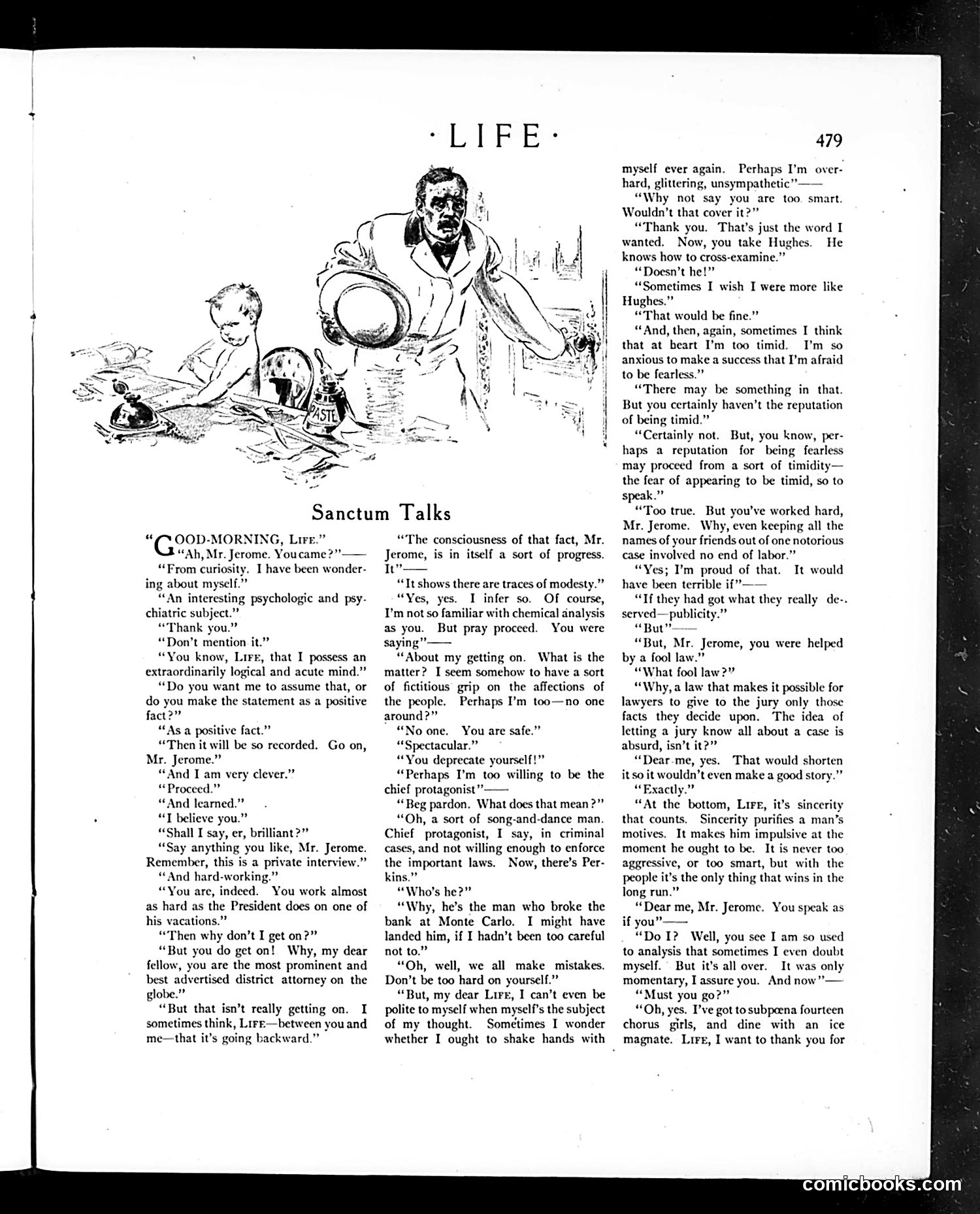
This satirical dialogue features **William Travers Jerome**, New York's prominent District Attorney in the early 1900s, being interviewed by "Life" magazine's editor. The cartoon mocks Jerome's self-aggrandizing reputation and perceived contradictions. Jerome boasts of his logical mind, cleverness, and hard work, yet complains he's not "getting on" despite being the most advertised DA. The satire targets his spectacle-driven prosecutions and selective case-handling. References to **"Hughes"** (likely Charles Evans Hughes, a contemporary prosecutor) suggest Jerome feels overshadowed by rivals. The interviewer exposes Jerome's contradictions: he's "fearless" yet admits to timidity; he kept friends' names from a "notorious case" (implying selective justice); he benefits from laws limiting jury information. The final jabs critique how Jerome prioritizes **publicity and "sincerity"** (emotional impact) over actual justice and complete disclosure—suggesting his prosecutions served his reputation more than the public interest. The satire is **political commentary on prosecutorial overreach and grandstanding**.
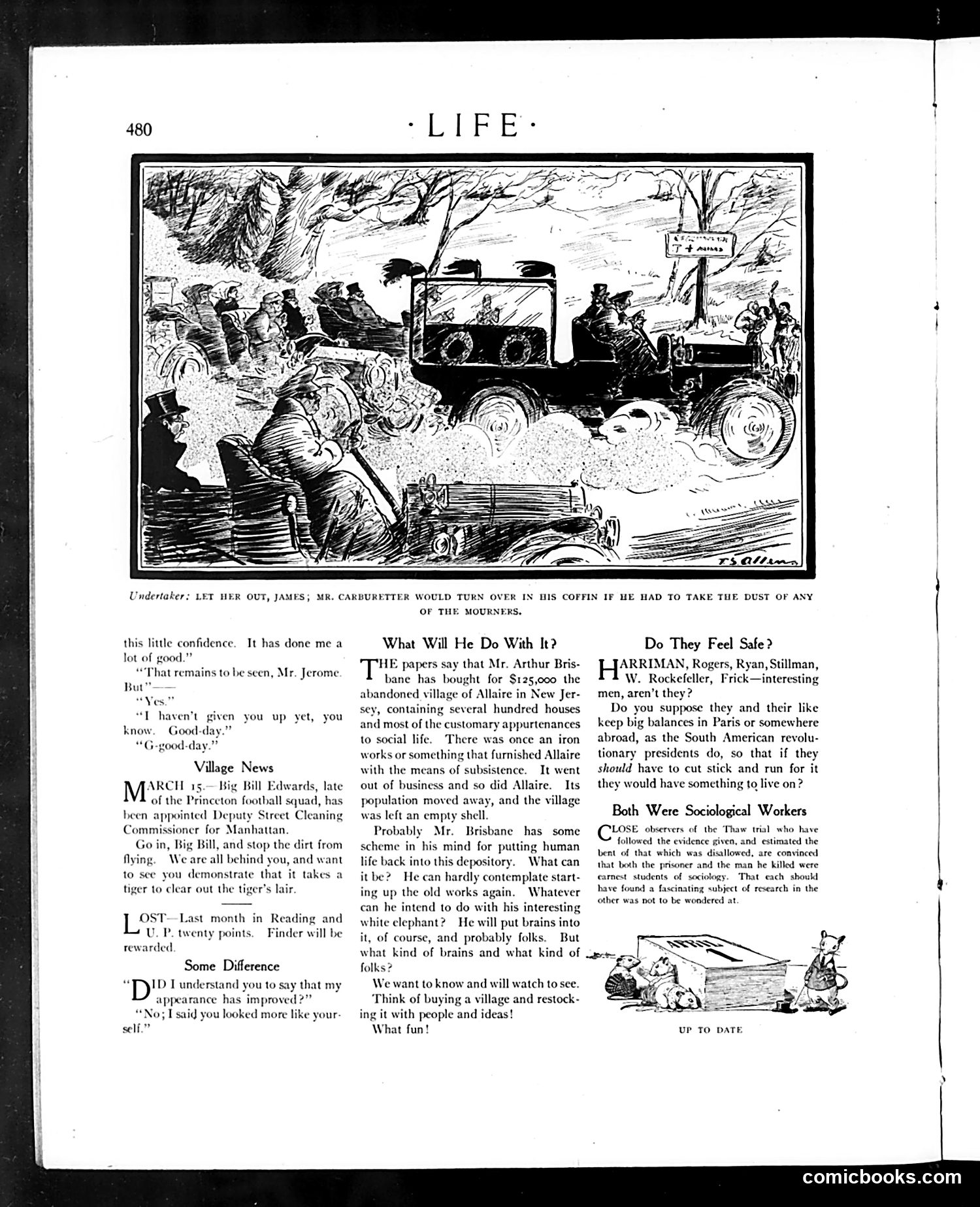
This page contains several satirical pieces typical of early 1900s American humor: **Main Cartoon:** Depicts Arthur Brisbane's purchase of the abandoned village of Allaire, New Jersey for $125,000. The satire questions what Brisbane intends to do with this "white elephant"—a defunct former iron-works town. Life mocks the impracticality of his scheme while expressing curiosity about whether he'll attempt to repopulate it with "people and ideas." **"Do They Feel Safe?"** sarcastically references wealthy industrialists (Harriman, Rogers, Ryan, Stillman, Rockefeller, Frick) who Life suggests may be stashing money abroad like South American revolutionaries, implying fear of civil unrest or expropriation. **"Both Were Sociological Workers"** makes dark commentary on the Thaw trial (Harry Thaw's 1906 murder trial), cynically suggesting both Thaw and his victim were "earnest students of sociology"—a contemptuous dig at their supposed intellectualism masking their actual depravity. The humor relies on readers' familiarity with contemporary scandals and wealthy figures.
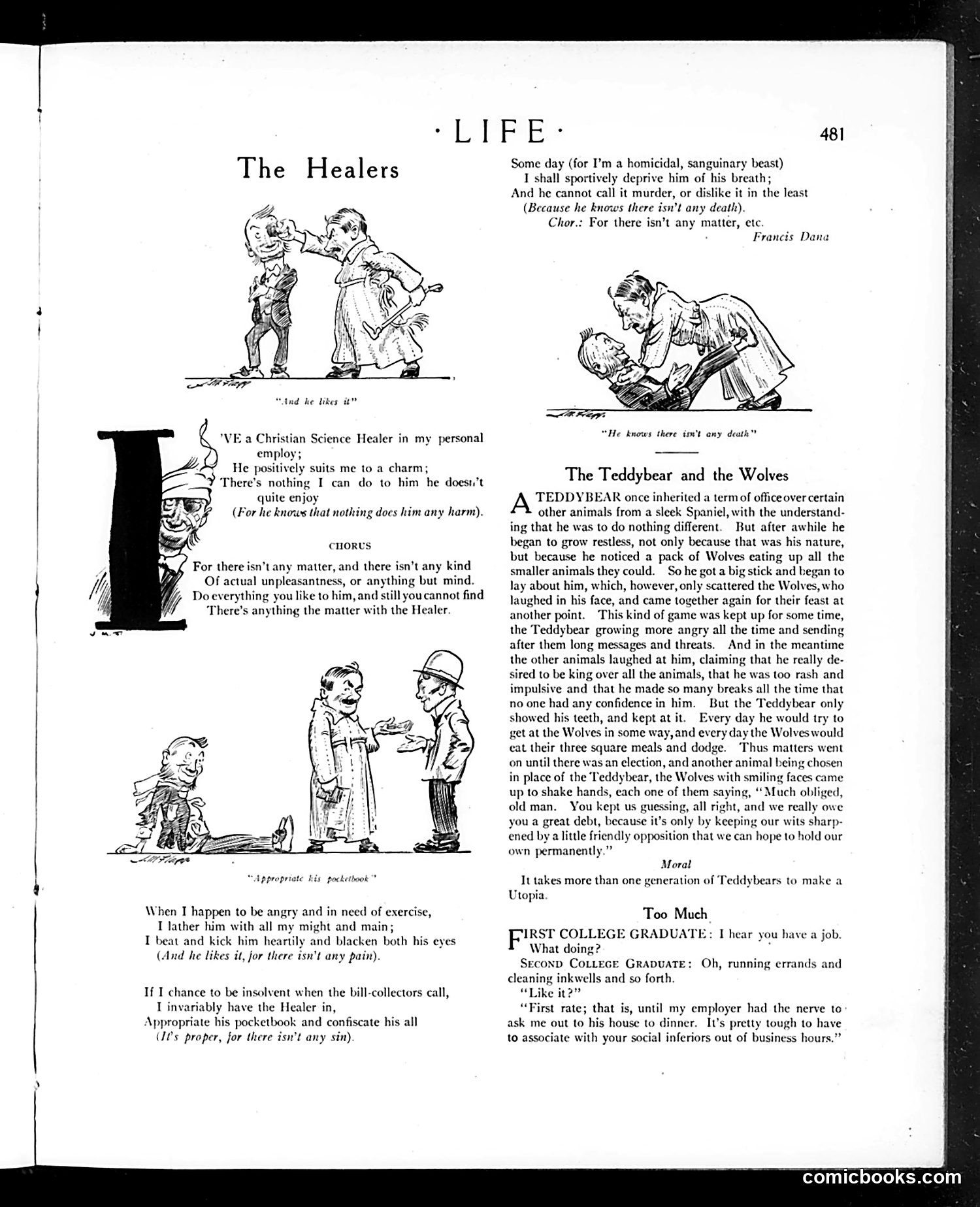
**"The Healers"** mocks Christian Science, a religious movement emphasizing that illness and pain are illusions of mortal mind. The cartoon shows a practitioner exploiting this doctrine: he beats, starves, and robs his patient with impunity because Christian Science teaches there is "no matter," "no pain," and "no sin." The satire's point: the belief system enables abusive behavior cloaked in spirituality. **"The Teddybear and the Wolves"** is political allegory. The Teddybear (appears to represent Theodore Roosevelt or aggressive leadership generally) inherits office and aggressively confronts enemies ("Wolves"), but accomplishes nothing—they merely scatter and return. Other animals mock him as rash and untrustworthy. When he's replaced, the Wolves congratulate him, suggesting his opposition actually *helped* them by keeping them sharp. The satire critiques aggressive foreign or domestic policy as ultimately ineffective and possibly counterproductive.
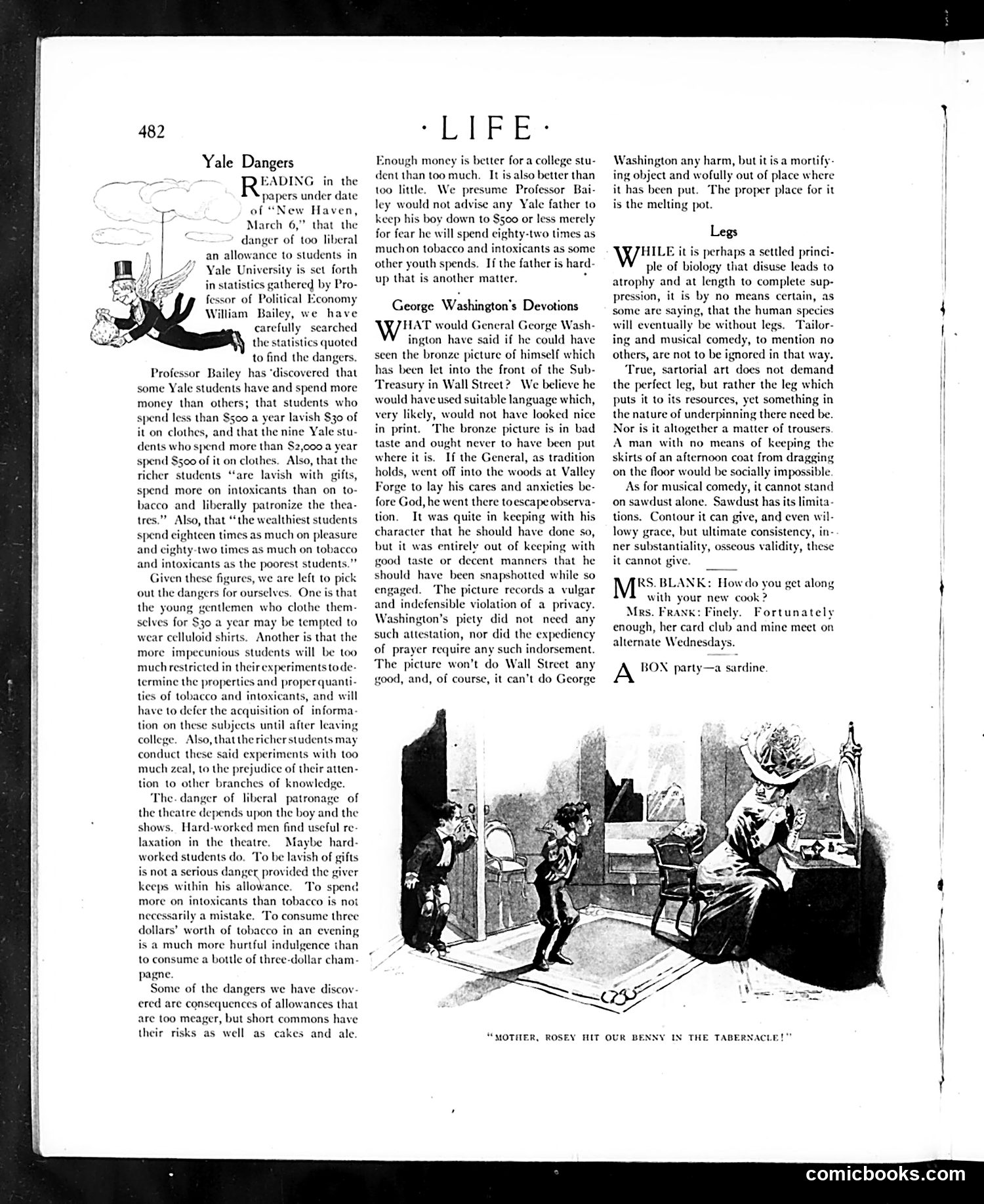
This 1890s *Life* page satirizes two distinct targets: **"Yale Dangers"** mocks Professor William Bailey's statistical report claiming wealthy Yale students pose social risks through excessive spending on clothes, theater, and intoxicants. *Life's* editors expose Bailey's faulty logic—his statistics merely document spending differences between rich and poor students, not actual "dangers." The satire argues that restricted allowances create their own problems, and that modest extravagance among privileged youth isn't inherently harmful. **"George Washington's Devotions"** attacks a bronze relief sculpture recently installed at the Sub-Treasury on Wall Street. The sculpture depicts Washington praying at Valley Forge. *Life* ridicules this as tasteless: Washington sought private devotion away from observation, so publicly displaying his prayer violates both his character and basic decorum. The satire argues that Washington's piety needs no advertisement and that the sculpture inappropriately sensationalizes a moment of private faith for commercial purposes.
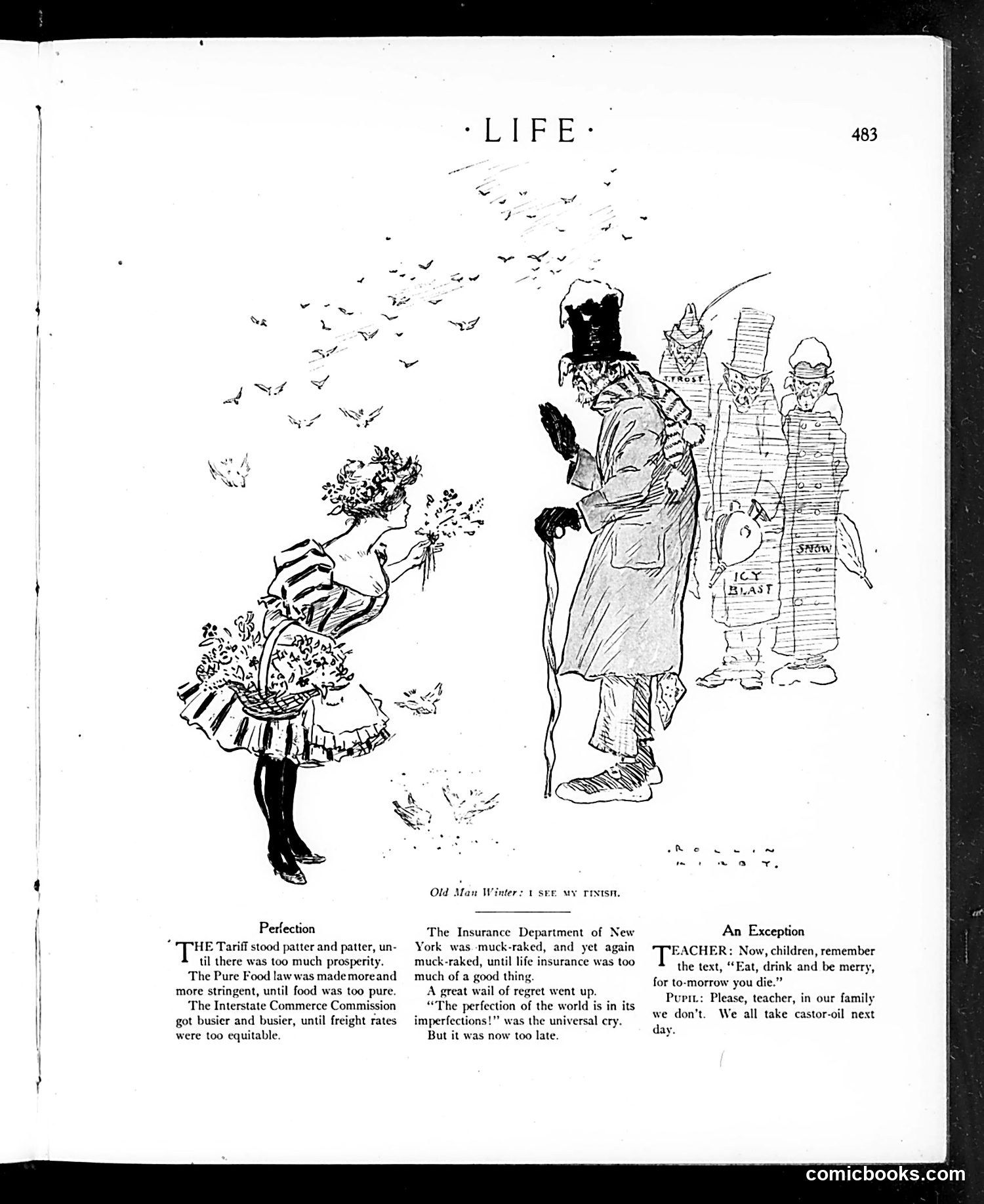
This page contains three separate satirical pieces typical of early 20th-century American humor: **"Perfection"** (left): A critique of Progressive Era regulatory overreach. The text ironically catalogs reforms—tariff protection, food safety laws, railroad regulation, insurance oversight—that were pushed so far they became counterproductive. The illustration of "Old Man Winter" appearing satisfied suggests regulations have become absurdly comprehensive. The satire argues that well-intentioned government intervention, taken to extremes, eliminates the beneficial friction of imperfection that makes markets and society function. **"An Exception"** (right): A gentle joke about a child's family defying the Biblical exhortation to "eat, drink and be merry." Instead of hedonism, the family practices digestive self-discipline through castor oil—a common laxative of the era. The humor lies in the contrast between carefree philosophy and mundane bodily maintenance. The page reflects anxieties about Progressive reform becoming excessive, balanced with genteel domestic humor.
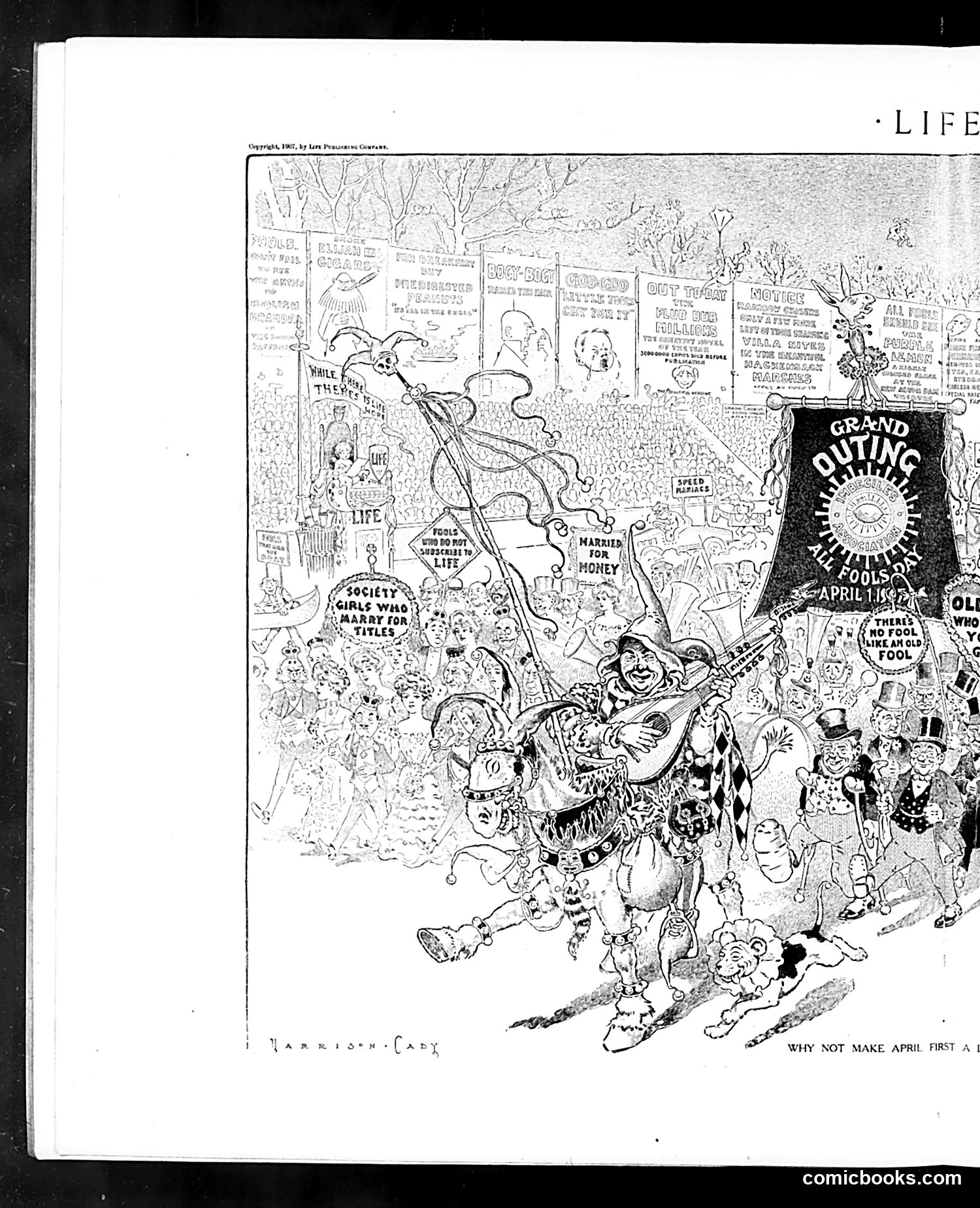
This is an elaborate April Fools' Day cartoon, as indicated by the "GRAND OUTING ALL FOOLS" banner and the headline "WHY NOT MAKE APRIL FIRST A..." (text cut off). The densely-packed illustration depicts various social types and institutions of the era engaged in foolish behavior. Visible references include signs about "LIFE," "SOCIETY GIRLS MARRY FOR TITLES," and "MARRIED FOR HONEY." The central figures appear to include jesters, fools, and costumed revelers. The satire targets social pretensions and follies of early 20th-century American society—presumably critiquing things like mercenary marriages, social climbing, and superficial values. The carnival/circus atmosphere reinforces that these behaviors are portrayed as foolish spectacles worthy of ridicule on April Fools' Day, inviting readers to recognize similar absurdities in their own society.
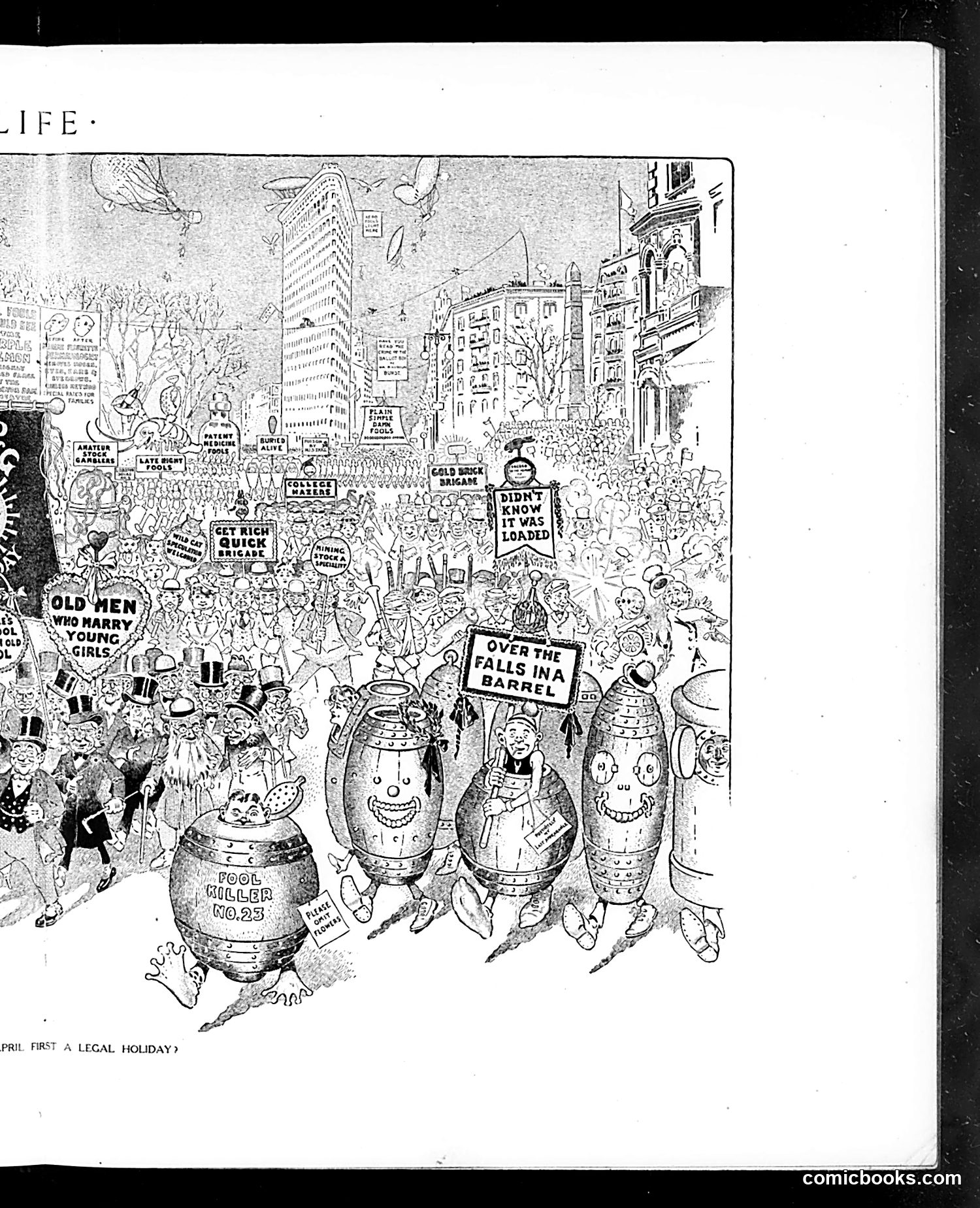
This is a satirical cartoon appearing to comment on April Fools' Day as a "legal holiday." The image depicts a crowded urban street scene with large bomb-like or barrel-shaped objects labeled "FOOL KILLER NO. 23" and a sign reading "OVER THE FALLS IN A BARREL." The satire suggests that if April Fools' Day were made official, there would be widespread foolishness worthy of elimination—hence the "fool killer" imagery. Various signs visible in the crowd reference foolish behavior ("Get Rich Quick," "Old Men Who Marry Young Girls," "I Didn't Know It Was Loaded"), satirizing common human follies and schemes that proliferate during this day of pranks and deception. The cartoon mocks both the gullibility of people and the absurdity of making such frivolous behavior officially sanctioned.
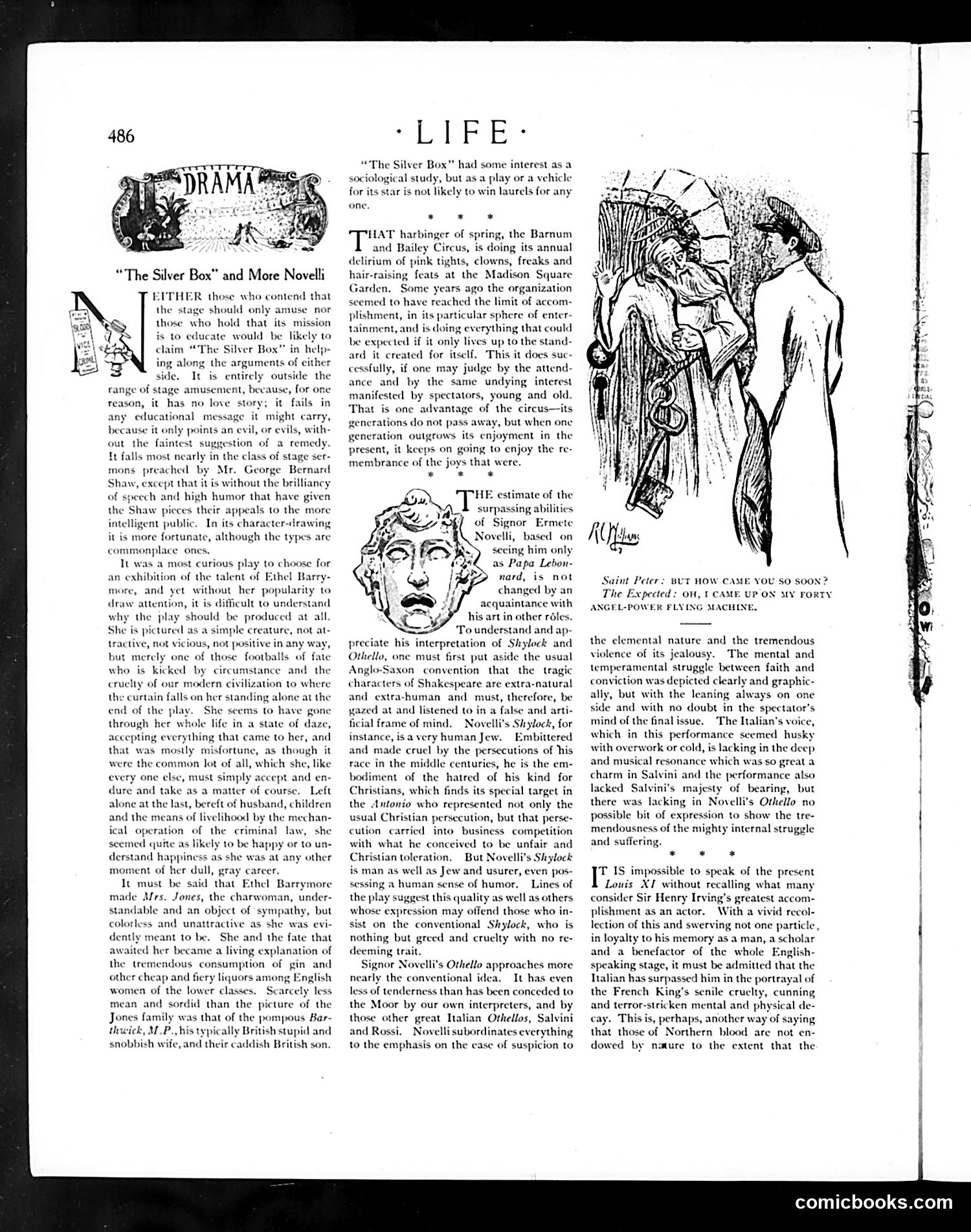
This page reviews theatrical productions. The main illustrated piece discusses George Bernard Shaw's play "The Silver Box," starring actress Ethel Barrymore. The reviewer criticizes the play as a depressing social sermon lacking entertainment value—it depicts the miserable fate of Mrs. Jones, a poor charwoman, and the morally corrupt Barthwick family (including an M.P., or Member of Parliament). The play offers no solutions to the evils it portrays, merely showing how poverty and "mechanical operation of the criminal law" destroy lives. The reviewer notes the play illustrates why working-class English women resort to gin and cheap liquor. The page also discusses actor Signor Ermete Novelli's performances in Shakespearean roles (Shylock and Othello). An illustration shows what appears to be a dramatic theatrical moment. The Barnum and Bailey Circus receives brief mention as seasonal spring entertainment with enduring appeal across generations.
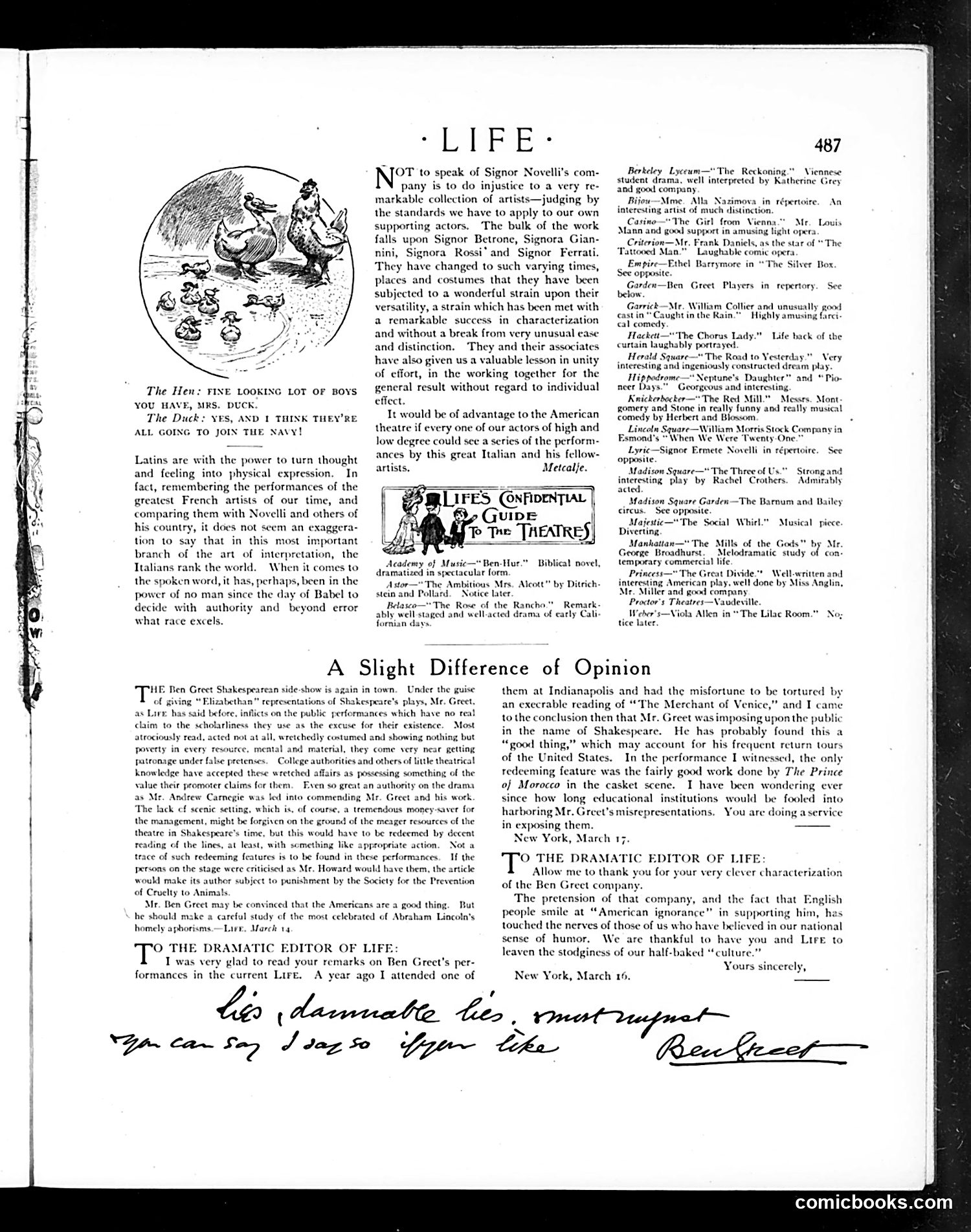
This page contains theater reviews and a debate about theatrical authenticity. The centerpiece is a letter exchange mocking Ben Greet's Shakespeare productions. **The Satire:** A reader complains that Greet's "Elizabethan representations" are inauthentic spectacles—pretentious but poorly executed. The reader contrasts this unfavorably with Signor Novelli's Italian theater company (reviewed above), praising the Italians' superior artistry and emotional expression. **The Point:** This reflects early 1900s American cultural anxiety about European vs. American theater quality. Greet represented commercialized, Anglicized "Shakespeare tourism," while Novelli represented genuine artistic passion. The debate critiques Americans' willingness to accept inferior theatrical experiences when packaged as "Shakespeare." **The Cartoon:** The opening "Hen and Duck" joke (unrelated) appears to be mild wartime Navy humor. The page demonstrates *Life's* role as cultural arbiter, using theater criticism to comment on American taste and authenticity.
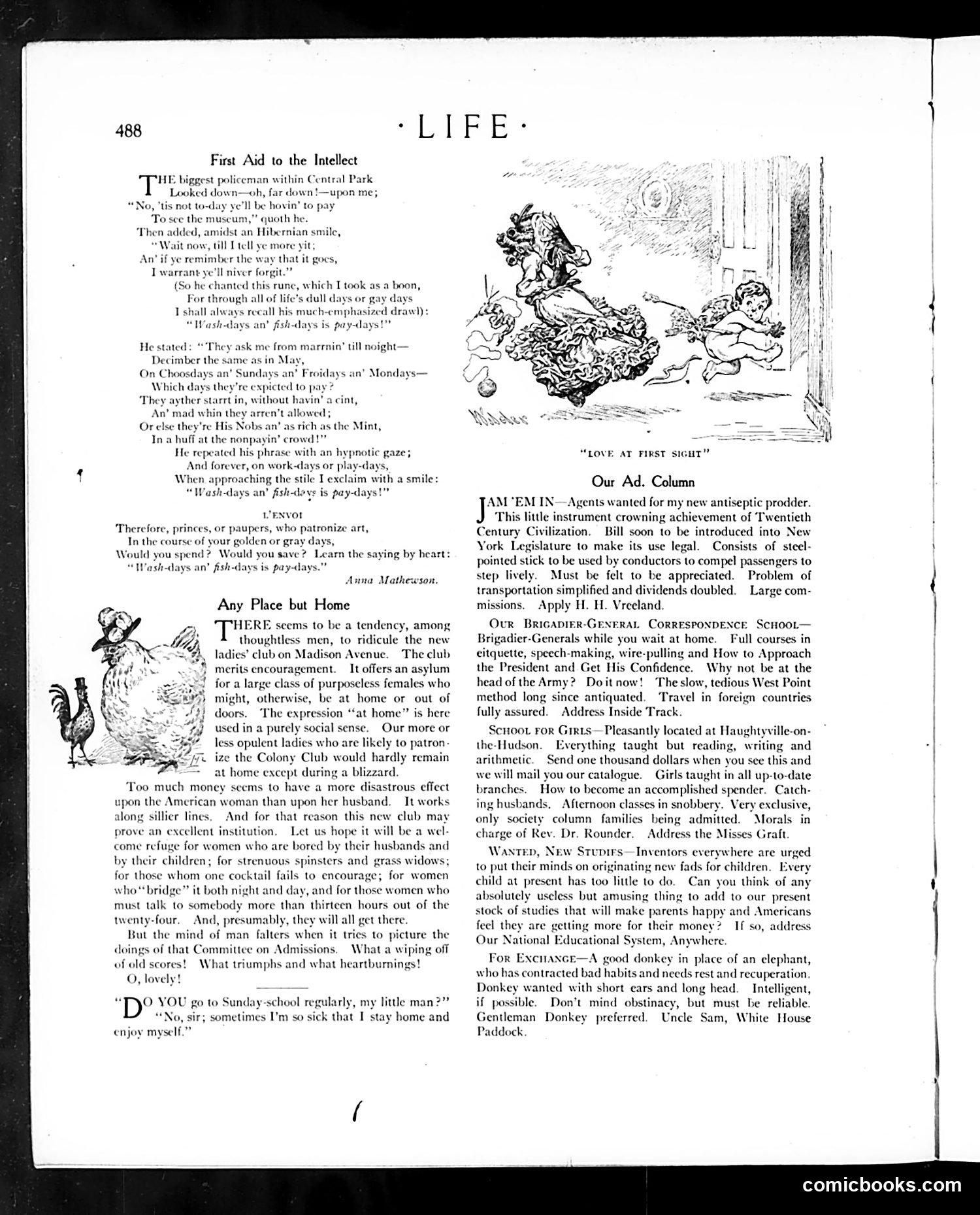
This Life magazine page contains two satirical pieces targeting different social subjects. **"First Aid to the Intellect"** features a humorous poem about a Central Park policeman (depicted with Irish dialect) advising a visitor about museum admission fees. The joke turns on the absurd, nonsensical rhyme "Wash-days an' fish-days is pay-days"—the policeman's hypnotic repetition of this meaningless phrase suggests satirizing mindless authority figures and empty conventional wisdom. **"Any Place but Home"** mocks wealthy women patronizing the new Madison Avenue "Colony Club." The satirist argues the club serves a useful social purpose: providing refuge for bored wives, idle spinsters, bridge-obsessed women, and those who'd otherwise clutter their homes. It's a backhanded critique of both purposeless female leisure and the boredom of wealthy married life, suggesting upper-class women need escape from domestic tedium. Both pieces exemplify Life's early satirical style—gently mocking American social pretensions and gender dynamics.
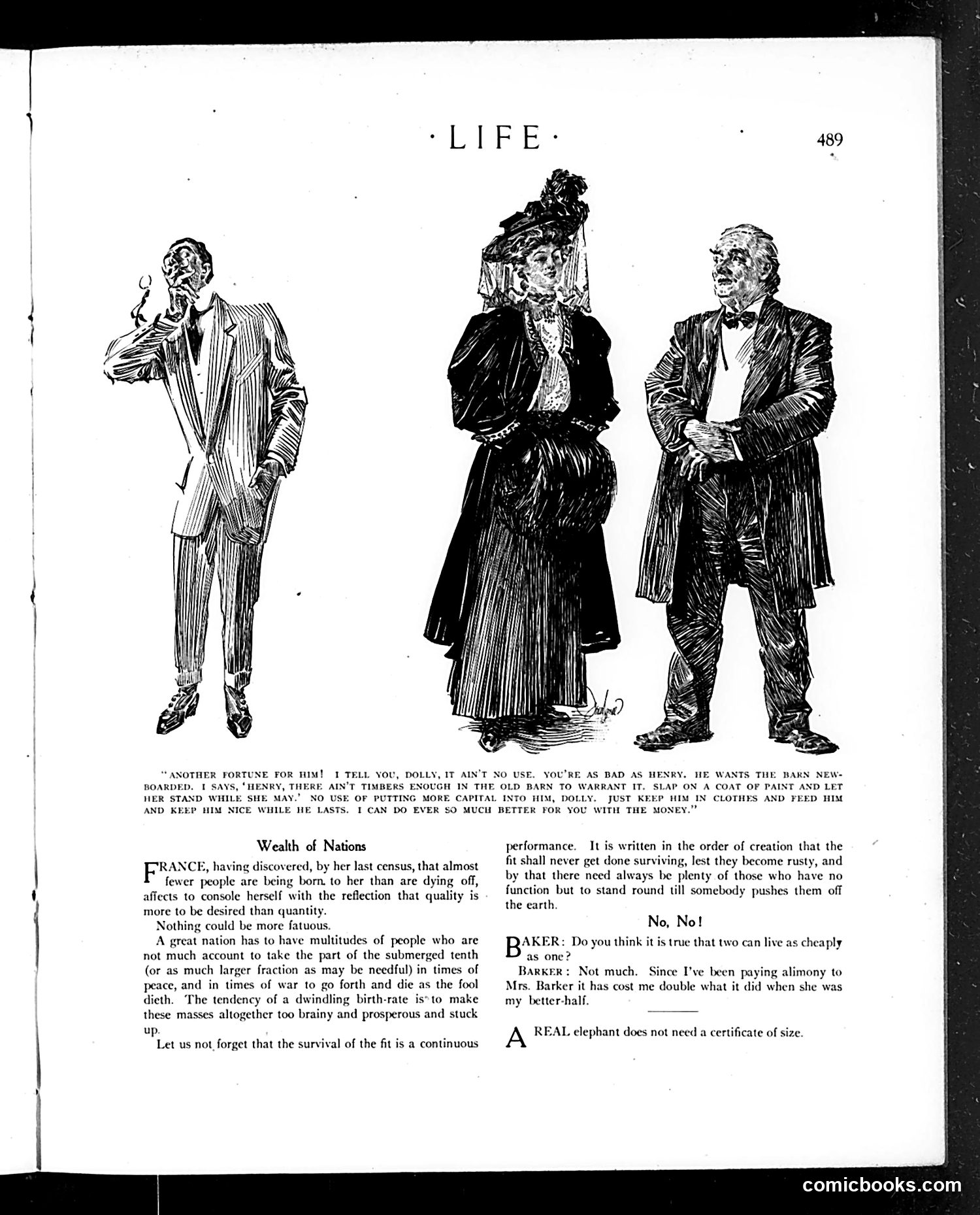
This page contains two distinct satirical pieces: **Top cartoon:** A domestic comedy about financial waste. A husband complains his wife won't stop spending money on their son Henry—demanding expensive clothes, paint, and improvements. The satire mocks upper-middle-class wives' frivolous spending habits and the tension between spouses over household finances. **"Wealth of Nations" essay:** A darkly cynical commentary on France's declining birth rate. The author argues sarcastically that France shouldn't worry—nations *need* masses of poor, unintelligent people to serve as cannon fodder in wars and cheap labor in peacetime. Quality population is actually *dangerous* because it makes the working classes "too brainy and prosperous and stuck up." This is social Darwinism presented as bitter satire. **"No, No!" joke:** A brief exchange where a man complains that paying alimony to his ex-wife costs him double—mocking divorce's financial burden on men. The page satirizes class attitudes, gender economics, and pseudo-scientific justifications for maintaining poverty.
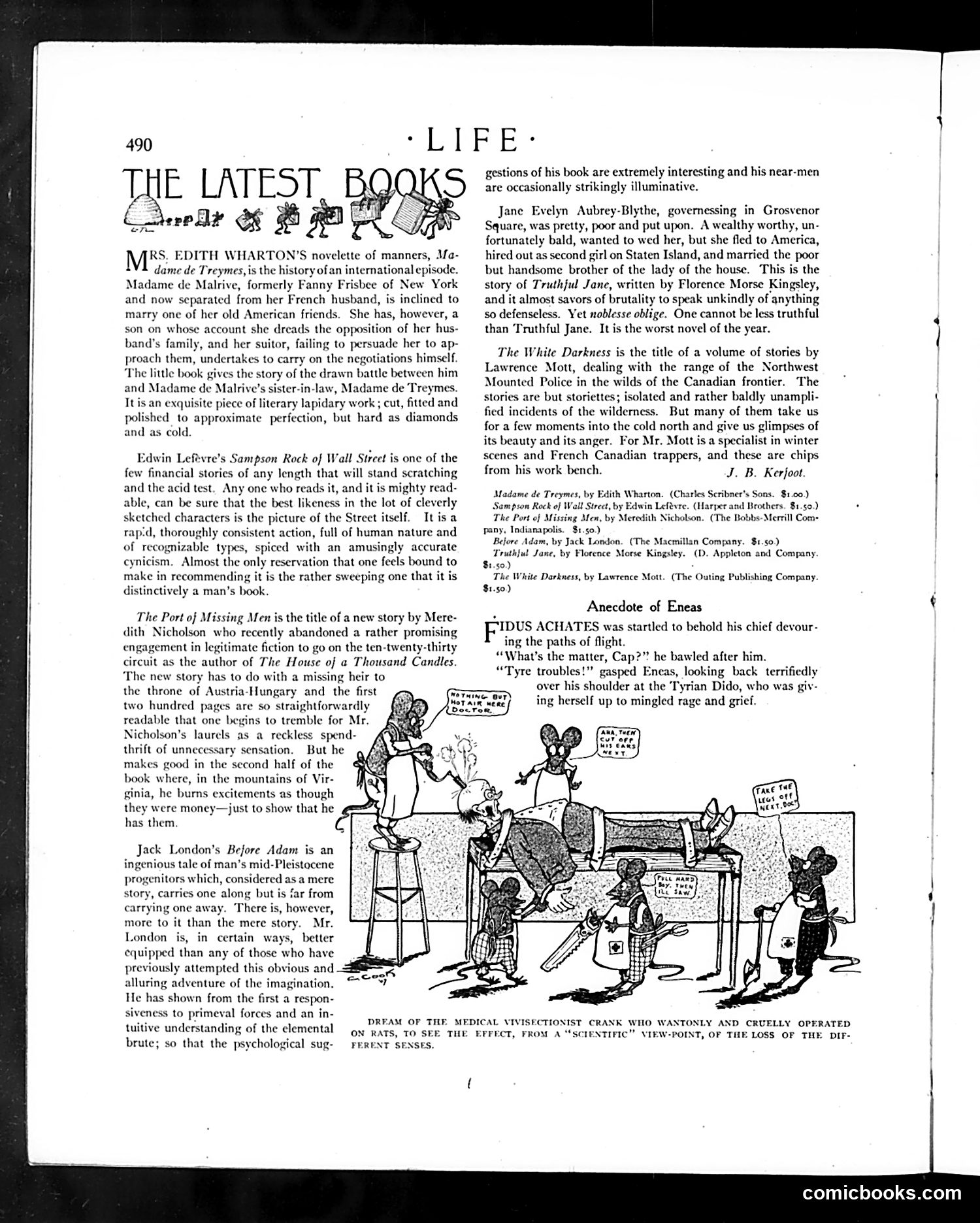
This cartoon illustrates a classical allusion from Virgil's *Aeneid*. Fidus Achates (Aeneas's faithful companion) chases after the fleeing Aeneas, who is terrified and looking back over his shoulder at the Tyrian Dido—a figure shown in the background. The joke targets vivisectionists and medical experimenters who claimed scientific justification for cruel animal testing. The caption sarcastically describes this as a "dream of the medical vivisectionist" operating on rats to observe suffering from a "scientific" standpoint. The satire conflates classical heroic narrative with contemporary animal cruelty, mocking scientists who rationalized brutality as legitimate research. By using the dignified Aeneas myth to depict panicked animals fleeing medical torture, the cartoonist undercuts claims of scientific nobility—suggesting such experiments were merely cruelty dressed in academic language. This reflects early-20th-century anti-vivisection sentiment, which questioned whether animal suffering could be ethically justified for research purposes.
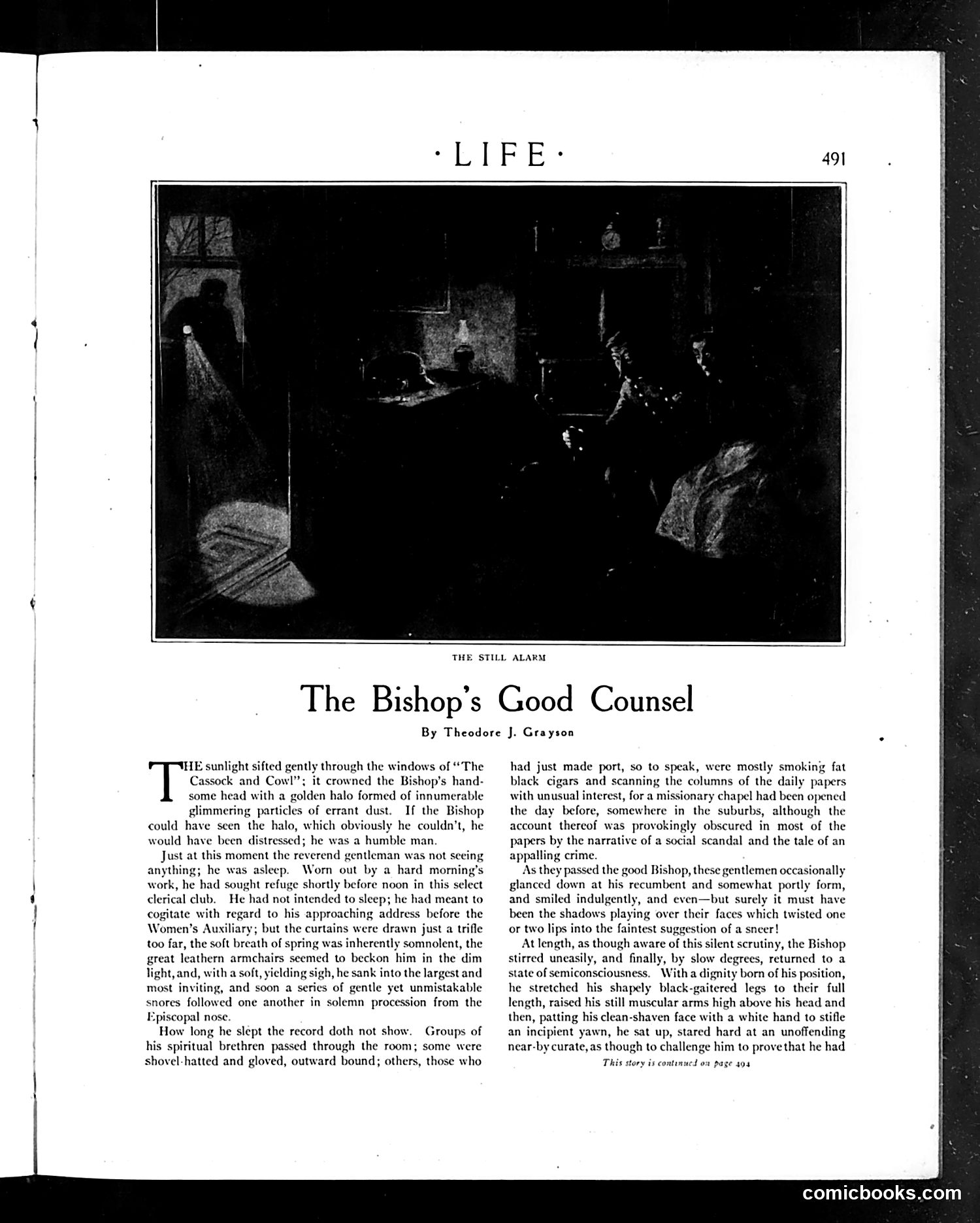
This is the opening of a short story, not a political cartoon. "The Bishop's Good Counsel" by Theodore J. Grayson depicts a humorous domestic scene at an exclusive clerical club ("The Cassock and Cowl"). The satire targets clerical hypocrisy and vanity. A bishop, portrayed as proud despite claiming humility, falls asleep during the day while supposedly preparing an important speech. His fellow clergy pass by, barely concealing their amusement and disdain—suggested by barely-suppressed sneers. The story mocks the gap between ecclesiastical dignity and human weakness: the bishop wakes irritably, stares aggressively at an innocent bystander to reassert authority, attempting to cover his embarrassment. The illustration shows the dimly-lit club interior with the sleeping bishop and observing clergymen, emphasizing the comic awkwardness of the scene. The narrative continues on page 394.
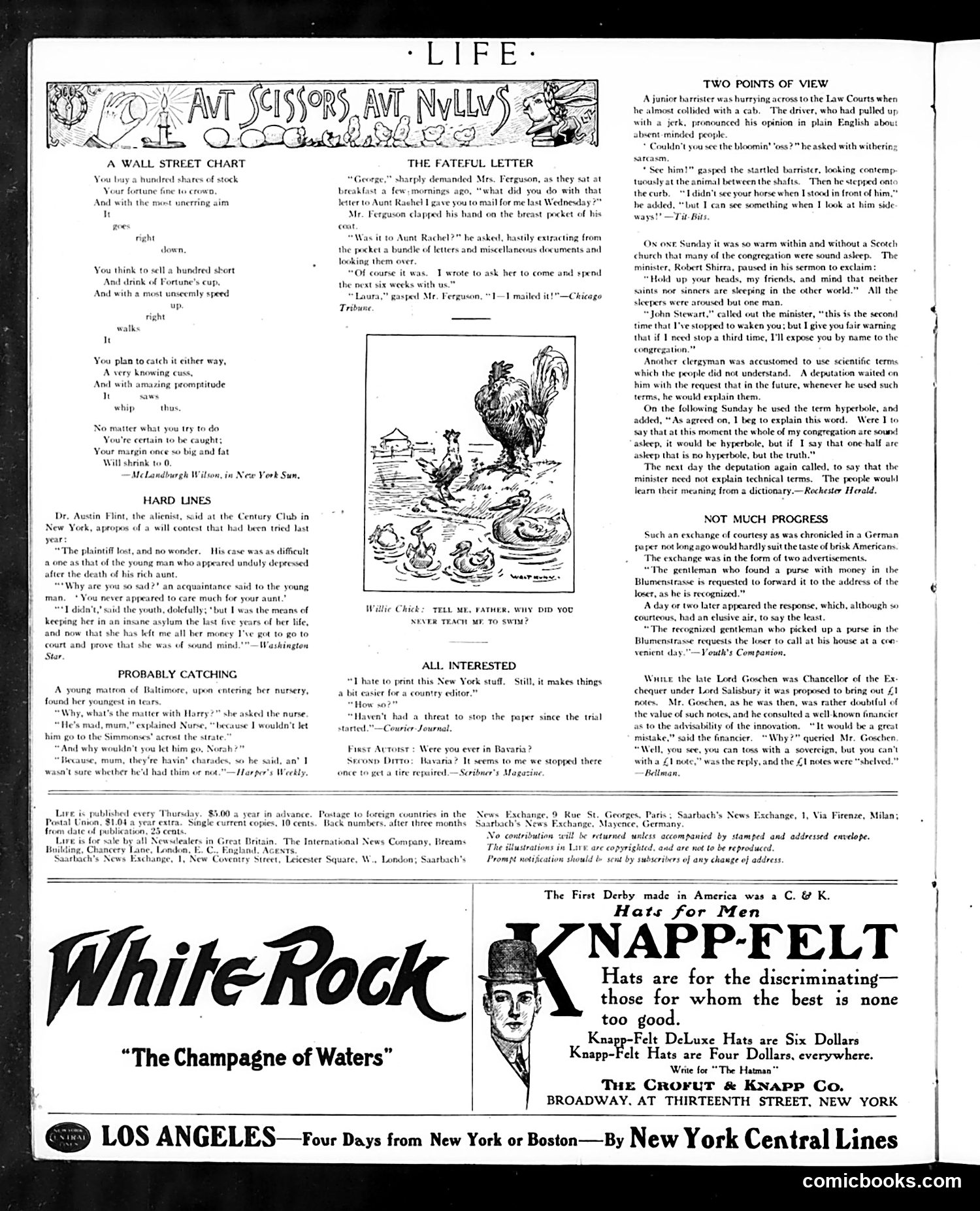
This Life magazine page contains several brief humorous anecdotes and a cartoon, typical of early 20th-century satirical journalism. **Main Content:** - **"The Fateful Letter"** and **"Two Points of View"** appear to be paired short stories about misunderstandings: one involving a lost letter to "Aunt Rachel," another about a barrister and cab driver each claiming not to have seen the other. - **"A Wall Street Chart"** is a poem about stock speculation and financial loss—satirizing get-rich-quick schemes. - **"Hard Lines"** recounts an anecdote about a wealthy aunt in an asylum, mocking the absurdity of inheritance law. - **"Probably Catching"** jokes about children's misbehavior at social gatherings. - **"Willie Chick"** cartoon (visible) appears to depict a child asking his father why he was never taught to swim—likely setting up an ironic punchline. The page primarily mocks everyday middle-class anxieties: financial insecurity, domestic absurdities, and social propriety. The humor relies on wordplay and situational irony rather than political commentary.
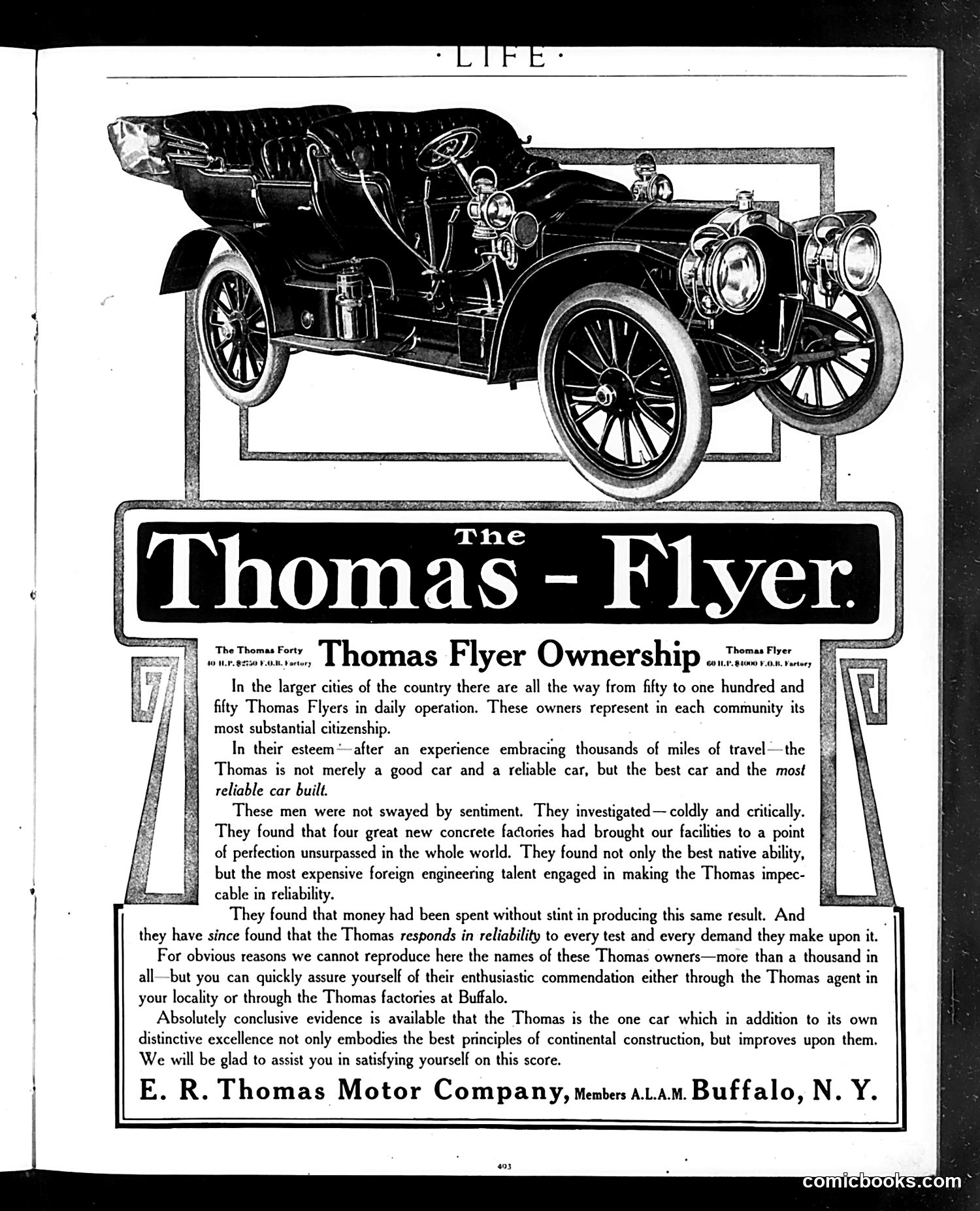
This is **not a cartoon or satire**—it's a straightforward automobile advertisement from *Life* magazine for the Thomas-Flyer, manufactured by E.R. Thomas Motor Company in Buffalo, New York. The ad uses a marketing strategy common to early automotive advertising: **testimonial-based credibility**. It claims that over 1,000 owners in major American cities—described as "most substantial citizenship"—have tested the Thomas through thousands of miles and concluded it's "the best car and the most reliable car built." The advertisement emphasizes rational decision-making ("not swayed by sentiment") and highlights the company's investment in four new concrete factories and foreign engineering talent. This appeals to early-1900s consumers' concerns about manufacturing quality and reliability during the automobile industry's formative years. The visual shows a detailed technical drawing of the vehicle itself, typical of period automotive advertising. There is no satire or political content evident on this page.
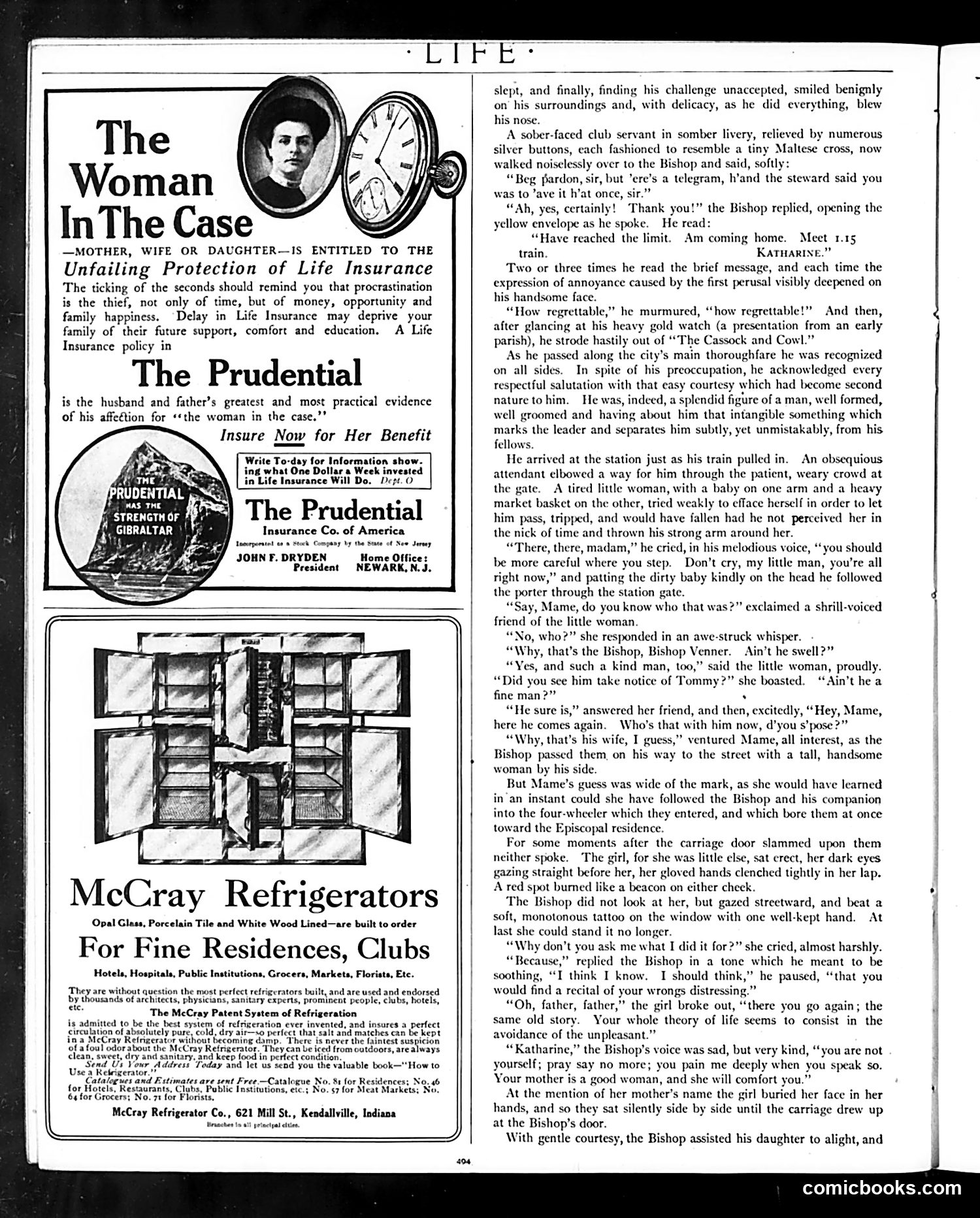
This page combines fiction with advertising. The main story (right column) depicts a Bishop receiving a telegram from "Katharine" announcing her arrival home, creating domestic tension. The narrative suggests scandal or impropriety—the Bishop's visible annoyance and the suggestive title ("The Woman in the Case") imply Katharine is either a daughter or someone whose return troubles him. The advertisements are the page's primary content: **The Prudential Insurance** (top) targets male breadwinners, framing life insurance as proof of affection for wives and daughters—a paternalistic appeal to masculine duty. **McCray Refrigerators** (bottom) advertises premium domestic appliances for wealthy households, hotels, and institutions. Together, these elements reflect early 20th-century concerns: economic insecurity (hence insurance), domestic respectability, and the aspirational lifestyle of the affluent middle and upper classes Life's readership inhabited.
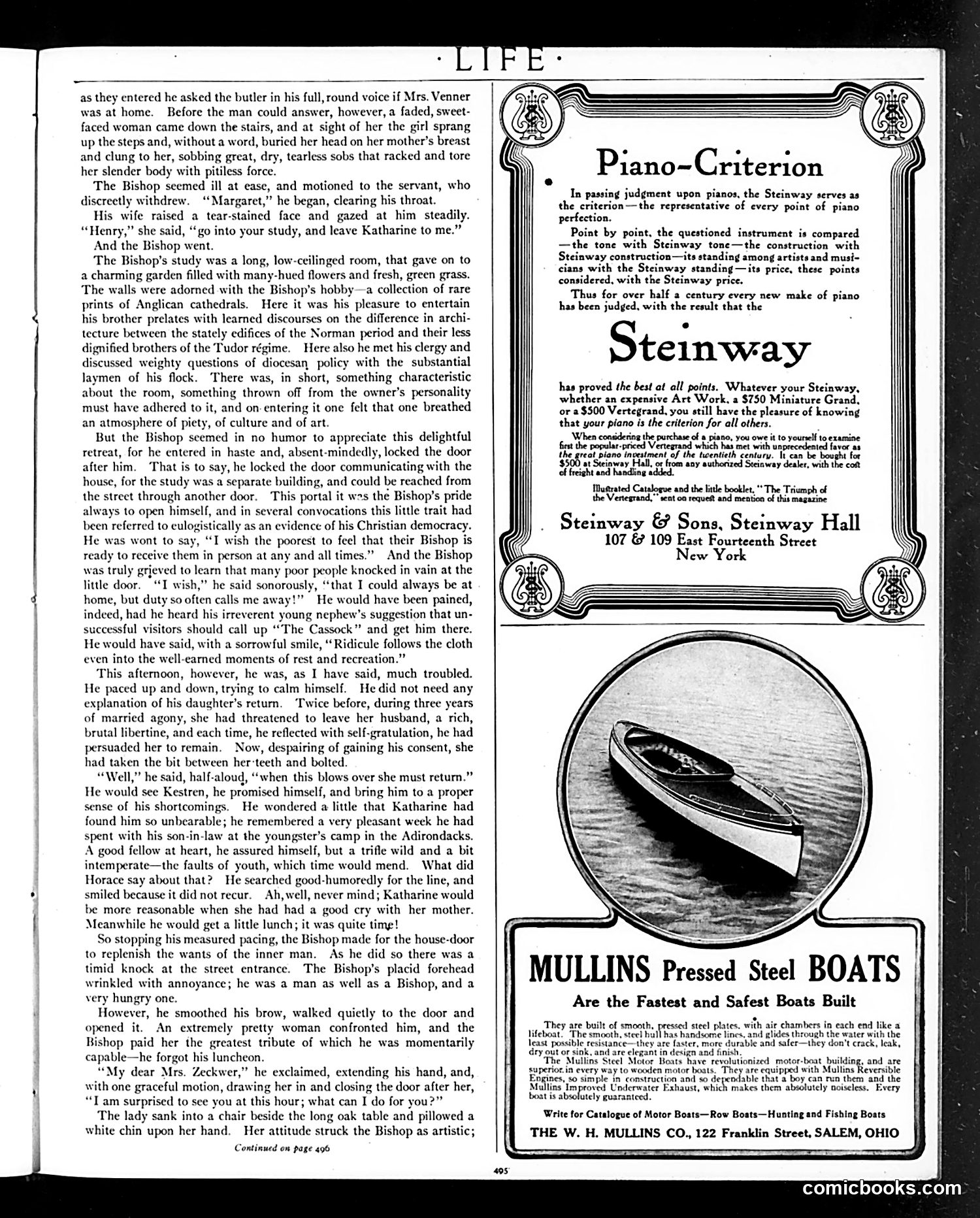
This page is primarily **literary fiction**, not political satire or cartoon content. It presents a serialized story (continued from page 496) depicting a domestic drama within an Anglican bishop's family. The narrative describes a bishop's distressed response to his daughter Katharine's return home after leaving her abusive, philandering husband. The story critiques the bishop's hypocrisy: he publicly preaches Christian virtue and claims accessibility to the poor through his study's open door, yet privately prioritizes "duty" and social propriety over his daughter's suffering. The satire targets **institutional religion**—particularly the gap between clergy's public piety and private priorities. The bishop's focus on his cathedral print collection and theological discussions contrasts sharply with his indifference to his own family's crisis. The page also contains **period advertisements** for Steinway pianos and Mullins steel boats, unrelated to the story.
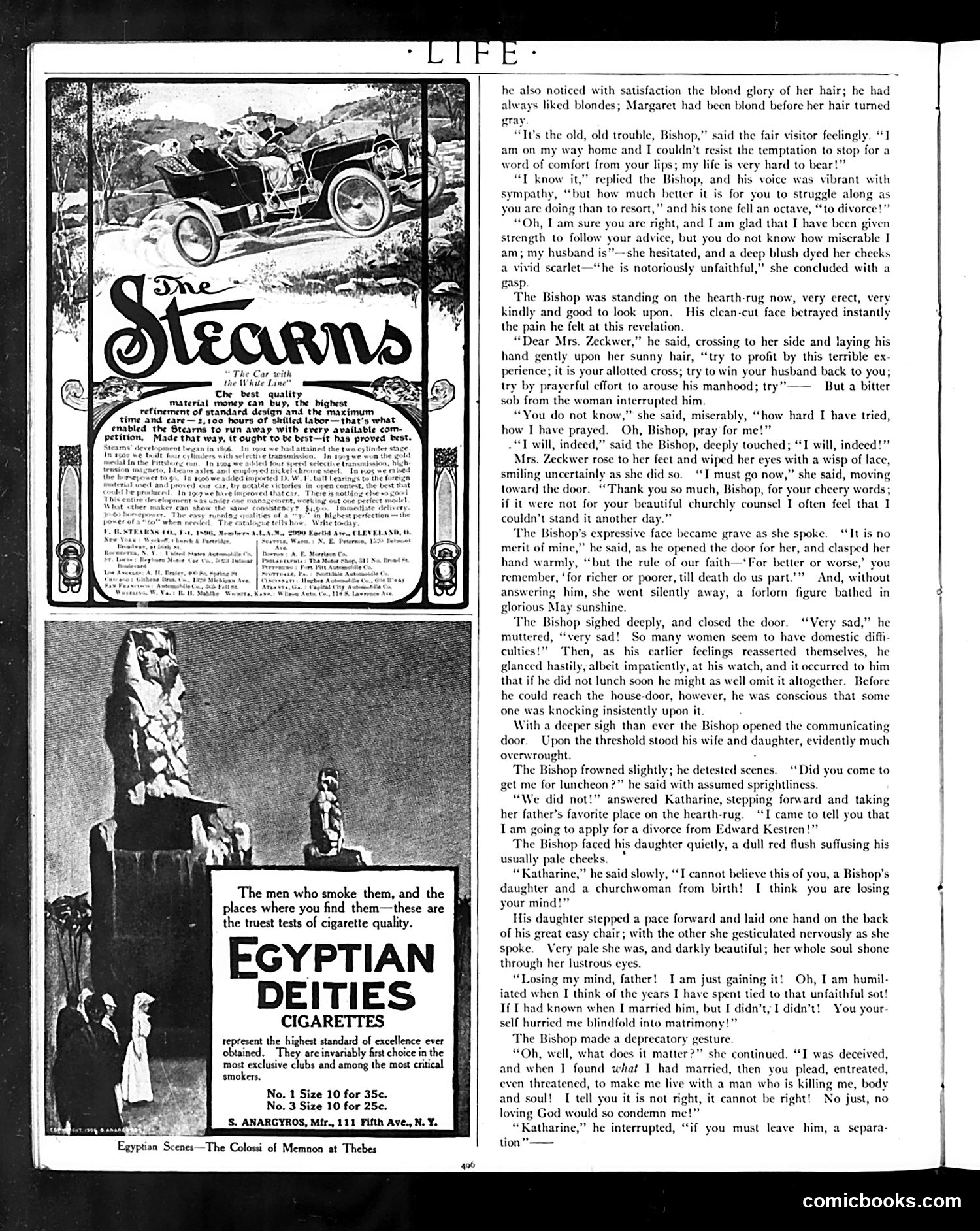
This page contains **two distinct advertisements** and a serialized **fictional story** about a bishop and marital discord. **The Advertisements:** 1. **Stearns automobiles** (top left): A luxury car ad emphasizing handcrafted quality and superiority over competitors—typical early 1900s automotive marketing. 2. **Egyptian Deities Cigarettes** (bottom): A cigarette brand claiming superiority by association with "exclusive clubs" and "critical smokers"—a common marketing strategy before tobacco's health risks were widely acknowledged. **The Story:** The narrative depicts a bishop counseling a distressed woman (Mrs. Zeckwer) about her unfaithful husband, urging her to endure the marriage rather than divorce. The irony becomes apparent when his own wife and daughter arrive "evidently much overwrought"—suggesting the bishop practices moral hypocrisy. The story appears to satirize religious authority figures who impose strict marital doctrine while their own families suffer.
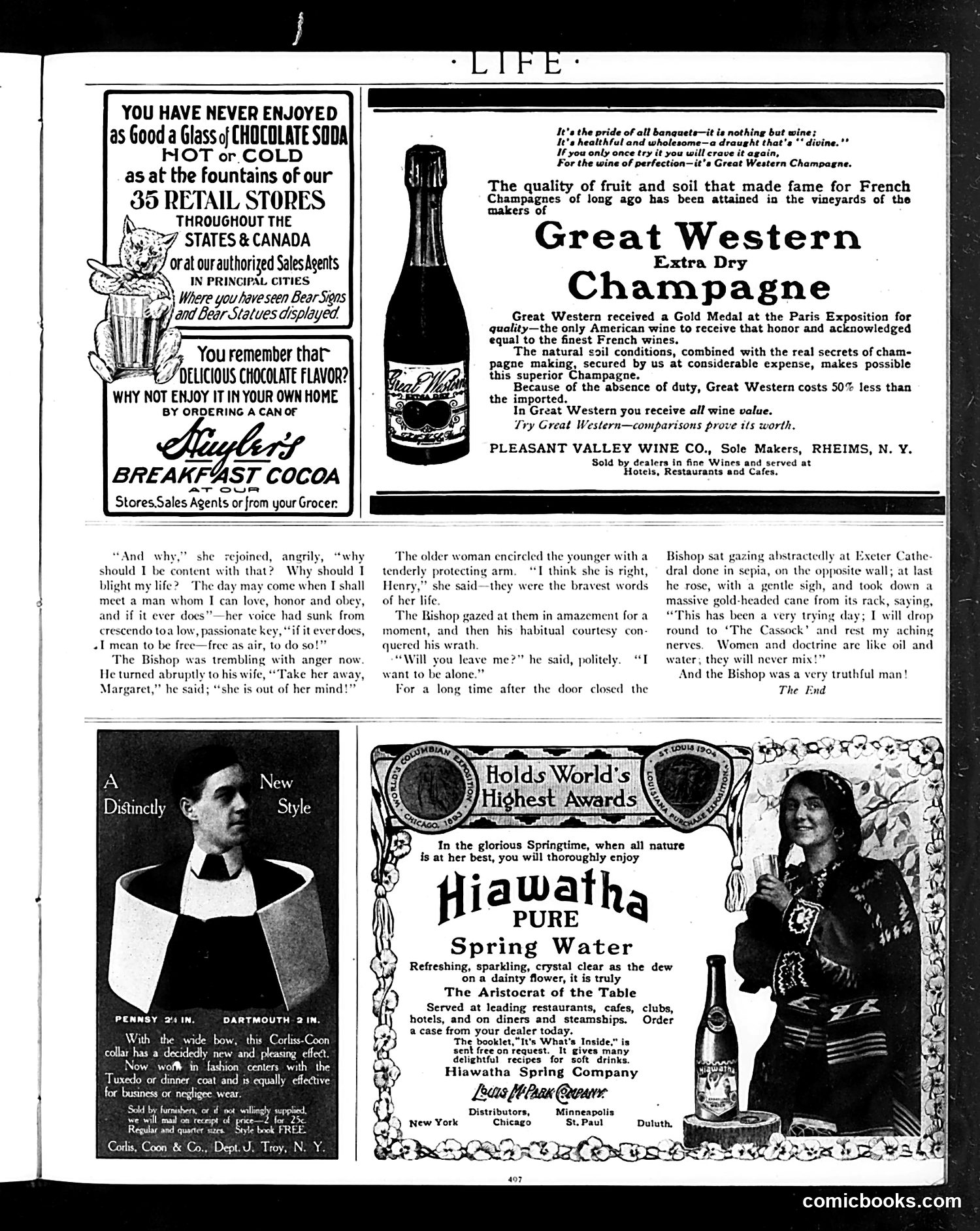
This page contains primarily **advertisements** interspersed with a short **satirical story** about gender and religious authority. ## The Story The narrative depicts a **Bishop confronting his niece** who demands independence and the right to marry for love rather than duty. She declares "I mean to be free—free as air." The Bishop, shocked and angry, orders her removed as "out of her mind." When his wife sides with the niece, the Bishop retreats to his club, complaining that "Women and doctrine are like oil and water, they will never mix." ## The Satire The humor targets **Victorian patriarchal attitudes**: the Bishop cannot tolerate a woman asserting autonomy over her own life and marriage. His retreat and complaint reveal his inability to engage with women's perspectives. The final line—"the Bishop was a very truthful man!"—is **ironic**, since his absolutist dismissal contradicts his claim to truth-seeking. ## The Advertisements Typical early-20th-century product ads: chocolate soda, breakfast cocoa, champagne, spring water, and a men's collar marketed as "distinctly new style"—reflecting consumer culture of the era.
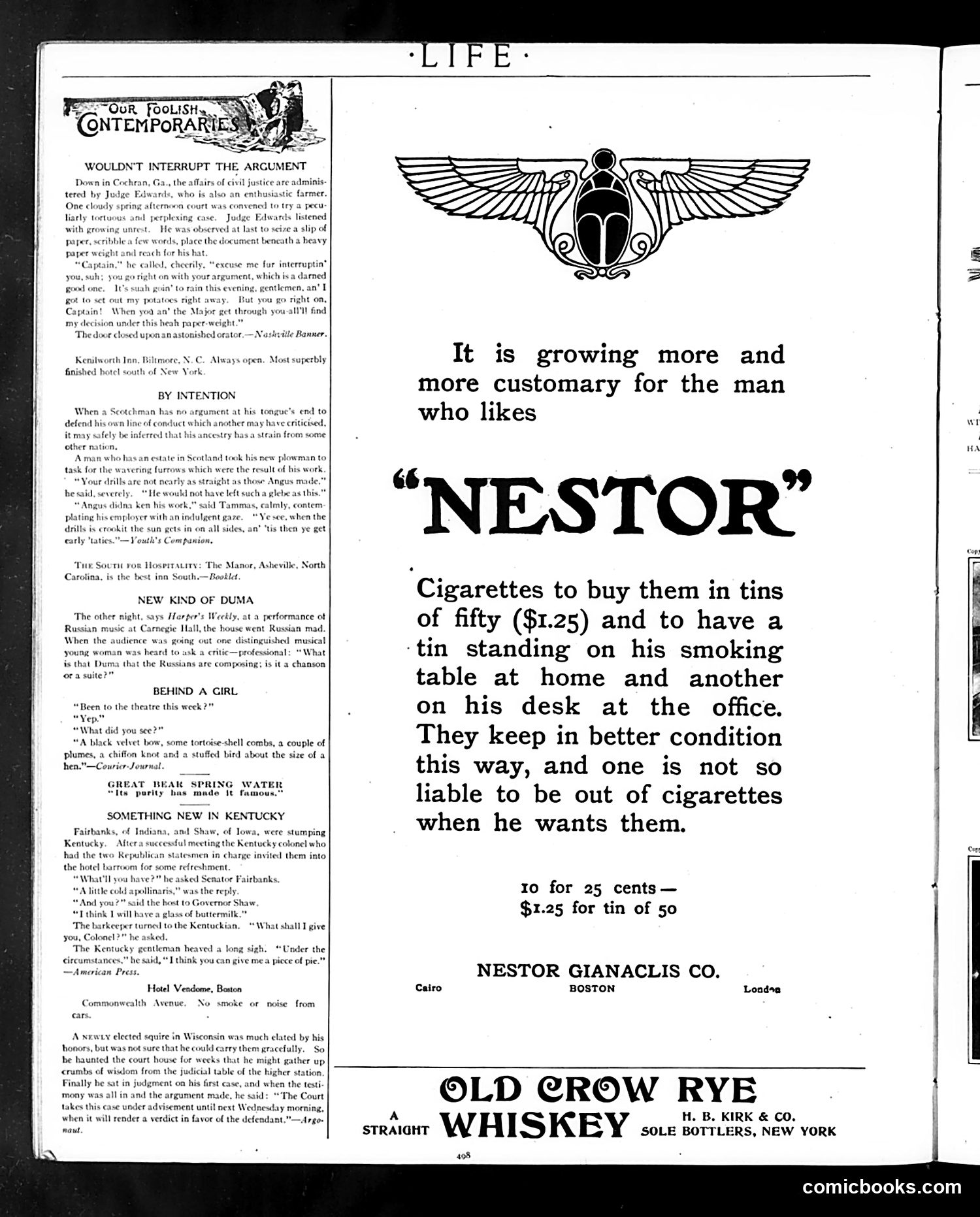
This page is primarily **advertising**, not political satire. The main content is a full-page advertisement for **Nestor cigarettes**, featuring an Art Deco winged logo and copy explaining the product's appeal: purchasing cigarettes in tins of 50 (for $1.25) keeps them fresher at home and office. The left column contains brief humorous anecdotes under "Our Foolish Contemporaries"—satirizing everyday social situations (courtroom interruptions, Scottish farmers, Russian composers)—typical of Life's light satirical content. The bottom features advertisements for **Old Crow Rye whiskey** and other products, reflecting early 20th-century magazine practices. **Historical context a modern reader needs**: This appears pre-Prohibition (whiskey advertised openly) and predates widespread health concerns about smoking. The casual marketing of cigarettes as a lifestyle accessory reflects early 1900s attitudes toward tobacco.
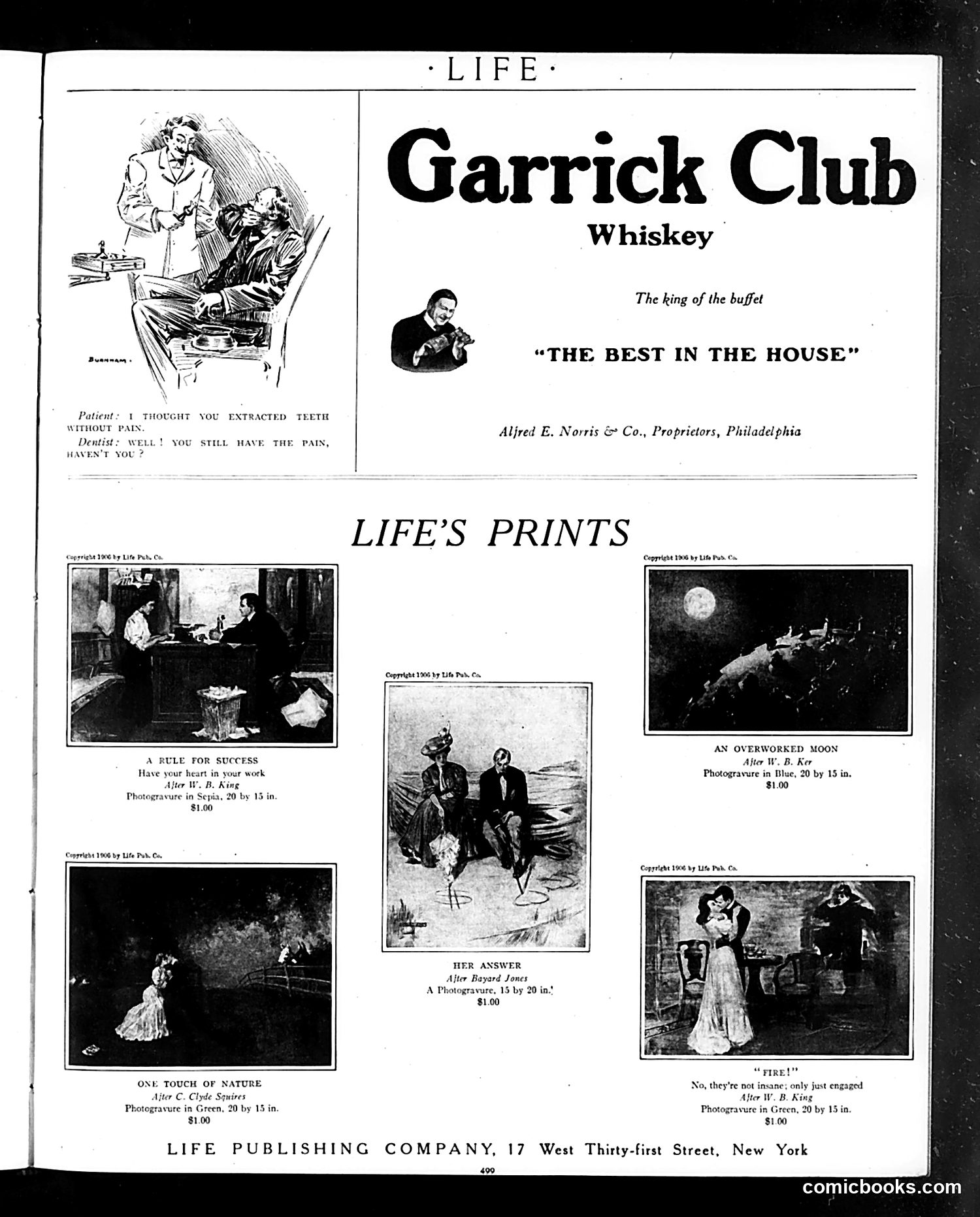
This page combines a **dental humor cartoon** with **whiskey advertising** and art prints for sale. ## The Cartoon (Top Left) The joke depicts a dentist-patient exchange: The patient complains the dentist extracted teeth "without pain," yet still has pain afterward. The dentist's response—"Well! You still have the pain, haven't you?"—is a crude pun suggesting the extraction itself was painless, but post-operative pain is expected and inevitable. It's satirizing either dental incompetence or the gap between promises and reality in dental work. ## The Advertisement The Garrick Club Whiskey ad ("The Best in the House") occupies the upper right, marketing liquor as a social good. ## The Prints Section Below are five art prints available for purchase ($1.00 each), including romantic/sentimental scenes by various illustrators—typical merchandise Life magazine sold to readers. The page reflects early 1900s magazine content mixing satire, commerce, and reproduced artwork.
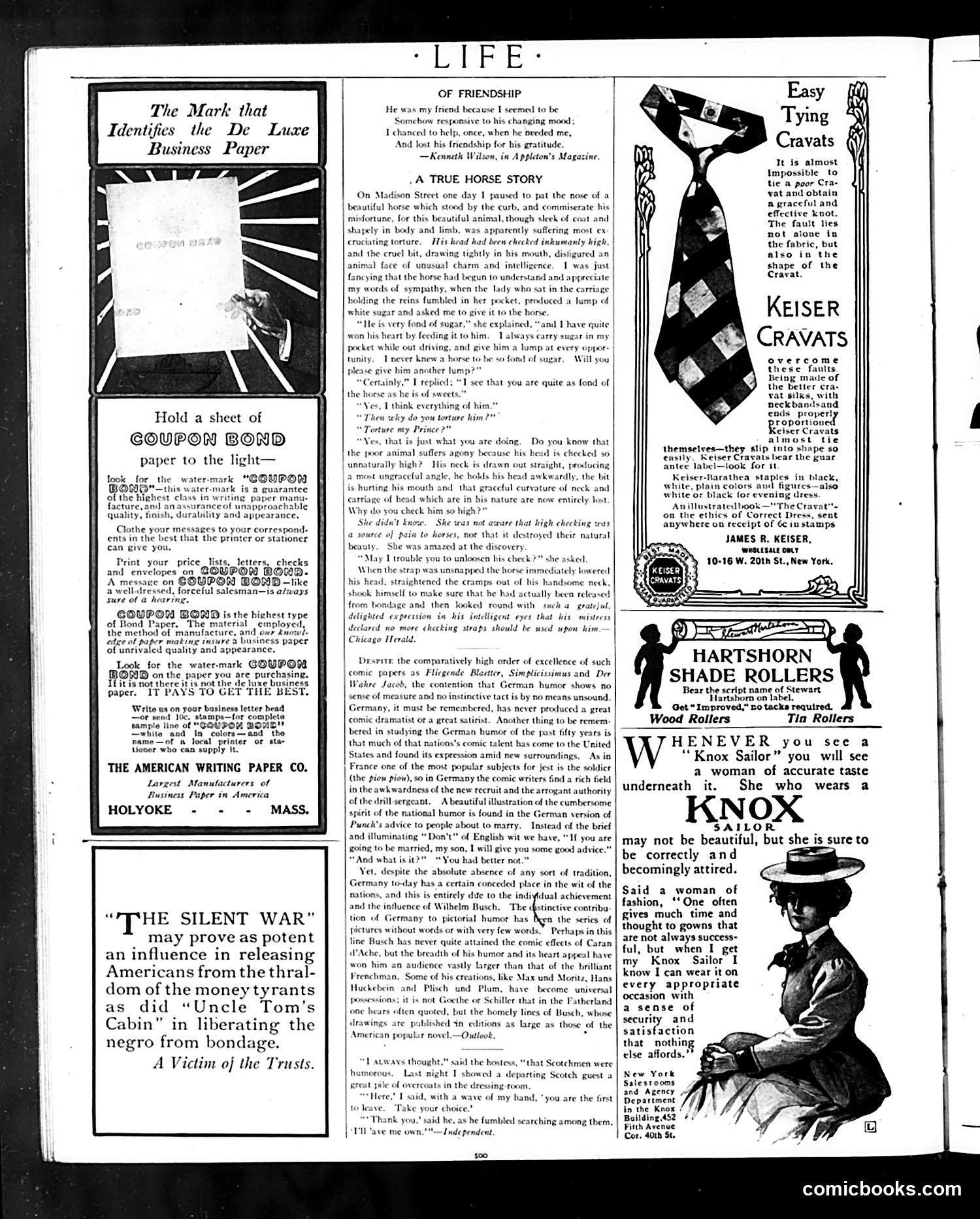
This page contains primarily **advertisements and editorial content** rather than political cartoons. The main article, "A True Horse Story," depicts animal cruelty in early 20th-century urban America. It recounts an encounter with a horse whose neck was painfully checked (pulled upward by reins), causing distress. The story advocates for humane treatment—the horse owner learns the practice causes suffering and removes the cruel restraint. This reflects Progressive Era concerns about animal welfare. The advertisements promote **business paper** (Coupon Bond), **neckwear** (Keiser Cravats), **shade rollers**, and **Knox Sailor hats**—typical period merchandise. A sidebar editorial titled "The Silent War" references **Uncle Tom's Cabin**, comparing the struggle against economic monopolies ("trusts") to abolitionism—suggesting corporate exploitation parallels slavery's moral urgency. The page reflects early 1900s American values: humane reform, consumer goods, and anti-monopoly sentiment.
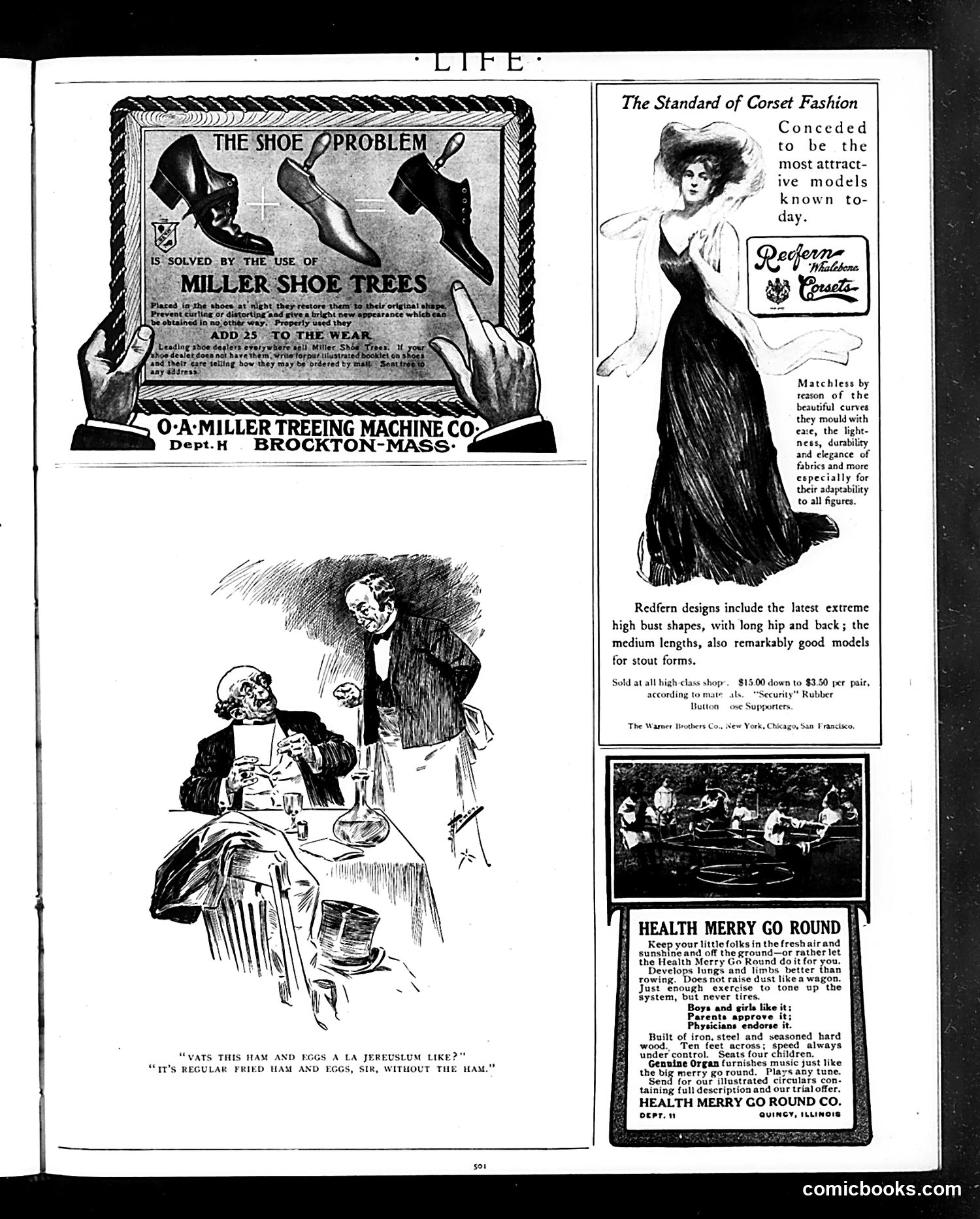
This page mixes advertising with one satirical cartoon. The main cartoon depicts a dining scene with the caption "Vats this ham and eggs a la Jerusalem like? / It's regular fried ham and eggs, sir, without the ham." The joke appears to mock pretentious restaurant naming—serving ordinary fried ham and eggs but marketing it with a fancy foreign name to justify higher prices. This reflects early 1900s satirical criticism of restaurants using elaborate titles to disguise mundane food. The page's advertisements promote consumer goods typical of the era: Miller Shoe Trees (shoe care), Redfern corsets (fashionable women's undergarments emphasizing specific body shapes), and Health Merry Go Round (a children's playground equipment that doubled as exercise equipment). These ads collectively reflect period preoccupations: proper grooming, women's fashion standards, and children's health through outdoor recreation.
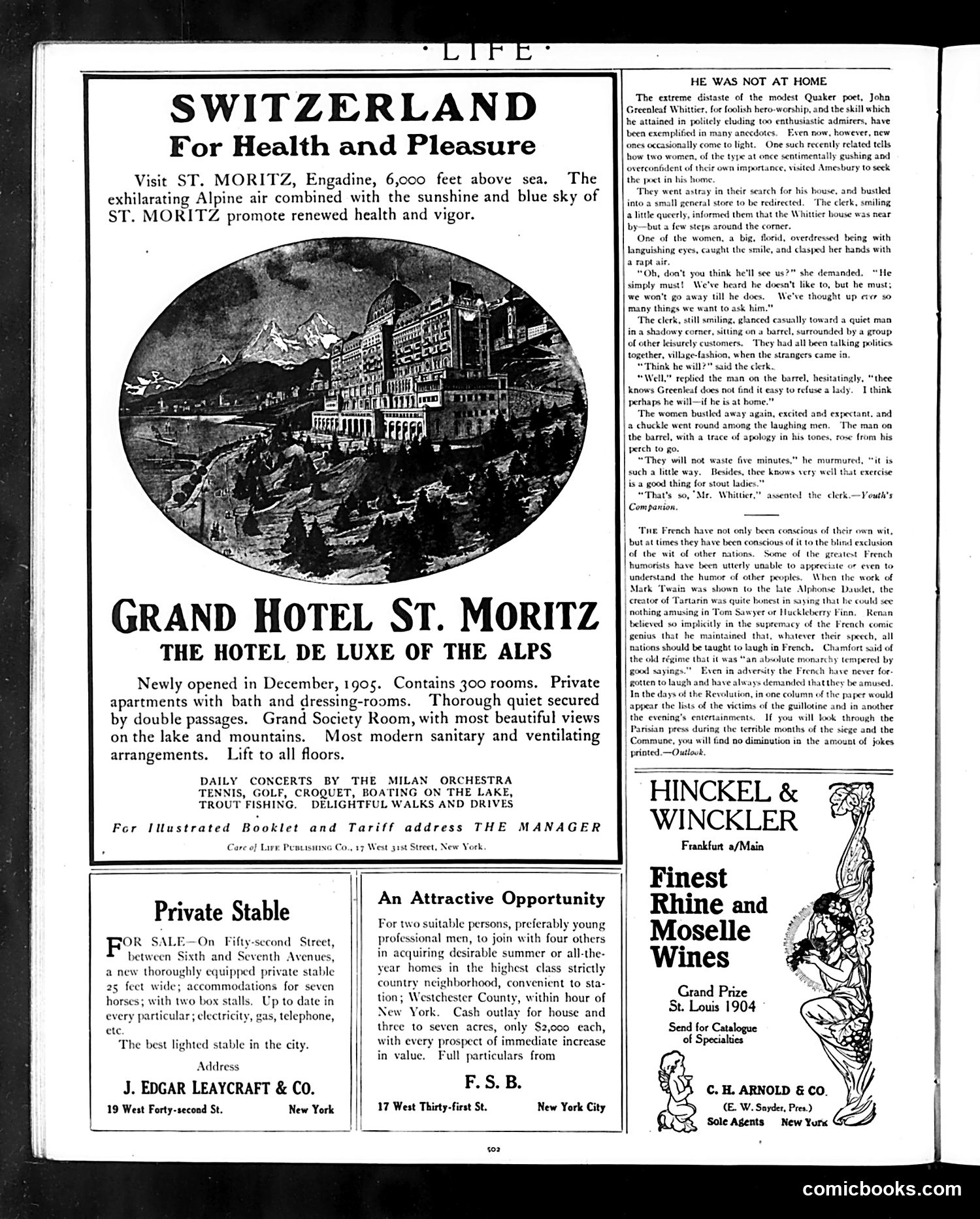
This page is primarily **advertisements** (Swiss hotel, real estate, wine), but includes a lengthy humorous story about the poet **John Greenleaf Whittier**. The satire depicts two overeager female admirers visiting Whittier's home in Amesbury. They enthusiastically demand to see him, insisting he "simply must" receive them despite his known dislike of such visits. The joke's punchline: the "quiet man on the barrel" they've been speaking with *is actually Whittier himself*—and he deliberately avoids them by implying he's "not at home." The humor works on multiple levels: the women's obliviousness, Whittier's polite deception, and the irony that he successfully dodges admirers through their own ignorance. The clerk's final comment about exercise being "good for stout ladies" adds a mild body-shaming joke typical of the era. The anecdote illustrates Whittier's legendary skill at avoiding unwanted hero-worship while maintaining courtesy.
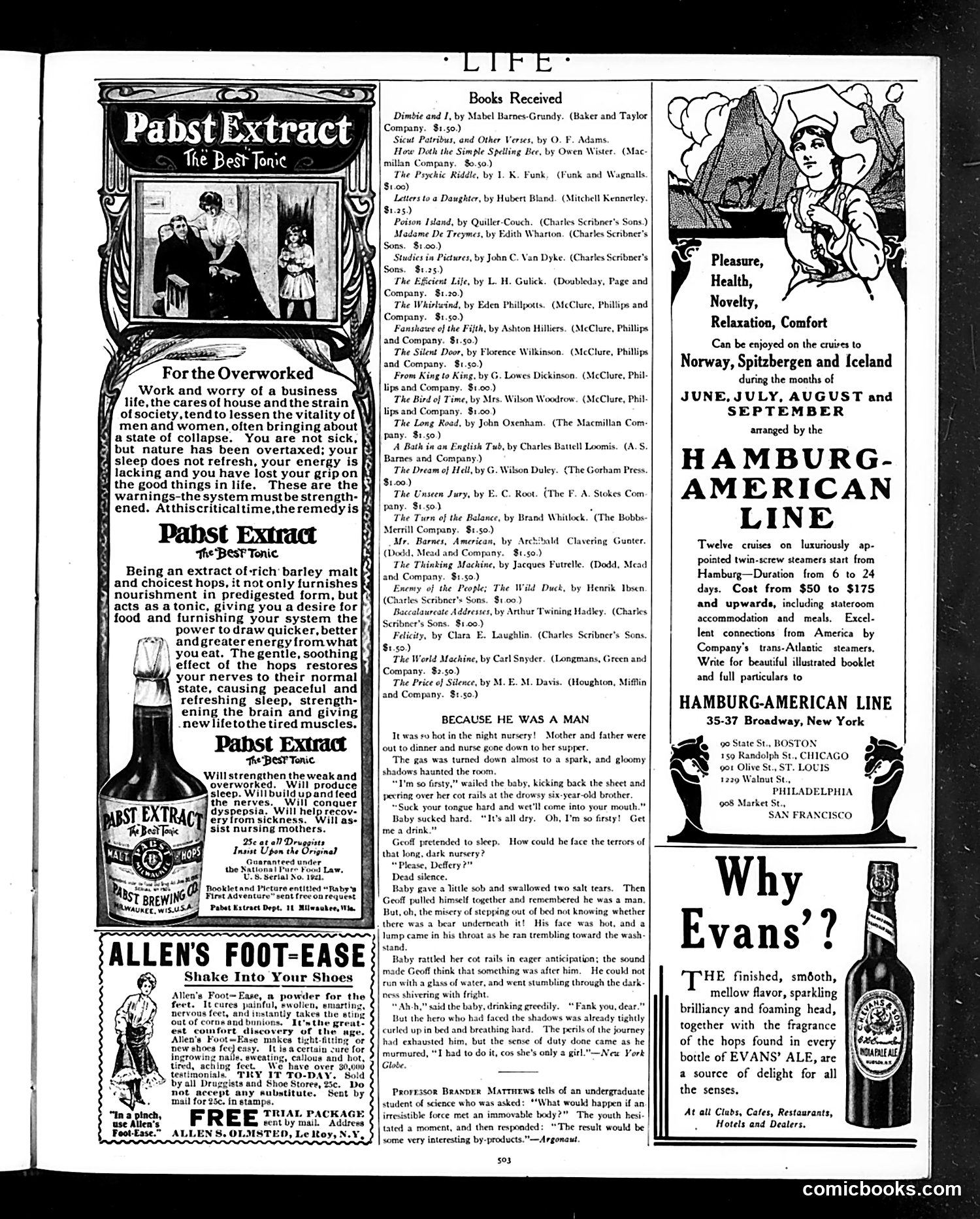
This page is primarily **advertisements and a book review section**, not political satire. The dominant content features **Pabst Extract** (a malt tonic), marketed as a cure-all for overworked Americans—targeting fatigue, nervousness, and depleted vitality from modern life. The accompanying imagery shows a tired businessman and family, reflecting early 1900s anxieties about industrial strain. Below appears **Allen's Foot-Ease**, a patent medicine powder for foot ailments. The "**Because He Was a Man**" story excerpt depicts a domestic scene where a baby cries at night while parents worry—seemingly advocating paternal responsibility and emotional control during distress. **Books Received** is a straightforward publisher listing of contemporary fiction and essays. **Why Evans?** advertises Evans beer, emphasizing its quality through sensory language ("smooth, mellow flavor"). The page reflects **turn-of-century American consumer culture**, promoting commercial solutions to modern anxieties rather than offering political commentary.
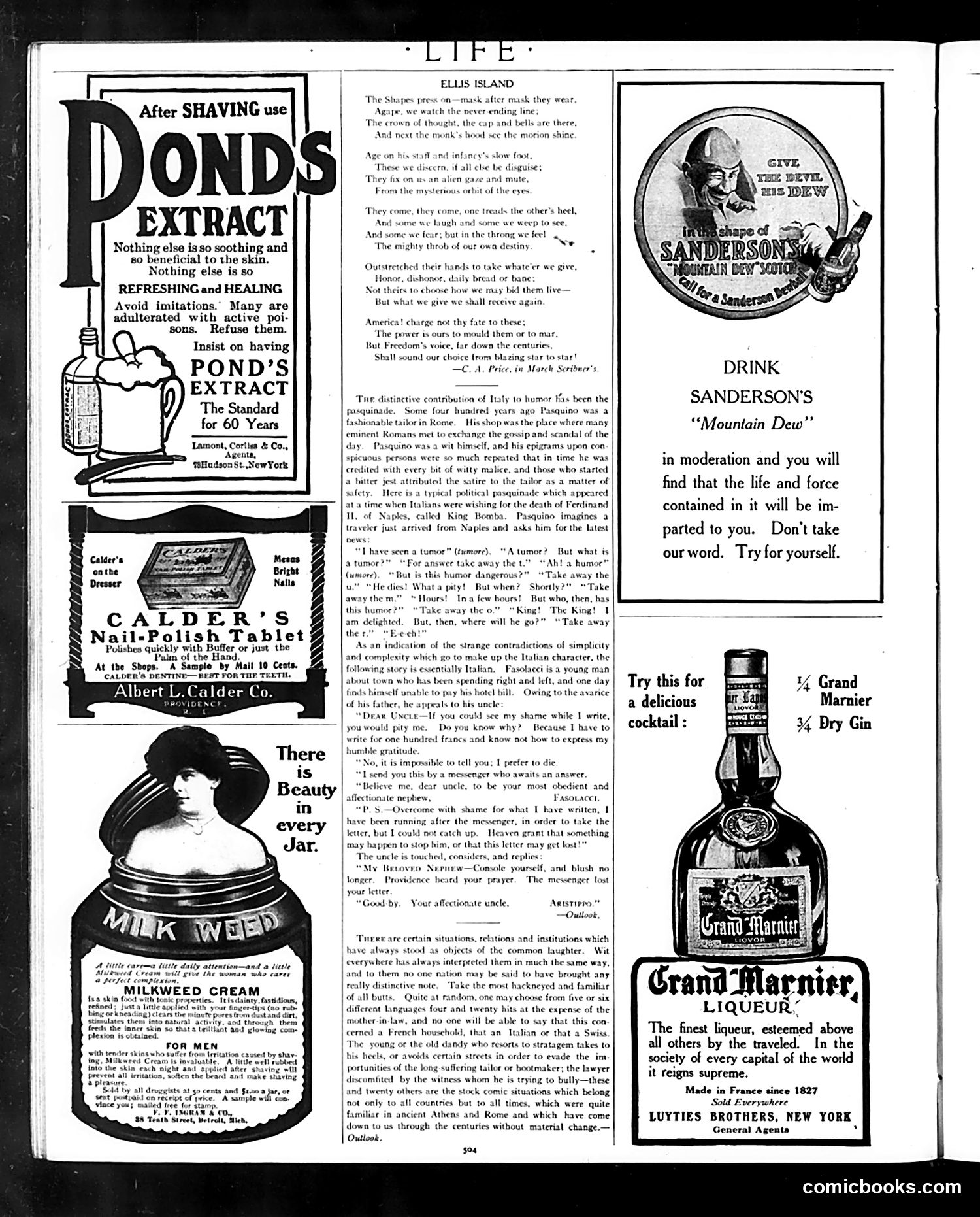
This page is primarily **advertising** with two notable editorial pieces: **"Ellis Island" Poem:** A patriotic verse addressing Italian immigration to America. The poem warns against judging immigrants by appearance ("mask after mask") and frames their arrival as a test of American values and freedom. It references the responsibility to treat newcomers fairly, ending with an appeal to national conscience. **Italian Humor Section:** Explains the "pasquinade"—Italian satirical tradition originating with a witty Roman tailor. The example mocks King Ferdinand II of Naples (called "King Bomba"), using wordplay where removing letters from "tumore" (tumor) reveals it's actually the king himself—a coded political critique suggesting the monarch is a disease on the state. **Context:** Both pieces reflect early 20th-century American concerns: immigrant assimilation and European political satire. The advertisements (Pond's Extract, Milkweed Cream) occupy the remaining space, typical of *Life* magazine's mixed editorial-commercial format.
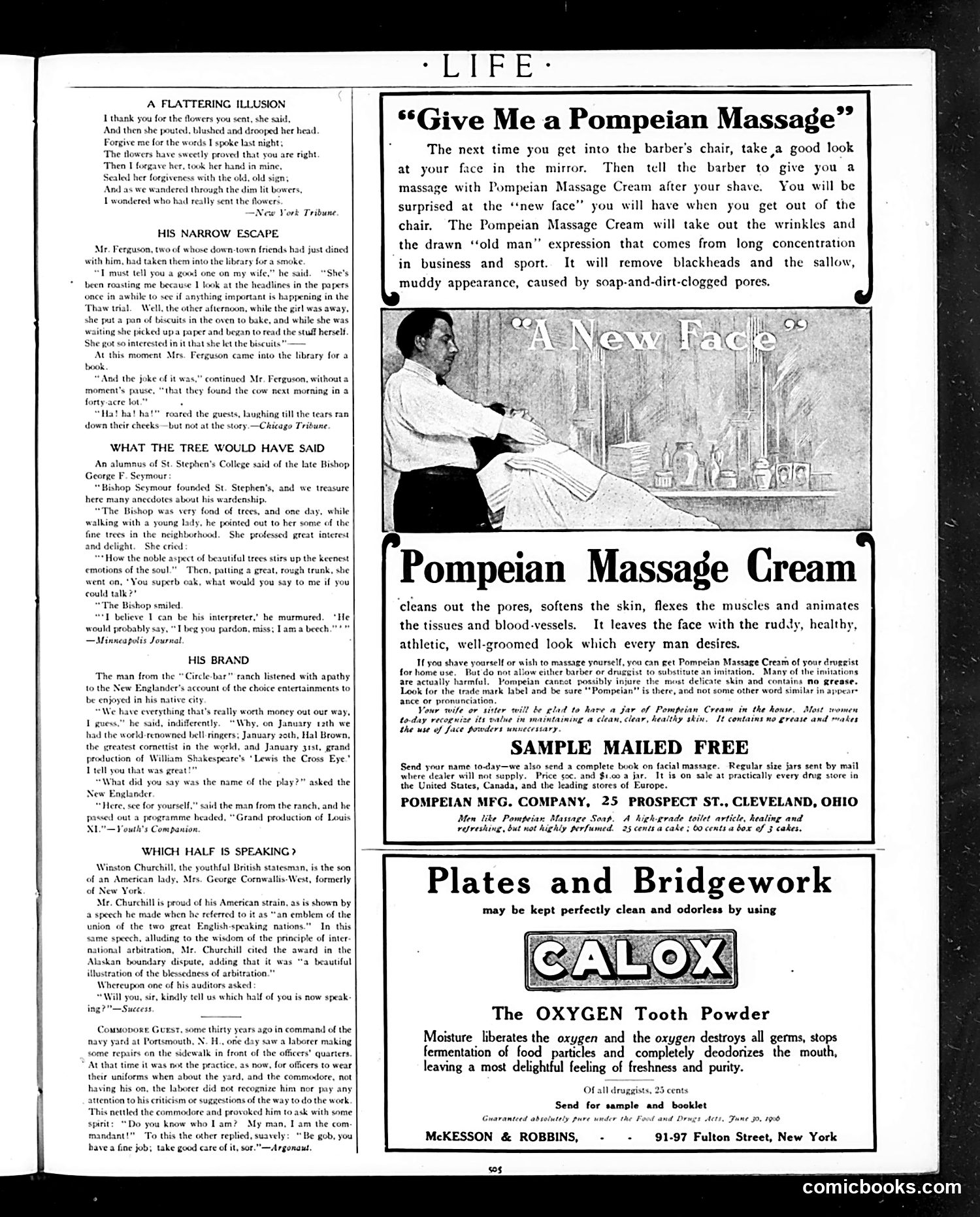
This page contains four humorous short stories typical of early 20th-century American humor magazines: **"A Flattering Illusion"** and **"His Narrow Escape"** are domestic comedy sketches about marital misunderstandings—the first romantic, the second about a wife catching her husband doing something he claimed to disapprove of her doing. **"What the Tree Would Have Said"** mocks a young lady's pretentious sentimentality about nature through a bishop's gentle correction—she mistakes a beech tree for an oak, undermining her philosophical pronouncements. **"His Brand"** satirizes Western ranch culture's perceived unsophistication, with the rancher mishearing Shakespeare's "Louis XI" as "Louis Cross Eye." **"Which Half Is Speaking?"** is a joke about Winston Churchill's mixed British-American heritage, questioning which national identity is currently "speaking" when he advocates for something. The page also contains advertisements for Pompeian Massage Cream and Calox tooth powder—typical period beauty/hygiene products.
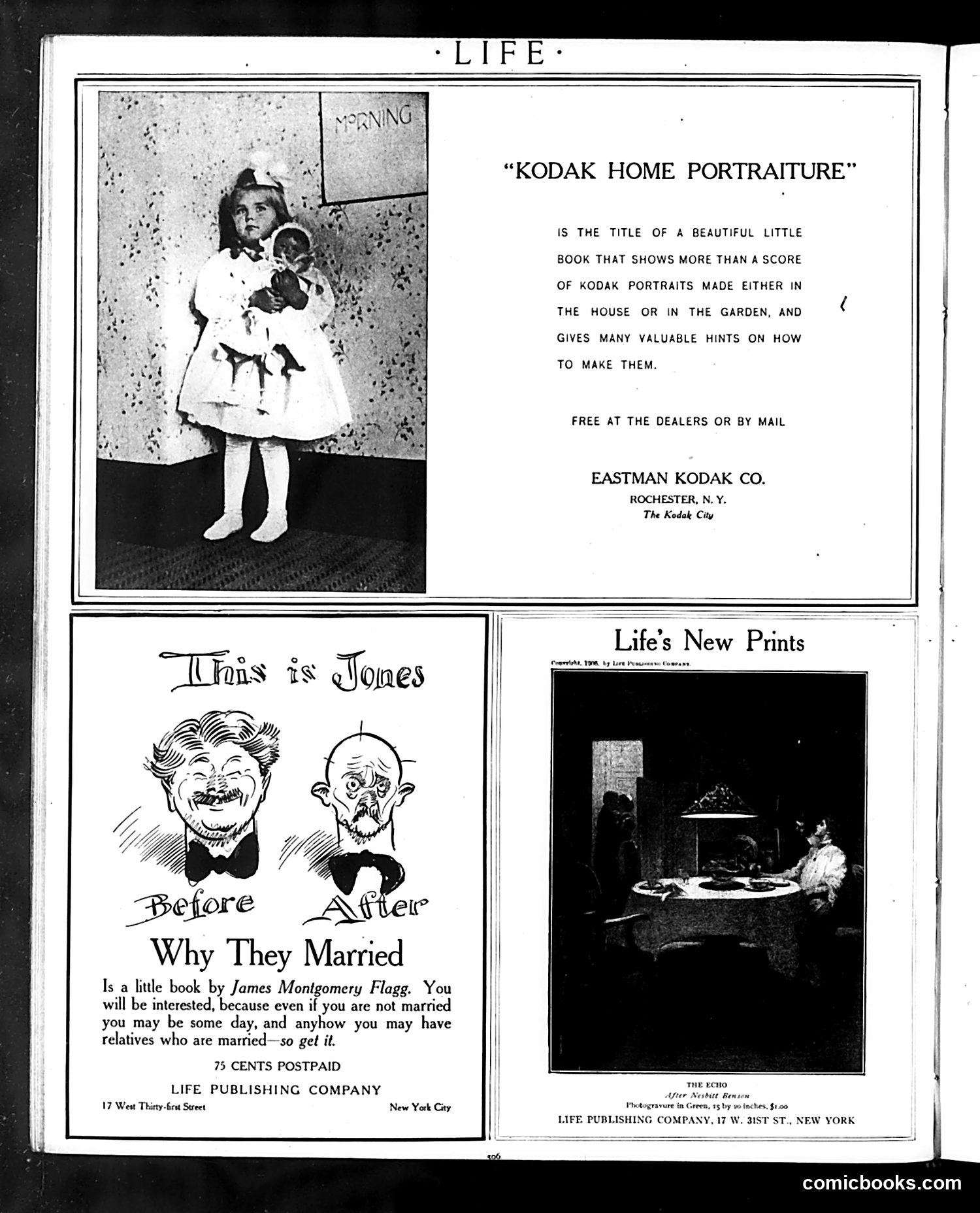
This page consists primarily of **advertisements** rather than editorial satire. The main content includes: 1. **Kodak advertisement** (top): Promotes a free instructional booklet on home portrait photography, positioning amateur photography as an accessible hobby. 2. **"Why They Married" advertisement** (lower left): A humorous book by James Montgomery Flagg (a well-known illustrator) using before/after caricatures of a man's face to joke about marriage's effects on appearance. The satire suggests marriage transforms men—the "before" shows a smiling face; "after" shows an older, more weathered version. This reflects early 20th-century cynicism about matrimony as a life-altering (implicitly negative) event. 3. **"Life's New Prints"** (right): Appears to be another book or publication advertisement. The page reflects *Life* magazine's business model: combining satirical content with commercial advertising, while the marriage joke represents period attitudes treating wedlock as comedic misfortune.
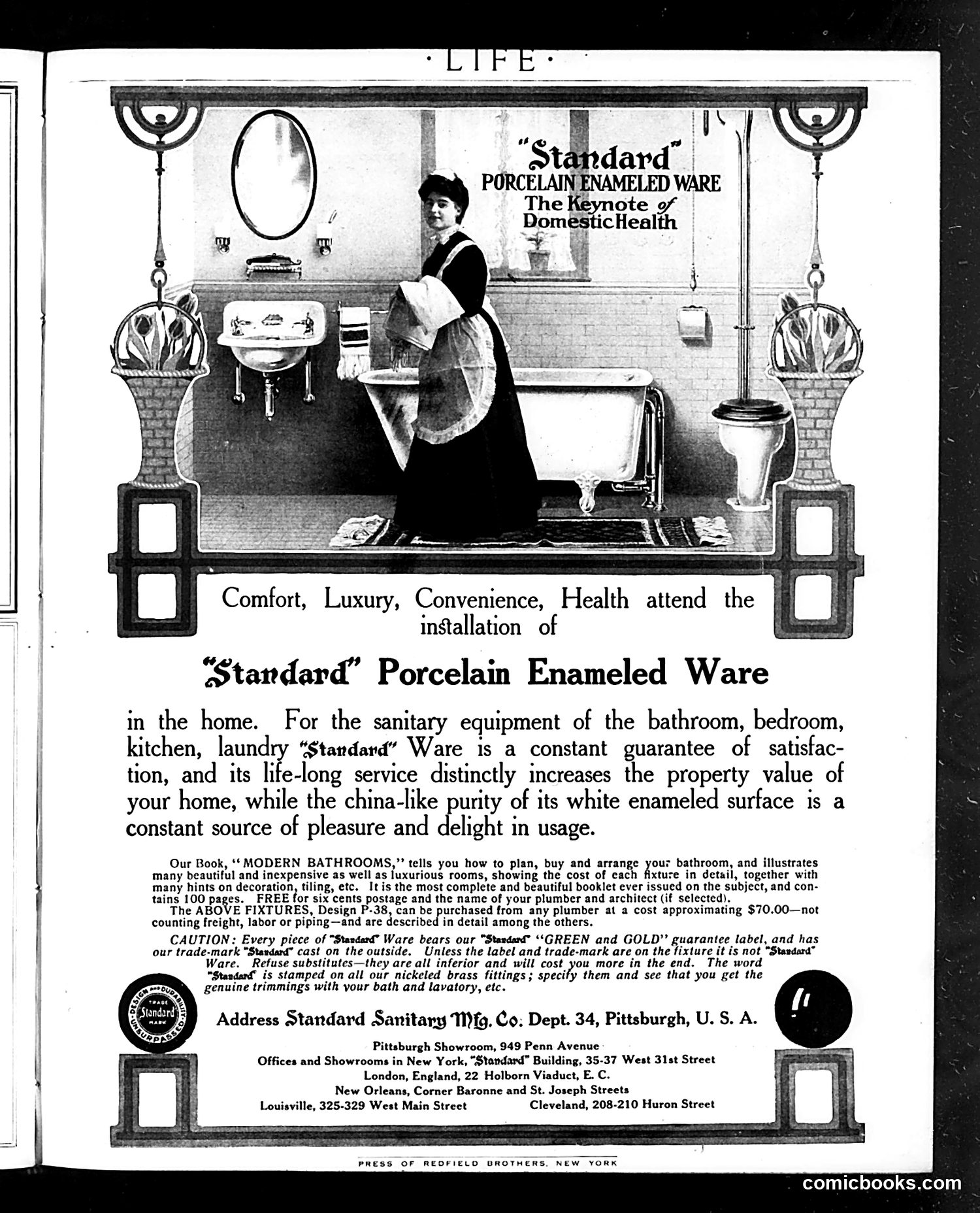
This is **not a cartoon or satire**—it's a full-page **advertisement** for Standard Sanitary Manufacturing Company's porcelain bathroom fixtures. The image shows a woman in early 20th-century dress holding towels in a modern bathroom, posed to showcase the advertised products (sink, toilet, bathtub). The ad promises that installing Standard ware brings "Comfort, Luxury, Convenience, Health" and increases home property value. The text functions as promotional copy, emphasizing product quality, offering a free 100-page booklet on modern bathroom design, and warning consumers against counterfeit products by checking for the "GREEN and GOLD" guarantee label. Multiple showroom locations are listed (Pittsburgh, New York, London, New Orleans, Louisville, Cleveland). This reflects the early 1900s when modern indoor plumbing was still a luxury amenity that signified wealth and respectability—hence the emphasis on health benefits and home value appreciation.