
Life, 1907-04-04 · page 19 of 48
Life — April 4, 1907 — page 19: what you’re looking at
What you’re looking at
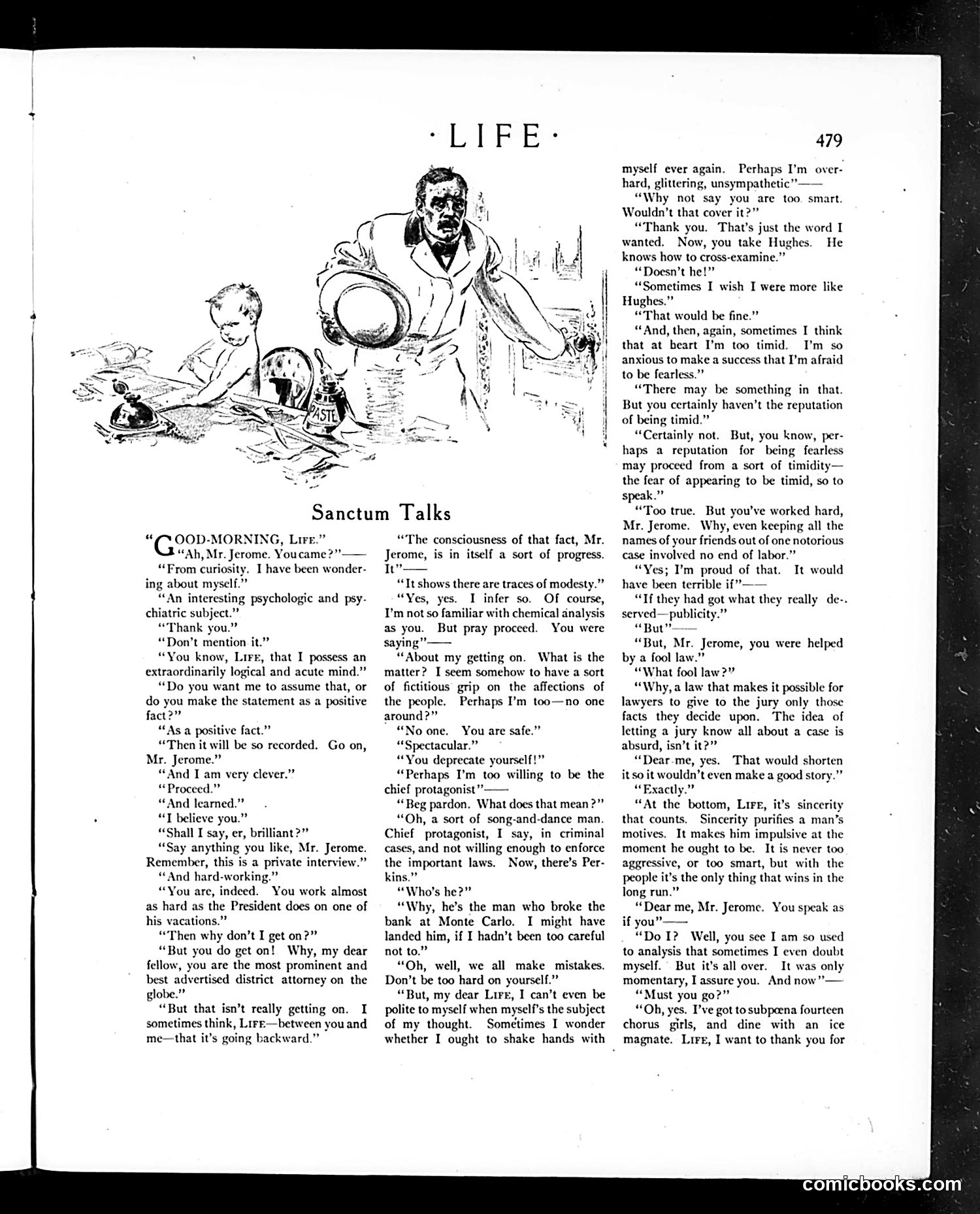
This satirical dialogue features **William Travers Jerome**, New York's prominent District Attorney in the early 1900s, being interviewed by "Life" magazine's editor. The cartoon mocks Jerome's self-aggrandizing reputation and perceived contradictions. Jerome boasts of his logical mind, cleverness, and hard work, yet complains he's not "getting on" despite being the most advertised DA. The satire targets his spectacle-driven prosecutions and selective case-handling. References to **"Hughes"** (likely Charles Evans Hughes, a contemporary prosecutor) suggest Jerome feels overshadowed by rivals. The interviewer exposes Jerome's contradictions: he's "fearless" yet admits to timidity; he kept friends' names from a "notorious case" (implying selective justice); he benefits from laws limiting jury information. The final jabs critique how Jerome prioritizes **publicity and "sincerity"** (emotional impact) over actual justice and complete disclosure—suggesting his prosecutions served his reputation more than the public interest. The satire is **political commentary on prosecutorial overreach and grandstanding**.
📄 Transcribed text from this page (OCR, searchable)
Machine-transcribed from the original scan — historical spelling and the odd misread are preserved.
Sanctum Talks “7 OOD-MORNING, Lire.” “Ah, Mr. Jerome. Youcame ?””—— “From curiosity. I have been wonder- ing about myself.” “An interesting psychologic and psy- chiatric subject.” “Thank you.” “Don’t mention it.” “You know, Lire, that I possess an extraordinarily logical and acute mind.” “Do you want me to assume that, or do you make the statement as a positive fact?” “As a positive fact.” “Then it will be so recorded. Go on, Mr. Jerome.” “And I am very clever.” “Proceed.” “And learned.” “T believe you.” “Shall I say, er, brilliant?” “Say anything you like, Mr. Jerome. Remember, this is a private interview.” “And hard-working.” “You are, indeed. You work almost as hard as the President does on one of his vacations.” “Then why don’t I get on?” “But you do get on! Why, my dear fellow, you are the most prominent and best advertised district attorney on the globe.” “But that isn’t really getting on. I sometimes think, Lirr—between you and me—that it’s going backward.” “The consciousness of that fact, Mr. Jerome, is in itself a sort of progress. It” “Tt shows there are traces of modesty.” “Yes, yes. I infer so. Of course, I’m not so familiar with chemical analysis as you. But pray proceed. You were saying” “About my getting on. What is the matter? I seem somehow to have a sort of fictitious grip on the affections of the people. Perhaps I’m too—no one around?” “No one. You are safe. “Spectacular.” “You deprecate yourself “Perhaps I’m too willing to be the chief protagonist ””—— “Beg pardon. What does that mean?” “Oh, a sort of song-and-dance man. Chief protagonist, I say, in criminal cases, and not willing enough to enforce the important laws. Now, there’s Per- kins.” “Who's he?” “Why, he’s the man who broke the bank at Monte Carlo. I might have landed him, if I hadn’t been too careful not to.” “Oh, well, we all make mistakes. Don’t be too hard on yourself.” “But, my dear Lirr, I can’t even be polite to myself when myself’s the subject of my thought. Sometimes I wonder whether I ought to shake hands with 479 myself ever again. Perhaps I'm over- hard, glittering, unsympathetic” —— “Why not say you are too. smart. Wouldn’t that cover it?” “Thank you. That’s just the word I wanted. Now, you take Hughes. He knows how to cross-examine.” “Doesn’t he!” “Sometimes I wish I were more like Hughes.” “That would be fine.” “And, then, again, sometimes I think that at beart I’m too timid. I’m so anxious to make a success that I’m afraid to be fearless.” “There may be something in that. But you certainly haven’t the reputation of being timid.” “Certainly not. But, you know, per- haps a reputation for being fearless may proceed from a sort of timidity— the fear of appearing to be timid, so to speak.” “Too true. But you’ve worked hard, Mr. Jerome. Why, even keeping all the names of your friends out of one notorious case involved no end of labor.” “Yes; I’m proud of that. It would have been terrible if?’ —— “Tf they had got what they really de-. served—publicity.” “But” “But, Mr. Jerome, you were helped by a fool law.” “What fool law?” “Why, a law that makes it possible for lawyers to give to the jury only those facts they decide upon, The idea of letting a jury know all about a case is absurd, isn’t it?” “Dear.me, yes. That would shorten it so it wouldn’t even make a good story.” “Exactly.” “At the bottom, Lire, it’s sincerity that counts. Sincerity purifies a man’s motives. It makes him impulsive at the moment he ought to be. It is ni too aggressive, or too smart, but with the people it’s the only thing that wins in the long run.” “Dear me, Mr. Jerome. You speak as if you” —— “Do I? Well, you see I am so used to analysis that sometimes I even doubt myself. But it’s all over. It was only momentary, I assure you. And now”— “Must you go?” “Oh, yes. I’ve got to subpoena fourteen chorus girls, and dine with an ice magnate. Lirr, I want to thank you for