
Life, 1907-04-04 · page 26 of 48
Life — April 4, 1907 — page 26: what you’re looking at
What you’re looking at
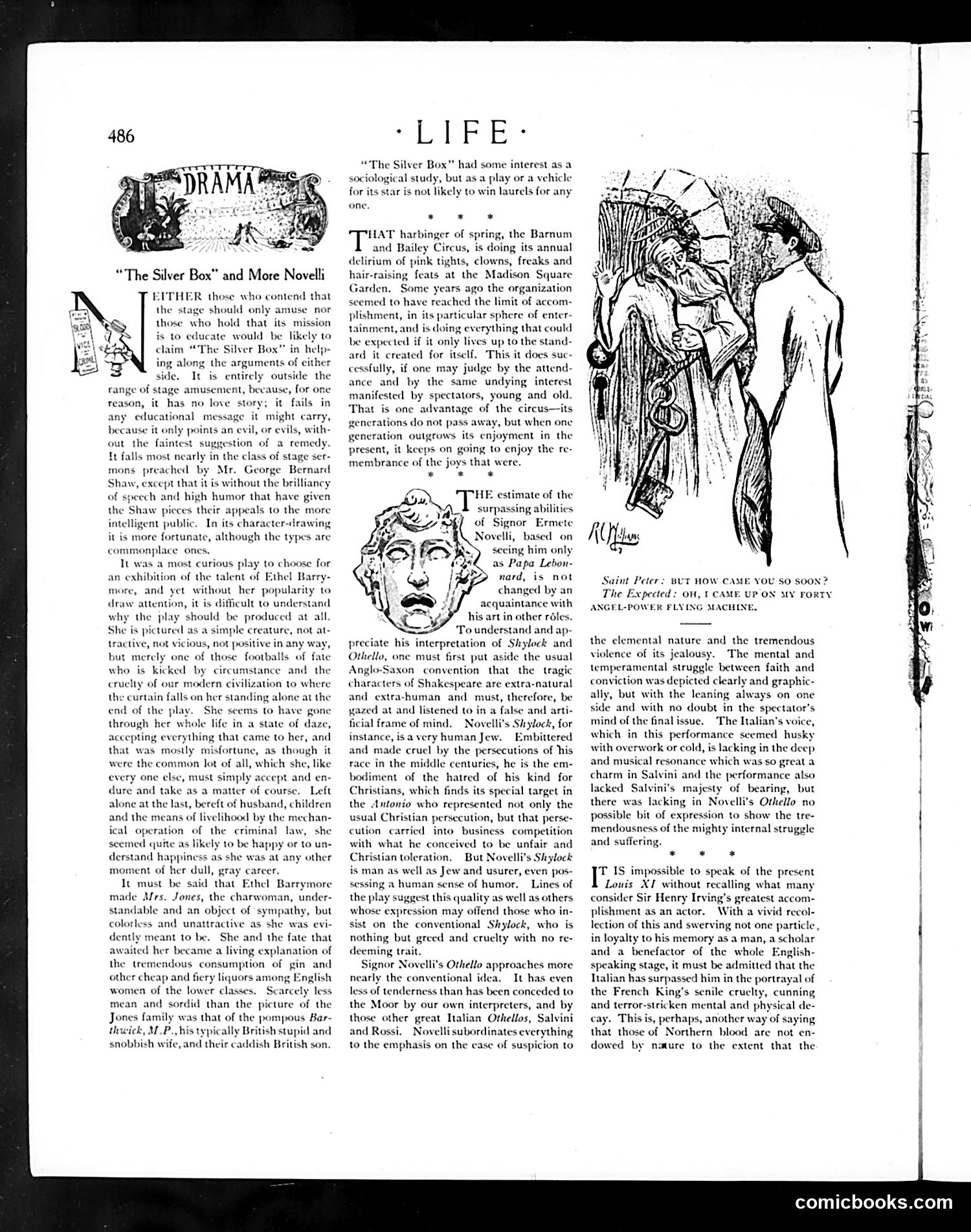
This page reviews theatrical productions. The main illustrated piece discusses George Bernard Shaw's play "The Silver Box," starring actress Ethel Barrymore. The reviewer criticizes the play as a depressing social sermon lacking entertainment value—it depicts the miserable fate of Mrs. Jones, a poor charwoman, and the morally corrupt Barthwick family (including an M.P., or Member of Parliament). The play offers no solutions to the evils it portrays, merely showing how poverty and "mechanical operation of the criminal law" destroy lives. The reviewer notes the play illustrates why working-class English women resort to gin and cheap liquor. The page also discusses actor Signor Ermete Novelli's performances in Shakespearean roles (Shylock and Othello). An illustration shows what appears to be a dramatic theatrical moment. The Barnum and Bailey Circus receives brief mention as seasonal spring entertainment with enduring appeal across generations.
📄 Transcribed text from this page (OCR, searchable)
Machine-transcribed from the original scan — historical spelling and the odd misread are preserved.
“The Silver Box” and More Novelli EITHER those who contend that the stage should only those who hold that its mission is to educate would be likely to claim “The Silver Box” in help- ing along the arguments of either side. It is entirely outside the range of stage amusement, because, for one reason, it has no love story; it fails in any educational message it might carry, because it only points an evil, or evils, with- out the faintest suggestion of a remedy. It falls most nearly in the class of stage ser- mons preached by Mr. George Bernard Shaw, except that it is without the brilliancy of speech and high humor that have gi the Shaw pieces their appeals to the more intelligent public. In its character-drawing it is more fortunate, although the types are commonplace ones. It was a most curious play to choose for an exhibition of the talent of Ethel Barry- more, and yet without her popularity to draw attention, it is difficult to understand why the play should be produced at all She is pictured as a simple creature, not at- tractive, not vicious, not positive in any way, but merely one of those footballs of fate who is kicked by circumstance and the cruclty of our modern civilization to where the curtain falls on her standing alone at the cad of the play. through her whole life in a state of daze, accepting everything that came to her, and that was mostly misfortune, as though it were the common lot of all, which she, like every one else, must simply accept and en- dure and take as a matter of course. Left alone at the last, bereft of husband, children and the means of livelihood by the mechan- ical operation of the criminal law, she seemed quite as likely to be happy or to un- derstand happiness as she was at any other moment of her dull, gray career. It must be said that Ethel Barrymore made Mrs, Jones, the charwoman, under- standable and an object of sympathy, but colorless and unattractive as she was evi- dently meant to be. She and the fate that awaited her became a living explanation of the tremendous consumption of gin and other cheap and fiery liquors among English women of the lower classes. Scarcely less mean and sordid than the picture of the Jones family was that of the pompous Bar- thwick, M-P., his typically British stupid and snobbish wife, and their caddish British son. amuse nor She seems to have gone “The Silver Be had some interest as a sociological study, but as a play or a vehicle for its star is not likely to win laurels for any one. + * HAT harbinger of spring, the Barnum and Bailey Circus, is doing its annual delirium of pink tights, clowns, freaks and hair-raising feats at the Madison Square Garden. Some years ago the organization d to have reached the limit of accom- plishment, in its particular sphere of enter- tainment, and is doing everything that could be expected if it only lives up to the stand- ard it created for itself. This it does suc- cessfully, if one may judge by the attend ance and by the same undying interest manifested by spectators, young and old. That is one advantage of the circus—its generations do not pass away, but when one generation outgrows its cnjoyment in the present, it keeps on going to enjoy the re- membrance of the joys that were. * HE estimate of the surpassing abilities of Signor Ermete Novelli, based on seeing him only as Papa Lebon- nard, is not changed by an acquaintance with his art in other réles. ‘To understand and ap- preciate his interpretation of Shylock and Othello, one must first put aside the usu Anglo-Saxon convention that the tragic characters of Shakespeare are extra-natural and extra-human and must, therefore, be zed at and listened to in a false and arti- ficial frame of mind. Novelli’s Shylock, for instance, is a very human Jew. Embittered and made cruel by the persecutions of his rr in the middle centuries, he is the em- bodiment of the hatred of his kind for Christians, which finds its special target in the Antonio who represented not only the usual Christian persecution, but that perse- cution carried into business competition with what he conceived to be unfair and Christian toleration. But Novelli’s Shylock is man as well as Jew and usurer, even pos- sessing a human sense of humor. Lines of the play suggest this quality as well as others whose expression may offend those who in- sist on the conventional Shylock, who is nothing but greed and cruelty with no re- deeming trait. Signor Novelli’s Othello approaches more nearly the conventional idea. It has even less of tenderness than has been conceded to the Moor by our own interpreters, and by those other great Italian Othellos, Salvini and Rossi. Novelli subordinates everything to the emphasis on the case of suspicion to Saint Peter: BUT HOW CAME YOU SO SOON? The Expected: OW, t CAME UP ON MY FORTY L-POWER FLYING MACHID the elemental nature and the tremendous violence of its jealou The mental and temperamental struggle between faith and conviction was depicted clearly and graphic- ally, but with the leaning always on one side and with no doubt in the spectator’s mind of the final issue. The Italian's voice, which in this performance seemed husky with overwork or cold, is lacking in the deep and musical resonance which was so great a charm in Salvini and the performance also lacked Salvini's majesty of bearing, but there was lacking in Novelli’s Othello no possible bit of expression to show the tre- mendousness of the mighty internal struggle and suffering. * * « T IS impossible to speak of the present Louis XI without recalling what many consider Sir Henry Irving’s greatest accom- plishment as an actor. With a vivid recol- lection of this and swerving not one particle in loyalty to his memory as a man, a scholar and a benefactor of the whole English- speaking stage, it must be admitted that the Ttalian has surpassed him in the portrayal of the French King’s senile cruelty, cunning and terror-stricken mental and physical de- cay. This is, perhaps, another way of saying that those of Northern blood are not en- dowed by nature to the extent that the comicbooks.com