
Life, 1907-04-04 · page 27 of 48
Life — April 4, 1907 — page 27: what you’re looking at
What you’re looking at
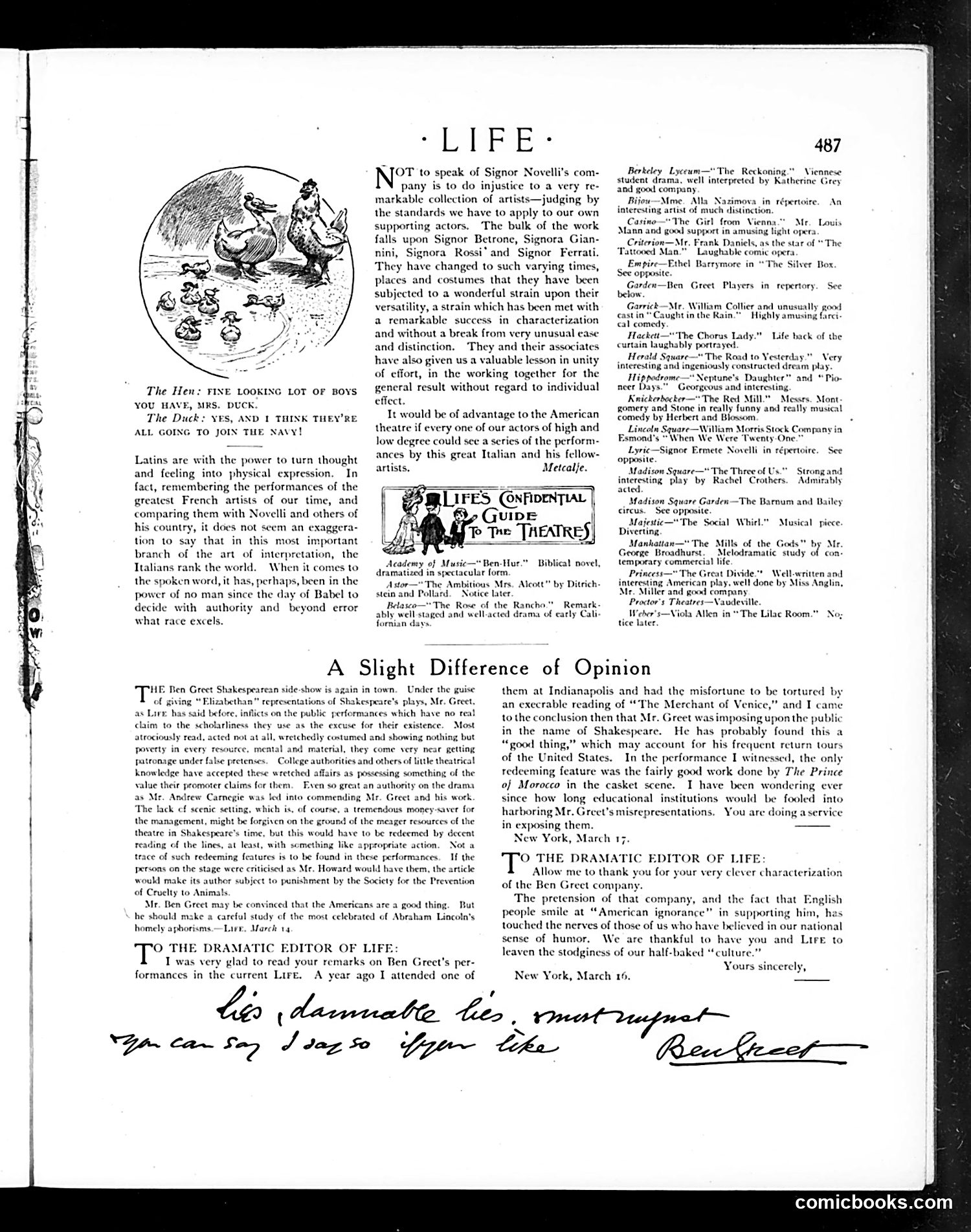
This page contains theater reviews and a debate about theatrical authenticity. The centerpiece is a letter exchange mocking Ben Greet's Shakespeare productions. **The Satire:** A reader complains that Greet's "Elizabethan representations" are inauthentic spectacles—pretentious but poorly executed. The reader contrasts this unfavorably with Signor Novelli's Italian theater company (reviewed above), praising the Italians' superior artistry and emotional expression. **The Point:** This reflects early 1900s American cultural anxiety about European vs. American theater quality. Greet represented commercialized, Anglicized "Shakespeare tourism," while Novelli represented genuine artistic passion. The debate critiques Americans' willingness to accept inferior theatrical experiences when packaged as "Shakespeare." **The Cartoon:** The opening "Hen and Duck" joke (unrelated) appears to be mild wartime Navy humor. The page demonstrates *Life's* role as cultural arbiter, using theater criticism to comment on American taste and authenticity.
📄 Transcribed text from this page (OCR, searchable)
Machine-transcribed from the original scan — historical spelling and the odd misread are preserved.
The Hen; FINE LOOKING LOT OF BOYS YOU HAVE, MRS. DUCK. The Duck: y¥S, AND 1 THINK THEY'RE ALL GOING TO JOIN THE Navy! Latins are with the power to turn thought and feeling into physical expression. In fact, remembering the performances of the greatest French artists of our time, and comparing them with Novelli and others of his country, it does not seem an exaggera- tion to say that in this most important branch of the art of interpretation, the Italians rank the world. When it comes to the spoken word, it has, perhaps, been in the power of no man since the day of Babel to decide with authority and beyond error what race excels. A Slight Difference of Opinion HE, Ben Greet Shakespearean side-show is again in town. Under the guise * representations of Shakespeare's plays, Mr. Greet, ts on the public performances which have no real of giving “Elizabeth as Lire: has said before, inf «“LIPE* ‘OT to speak of Signor Novelli’s com- pany is to do injustice to a very re- markable collection of artists—judging by the standards we have to apply to our own supporting actors. ‘The bulk of the work falls upon Signor Betrone, Signora Gian- nini, Signora Rossi‘ and Signor Ferrati. They have changed to such varying times, places and costumes that they have been subjected to a wonderful strain upon their versatility, a strain which has been met with a remarkable success in characterization and without a break from very unusual ease and distinction. They and their associates have also given us a valuable lesson in unity of effort, in the working together for the general result without regard to individual effect. It would be of advantage to the American theatre if every one of our actors of high and low degree could sce a series of the perform- ances by this great Italian and his fellow- artists. Metcalfe. LIFES_GsfivenTu | GuipE | Tae THEATRES Academy of Music—" Ben-Hur.” Biblical novel, dramatized in spectacular form. Astor—""The Ambitious Mrs. Alcott" by Ditrich stein and Pollard. Notice later Belasco—"The Rose of the Rancho." Remark- ably well staged and well-acted drama of carly Cali fornian days. them at Indianapolis and had the misfortune to be tortured by an execrable reading of “The Merchant of Venice,” and I came 487 Viennese atherine Grey Berkeley Lyceum—"The Reckor student drama. well interpreted by and good company Bijou—Mme. Alla Nazimova in interesting artist of much distinction. Casino—"'The Girl from Vienna.” Mr. Lovis ‘Mann and good support in amusing light opera Criterion—Mr, Frank Daniels, as the star of “The Tattooed Man.” Laughable comic opera Em pire—Ethel Barrymore in Silver Box See opposite. Garden—Ben Greet Players in repertory. See below. Garrick Mr. William Collier cast in" Caught in the Rain." H cal comedy Hackett—""The Chorus Lady.” Life back of the curtain laughably portrayed Herald Square—" The Road to Yesterday.” Very interesting and ingeniously constructed dream play Hippodrome—* Neptune's Daughter” and * Pio- neet Days.” Georgeous and interesting. Knickerbocker—"The Red Mill.” Messrs. Mont gomery and Stone in really funny and really musical comedy by Herbert and Blossom z Lincoln Square—William Mortis Stock Company in Esmond’s “When We Were Twenty-One.” Lyric—Signor Ermete Novelli in répertoire. See opposite. Madison Square—" The Three of Us." Strong interesting ‘play by Rachel Crothers. Admirably acted Madison Square Garden—The Barnum and Bailey circus. See opposite Majestic—""The Social Whirl." Musical piece. Diverting, Manhattan—" The Mills of the Gods" by Mr. George Broadhurst. Melodramatic study of con: temporary commercial life Princess—" The Great Divide* Well-written and interesting American play, well done by Miss Anglin, Mr. Miller and good company Proctor’s Theatres—Vavdeville. Weber's—Viola Allen in “The Lilac Room.” tice later. rtoire. An nd unusually good hly amusing farci- claim to the scholarliness they use as the excuse for theit existence. Most atrociously read, acted not at all, wretchedly costumed and showing nothing but poverty in every reso tal and material, they come very near getting patronage under false pretenses. College authorities and others of little theatrical knowledge have accepted these wretched affairs as possessing something of the value their promoter claims for them. Even so great an authority on the drama as Mr. Andrew Carnegie was led into commending Mr. Greet and his work The lack cf scenic setting, which is, of course, a tremendous money-saver for the management, might be forgiven on the ground of the meager resources of the theatre in Shakespeare's time, but this would have to be redeemed by decent reading of the lines, at least, with something like appropriate action. Not a trace of such redeeming features is to be found in these performances. If the persons on the stage were criticised as Me. Howard would have them, the article would make its author subject to punishment by the Society for the Prevention of Cruelty to Animals Mr. Ben Greet may be convinced that the Americans are a good thing. But he should make a careful study of the most celebrated of Abraham Lincoln's homely aphorisms. Lue, March v4 ‘0 THE DRAMATIC EDITOR OF LIFE: I was very glad to read your remarks on Ben Greet's per- formances in the current Lire. A year ago I attended one of to the conclusion then that Mr. Greet was imposing upon the public in the name of Shakespeare. He has probably found this a “good thing,” which may account for his frequent return tours of the United States. In the performance I witnessed, the only redceming feature was the fairly good work done by The Prince of Morocco in the casket scene. I have been wondering ever since how long educational institutions would be fooled into harboring Mr. Greet's misrepresentations. You are doing 4 : in exposing them. New York, March 17. ‘0 THE DRAMATIC EDITOR OF LIF Allow me to thank you for your very clever characterization of the Ben Greet company. The pretension of that company, and the fact that English people smile at “American ignorance” in supporting him, has touched the nerves of those of us who have believed in our national sense of humor, We are thankful to have you and Lire to leaven the stodginess of our half-baked “culture.” Yours sincerely, ww York, March 16, comicbooks.com