
Life, 1907-04-04 · page 30 of 48
Life — April 4, 1907 — page 30: what you’re looking at
What you’re looking at
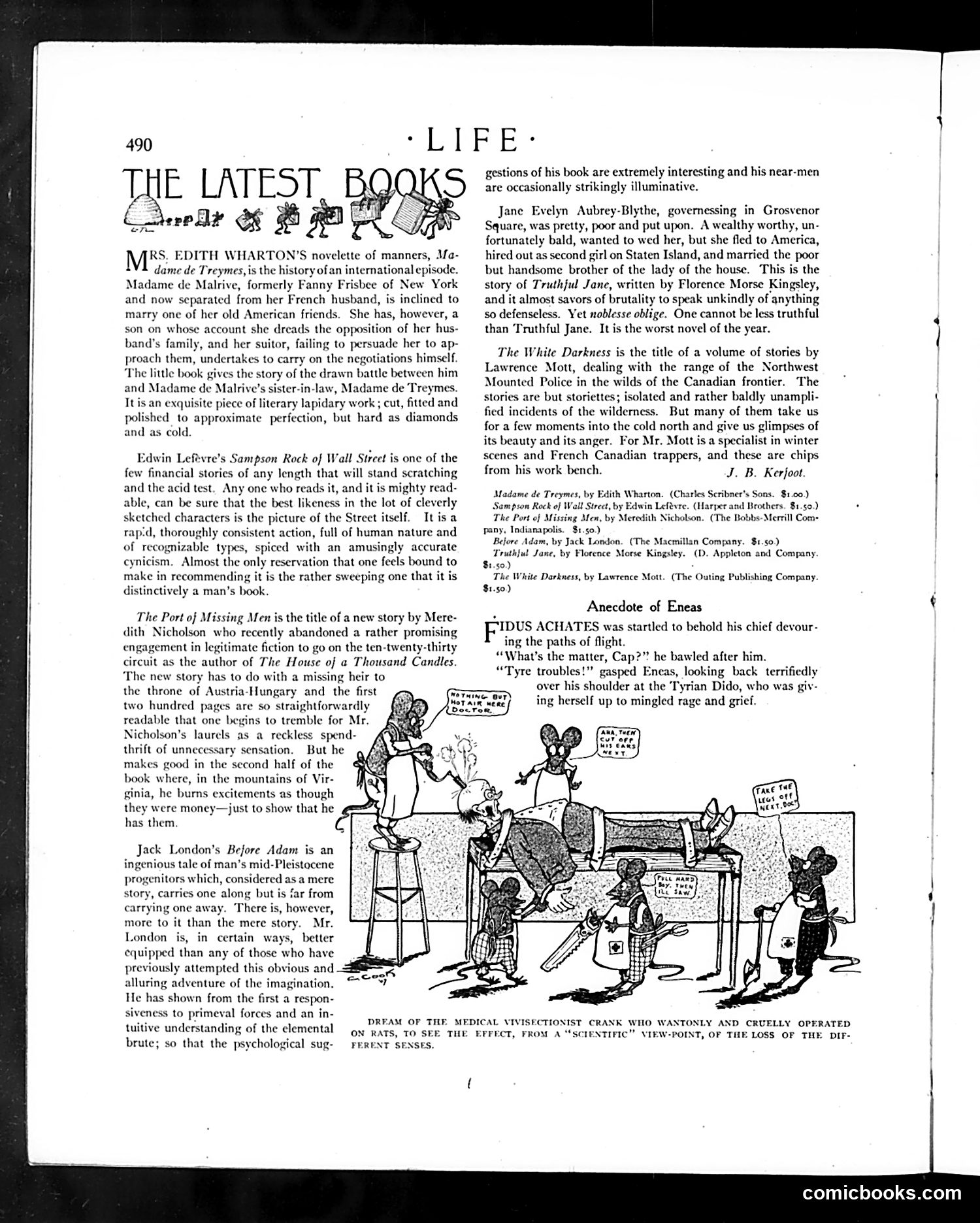
This cartoon illustrates a classical allusion from Virgil's *Aeneid*. Fidus Achates (Aeneas's faithful companion) chases after the fleeing Aeneas, who is terrified and looking back over his shoulder at the Tyrian Dido—a figure shown in the background. The joke targets vivisectionists and medical experimenters who claimed scientific justification for cruel animal testing. The caption sarcastically describes this as a "dream of the medical vivisectionist" operating on rats to observe suffering from a "scientific" standpoint. The satire conflates classical heroic narrative with contemporary animal cruelty, mocking scientists who rationalized brutality as legitimate research. By using the dignified Aeneas myth to depict panicked animals fleeing medical torture, the cartoonist undercuts claims of scientific nobility—suggesting such experiments were merely cruelty dressed in academic language. This reflects early-20th-century anti-vivisection sentiment, which questioned whether animal suffering could be ethically justified for research purposes.
📄 Transcribed text from this page (OCR, searchable)
Machine-transcribed from the original scan — historical spelling and the odd misread are preserved.
THE LATEST. BQ tere le OF x ey RS, EDITH WHARTON’S novelette of manners, Ma- dame de Treymes, is the history ofan international episode. Madame de Malrive, formerly Fanny Frisbee of New York and now separated from her French husband, is inclined to marry one of her old American friends. She has, however, a son on whose account she dreads the opposition of her hus- band’s family, and her suitor, failing to persuade her to ap- proach them, undertakes to carry on the negotiations himself. The little book gives the story of the drawn battle between him and Madame de Malrive’s sister-in-law, Madame de Treymes. It is an exquisite piece of literary lapidary work ; cut, fitted and polished to approximate perfection, but hard as diamonds and as cold. Edwin Lefevre’s Sampson Rock of Wall Street is one of the few financial stories of any length that will stand scratching and the acid test. Any one who reads it, and it is mighty read- able, can be sure that the best likeness in the lot of cleverly sketched characters is the picture of the Street itself. It is a rapid, thoroughly consistent action, full of human nature and of recognizable types, spiced with an amusingly accurate . Almost the only reservation that one feels bound to make in recommending it is the rather sweeping one that it is distinctively a man’s book. The Port of Missing Men is the title of a new story by Mere- dith Nicholson who recently abandoned a rather promising engagement in legitimate fiction to go on the ten-twenty-thirty circuit as the author of The House of a Thousand Candles. The new story has to do with a missing heir to the throne of Austria-Hungary and the first two hundred pa, are so straightforwardly readable that one begins to tremble for Mr. Nicholson’s laurels as a reckless spend- thrift of unnecessary sensation. But he makes good in the second half of the book where, in the mountains of Vi ginia, he burns excitements as though they were money—just to show that he has them. Jack London’s Before Adam is an ingenious tale of man’s mid-Pleistocene progenitors which, considered as a mere story, carries one along but is far from carrying one away. There is, however, more to it than the mere story. Mr. London is, in certain ways, better equipped than any of those who have previously attempted this obvious and alluring adventure of the imagination. He has shown from the first a respon- siveness to primeval forces and an in- tuitive understanding of the elemental 9; pats, To SE brute; so that the psychological sug- FERENT SENSES. THE 490 *LIFE- DREAM OF THE MEDIC EFFECT, FROM A“ gestions of his book are extremely interesting and his near-men are occasionally strikingly illuminative. Jane Evelyn Aubrey-Blythe, governessing in Grosvenor Square, was pretty, poor and put upon. A wealthy worthy, un- fortunately bald, wanted to wed her, but she fled to America, hired out as second girl on Staten Island, and married the poor but handsome brother of the lady of the house. This is the story of Truthful Jane, written by Florence Morse Kingsley, and it almost savors of brutality to speak unkindly of anything so defenseless. Yet noblesse oblige. One cannot be less truthful than Truthful Jane. It is the worst novel of the year. The White Darkness is the title of a volume of stories by Lawrence Mott, dealing with the range of the Northwest Mounted Police in the wilds of the Canadian frontier. The stories are but storiettes; isolated and rather baldly unampli- fied incidents of the wilderness. But many of them take us for a few moments into the cold north and give us glimpses of its beauty and its anger. For Mr. Mott is a specialist in winter scenes and French Canadian trappers, and these are chips from his work bench. J. B. Kerfoot. Madame de Treymes, by Edith Wharton. (Charles Scribner's Sons. $1.00.) Sampson Rock of Wall Street, by Edwin Lefevre. (Harper and Brothers. $1.50.) The Port oj Missing Men, by Meredith Nicholson. (The Bobbs-Merrill Com: pany, Indianapolis. $1.50.) Bejore Adam, by Jack London. (The Macmillan Company. $1.50.) Truthjul Jane, by Florence Morse Kingsley. (D. Appleton and Company $1.50.) : The Wi $1.50) ite Darkness, by Lawrence Mott. (The Outing Publishing Company. Anecdote of Eneas TIDUS ACHATES was startled to behold his chief devour- ing the paths of flight. “What's the matter, Cap?” he bawled after him. “Tyre troubles!” gasped Eneas, looking back terrifiedly is shoulder at the Tyrian Dido, who was giv- ing herself up to mingled rage and grief. comicbooks.com VHO WANTONLY AND CRUELLY OPERATED " VIEW-POINT, OF THE LOSS OF THE DIF- —